
Puck, 1877-10-24 · page 10 of 16
Puck — October 24, 1877 — page 10: what you’re looking at
What you’re looking at
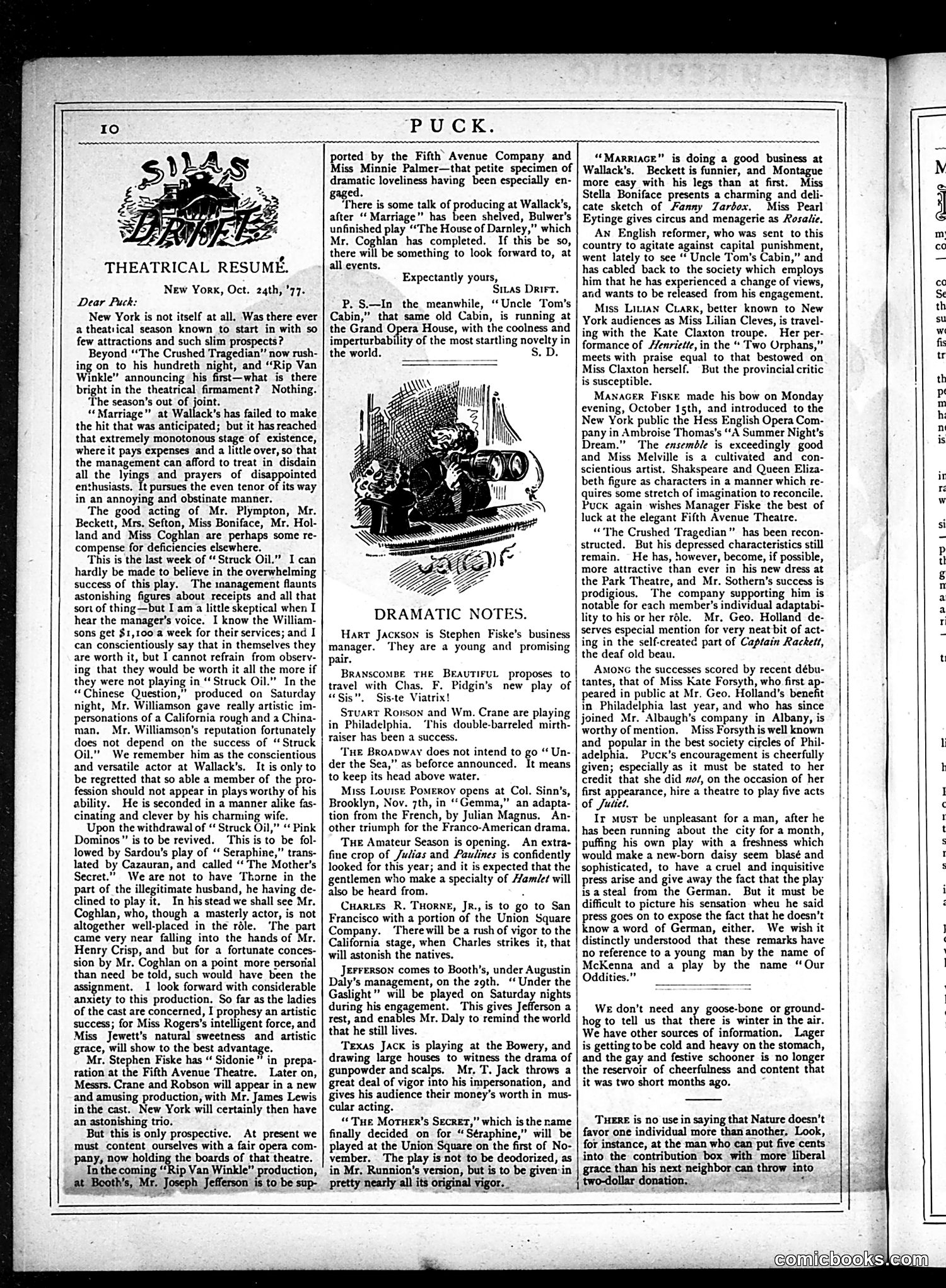
This page contains theatrical reviews and dramatic notes rather than political cartoons. The main illustration shows a caricatured figure in period costume, appearing to satirize theatrical productions of the era. The "Theatrical Résumé" discusses New York theater season openings, reviewing productions like "Marriage" at Wallack's Theatre and "Uncle Tom's Cabin." The text critiques various performances and actors, including comments on Mr. Plympton and Mr. Beckett's acting abilities. The "Dramatic Notes" section provides gossip and commentary on theatrical personnel and upcoming shows. References include debates about whether certain plays should be produced and commentary on actors' relative merits. The satire is primarily theatrical rather than political—mocking pretentious performances and industry gossip rather than addressing broader social issues. Without clearer identification of specific caricatured individuals, the precise satirical targets remain unclear.
📄 Transcribed text from this page (OCR, searchable)
Machine-transcribed from the original scan — historical spelling and the odd misread are preserved.
PUCK. THEATRICAL RESUME. New York, Oct. 24th, '77. Dear Puck: New York is not itself at all. Was there ever a theatrical season known to start in with so few attractions and such slim prospects? Beyond “The Crushed Tragedian” now rush- ing on to his hundreth night, and “Rip Van Winkle” announcing his first—what is there bright in the theatrical firmament? Nothing. The season’s out of joint. “Marriage” at Wallack’s has failed to make the hit that was anticipated; but it has reached that extremely monotonous stage of existence, where it pays expenses and a little over, so that the management can afford to treat in disdain all the lyings and prayers of disappointed enthusiasts. ft pursues the even tenor of its way in an annoying and obstinate manner. The good acting of Mr. Plympton, Mr. Beckett, Mrs. Sefton, Miss Boniface, Mr. Hol- land and Miss Coghlan are perhaps some re- compense for deficiencies elsewhere. ‘This is the last week of ‘ Struck Oil.” I can hardly be made to believe in the overwhelming success of this play. The inanagement flaunts astonishing figures about receipts and all that sort of thing—but I am a little skeptical when I hear the manager’s voice. I know the William- sons get $1,100 a week for their services; and I can conscientiously say that in themselves they are worth it, but I cannot refrain from observ- ing that they would be worth it all the more if they were not playing in ‘ Struck Oil.” In the “Chinese Question,” produced on Saturday night, Mr. Williamson gave really artistic im- personations of a California rough and a China- man, Mr. Williamson’s reputation fortunately does not depend on the success of “ Struck Oil." We remember him as the conscientious and versatile actor at Wallack’s. It is only to be regretted that so able a member of the pro- fession should not appear in plays worthy of his ability. He is seconded in a manner alike fas- cinating and clever by his charming wife. Upon the withdrawal of “ Struck Oil,” “ Pink Dominos” is to be revived. This is to be fol- lowed by Sardou’s play of “ Seraphine,” trans- lated by Cazauran, and called ‘‘ The Mother’s Secret.” We are not to have Thorne in the part of the illegitimate husband, he having de- clined to play it. In his stead we shall see Mr. Coghlan, who, though a masterly actor, is not altogether well-placed in the rdle. ‘The part came very near falling into the hands of Mr. Henry Crisp, and but for a fortunate conces- sion by Mr. Coghlan on a point more versorial than need be told, such would have been the assignment. I look forward with considerable anxiety to this production. So far as the ladies of the cast are concerned, I prophesy an artistic success; for Miss Rogers’s intelligent force, and Miss Jewett’s natural sweetness and artistic grace, will show to the best advantage. Mr. Stephen Fiske has “ Sidonie” in prepa- ration at the Fifth Avenue Theatre. Later on, Messrs. Crane and Robson will appear in a new and amusing production, with Mr. James Lewis in the cast. New York will certainly then have an astonishing trio. But this is only prospective. At present we must content ourselves with a fair opera com- pany, now holding the boards of that theatre. Tn the coming ‘Rip Van Winkle” production, at Booth’s, Mr. Joseph. Jefferson is to be sup- ported by the Fifth Avenue Company and Miss Minnie Palmer—that petite specimen of dramatic loveliness having been especially en- ed. There is some talk of producing at Wallack’s, after ‘ Marriage” has been shelved, Bulwer’s unfinished play ‘The House of Darnley,” which Mr. Coghlan has completed. If this be so, there will be something to look forward to, at all events. Expectantly yours, Sitas Drier. P. S.—In the meanwhile, “Uncle Tom’s Cabin,” that same old Cabin, is running at the Grand Opera House, with the coolness and imperturbability of the most startling novelty in the world. Ss. D. DRAMATIC NOTES. Hart Jackson is Stephen Fiske’s business manager. ‘They are a young and_ promising pair. BRANSCOMBE THE BEAUTIFUL proposes to travel with Chas. F. Pidgin’s new play of “Sis”. Sis-te Viatrix! Stuart Ronson and Wm. Crane are playing in Philadelphia. ‘This double-barreled mirth- raiser has been a success. ‘THE Broapway does not intend to go “ Un- der the Sea,” as beforce announced. It means to keep its head above water. Miss Louise Pomeroy opens at Col. Sinn's, Brooklyn, Nov. 7th, in ‘*Gemma,” an adapta- tion from the French, by Julian Magnus. An- other triumph for the Franco-American drama. ‘Tue Amateur Season is opening. An extra- fine crop of Julias and Paulines is confidently looked for this year; and it is expected that the gentlemen who make a specialty of Hamlet will also be heard from. = Cuartes R. THorNE, JR., is to go to San Francisco with a portion of the Union Square Company. ‘There will be a rush of vigor to the California stage, when Charles strikes it, that will astonish the natives. Jerrerson comes to Booth’s, under Augustin Daly's management, on the 29th. ‘Under the Gaslight” will be played on Saturday nights during his engagement. ‘This gives Jefferson a rest, and enables Mr. Daly to remind the world that he still lives. Texas Jack is playing at the Bowery, and drawing large houses to witness the drama of gunpowder and scalps. Mr, T. Jack throws a great deal of vigor into his impersonation, and gives his audience their money’s worth in mus- cular acting. “THe Motuer’s Secret," which is the name finally decided on for “Séraphine,” will be played at the Union Square on the first of No- vember. The play is not to be deodorized, as in Mr. Runnion’s version, but is to be given-in pretty nearly all its original vigor. “MarriaGE” is doing a good business at Wallack’s. Beckett is funnier, and Montague more easy with his legs than at first. Miss Stella Boniface presents a charming and deli- cate sketch of Fanny Zarbox. Miss Pearl Eytinge gives circus and menagerie as Rosalie, Aw English reformer, who was sent to this country to agitate against capital punishment, went lately to see ‘ Uncle Tom's Cabin,” and has cabled back to the society which employs him that he has experienced a change of views, and wants to be released from his engagement. Miss Litian Ciark, better known to New York audiences as Miss Lilian Cleves, is travel- ing with the Kate Claxton troupe. Her per- formance of Henriette, in the “ Two Orphans,” meets with praise equal to that bestowed on Miss Claxton herself. But the provincial critic is susceptible. Manacer Fiske made his bow on Monday evening, October 15th, and introduced to the New York public the Hess English Opera Com- pany in Ambroise Thomas's “A Summer Night's Dream.” ‘The ensemble is exceedingly good and Miss Melville is a cultivated and_con- scientious artist. Shakspeare and Queen Eliza- beth figure as characters in a manner which re- quires some stretch of imagination to reconcile. Puck again wishes Manager Fiske the best of luck at the elegant Fifth Avenue Theatre. “The Crushed Tragedian” has been recon- structed. But his depressed characteristics still remain. He has, however, become, if possible, more attractive than ever in his new dress at the Park Theatre, and Mr. Sothern’s success is prodigions. The company supporting him is notable for each member’s individual adaptabi- lity to his or her réle. Mr. Geo. Holland de- serves especial mention for very neat bit of act- ing in the self-created part of Captain Racket, the deaf old beau. Amonc the successes scored by recent débu- tantes, that of Miss Kate Forsyth, who first ap- peared in public at Mr. Geo. Holland's benefit in Philadelphia last year, and who has since joined Mr. Albaugh’s company in Albany, is worthy of mention, Miss Forsyth is well known and popular in the best society circles of Phil- adelphia. Puck's encouragement is cheerfully given; especially as it must be stated to her credit that she did no/, on the occasion of her first appearance, hire a theatre to play five acts of Juliet. Ir must be unpleasant for a man, after he has been running about the city for a month, puffing his own play with a freshness which would make a new-born daisy seem blasé and sophisticated, to have a cruel and inquisitive press arise and give away the fact that the play isa steal from the German. But it must be difficult to picture his sensation wheu he said ress goes On to expose the fact that he doesn’t oe a word of German, either. We wish it distinctly understood that these remarks have no reference to a young man by the name of McKenna and a play by the name “Our Oddities.” We don't need any goose-bone or ground- hog to tell us that there is winter in the air. We have other sources of information. Lager is getting tobe cold and heavy on the stomach, and the gay and festive schooner is no longer the reservoir of cheerfulness and content that it was two short months ago. Tere is no use in saying that Nature doesn’t favor one individual more than another. Look, for instance, at the man who can put five cents into the contribution box with more liberal grace than his next neighbor can throw into