
Puck, 1877-10-24 · page 2 of 16
Puck — October 24, 1877 — page 2: what you’re looking at
What you’re looking at
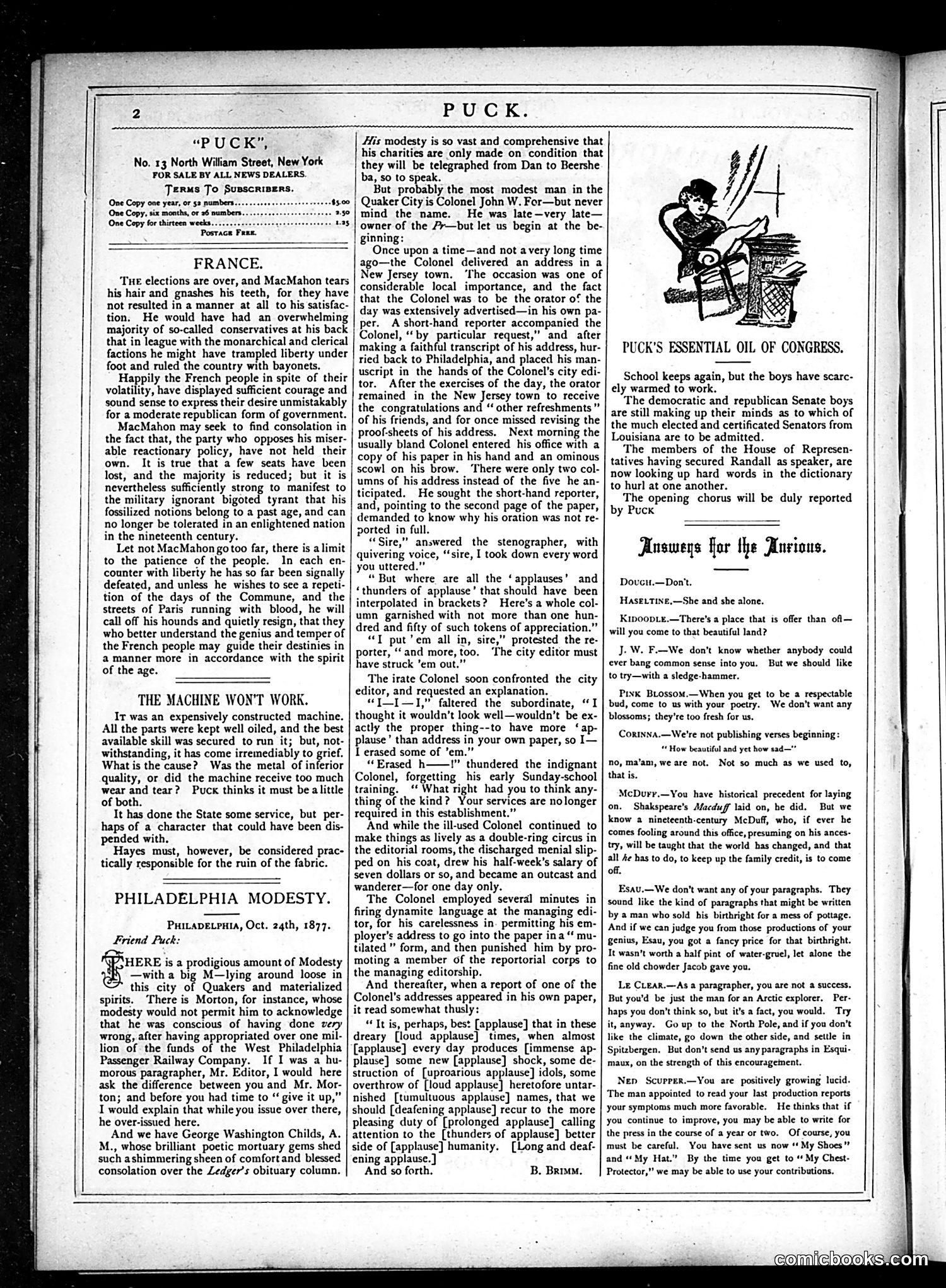
The main cartoon, "Puck's Essential Oil of Congress," depicts a figure (likely representing Congress or a politician) operating what appears to be an oil press or mechanical device. The cartoon satirizes Congress as producing nothing of value—just "essential oil," a useless distillation. The text below discusses Senate members from Louisiana being elected and certificated despite controversy, suggesting congressional dysfunction and corruption. Additional sections address French elections, a malfunctioning machine, and Philadelphia's "modesty" regarding appropriations misuse. The overall message criticizes Congress as ineffective and corrupt, producing only empty rhetoric while important matters languish. The "essential oil" metaphor suggests Congress extracts nothing of substance from its deliberations.
📄 Transcribed text from this page (OCR, searchable)
Machine-transcribed from the original scan — historical spelling and the odd misread are preserved.
PUCK. “PUCK”, No. 13 North William Street, New York FOR SALE BY ALL NEWS DEALERS. TJerus To Susscripers. One Copy one year, or $2 numbers... One Copy, six months, or 26 numbers. ‘One Copy for thirteen weeks... Postace Fans, FRANCE. ‘Tue elections are over, and MacMahon tears his hair and gnashes his teeth, for they have not resulted in a manner at all to his satisfac- tion. He would have had an overwhelming majority of so-called conservatives at his back that in league with the monarchical and clerical factions he might have trampled liberty under foot and ruled the country with bayonets, Happily the French people in spite of their volatility, have displayed sufficient courage and sound sense to express their desire unmistakably for a moderate republican form of government. MacMahon may seek to find consolation in the fact that, the party who opposes his miser- able reactionary policy, have not held their own. It is true that a few seats have been lost, and the majority is reduced; but it is nevertheless sufficiently strong to manifest to the military ignorant bigoted tyrant that his fossilized notions belong to a past age, and can no longer be tolerated in an enlightened nation in the nineteenth century. Let not MacMahon gotoo far, there is a limit to the patience of the people. In each en- counter with liberty he has so far been signally defeated, and unless he wishes to see a repeti- tion of the days of the Commune, and the streets of Paris running with blood, he will call off his hounds and quietly resign, that they who better understand the genius and temper of the French people may guide their destinies in a manner more in accordance with the spirit of the age. THE MACHINE WON'T WORK. Ir was an expensively constructed machine. All the parts were kept well oiled, and the best available skill was secured to run it; but, not- withstanding, it has come irremediably to grief. What is the cause? Was the metal of inferior quality, or did the machine receive too much wear and tear? Puck thinks it must be alittle of both. It has done the State some service, but per- haps of a character that could have been dis- pended with. Hayes must, however, be considered prac- tically responsible for the ruin of the fabric. PHILADELPHIA MODESTY. PHILADELPHIA, Oct. 24th, 1877. Friend Puck: HERE is a prodigious amount of Modesty —with a big M—lying around loose in this city of Quakers and materialized spirits. There is Morton, for instance, whose modesty would not permit him to acknowledge that he was conscious of having done very wrong, after having appropriated over one mil- lion of the funds of the West Philadelphia Passenger Railway Company. If I was a hu- morous paragrapher, Mr. Editor, I would here ask the difference between you and Mr. Mor- ton; and before you had time to “ give it up,” I would explain that while you issue over there, he over-issued here. And we have George Washington Childs, A. M., whose brilliant poetic mortuary gems shed such ashimmering sheen of comfort and blessed consolation over the Ledger’s obituary column. His modesty is so vast and comprehensive that his charities are only made on condition that they will be telegraphed from Dan to Beershe ba, so to speak. But probably the most modest man in the | Quaker City is Colonel John W. For—but never mind the name. He was late—very late— owner of the r—but let us begin at the be- | ginning: Once upon a time—and not avery long time ago—the Colonel delivered an address in a New Jersey town. ‘The occasion was one of considerable local importance, and the fact that the Colonel was to be the orator of the day was extensively advertised—in his own pa- per. A short-hand reporter accompanied the Colonel, “by particular request,” and after making a faithful transcript of his address, hur- ried back to Philadelphia, and placed his man- uscript in the hands of the Colonel’s city edi- tor. After the exercises of the day, the orator remained in the New Jersey town to receive the congratulations and “ other refreshments” of his friends, and for once missed revising the proof-sheets of his address. Next morning the usually bland Colonel entered his office with a copy of his paper in his hand and an ominous scowl on his brow. ‘There were only two col- umns of his address instead of the five he an- ticipated. He sought the short-hand reporter, and, pointing to the second page of the paper, demanded to know why his oration was not re- ported in full. “Sire,” answered the stenographer, with quivering voice, ‘sire, I took down every word you uttered.” “But where are all the ‘applauses’ and ‘thunders of applause’ that should have been interpolated in brackets? Here’s a whole col- umn garnished with not more than one hun- dred and fifty of such tokens of appreciation.” “T put’em all in, sire,” protested the re- porter, “and more, too. ‘he city editor must have struck ‘em out.” The irate Colonel soon confronted the city editor, and requested an explanation. “J_I—]I,” faltered the subordinate, “I thought it wouldn't look well—wouldn’t be ex- actly the proper thing--to have more ‘ap- plause’ than address in your own paper, so I— I erased some of ’em.” “Erased h——!” thundered the indignant Colonel, forgetting his early Sunday-school training. ‘ What right had you to think any- thing of the kind? Your services are nolonger required in this establishment.” And while the ill-used Colonel continued to make things as lively as a double-ring circus in the editorial rooms, the discharged menial slip- ped on his coat, drew his half-week’s salary of seven dollars or so, and became an outcast and wanderer—for one day only. The Colonel employed several minutes in firing dynamite language at the managing edi- tor, for his carelessness in. permitting his em- ployer’s address to go into the paper ina “ mu- tilated ” form, and then punished him by pro- moting a member of the reportorial corps to the managing editorship. And thereafter, when a report of one of the Colonel's addresses appeared in his own paper, it read somewhat thusly: “It is, perhaps, best [applause] that in these dreary [loud applause] times, when almost [applause] every day produces [immense ap- plause] some new [applause] shock, some de- struction of [uproarious applause] idols, some overthrow of [loud applause] heretofore untar- nished [tumultuous applause] names, that we should [deafening applause] recur to the more pleasing duty of [prolonged applause] calling attention to the [thunders of applause] better side of [applause] humanity, [Long and deaf- ening applause.) And so forth. B. Broa. PUCK’S ESSENTIAL OIL OF CONGRESS. School keeps again, but the boys have scarc- ely warmed to work. The democratic and republican Senate boys are still making up their minds as to which of the much elected and certificated Senators from Louisiana are to be admitted. The members of the House of Represen- tatives having secured Randall as speaker, are now looking up hard words in the dictionary to hurl at one another. The opening chorus will be duly reported by Puck Answeys for the Anrions. Dovet.—Don't. Haseutine,—She and she alone. K1noopte.—There’s a place that is offer than of — will you come to that beautiful land? J.W. F.We don’t know whether anybody could ever bang common sense into you. But we should like to try—with a sledge-hammer. Piyk Buossom.—When you get to be a respectable bud, come to us with your poetry. We don’t want any blossoms; they're too fresh for us. Corixwa.—We're not publishing verses beginning: * How beautiful and yet how sad—" no, ma’am, we are not. Not so much as we used to, that is. McDurv.—You have historical precedent for laying on. Shakspeare’s Macduff \aid on, he did. But we know a nineteenth-century McDuff, who, if ever he comes fooling around this office, presuming on his ances- try, will be taught that the world has changed, and that all he has to do, to keep up the family credit, is to come off. Esav.—We don’t want any of your paragraphs. They sound like the kind of paragraphs that might be written by a man who sold his birthright for a mess of pottage. And if we can judge you from those productions of your genius, Esau, you got a fancy price for that birthright. It wasn’t worth a half pint of water-gruel, let alone the fine old chowder Jacob gave you. Le CLear.—As a paragrapher, you are not a success. But you'd be just the man for an Arctic explorer. Per- haps you don’t think so, but it’s a fact, you would. Try it, anyway. Go up to the North Pole, and if you don’t like the climate, go down the other side, and settle in Spitzbergen. But don’t send us any paragraphs in Esqui- maux, on the strength of this encourageinent. Nep Scurrer.—You are positively growing lucid. ‘The man appointed to read your last production reports your symptoms much more favorable. He thinks that if you continue to improve, you may be able to write for the press in the course of a year or two. Of course, you must be careful, You have sent us now “ My Shoes’? and “My Hat.” By the time you get to “My Chest- Protector,” we may be able to use your contributions.