
A complete issue · 16 pages · 1877
Puck — October 3, 1877
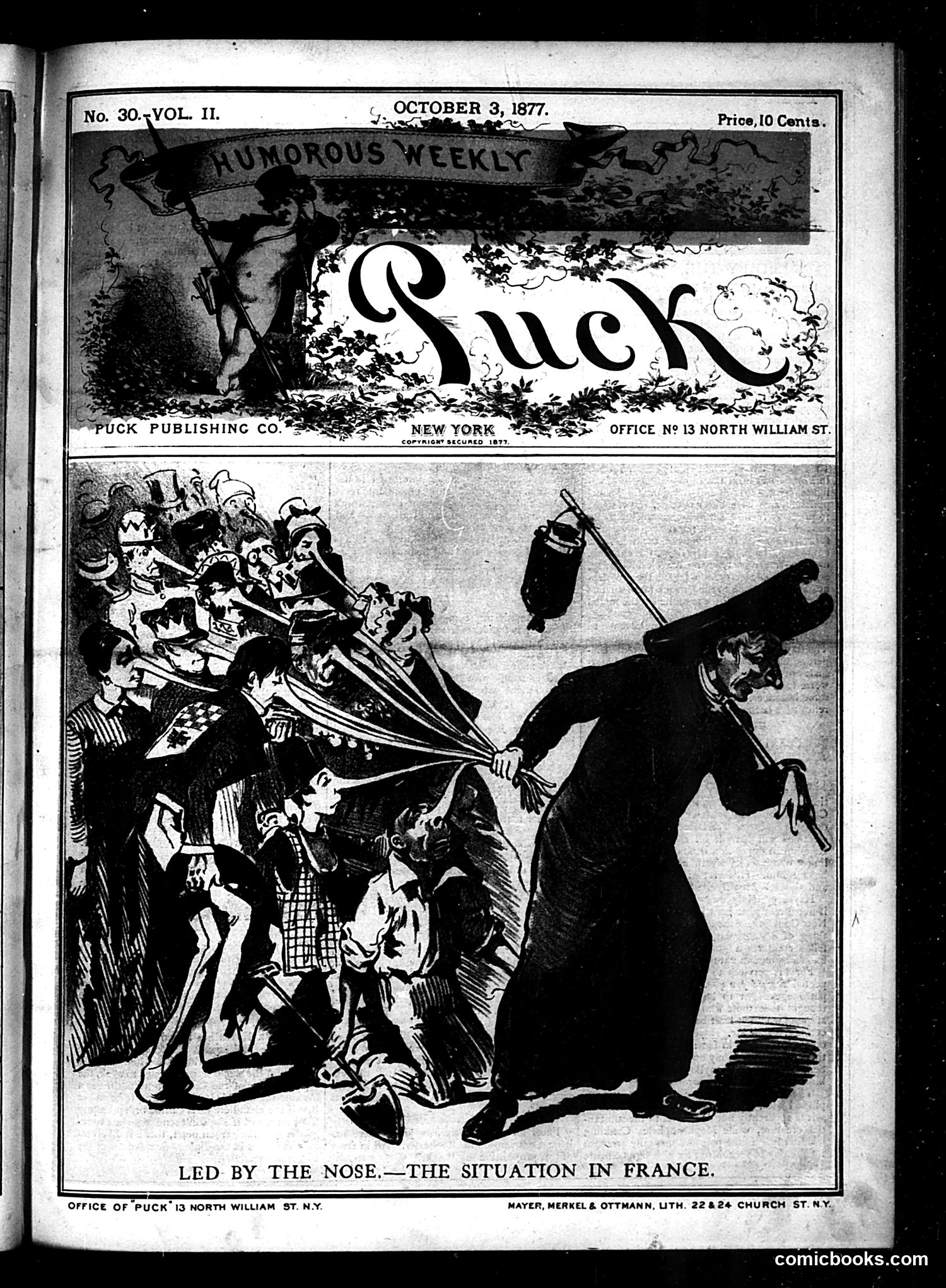
The main cartoon, titled "Led by the Nose—The Situation in France," depicts political turmoil in post-Commune France. A large figure on the right (likely representing a political leader or faction) is being led by the nose by a group of military officers and officials on the left, who pull strings controlling him like a puppet. Various figures in military uniforms and formal dress surround him, suggesting competing political interests manipulating French government. The satire critiques how French leadership was controlled by powerful military and political elites rather than acting independently. This reflects the unstable period following the 1871 Paris Commune, when France struggled with political reconstruction and competing power centers sought dominance.
This page from *Puck* magazine satirizes Senator Conkling's influence over the Republican Party. The main article criticizes how Conkling, a powerful New York Republican, allegedly controls party members through intimidation and patronage rather than merit. The piece argues that Conkling's "semiconscious" leadership has caused Republicans to blindly follow him, compromising their independence. The metaphor of being "led by the nose" suggests he manipulates subordinates like animals. The article contrasts this with ideals of representative democracy, claiming Conkling's influence represents a return to monarchical or aristocratic rule—worse than other corrupt leaders because he operates through party rather than official position. This reflects broader late-19th-century reform debates about political boss control.
This page from *Puck* contains a short story titled "The Romance of an Excursion," not a political cartoon. The narrative describes a young couple's romantic encounter aboard a steamer to Manhattan Beach. The story is lighthearted fiction focusing on courtship and social interaction rather than political satire. Below the story is a section called "Answers for the Anxious"—an advice column addressing reader questions on various personal matters (employment, love, baldness, writing). The page is primarily **literary content and advice**, not political commentary. While *Puck* was known for satirical cartoons, this particular page lacks the visual caricatures or topical references typical of the magazine's political humor. It represents the miscellaneous entertainment material that filled publication spaces between major satirical pieces.
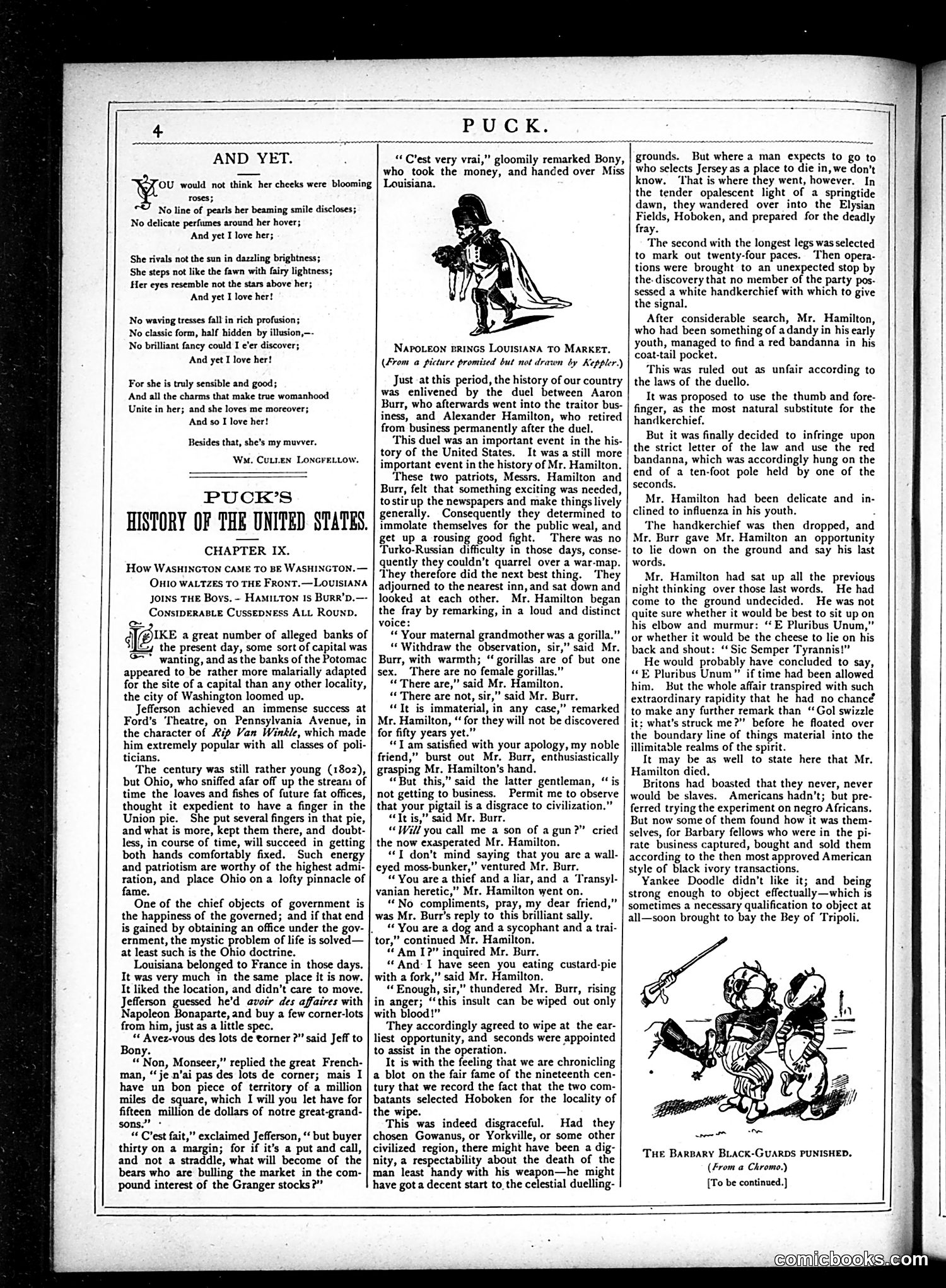
This page contains **"Puck's History of the United States," Chapter IX**, focusing on the Aaron Burr-Alexander Hamilton duel and its historical significance. The main cartoon shows **"Napoleon Brings Louisiana to Market,"** depicting the Louisiana Purchase transaction. The text discusses how the Burr-Hamilton duel disrupted American politics, with Hamilton's death removing a key Federalist figure. The narrative emphasizes this as a pivotal moment in U.S. history. The bottom illustration, **"The Barbary Black-Guards Punished,"** appears to reference early American military conflicts with North African pirates—a separate historical episode. This is primarily **educational satire** rather than contemporary political commentary, using historical episodes to entertain Puck's readers while reviewing formative American events.
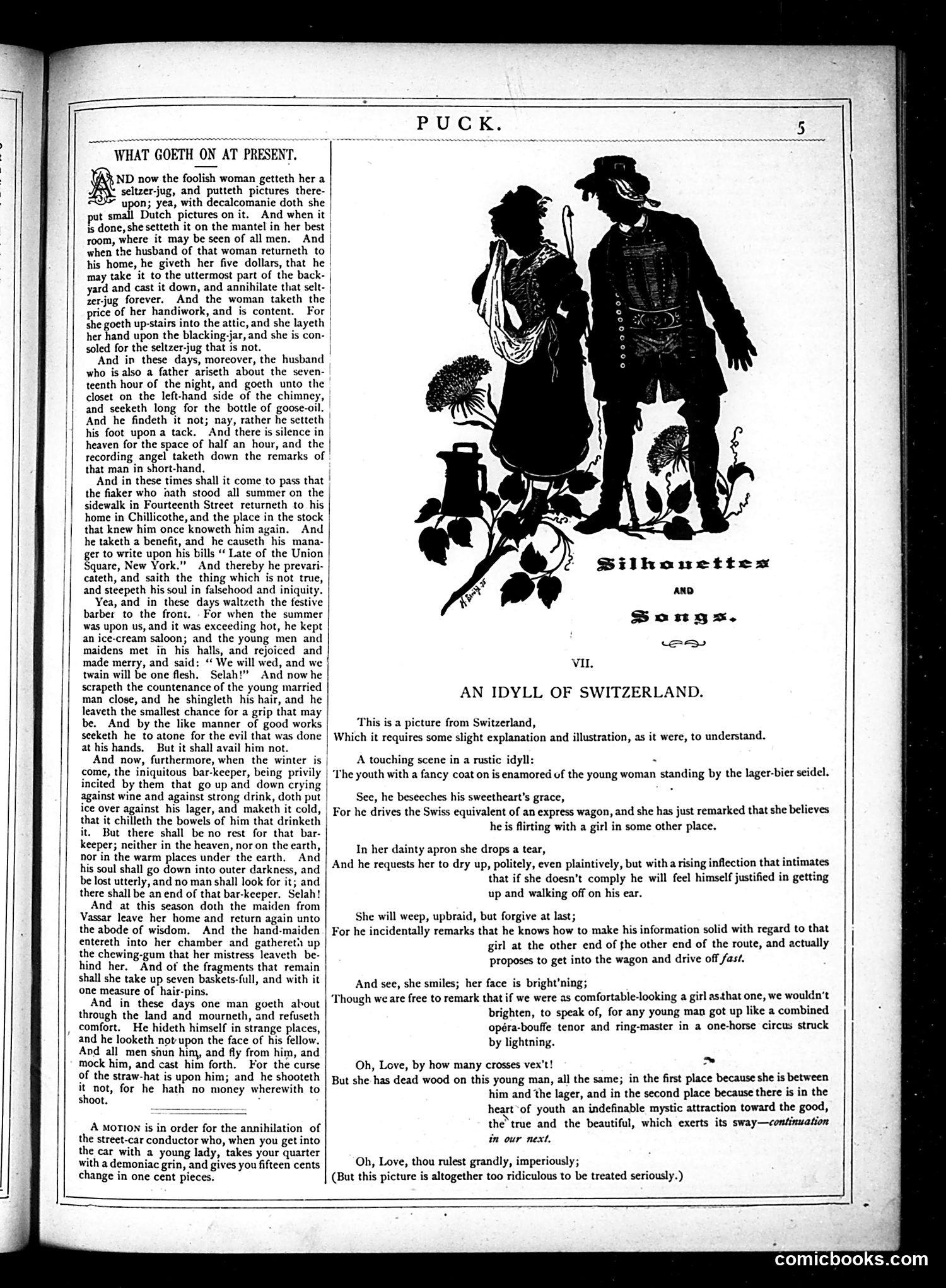
This page contains two distinct pieces: **"What Goeth On at Present"** (left column): A satirical prose narrative mocking foolish wealthy women who purchase decorative items—a "seltzer-jug" with Dutch pictures—then destroy them in fits of pique when husbands disapprove. The piece ridicules both the women's frivolous spending and their destructive tantrums, while also lampooning husbands' attempts to manage household finances and morality through intimidation. **"An Idyll of Switzerland"** (right): A humorous poem with silhouette illustration depicting a romantic Swiss scene. A young woman flirts with a man driving a wagon while her jealous boyfriend watches. The poem satirizes romantic melodrama and the absurdity of love's complications, concluding that the situation is "too ridiculous to be treated seriously." Both pieces target upper-class social pretension and relationship dynamics.
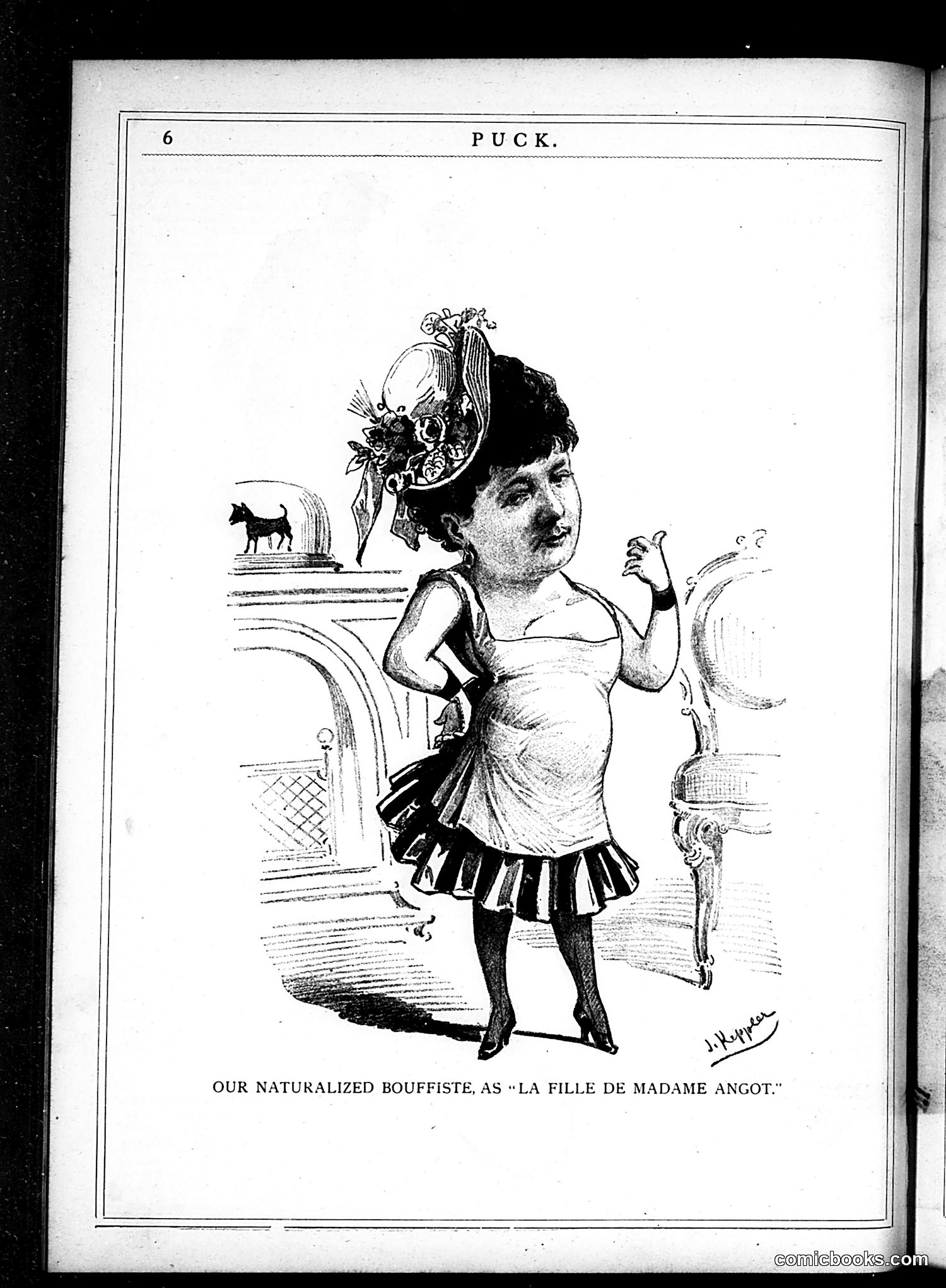
This satirical cartoon depicts a woman in fashionable dress, labeled "OUR NATURALIZED BOUFFISTE, AS 'LA FILLE DE MADAME ANGOT.'" The satire appears to mock a woman—likely a prominent American society figure or performer—who has adopted exaggerated French affectations and fashion. "Bouffiste" refers to burlesque or comedic theater; "La Fille de Madame Angot" was a popular French operetta. The woman's extravagant headdress, theatrical pose, and exaggerated features suggest she's ridiculed for pretentious Francophilia. The background detail showing a small dog on a pedestal reinforces the satire: she treats even pets with affected French refinement. The overall mockery targets Americans who uncritically adopt French cultural pretensions, a recurring Puck theme critiquing social climbing and cultural snobbery among the wealthy.
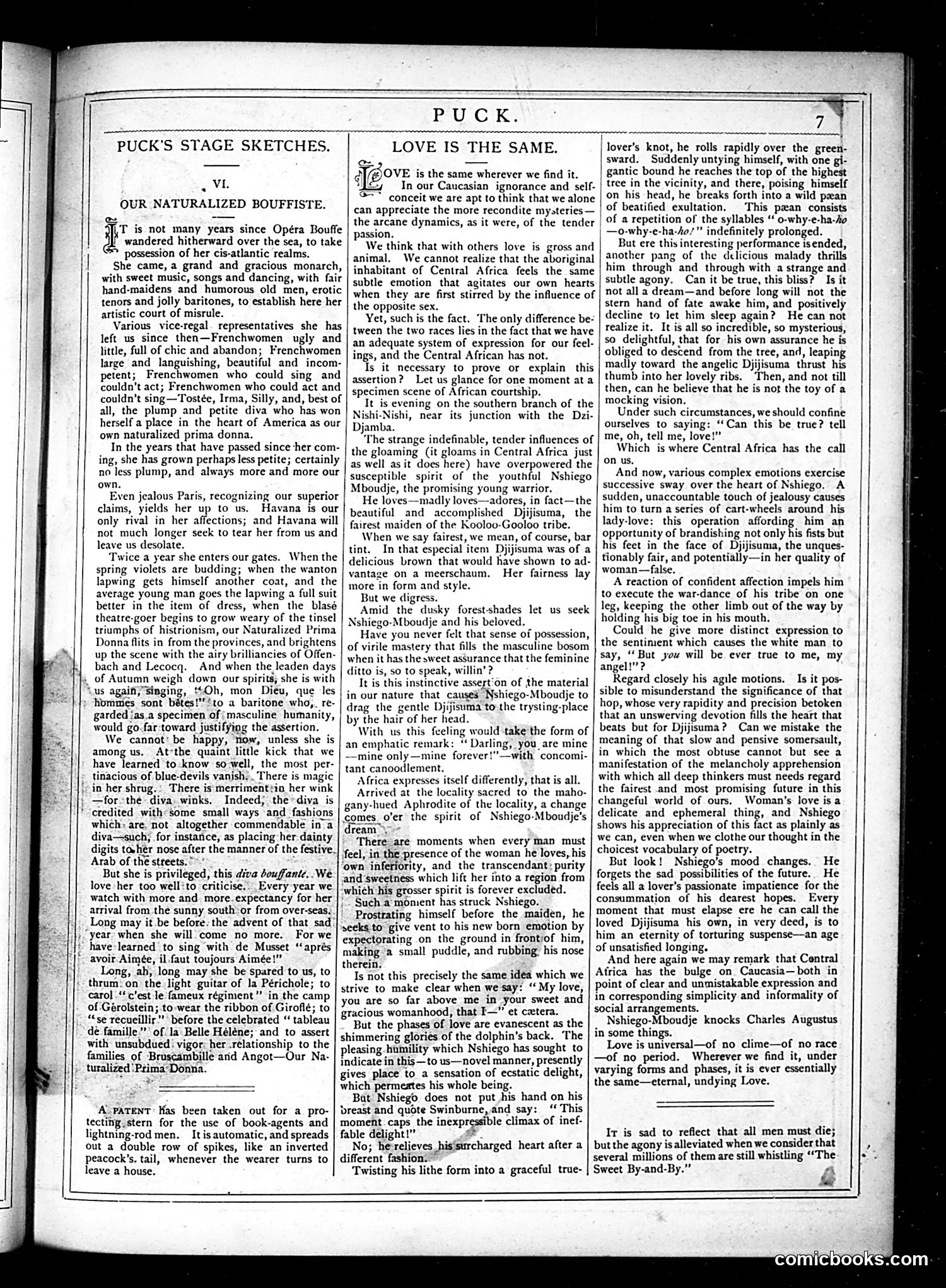
This page contains two distinct pieces: **Left column:** "Our Naturalized Bouffiste" (Stage Sketches VI) - A theatrical critique mocking the pretensions of naturalized French performers in American opera houses. The author sarcastically praises their "artistic court of mischief," satirizing how European performers were celebrated despite mediocre talents. The piece names specific performers (Tooste, Irma, Silly) and pokes fun at their artistic pretensions and accents. **Right column:** "Love Is The Same" - An essay arguing that love transcends racial and cultural boundaries, using Central African courtship rituals as examples. It defends the emotional validity of African peoples against contemporary dismissive attitudes, comparing African expressions of love to European ones to argue their essential equivalence. The juxtaposition suggests Puck's mixed editorial positions on cultural hierarchies and authenticity.
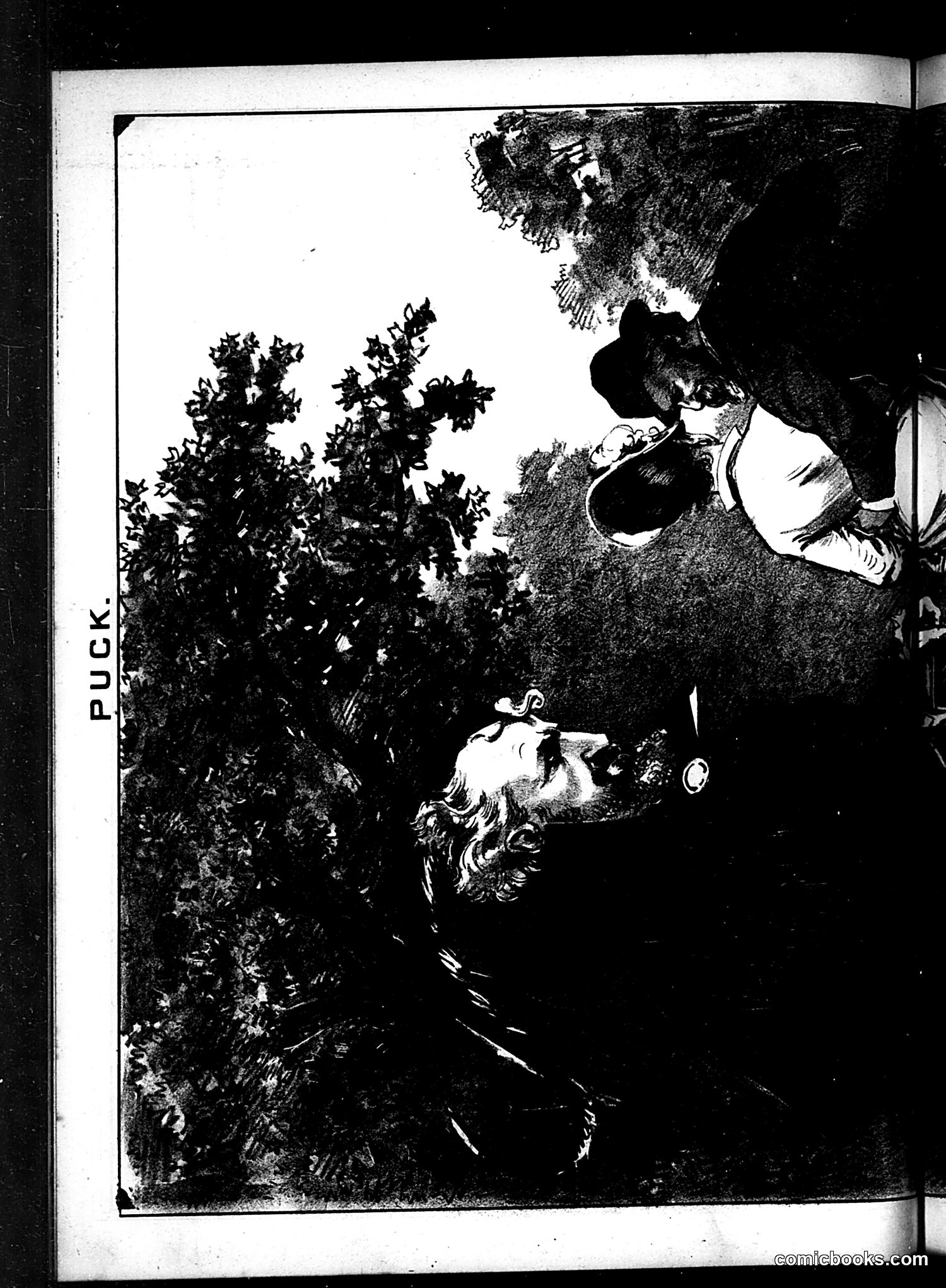
This page contains an illustration labeled "PUCK" (visible on the left margin). The black-and-white image depicts two figures in what appears to be a garden or outdoor setting with vegetation. One figure appears to be a woman in period dress, and another figure is visible above/behind her. However, without clearer text visible on this page or additional context about the specific issue date, I cannot confidently identify the specific political or social references, the named individuals being satirized, or the cartoon's particular point. The artistic style and printing quality suggest late 19th or early 20th century, consistent with Puck's publication period, but the image quality and lack of legible caption text prevent accurate interpretation of the satire's target and meaning.
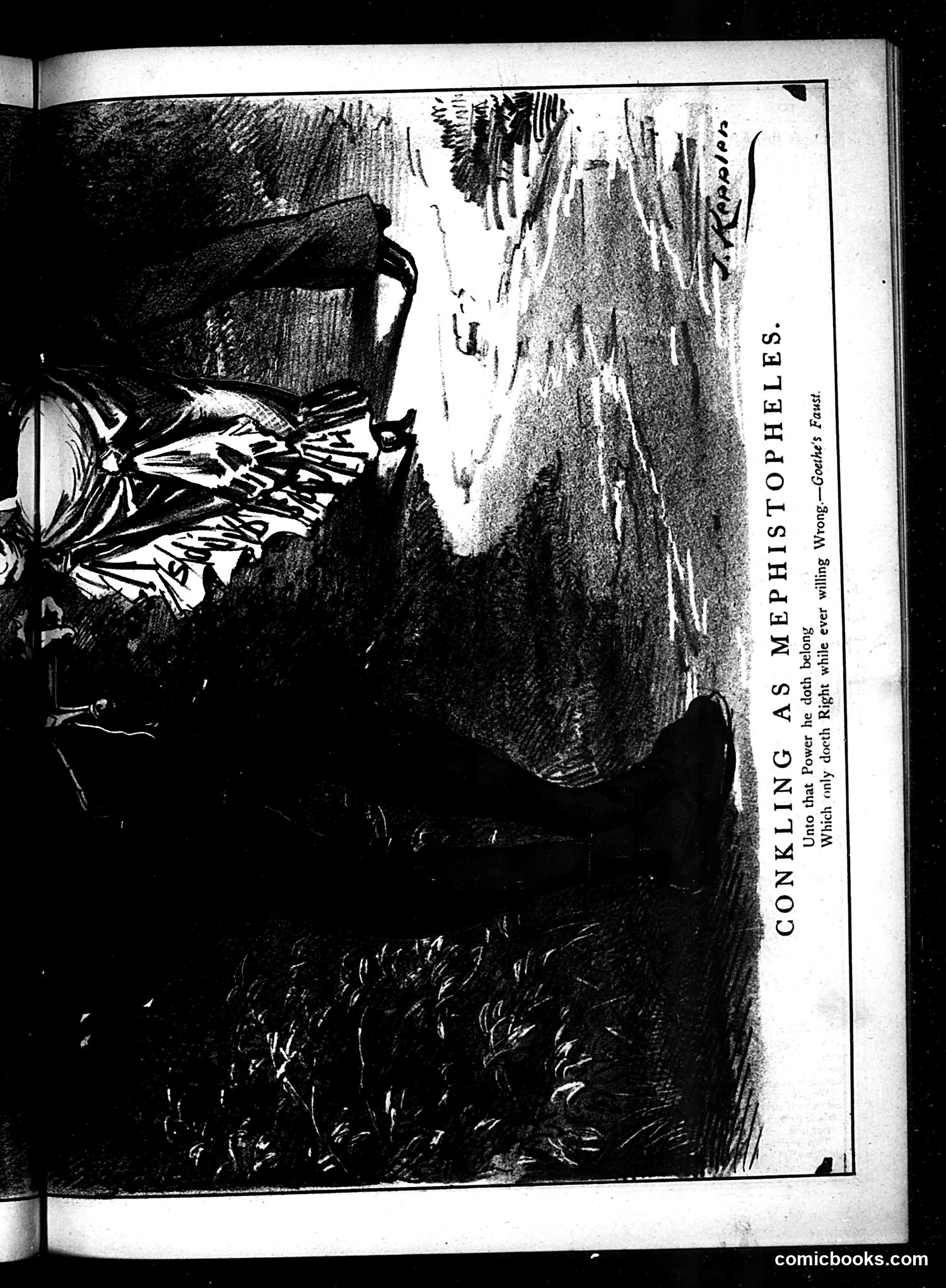
This page shows an illustration titled "CONKLING AS MEPHISTOPHELES" with the subtitle "Unto that Poorer is each beling / Which only doth Right sile ever willing Goethe's Faust" The cartoon depicts **Roscoe Conkling**, a prominent Republican politician of the Gilded Age, portrayed as Mephistopheles (the devil figure from Goethe's *Faust*). The classical literary reference suggests Conkling is being satirized as a manipulative, devilish influence—likely regarding his controversial political maneuvers or his role in factional Republican politics. The Faustian allusion implies Conkling tempts others toward morally questionable deals or compromises. This reflects contemporary criticism of Conkling's machine politics and his attempts to consolidate power, particularly during disputes over patronage and party leadership in the 1870s-1880s.
This page contains primarily **theatrical criticism and drama notes**, not political cartoons. The main content is "A Ballad of Burdens" — a satirical poem mocking various social types and their complaints, written "for the use of paragraphers." The "Dramatic Notes" section critiques recent theater productions and performers, particularly attacking the Chesterfieldian (pretentious, affected) style of a theater manager who opened a show called "That Wife of Mine" at the Eagle Theatre. The satire targets his pompous management, poor taste, and the production's failure—despite featuring a clever comedian (Mr. Florence), the play itself was dull and the manager's pretensions undermined the performers. The small illustration at bottom appears to be **"The Latest Eagle Novelty"** — likely a decorative emblem rather than satirical content.
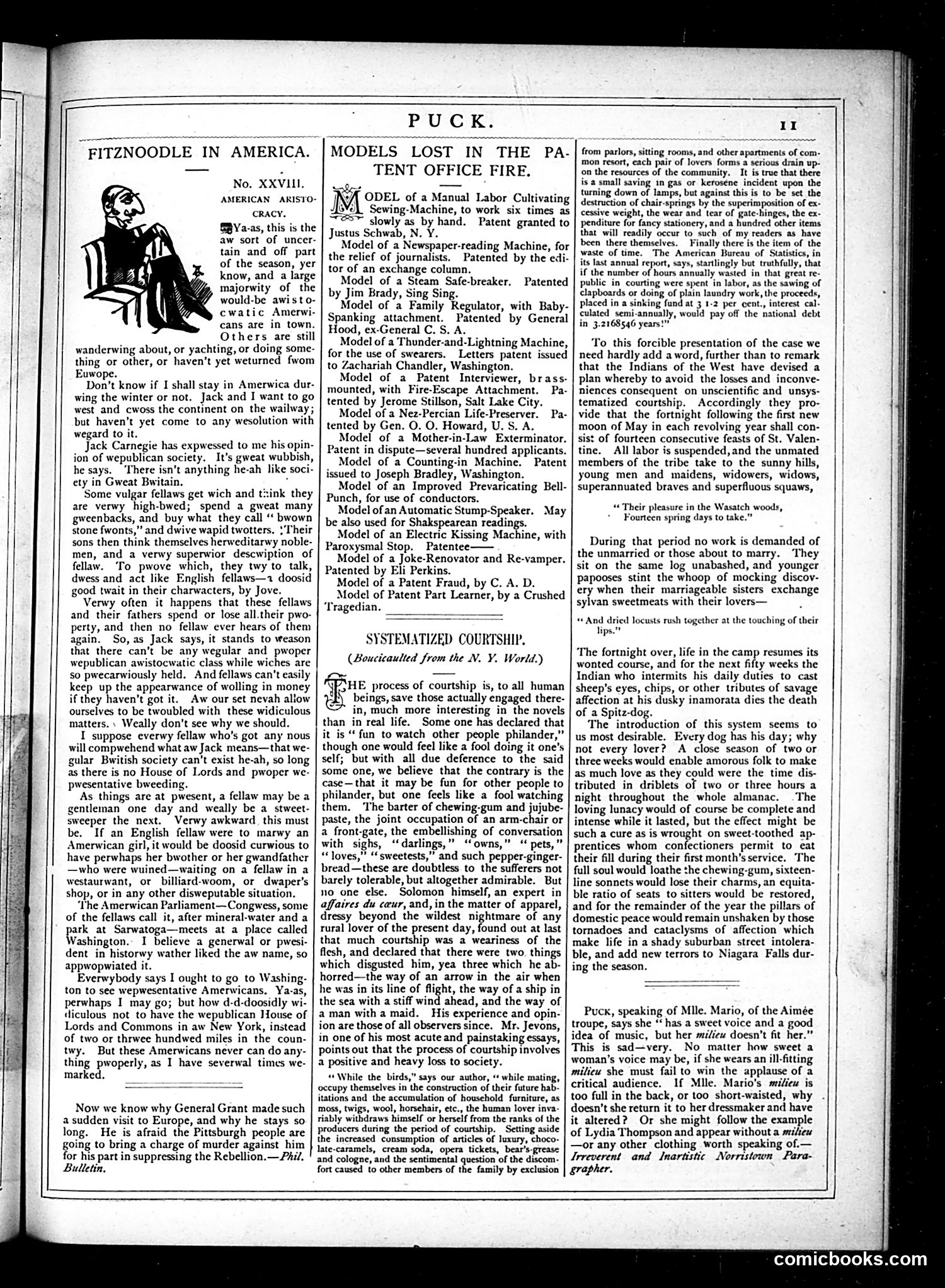
The page contains three distinct sections: **"Fitznoodle in America" (Left Column):** A caricatured figure represents a stereotypical Irish immigrant ("Fitznoodle"), mocking Irish-American visitors to Europe who affect aristocratic pretensions. The satire ridicules their attempts to appear cultured and their claims of European connections. **"Models Lost in the Patent Office Fire" (Center):** This lists absurd patent inventions—a "Manual Labor Cultivating Spring-Machine," "Thunder-and-Lightning Machine," and "Electric Kissing Machine"—mocking the patent office. The humor derives from patenting obviously impractical or ridiculous contraptions, likely referencing an actual patent office fire. **"Systematized Courtship" (Right Column):** Satirizes overly mechanical approaches to romance and courtship, suggesting that some reduce human relationships to systematic procedures rather than genuine emotion.
This page contains the continuation of a serialized story titled "Two Knaves and a Queen" by Frank Barrett, not a political cartoon. The narrative follows characters including Mattie, Tom, René, and Miss Hiron in what appears to be a Victorian-era romantic drama involving business dealings and emotional entanglements. The text focuses on personal relationships rather than political satire: a woman (Mattie) struggles with a husband in financial difficulty, while another character (René) harbors romantic feelings. There are discussions of a modeling career and social propriety typical of period fiction. This is **literary content**, not satirical cartooning, making political interpretation inapplicable to this particular page. The magazine Puck did publish satirical cartoons, but this installment is serialized fiction.
This page contains primarily text rather than a prominent political cartoon. The main content is a serialized story ("To be continued") about an artist and his romantic entanglement with a model named René. The narrative depicts Hugh, the artist, conflicted between his artistic principles and personal desire. Below the story is a section titled "Puck's Jottings"—a collection of brief satirical commentary on contemporary issues. These include jabs at: - Inflated prices (squab and blankets) - Newspaper sensationalism - Kentucky's troubles - Various social absurdities The jottings employ Puck's typical format: short, punchy observations mocking public figures, institutions, and current events through humor. Without clearer identification of specific references, the precise targets remain unclear from this page alone.
This page is primarily **text-based content** rather than cartoon illustrations. It contains several short satirical pieces and anecdotes typical of Puck's humor section, including: - Commentary on unemployment and social issues - Humorous observations about women's fashion and behavior - A fable titled "A Kind-Hearted She-Elephant" with moral lessons - Various brief jokes and witticisms about marriage, coffee, and social customs The satire targets **everyday social absurdities** rather than specific political figures—poking fun at women's impracticality, marital dynamics, and human pretension. One piece mocks "female postmasters," suggesting contemporary debates about women in professional roles. The humor reflects **turn-of-the-century American attitudes** toward gender, class, and domestic life, emphasizing wit over visual comedy.
This appears to be primarily an **advertising and announcements page** from Puck magazine rather than a satirical cartoon page. The top features an **"In Memoriam" notice for Brigham Young**, the Mormon leader, along with publication details about Puck's cartoon depicting "Mormon's Empty Pillow." The remainder consists of period advertisements for: - Gentlemen's hats - Champagne and wine importers - Puck's Illustrated Almanac - Compressed yeast - Portraits and cigars - Printing inks - Filing covers The only significant illustrated content is a decorative **Hungarian wines advertisement** featuring ornate baroque-style imagery. This is a back-matter page serving commercial purposes rather than editorial satire.
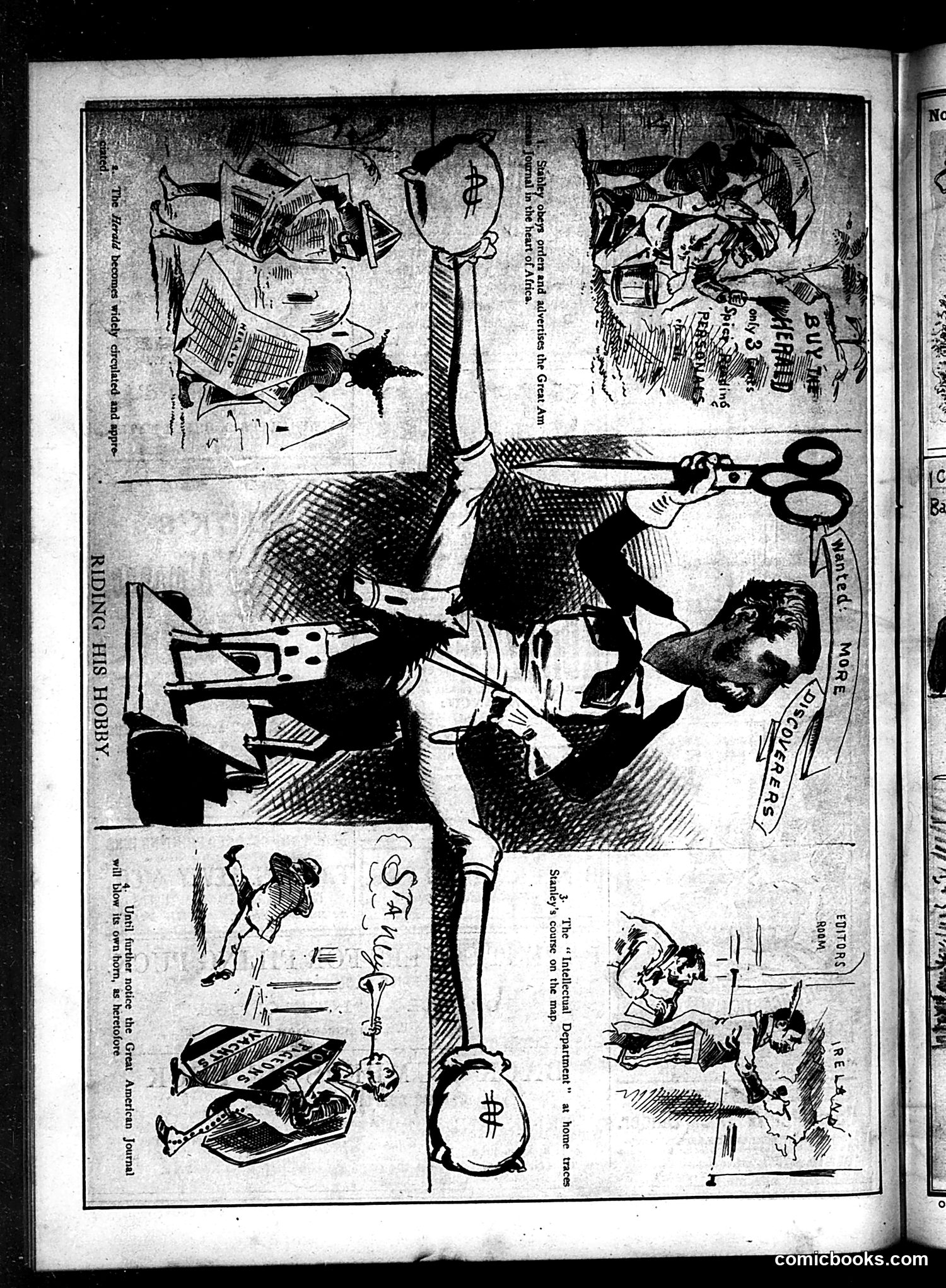
This Puck page contains political satire cartoons, though the OCR text is too degraded to read clearly. The central image shows a tall figure wielding oversized scissors, appearing to cut financial instruments or money (dollar signs visible). Smaller panels surround this main cartoon, depicting various figures in what appears to be commentary on economic or financial matters. The imagery suggests satire about wealth disparity, financial manipulation, or perhaps monopolistic practices—common Puck targets. The scissors as a cutting tool likely represent intervention in financial systems or the division of wealth. Without clearer text, I cannot identify specific political figures or date this precisely, but the visual language indicates commentary on American economic power dynamics and inequality.