
Puck, 1877-10-03 · page 13 of 16
Puck — October 3, 1877 — page 13: what you’re looking at
What you’re looking at
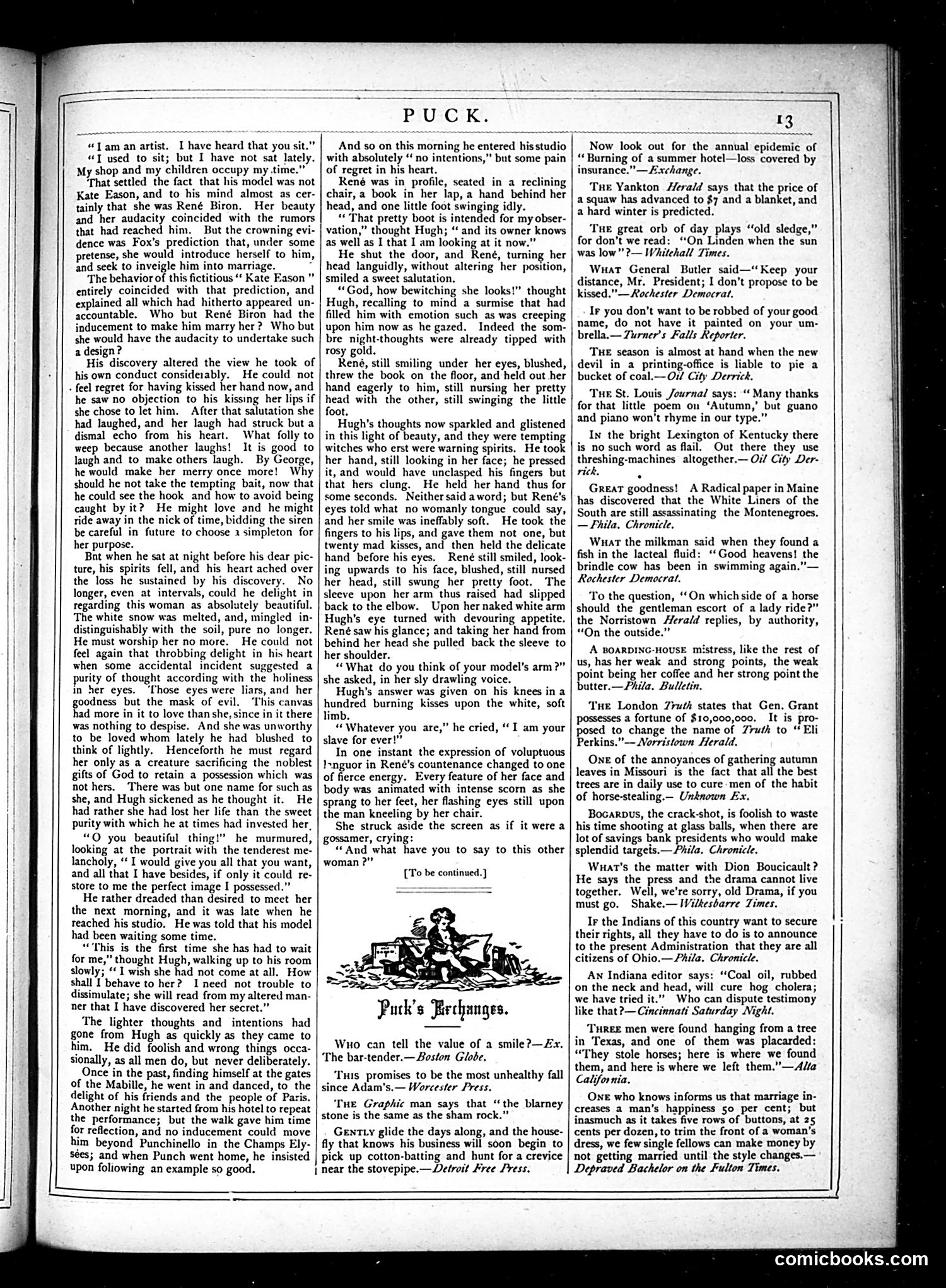
This page contains primarily text rather than a prominent political cartoon. The main content is a serialized story ("To be continued") about an artist and his romantic entanglement with a model named René. The narrative depicts Hugh, the artist, conflicted between his artistic principles and personal desire. Below the story is a section titled "Puck's Jottings"—a collection of brief satirical commentary on contemporary issues. These include jabs at: - Inflated prices (squab and blankets) - Newspaper sensationalism - Kentucky's troubles - Various social absurdities The jottings employ Puck's typical format: short, punchy observations mocking public figures, institutions, and current events through humor. Without clearer identification of specific references, the precise targets remain unclear from this page alone.
📄 Transcribed text from this page (OCR, searchable)
Machine-transcribed from the original scan — historical spelling and the odd misread are preserved.
“Taman artist. I have heard that you sit.” “T used to sit; but I have not sat lately. My shop and my children occupy my time.” ‘That settled the fact that his model was not Kate Eason, and to his mind almost as cer- tainly that she was René Biron. Her beauty and her audacity coincided with the rumors that had reached him. But the crowning evi- dence was Fox's prediction that, under some pretense, she would introduce herself to him, and seek to inveigle him into marriage. The behavior of this fictitious “‘ Kate Eason " entirely coincided with that prediction, and explained all which had hitherto appeared un- accountable. Who but René Biron had the inducement to make him marry her? Who but she would have the audacity to undertake such a design? His discovery altered the view he took of his own conduct considerably. He could not - feel regret for having kissed her hand now, and he saw no objection to his kissing her lips if she chose to let him. After that salutation she had laughed, and her laugh had struck but a dismal echo from his heart. What folly to weep because another laughs! It is good to laugh and to make others laugh. By George, he would make her merry once more! Why should he not take the tempting bait, now that he could see the hook and how to avoid being caught by it? He might love and he might ride away in the nick of time, bidding the siren be careful in future to choose a simpleton for her purpose. Bnt when he sat at night before his dear pic- ture, his spirits fell, and his heart ached over the loss he sustained by his discovery. No longer, even at intervals, could he delight in regarding this woman as absolutely beautiful. The white snow was melted, and, mingled in- distinguishably with the soil, pure no longer. He must worship her no more. He could not feel again that throbbing delight in his heart when some accidental incident suggested a purity of thought according with the holiness in her eyes. ‘Those eyes were liars, and her goodness but the mask of evil. This canvas had more in it to love than she, since in it there was nothing to despise. And she was unworthy to be loved whom lately he had blushed to think of lightly. Henceforth he must regard her only as a creature sacrificing the noblest gifts of God to retain a possession which was not hers. There was but one name for such as she, and Hugh sickened as he thought it. He had rather she had lost her life than the sweet purity with which he at times had invested her, “O you beautiful thing!” he murmured, looking at the portrait with the tenderest me- lancholy, * I would give you all that you want, and all that I have besides, if only it could re- store to me the perfect image I possessed.” He rather dreaded than desired to meet her the next morning, and it was late when he reached his studio. He was told that his model had been waiting some time. “This is the first time she has had to wait for me,” thought Hugh, walking up to his room slowly; ‘1 wish she Rad not come at all. How shall I behave to her? I need not trouble to dissimulate; she will read from my altered man- ner that I have discovered her secret.” The lighter thoughts and intentions had gone from Hugh as quickly as they came to him. He did foolish and wrong things occa- sionally, as all men do, but never deliberately. Once in the past, finding himself at the gates of the Mabille, he went in and danced, to the delight of his friends and the people of Paris. Another night he started from his hotel to repeat the performance; but the walk gave him time for reflection, and no inducement could move him beyond Punchinello in the Champs Ely- sées; and when Punch went home, he insisted upon foliowing an example so good. And so on this morning he entered his studio with absolutely “no intentions,” but some pain of regret in his heart. René was in profile, seated in a reclining chair, a book in her lap, a hand behind her head, and one little foot swinging idly. “« That pretty boot is intended for my obser- vation,” thought Hugh; “ and its owner knows as well as I that I am looking at it now.” He shut the door, and René, turning her head languidly, without altering her position, smiled a sweet salutation. “God, how bewitching she looks!” thought Hugh, recalling to mind a surmise that had upon him now as he gazed. bre night-thoughts were already tipped with rosy gold. René, still smiling under her eyes, blushed, threw the book on the floor, and held out her hand eagerly to him, still nursing her pretty head with the other, still swinging the little foot. Hugh's thoughts now sparkled and glistened in this light of beauty, and they were temptin; witches who erst were warning spirits. He tool her hand, still looking in her face; he pressed it, and would have unclasped his fingers but that hers clung. He held her hand thus for some seconds. Neither said aword; but René’s eyes told what no womanly tongue could say, and her smile was ineffably soft. He took the fingers to his lips, and gave them not one, but twenty mad kisses, and then held the delicate hand before his eyes. René still smiled, look- ing upwards to his face, blushed, still nursed her head, still swung her pretty foot. The sleeve upon her arm thus raised had slipped back to the elbow. Upon her naked white arm Hugh’s eye turned with devouring appetite. René saw his glance; and taking her hand from behind her head she pulled back the sleeve to her shoulder. “What do you think of your model’s arm?” she asked, in her sly drawling voice. Hugh’s answer was given on his knees in a hundred burning kisses upon the white, soft limb. “Whatever you are,” he cried, “I am your slave for ever!” In one instant the expression of voluptuous Ienguor in René’s countenance changed to one of fierce energy. Every feature of her face and body was animated with intense scorn as she sprang to her feet, her flashing eyes still upon the man kneeling by her chair. She struck aside the screen as if it were a gossamer, crying: “And what have you to say to this other woman ?”” [To be continued.} Wuo can tell the value of a smile?—Zx. ‘The bar-tender.— Boston Globe, ‘Tus promises to be the most unhealthy fall since Adam's.— Worcester Press. ‘Tne Graphic man says that “the blarney stone is the same as the sham rock.” GentLy glide the days along, and the house- fly that knows his business will soon begin to pick up cotton-batting and hunt for a crevice | near the stovepipe.—Detrott Free Press. filled him with emotion such as was creeping | Indeed the som- | Now look out for the annual epidemic of “Burning of a summer hotel—loss covered by insurance.” —Exchange. Tne Yankton Herald says that the price of a squaw has advanced to $7 and a blanket, and a hard winter is predicted. ‘Tue great orb of day plays “old sledge,” for don’t we read: “On Linden when the sun | was low" ?— Whitehall Times. Wuat General Butler said—“Keep your distance, Mr. President; I don’t propose to be kissed." —Xochester Democrat. Ir you don’t want to be robbed of your good name, do not have it painted on your um- brella.— Zurner’s Falls Reporter. Tue season is almost at hand when the new devil in a printing-office is liable to pie a bucket of coal.— Oi City Derrick. Tue St. Louis Journal says: “Many thanks for that little poem on ‘Autumn,’ but guano and piano won't rhyme in our type.”” In the bright Lexington of Kentucky there is no such word as flail. Out there they use threshing-machines altogether.— Oi/ City Der- rick. . Great goodness! A Radical paper in Maine has discovered that the White Liners of the South are still assassinating the Montenegroes. —Fhila. Chronicle, Wuart the milkman said when they found a fish in the lacteal fluid: ‘‘Good heavens! the brindle cow has been in swimming again.”— Rochester Democrat. ‘To the question, “On which side of a horse should the gentleman escort of a lady ride?” the Norristown Herald replies, by authority, “On the outside.” A BOARDING-HOUSE mistress, like the rest of us, has her weak and strong points, the weak point being her coffee and her strong point the butter.—Phila, Bulletin. Tue London 7ruth states that Gen. Grant possesses a fortune of $10,000,000. It is pro- posed to change the name of Zruth to “Eli Perkins.”— Norristown Herald. One of the annoyances of gathering autumn leaves in Missouri is the fact that all the best trees are in daily use to cure-men of the habit of horse-stealing.— Unknown Ex. Bocarous, the crack-shot, is foolish to waste his time shooting at glass balls, when there are lot of savings bank presidents who would make splendid targets.— Phila, Chronicle. Wuat's the matter with Dion Boucicault? He says the press and the drama cannot live together. Well, we're sorry, old Drama, if you must go. Shake.—IVilkesbarre Times. Ir the Indians of this country want to secure their rights, all they have to do is to announce to the present Administration that they are all citizens of Ohio.— Phila. Chronicle. AN Indiana editor says: “Coal oil, rubbed on the neck and head, will cure hog cholera; we have tried it.” Who can dispute testimony like that?—Cincinnati Saturday Night. ‘Turee men were found hanging from a tree in Texas, and one of them was placarded: “They stole horses; here is where we found them, and here is where we left them.”—Al/a California. One who knows informs us that marriage in- creases a man’s happiness so per cent; but inasmuch as it takes five rows of buttons, at 25 cents per dozen, to trim the front of a woman’s dress, we few single fellows can make money by not getting married until the style changes.— Depraved Bachelor on the Fulton Times. comicbooks.com