
Puck, 1877-10-03 · page 2 of 16
Puck — October 3, 1877 — page 2: what you’re looking at
What you’re looking at
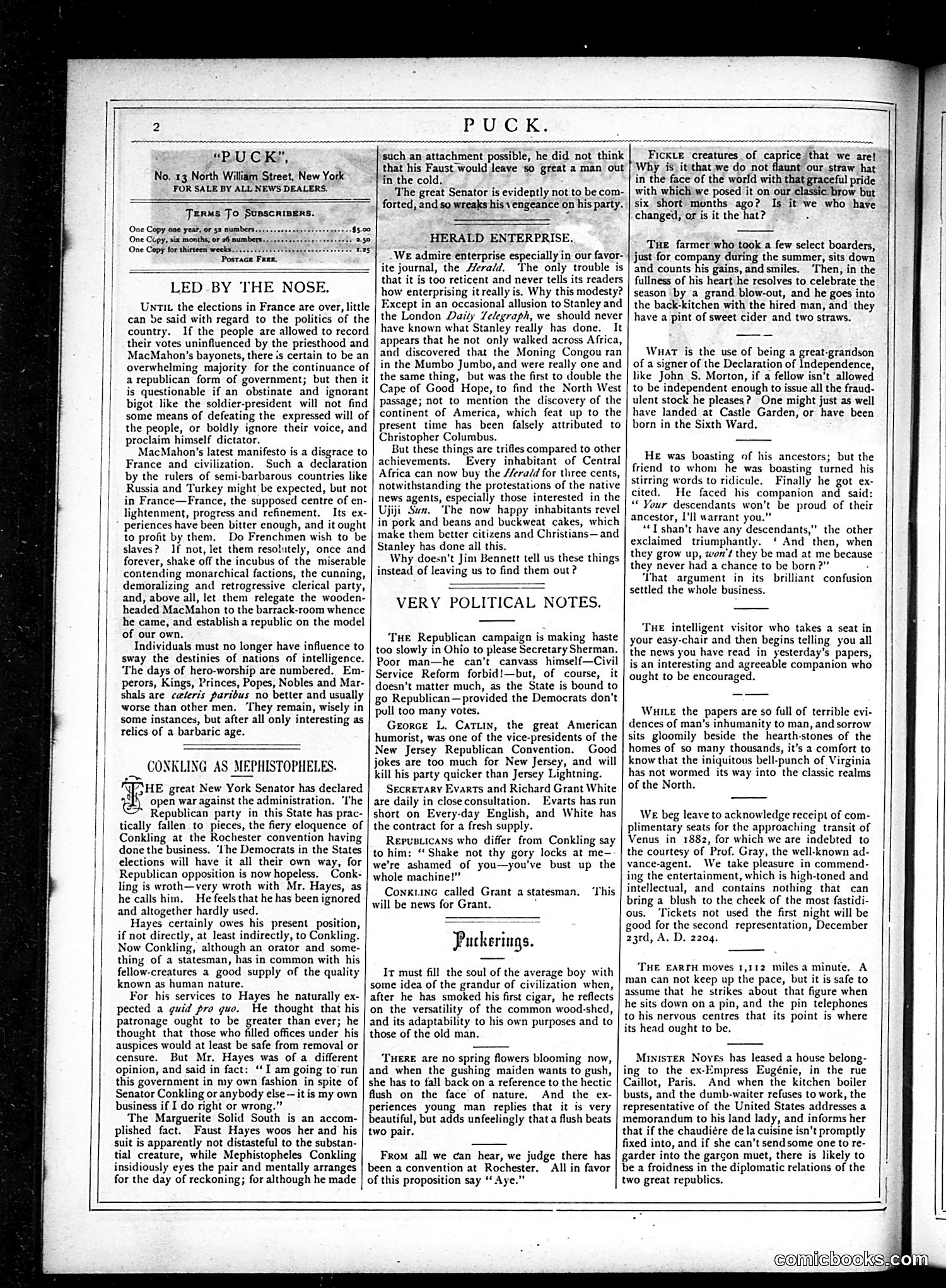
This page from *Puck* magazine satirizes Senator Conkling's influence over the Republican Party. The main article criticizes how Conkling, a powerful New York Republican, allegedly controls party members through intimidation and patronage rather than merit. The piece argues that Conkling's "semiconscious" leadership has caused Republicans to blindly follow him, compromising their independence. The metaphor of being "led by the nose" suggests he manipulates subordinates like animals. The article contrasts this with ideals of representative democracy, claiming Conkling's influence represents a return to monarchical or aristocratic rule—worse than other corrupt leaders because he operates through party rather than official position. This reflects broader late-19th-century reform debates about political boss control.
📄 Transcribed text from this page (OCR, searchable)
Machine-transcribed from the original scan — historical spelling and the odd misread are preserved.
PUCK. «PU CK, No. 13 North William Street, New York FOR SALE BY ALL NEWS DEALERS. Terms To Sonscriners. ‘One Copy one year, or 52 numbers... ‘One Cépy, six months, or 26 numbers LED BY THE NOSE. Untit the elections in France are over, little can de said with regard to the politics of the country. If the people are allowed to record their votes uninfluenced by the priesthood and MacMahon’s bayonets, there is certain to be an overwhelming majority for the continuance of arepublican form of government; but then it is questionable if an obstinate and ignorant bigot like the soldier-president will not find some means of defeating the expressed will of the people, or boldly ignore their voice, and proclaim himself dictator. MacMahon’s latest manifesto is a disgrace to France and civilization. Such a declaration by the rulers of semi-barbarous countries like Russia and Turkey might be expected, but not in France—France, the supposed centre of en- lightenment, progress and refinement. Its ex- periences have been bitter enough, and it ought to profit by them. Do Frenchmen wish to be slaves? If not, let them resolutely, once and forever, shake off the incubus of the miserable contending monarchical factions, the cunning, demoralizing and retrogressive clerical party, and, above all, let them relegate the wooden- headed MacMahon to the barrack-room whence he came, and establish a republic on the model of our own. Individuals must no longer have influence to sway the destinies of nations of intelligence. ‘The days of hero-worship are numbered. Em- perors, Kings, Princes, Popes, Nobles and Mar- shals are celeris paribus no better and usually worse than other men. They remain, wisely in some instances, but after all only interesting as relics of a barbaric age. __ CONKL ING AS MEPHISTOPHELES. TRHE great New York Senator has declared A open war against the administration. ‘The Republican party in this State has prac- tically fallen to pieces, the fiery eloquence of Conkling at the Rochester convention having done the business. ‘Ihe Democrats in the States elections will have it all their own way, for Republican opposition is now hopeless. Conk- ling is wroth—very wroth with Mr. Hayes, as he calls him. He feels that he has been ignored and altogether hardly used. Hayes certainly owes his present position, if not directly, at least indirectly, to Conkling. Now Conkling, although an orator and some- thing of a statesman, has in common with his fellow-creatures a good supply of the quality known as human nature. For his services to Hayes he naturally ex- pected a guid pro guo. He thought that his patronage ought to be greater than ever; he thought that those who filled offices under his auspices would at least be safe from removal or censure. But Mr, Hayes was of a different opinion, and said in fact: “I am going to run this government in my own fashion in spite of Senator Conkling or anybody else—it is my own business if I do right or wrong.” The Marguerite Solid South is an accom- plished fact. Faust Hayes woos her and his suit is apparently not distasteful to the substan- creature, while Mephistopheles Conkling insidiously eyes the pair and mentally arranges for the day of reckoning; for although he made | such an attachment possible, he did not think that his Faust would leave so great a man out in the cold. The great Senator is evidently not to be com- forted, and so wreaks his vengeance on his party. HERALD ENTERPRISE. -We admire enterprise especially in our favor- ite journal, the Hera/d. ‘The only trouble is that it is too reticent and never tells its readers how enterprising it really is. Why this modesty? Except in an occasional allusion to Stanley and the London Daity Zelegraph, we should never have known what Stanley really has done. It appears that he not only walked across Africa, and discovered that the Moning Congou ran in the Mumbo Jumbo, and were really one and the same thing, but was the first to double the Cape of Good Hope, to find the North West passage; not to mention the discovery of the continent of America, which feat up to the present time has been falsely attributed to Christopher Columbus. But these things are trifles compared to other achievements. Every inhabitant of Central Africa can now buy the //era/d for three cents, notwithstanding the protestations of the native news agents, especially those interested in the Ujiji Sun, “he now happy inhabitants revel in pork and beans and buckweat cakes, which make them better citizens and Christians— and Stanley has done all this. Why doesn’t Jim Bennett tell us these things instead of leaving us to find them out? VERY POLITICAL NOTES. ‘THe Republican campaign is making haste too slowly in Ohio to please Secretary Sherman. Poor man—he can’t canvass himself—Civil Service Reform forbid!—but, of course, it doesn't matter much, as the State is bound to go Republican —provided the Democrats don't pull too many votes. Georce L, Catiin, the great American humorist, was one of the vice-presidents of the New Jersey Republican Convention. Good jokes are too much for New Jersey, and will kill his party quicker than Jersey Lightning. Secretary Evarts and Richard Grant White are daily in closeconsultation. Evarts has run short on Every-day English, and White has the contract for a fresh supply. Repus.icans who differ from Conkling say to him: ‘Shake not thy gory locks at me- we're ashamed of you—you've bust up the whole machine!” Conktinc called Grant a statesman. will be news for Grant. ‘This Puckerings. Ir must fill the soul of the average boy with some idea of the grandur of civilization when, after he has smoked his first cigar, he reflects on the versatility of the common wood-shed, and its adaptability to his own purposes and to those of the old man. ‘THERE are no spring flowers blooming now, and when the gushing maiden wants to gush, she has to fall back on a reference to the hectic flush on the face of nature. And the ex- periences young man replies that it is very beautiful, but adds unfeelingly that a flush beats two pair. From all we can hear, we judge there has been a convention at Rochester. All in favor of this proposition say “Aye.” FIckte creatures of caprice that we are! Why is) itithat we do not price our, straw hat in the face of the world with that graceful pride with which we posed it on our classic: brow but six short months ago? Is it we who have changed, or is it the hat? Tue farmer who took a few select boarders, just for company during the summer, sits down and counts his gains, and smiles. ‘Then, in the fullness of his heart he resolves to celebrate the season by a grand blow-out, and he goes into the back-kitchen with the hired man, and they have a pint of sweet cider and two straws. Wuar is the use of being a great-grandson of a signer of the Declaration of Independence, like John S. Morton, if a fellow isn’t allowed to be independent enough to issue all the fraud- ulent stock he pleases? One might just as well have landed at Castle Garden, or have been born in the Sixth Ward. HE was boasting of his ancestors; but the friend to whom he was boasting turned his stirring words to ridicule. Finally he got ex- cited. He faced his companion and said: “Your descendants won't be proud of their ancestor, I'll warrant you.” “Tshan’t have any descendants,” the other exclaimed triumphantly. ‘ And then, when they grow up, won't they be mad at me because they never had a chance to be born?” ‘That argument in its brilliant confusion settled the whole business. ‘THE intelligent visitor who takes a seat in your easy-chair and then begins telling you all the news you have read in yesterday's papers, is an interesting and agreeable companion who ought to be encouraged. Waite the papers are so full of terrible evi- dences of man’s inhumanity to man, and sorrow sits gloomily beside the hearth-stones of the homes of so many thousands, it’s a comfort to know that the iniquitous bell-punch of Virginia has not wormed its way into the classic realms of the North. We beg leave to acknowledge receipt of com- plimentary seats for the approaching transit of Venus in 1882, for which we are indebted to the courtesy of Prof. Gray, the well-known ad- vance-agent. We take pleasure in commend- ing the entertainment, which is high-toned and intellectual, and contains nothing that can bring a blush to the cheek of the most fastidi- ous. ‘Tickets not used the first night will be good for the second representation, December 23rd, A. D. 2204. ‘THE EARTH moves 1,112 miles a minute. A man can not keep up the pace, but it is safe to assume that he strikes about that figure when he sits down on a pin, and the pin telephones to his nervous centres that its point is where its head ought to be, has leased a house belong- mpress Eugénie, in the rue Caillot, Paris. And when the kitchen boiler busts, and the dumb-waiter refuses to work, the representative of the United States addresses a memorandum to his land lady, and informs her that if the chaudiére de la cuisine isn’t promptly fixed into, and if she can’t sendsome one to re- garder into the gargon muet, there is likely to be a froidness in the diplomatic relations of the two great republics. ——— comichooks, (ofe) m