
Puck, 1877-10-03 · page 11 of 16
Puck — October 3, 1877 — page 11: what you’re looking at
What you’re looking at
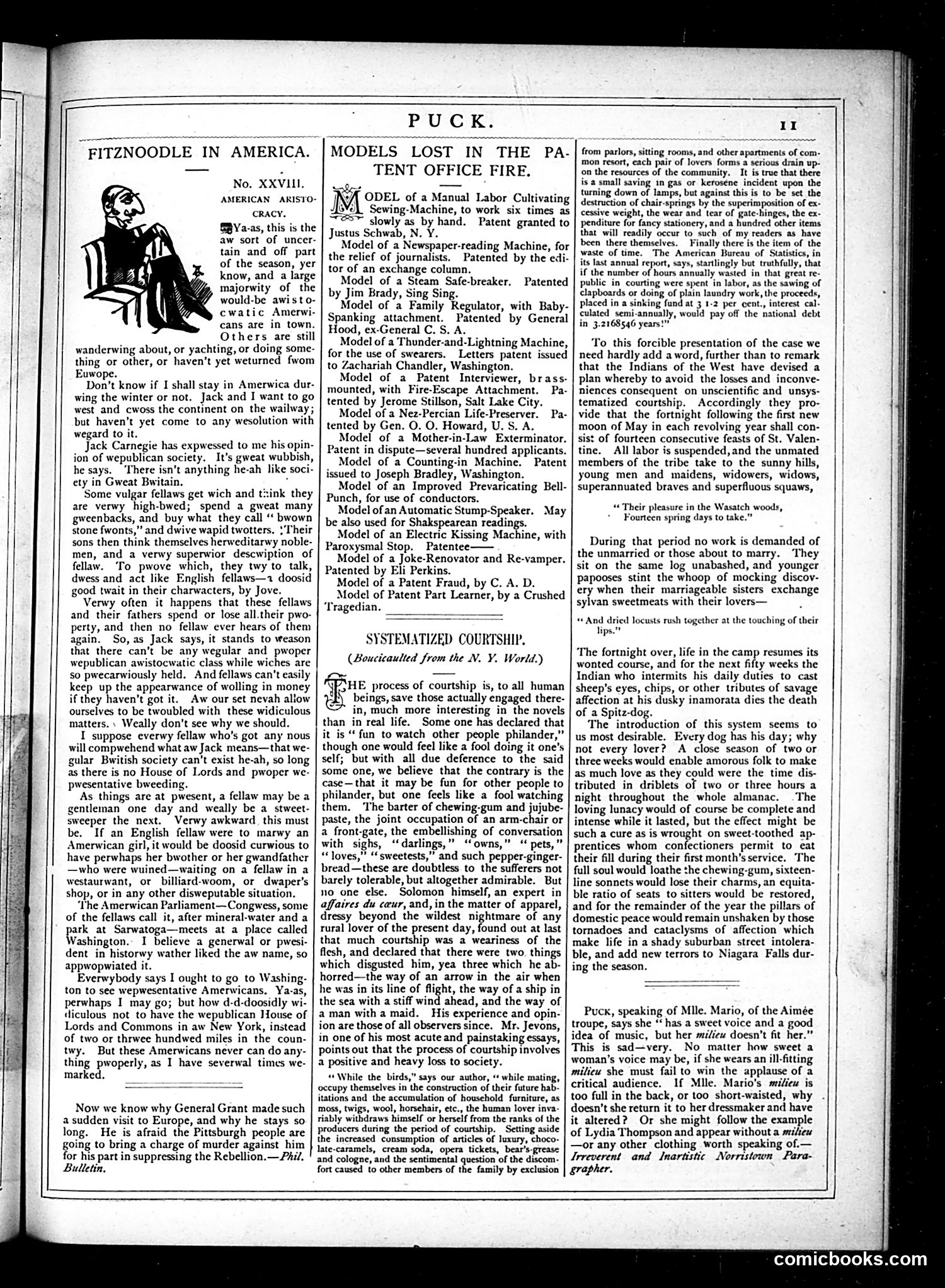
The page contains three distinct sections: **"Fitznoodle in America" (Left Column):** A caricatured figure represents a stereotypical Irish immigrant ("Fitznoodle"), mocking Irish-American visitors to Europe who affect aristocratic pretensions. The satire ridicules their attempts to appear cultured and their claims of European connections. **"Models Lost in the Patent Office Fire" (Center):** This lists absurd patent inventions—a "Manual Labor Cultivating Spring-Machine," "Thunder-and-Lightning Machine," and "Electric Kissing Machine"—mocking the patent office. The humor derives from patenting obviously impractical or ridiculous contraptions, likely referencing an actual patent office fire. **"Systematized Courtship" (Right Column):** Satirizes overly mechanical approaches to romance and courtship, suggesting that some reduce human relationships to systematic procedures rather than genuine emotion.
📄 Transcribed text from this page (OCR, searchable)
Machine-transcribed from the original scan — historical spelling and the odd misread are preserved.
— FITZNOODLE IN AMERICA. No. XXVIII. AMERICAN ARISTO- CRACY, §BYa-as, this is the aw sort of uncer- tain and off part of the season, yer know, and a large majorwity of the would-be awisto- cwatic Amerwi- cans are in town. Others are still wanderwing about, or yachting, or doing some- thing or other, or haven’t yet weturned fwom Euwope. Don’t know if I shall stay in Amerwica dur- wing the winter or not. Jack and I want to go west and cwoss the continent on the wailway; but haven’t yet come to any wesolution with wegard to it. Jack Carnegie has expwessed to me his opi ion of wepublican society. It’s gweat wubbish, he says. ‘There isn’t anything he-ah like soci- ety in Gweat Bwitain. : ‘Some vulgar fellaws get wich and tink they are verwy high-bwed; spend a gweat many gweenbacks, and buy what they call “ bwown stone fwonts,” and dwive wapid twotters. heir sons then think themselves herweditarwy noble- men, and a verwy superwior descwiption of fellaw. ‘To pwove which, they twy to talk, dwess and act like English fellaws—1 doosid good twait in their charwacters, by Jove. Verwy often it happens that these fellaws and their fathers spend or lose all.their pwo- perty, and then no fellaw ever hears of them again. So, as Jack says, it stands to weason that there can’t be any wegular and pwoper wepublican awistocwatic class while wiches are so pwecarwiously held. And fellaws can’t easily keep up the appearwance of wolling in money if they haven't got it. Aw our set nevah allow ourselves to be twoubled with these widiculous matters. , Weally don't see why we should. I suppose everwy fellaw who's got any nous will compwehend what aw Jack means—that we- gular Bwitish society can’t exist he-ah, so long as there is no House of Lords and pwoper we- pwesentative bweeding. As things are at pwesent, a fellaw may be a gentleman one day and weally be a stweet- sweeper the next. Verwy awkward. this must be. If an English fellaw were to marwy an Amerwican girl, it would be doosid curwious to have perwhaps her bwother or her gwandfather —who were wuined—waiting on a fellaw in a westaurwant, or billiard-woom, or dwaper’s shop, or in any other disweputable situation. ‘The Amerwican Parliament—Congwess, some of the fellaws call it, after mineral-water and a Be at Sarwatoga—meets at a place called Washington. I believe a generwal or pwesi- dent in historwy wather liked the aw name, so appwopwiated it. Everwybody says I ought to go to Washing- ton to see wepwesentative Amerwicans. Ya-as, perwhaps I may go; but how d-d-doosidly wi- diculous not to have the wepublican House of Lords and Commons in aw New York, instead of two or thrwee hundwed miles in the coun- twy. But these Amerwicans never can do any- thing pwoperly, as I have severwal times we- marked. Now we know why General Grant made such a sudden visit to Europe, and why he stays so long. He is afraid the Pittsburgh people are going to bring a charge of murder against him for his part in suppressing the Rebellion. — Phil. Bulletin, PUCK. MODELS LOST IN THE PA- TENT OFFICE FIRE. AS ODEL of a Manual Labor Cultivating ANel Sewing-Machine, to work six times as “S5~ slowly as by hand. Patent granted to Justus Schwab, N. Y. Model of a Newspaper-reading Machine, for the relief of journalists. Patented by the edi- tor of an exchange column. Model of a Steam Safe-breaker. by Jim Brady, Sing Sing. Model of a Family Regulator, with Baby- Spanking attachment. Patented by General Hood, ex-General C. S. A. Model of a Thunder-and-Lightning Machine, for the use of swearers. Letters patent issued to Zachariah Chandler, Washington. Model of a_ Patent Interviewer, brass- mounted, with Fire-Escape Attachment. Pa- tented by Jerome Stillson, Salt Lake City. Model of a Nez-Percian Life-Preserver. tented by Gen. O. O. Howard, U. S. A. Model of a Mother-in-Law Exterminator. Patent in dispute—several hundred applicants. Model of a Counting-in Machine. Patent issued to Joseph Bradley, Washington. Model of an Improved Prevaricating Bell- Punch, for use of conductors. Model ofan Automatic Stump-Speaker. May be also used for Shakspearean readings. Model of an Electric Kissing Machine, with Paroxysmal Stop. Patentee—— Model of a Joke-Renovator and Re-vamper. Patented by Eli Perkins. Model of a Patent Fraud, by C. A. D. Model of Patent Part Learner, by a Crushed ‘Tragedian. Patented Pa- SYSTEMATIZED COURTSHIP. (Boucicaulted from the N. Y. World.) Puc process of courtship is, to all human rey beings, save those actually engaged there- <* in, much more interesting in the novels than in real life. Some one has declared that it is ‘fun to watch other people philander,” though one would feel like a fool doing it one’s self; but with all due deference to the said some one, we believe that the contrary is the case—that it may be fun for other people to philander, but one feels like a fool watching them. The barter of chewing-gum and jujube- paste, the joint occupation of an arm-chair or a front-gate, the embellishing of conversation with sighs, ‘‘darlings,” ‘‘owns,” ‘ pets,” “loves,” “sweetests,” and such pepper-ginger- bread—these are doubtless to the sufferers not barely tolerable, but altogether admirable. But no one else. Solomon himself, an expert in affaires du cvur, and, in the matter of apparel, dressy beyond the wildest nightmare of any rural lover of the present day, found out at last that much courtship was a weariness of the flesh, and declared that there were two. things which disgusted him, yea three which he ab- horred—the way of an arrow in the air when he was in its line of flight, the way of a ship in the sea with a stiff wind ahead, and the way of a man with a maid. His experience and opin- ion are those of all observers since. Mr. Jevons, in one of his most acute and painstaking essays, points out that the process of courtship involves a positive and heavy loss to society. “While the birds,” says our author, “ while mating, occupy themselves in the construction of their future hab- itations and the accumulation of household furniture, as moss, twigs, wool, horsehair, etc., the human lover inva- riably withdraws himself or herself from the ranks of the producers during the period of courtship. Setting aside the increased consumption of articles of luxury, choco- late-caramels, cream soda, opera tickets, bear’s-grease and cologne, and the sentimental question of the discom- fort caused to other members of the family by exclusion from parlors, sitting rooms, and other apartments of com- mon resort, each pair of lovers forms a serious drain up- on the resources of the community. It is true that there isa small saving in gas or kerosene turning down of lamps, but against t destruction of chair-springs by the superimposition of ex- cessive weight, the wear and tear of gate-hinges, the ex- penditure for fancy stationery, and a hundred other items that will readily occur to such of my readers as have been there themselves. Finally there is the item of the waste of time. The American Bureau of Statistics, in its last annual report, says, startlingly but truthfully, that if the number of hours annually wasted in that great re- public in courting were spent in labor, as the sawing of clapboards or doing of plain laundry work, the proceeds, placed in a sinking fund at 3 1-2 per cent., interest cal- culated semi-annually, would pay off the national debt in 3.2168546 years!” To this forcible presentation of the case we need hardly add a word, further than to remark that the Indians of the West have devised a plan whereby to avoid the losses and inconve- niences consequent on unscientific and unsys- tematized courtship. Accordingly they pro- vide that the fortnight following the first new moon of May in each revolving year shall con- sist of fourteen consecutive feasts of St. Valen- tine. All labor is suspended, and the unmated members of the tribe take to the sunny hills, young men and maidens, widowers, widows, superannuated braves and superfluous squaws, “Their pleasure in the Wasatch woods, Fourteen spring days to take.” During that period no work is demanded of the unmarried or those about to marry. ‘They sit on the same log unabashed, and younger papooses stint the whoop of mocking discov- ery when their marriageable sisters exchange sylvan sweetmeats with their lovers— “And dried locusts rush together at the touching of their lips.” ‘The fortnight over, life in the camp resumes its wonted course, and for the next fifty weeks the Indian who intermits his daily duties to cast sheep's eyes, chips, or other tributes of savage affection at his dusky inamorata dies the death of a Spitz-dog. The introduction of this system seems to us most desirable. Every dog has his day; why not every lover? A close season of two or three weeks would enable amorous folk to make as much love as they could were the time dis- tributed in driblets of two or three hours a night throughout the whole almanac. .The loving lunacy would of course be complete and intense while it lasted, but the effect might be such a cure as is wrought on sweet-toothed ap- prentices whom confectioners permit to eat their fill during their first month’s service. The full soul would loathe the chewing-gum, sixteen- line sonnets would lose their charms, an equita- ble ratio of seats to sitters would be restored, and for the remainder of the year the pillars of domestic peace would remain unshaken by those tornadoes and cataclysms of affection which make life in a shady suburban street intolera- ble, and add new terrors to Niagara Falls dur- ing the season. Puck, speaking of Mlle. Mario, of the Aimée troupe, says she ‘‘ has a sweet voice and a good idea of music, but her milieu doesn't fit her.” This is sad—very. No matter how sweet a woman’s voice may be, if she wears an ill-fitting milieu she must fail to win the applause of a critical audience. If Mlle. Mario's miliew is too full in the back, or too short-waisted, why doesn’t she return it to her dressmaker and have it altered? Or she might follow the example of Lydia Thompson and appear without a mifiew —or any other clothing worth speaking of.— Irreverent and Inartistic Norristown Para- grapher. comicbooks.com