
Puck, 1877-10-03 · page 4 of 16
Puck — October 3, 1877 — page 4: what you’re looking at
What you’re looking at
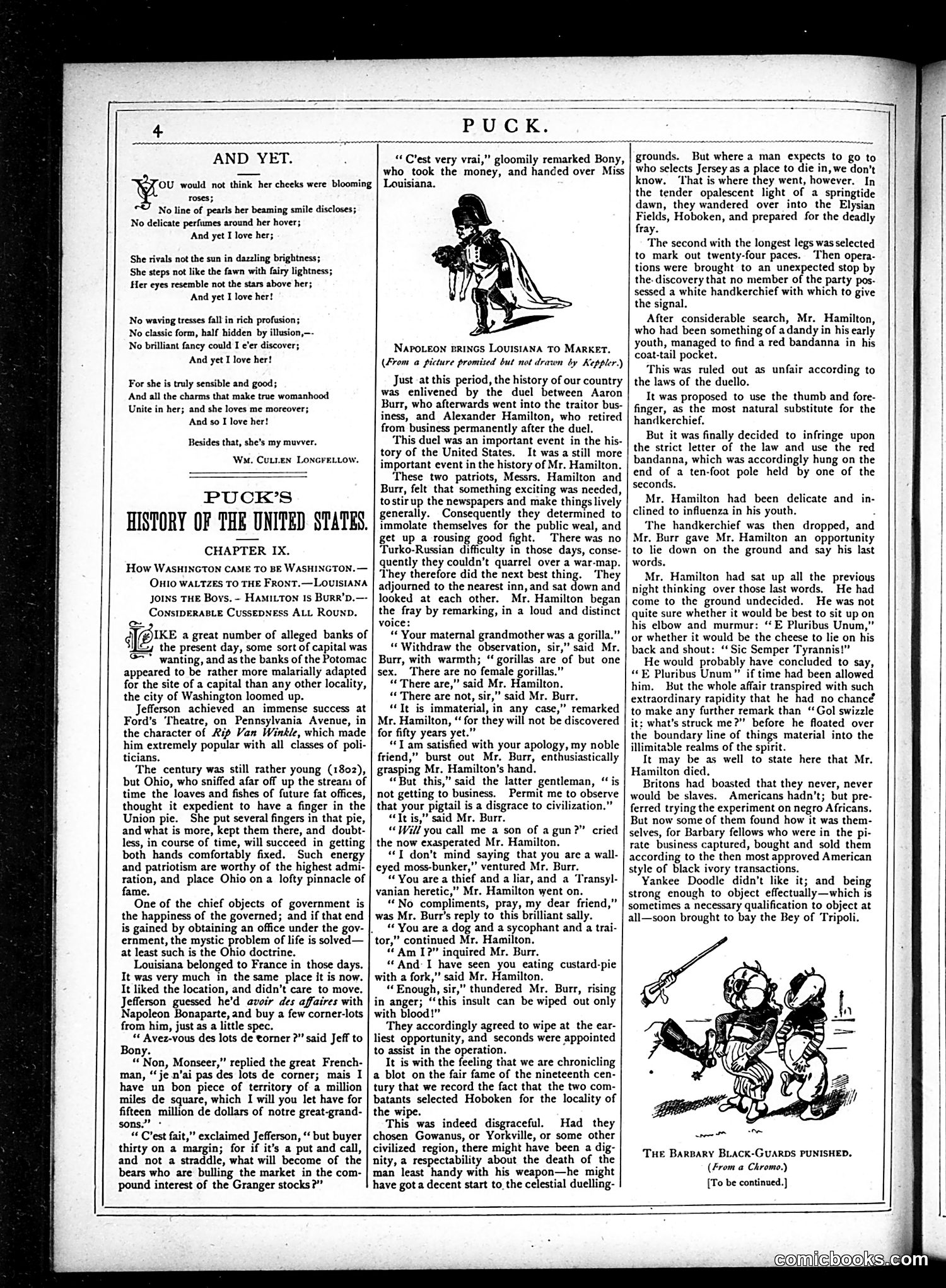
This page contains **"Puck's History of the United States," Chapter IX**, focusing on the Aaron Burr-Alexander Hamilton duel and its historical significance. The main cartoon shows **"Napoleon Brings Louisiana to Market,"** depicting the Louisiana Purchase transaction. The text discusses how the Burr-Hamilton duel disrupted American politics, with Hamilton's death removing a key Federalist figure. The narrative emphasizes this as a pivotal moment in U.S. history. The bottom illustration, **"The Barbary Black-Guards Punished,"** appears to reference early American military conflicts with North African pirates—a separate historical episode. This is primarily **educational satire** rather than contemporary political commentary, using historical episodes to entertain Puck's readers while reviewing formative American events.
📄 Transcribed text from this page (OCR, searchable)
Machine-transcribed from the original scan — historical spelling and the odd misread are preserved.
AND YET. ye would not think her cheeks were blooming roses; No line of pearls her beaming smile discloses; No delicate perfumes around her hover; And yet I love her She rivals not the sun in dazzling brightness; She steps not like the fawn with fairy lightness; Her eyes resemble not the stars above her; ‘And yet I love her! No waving tresses fall in rich profusion; No classic form, half hidden by illusion,—- No brilliant fancy could I e’er discover; And yet I love her! For she is truly sensible and good; And all the charms that make true womanhood Unite in her; and she loves me moreover; And so I love her! Besides that, she’s my muvver. Wa. Cutten Loncre.tow. PUCK’S HISTORY OF THE UNITED STATES. CHAPTER IX. How WASHINGTON CAME TO BE WASHINGTON. — OHIO WALTZES TO THE FRONT.—LOUISIANA JOINS THE Boys. - HamiLton 1s Burr’p.—- ConstDeERABLE CussepNess ALL Rounp. d (BIKE a great number of alleged banks of I) the present day, some sort of capital was =" wanting, and as the banks of the Potomac appeared to be rather more malarially adapted for the site of a capital than any other locality, the city of Washington loomed up. Jefferson achieved an immense success at Ford’s Theatre, on Pennsylvania Avenue, in the character of Rip Van Winkle, which made him extremely popular with all classes of poli- ticians. ‘The century was still rather young (1802), but Ohio, who sniffed afar off up the strean of time the loaves and fishes of future fat offices, thought it expedient to have a finger in the Union pie. She put several fingers in that pie, and what is more, kept them there, and doubt- less, in course of time, will succeed in getting both hands comfortably fixed. Such energy and patriotism are worthy of the highest admi- ration, and place Ohio on a lofty pinnacle of fame. One of the chief objects of government is the happiness of the governed; and if that end is gained by obtaining an office under the gov- |. ernment, the mystic problem of life is solved— at least such is the Ohio doctrine. Louisiana belonged to France in those days. It was very much in the same place it is now. It liked the location, and didn’t care to move. Jefferson guessed he'd avoir des affaires with Napoleon Bonaparte, and buy a few corner-lots from him, just as a little spec. “* Avez-vous des lots de torner ?” said Jeff to Bony. “Non, Monseer,” replied the great French- man, “je .n’ai des lots de corner; mais I have un bon piece of territory of a million miles de square, which I will you let have for fifteen million de dollars of notre great-grand- eorigst “ C'est fait,” exclaimed Jefferson, “ but buyer thirty on a margin; for if it’s a put and call, and not a straddle, what will become of the bears who are bulling the market in the com- pound interest of the Granger stocks?” «C'est very vrai,” gloomily remarked Bony, who took the money, and handed over Miss Louisiana. NAPOLEON BRINGS LOUISIANA TO MARKET. (From a picture promised but not drawn by Keppler.) Just at this period, the history of our country was enlivened by the duel between Aaron Burr, who afterwards went into the traitor bus- iness, and Alexander Hamilton, who retired from business permanently after the duel. This duel was an important event in the his- tory of the United States. It was a still more important event in the history of Mr. Hamilton. These two patriots, Messrs. Hamilton and Burr, felt that something exciting was needed, tostirup the newspapers and make things lively generally. Consequently they determined to immolate themselves for the public weal, and get up a rousing good fight. There was no Turko-Russian difficulty in those days, conse- quently they couldn’t quarrel over a war-map. They therefore did the next best thing. They adjourned to the nearest inn, and sat down and looked at each other. Mr. Hamilton began the fray by remarking, in a loud and distinct voice: “Your maternal grandmother was a gorilla.” ‘€ Withdraw the observation, sir,” said Mr. Burr, with warmth; “ gorillas are of but one sex. ‘There are no female gorillas.” “There are,” said Mr. Hamilton. “ There are not, sir,” said Mr. Burr. “It is immaterial, in any case,” remarked Mr. Hamilton, “ for they will not be discovered for fifty years yet.” “Tam satisfied with your apology, my noble friend,” burst out Mr. Burr, enthusiastically grasping Mr. Hamilton’s hand. “But this,” said the latter gentleman, “ is not getting to business. Permit me to observe that your pigtail is a disgrace to civilization.” “Tt is,” said Mr. Burr. “Will you call me a son of agun?” cried the now exasperated Mr. Hamilton. “I don’t mind saying that you are a wall- eyed moss-bunker,” ventured Mr. Burr. “You are a thief and a liar, and a Transyl- vanian heretic,” Mr. Hamilton went on. “No compliments, pray, my dear friend,” was Mr. Burr's reply to this brilliant sally. “You are a dog and a sycophant and a trai- tor,” continued Mr. Hamilton. “ Am I?” inquired Mr. Burr. “And: I have seen you eating custard-pie with a fork,” said Mr. Hamilton. “Enough, sir,” thundered Mr, Burr, rising in anger; ‘‘this insult can be wiped out only with blood!” ‘They accordingly agreed to wipe at the ear- liest opportunity, and seconds were appointed to assist in the operation. It is with the feeling that we are chronicling a blot on the fair fame of the nineteenth cen- tury that we record the fact that the two com- batants selected Hoboken for the locality of the wipe. This was indeed disgraceful. Had they chosen Gowanus, or Yorkville, or some other civilized region, there might have been a dig- nity, a respectability about the death of the man least handy with his weapon—he might have got a decent start to, the celestial duelling- grounds. But where a man expects to go to who selects Jersey as a place to die in, we don't know. ‘That is where they went, however. In the tender opalescent light of a springtide dawn, they wandered over into the Elysian Fields, Hoboken, and prepared for the deadly fray. The second with the longest legs was selected to mark out twenty-four paces. Then opera- tions were brought to an unexpected stop by the. discovery that no member of the party pos- sessed a white handkerchief with which to give the signal. After considerable search, Mr. Hamilton, who had been something of adandy in his early youth, managed to find a red bandanna in his coat-tail pocket. This was ruled out as unfair according to the laws of the duello. It was proposed to use the thumb and fore- finger, as the most natural substitute for the handkerchief. But it was finally decided to infringe upon the strict letter of the law and use the red bandanna, which was accordingly hung on the end of a ten-foot pole held by one of the seconds. Mr. Hamilton had been delicate and in- clined to influenza in his youth. Z The handkerchief was then dropped, and Mr. Burr gave Mr. Hamilton an opportunity to lie down on the ground and say his last words. Mr. Hamilton had sat up all the previous night thinking over those last words. He had come to the ground undecided. He was not quite sure whether it would be best to sit up on his elbow and murmur: “E Pluribus Unum,” or whether it would be the cheese to lie on his back and shout: ‘Sic Semper Tyrannis!” He would probably have concluded to say, “E Pluribus Unum” if time had been allowed him. But the whole affair transpired with such extraordinary rapidity that he had no chancé to make any further remark than “Gol swizzle it; what's struck me?” before he floated over the boundary line of things material into the illimitable realms of the spirit. It may be as well to state here that Mr. Hamilton died. Britons had boasted that they never, never would be slaves. Americans hadn't; but pre- ferred trying the experiment on negro Africans. But now some of them found how it was them- selves, for Barbary fellows who were in the pi- rate business captured, bought and sold them according to the then most approved American style of black ivory transactions. Yankee Doodle didn’t like it; and being strong enough to object effectually—which is sometimes a necessary qualification to object at all—soon brought to bay the Bey of Tripoli. THe BaRBARY BLACK-GUARDS PUNISHED. (From a Chromo.) [To be continued.}