
Puck, 1877-10-03 · page 12 of 16
Puck — October 3, 1877 — page 12: what you’re looking at
What you’re looking at
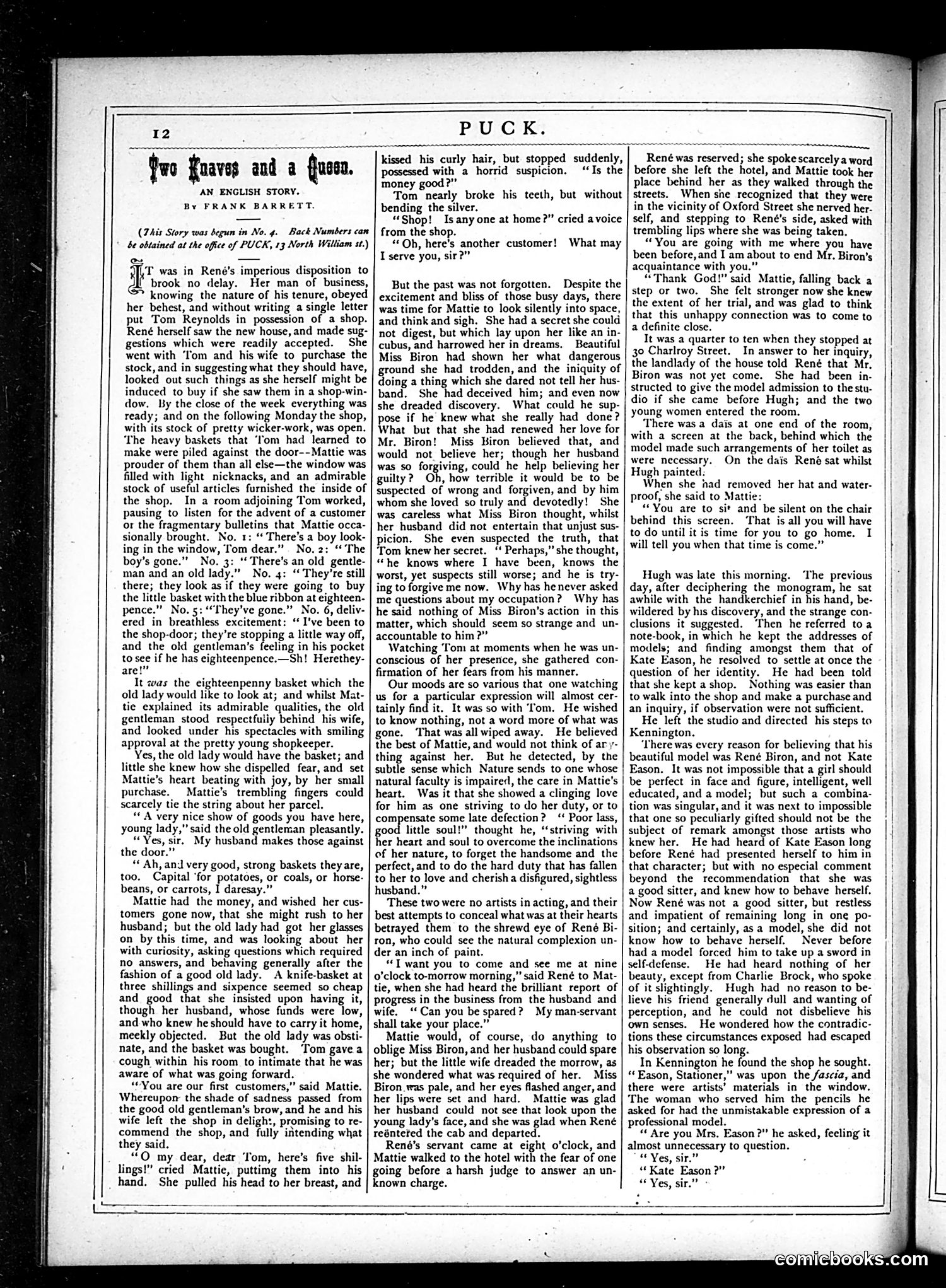
This page contains the continuation of a serialized story titled "Two Knaves and a Queen" by Frank Barrett, not a political cartoon. The narrative follows characters including Mattie, Tom, René, and Miss Hiron in what appears to be a Victorian-era romantic drama involving business dealings and emotional entanglements. The text focuses on personal relationships rather than political satire: a woman (Mattie) struggles with a husband in financial difficulty, while another character (René) harbors romantic feelings. There are discussions of a modeling career and social propriety typical of period fiction. This is **literary content**, not satirical cartooning, making political interpretation inapplicable to this particular page. The magazine Puck did publish satirical cartoons, but this installment is serialized fiction.
📄 Transcribed text from this page (OCR, searchable)
Machine-transcribed from the original scan — historical spelling and the odd misread are preserved.
wo foaves and a ues. AN ENGLISH STORY. By FRANK BARRETT. (This Story was begun in No. 4. Back Numbers can be obtained at the office of PUCK, 13 North William st.) ee — ie was in René’s imperious disposition to brook no delay. Her man of business, knowing the nature of his tenure, obeyed her behest, and without writing a single letter put Tom Reynolds in possession of a shop. René herself saw the new house, and made sug- gestions which were readily accepted. She went with ‘om and his wife to purchase the stock, and in suggesting what they should have, looked out such things as she herself might be induced to buy if she saw them in a shop-win- dow. By the close of the week everything was ready; and on the following Monday the shop, with its stock of pretty wicker-work, was open. ‘The heavy baskets that ‘l'om had learned to make were piled against the door--Mattie was prouder of them than all else—the window was filled with light nicknacks, and an admirable stock of useful articles furnished the inside of the shop. In a room adjoining ‘Tom worked, pausing to listen for the advent of a customer or the fragmentary bulletins that Mattie occa- sionally brought. No. 1: “ There’s a boy look- ing in the window, Tom dear.” No, 2: “The boy’s gone.” No. 3: “There's an old gentle- man and an old lady.” No. 4: ‘ They’re still there; they look as if they were going to buy the little basket with the blue ribbon at eighteen. pence.” No. 5: “They've gone.” No. 6, deliv- ered in breathless excitement: ve been to the shop-door; they’re stopping a little way off, and the old gentieman’s feeling in his pocket to see if he has eighteenpence.—Sh! Herethey- are!” It was the eighteenpenny basket which the old lady would like to look at; and whilst Mat- tie explained its admirable qualities, the old gentleman stood respectfully behind his wife, and looked under his spectacles with smiling approval at the pretty young shopkeeper. Yes, the old lady would have the basket; and little she knew how she dispelled fear, and set Mattie’s heart beating with joy, by her small purchase. Mattie’s trembling fingers could scarcely tie the string about her parcel. “A very nice show of goods you have here, young lady,” said the old gentleman pleasantly. “Yes, sir. My husband makes those against the door.”” “Ah, and very good, strong baskets they are, too. Capital ‘for potatoes, or coals, or horse- beans, or carrots, I daresay.” Mattie had the money, and wished her cus- tomers gone now, that she might rush to her husband; but the old lady had got her glasses on by this time, and was looking about her with curiosity, asking questions which required no answers, and behaving generally after the fashion of a good old lady. A knife-basket at three shillings and sixpence seemed so cheap and good that she insisted upon having it, though her husband, whose funds were low, and.who knew he should have to carry it home, meekly objected. But the old lady was obsti- nate, and the basket was bought. ‘Tom gave a cough within his room to intimate that he was aware of what was going forward. “©You are our first customers,” said Mattie. Whereupon: the shade of sadness passed from the good old gentleman’s brow, and he and his wife left the shop in deligh:, promising to re- commend the shop, and fully intending what they said. “O my dear, dear ‘Tom, here’s five shil- lings!” cried Mattie, puttimg them into his hand. She pulled his head to her breast, and PUCK. kissed his curly hair, but stopped suddenly, possessed with a horrid suspicion. “Is the money good?” . Tom nearly broke his teeth, but without bending the silver. “Shop! Is anyone at home?” cried avoice from the shop. “Oh, here's another customer! I serve you, sir?” What may But the past was not forgotten. Despite the excitement and bliss of those busy days, there was time for Mattie to look silently into space, and think and sigh. She had a secret she could not digest, but which lay upon her like an in- cubus, and harrowed her in dreams. Beautiful Miss Biron had shown her what dangerous ground she had trodden, and the iniquity of doing a thing which she dared not tell her hus- band. She had deceived him; and even now she dreaded discovery. What could he sup- pose if he knew what she really had done? What but that she had renewed her love for Mr. Biron! Miss Biron believed that, and would not believe her; though her husband was so forgiving, could he help believing her guilty? Oh, how terrible it would be to be suspected of wrong and forgiven, and by him whom she loved so truly and devotedly! She was careless what Miss Biron thought, whilst her husband did not entertain that unjust sus- picion. She even suspected the truth, that ‘Tom knew her secret.“ Perhaps,” she thought, “he knows where I have been, knows the worst, yet suspects still worse; and he is try- ing to forgive me now. Why has henever asked me questions about my occupation? Why has he said nothing of Miss Biron’s action in this matter, which should seem so strange and un- accountable to him ?”” Watching ‘Tom at moments when he was un- conscious of her presence, she gathered con- firmation of her fears from his manner. Our moods are so various that one watching us for a particular expression will almost cer- tainly find it. It was so with Tom. He wished to know nothing, not a word more of what was gone. That was all wiped away. He believed the best of Mattie, and would not think of ar y- thing against her. But he detected, by the subtle sense which Nature sends to one whose natural faculty is impaired, the care in Mattie’s heart. Was it that she showed a clinging love for him as one striving to do her duty, or to compensate some late defection? ‘ Poor lass, good little soul!” thought he, “striving with her heart and soul to overcome the inclinations of her nature, to forget the handsome and the perfect, and to do the hard duty that has fallen to her to love and cherish a disfigured, sightless husband.” . These two were no artists in acting, and their best attempts to conceal what was at their hearts betrayed them to the shrewd eye of René Bi- ron, who could see the natural complexion un- der an inch of paint. “T want you to come and see me at nine o'clock to-morrow morning,” said René to Mat- tie, when she had heard the brilliant report of progress in the business from the husband and wife. ‘Can you be spared? My man-servant shall take your place.” Mattie would, of course, do anything to oblige Miss Biron, and her husband could spare her; but the little wife dreaded the morrow, as she wondered what was required of her. Miss Biron was pale, and her eyes flashed anger, and her lips were set and hard. Mattie was glad her husband could not sce that look upon the young lady’s face, and she was glad when René re&nteted the cab and departed. René’s servant came at eight o'clock, and Mattie walked to the hotel with the fear of one going before a harsh judge to answer an un- known charge. pn René was reserved; she spoke scarcely a word before she left the hotel, and Mattie took her place behind her as they walked through the streets. When she recognized that they were in the vicinity of Oxford Street she nerved her- self, and stepping to René’s side, asked with trembling lips where she was being taken, “You are going with me where you have been before, and I am about to end Mr. Biron’s acquaintance with you.” “Thank God!" said Mattie, falling back a step or two. She felt stronger now she knew the extent of her trial, and was glad to think that this unhappy connection was to come to a definite close. It was a quarter to ten when they stopped at 30 Charlroy Street. In answer to her inquiry, the landlady of the house told René that Mr, Biron was not yet come. She had been in- structed to give the model admission to the stu- dio if she came before Hugh; and the two young women entered the room, ‘There was a dais at one end of the room, with a screen at the back, behind which the model made such arrangements of her toilet as were necessary. On the dais René sat whilst Hugh painted: When she had removed her hat and water- proof, she said to Mattie: “You are to sit and be silent on the chair behind this screen. ‘That is all you will have to do until it is time for you to go home. I will tell you when that time is come.” Hugh was late this morning. ‘The previous day, after deciphering the monogram, he sat awhile with the handkerchief in his hand, be- wildered by his discovery, and the strange con- clusions it suggested. ‘Then he referred toa note-book, in which he kept the addresses of models; and finding amongst them that of Kate Eason, he resolved to settle at once the question of her identity. He had been told that she kept a shop. Nothing was easier than to walk into the shop and make a purchase and an inquiry, if observation were not sufficient. He left the studio and directed his steps to Kennington. ‘There was every reason for believing that his beautiful model was René Biron, and not Kate Eason. It was not impossible that a girl should be perfect in face and figure, intelligent, well educated, and a model; but such a combina- tion was singular, and it was next to impossible that one so peculiarly gifted should not be the subject of remark amongst those artists who knew her. He had heard of Kate Eason long before René had presented herself to him in that character; but with no especial comment beyond the recommendation that she was a good sitter, and knew how to behave herself. Now René was not a good sitter, but restless and impatient of remaining long in one po- sition; and certainly, as a model, she did not know how to behave herself. Never before had a model forced him to take up a sword in self-defense. He had heard nothing of her beauty, except from Charlie Brock, who spoke of it slightingly. Hugh had_no reason to be- lieve his friend generally dull and wanting of perception, and he could not disbelieve his own senses. He wondered how the contradic- tions these circumstances exposed had escaped his observation so long. In Kennington he found the shop he sought. “Eason, Stationer,” was upon the fascia, and there were artists’ materials in the window. ‘The woman who served him the pencils he asked for had the unmistakable expression of a professional model. “Are you Mrs. Eason?” he asked, feeling it almost unnecessary to question. “Yes, sir.” “Kate Eason ?” “Yes, sir.”