
Puck, 1877-10-03 · page 3 of 16
Puck — October 3, 1877 — page 3: what you’re looking at
What you’re looking at
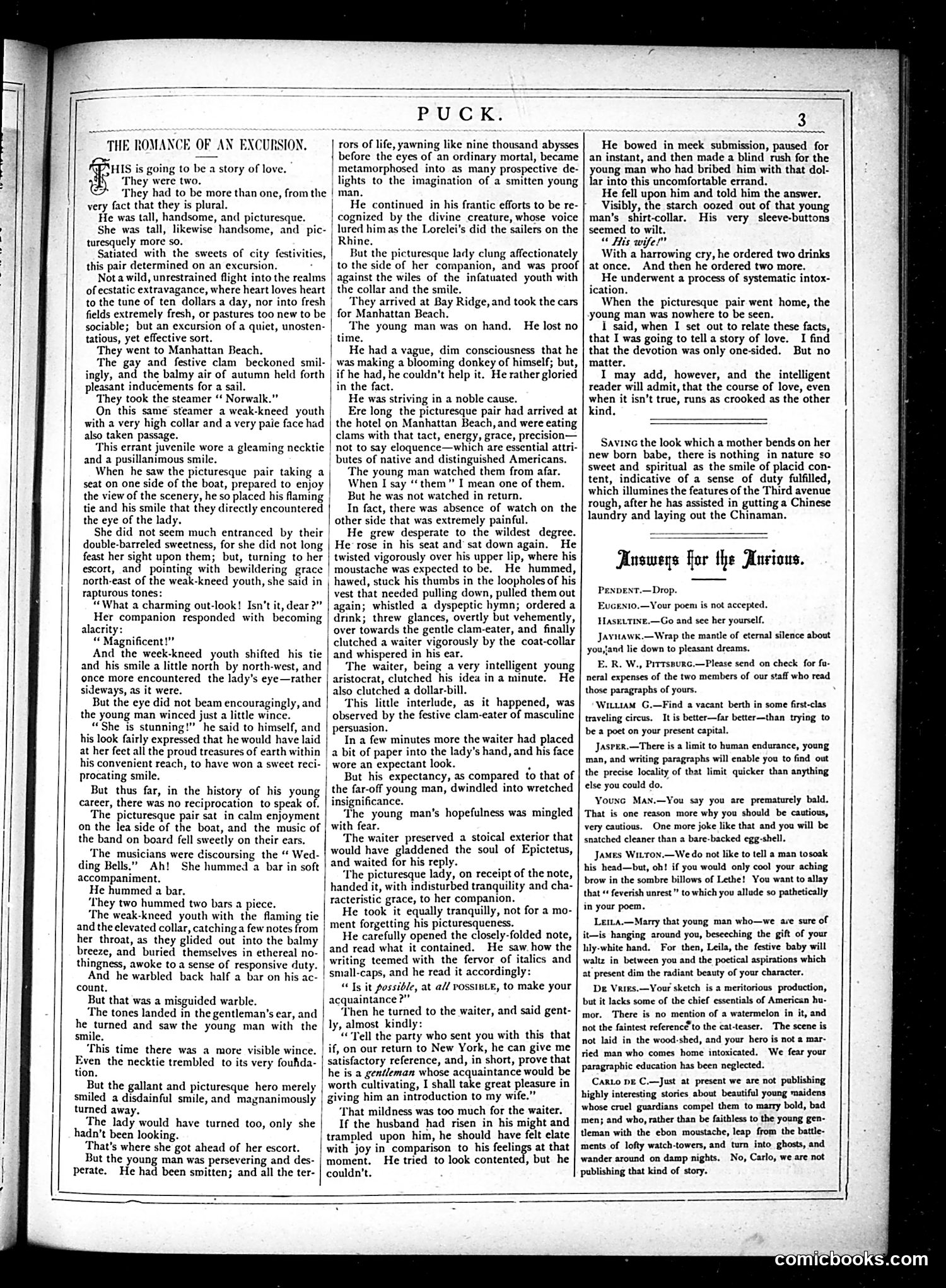
This page from *Puck* contains a short story titled "The Romance of an Excursion," not a political cartoon. The narrative describes a young couple's romantic encounter aboard a steamer to Manhattan Beach. The story is lighthearted fiction focusing on courtship and social interaction rather than political satire. Below the story is a section called "Answers for the Anxious"—an advice column addressing reader questions on various personal matters (employment, love, baldness, writing). The page is primarily **literary content and advice**, not political commentary. While *Puck* was known for satirical cartoons, this particular page lacks the visual caricatures or topical references typical of the magazine's political humor. It represents the miscellaneous entertainment material that filled publication spaces between major satirical pieces.
📄 Transcribed text from this page (OCR, searchable)
Machine-transcribed from the original scan — historical spelling and the odd misread are preserved.
THE ROMANCE OF AN EXCURSION, SFAHIS is going to be a story of love. ‘They were two. They had to be more than one, from the | very fact that they is plural. | He was tall, handsome, and picturesque. | She was tall, likewise handsome, and _pic- turesquely more so. Satiated with the sweets of city festivi this pair determined on an excursion. : Nota wild, unrestrained flight into the realms of ecstatic extravagance, where heart loves heart to the tune of ten dollars a day, nor into fresh | fields extremely fresh, or pastures too new to be | sociable; but an excursion of a quiet, unosten- tatious, yet effective sort. | They went to Manhattan Beach, The gay and festive clam beckoned smil- ingly, and the balmy air of autumn held forth pleasant inducements for a sail. They took the steamer ‘‘ Norwalk.” On this same steamer a weak-kneed youth | with a very high collar and a very paie face had also taken passage. This errant juvenile wore a gleaming necktie and a pusillanimous smile. When he saw the picturesque pair taking a seat on one side of the boat, prepared to enjoy the view of the scenery, he so placed his flaming tie and his smile that they directly encountered the eye of the lady, She did not seem much entranced by their double-barreled sweetness, for she did not long feast her sight upon them; but, turning to her escort, and pointing with bewildering grace north-east of the weak-kneed youth, she said in rapturous tones: “What a charming out-look! Isn’t it, dear?” Her companion responded with becoming | alacrity: “ Magnificent!” And the week-kneed youth shifted his tie and his smile a little north by north-west, and | once more encountered the lady's eye—rather | sideways, as it were. But the eye did not beam encouragingly, and | the young man winced just a little wince. “She is stunning!” he said to himself, and his look fairly expressed that he would have laid at her feet all the proud treasures of earth within his convenient reach, to have won a sweet reci- | procating smile. | But thus far, in the history of his youn career, there was no reciprocation to speak of The picturesque pair sat in calm enjoyment on the lea side of the boat, and the music of the band on board fell sweetly on their ears. _The musicians were discoursing the “ Wed- ding Bells.” Ah! She hummed a bar in soft accompaniment. He hummed a bar. ‘They two hummed two bars a piece. ‘The weak-kneed youth with the flaming tie and the elevated collar, catching a few notes from her throat, as they glided out into the balmy breeze, and buried themselves in ethereal no- thingness, awoke to a sense of responsive duty. And he warbled back half a bar on his ac- | count. But that was a misguided warble. The tones landed in the gentleman's ear, and he turned and saw the young man with the smile. _ This time there was a more visible wince. Even the necktie trembled to its very foufda- ion. But the gallant and picturesque hero merely smiled a disdainful smile, and magnanimously turned away. The lady would have turned too, only she hadn’t been looking. That's where she got ahead of her escort. But the young man was persevering and des- eS, Perate. He had been smitten; and all the ter- PAU CK rors of life, yawning like nine thousand abysses before the eyes of an ordinary mortal, became | metamorphosed into as many prospective de- lights to the imagination of a smitten young man. He continued in his frantic efforts to be re- cognized by the divine creature, whose voice lured himas the Lorelei’s did the sailers on the Rhine. But the picturesque lady clung affectionately to the side of her companion, and was proof against the wiles of the infatuated youth with | the collar and the smile. They arrived at Bay Ridge, and took the cars for Manhattan Beach. _ The young man was on hand. He lost no time. He had a vague, dim consciousness that he was making a blooming donkey of himself; but, if he had, he couldn't Relp it. He rather gloried in the fact. He was striving in a noble cause. Ere long the picturesque pair had arrived at the hotel on Manhattan Beach, and were eating clams with that tact, energy, grace, precision— not to say eloquence—which are essential attri- butes of native and distinguished Americans. The young man watched them from afar. When I say “‘ them” I mean one of them. But he was not watched in return, In fact, there was absence of watch on the other side that was extremely painful. He grew desperate to the wildest degree. He rose in his seat and’ sat down again. He twisted vigorously over his upper lip, where his moustache was expected to be. He hummed, hawed, stuck his thumbs in the loopholes of his vest that needed pulling down, pulled them out again; whistled a dyspeptic hymn; ordered a drink; threw glances, overtly but vehemently, over towards the gentle clam-eater, and finally clutched a waiter vigorously by the coat-collar and whispered in his ear. The waiter, being a very intelligent young aristocrat, clutched his idea ina minute. He also clutched a dollar-bill. ‘This little interlude, as it happened, was observed by the festive clam-eater of masculine persuasion. In a few minutes more the waiter had placed a bit of paper into the lady's hand, and his face wore an expectant look. . But his expectancy, as compared to that of the far-off young man, dwindled into wretched insignificance. The young man’s hopefulness was mingled with fear. The waiter preserved a stoical exterior that would have gladdened the soul of Epictetus, and waited for his reply. ‘The picturesque lady, on receipt of the note, handed it, with indisturbed tranquility and cha- racteristic grace, to her companion. He took it equally tranquilly, not for a mo- ment forgetting his picturesqueness. He carefully opened the closely-folded note, and read what it contained. He saw. how the writing teemed with the fervor of italics and small-caps, and he read it accordingly: “Ts it possible, at a// possiBLe, to make your acquaintance ?”" ‘Then he turned to the waiter, and said gent- ly, almost kindly: : “Tell the party who sent you with this that if, on our return to New York, he can give me satisfactory reference, and, in short, prove that he is a gentleman whose acquaintance would be worth cultivating, I shall take great pleasure in giving him an introduction to my wife.” ‘That mildness was too much for the waiter. If the husband had risen in his might and j trampled upon him, he should have felt elate with joy in comparison to his feelings at that moment. He tried to look contented, but he couldn’t. He bowed in meek submission, paused for an instant, and then made a blind rush for the young man who had bribed him with that dol- ir into this uncomfortable errand. He fell upon him and told him the answer. Visibly, the starch oozed out of that young man’s shirt-collar. His very sleeve-buttons seemed to wilt. “ His wife With a harrowing cry, he ordered two drinks at once. And then he ordered two more. _ He underwent a process of systematic intox- ication. When the picturesque pair went home, the young man was nowhere to be seen. 1 said, when I set out to relate these facts, that I was going to tell a story of love. I find that the devotion was only one-sided. But no matter. I may add, however, and the intelligent reader will admit, that the course of love, even men it isn’t true, runs as crooked as the other ind. Savinc the look which a mother bends on her new born babe, there is nothing in nature so sweet and spiritual as the smile of placid con- tent, indicative of a sense of duty fulfilled, which illumines the features of the Third avenue rough, after he has assisted in gutting a Chinese laundry and laying out the Chinaman. Answers for the Anrious. DENT.—Drop. N10.—Your poem is not accepted. HAsEvtine.—Go and see her yourself. Javawk.—Wrap the mantle of eternal silence about you,tand lie down to pleasant dreams. E. R. W., Prrtspurc.—Please send on check for fa- neral expenses of the two members of our staff who read those paragraphs of yours. : Wituiam G.—Find a vacant berth in some first-clas traveling circus. It is better—far better—than trying to be a poet on your present capital. JasreR.—There is a limit to human endurance, young man, and writing paragraphs will enable you to find out the precise locality of that limit quicker than anything else you could do. Younc MAN.—You say you are prematurely bald. That is one reason more why you should be cautious, very cautious. One more joke like that and you will be snatched cleaner than a bare-backed egg-shell. James Wi:tox.—We do not like to tell a man tosoak his head—but, oh! if you would only cool your aching brow in the sombre billows of Lethe! You want to allay that «feverish unrest ” to which you allude so pathetically in your poem. Letta.—Mary that young man who—we are sure of itis hanging around you, beseeching the gift of your hly-white hand. For then, Leila, the festive baby will waltz in between you and the poetical aspirations which at present dim the radiant beauty of your character. De Vairs.—Your sketch is a meritorious production, but it lacks some of the chief essentials of American hu- mor. There is no mention of a watermelon in it, and not the faintest referencé'to the cat-teaser. The scene is not laid in the wood-shed, and your hero is not a mar- ried man who comes home intoxicated. We fear your paragraphic education has been neglected. Canto ne C.—Just at present we are not publishing highly interesting stories about beautiful young maidens whose cruel guardians compel them to marry bold, bad men; and who, rather than be faithless to the young gen- tleman with the ebon moustache, leap from the battle- ments of lofty watch-towers, and turn into ghosts, and wander around on damp nights. No, Carlo, we are not publishing that kind of story.