
Puck, 1877-10-03 · page 7 of 16
Puck — October 3, 1877 — page 7: what you’re looking at
What you’re looking at
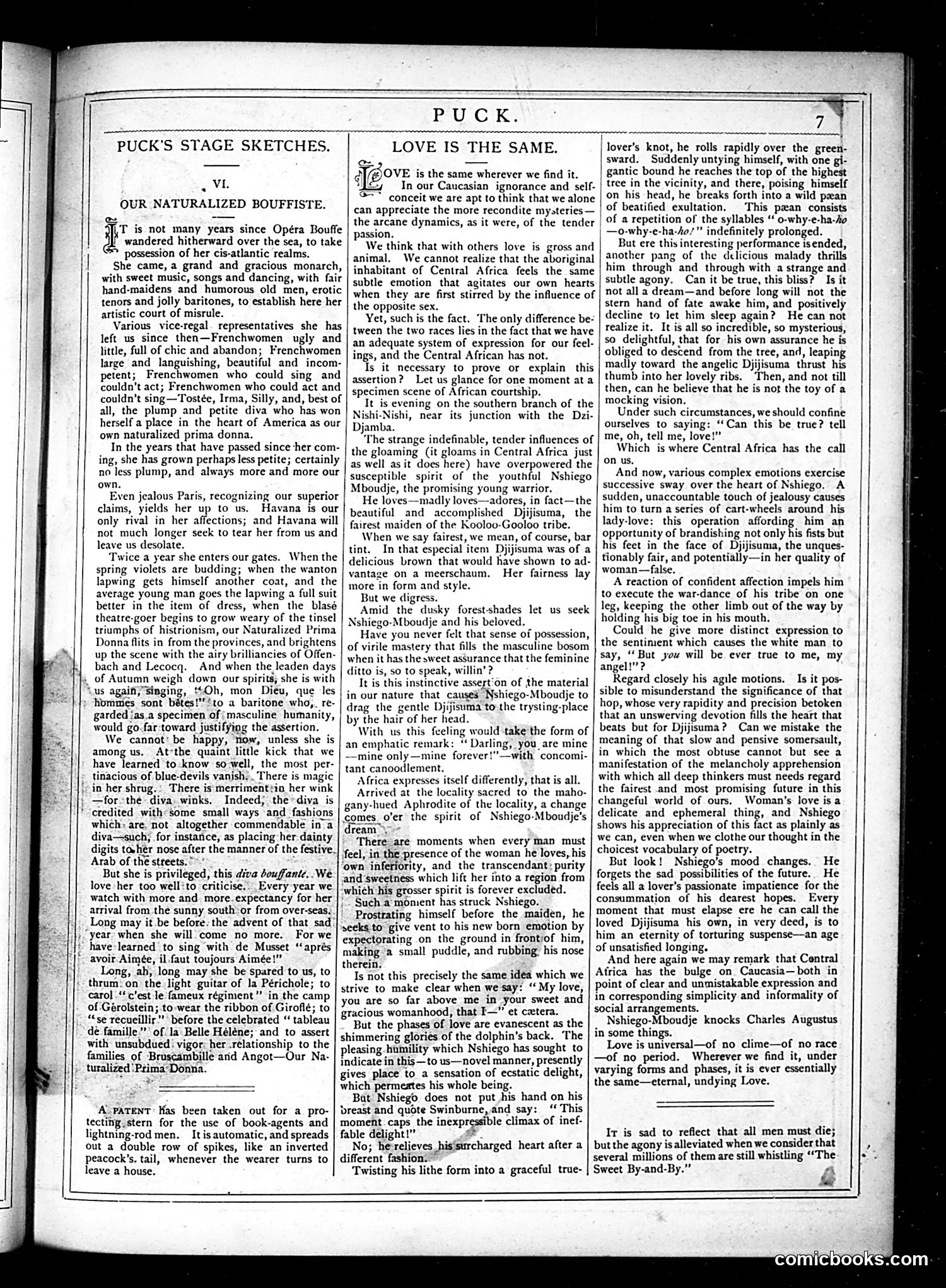
This page contains two distinct pieces: **Left column:** "Our Naturalized Bouffiste" (Stage Sketches VI) - A theatrical critique mocking the pretensions of naturalized French performers in American opera houses. The author sarcastically praises their "artistic court of mischief," satirizing how European performers were celebrated despite mediocre talents. The piece names specific performers (Tooste, Irma, Silly) and pokes fun at their artistic pretensions and accents. **Right column:** "Love Is The Same" - An essay arguing that love transcends racial and cultural boundaries, using Central African courtship rituals as examples. It defends the emotional validity of African peoples against contemporary dismissive attitudes, comparing African expressions of love to European ones to argue their essential equivalence. The juxtaposition suggests Puck's mixed editorial positions on cultural hierarchies and authenticity.
📄 Transcribed text from this page (OCR, searchable)
Machine-transcribed from the original scan — historical spelling and the odd misread are preserved.
PUCK. PUCK’S STAGE SKETCHES. Vi. OUR NATURALIZED BOUFFISTE. cs ee a is not many years since Opéra Bouffe j wandered hitherward over the sea, to take possession of her cis-atlantic realms. She came, a grand and gracious monarch, with sweet music, songs and dancing, with fair hand-maidens and humorous old men, erotic tenors and jolly baritones, to establish here her artistic court of misrule. Various vice-regal representatives she has left us since then—Frenchwomen ugly and little, full of chic and abandon; Frenchwomen large and languishing, beautiful and incom- tent; Frenchwomen who could sing and couldn’t act; Frenchwomen who could act and couldn't sing—Tostée, Irma, Silly, and, best of all, the plump and petite diva who has won herself a place in the heart of America as our own naturalized prima donna. In the years that have passed since her com- ing, she has grown perhaps less petite; certainly no less plump, and always more and more our own. Even jealous Paris, recognizing our superior claims, yields her up to us. Havana is our only rival in her affections; and Havana will not much longer seck to tear her from us and leave us desolate. Twice a year she enters our gates. When the spring violets are budding; when the wanton lapwing gets himself another coat, and the average young man goes the lapwing a full suit better in the item of dress, when the blasé theatre-goer begins to grow weary of the tinsel triumphs of histrionism, our Naturalized Prima Donna flits in from the provinces, and brightens up the scene with the airy brilliancies of Offen- bach and Lecocq. And when the leaden days . of Autumn weigh down our spirits; she is with Sus agaify"Singing, Oh, mon Dieu, que les jommes sont bétes!’’*to a baritone who,. re- garded ‘as.a specimen of masculine humanity, would go.far:toward justifying the assertion. We cannot: happy, now, unless she is among us. At-the quaint little kick that we have learned to-know so well, the most per- tinacious of blue-devils vanish; There is magic ‘vin her shrug.’ There is merrimenttia her wink | —for-the diva. winks. Indeed; the’ diva is “credited with some small ways and fashions which: are, not altogether commendable ina diva—such; for instance, as placing-her dainty digits taher nose after the manner of the festive. Arab of the streets. >" i But she is privileged, this diva bouffante..Wé love -her too wellto criticise... Every year we watch with more and more.expectancy for her arrival from the sunny south: or from over-seas. Long may it be before. the advent of that sad year when she will.come no more. For we '}) have-learned to sing with de Musset ‘‘aprés avoir Aimée, il faut toujours Aimée!” Long, ah, long may she be spared to us, to thrum:on the light guitar of la Périchole; to carol ‘c'est le fameux régiment” in the camp of Gerolstein; to-wear the ribbon of Giroflé; to “se recueillir”” before the celebrated “ tableau de famille””’ of. la Belle Héléne; and to assert with unsubdued: vigor: her -relationship to the families of Bruscambille and Angot—Our Na- ) turalized‘Prima-Donna. A-PATENT’ Has been taken out for a pro- tecting.stern for the use of book-agents and lightning-rod men, It is automatic, and spreads out a double row of spikes, like an inverted peacock’s. tail, whenever the wearer turns to leave a house. LOVE IS THE SAME. e ee Q]@OVE is the same wherever we find it. ‘P<, In our Caucasian ignorance and self- | S* conceit we are apt to think that we alone can appreciate the more recondite mysteries — the arcane dynamics, as it were, of the tender passion. We think that with others love is gross and animal. We cannot realize that the aboriginal inhabitant of Central Africa feels the same subtle emotion that agitates our own hearts when they are first stirred by the influence of the opposite sex. Yet, such is the fact. The only difference be- tween the two races lies in the fact that we have an adequate system of expression for our feel- ings, and the Central African has not. Is it necessary to prove or explain this assertion? Let us glance for one moment at a specimen scene of African courtship. It is evening on the southern branch of the Nishi-Nishi, near its junction with the Dzi- Djamba. ‘The strange indefinable, tender influences of the gloaming (it gloams in Central Africa just as well as it does here) have overpowered the susceptible spirit of the youthful Nshiego Mboudje, the promising young warrior. He loves—madly loves—adores, in fact—the beautiful and accomplished Djijisuma, the fairest maiden of the Kooloo-Gooloo tribe. When we say fairest, we mean, of course, bar tint. In that especial item Djijisuma was of a delicious brown that would have shown to ad- vantage on a meerschaum. Her fairness lay more in form and style. But we digress. Amid the dusky forest-shades let us seek Nshiego-Mboudje and his beloved. Have you never felt that sense of possession, of virile mastery that fills the masculine bosom when it has the sweet assurance that the feminine ditto is, so to speak, willin’? It is this instinctive assest‘on of the material in our nature that cause’ Nshiego-Mboudje to drag the gentle Djijisuma to the trysting-place by the hair of her head. With us this feeling would take the form of an emphatic remark: “ Darling, you, are mine —mine only—mine forever!"—with ‘concomi- tant canoodlement. Africa expresses itself differently, that is all. Arrived at the locality sacred to the maho- gany-hued Aphrodite of the locality, a change o'er the spirit of Nshiego-Mboudje’s ‘There-are moments when every man must feel, in the presence of the woman he loves, his ‘own inferiority, and the transcendant: purity and sweetness which lift her into a region from which his grosser spirit is forever excluded. Such a moment has struck Nshiego. Prostrating himself before the maiden, he seeks to give vent to his new born emotion by expectorating on the ground in frontiof him, making’a small puddle, and rubbing. his nose therein. Is not this precisely the same idea which we strive to make clear when we say: ‘My love, you are so far above me in your sweet and gracious womanhood, that I—” et cattera. But the phases of love are evanescent as the shimmering glories of the dolphin’s back. The leasing humility which Nshiego has sought to indicate in this—to us—novel manner, presently gives place to a sensation of ecstatic delight, which permeates his whole being. ; Bat Nshiego does not put his hand on his breast and quote Swinburne, and say: ‘ This moment. caps the inexpressible climax of inef- fable delight!” bad No; he relieves his'surcharged heart after a different fashion: Twisting his lithe form into a graceful true- me, oh, tell me, love! successive sway over the heart of Nshiego. sudden, unaccountable touch of jealousy causes him to turn a series of cart-wheels around his lady-love: this operation affording him an opportunity of brandishin his feet in the face of Dj tionably fair, and potentially—in her quality of woman—false. forgets the sad possibilities of the future. feels all a lover's passionate impatience for the consummation of his dearest hopes. Every moment that must elapse ere he can call the loved Djijisuma his own, in very deed, is to him an eternity of torturing suspense—an age of unsatisfied longing, —of no period. n varying forms and phases, it is ever essentially the same—eternal, undying Love. 7 lover's knot, he rolls rapidly over the green- sward. Suddenly untying himself, with one gi- gantic bound he reaches the top of the highest tree in the vicinity, and there, poising himself on his head, he breaks forth into a wild pan of beatified exultation. of a repetition of the syllables “ o-why-e-ha-ho | —o-why-e-ha-ho/” indefinitely prolonged. This pzan consists But ere this interesting performance isended, another pang of the delicious malady thrills him through and through with a strange and subtle agony. Can it be true, this bliss? Is it not all a dream—and before long will not the stern hand of fate awake him, and positively decline to let him sleep again? He can not realize it. It is all so incredible, so mysterious, so delightful, that for his own assurance he is obliged to descend from th madly toward the angelic Dj thumb into her lovely ribs. then, can he believe that he is not the toy of a mocking vision. ee, and, leaping uma thrust his Then, and not till Under such circumstances, we should confine ourselves to saying: “Can this be true? tell Which is where Central Africa has the call on us, And now, various complex emotions exercise A it only his fists but uma, the unques- A reaction of confident affection impels him to execute the war-dance of his tribe on one leg, keeping the other limb out of the way by holding his big toe in his mouth. Could he give more distinct expression to the sentiment which causes the white man to say, “But you will be ever true to me, my angel!” ? Regard closely his agile motions. _Is it pos- sible to misunderstand the significance of that hop, whose very rapidity and precision betoken that an unswervii beats but for meaning of that slow and pensive somersault, in which the most obtuse cannot but see a manifestation of the melancholy apprehension with which all deep thinkers must needs regard the fairest and most promising future in this changeful world of ours. delicate and ephemeral thing, shows his appreciation of this fee we can, even when we clothe our thought in the choicest vocabulary of poetry. devotion fills the heart that uma? Can we mistake the Woman's love is a and Nshiego tas plainly as Nshiego’s mood changes. He But look! He And here again we may remark that Contral Africa has the bulge on. Caucasia—both in point of clear and un n in corresponding simplicity and informality of social arrangements. akable expression and Nshiego-Mboudje knocks Charles Augustus in some things. Love is universal—of no clime—of no race Wherever we find it, under Ir is sad to reflect that all men must die; but the agony is alleviated when we consider that several millions of them are still whistling “The Sweet By-and-By.”