
Puck, 1877-10-03 · page 10 of 16
Puck — October 3, 1877 — page 10: what you’re looking at
What you’re looking at
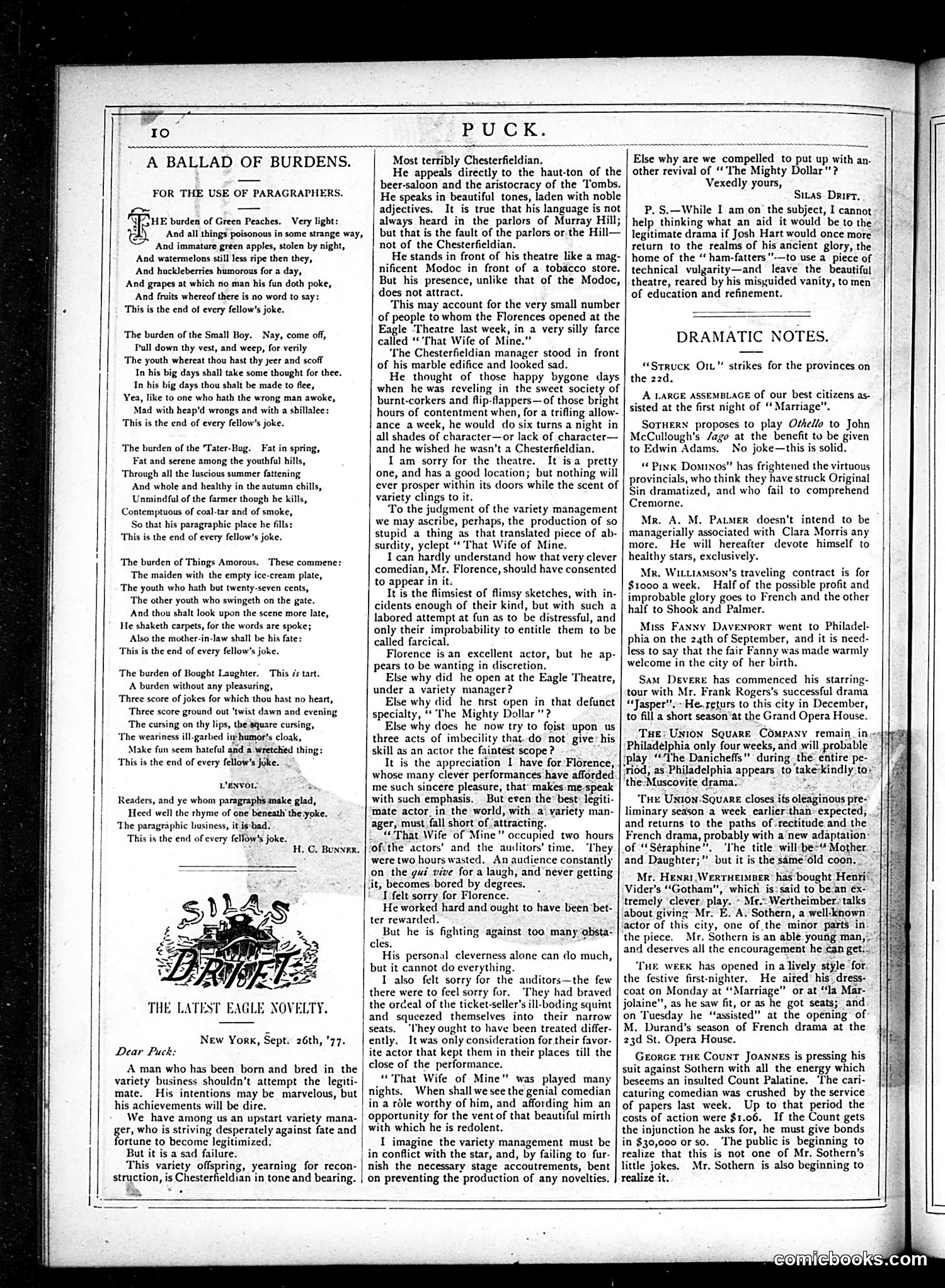
This page contains primarily **theatrical criticism and drama notes**, not political cartoons. The main content is "A Ballad of Burdens" — a satirical poem mocking various social types and their complaints, written "for the use of paragraphers." The "Dramatic Notes" section critiques recent theater productions and performers, particularly attacking the Chesterfieldian (pretentious, affected) style of a theater manager who opened a show called "That Wife of Mine" at the Eagle Theatre. The satire targets his pompous management, poor taste, and the production's failure—despite featuring a clever comedian (Mr. Florence), the play itself was dull and the manager's pretensions undermined the performers. The small illustration at bottom appears to be **"The Latest Eagle Novelty"** — likely a decorative emblem rather than satirical content.
📄 Transcribed text from this page (OCR, searchable)
Machine-transcribed from the original scan — historical spelling and the odd misread are preserved.
wae A BALLAD OF BURDENS. FOR THE USE OF PARAGRAPHERS. ee burden of Green Peaches. Very light: rey And all things poisonous in some strange way, And immature green apples, stolen by night, ‘And watermelons still less ripe then they, And huckleberries humorous for a day, And grapes at which no man his fun doth poke, And fruits whereof there is no word to say: This is the end of every fellow’s joke. ‘The burden of the Small Boy. Nay, come off, Pull down thy vest, and weep, for verily ‘The youth whereat thou hast thy jeer and scoff In his big days shall take some thought for thee. In his big days thou shalt be made to flee, Yea, like to one who hath the wrong man awoke, Mad with heap'd wrongs and with a shillalee: This is the end of every fellow’s joke. ‘The burden of the "Tater-Bug. Fat in spring, Fat and serene among the youthful hills, ‘Through all the luscious summer fattening And whole and healthy in the autumn chills, Unmindful of the farmer though he kills, Contemptuous of coal-tar and of smoke, So that his paragraphic place he fills: This is the end of every fellow’s joke. The burden of Things Amorous. ‘These commene: The maiden with the empty ice-cream plate, The youth who hath but twenty-seven cents, ‘The other youth who swingeth on the gate. And thou shalt look upon the scene more late, He shaketh carpets, for the words are spoke} Also the mother-in-law shall be his fate: This is the end of every fellows joke. The burden of Bought Laughter. This is tart. A burden without any pleasuring, Three score of jokes for which thou hast no heart, Three score ground out 'twixt dawn and evening The cursing on thy lips, thesquare cursing, The weariness ill-garbed in-humor’s cloak, Make fun seem hateful and a wretehied thing: This is the end of every fellow’s joke. LIENVOL > Readers, and ye whom paragraphs make glad, Heed well the rhyme of one beneath the:yoke. ‘The paragriphic business, it is-bad. This is the end of every fellow's joke. H. C. Bunyrr. THE LATEST EAGLE NOVELTY. New York, Sept. 26th, ’77. Dear Puck: A man who has been born and bred in the | variety business shouldn’t attempt the legiti- mate. is intentions may be marvelous, but his achievements will be dire. We have among us an upstart variety mana- er, who is striving desperately against fate and fortune to become legitimized. But it is a sad failure. This variety offspring, yearning for recon- | struction, is Chesterfieldian in tone and bearing. | PUCK. Most terribly Chesterfieldian. He appeals directly to the haut-ton of the beer-saloon and the aristocracy of the Tombs. He speaks in beautiful tones, laden with noble adjectives. It is true that his language is not always heard in the parlors of Murray Hill; but that is the fault of the parlors or the Hill— not of the Chesterfieldian. He stands in front of his theatre like a mag- nificent Modoc in front of a tobacco store. But his presence, unlike that of the Modoc, does not attract. ‘This may account for the very small number of people to whom the Florences opened at the Eagle ‘Theatre last week, in a very silly farce called “That Wife of Mine.” ‘The Chesterfieldian manager stood in front of his marble edifice and looked sad. He thought of those happy bygone days when he was reveling in the sweet society of burnt-corkers and flip-flappers—of those bright hours of contentment when, for a trifling allow- ance a week, he would do six turns a night in all shades of character—or lack of character— and he wished he wasn’t a Chesterfieldian. I am sorry for the theatre. It isa pretty one, and has a good location; but nothing will ever prosper within its doors while the scent of variety clings to it. To the judgment of the variety management we may ascribe, perhaps, the production of so stupid a thing as that translated piece of ab- surdity, yclept “That Wife of Mine. I can hardly understand how that very clever comedian, Mr. Florence, should have consented to appear in it. It is the flimsiest of flimsy sketches, with in- cidents enough of their kind, but with such a labored attempt at fun as to be distressful, and only their improbability to entitle them to be called farcical. Florence is an excellent actor, but he ap- pears to be wanting in discretion. Else why did he open at the Eagle Theatre, under a variety manager? Else why did he hrst open in that defunct specialty, * The Mighty Dollar”? Else why does he now try to foist upon us three acts of imbecility that. do not’ give: his skill as an actor the faintest scope ? It is the appreciation 1 have for’Florence, whose many clever performances have afforded me such sincere pleasure, that’ makes me-speak with such emphasis. But even the® best) legiti- mate actor, in the world, with. a; yariety man- ager, must fall short of ‘attracting. “That Wife of Mine” occupied two hours ofthe actors’ and the auditors’ time. ‘They were two hours wasted. An audience constantly on the gui vive for a laugh, and never getting Jit, becomes bored by degrees. I felt sorry for Florence. He worked hard and ought to have been bet- ter rewarded. But he is fighting against too many obsta- | cles. His personal cleverness alone can do much, but it cannot do everything. I also felt sorry for the auditors—the few there were to feel sorry for. ‘They had braved the ordeal of the ticket-seller’s ill-boding squint | and squcezed themselves into their narrow seats. ‘They ought to have been treated differ- ently. It was only consideration for their favor- ite actor that kept them in their places till the close of the performance. “That Wife of Mine” was played many nights. When shall we see the genial comedian in a role worthy of him, and affording him an opportunity for the vent of that beautiful mirth with which he is redolent. I imagine the variety management must be in conflict with the star, and, by failing to fur- nish the necessary stage accoutrements, bent on preventing the production of any novelties, Else why are we compelled to put up with an. other revival of ‘he Mighty Dollar"? Vexedly yours, Sitas. Drier. P. S.—While I am on the subject, I cannot help thinking what an aid it would be to the legitimate drama if Josh Hart would once more return to the realms of his ancient glory, the home of the ‘ ham-fatters"-—to use a piece of technical vulgarity—and leave the beautiful theatre, reared by his misyuided vanity, to men of education and refinement. DRAMATIC NOTES, “Struck O1L” strikes for the provinces on the 22d. A LARGE ASSEMBLAGE of our best ci sisted at the first night of ‘ Marriage”. SoTHERN proposes to play Othello to John McCullough's /ago at the benefit to be given to Edwin Adams. No joke—this is solid. “Pink Dontnos” has frightened the virtuous provincials, who think they have struck Original Sin dramatized, and who fail to comprehend Cremorne. Mr. A. M. Patmer doesn’t intend to be managerially associated with Clara Morris any more. He will hereafter devote himself to healthy stars, exclusively. Mr. WILLIAMson’s traveling contract is for $1000 a week. Half of the possible profit and improbable glory goes to French and the other half to Shook and Palmer. Miss Fanny Davenport went to Philadel- phia on the 24th of September, and it is need- less to say that the fair Fanny was made warmly welcome in the city of her birth. Sam Devere has commenced his starring- tour with Mr. Frank Rogers's successful drama “Jas > He. returs to this city in December, to fill a short seasonat the Grand Opera House. Tue: Union Square Company remain. in Philadélphia only four weeks, and will probable play ‘The Danicheffs” during the entire pe- riod, as Philadelphia appears to take-kindly to» the:-Muscovite drama. ‘ Tue Unton-Square closes its oleaginous pre- liminary season a week carlier‘than: expected, and returns to the paths of rectitude and the French drama, probably with a new adaptation: of ‘*Séraphine”. ‘I'he title willbe? Mother. _|) and Daughter;” but it is the same’6ld coon. - Mr. Henri, WerrHeIMBER: has bought Hen! Vider’s “Gotham”, which is:said to be/an €x- tremely ‘clever. play. » Mc. Wertheimber: talks about giving Mr. E. A. Sothern, a well-known actor of this city, one of the minor parts in the piece. Mr. Sothern is an able. young man, and deserves all the encouragement he can get... ‘rue weex has opened ina lively style ‘for. the festive first-nighter. He aited’ his. dress- coat on Monday at ‘‘Marriage” or at “la Mar- jolaine”, as he saw fit, or as he got seats; and on Tuesday he “assisted” at the opening of M. Durand’s season of French drama at the 23d St. Opera House. GeorcE THE Count Joannes is pressing his suit against Sothern with all the energy which beseems an insulted Count Palatine. ‘The cari- caturing comedian was crushed by the service of papers last week. Up to that period the costs of action were $1.06. If the Count gets the injunction he asks for, he must give bonds in $30,000 or so. ‘The public is beginning to realize that this is not one of Mr. Sothern’s little jokes. Mr. Sothern is also beginning to realize it.