
A complete issue · 40 pages · 1928
Life — October 26, 1928
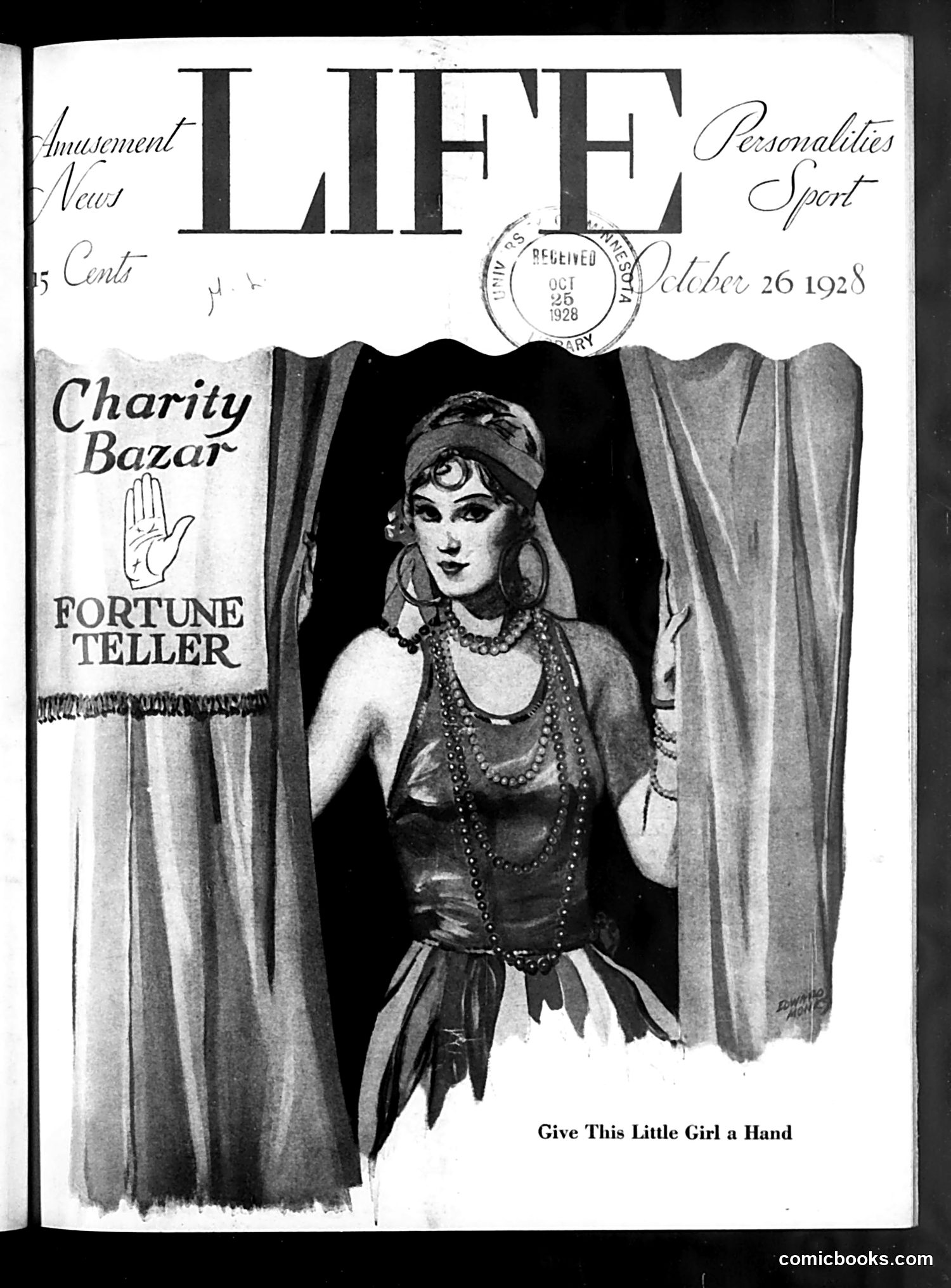
This is primarily a **cover advertisement for a charity bazaar**, not political satire. The main image depicts a woman dressed as a fortune teller—complete with headwrap, beaded costume, and dramatic makeup—positioned in a fortune teller's booth with curtains. The advertisement promotes a "Charity Bazar Fortune Teller" attraction, with the caption "Give This Little Girl a Hand," appealing to readers to support the charitable cause. The satire is gentle: the exoticized, theatrical fortune-teller costume stereotypes mystical practitioners common in 1920s entertainment. The phrase "Give This Little Girl a Hand" uses emotional appeal typical of charity fundraising advertising from this era. The page also indicates standard Life magazine sections: Amusement News, Personalities, and Sport.
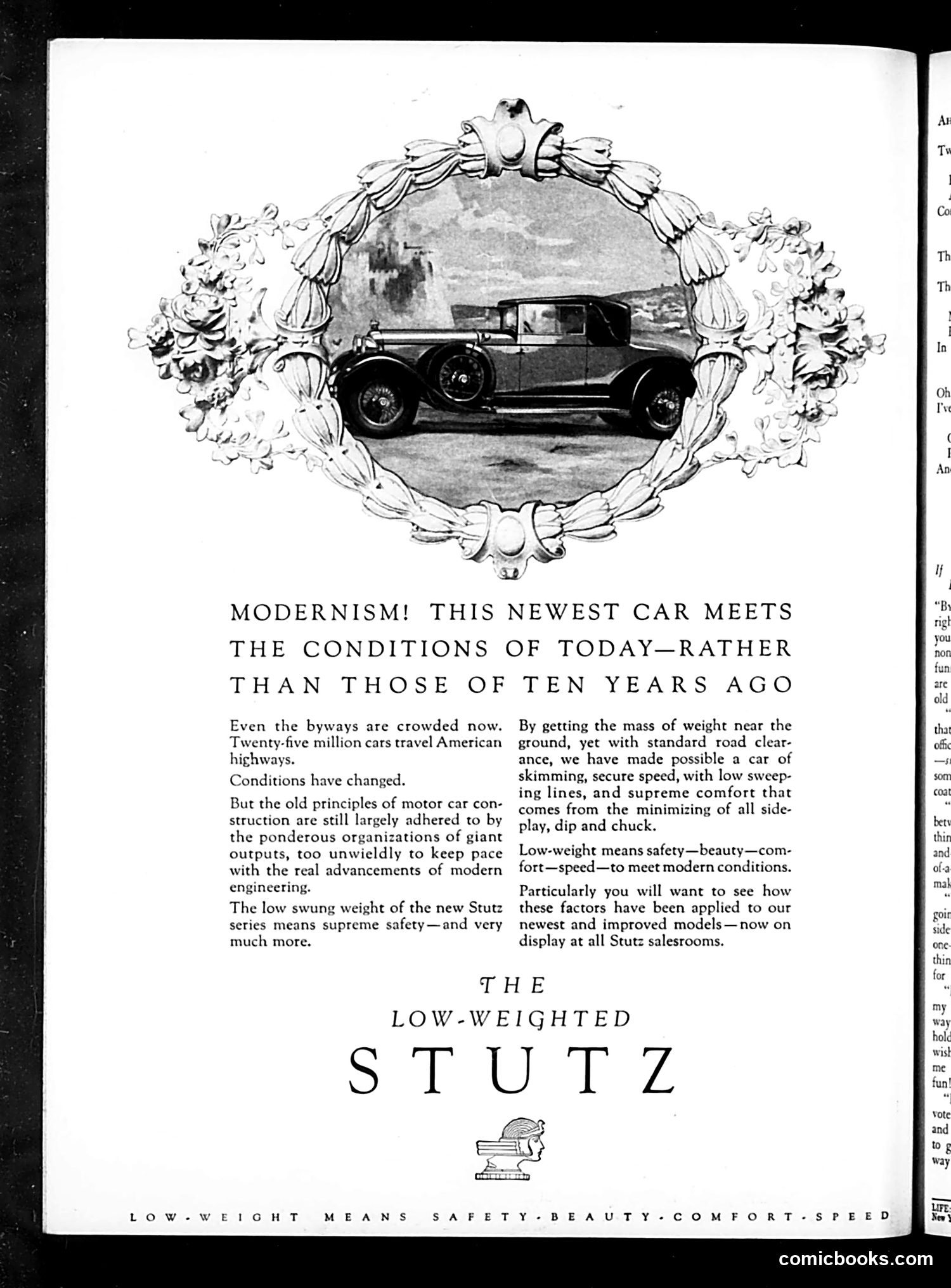
This is **not a political cartoon but a Stutz automobile advertisement** from Life magazine's heyday as a humor and lifestyle publication. The ad argues that Stutz cars represent "modernism" by meeting contemporary conditions (crowded highways, modern engineering demands) rather than outdated designs. The ornate decorative frame ironically contrasts classical, old-fashioned styling with the car's modern features—a visual joke about modernism itself. Key selling points emphasized: low weight equals safety, beauty, comfort, and speed. The ad targets affluent readers by positioning Stutz as the intelligent choice for drivers navigating 1920s America's changing infrastructure and traffic conditions. The page demonstrates how Life blended satirical humor with high-end advertising to wealthy audiences.
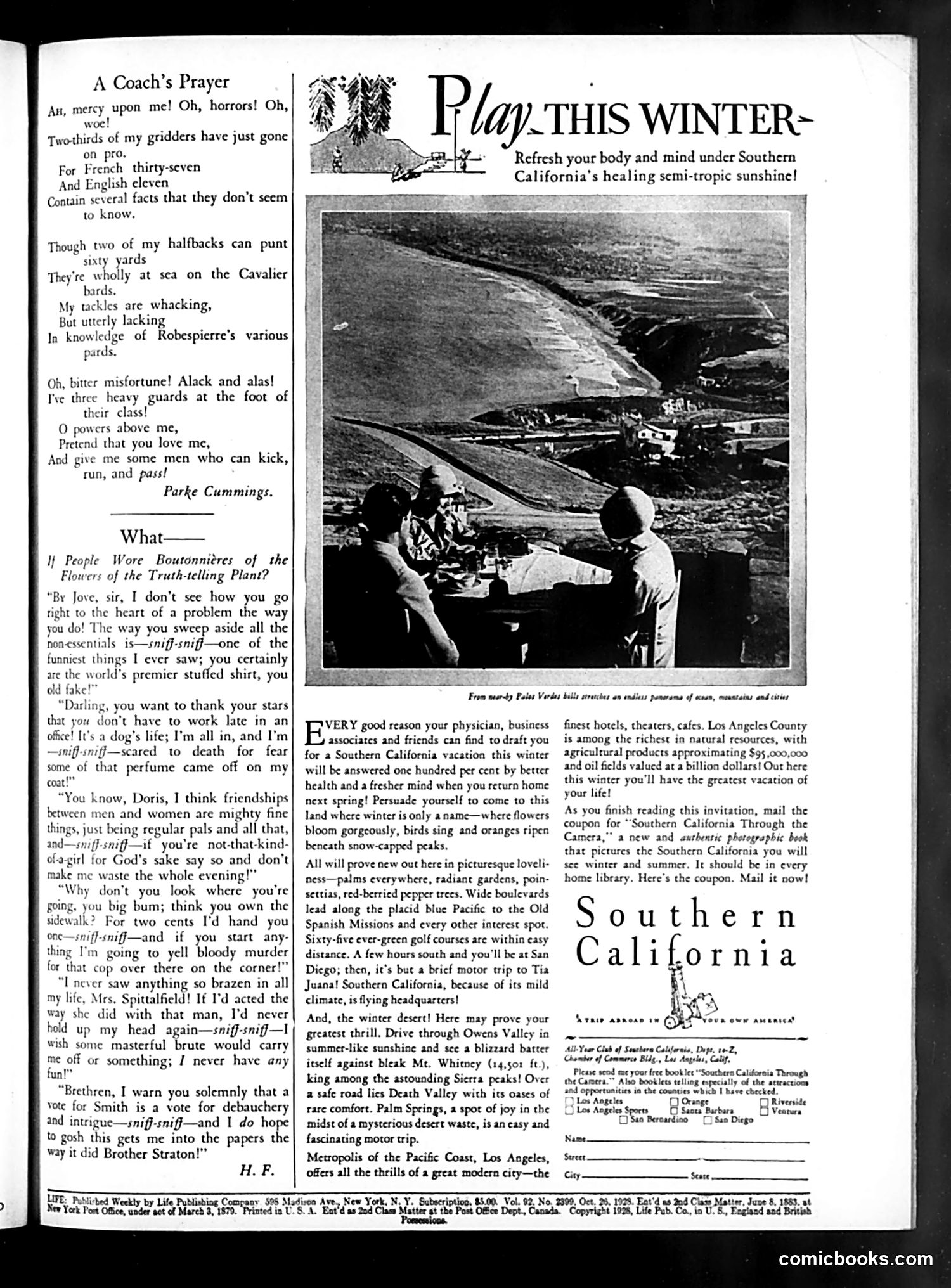
This page contains two distinct elements: **"A Coach's Prayer"** (left): A humorous poem by Parke Cummings lamenting a football coach's troubles—poor tackling, weak guards, and players lacking knowledge of plays. The satirical prayer asks divine intervention for "men who can kick, run, and pass." It's gentle sports satire targeting coaching frustrations of the era. **"Play This Winter"** (right): A Southern California tourism advertisement disguised as editorial content, promoting winter vacations. The large photograph shows tourists in a desert landscape. The accompanying text encourages readers to visit for health benefits and recreation—golf courses, desert drives, missions—positioning Southern California as an ideal winter escape for wealthy easterners. The page illustrates Life magazine's mixed editorial-advertising format typical of early 20th-century publications.
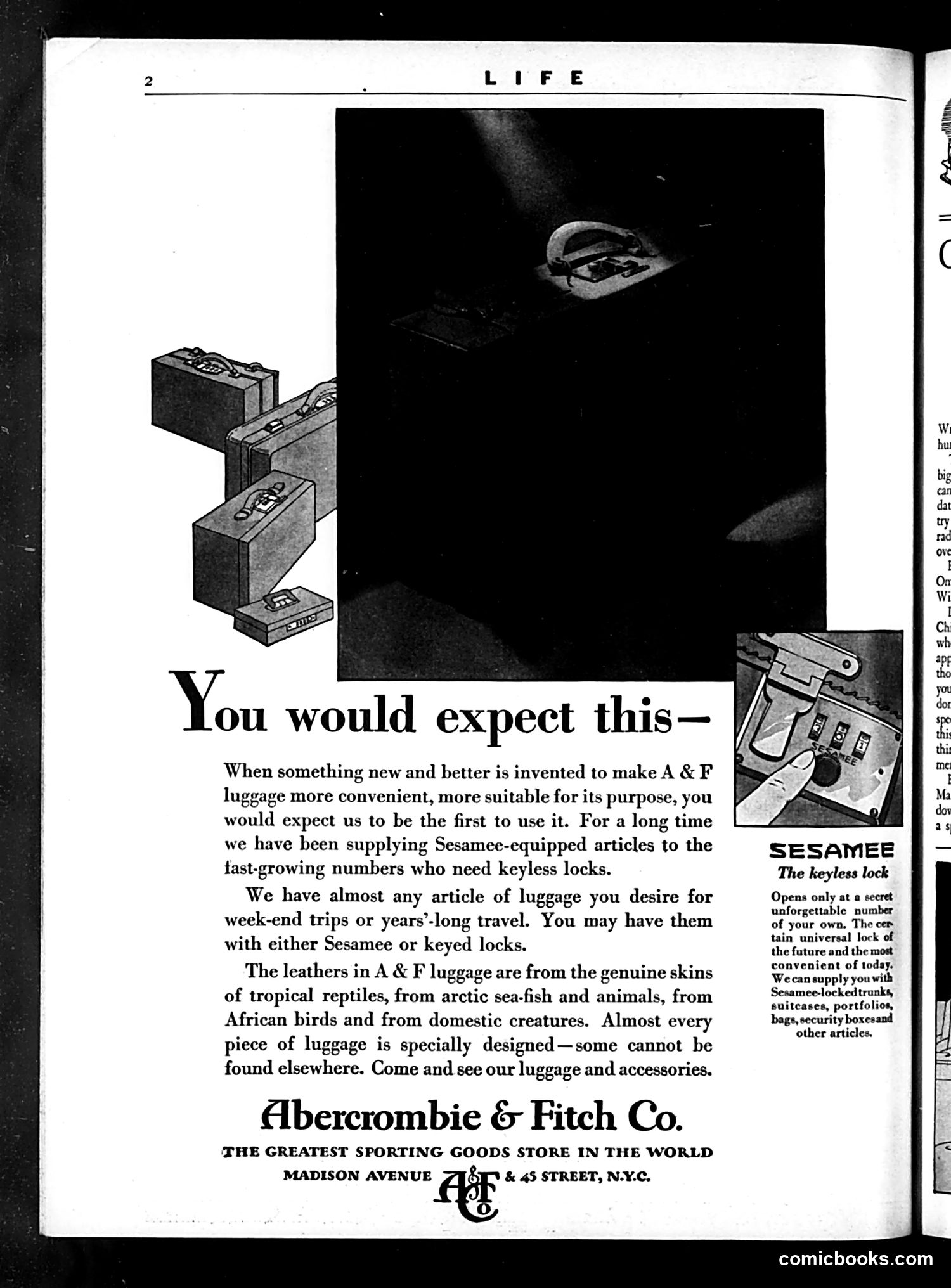
This page is primarily **commercial advertising**, not political satire. It promotes Abercrombie & Fitch Co.'s luggage line featuring "Sesamee" keyless locks—a new innovation for the era. The ad's visual strategy uses dramatic photography and product displays (left: stacked luggage; center: large dramatic photo; right: lock mechanism detail) to convey sophistication and modernity. The headline "You would expect this—" appeals to consumer expectations of quality: A&F should naturally adopt the latest conveniences first. The text emphasizes luxury materials (tropical reptile skins, arctic sea-fish leather, African bird feathers) to justify premium pricing. This reflects early-20th-century advertising techniques: positioning established brands as trendsetters, emphasizing exotic materials as status symbols, and marketing convenience innovations to leisure travelers.
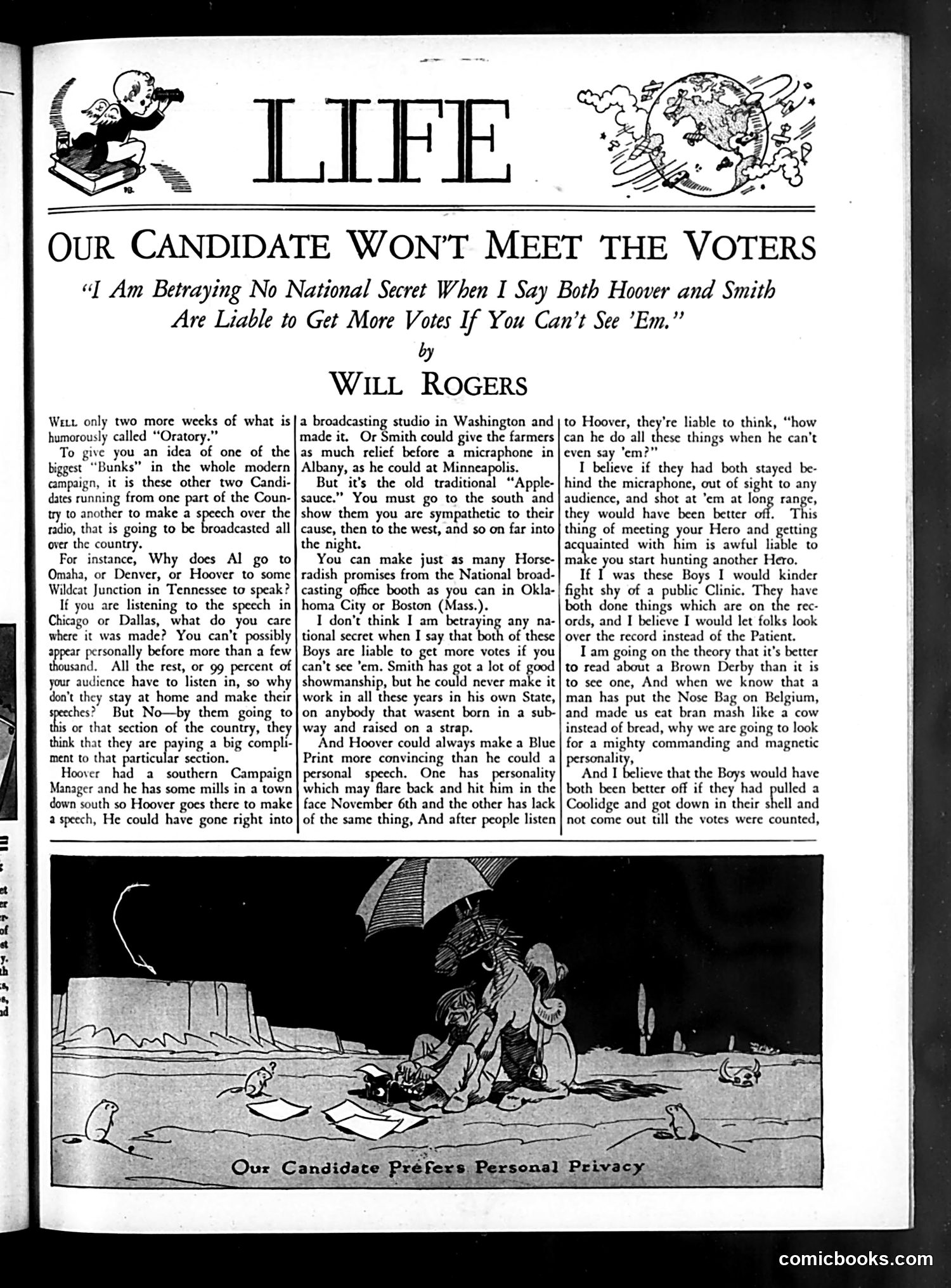
This 1928 piece by humorist Will Rogers satirizes presidential candidates' reluctance to campaign publicly. Rogers argues that both Herbert Hoover and Al Smith avoid direct voter contact, instead relying on radio broadcasts and carefully controlled appearances. The cartoon depicts a candidate hiding under an umbrella in bad weather, labeled "Our Candidate Prefers Personal Privacy"—mocking the avoidance of face-to-face campaigning. Rogers' point: candidates claim visibility matters less when voters can't see them in person, yet both Hoover and Smith would get more votes if voters actually met them. He criticizes this as cowardly, suggesting direct campaigning would benefit both candidates and democracy. The satire targets the emerging preference for mediated (radio) over personal political engagement.
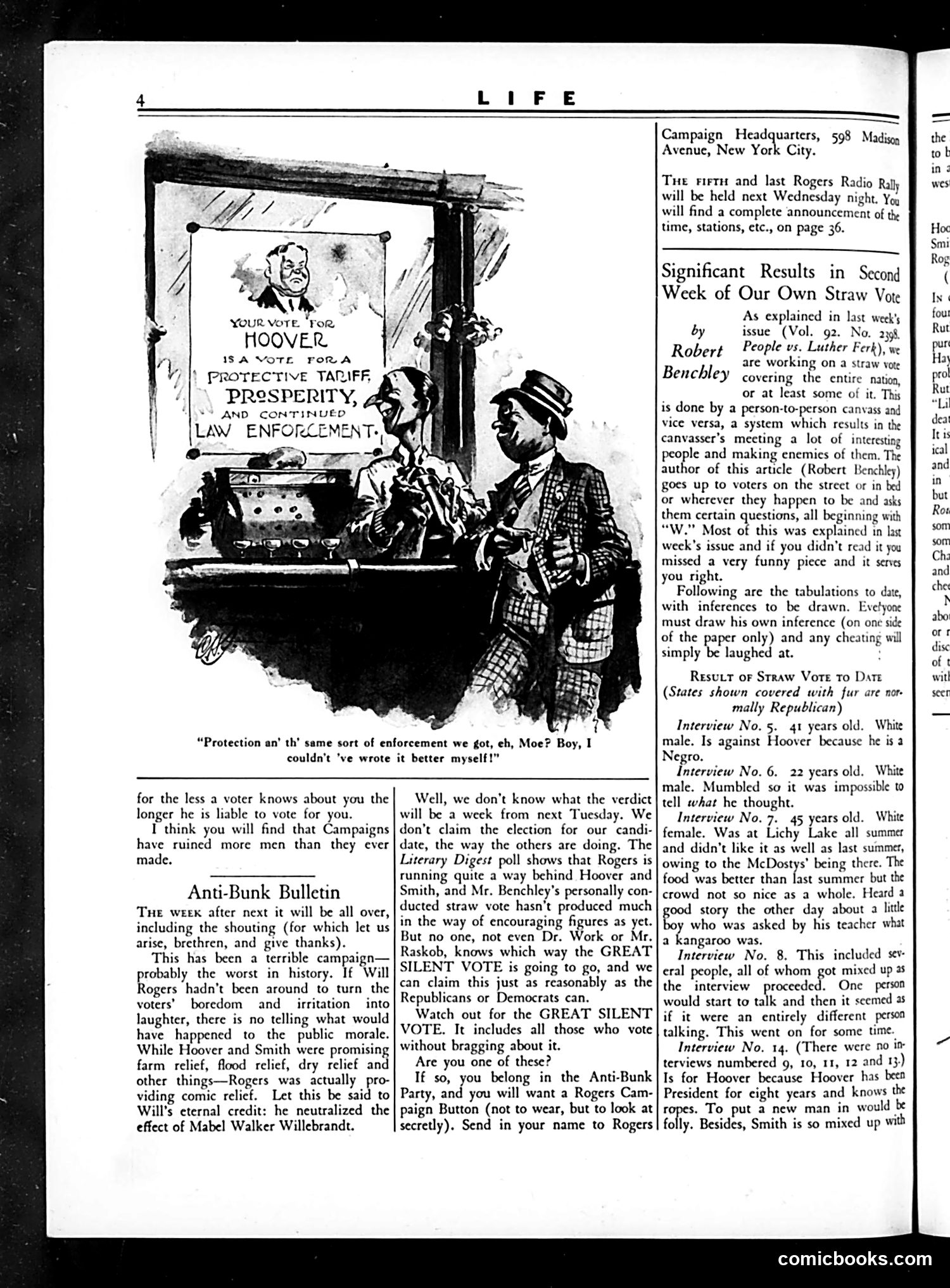
This 1932 Life magazine cartoon satirizes Herbert Hoover's presidential campaign during the Great Depression. Two men examine a campaign poster promoting Hoover's promises of "a protective tariff, prosperity, and sound law enforcement." One figure sarcastically comments: "Protection an' th' same sort of enforcement we got, eh, Moe? Boy, I couldn't 've wrote it better myself!" The satire is biting: Hoover's campaign rhetoric about protection and prosperity rings hollow to struggling Americans experiencing economic collapse. The cartoon mocks the disconnect between the administration's optimistic campaign claims and the harsh economic reality voters faced. The ironic tone suggests voters view such promises as empty propaganda given the Depression's devastating effects on employment and living standards.
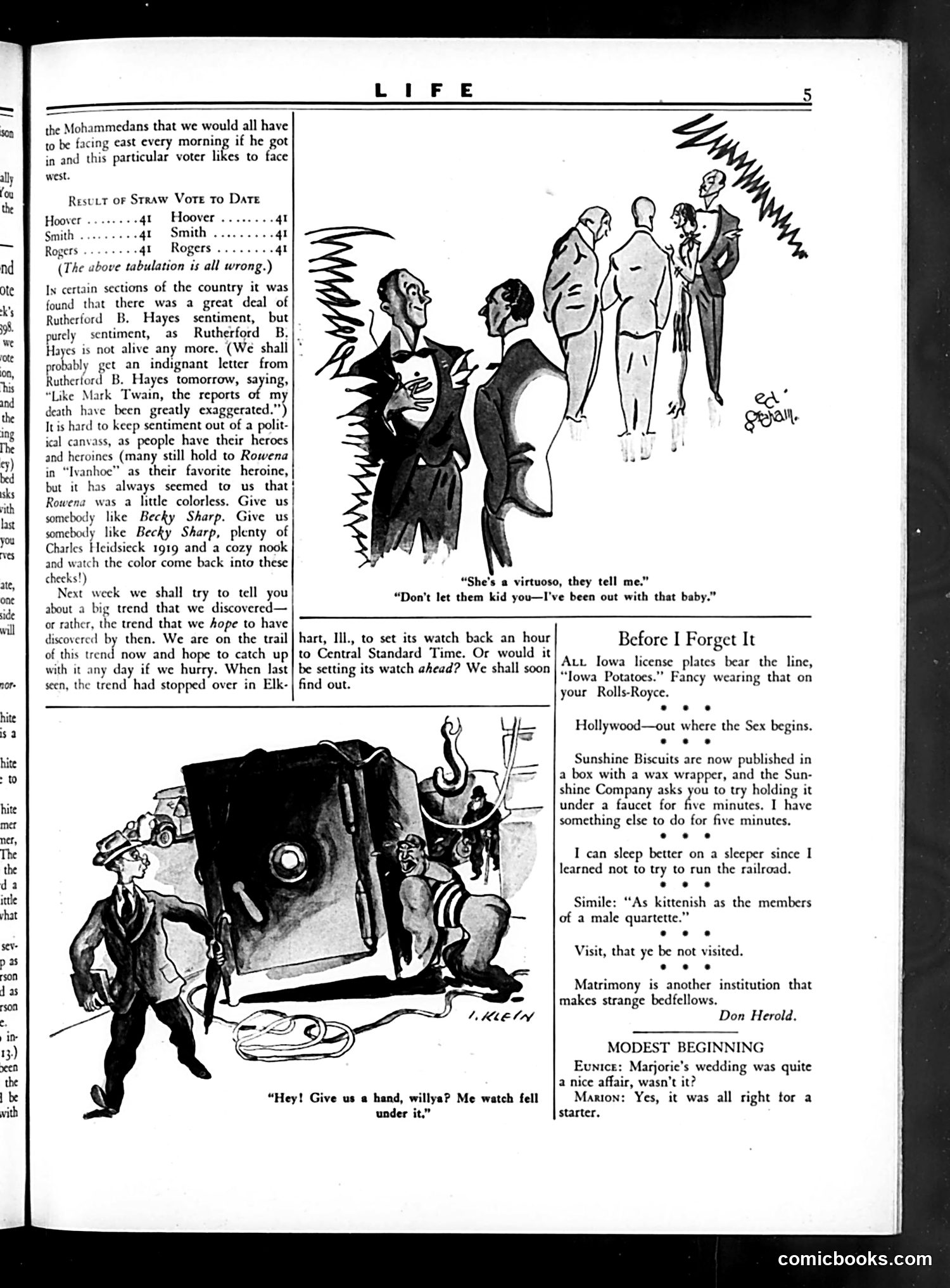
This page contains two main cartoons satirizing early 20th-century American politics and social customs. **Top cartoon**: Shows a woman confronting men, with captions suggesting she's a "virtuoso" whom someone warns "Don't let them kid you—I've been out with that baby." This appears to satirize concerns about women's changing social freedoms and dating practices of the era. **Bottom cartoon**: Depicts a large safe or vault with a man asking "Hey! Give us a hand, willya? Me watch fell under it." This likely satirizes prohibition-era bootlegging or criminal activity, using the safe as a symbol of contraband or illegal operations. The page also includes brief social commentary items mocking various American institutions and customs, reflecting Life magazine's characteristic irreverent humor toward contemporary society.
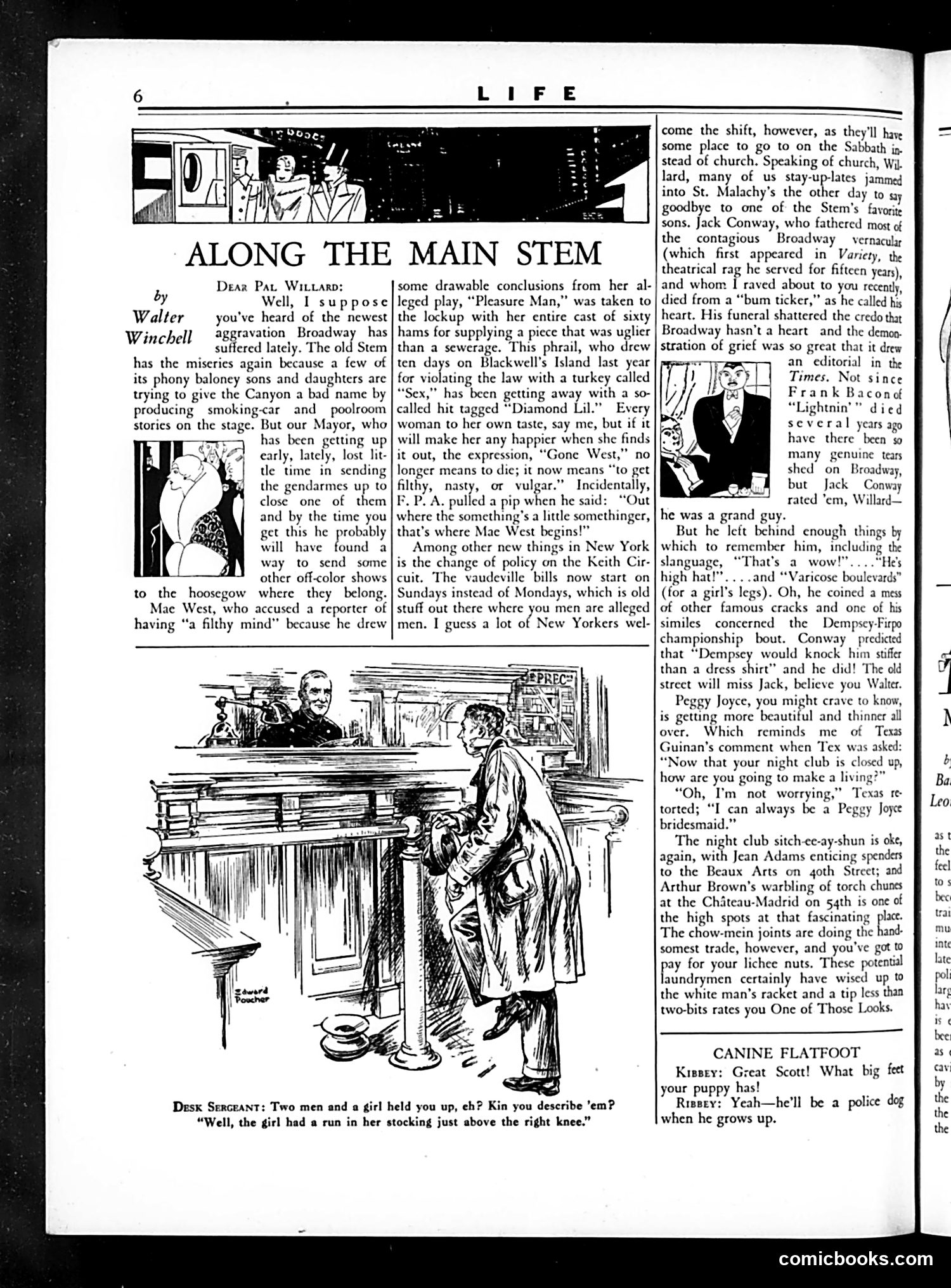
This is a theatrical gossip column by entertainment columnist Walter Winchell. The main cartoon depicts a desk sergeant interviewing a man about a woman, with the punchline: "Well, the girl had a run in her stocking just above the right knee." The column discusses Broadway personalities and scandals, including Jack Conway (a theatrical figure), Mae West (actress), and mentions changes to New York entertainment venues like the Keith Circuit vaudeville circuit shifting from Mondays to Sundays. The humor relies on theater-world insider knowledge—references to productions, performer gossip, and nightclub closures. "Canine Flatfoot" is a separate joke about a police dog. The column exemplifies 1920s-30s entertainment journalism's gossipy, irreverent tone, targeting readers interested in Broadway drama and celebrity scandals.
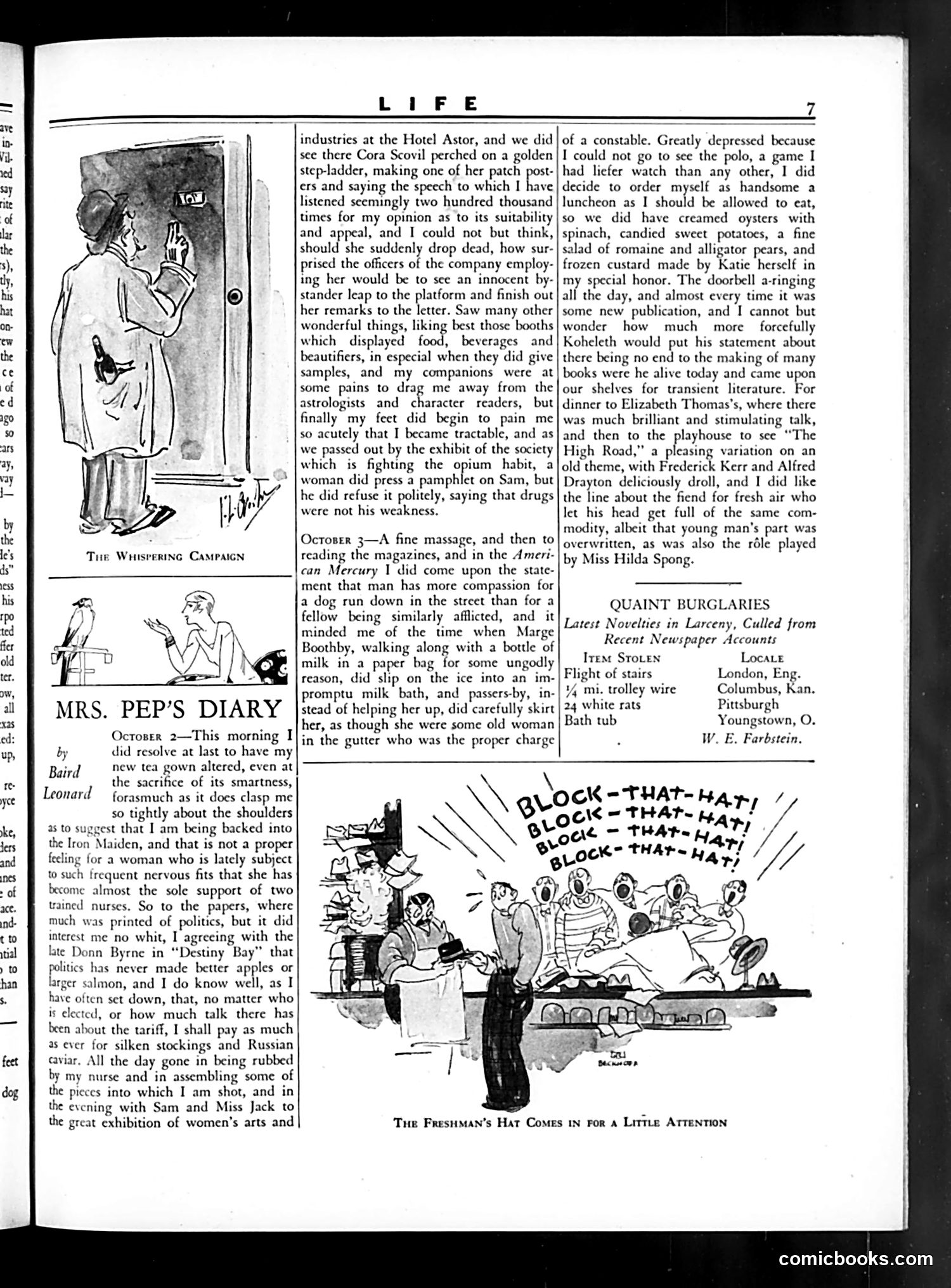
This page contains two cartoons and diary entries satirizing early 20th-century social life. **"The Whispering Campaign"** depicts a woman at a doorway, illustrating gossip spreading through society—a timeless target of satire. **"Mrs. Pep's Diary"** mocks fashionable women's concerns: a new gown, social hierarchies (the "Iron Maiden"), and trivial pursuits. The diarist complains about nursing duties while attending exhibitions of "women's arts." **"The Freshman's Hat Comes in for a Little Attention"** shows a college freshman being hazed—his hat repeatedly knocked off by older students shouting "BLOCK-THAT-HAT!" This reflects period college hazing culture, presenting it as humorous rough-and-tumble masculine initiation. The page's humor derives from exaggerating social pretension, class consciousness, and college tradition as worthy of ridicule.
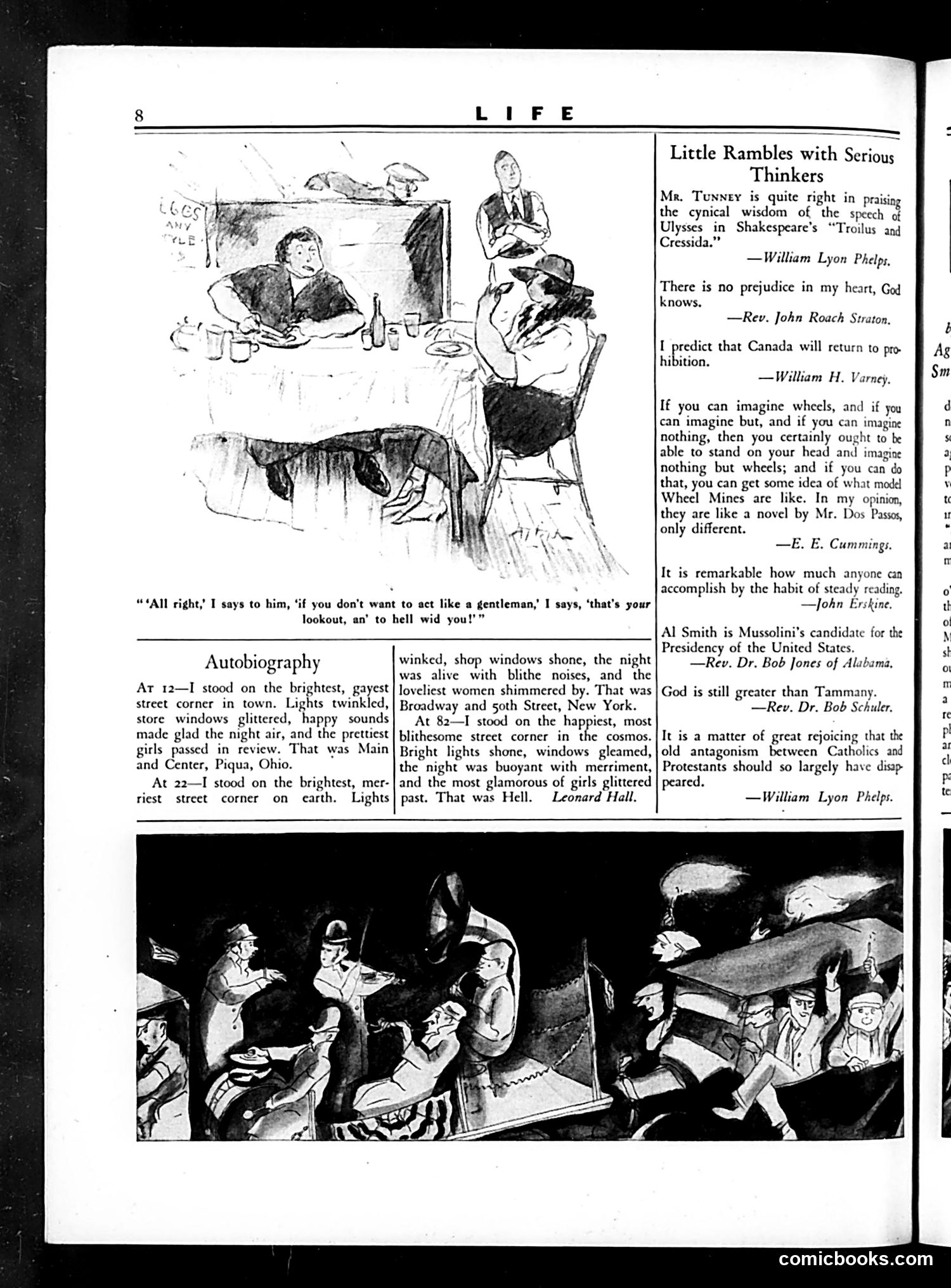
The top cartoon depicts a dinner scene with a caption about gentlemanly behavior and etiquette. The sketch shows diners at a table with a dog underneath—a humorous scene about social propriety. The "Autobiography" section references Piqua, Ohio and New York street corners from specific years (12 and 22), suggesting a coming-of-age narrative contrasting small-town life with urban experience. The "Little Rambles with Serious Thinkers" section collects brief quotes from various public figures on topics like Shakespeare, prohibition, Canada's politics, and religious matters—typical of Life's format mixing humor with commentary on contemporary issues. The lower illustration shows what appears to be a crowded street or public gathering scene, though details are unclear in this reproduction. The overall page reflects Life's satirical approach to American culture and politics circa the 1920s-30s.
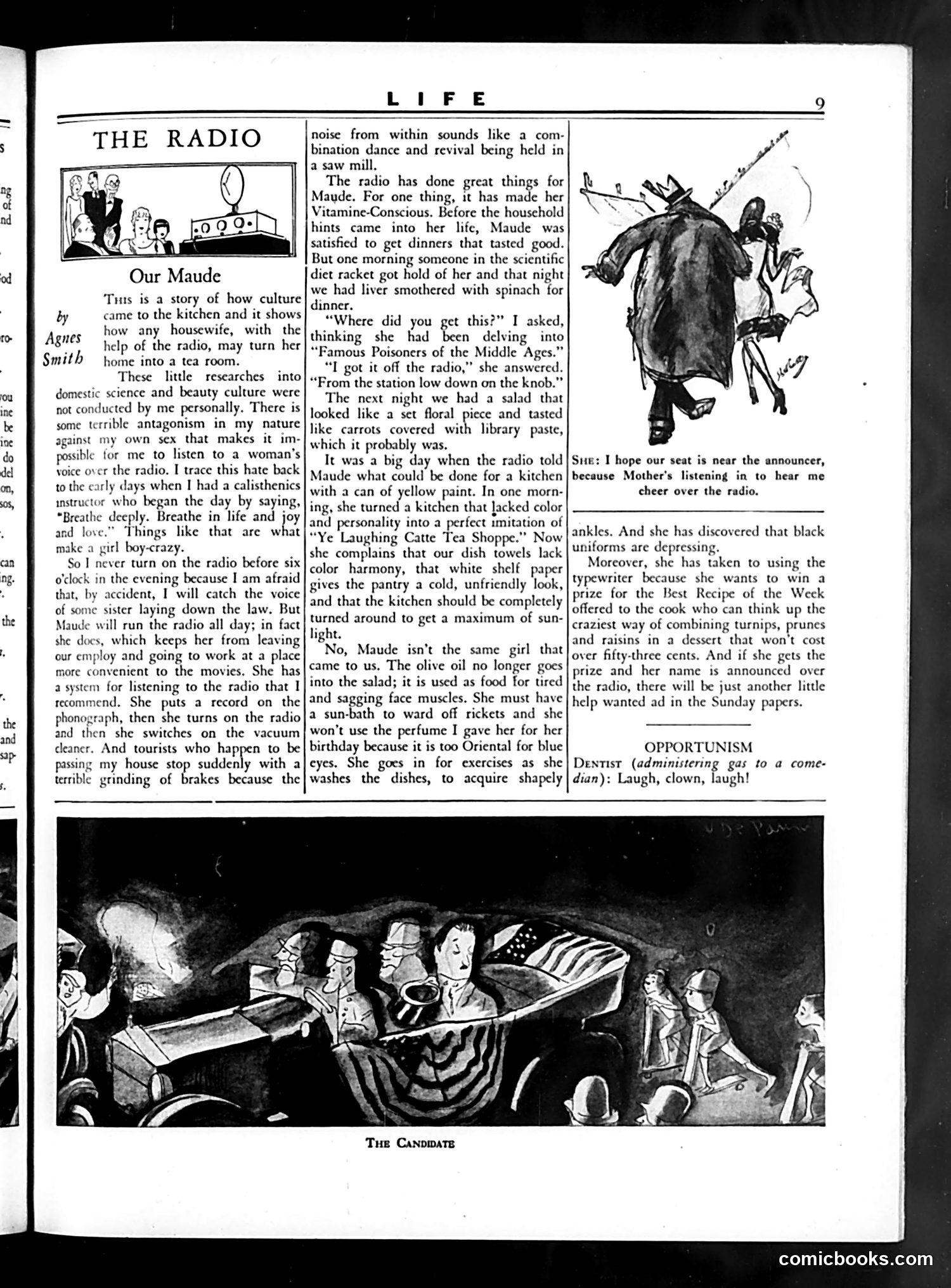
The page contains two pieces: **"Our Maude"** (by Agnes Smith) is a humorous essay about how radio broadcasts have improved domestic life. The author describes Maude, a housewife who now gets cooking and decoration ideas from radio programs—transforming her kitchen into a stylish "Ye Laughing Cattle Tea Shoppe" inspired by radio advice. The satire mocks how radio culture influences middle-class homemakers' aspirations and consumption habits. **"The Candidate"** (bottom cartoon) appears to be a political satire showing figures in a boat or vessel, likely depicting candidates or politicians. The illustration style suggests commentary on electoral politics, though the specific context is unclear without additional caption details visible in the image. Both pieces reflect 1920s-30s concerns about radio's cultural influence and political messaging.
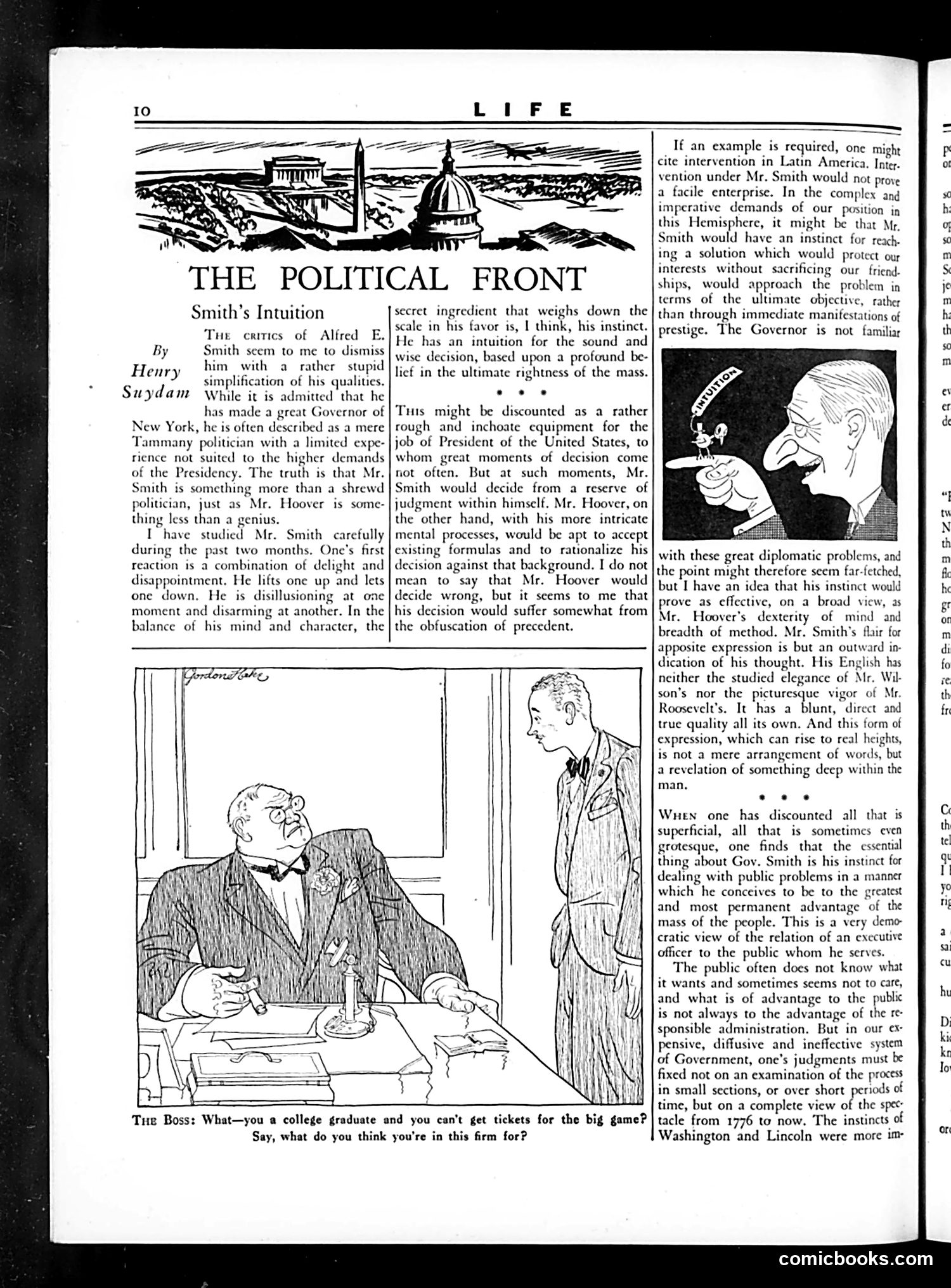
This article by Henry Snyder analyzes Governor Alfred E. Smith of New York as a political figure. The accompanying cartoon illustrates Smith's management style through a dialogue between a boss and a standing employee. **The Satire**: The caption reads: "The Boss: What—you a college graduate and you can't get tickets for the big game? Say, what do you think you're in this firm for?" This mocks Smith's pragmatic, direct approach to governance—treating politics like running a business rather than through ideological frameworks. The article contrasts Smith's "blunt" instinct-based decision-making favorably with President Hoover's more intellectual but potentially detached methods. The joke emphasizes Smith's no-nonsense, results-oriented management: he values practical utility over credentials or theory.
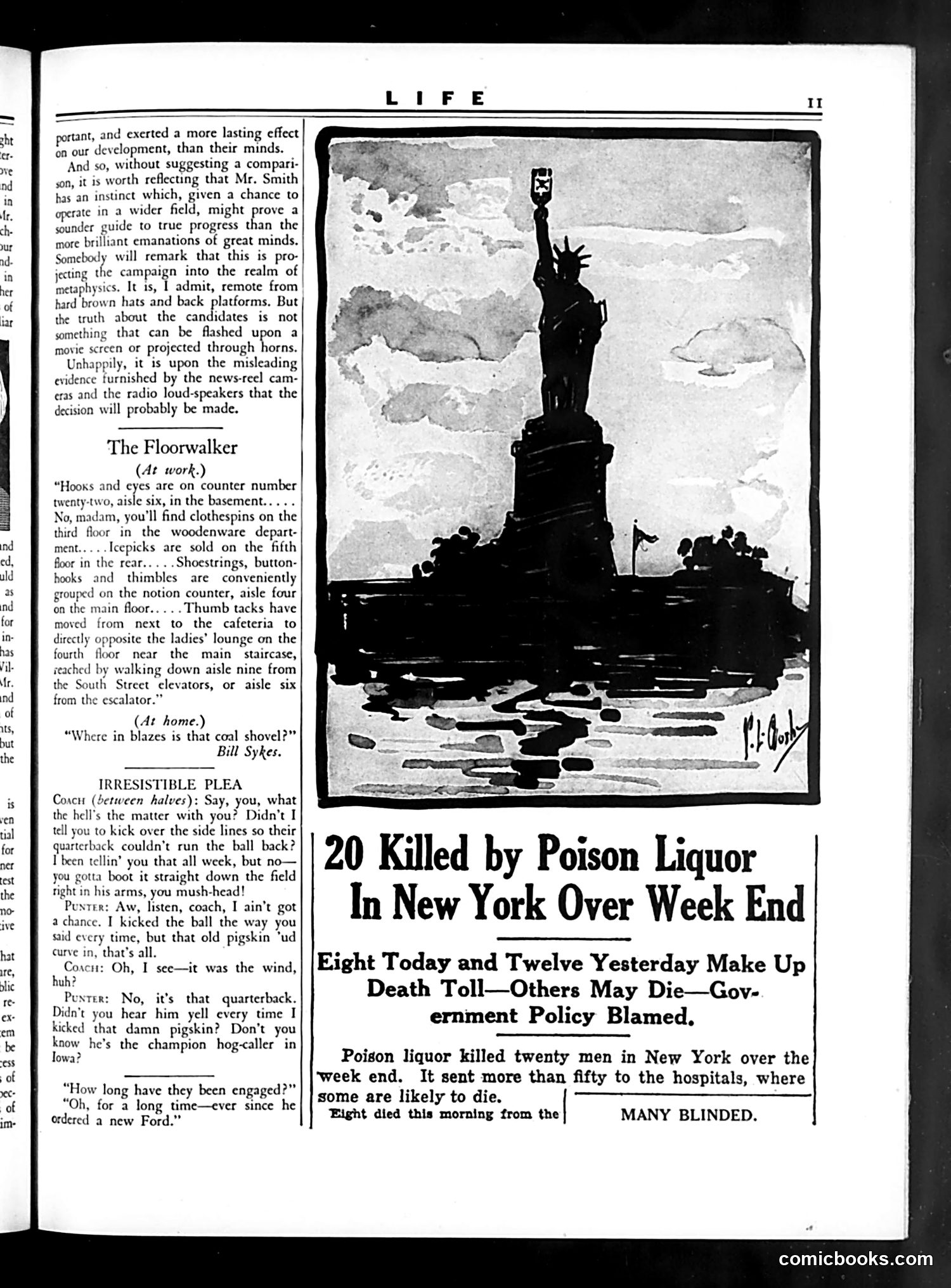
This page contains a political cartoon titled "The Floorwalker" (marked "At work") and a news headline about poison liquor deaths in New York. The cartoon depicts a statue or monument silhouetted against a cloudy sky, with crowds gathered below. The statue appears to represent Lady Liberty or similar civic monument. The satirical point seems critical of a "floorwalker"—likely a store manager or official figure—though the specific target remains unclear without additional context. The adjacent newspaper headline reports a serious public health crisis: "20 Killed by Poison Liquor In New York Over Week End." This references poisoning deaths from contaminated alcohol, a documented problem during Prohibition. The article notes government policy is blamed for the deaths, suggesting criticism of alcohol prohibition laws that may have driven people to consume dangerous substitutes.
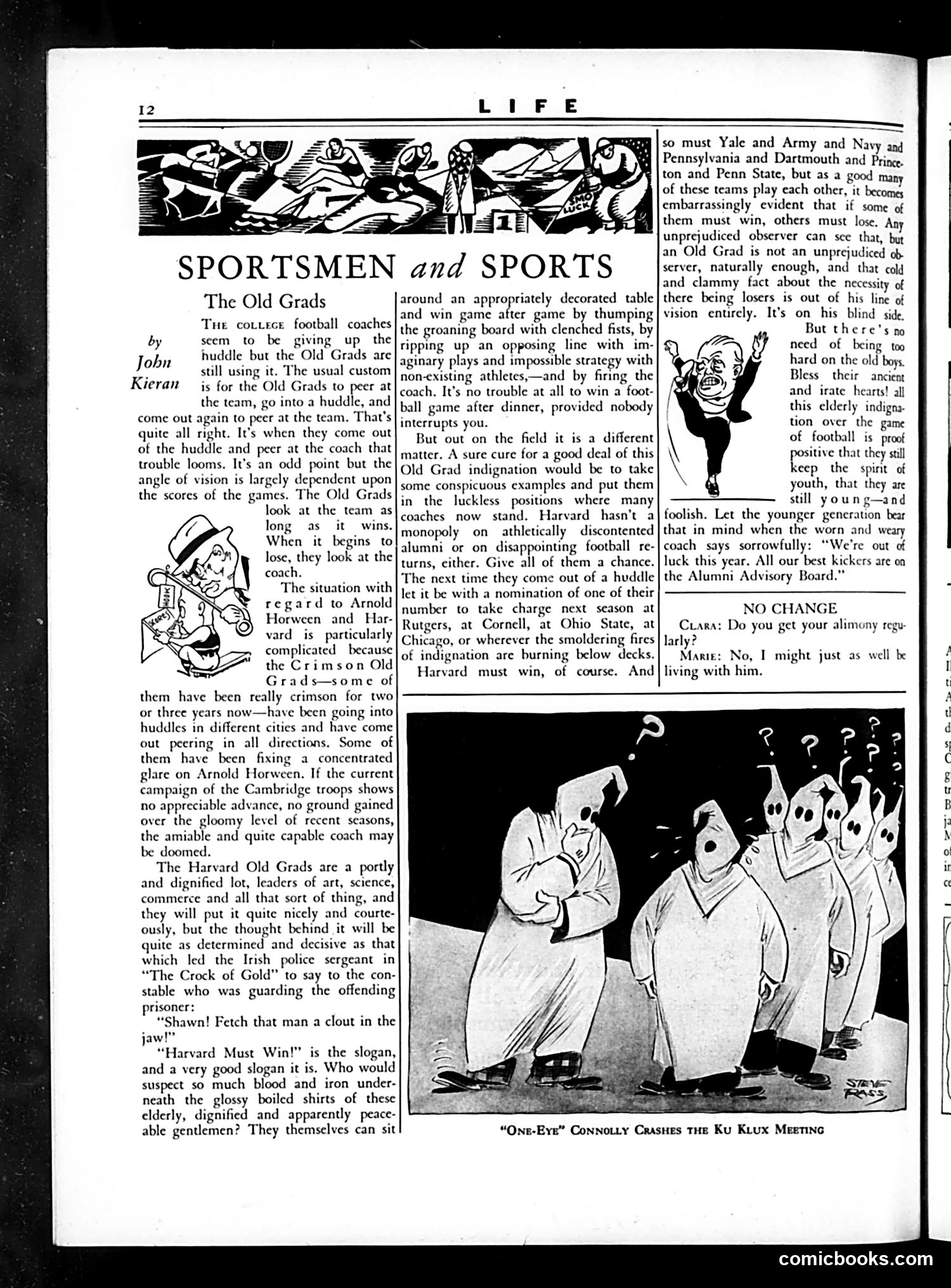
**Main Article: "Sportsmen and Sports - The Old Grads"** By John Kieran, this piece critiques college football coaches who blame losses on their alumni ("Old Grads"). The author argues coaches use alumni as convenient scapegoats rather than accepting responsibility for poor coaching decisions. **Bottom Cartoon: "One-Eye Connolly Crashes the Ku Klux Meeting"** This satirical cartoon depicts a figure labeled "One-Eye" Connolly disrupting a KKK gathering. The robed figures display question marks, suggesting confusion or concern. The satire appears to mock the Klan by portraying their meeting as something that could be casually "crashed" by an outsider, thereby ridiculing their secrecy and organization. The context suggests this reflects anti-Klan sentiment during the 1920s when the organization was publicly prominent and widely criticized in satirical media.
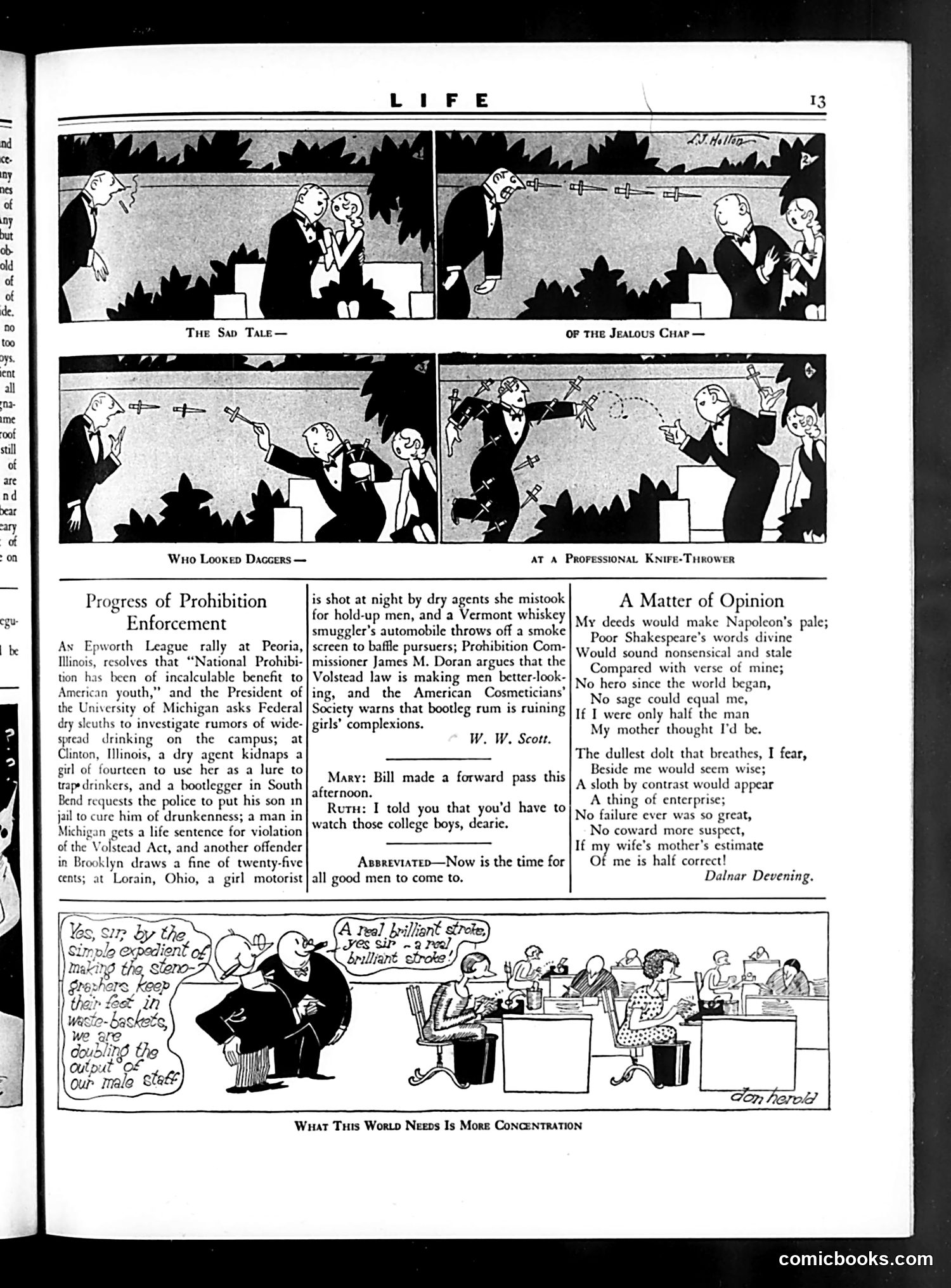
This page contains satirical comics and commentary about **Prohibition enforcement** in 1920s America. The top comic strip titled "The Sad Tale of the Jealous Chap Who Looked Daggers—At a Professional Knife-Thrower" depicts a domestic jealousy scenario ending in slapstick violence, likely a humorous interlude. The main content addresses **Prohibition's effects**: an article reports on enforcement efforts (raids, arrests for bootlegging) and quotes opponents warning that bootleg alcohol is damaging public health. A poem titled "A Matter of Opinion" sarcastically contrasts a man's boasts of achievement with his wife's humbler assessment. The bottom cartoon, "What This World Needs Is More Concentration," shows office workers at desks discussing work productivity while one figure gestures emphatically—likely satirizing corporate management's obsession with efficiency during Prohibition's economic disruption.
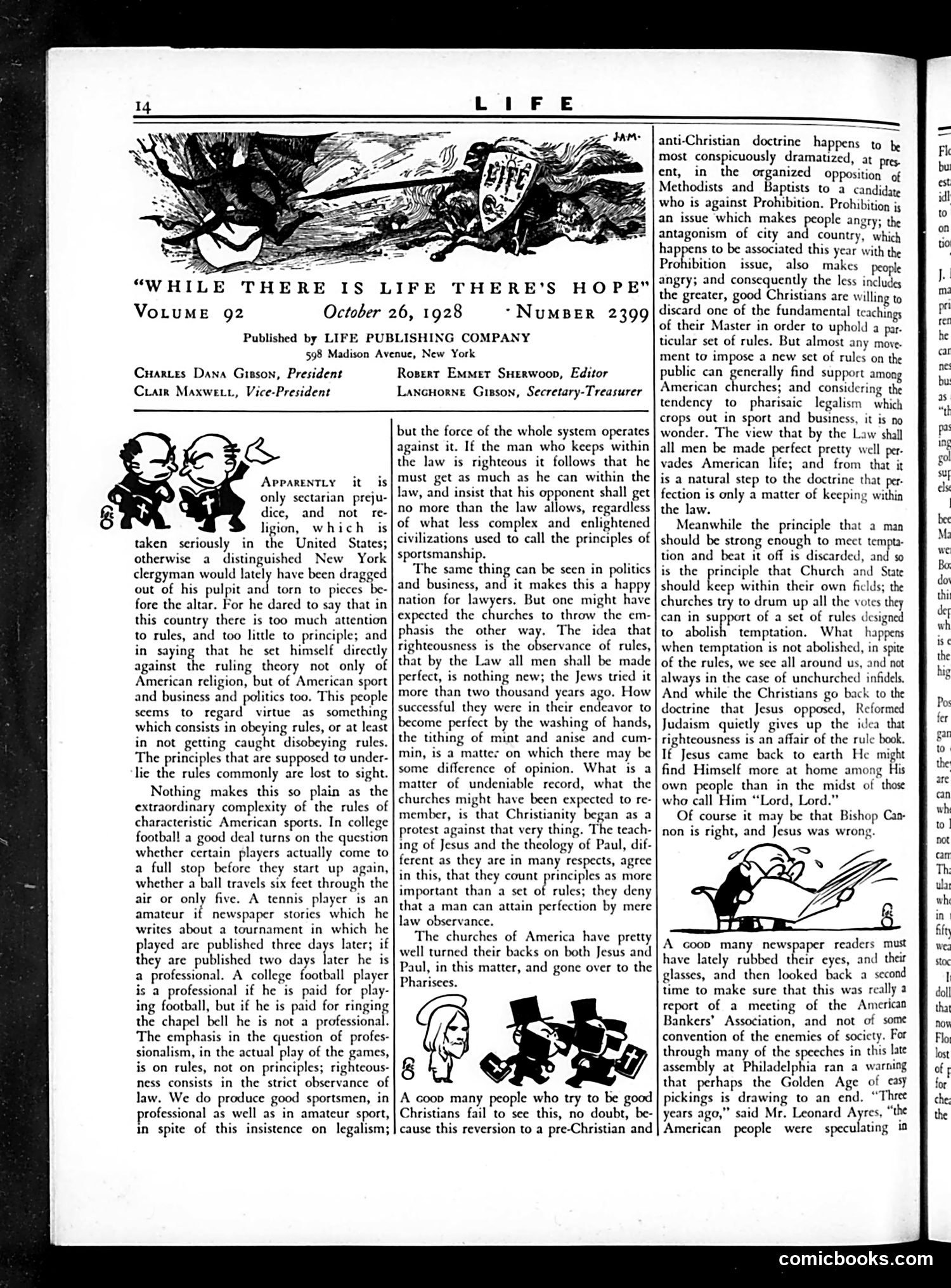
This page contains editorial commentary on American attitudes toward rules and legalism in sports, business, and religion. The main text criticizes how Americans simultaneously demand strict rule-following while breaking rules themselves—a hypocrisy the author traces through football, business, and church conduct. The cartoons appear to satirize this contradiction: one shows figures engaged in rule-breaking (likely gambling or financial speculation), while another depicts people trying to appear virtuous while violating Christian principles. A caption references the "Golden Age of easy pickings" and speculation, likely alluding to pre-1929 stock market excess. The piece argues Americans have abandoned genuine Christian ethics in favor of performative legalism—following surface rules while ignoring underlying moral principles. The tone is disapproving of this cultural hypocrisy.
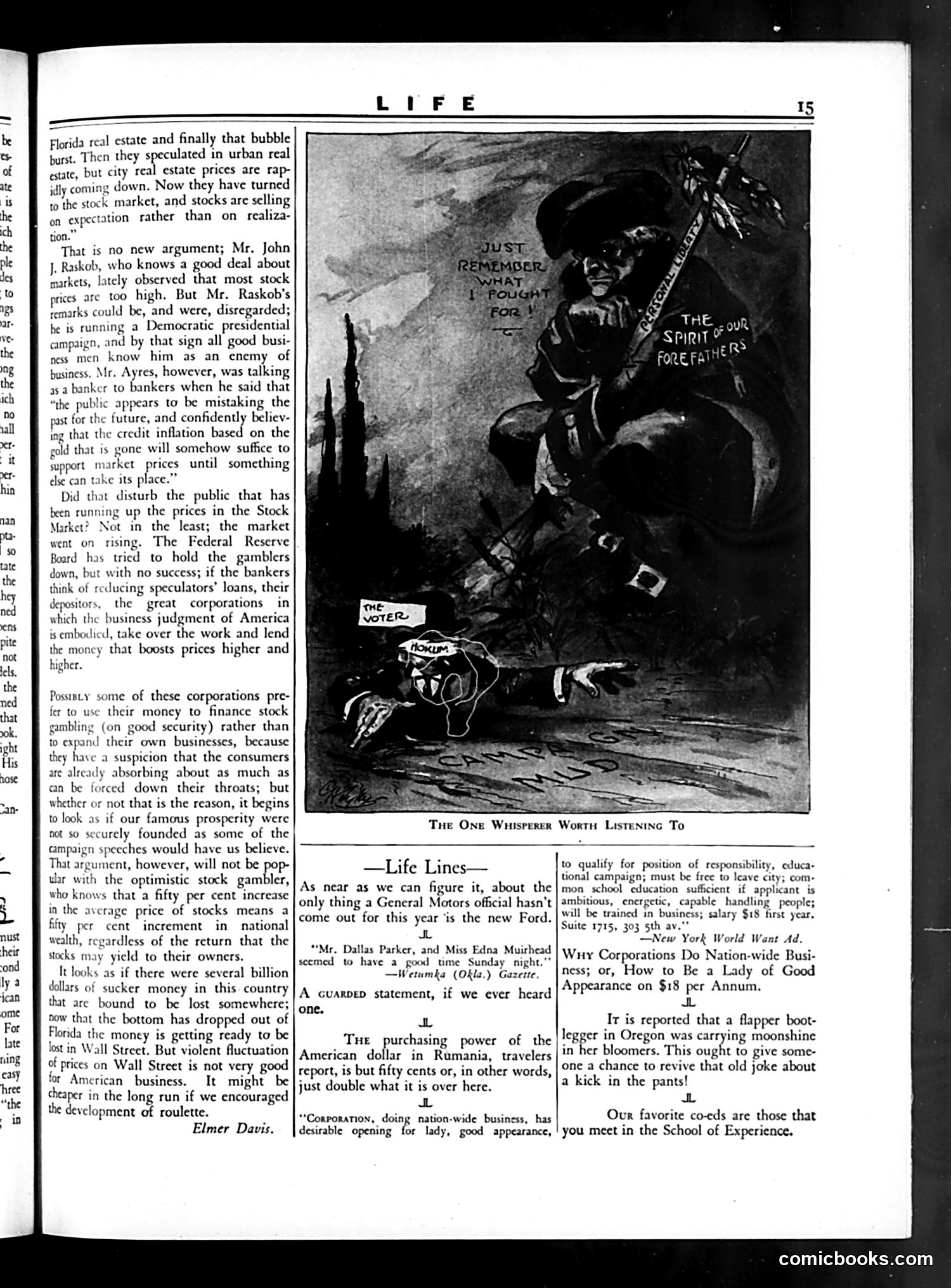
This page features a large political cartoon titled "The One Whisperer Worth Listening To." The central figure appears to be "The Voter"—depicted as small and hunched—receiving guidance from a much larger, ghostly figure labeled "The Spirit of Our Forefathers." The cartoon critiques stock market speculation and inflation during what appears to be the 1920s economic boom. The accompanying article discusses how the Federal Reserve and corporations have inflated stock prices artificially. The satire suggests that voters should heed historical wisdom about sound economic practices rather than being seduced by speculative gambling disguised as investment. The "forefathers" represent traditional American values of productive business over financial manipulation—a nostalgic appeal during an era of rampant market excess.
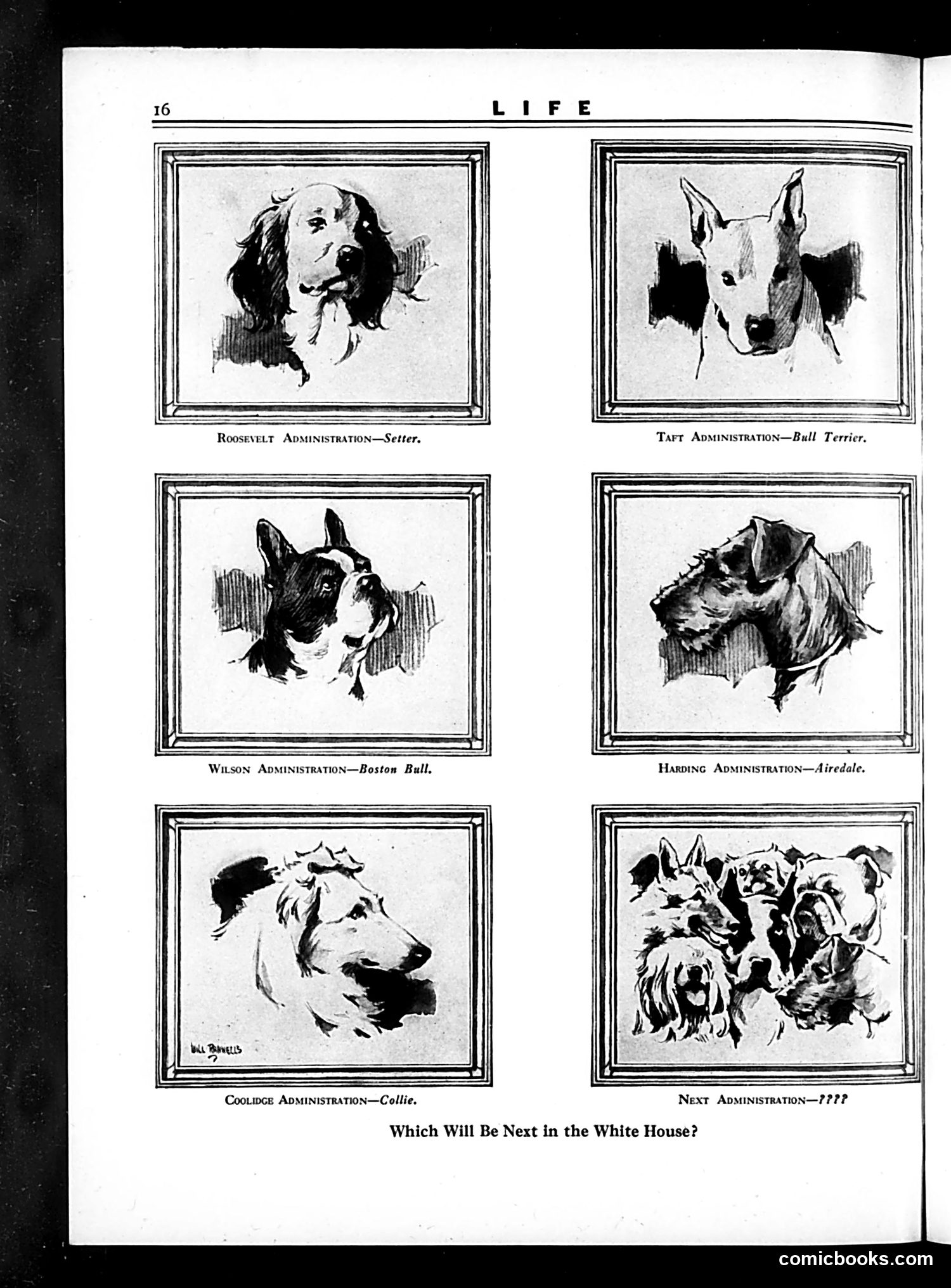
This is a political satire comparing U.S. presidential administrations to their respective presidential dogs: - **Roosevelt Administration** — Setter - **Taft Administration** — Bull Terrier - **Wilson Administration** — Boston Ball - **Harding Administration** — Airedale - **Coolidge Administration** — Collie - **Next Administration** — "????" (a pack of mixed dogs) The cartoon uses dog breeds as humorous metaphors for each president's character or leadership style. The final panel's chaotic pack of dogs humorously suggests uncertainty about which candidate or political faction will win the next presidential election. This appears to be satirizing the unpredictability of upcoming political campaigns, using dog personalities as stand-ins for presidential traits—a playful commentary on electoral politics.
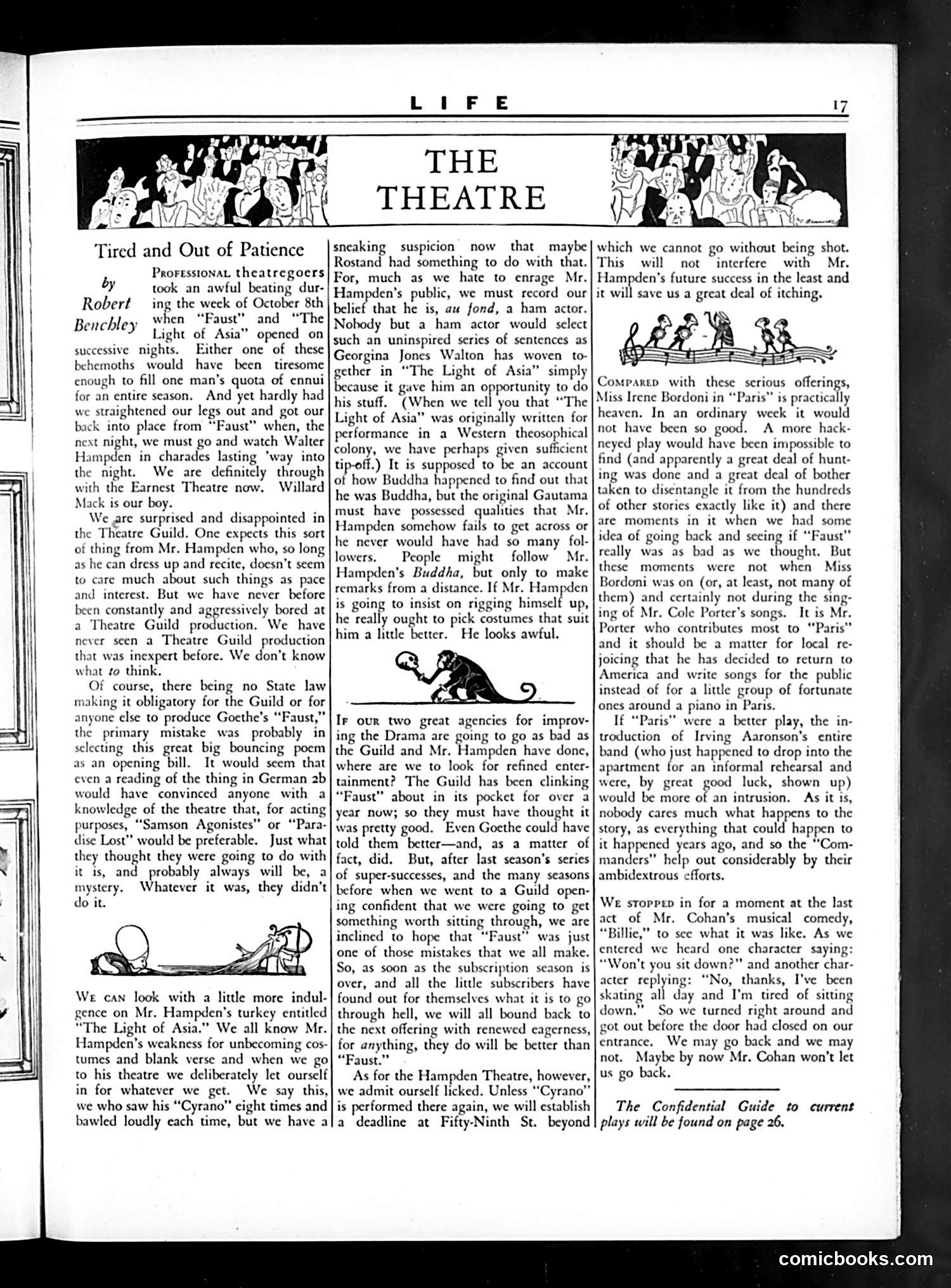
This page is a theatre review by Robert Benchley critiquing recent Broadway productions. The main cartoon (bottom left) appears to be a simple decorative illustration unrelated to specific satire. The text satirizes the Theatre Guild's recent productions, particularly criticizing Walter Hampden's performances in "Faust" and "The Light of Asia." Benchley argues these plays are poorly written and that Hampden, despite his talent, cannot elevate mediocre material. He mocks the Guild's decision-making, suggesting they've lost their way. The review also mentions Miss Irene Bordoni's "Paris" favorably, contrasting it with the Guild's failures. Benchley's satire targets institutional artistic decline—suggesting even prestigious organizations like the Theatre Guild can make embarrassing mistakes when selecting scripts and casting decisions.
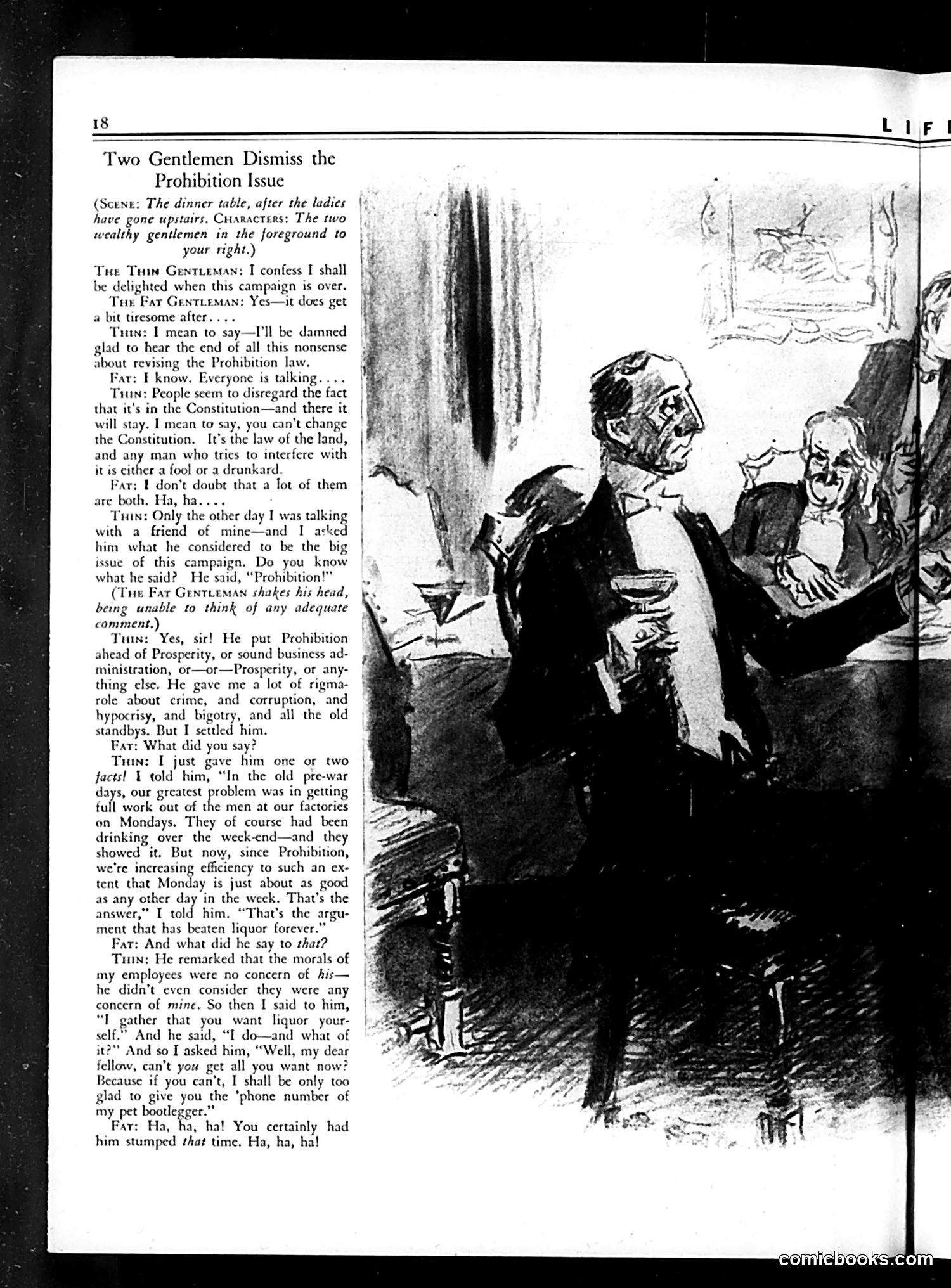
This satirical sketch mocks wealthy businessmen who defend Prohibition while privately flouting it. Two affluent gentlemen discuss dismissing anti-Prohibition arguments during after-dinner conversation. The satire targets their hypocrisy: one claims Prohibition benefits factory productivity and worker morality, yet admits he obtains liquor through a "pet bootlegger." The joke exposes the contradiction—they support Prohibition's legal enforcement while personally circumventing it through illegal channels. The cartoon critiques how the wealthy used moral arguments about Prohibition (worker efficiency, morality, crime reduction) to justify the law, while their actual behavior revealed indifference to those stated principles. It suggests Prohibition enforcement was selective: enforced against working-class "drunkards" but casually ignored by the privileged classes who could afford bootleggers. This reflects genuine 1920s tensions where Prohibition proved deeply unpopular, unevenly enforced, and frequently violated by those with resources.
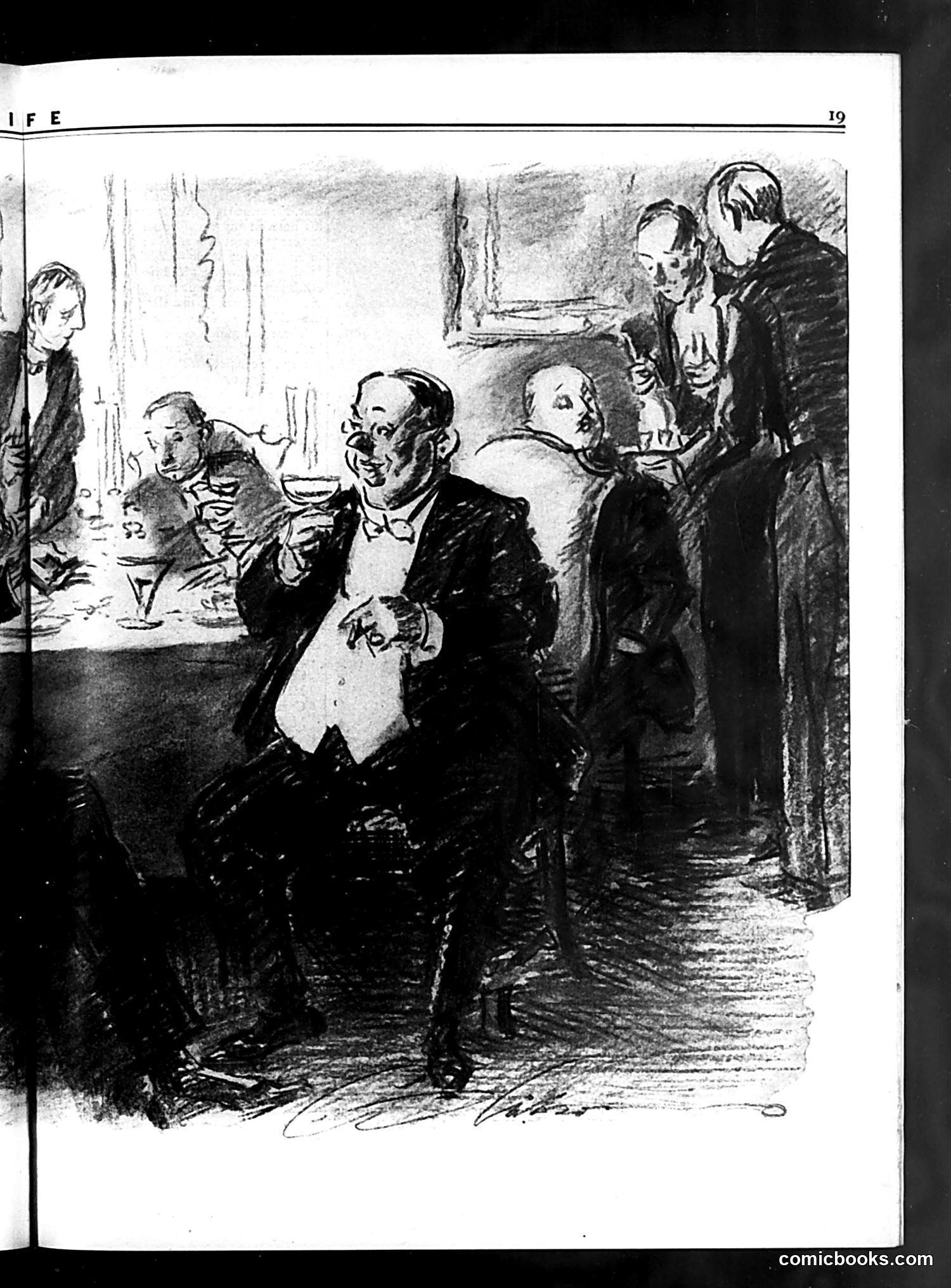
This is a satirical sketch depicting a formal dinner scene. A portly, well-dressed gentleman in the center appears to be the main subject of mockery—his exaggerated facial features and prominent belly suggest caricature of a specific public figure, though the OCR text provides no identifying information. The scene shows various attendees at what appears to be an upper-class social gathering. The artist's style suggests late 19th or early 20th century. The humor likely targets the gentleman's pretensions or behavior at the social event, typical of Life magazine's satirical approach to mocking wealthy society figures and their affectations. Without additional text or context visible on this page, the specific identity of the subject and precise social commentary remain unclear.
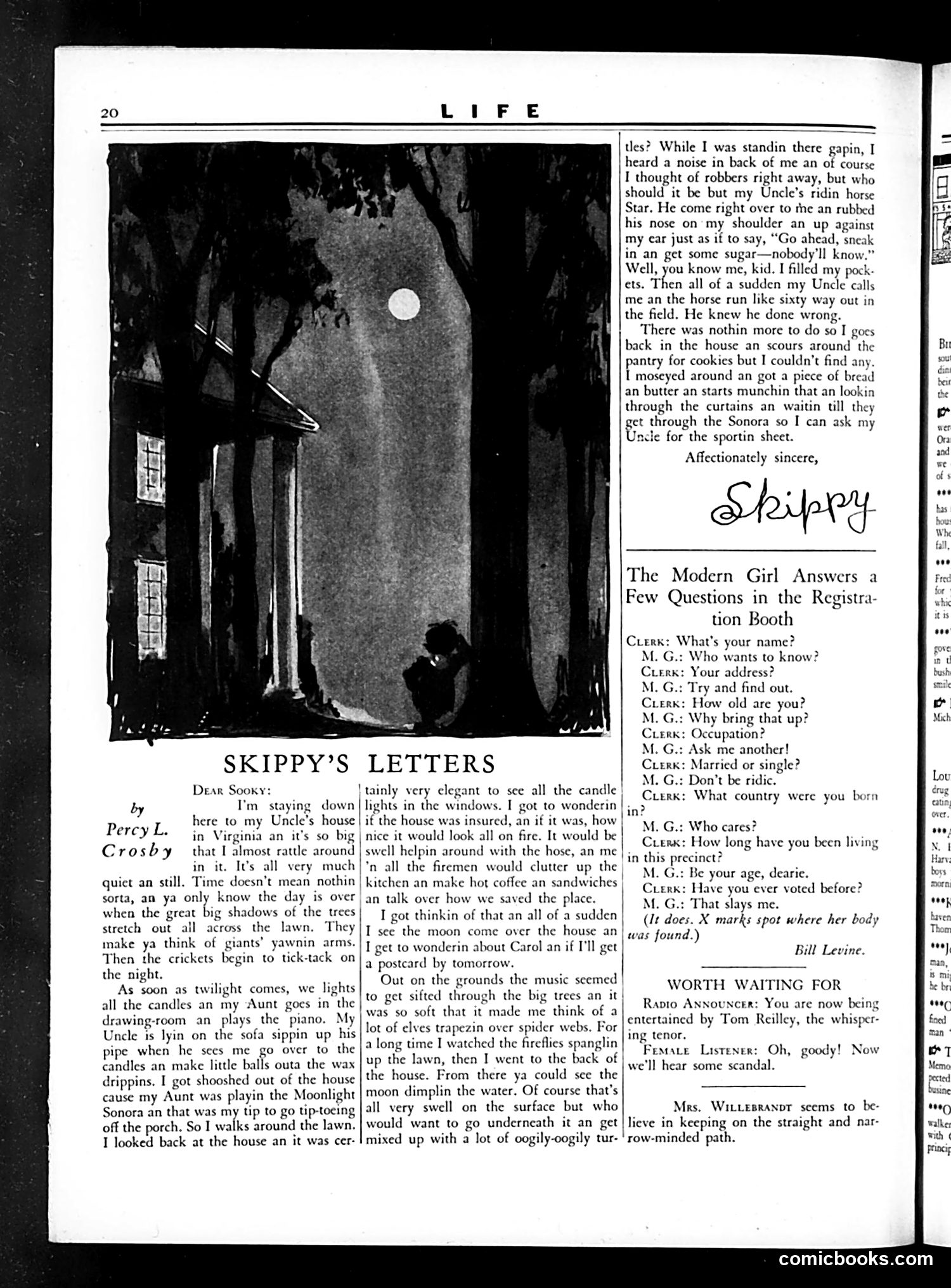
This page contains two distinct humor pieces: **"Skippy's Letters"** is a nostalgic coming-of-age narrative by Percy L. Crosby about a boy visiting his uncle's Virginia estate. The humor lies in the protagonist's youthful observations—admiring the candlelit house while imagining it on fire, romanticizing moonlight while worried about underwater creatures, and being tempted by the family horse with sugar. It captures innocent adolescent psychology with gentle, wistful comedy. **"The Modern Girl Answers Questions"** is satirical commentary on 1920s women's liberation. A young woman repeatedly deflects a registration clerk's routine questions with flippant, evasive answers ("Who wants to know?"). The final line—"(It does. X marks spot where her body was found.)"—darkly jokes that her independence got her killed. This reflects contemporary anxiety about changing gender roles and "modern girls" rejecting traditional deference to authority. Both pieces use humor to explore social change: one celebrates rural innocence, the other mocks or warns about female assertiveness.
This page features a decorative header cartoon depicting a small-town main street with various storefronts and businesses. The illustration is purely decorative—a charming period scene establishing the "neighborhood" theme. The actual content is **not satirical cartoon commentary** but rather a genuine gossip/news column feature common in Life magazine. Each section (Detroit, Boston, Denver, Seattle, Chicago) contains brief, humorous anecdotes about local figures—mostly unnamed ordinary citizens and minor public figures like politicians William A. Comstock and Representative W. Frank James. The humor derives from **gentle, small-town observations**: peculiar personal habits (a man's expensive camel-hair coat), minor social embarrassments (calling someone "mister" at a luncheon), and everyday events (onion and potato price fluctuations). The tone is affectionate mockery of provincial American life rather than pointed political satire. This represents Life's "human interest" humor tradition—celebrating the amusing absurdities of ordinary American communities rather than attacking public figures or institutions.
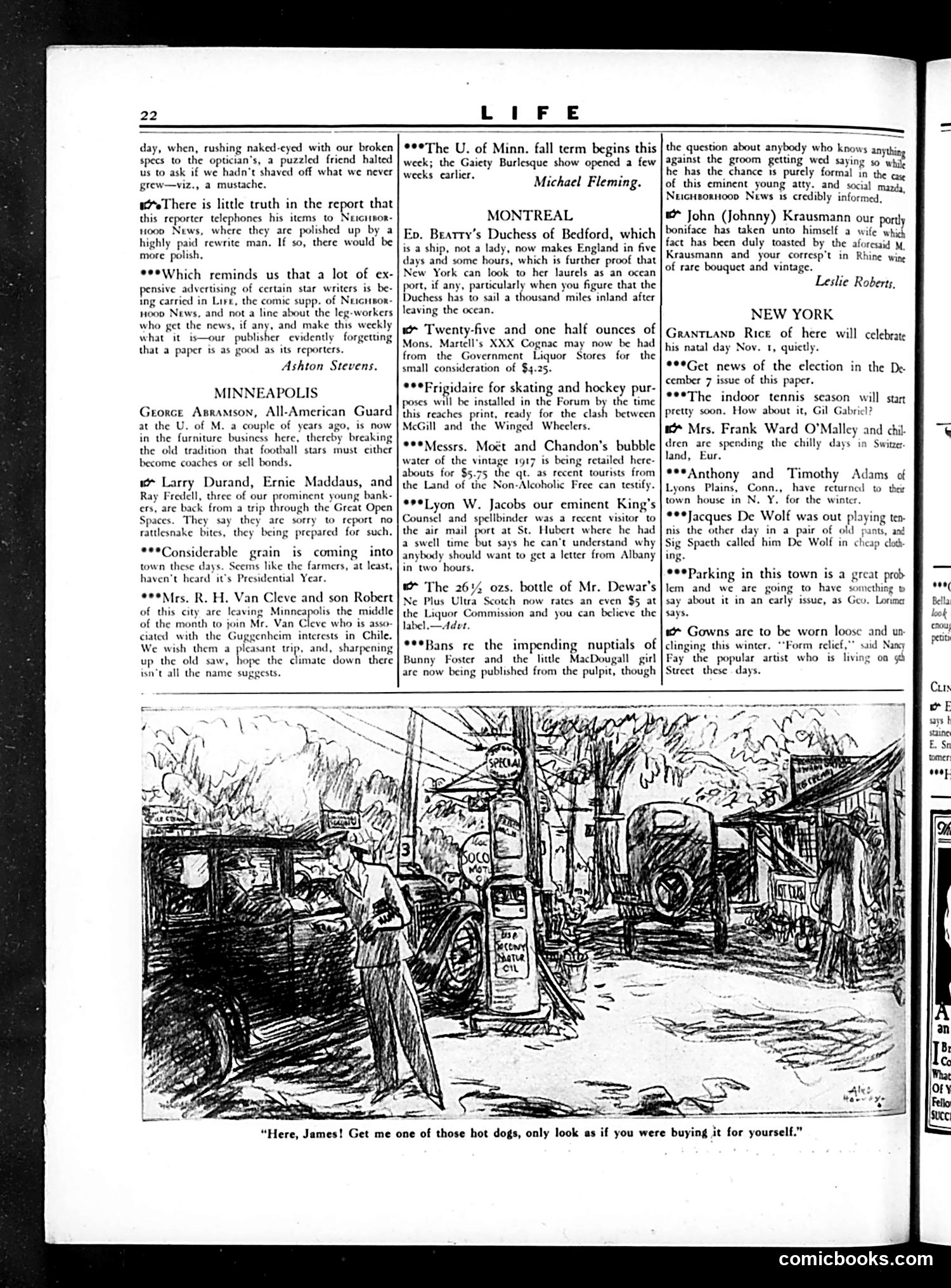
This single-panel cartoon depicts a street scene at what appears to be a hot dog vendor's stand. A well-dressed woman instructs a male companion (presumably James) to buy her a hot dog, but "only look as if you were buying it for yourself." **The Joke:** The satire targets upper-class pretension and social hypocrisy. The woman wants to eat a humble street food (hot dogs were considered lower-class fare) but is concerned about maintaining her social appearance. Rather than openly purchasing and consuming it herself, she has her male companion buy it while she pretends it's for him—preserving her facade of refinement and superiority. This reflects early 20th-century class anxieties and the American obsession with maintaining proper social standing, even in trivial matters. The cartoon mocks how artificial and performative such social conventions were, suggesting that even enjoyable simple pleasures required careful stagecraft to avoid damaging one's reputation.
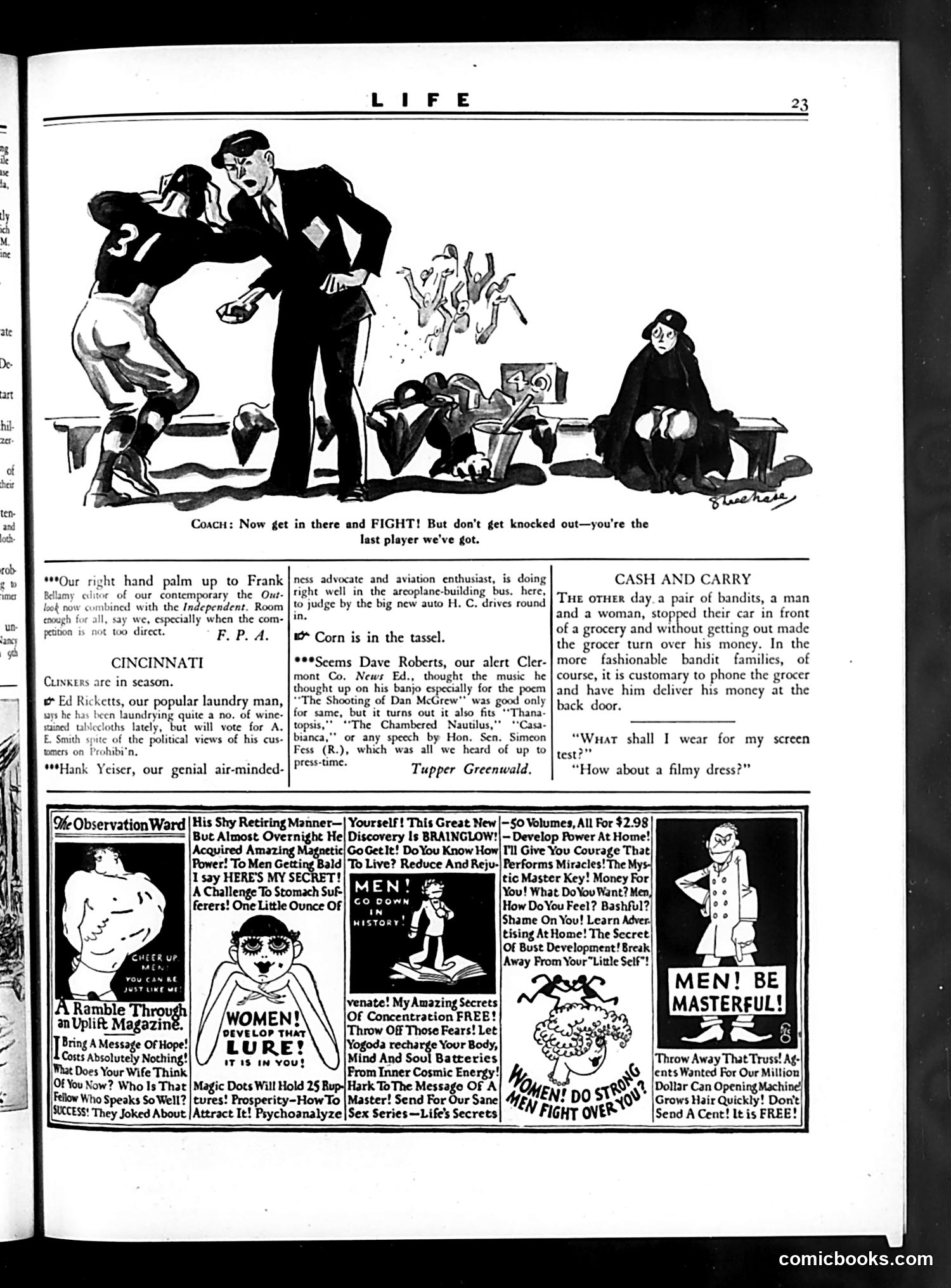
**Main Cartoon:** A coach harangues an exhausted football player (number 37), urging him to fight despite being battered. Around them lie injured or unconscious teammates and equipment scattered on the ground. A woman sits alone to the right, apparently a player's wife or companion. **The Satire:** This depicts the desperation of a losing team—or possibly a struggling organization more broadly—sacrificing its remaining resources. The coach's plea that this is "the last player we've got" suggests the institution is nearly depleted. The darkly comic point: leadership demands maximum effort from the one remaining asset, regardless of the cost. **Context:** Without specific dating, the cartoon likely comments on either a particular season's athletic failure or uses sports as metaphor for institutional decline during economic hardship (plausible given the 1920s-30s timeframe of Life's satirical heyday). **Secondary Content:** The page also contains personal gossip items about Cincinnati locals and period advertisements for mail-order self-help courses ("Brainglow," concentration secrets, hair growth)—typical Life magazine filler.
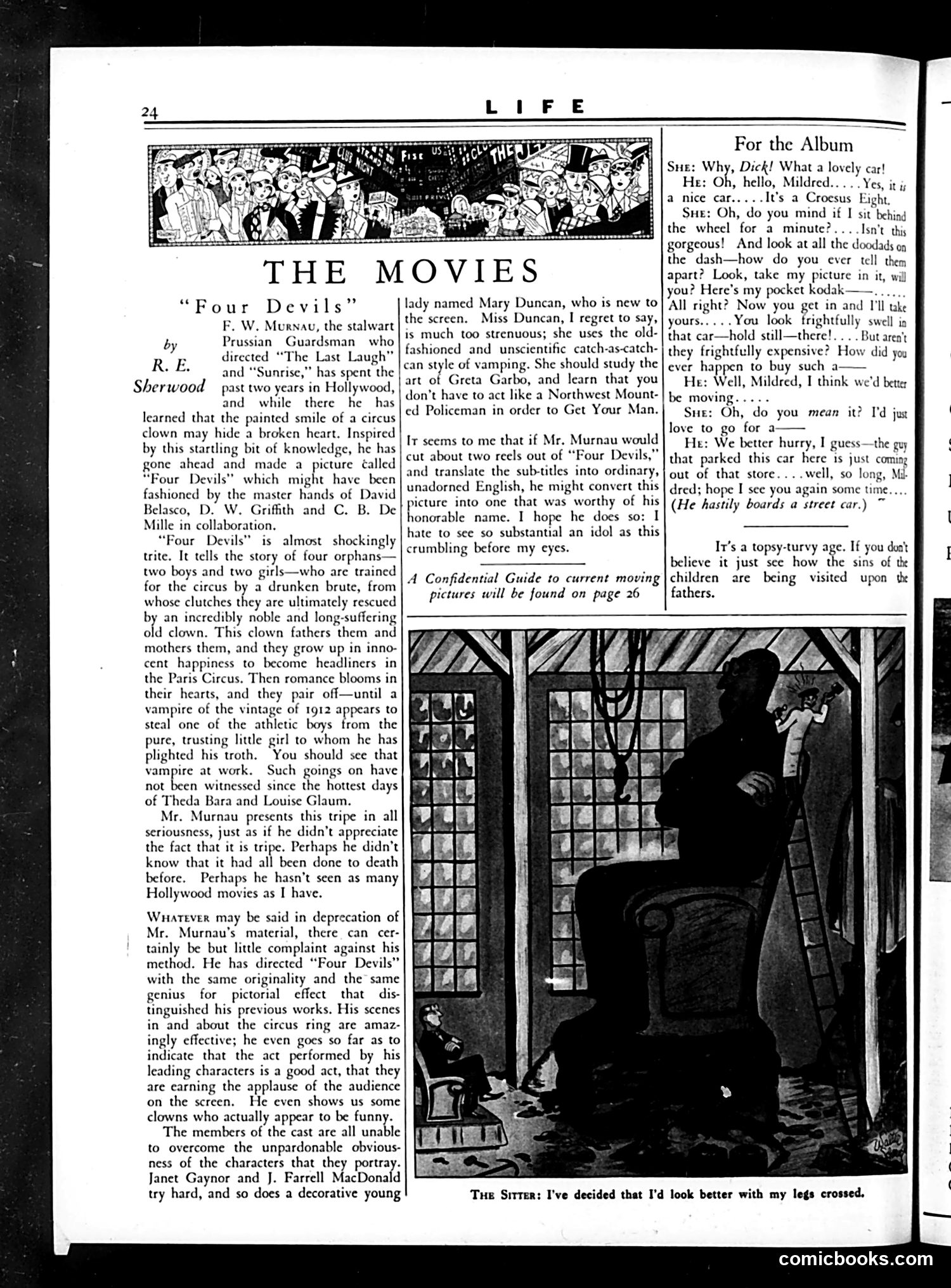
This page contains a **film review by R.E. Sherwood** of F.W. Murnau's movie "Four Devils" (a silent film about circus orphans). Sherwood criticizes the plot as derivative melodrama featuring outdated tropes—a drunken brute, noble clown, and a "vampire" character (seductress) reminiscent of 1910s silent-film stock characters like Theda Bara. He praises Murnau's directorial skill but finds the material trite. The **right column shows a social cartoon** satirizing the era's consumerism and courtship rituals. A woman enthuses over a man's expensive "Croesus Eight" automobile, requesting photos and asking intrusive questions about cost—reducing romantic interest to material display. The humor mocks both women's superficiality and the conspicuous consumption defining 1920s American culture. Together, the page reflects *Life* magazine's dual critique: Hollywood's reliance on worn-out narratives and the shallow materialism of modern social life.
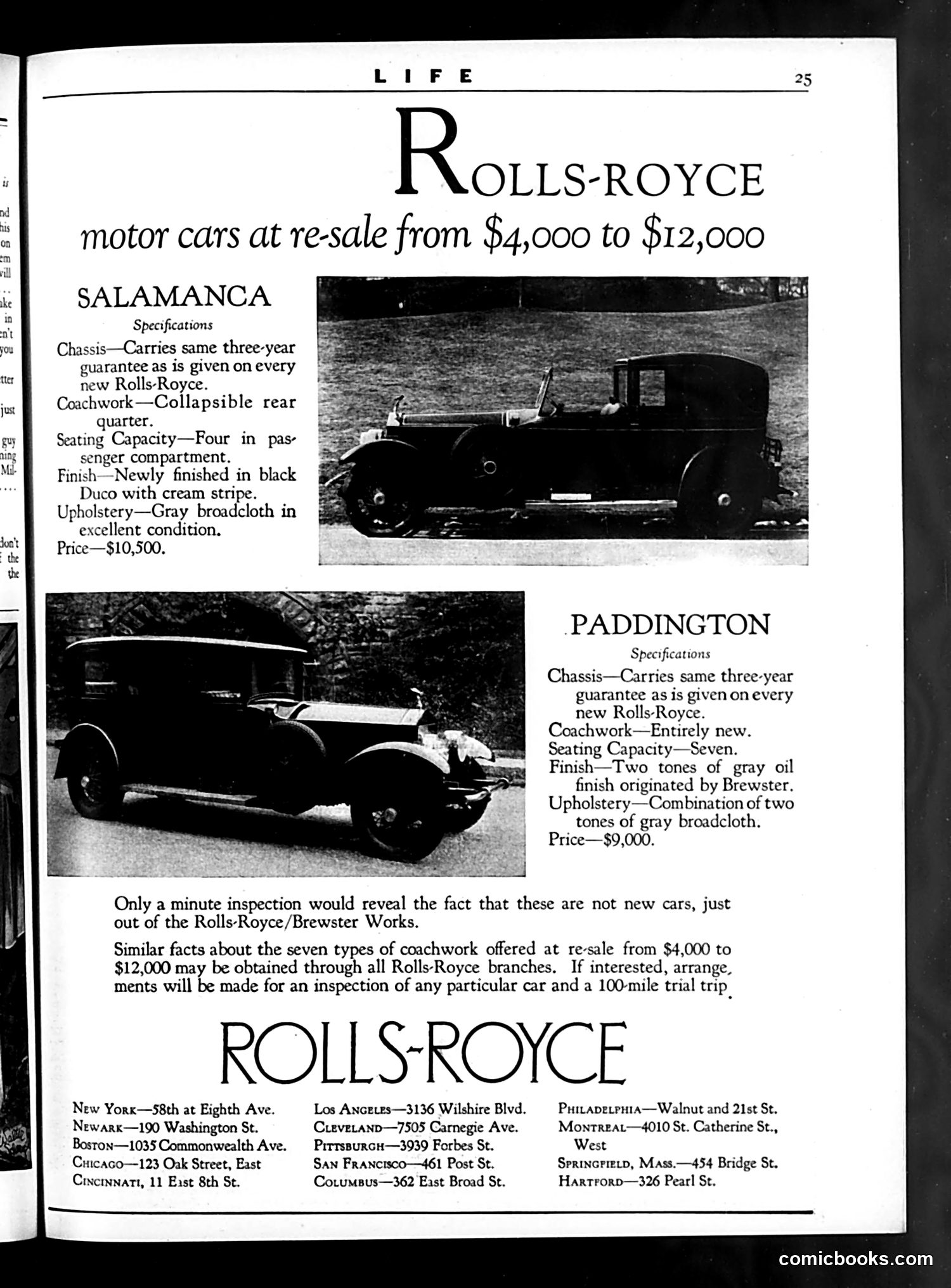
This is not satire—it's a straightforward advertisement for used Rolls-Royce automobiles. The page showcases two specific pre-owned models (Salamanca and Paddington) available through Rolls-Royce dealers, priced between $4,000–$12,000. The implicit humor lies in the candid admission that these are *not* new cars fresh from the factory, despite their pristine condition. The text acknowledges: "Only a minute inspection would reveal the fact that these are not new cars." This transparency about selling used luxury vehicles was likely novel marketing for the era—positioning second-hand Rolls-Royces as still-prestigious purchases carrying three-year warranties identical to new models. The ad emphasizes quality specifications (collapsible rear quarters, gray broadcloth upholstery) to reassure wealthy buyers that pre-owned didn't mean compromised luxury. The multiple branch locations suggest this was a significant sales channel during this period.
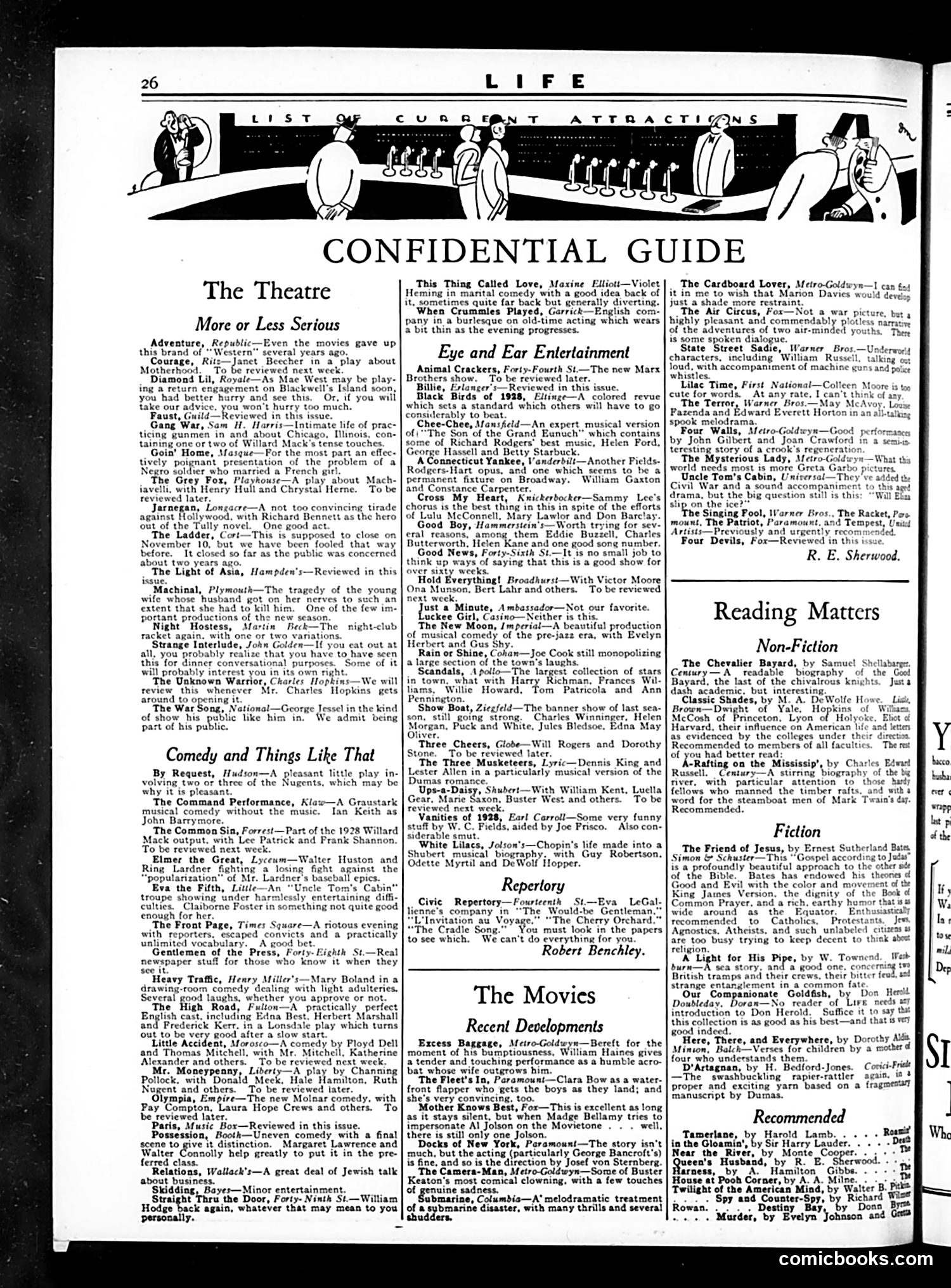
This page is a **theater review section** from *Life* magazine, not a political cartoon. It contains no caricatures or satire requiring historical context. The "Confidential Guide" offers brief, snappy reviews of Broadway plays currently running. The humor is *editorial tone*, not visual satire. For example, the review of *Diamond Lil* (Mae West's play) quips that "you had better hurry and see this. Or, if you will take our adv you won't hurry too much"—a backhanded insult suggesting the play might get West arrested soon. Other jokes mock specific shows: *The Ladder* "is supposed to close on November 10, but we have been fooled that way before"; *Strange Interlude* is so culturally mandatory "you probably realize that you have to have seen [it] for dinner conversational purposes." The magazine adopts a know-it-all, dismissive tone toward Broadway's offerings—typical 1920s *Life* magazine style: witty, urbane, slightly mean-spirited toward popular entertainment.
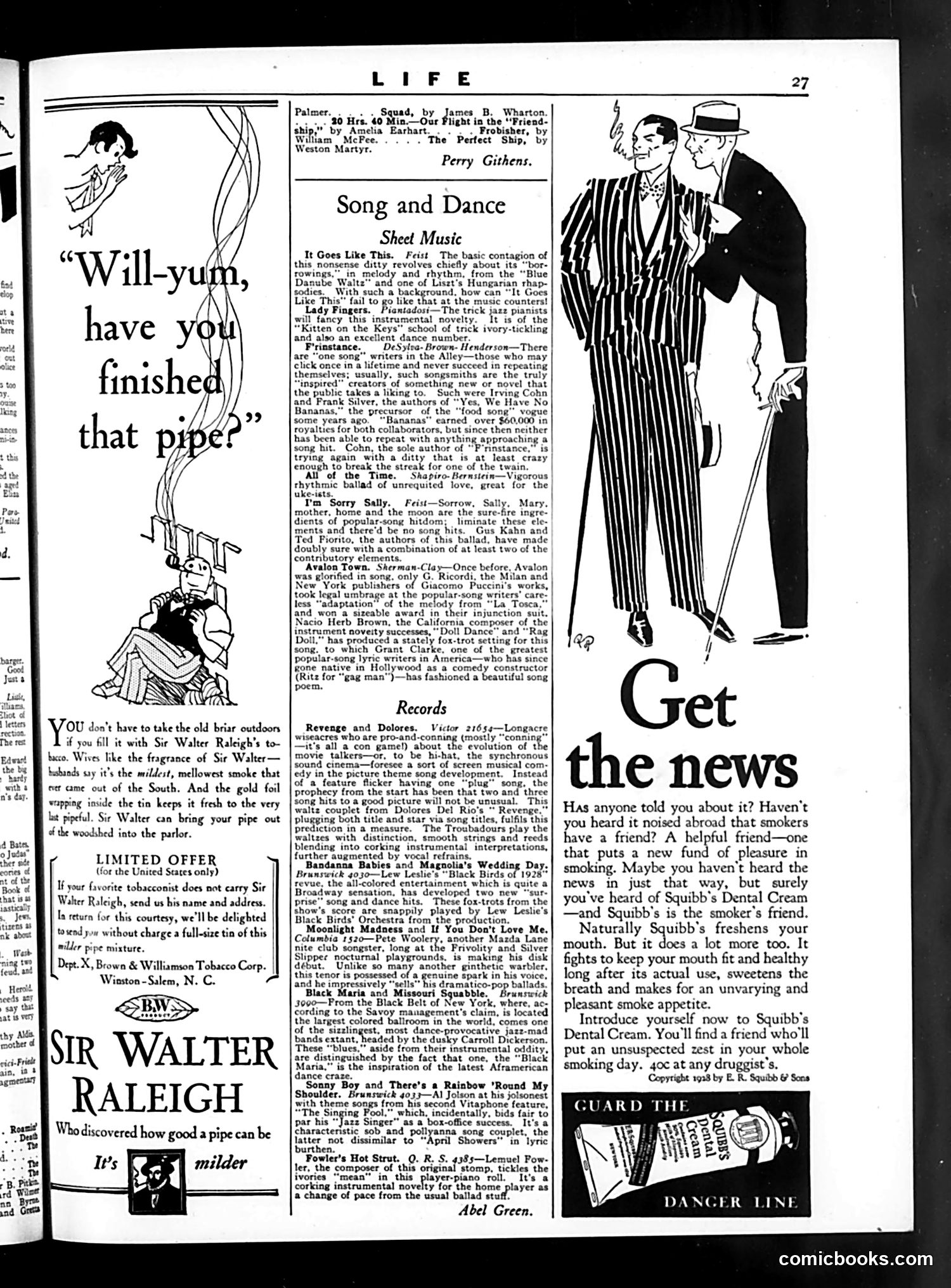
This page is primarily **advertising**, not satire. The main content is a Sir Walter Raleigh pipe tobacco advertisement featuring a humorous domestic scene: a wife asking her husband if he's finished smoking his pipe so he can rejoin her in the parlor rather than staying in the woodshed. The joke plays on tobacco marketing conventions of the 1920s-30s: the advertisement promises that Sir Walter Raleigh tobacco smells pleasant enough that wives won't mind their husbands smoking indoors. It's genteel advertising humor targeting male smokers by suggesting their wives will actually *approve* of this particular tobacco's "mild, mellowest" qualities. The page also contains music reviews and a Squibb's Dental Cream advertisement—typical Life magazine content of the era.
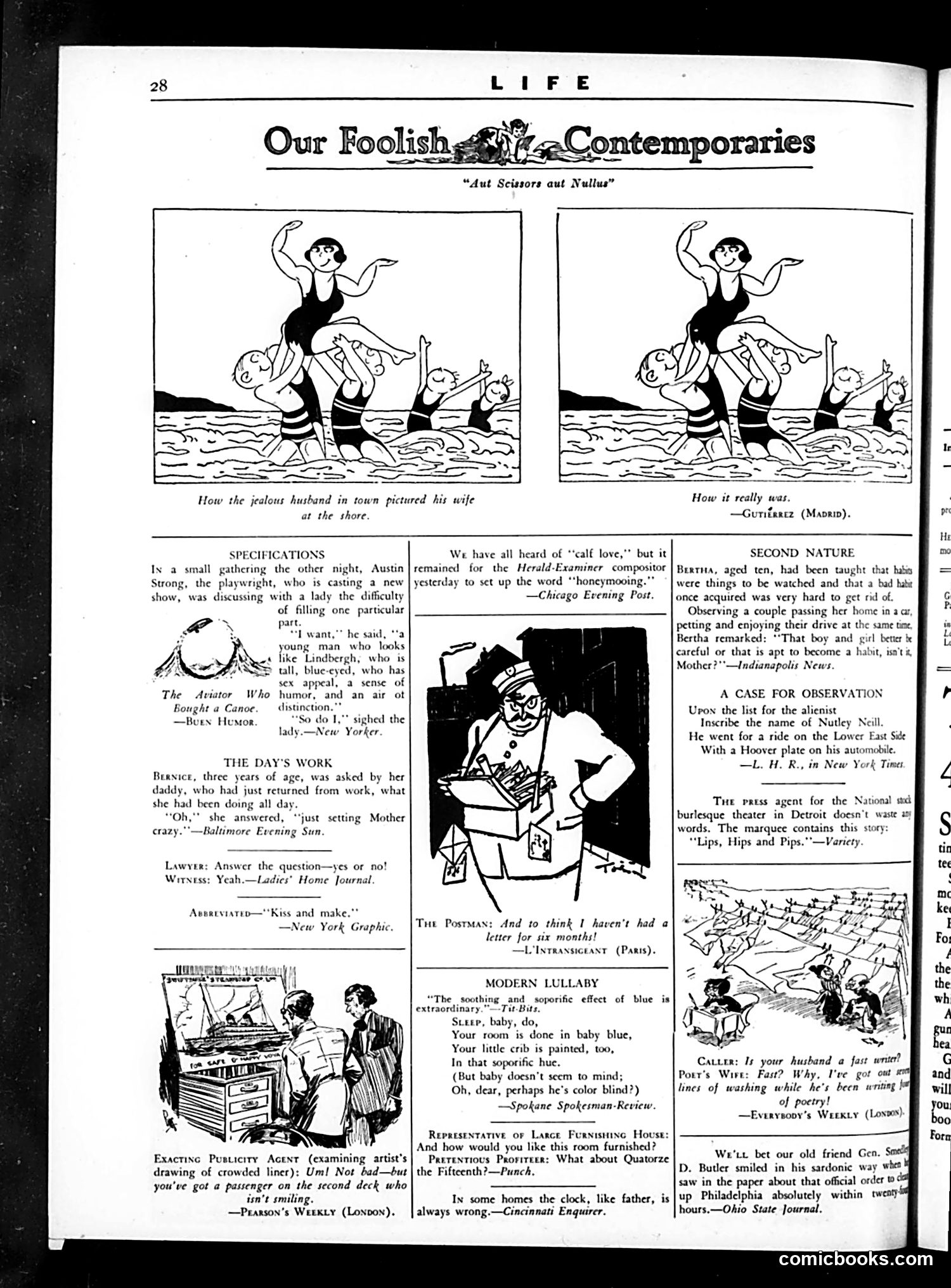
This page collects humorous quotes and cartoons from newspapers and magazines, mocking contemporary society and language. **Main cartoon**: Two side-by-side beach scenes contrast how a "jealous husband" imagines his wife behaving versus reality. The left shows her as a glamorous flirt surrounded by admiring men; the right shows the actual modest family scene. The satire mocks male jealousy and the gap between imagination and truth. **Other jokes target**: - Newspaper typos (a compositor writing "honeymooing" instead of the correct term) - Theatrical casting absurdities (an agent wanting an actor who looks like Lindbergh with "sex appeal") - Children's innocent honesty ("just setting Mother crazy") - Baby nursery design trends (blue rooms supposedly soothing, though the baby doesn't care) - Modern courtship behavior (youth "petting" in cars becoming a habit) The page's title, "Aut Scissors aut Nullus" (Latin: "Either scissors or nothing"), suggests editorial cutting of submitted content. These are typical *Life* magazine filler pieces satirizing contemporary manners, language, and social pretension.
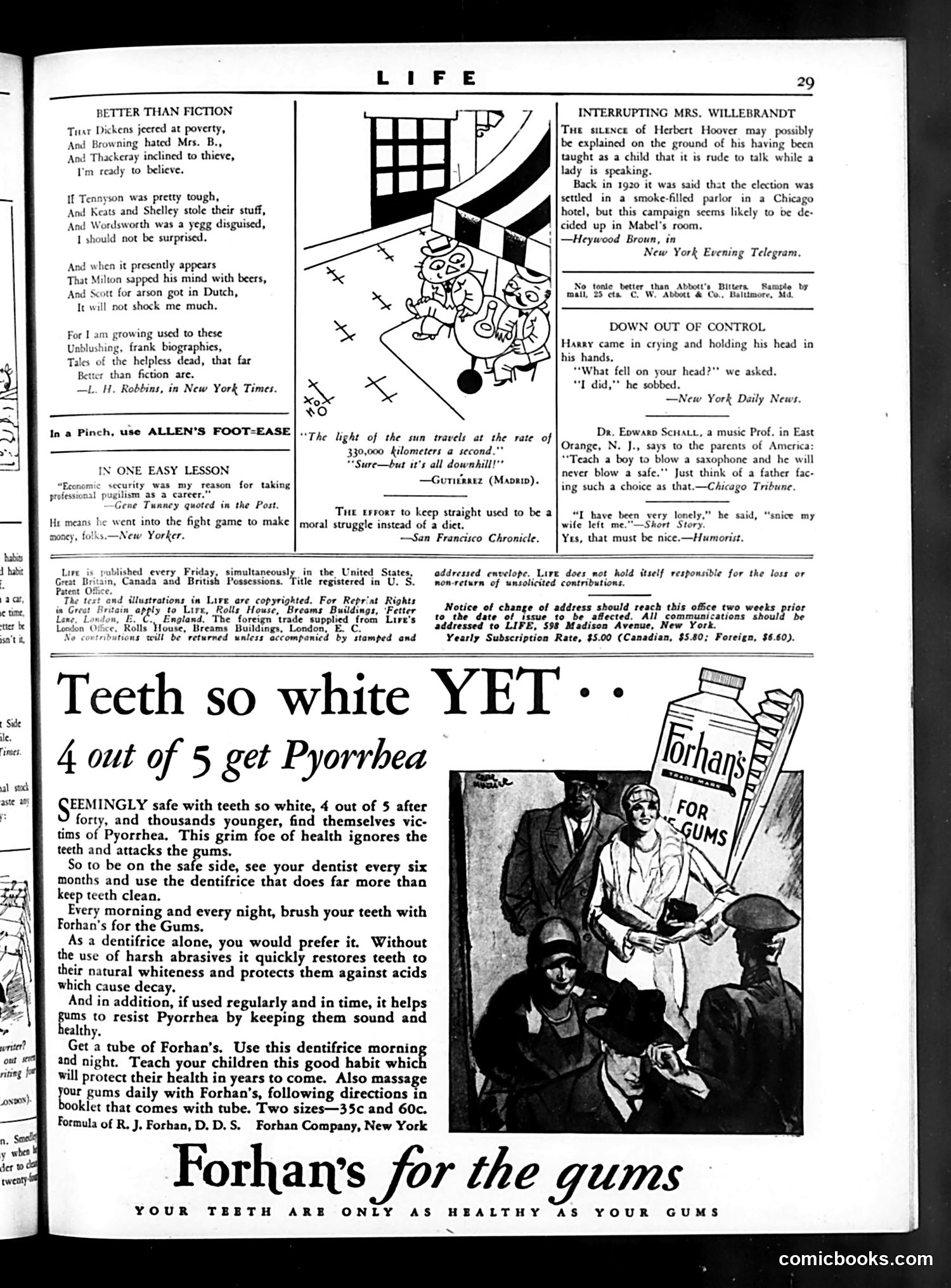
This page contains brief satirical pieces typical of Life's humor section, plus a Forhan's toothpaste advertisement. **The Poetry/Satire Section:** The main feature is a poem by L.H. Robbins mocking the modern trend of "debunking" literary giants through unauthorized biographies. The satire suggests that revelations about famous writers' personal flaws (Dickens, Tennyson, Shelley, etc.) have become so common that nothing shocks readers anymore. This reflects 1920s-era publishing's appetite for scandalous biographies of historical figures. **The Brief Jokes:** Include commentary on boxer Gene Tunney's remarks about professional boxing, observations about political campaigning, and references to Herbert Hoover's silence during an election (possibly the 1928 campaign). One joke references "Mabel's room," likely alluding to the 1920 Republican convention's "smoke-filled room." **Bottom Section:** A substantial Forhan's dentifrice advertisement warning that white teeth can mask gum disease (pyorrhea), promoting regular dental care—typical health advertising of the era. The page reflects 1920s concerns: debunking culture, boxing, politics, and periodontal disease awareness.
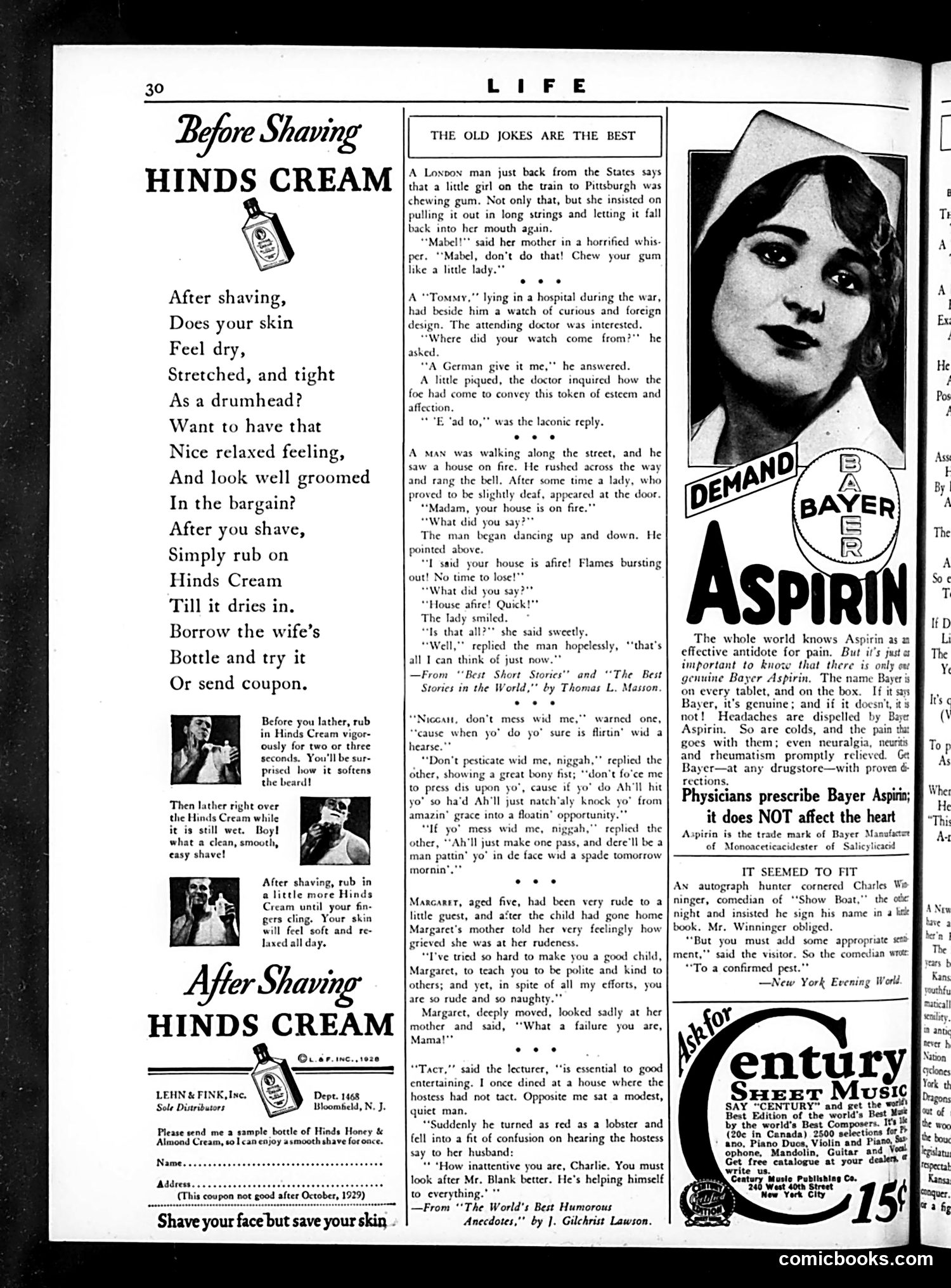
This page is primarily **advertising** for Hinds Cream shaving product, with the left side showing product copy and usage instructions in illustrated panels. The right side contains "The Old Jokes Are the Best"—a humor column featuring several brief anecdotes. These appear to be vintage jokes recycled from earlier sources (credited to Thomas L. Masson's collections). The jokes include: 1. A child chewing gum impolitely on a train 2. A WWI soldier explaining a German watch with "E 'ad to" 3. A slapstick scene about a man trying to warn a deaf woman her house is on fire 4. Dialect humor involving African American characters using aggressive slang 5. A child telling her mother she's "a failure" for not teaching manners 6. A dinner party anecdote about tactlessness The column's title suggests these are older, well-worn jokes being recycled—humor that relies on physical comedy, wordplay, and social embarrassment rather than topical satire. The dialect humor reflects period attitudes typical of 1920s publications.
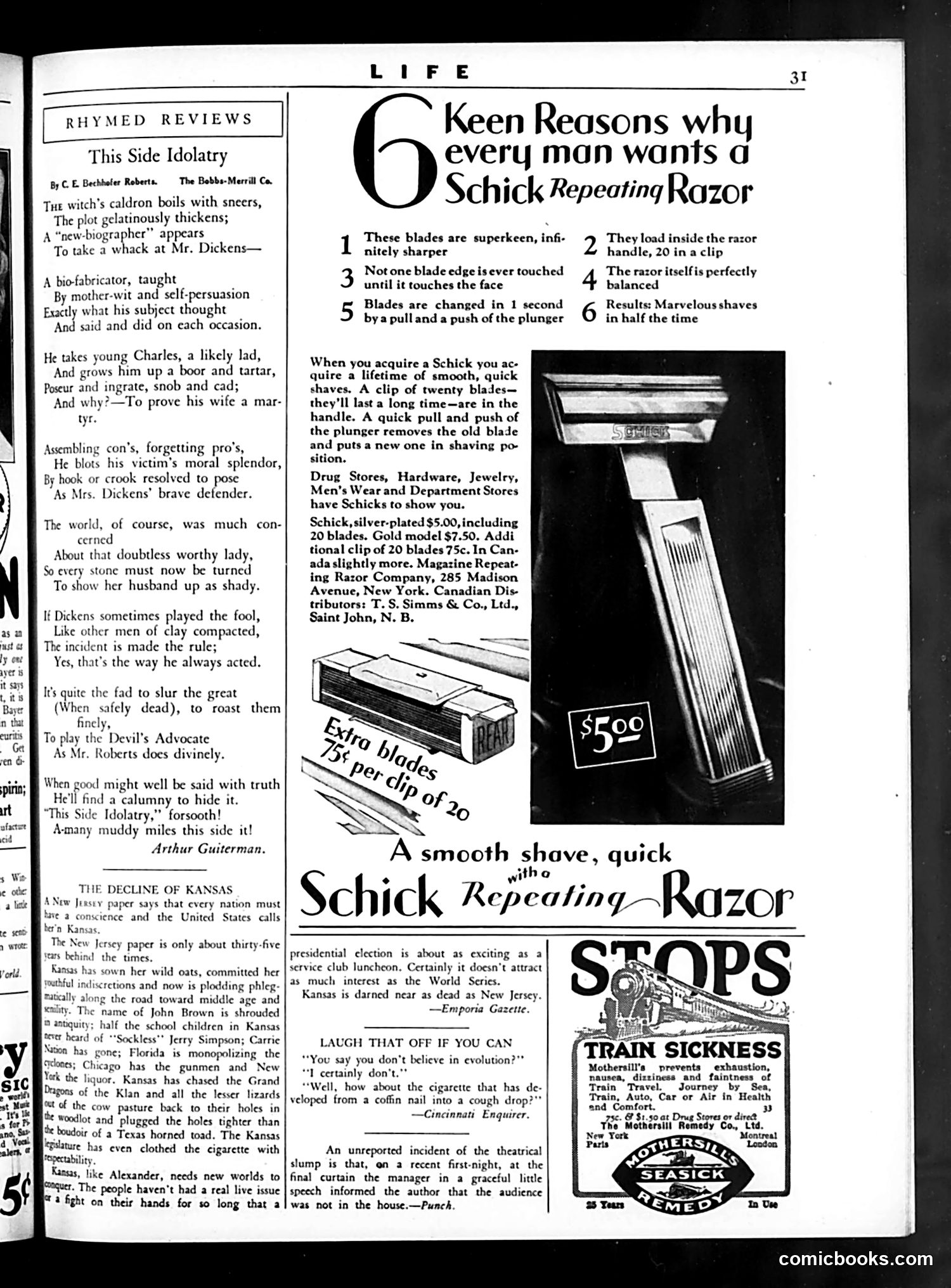
This page contains primarily advertisements, with some satirical poetry. The main content is an extended **Schick Repeating Razor advertisement** featuring "6 Keen Reasons why every man wants a Schick Repeating Razor" — promoting its blade-changing mechanism and shaving efficiency. The left column features **"This Side Idolatry,"** a poem by Arthur Guiterman criticizing biographers (apparently of Charles Dickens) who fabricate negative stories about historical figures to create dramatic narratives. The poet satirizes the fashion of portraying great men unfairably after their death, turning isolated incidents into character flaws. Below that, a brief satirical note about **Kansas's decline** observes that the state once notable for radical figures (John Brown, "Sockless Jerry Simpson") and progressive causes has become as culturally "dead" as New Jersey. The page also includes small humorous observations and an advertisement for **Mothersill's Remedy** for motion sickness.
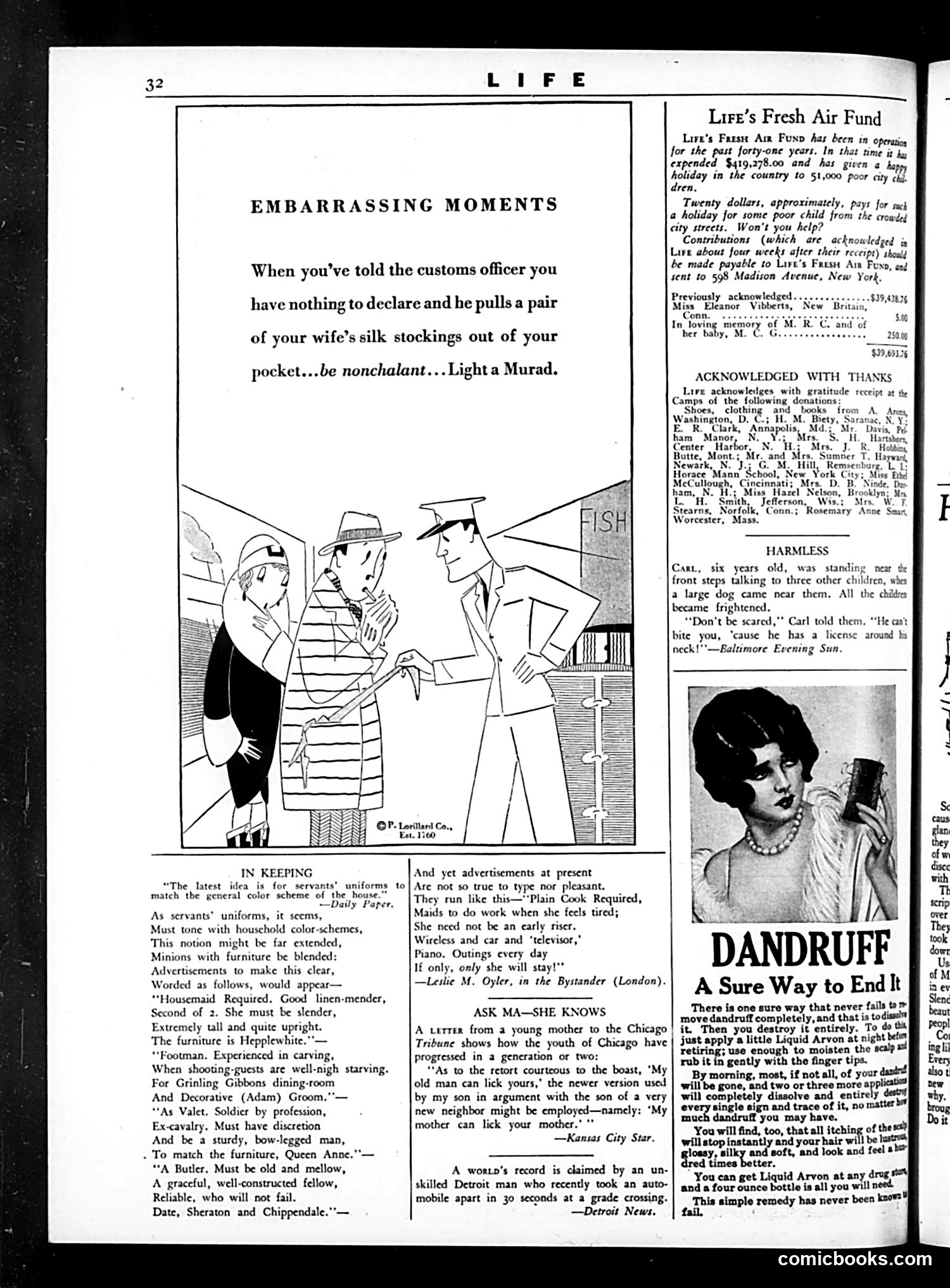
This page contains three separate satirical pieces: 1. **"Embarrassing Moments"** (top cartoon): A husband awkwardly faces a customs officer who has discovered silk stockings in his pocket—implying he was smuggling them or hiding them from his wife. The joke plays on marital embarrassment and 1920s-era anxiety about luxury goods and infidelity. 2. **"In Keeping"** (middle section): A humorous poem satirizing a newspaper trend where servant uniforms were being color-coordinated with household furniture. The piece mocks this by imagining absurd job listings where servants themselves must physically match furniture styles (a tall maid for "Hepplewhite," a bow-legged valet for "Queen Anne" furniture). 3. **"Ask Ma—She Knows"** (bottom): A advice column discussing how modern youth lack respect, contrasting old insults ("my old man can lick yours") with new ones where children insult each other's mothers instead. The page also includes charity notices for Life's Fresh Air Fund (sending poor city children to the country) and a Dandruff remedy advertisement.
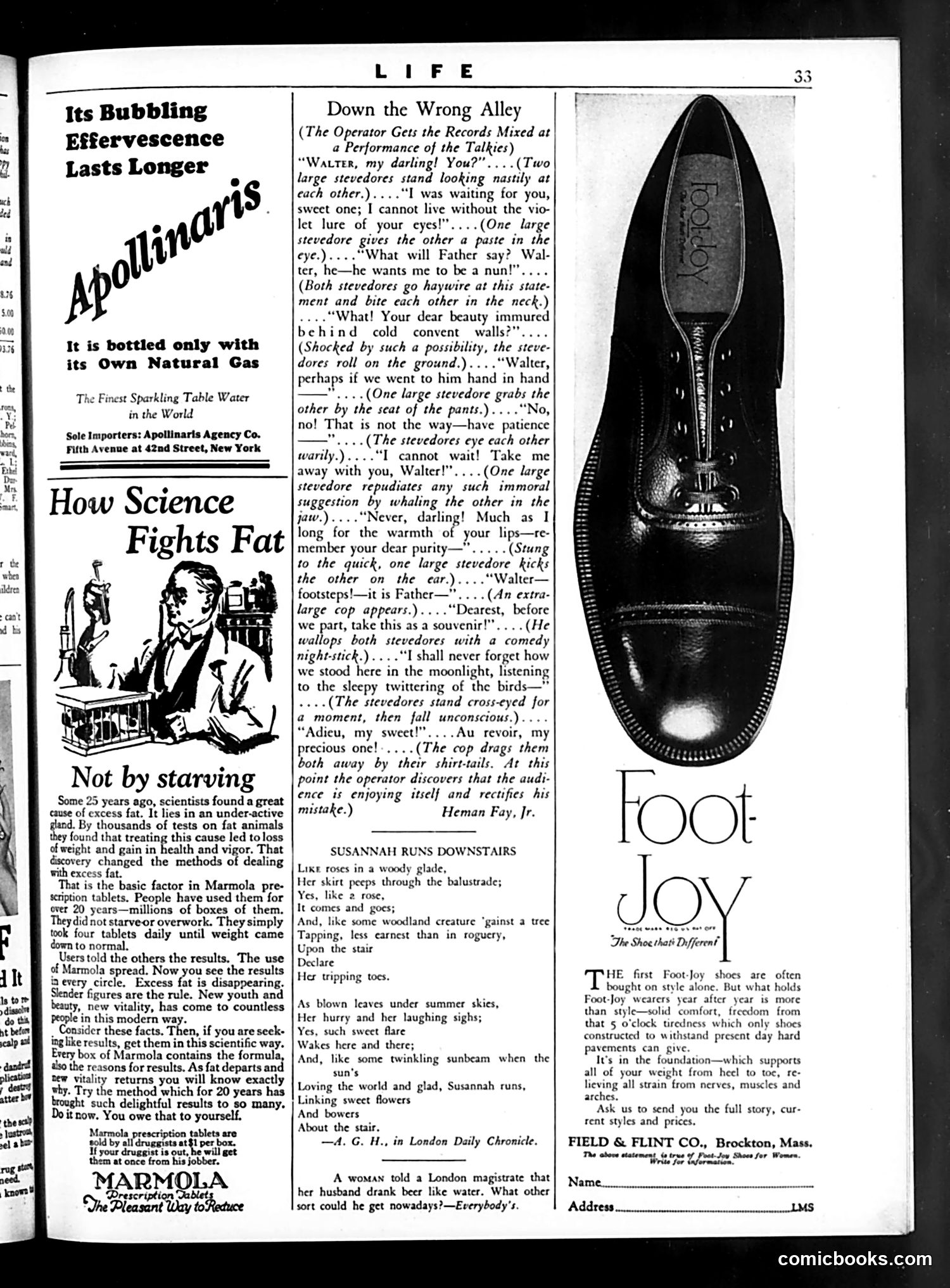
This is a satirical piece about **early "talking pictures" (talkies)** and the new technology's vulnerabilities. The joke: a projectionist accidentally plays the wrong film soundtrack during a romantic drama performance. The audience expects a sentimental love scene between refined characters ("Walter, my darling!"). Instead, they hear this dialogue paired with footage of **two large dock workers (stevedores)** engaging in slapstick violence—punching, biting, kicking each other in the eyes and ears in response to the romantic dialogue. The humor mocks both: 1. **The absurdity of mismatched sound/film** in early talkies 2. **Class contrast**: genteel romantic language contradicted by brutish working-class behavior and violence 3. **The operator's eventual realization** that audiences prefer the chaotic mistake to the intended sentimental film The satire comments on how new sound technology could fail spectacularly, and perhaps suggests audience taste for physical comedy over saccharine romance.
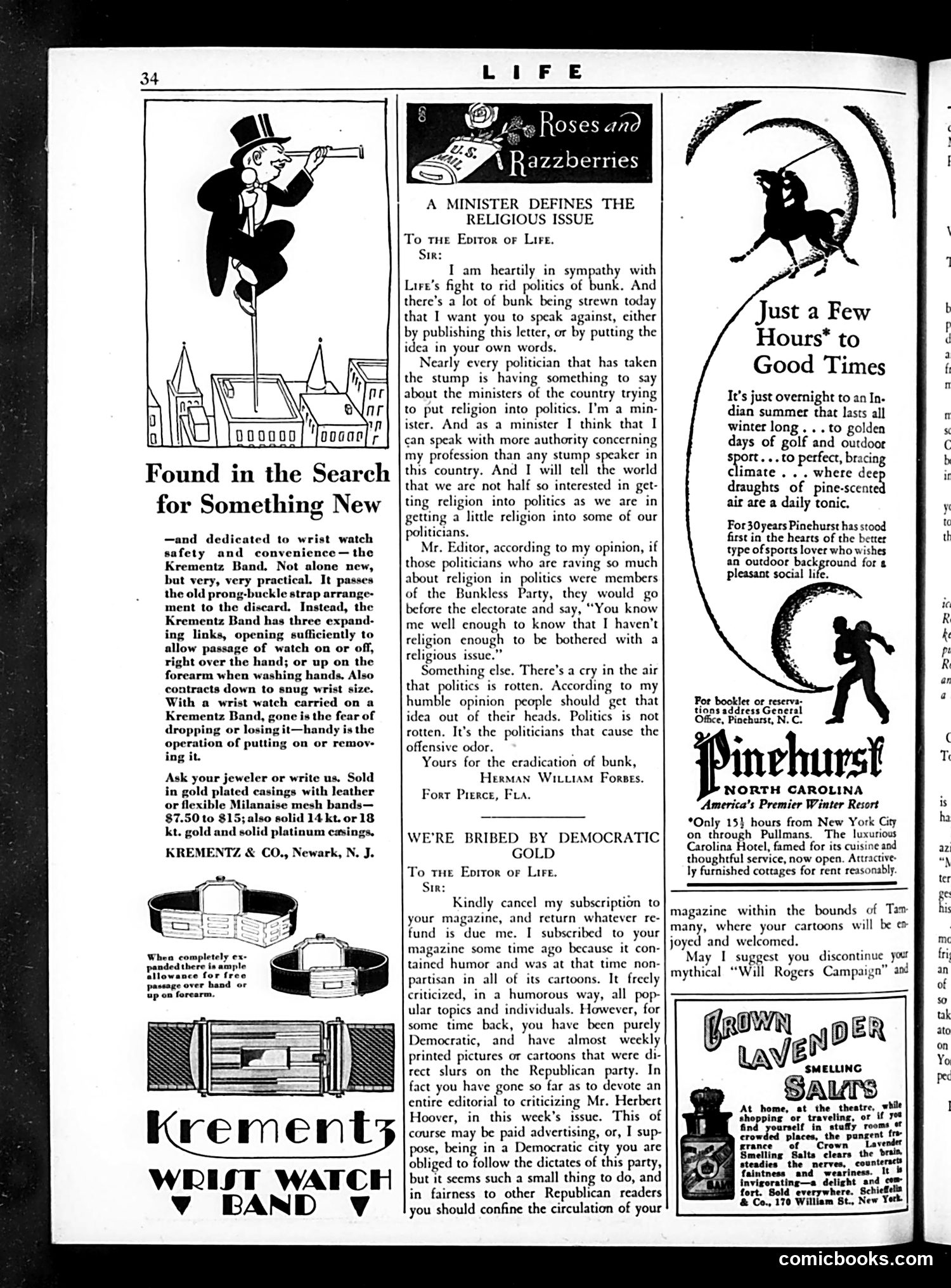
This Life magazine page (likely 1920s-early 1930s) contains reader letters debating political bias and religion in politics—issues strikingly relevant today. **Left cartoon**: A caricatured politician with exaggerated features stands on a church steeple, using a telescope. This satirizes politicians exploiting religion for electoral gain—the central complaint of Rev. Herman William Forbes's letter, which argues politicians insert "religion into politics" rather than bringing actual morality to government. **Main controversy**: A Republican subscriber accuses Life of Democratic bias, claiming the magazine once-nonpartisan now regularly attacks Republicans (specifically Herbert Hoover). Life responds dismissively, suggesting the reader is overly sensitive. **The irony**: Both letters highlight how "bias" accusations are perennial—politicians blame clergy for politicizing faith; readers blame magazines for partisan coverage. The substance of these complaints remains virtually unchanged in modern political discourse. The page is predominantly advertisements and letters, with satire directed at political hypocrisy rather than specific individuals.
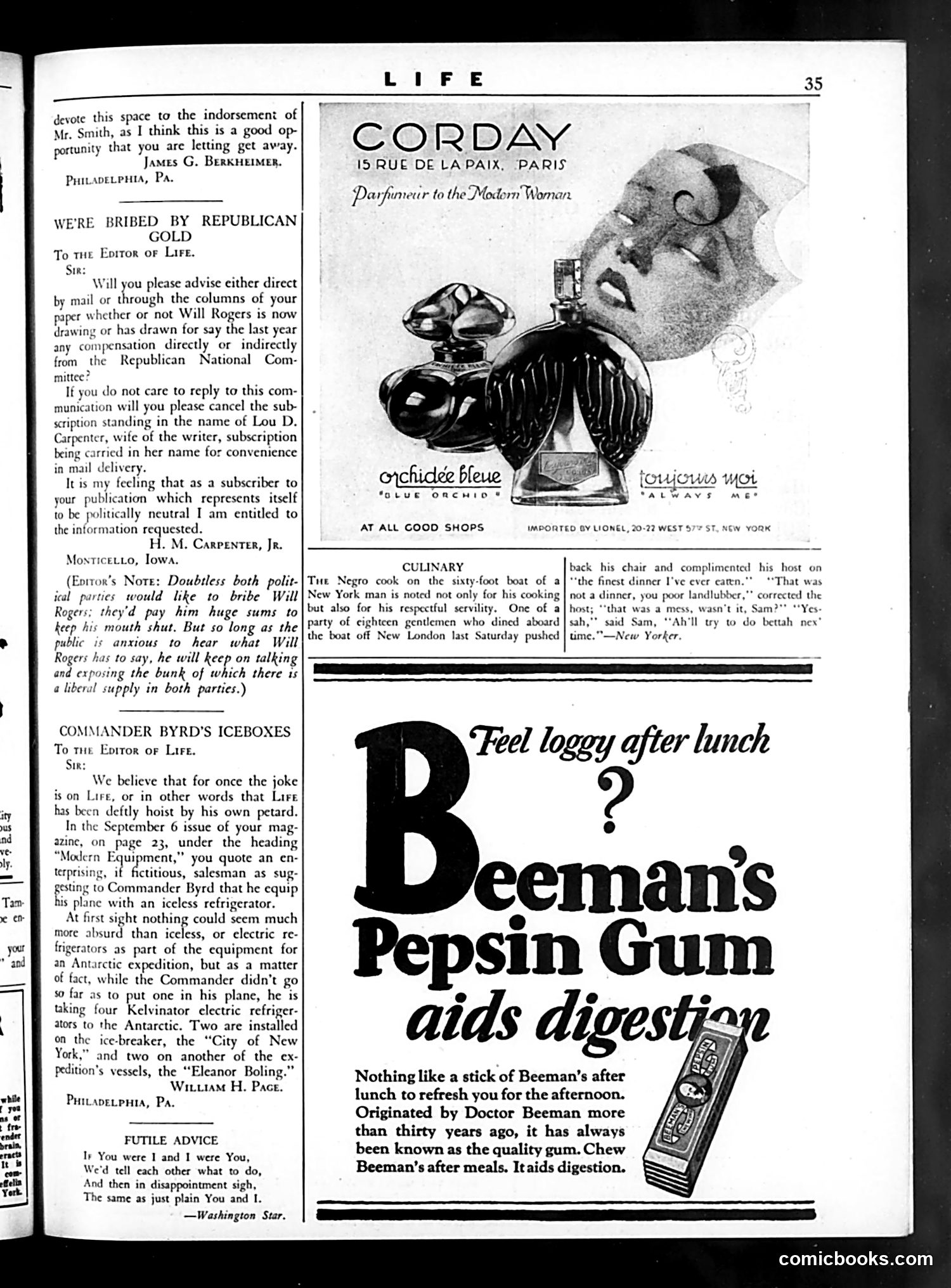
This page contains **reader letters and advertisements** rather than political cartoons. The notable content is two satirical **letters to the editor**: 1. **"Bribed by Republican Gold"**: A reader demands Life reveal whether humorist Will Rogers receives Republican funding, threatening to cancel his wife's subscription if they don't answer. Life's editor sardonically responds that both parties would *pay* Rogers to stay silent, but the public wants his commentary exposing political "bunk." 2. **"Commander Byrd's Iceboxes"**: A reader mocks Life for suggesting electric refrigerators for an Antarctic expedition as absurd—only to be corrected that Commander Byrd actually *is* taking Kelvinator refrigerators on his polar expedition, making Life's supposed joke reality. Both letters reflect 1920s anxieties about **media independence, political neutrality, and the embarrassment of being fact-checked by readers**. The page also includes perfume and digestive gum advertisements typical of the era.
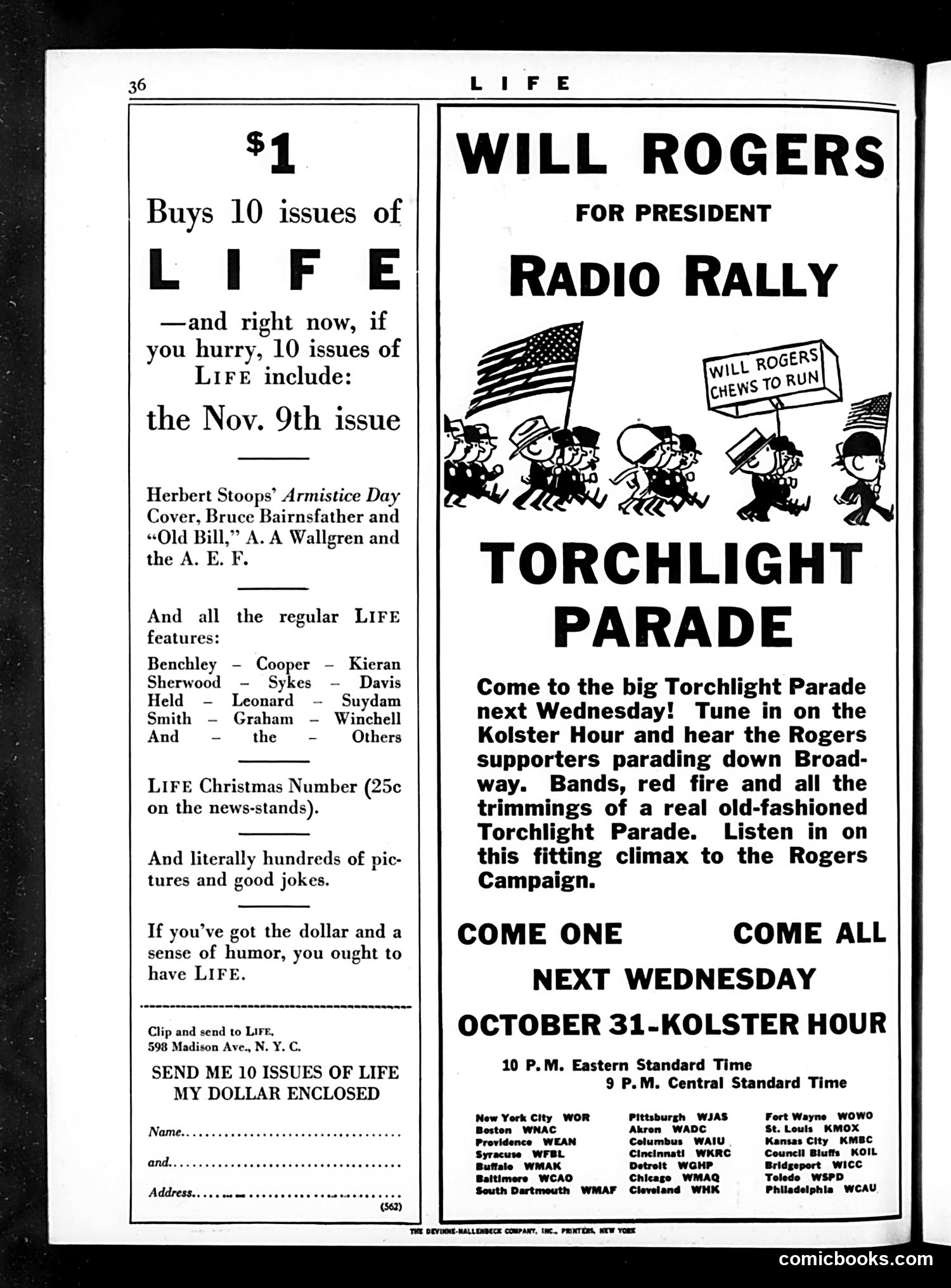
This page is primarily **advertising**, not political satire. It promotes a "Will Rogers for President" radio rally scheduled for October 31st—presented as humorous, tongue-in-cheek political theater rather than a serious campaign. **The content:** - Left side: subscription offer for *Life* magazine ($1 for 10 issues) - Right side: promotional advertisement for a torchlight parade and radio broadcast celebrating Will Rogers's mock presidential candidacy **Context for modern readers:** Will Rogers was a famous humorist and social commentator of the 1920s-30s. This appears to be a satirical stunt—presenting Rogers as a presidential candidate as a joke. The "torchlight parade" references 19th-century political rallies. The cartoon shows cartoon characters with a "Will Rogers Chews to Run" sign, treating the candidacy as entertainment rather than serious politics. The ad emphasizes the humorous nature ("if you've got...a sense of humor") and lists numerous radio stations carrying the broadcast, suggesting this was a coordinated, lighthearted media event rather than genuine political campaigning.
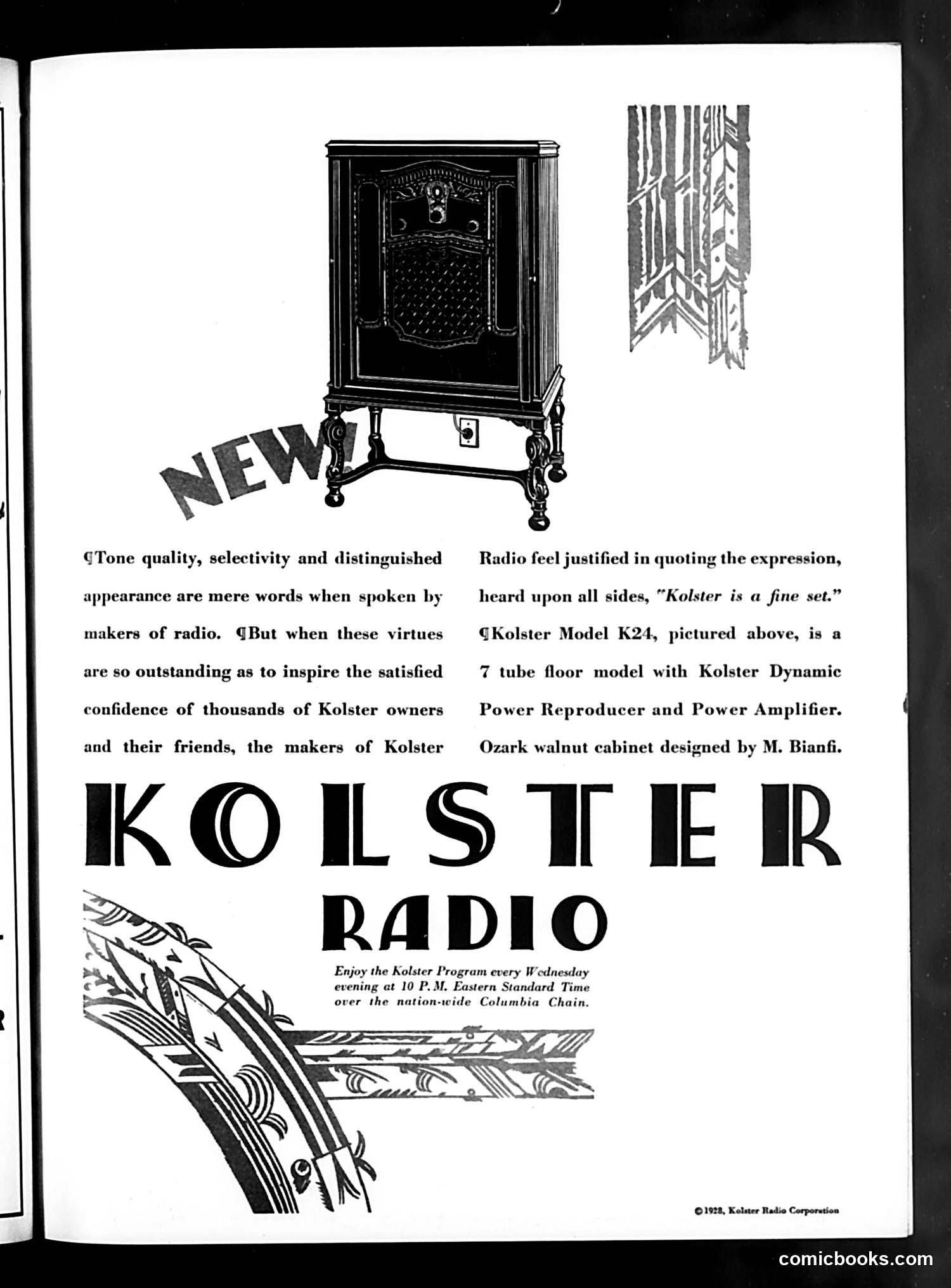
The page advertises the Kolster Model K24 radio receiver, a luxury floor model with a walnut cabinet. There are no cartoons or satirical figures present. The ad emphasizes quality attributes—"tone quality, selectivity and distinguished appearance"—and claims thousands of satisfied owners endorse the product as "a fine set." It highlights technical features like the "Dynamic Power Reproducer and Power Amplifier" and mentions a weekly Kolster radio program broadcast Wednesdays at 10 P.M. over Columbia's nationwide chain. The decorative illustrations are Art Deco-style designs accompanying the brand name, not satirical content. This represents 1920s consumer marketing for early home electronics, when radios were expensive furniture pieces marketed to affluent audiences.
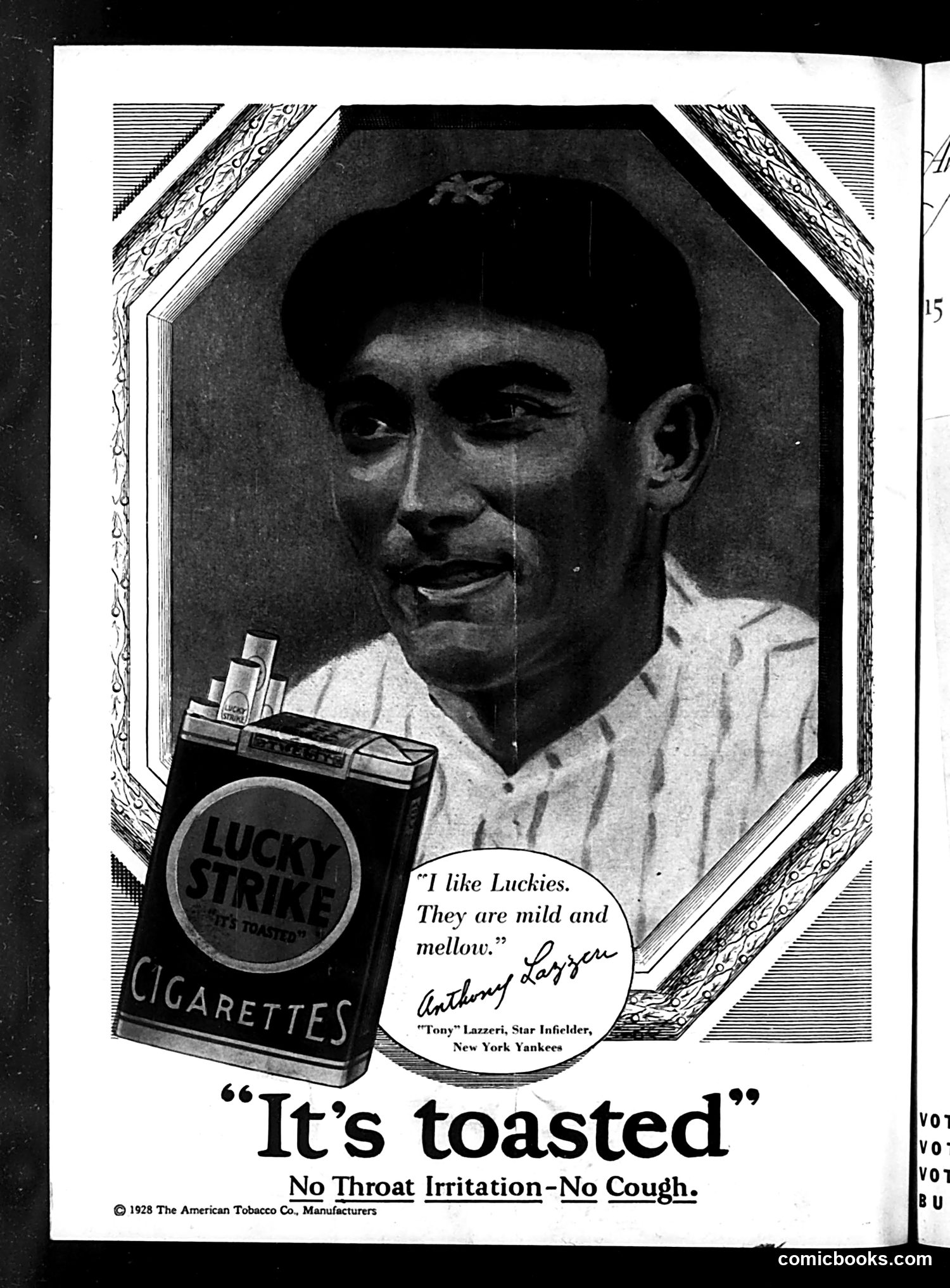
This is a Lucky Strike cigarette advertisement featuring "Tony" Lazzeri, identified as a star infielder for the New York Yankees. The ad claims cigarettes are "mild and mellow" with "No Throat Irritation—No Cough," a common marketing pitch of the era. The satire likely lies in Life magazine presenting this endorsement: Lazzeri's athletic credibility is used to legitimize health claims about cigarettes that modern readers recognize as false. By 1928, cigarette advertising routinely featured prominent athletes and celebrities making dubious health assertions. The phrase "It's toasted" was Lucky Strike's distinctive marketing slogan, implying a superior manufacturing process. This represents pre-regulation tobacco advertising when such claims faced no FDA scrutiny.