
Life, 1928-10-26 · page 28 of 40
Life — October 26, 1928 — page 28: what you’re looking at
What you’re looking at
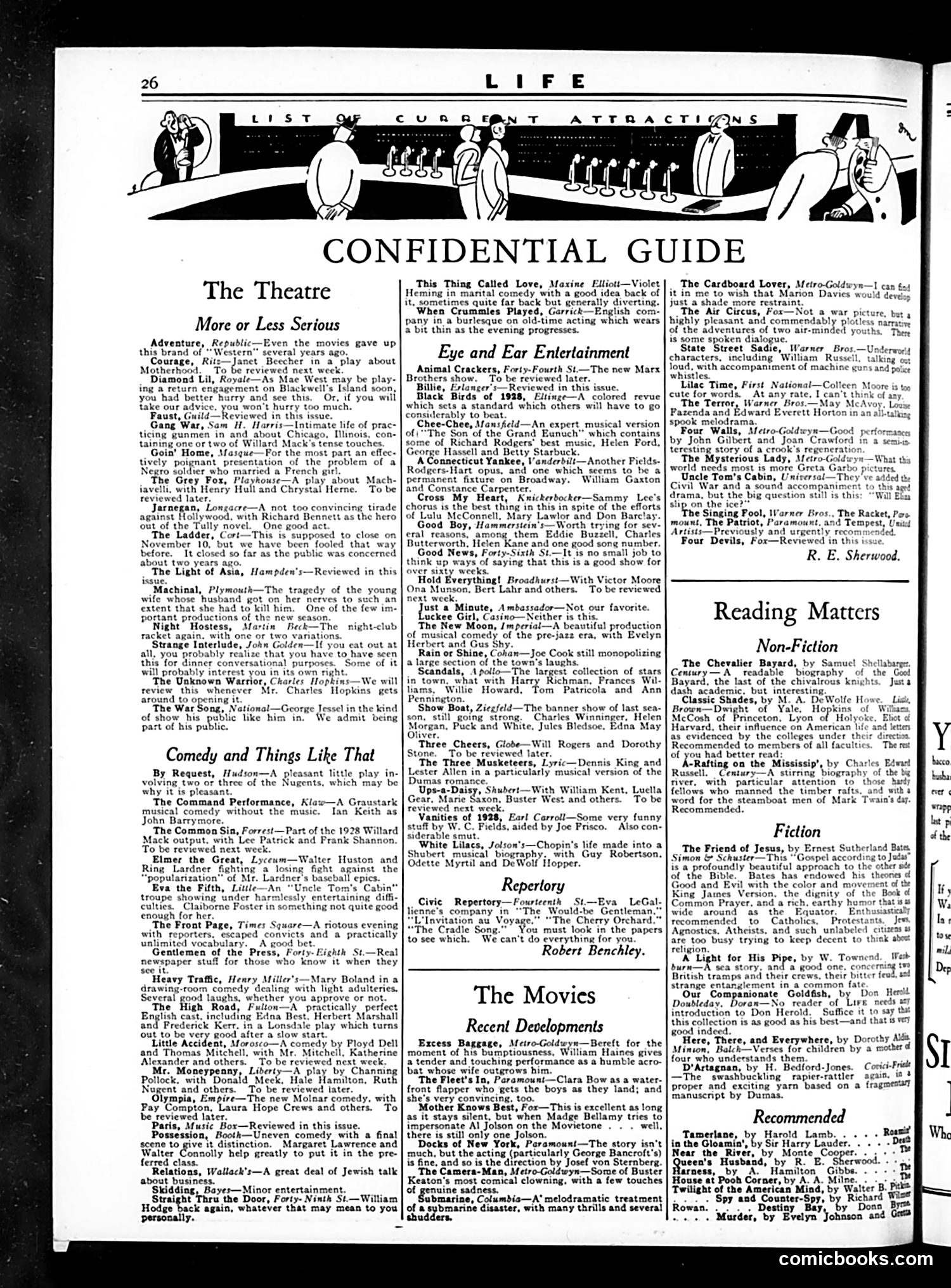
This page is a **theater review section** from *Life* magazine, not a political cartoon. It contains no caricatures or satire requiring historical context. The "Confidential Guide" offers brief, snappy reviews of Broadway plays currently running. The humor is *editorial tone*, not visual satire. For example, the review of *Diamond Lil* (Mae West's play) quips that "you had better hurry and see this. Or, if you will take our adv you won't hurry too much"—a backhanded insult suggesting the play might get West arrested soon. Other jokes mock specific shows: *The Ladder* "is supposed to close on November 10, but we have been fooled that way before"; *Strange Interlude* is so culturally mandatory "you probably realize that you have to have seen [it] for dinner conversational purposes." The magazine adopts a know-it-all, dismissive tone toward Broadway's offerings—typical 1920s *Life* magazine style: witty, urbane, slightly mean-spirited toward popular entertainment.
📄 Transcribed text from this page (OCR, searchable)
Machine-transcribed from the original scan — historical spelling and the odd misread are preserved.
CONFIDENTIAL GUIDE The Theatre More or Less Serious Adventure, Republic—Even the movies gave up this brand of’ “Western” several years ago. Courage, Ritz—Janet Beecher in a play about Motherhood. To be reviewed next week. Diamond Lil, Royale—As Mae West may be play- ing & return ¢ ge me: on Blackwell's Island soon, you had better hurry and see this. Or, if you will take our adv you won't hurry too much. Faust, Guild—Reviewed in this issue. Gang ‘War, Sam H. Harris—Int' ticing gunmen in and about Chicago, Ilinois, con- taining one or two of Willard Mack's tense touches. Goin’ Home, Afasque—For the most part an effec- tively poignant presentation of the problem of a Negro soldier who married a French giel The Grey Fox, Playkouse—A play about Mach- iavelli, with Henry Hull and Chrystal Herne. To be reviewed later. Jarnegan, Longacre—A not too convincing against Hollywood, with Richard Bennett as th out of the Tully novel. One good act. The Ladder, Cort—This is supposed to close on November 10,’ but we have been fooled that way before. It closed so far as the public was concerned about two years ago. The Light of Asia, Hampden's—Reviewed in this issue. Machinal, Plymouth—The tragedy of the young wife whose ‘husband got on her nerves to such an extent that she had to kill him. One of the few im- portant productions of the new season. Night Hostess, Martin Beck—The racket again, with one or two variations. Strange Interlude, John Golden—I{ you eat out at all, you probably realize at you have to have seen this for dinner conversational purposes. of it will probably interest you in its own right. The Unknown Warrior, Charles Hopkins—We will review this whenever Mr. Charles Hopkins gets around to opening it. The War Song, National—Gcorge Jessel in the kind of show his public like him We admit being life of prac- irade hero night-club part of his public. Comedy and Things Like That By Request, Hudson—A pleasant little volving two three of the why it is pleasant. The Command Performance, Klaw—A Grau musical comedy without the music. Ian Ke John Barrymore. The Common Sin, Forrest—Part of the 1928 Willard Mack output, with Lee Patrick and Prank Shannon. To be reviewed next week. Elmer the Great, Lyceum—Walter Hust Ring Lardner fighting a losing fight again: “popularization” of Mr. Lardner's baseball epics. Eva the Fifth, Littk—An “Uncle Tom's Cabin” troupe showing under harmlessly entertaining diffi. culties. Claiborne Foster in something not quite good enough for her. . ‘The Front Page, Times Square—A riotous evening with reporters, escaped convicts and a practically unlimited vocabulary. A good bet. Gentlemen of the Press, Forty- Eighth St.—Real newspaper stuff for those who know it when they see it Heavy Traffic, Henry Miller's—Mary Boland in a comedy dealing with light adulteries. 2 s, whether you approve or not. The High Road, Fulton—A practically perfect English cast, including Edna Best. Herbert Marshall and Prederick Kerr. in a Lonsdale play which turns out to be very good after a slow start. ittle Accident, Morosco—A comedy by Ployd Dell and Thomas Mitchell, with Mr. Mitchell, Katherine lexander and others. To be reviewed next week. Mr. Moneypenny, Liberty—A play by Channing Pollock. with Donald Meek, Hale Hamilton, Ruth Nugent and others. To be reviewed later. Olympia, Empire—The new Molnar comedy, with Pay Compton, Laura Hope Crews and others. To be reviewed later, ‘ Paris, Music Bor—Reviewed in this issue. Possession, Booth—Uneven comedy with a final scene to give it distinction. Margaret Lawrence and Walter Connolly help greatly to put it in the pre- ferred class. Relations, Wallack's—A great deal of Jewish talk about business. Bayes—Minor entertainment. ‘Thru the Door, Fort th Si—Wiltiam ck again, whatever that may mean to you play in Nugents, which may be ark as and the This Thing Called Love, Maxine Elliott—Violet Heming in mantal comedy with a good idea back of it, sometimes quite far back but generally diverting, When Crummles Played, Garrick—English com- pany in a burlesque on old-time acting which wears a bit thin as the evening progresses. Eye and Ear Entertainment Animal Crackers, Forty-Fourth St—The new Marx Brothers show. TO be reviewed later. Billie, Erlanger’s—Reviewed in this issue. Black Birds of 1928, Fitinge—A colored revue which sets a standard which others will have to go considerably to beat. Chee-Chee, Mansfield—An expert, musical version of | f the Grand Eunuch” which contains some of Richard Rodgers’ best music, Helen Ford, George Hassell and Betty Starbuck, ‘A Connecticut Yankee, Vanderbilt—Another Pields- Rodgers-Hart opus, and one which seems to be a nt fixture on Broadway. William Gaxton and Constance Carpenter. Cross My Heart, Knickerbocker—Sammy Lee's chorus is the best thing in this in spite of the efforts of Lulu McConnell, Mary Lawlor and Don Barclay. Good Boy, Hammerstein's—Worth trying for sev- eral reasons, among them Eddie Buzzell, Charles Butterworth, Helen Kane and one good song number. Good News, Forty-Sixth St.—It 1s no small job to think up ways of saying that this is a good show for over sixty weeks. Hold Everything! Broadhurst—With Victor Moore Ona Munson, Bert Lahr and others. To be reviewed next week. {8st Minute, mbassador—Not our favorite. uckee Girl, Casino—Neither is this. The New Moon, Jmperial—A beautiful production of musical comedy of the pre-jazz era, with Evelyn jh Rain or Shine, Cohan—Joe Cook still monopolizing a large section of the town’s laughs. Scandals, pollo—The largest collection of stars in town, what with Harry Richman, Prances Wil- liams, Willie Howard, Tom Patricola and Ann Pennington Show Boat, Zicg/eld—The banner show of last sea- son, still going strong. Charles Winninger. Helen Morgan, Puck and White, Jules Bledsoe, Edna May ver, Three Cheers, Globe—Will Rogers and Dorothy Stone. To be reviewed later. The Three Musketeers, Lyric—Dennis Kin Lester Allen in a particularly musical version of the Dumas romance. Ups-a-Daisy, Shubert—With William Kent, Luella Gear, Marie Saxon, Buster West and others. To be reviewed next week Vanities of 1928, Earl Carroll—Some very funny stuff by W. C. Fields, aided by Joe Prisco. Also con- siderable smut. White Lilacs, Jolson's—Chopin’s life made into a Shubert musical biography. with Guy Robertson, Odette Myrtil and DeWolf Hopper. Repertory Civic Repertory—Fourteenth St—Eva LeGal- lienne’s company in “The Would-be Gentleman.” Invitation au Voya "The Cherry Orchar The Cradie Song.” You must look in the papers to see which, We can’t do everything for you Robert Benchley. The Movies Recent Developments Excess Baggage, Mciro-Goldwyn—Bereft for the moment of his bumptiousness, William Haines gives a tender and touching performance as a humble acro- bat whose wife outgrows him. The Fleet's In, Paramount—Clara Bow as a water- front flapper who gets the boys as they land; and she’s very convincing, too. . Mother Knows Best, For—This is excellent as long as it stays silent, but when Madge Bellamy tries to impersonate Al Jolson on the Movietone . . . well, there is still only one Jolson. : Docks of New York, Paramount—The story isn't much, but the acting (particularly George Bancroft’s) is fine, and so is the direction by Josef von Sternberg. The Camera-Man, Mctro-Goldwyn—Some of Buster Keaton’s most comical clowning, with a few touches of genuine sadness. ubmarine, Columbio—A’ melodramatic treatment of a.spbmarine disaster, with many thrills and several ers. _ The Cardboard Lover, Metro-Goldwyn—I can it in me to wish that Marion Davies would dew just a shade more restraint. The Air Circus, Fox—Not a war pict highly pleasant and commendably plot! of the adventures of two air-minded yo: is some spoken dialogue. State Street Sadie, Warner Bros.—Underword characters, lading ‘William Russell, talking ost loud, with accompaniment of machine guns and poise whistles. Lilac Time, First National—Colleen Moore is to cute for words. At any rate, I can’t think of aay. The Terror, Warner Bros.—May McAvoy, Pazenda and Edward Everett Horton in an spook melodrama. Four Walls, Metro-Gold: by John Gilbert and Joan C: teresting story of a cook's reg The Mysterious Lady, Metro- world needs most is more Greta Garbo p: Uncle Tom's Cabin, Universal—They’ ve add Civil War and a sound accom to drama, but the big question still is this slip on the ice?” e Singing Fool, Varner Bros., The Racket, Pow mount, The Patriot Artists—Previously and urgent! Four Devils, For—Reviewed in th: R. E. Sherwood. Reading Matters Non-Fiction The Chevalier Bayard, by Samuel Century—A readable biography Bayard, the last of the chivalrous knigh dash academic, but interesting. Classic Shades, by M. A. DeWolfe Howe. Brown—Dwight ‘of Yale, Hopkins of McCosh of Princeton, Lyon of Holy: Harvard, their influence on American li as evidenced by the colleges under th Recommended to members of all facult of you had better read: Rafting on the Mississip’, by Ch. Russell. Century—A stirring biograp ver, with particular attention to fellows who manned the timber raft word for the steamboat men of Mark Recommended. Shellabarger. the Good Jana those hardy nd with & wain's day. Fiction The Friend of Jesus, by Ernest Simon & Schuster—This “Gospel accor is a profoundly beautiful approach to the oth Bible. Bates has endowed his theones Good and Evil with the color and movement of the King James Version, the dignity of the Book d Common Prayer, and a rich. earthy humor that is wide around as the recommended to Catholics, Protes Agnostics, Atheists, and such’ unlabeled are too busy trying to keep decent to think abet pts by W. Towne al sea story, and a good one. co British tramps and their crews, their b strange entanglement in_a common fat, Our Companionate Goldfish, by D: Doubleday, Doran—No reader of Live introduction to Don Herold. Suffice it this collection is as good as his best—and that good indeed. ‘ Here, There, and Everywhere, by Dorothy Aids Minion, Balch—Verses for children by a mother d four who understands them D'Artagnan, by H. Bedford-Jones. Corici-Frielt —The swashbuckling rapier-rattler again. i@ + proper and exciting yarn based on a fragment manuscript by Dumas. Recommended by Harold Lamb, y Sir Harry Lauder Near the River, by Monte Coo Husband, by R. E. She larness, by A. Hamilton Gibbs. House at Pooh Corner, by A. A. Milne. Twilight of the American Mind, by W: sacwin? SPY 884 Counter-Spy, by Ri ha: Rowan. .. .. Destiny Bay, by Donn, ++ + + Murder, by Evelyn Johnson Tamerlane, comicbooks.com