
Life, 1928-10-26 · page 12 of 40
Life — October 26, 1928 — page 12: what you’re looking at
What you’re looking at
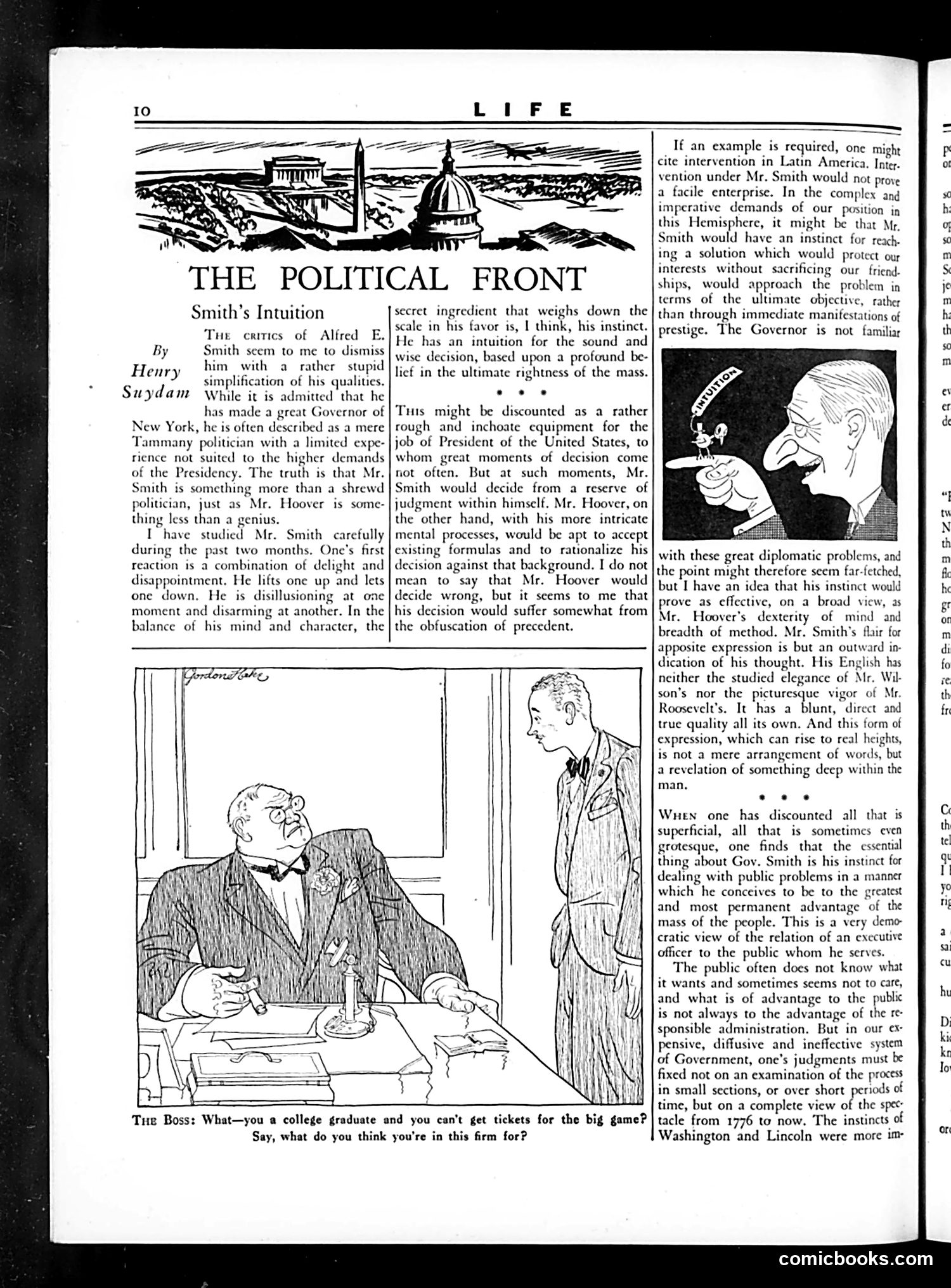
This article by Henry Snyder analyzes Governor Alfred E. Smith of New York as a political figure. The accompanying cartoon illustrates Smith's management style through a dialogue between a boss and a standing employee. **The Satire**: The caption reads: "The Boss: What—you a college graduate and you can't get tickets for the big game? Say, what do you think you're in this firm for?" This mocks Smith's pragmatic, direct approach to governance—treating politics like running a business rather than through ideological frameworks. The article contrasts Smith's "blunt" instinct-based decision-making favorably with President Hoover's more intellectual but potentially detached methods. The joke emphasizes Smith's no-nonsense, results-oriented management: he values practical utility over credentials or theory.
📄 Transcribed text from this page (OCR, searchable)
Machine-transcribed from the original scan — historical spelling and the odd misread are preserved.
10 THE POLITICAL FRONT Smith’s Intuition Tue critics of Alfred By Smith seem to me to dismiss Henry Suydam him with a rather stupid simplification of his qualities. While it is admitted that he has made a great Governor of New York, he is often described as a mere mmany politician with a limited expe- rience not suited to the higher demands of the Presidency. The truth is that Mr. Smith is something more than a shrewd politician, just as Mr. Hoover is some- thing less than a genius. I have studied Mr. Smith carefully during the past two months. One's first reaction is a combination of delight and disappointment. He lifts one up and lets one down. He is disillusioning at one moment and disarming at another. In the balance of his mind and character, the secret ingredient that weighs down the scale in his favor is, | think, his instinct. He has an intuition for the sound and wise decision, based upon a profound be- lief in the ultimate rightness of the mass. Tuts might be discounted as a rather rough and inchoate equipment for the job of President of the United States, to whom great moments of decision come not often, But at such moments, Mr. Smith would decide from a reserve of judgment within himself, Mr. Hoover, on the other hand, with his more intricate mental processes, would be apt to accept existing formulas and to rationalize his decision against that background. I do not mean to say that Mr. Hoover would decide wrong, but it scems to me that his decision would suffer somewhat from the obfuscation of precedent. Tue Boss: What—you a college graduate and you can't get tickets for the big game? Say, what do you think you're in this firm for? If an example is required, one might cite intervention in Laun America. Inter. vention under Mr. Smith would not Prove a facile enterprise. In the complex and imperative demands of our position in this Hemisphere, it might be that Mr, Smith would have an instinct for reach. ing a solution which would protect our interests without sacrificing our friend. ships, would approach the problem in terms of the ultimate objective, rather than through immediate manifestations of prestige. The Governor is not familiar with these great diplomatic problems, and the point might therefore seem far-fetched, but I have an idea that his instinct would prove as effective, on a broad view, as Mr. Hoover's dexterity of mind and breadth of method. Mr. Smith’s flair for apposite expression is but an outward in- dication of his thought. His English has neither the studied clegance of Mr. Wil- son's nor the picturesque vigor of Mr. Roosevelt's. It has a blunt, direct and true quality all its own. And this form of expression, which can rise to real heights, is not a mere arrangement of words, but a revelation of something deep within the man, eee Wuen one has discounted all that is superficial, all that is sometimes even grotesque, one finds that the essential thing about Gov. Smith is his instinct for dealing with public problems in a manner which he conceives to be to the greatest and most permanent advantage of the mass of the people. This is a very demo- cratic view of the relation of an executive officer to the public whom he serves. The public often does not know what it wants and sometimes scems not to care, and what is of advantage to the public is not always to the advantage of the re- sponsible administration. But in our ex- pensive, diffusive and ineffective system of Government, one’s judgments must be fixed not on an examination of the process in small sections, or over short periods of time, but on a complete view of the spec: tacle from 1776 to now. The instincts of Washington and Lincoln were more im comicbooks.com Sersasms Va sa eR 36 or