
Life, 1928-10-26 · page 20 of 40
Life — October 26, 1928 — page 20: what you’re looking at
What you’re looking at
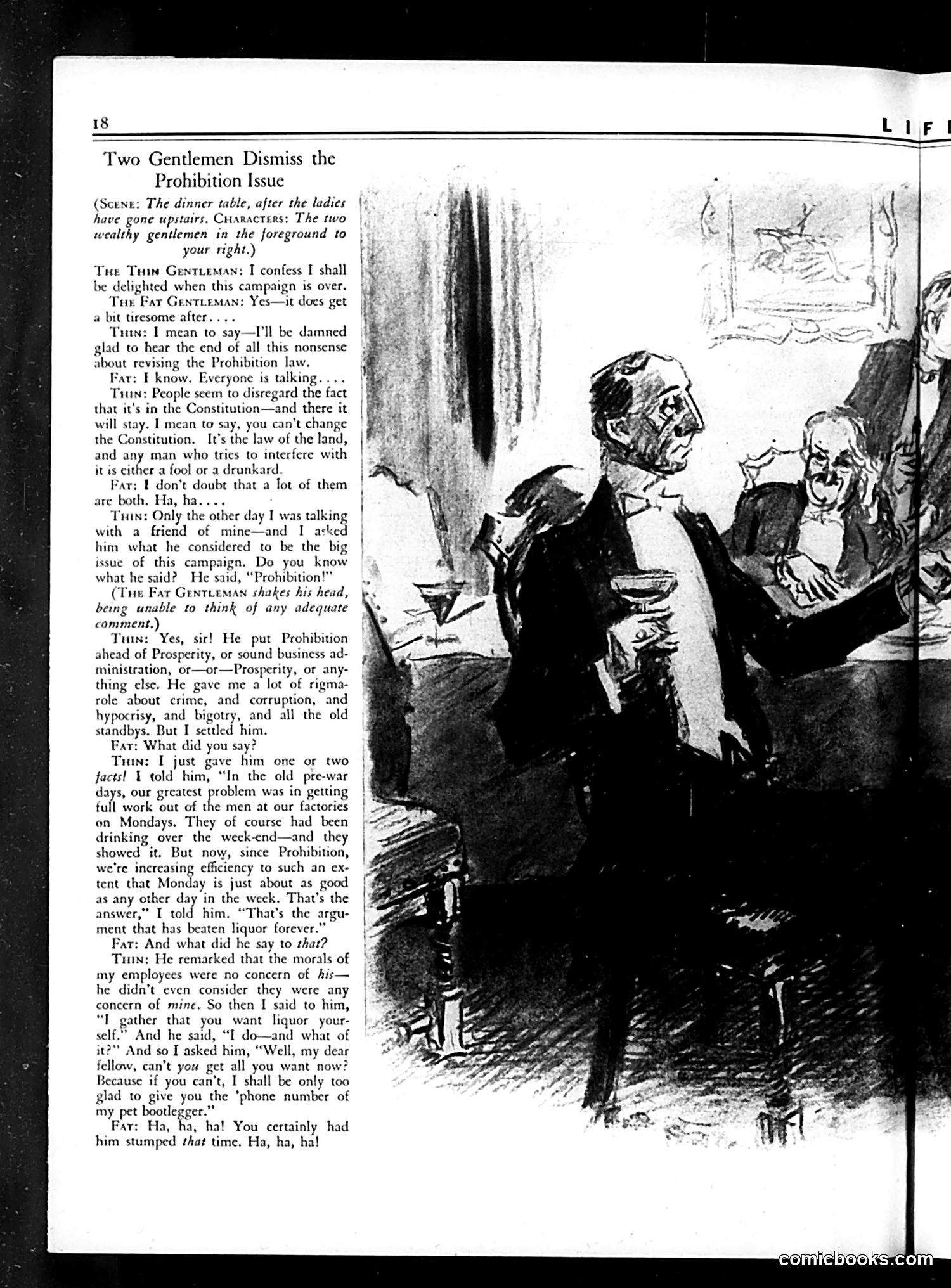
This satirical sketch mocks wealthy businessmen who defend Prohibition while privately flouting it. Two affluent gentlemen discuss dismissing anti-Prohibition arguments during after-dinner conversation. The satire targets their hypocrisy: one claims Prohibition benefits factory productivity and worker morality, yet admits he obtains liquor through a "pet bootlegger." The joke exposes the contradiction—they support Prohibition's legal enforcement while personally circumventing it through illegal channels. The cartoon critiques how the wealthy used moral arguments about Prohibition (worker efficiency, morality, crime reduction) to justify the law, while their actual behavior revealed indifference to those stated principles. It suggests Prohibition enforcement was selective: enforced against working-class "drunkards" but casually ignored by the privileged classes who could afford bootleggers. This reflects genuine 1920s tensions where Prohibition proved deeply unpopular, unevenly enforced, and frequently violated by those with resources.
📄 Transcribed text from this page (OCR, searchable)
Machine-transcribed from the original scan — historical spelling and the odd misread are preserved.
Two Gentlemen Dismiss the Prohibition Issue (Scene: The dinner table, after the ladies have gone upstairs. Cuaracters: The two wealthy gentlemen in the foreground to your right.) Tue Tuin Gentreman: I confess I shall be delighted when this campaign is over. Tue Fat Gentteman: Yes—it does get a bit tiresome after... . Turn: LT mean to say—I'll be damned glad to hear the end of all this nonsense about revising the Prohibition law. Far: FE know. Everyone is talking... . Tun: People seem to disregard the fact that it’s in the Constitution—and there it will stay. I mean to say, you can’t change the Constitution. It’s the law of the land, and any man who tries to interfere with it is cither a fool or a drunkard. Far: E don’t doubt that a Tot of them are both. Ha, ha.... Tui: Only the other day I was talking with a friend of mine—and I asked him what he considered to be the big issue of this campaign. Do you know what he said? He said, “Prohibition!” (Tue Fat Gentieman shakes his head, being unable to think of any adequate comment.) Tus: Yes, sir! He put Prohibition ahead of Prosperity, or sound business ad- ministration, or—or—Prosperity, or any- thing else. He gave me a lot of rigma- role about crime, and corruption, and hypocrisy, and bigotry, and all the old standbys. But I settled him. Fat: What did you say? Tun: I just gave him one or two facts! 1 told him, “In the old pre-war days, our greatest problem was in getting full work out of the men at our factories on Mondays. They of course had been drinking over the week-cnd—and_ they showed it. But now, since Prohibition, we're increasing efficiency to such an ex- tent that Monday is just about as good as any other day in the week. That's the answer,” I told him. “That's the argu- ment that has beaten liquor forever.” Fat: And what did he say to that? Tun: He remarked that the morals of my employees were no concern of his— he didn’t even consider they were any concern of mine. So then I said to him, “T gather that you want liquor your- * And he said, “I do—and what of it?” And so I asked him, “Well, my dear fellow, can’t you get all you want now? Because if you can’t, I shall be only too glad to give you the "phone number of my pet bootlegger.” Fat: Ha, ha, ha! You certainly had him stumped that time. Ha, ha, ha! comicbooks.com