
Life, 1928-10-26 · page 16 of 40
Life — October 26, 1928 — page 16: what you’re looking at
What you’re looking at
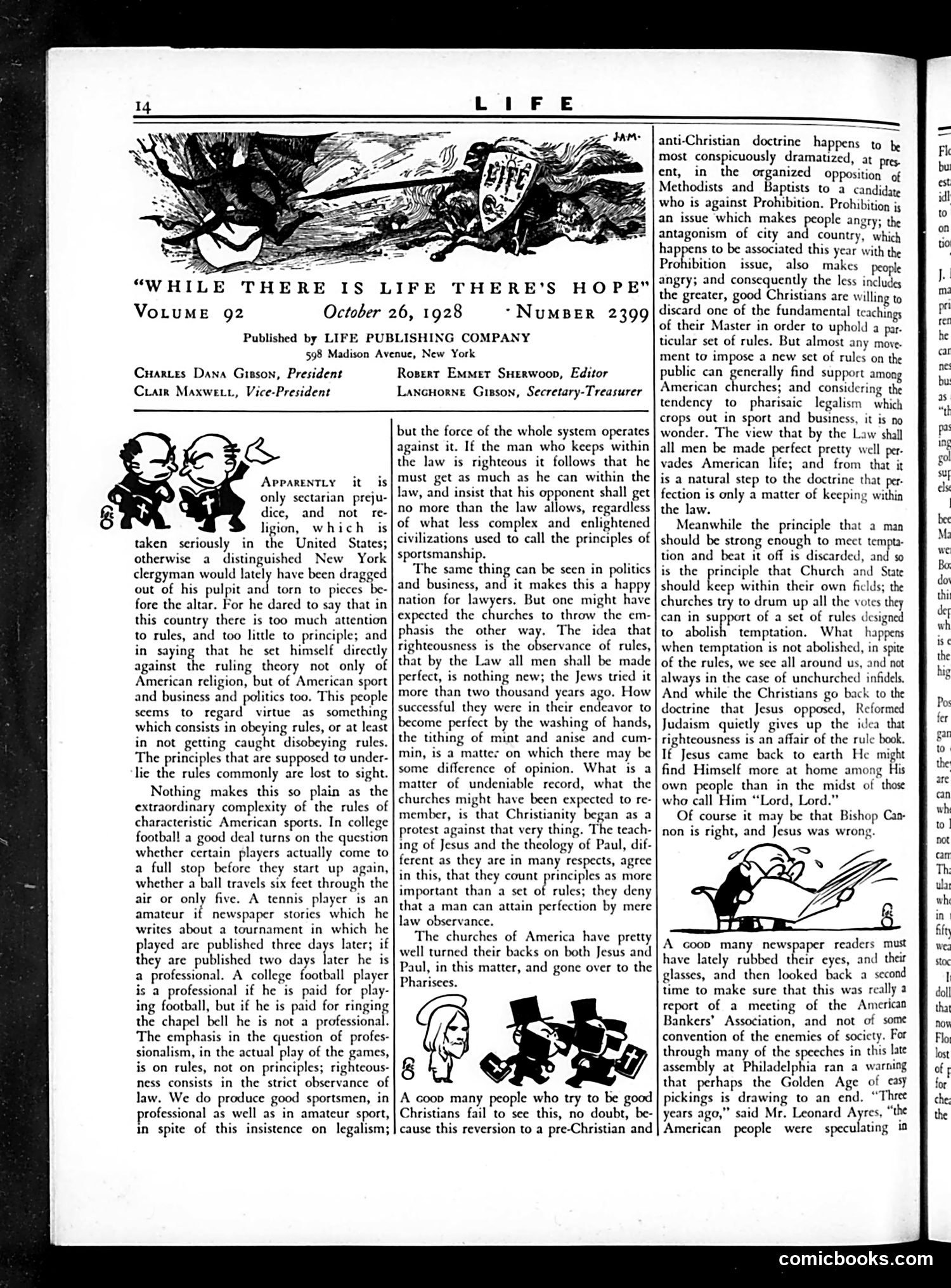
This page contains editorial commentary on American attitudes toward rules and legalism in sports, business, and religion. The main text criticizes how Americans simultaneously demand strict rule-following while breaking rules themselves—a hypocrisy the author traces through football, business, and church conduct. The cartoons appear to satirize this contradiction: one shows figures engaged in rule-breaking (likely gambling or financial speculation), while another depicts people trying to appear virtuous while violating Christian principles. A caption references the "Golden Age of easy pickings" and speculation, likely alluding to pre-1929 stock market excess. The piece argues Americans have abandoned genuine Christian ethics in favor of performative legalism—following surface rules while ignoring underlying moral principles. The tone is disapproving of this cultural hypocrisy.
📄 Transcribed text from this page (OCR, searchable)
Machine-transcribed from the original scan — historical spelling and the odd misread are preserved.
“WHILE THERE IS LIFE THERE’S HOPE" VoLUME 92 October 26, 1928 -NuMBER 2399 Published by LIFE PUBLISHING COMPANY 598 Madison Avenue, New York Cuarces Dana Gipson, President Crain Maxwett, Vice-President & ApparENTLY it is only sectarian preju- dice, and not re- ligion, which is taken seriously in the United States; otherwise a distinguished New York clergyman would sately have been dragged out of his pulpit and torn to pieces be- fore the altar. For he dared to say that in this country there is too much attention to rules, and too little to principle; and in saying that he set himself directly against the ruling theory not only of American religion, but of American sport and business and politics too. This people seems to regard virtue as something which consists in obeying rules, or at least in not getting caught disobeying rules. The principles that are supposed to under- lie the rules commonly are lost to sight. Nothing makes this so plain as the extraordinary complexity of the rules of characteristic American sports. In college football a good deal turns on the question whether certain players actually come to a full stop before they start up again, whether a ball travels six feet through the air or only five. A tennis player is an amateur if newspaper stories which he writes about a tournament in which he played are published three days later; if they are published two days later he is a professional. A college football player is a professional if he is paid for play- ing football, but if he is paid for ringing the chapel bell he is not a professional. The emphasis in the question of profes- sionalism, in the actual play of the games, is on rules, not on principles; righteous- ness consists in the strict observance of law. We do produce good sportsmen, in rofessional as well as in amateur sport, in spite of this insistence on legalism; Rosert Emmet SHerwoon, Editor Lancuorne Gipson, Secretary-Treasurer but the force of the whole system operates against it. If the man who keeps within the law is righteous it follows that he must get as much as he can within the law, and insist that his opponent shall get no more than the law allows, regardless of what less complex and enlightened civilizations used to call the principles of sportsmanship. The same thing can be seen in politics and business, aad it makes this a happy nation for lawyers. But one might have expected the churches to throw the em- phasis the other way. The idea that righteousness is the Gesnance of rules, that by the Law all men shall be made perfect, is nothing new; the Jews tried it more than two thousand years ago. How successful they were in their endeavor to become perfect by the washing of hands, the tithing of mint and anise and cum- min, is a matter on which there may be some difference of opinion. What is a matter of undeniable record, what the churches might have been expected to re- member, is that Christianity began as a protest against that very thing. The teach- ing of Jesus and the theology of Paul, dif- ferent as they are in many respects, agree in this, that they count principles as more important than a set of rules; they deny that aman can attain perfection by mere law observance. The churches of America have pretty well turned their backs on both Jesus and Paul, in this matter, and gone over to the Pharisees. RR A coop many people who try to be good Christians fail to see this, no doubt, be- cause this reversion to a pre-Christian and anti-Christian doctrine happens to be most conspicuously dramatized, at pres. ent, in the organized Opposition of Methodists and Baptists to a candidate who is against Prohibition. Prohibition js an issue which makes people angry; the antagonism of city an country, which happens to be associated this year with the Prohibition issue, also makes people angry; and consequently the less includes the greater, good Christians are willing to discard one of the fundamental teachings of their Master in order to uphold a par- ticular set of rules. But almost any move. ment to impose a new set of rules on the public can generally find support among American churches; and considering the tendency to pharisaic legalism which crops out in sport and business, it is no wonder. The view that by the Law shall all men be made perfect pretty well per- vades American life; and from that it is a natural step to the doctrine that per- fection is only a matter of keeping within the law. Meanwhile the principle that a man should be strong enough to meet tempta- tion and beat it off is discarded, and so is the principle that Church and State should Peep within their own fields; the churches try to drum up all the votes they can in support of a set of rules designed to abolish temptation. What happens when temptation is not abolished, in spite of the rules, we see all around us, and not always in the case of unchurched infidels. And while the Christians go back to the doctrine that Jesus opposed, Reformed Judaism quietly gives up the idea that righteousness is an affair of the rule book. If Jesus came back to earth He might find Himself more at home among His own people than in the midst of those who call Him “Lord, Lord.” Of course it may be that Bishop Can- non is right, and Jesus was wrong. A coop many newspaper readers must have lately rubbed thee eyes, and their glasses, and then looked back a second time to make sure that this was really 2 report of a meeting of the American Bankers’ Association, and not of some convention of the enemies of socicty. For through many of the speeches in this late assembly at Philadelphia ran a warning that perhaps the Golden Age of casy pickings is drawing to an end. “Three years ago,” said Mr. Leonard Ayres, “the American people were speculating ia comicbooks.com