
Life, 1928-10-26 · page 29 of 40
Life — October 26, 1928 — page 29: what you’re looking at
What you’re looking at
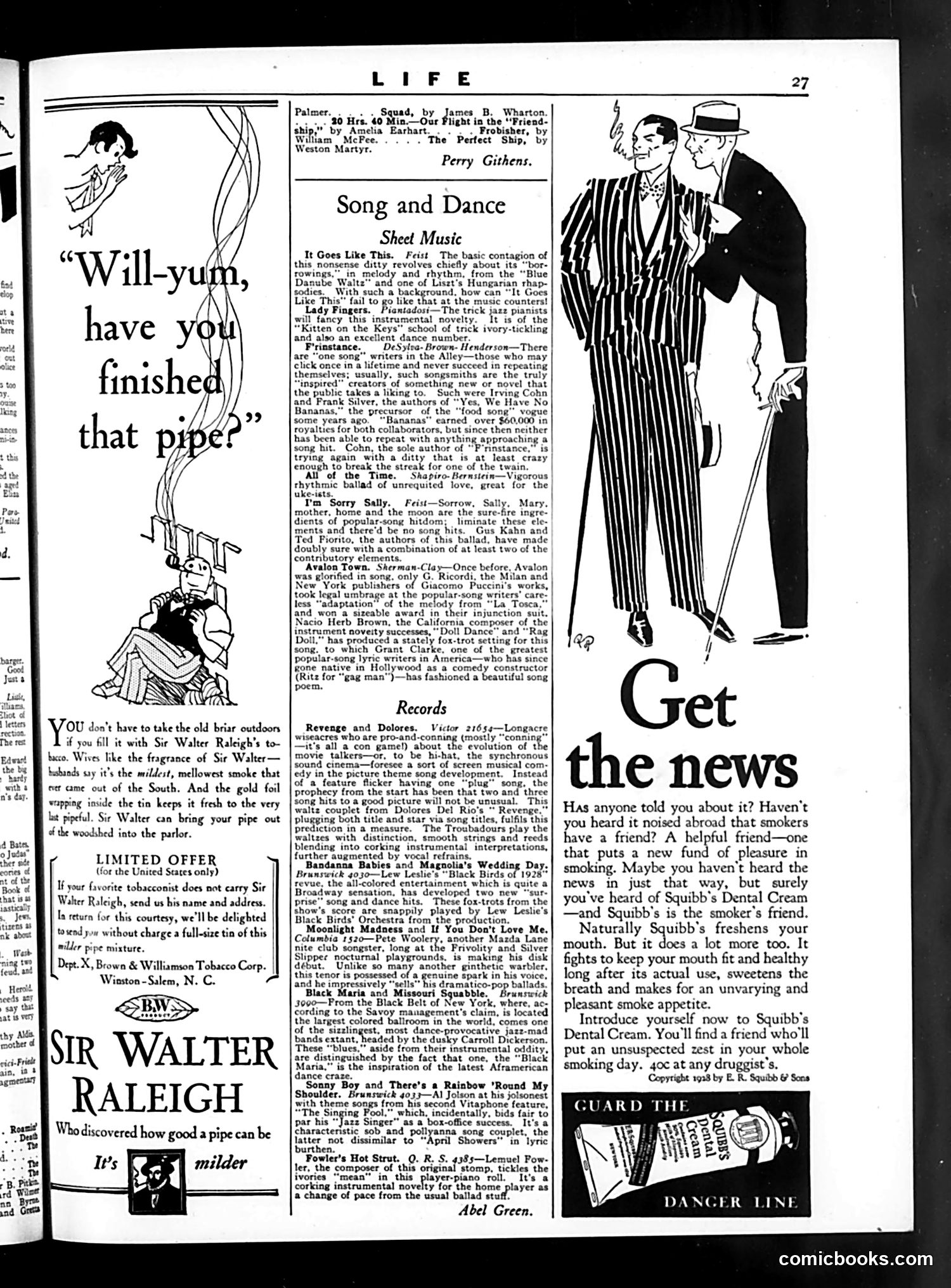
This page is primarily **advertising**, not satire. The main content is a Sir Walter Raleigh pipe tobacco advertisement featuring a humorous domestic scene: a wife asking her husband if he's finished smoking his pipe so he can rejoin her in the parlor rather than staying in the woodshed. The joke plays on tobacco marketing conventions of the 1920s-30s: the advertisement promises that Sir Walter Raleigh tobacco smells pleasant enough that wives won't mind their husbands smoking indoors. It's genteel advertising humor targeting male smokers by suggesting their wives will actually *approve* of this particular tobacco's "mild, mellowest" qualities. The page also contains music reviews and a Squibb's Dental Cream advertisement—typical Life magazine content of the era.
📄 Transcribed text from this page (OCR, searchable)
Machine-transcribed from the original scan — historical spelling and the odd misread are preserved.
OU don’t have to take the old briar outdoors you fill it with Sir Walter Raleigh's to- bacco. Wives like the fragrance of Sir Walter— hshands say it’s the mildest, mellowest smoke that eet ame out of the South. And the gold foil weapping inside the tin keeps it fresh to the very lat pipeful. Sir Walter can bring your pipe out the woodshed into the parlor. LIMITED OFFER (for the United States only) If your favorite tobacconist does not carry Sir Waker Raleigh, send us his name and address. Ia return for this courtesy, we'll be delighted tosend yow without charge a full-size tin of this ailler pipe mixture. Dept. X, Brown & Williamson Tobacco Corp. Winston-Salem, N. C. SIR WALTER RALEIGH Who discovered how good a pipe can be LIFE Pater so ss, ggSattee BY, games, B. «. «,. 20 Hrs. 40 Min.—Our Plight in the “Frien shij by Amelia Earhart. . . ., Frobisher, by Willlam MeFee.. . . . The Perfect Ship, by Weston Martyr. Perry Githens. Song and Dance Sheet Music It Goes Like This. Feist The basic contagion of this nonsense ditty revolves chiefly about its “bor- rowings,”” in melody and rhythm, from the “Blue Danube Waltz" and one of Liszt's Hungarian rhap- sodies. With such a background, how can “It Goes Like This” fail to go like that at the music counters! Lady Fingers. Piontadosi—The trick jazz pianists will fancy this instrumental novelty. It is of the “Kitten on the Keys” school of trick ivory-tickling and also an excellent dance number. Frrinstance. DeSyloa- Brown- Henderson—There are “one song” writers in the Alley—those who may click once in a lifetime and never succeed in repeating themselves; usually, such songsmiths are the truly “inspired” creators of something new of novel that the public takes a liking to. Such were Irving Cohn and Frank Silver, the authors of “Yes, We Have No Bananas,” the precursor of the “food song’ vogue some years ago. “Bananas” earned _over $60,000 in royalties for both collaborators, but since then neither has been able to repeat with anything approaching a song hit. Cohn, the sole author of “F'rinstance,” is trying again with a ditty that is at least crazy | enough to break the streak for one of the twain, All of the Time. Shapiro- Bernsiein—Vigorous rhythmic ballad of unrequited love, great for the uke-ists, I'm Sorry Sally. Feist—Sorrow, Sally, Mary. mother, home and the moon are the sure-fire ingre- dients of popular-song hitdom; liminate these ele- ments and there'd be no song hits. Gus Kahn and Ted Fiorito, the authors of this ballad, have made doubly sure with a combination of at least two of the contributory elements. Avalon Town. Sherman-Clay—Once before, Avalon as slorified in song, only G. Ricordi, the Milan and New York publishers o! took legal umbrage at the popular-song writers’ care. less “adaptation” of the melody from “La Tose: and won a sizeable award in their injunction sui Nacio Herb Brown, the California composer of the instrument noveity successes," Doll Dance” and "Rag Doll,” has produced a stately fox-trot setting for this song. to which Grant Clarke, one of the greatest popular-song lyric writers in America—who has since gone native in Hollywood as a comedy constructor (Ritz for “gag man”)—has fashioned a beautiful song poem. Records Revenge and Dolores. Victor 21654—Longacre wiseacres who are pro-and-conning (mostly “conning” —it's all a con gamel) about the evolution of ¢! movie talkers—or, to be hi-hat, the synchronous sound cinema—foresee a sort of screen musical com- edy in the picture theme song development. Instead of a feature flicker having one “plug” song, the prophecy from the start has been that two and three song hits to a good picture will not be unusual. This waltz couplet from Dolores Del Rio's " Revenge.” plugging both title and star via song titles, fulfils this prediction in a measure. The Troubadours play the waltzes with distinction, smooth strings and reeds blending into corking instrumental interpretations, further augmented by vocal refrains. Bandanna Babies and Magnolia’s Wedding Day, Brunswick 4030—Lew Leslie's “Black Birds of 1928" revue, the all-colored entertainment which is quite a Broadway sensation, has developed two new “sur- prise” song and dance hits. These fox-trots from the show's score are snappily played by Lew Leslie's Black Birds’ Orchestra from the production. Moonlight Madness and If You Don't Love Me. Columbia 1520—Pete Woolery, another Mazda Lane nite club songster, long at the Frivolity and Silver Slipper nocturnal playgrounds, is making his disk début. Unlike so many another ginthetic warbler, this tenor is possessed of a genuine spark in his voice, and he impressively “sells” his dramatico-pop ballads. Black Maria and Missouri Squabble. Brunswick 3090—Prom the Black Belt of New York, where, ac- cording to the Savoy management's claim, is located the largest colored ballroom in the world, comes one of the sizzlingest, most dance-provocative jazz-mad bands extant, headed by the dusky Carroll Dickerson. hese “*blues,”” aside from their instrumental oddity, are distinguished by the fact that one, the "Black Maria,” is the inspiration of the latest Aframerican dance craze. Sonny Boy and There's a Rainbow 'Round My Shoulder. Brunswick 4033—Al Jolson at his jolsonest with theme songs from his second Vitaphone feature, “The Singing Fool,” which, incidentally, bids fair to par his “Jazz Singer" as a box-office success. It's a characteristic sob. and pollyanna song couplet, the latter not dissimilar to “April Showers” in lyric burthen. Fowler's Hot Strut. 0. R. S. 4385—Lemuel Fow- ler, the com; of ‘this original ‘stomp, tickles the ivories “mean” in this player-piano roll. It's a corking instrumental novelty for the home player as Giacomo Puccini's works, | ~. ;~= —" J e the news Has anyone told you about it? Haven't you heard it noised abroad that smokers have a friend? A helpful friend—one that puts a new fund of pleasure in smoking. Maybe you haven't heard the news in just that way, but surely you've heard of Squibb’s Dental Cream —and Squibb's is the smoker's friend. Naturally Squibb’s freshens your mouth. But it does a lot more too. It fights to keep your mouth fit and healthy long after its actual use, sweetens the breath and makes for an unvarying and pleasant smoke appetite. Introduce yourself now to Squibb’s Dental Cream. You'll find a friend who'll put an unsuspected zest in your whole smoking day. 4oc at any druggist’s. Copyright 1928 by E.R. Squibb 6 Sons Bede i. Blige. ek a change of pace from the usual ballad stu: . IANCG NE Abel Green. DA PRELUDE comicbooks.com