
Life, 1928-10-26 · page 26 of 40
Life — October 26, 1928 — page 26: what you’re looking at
What you’re looking at
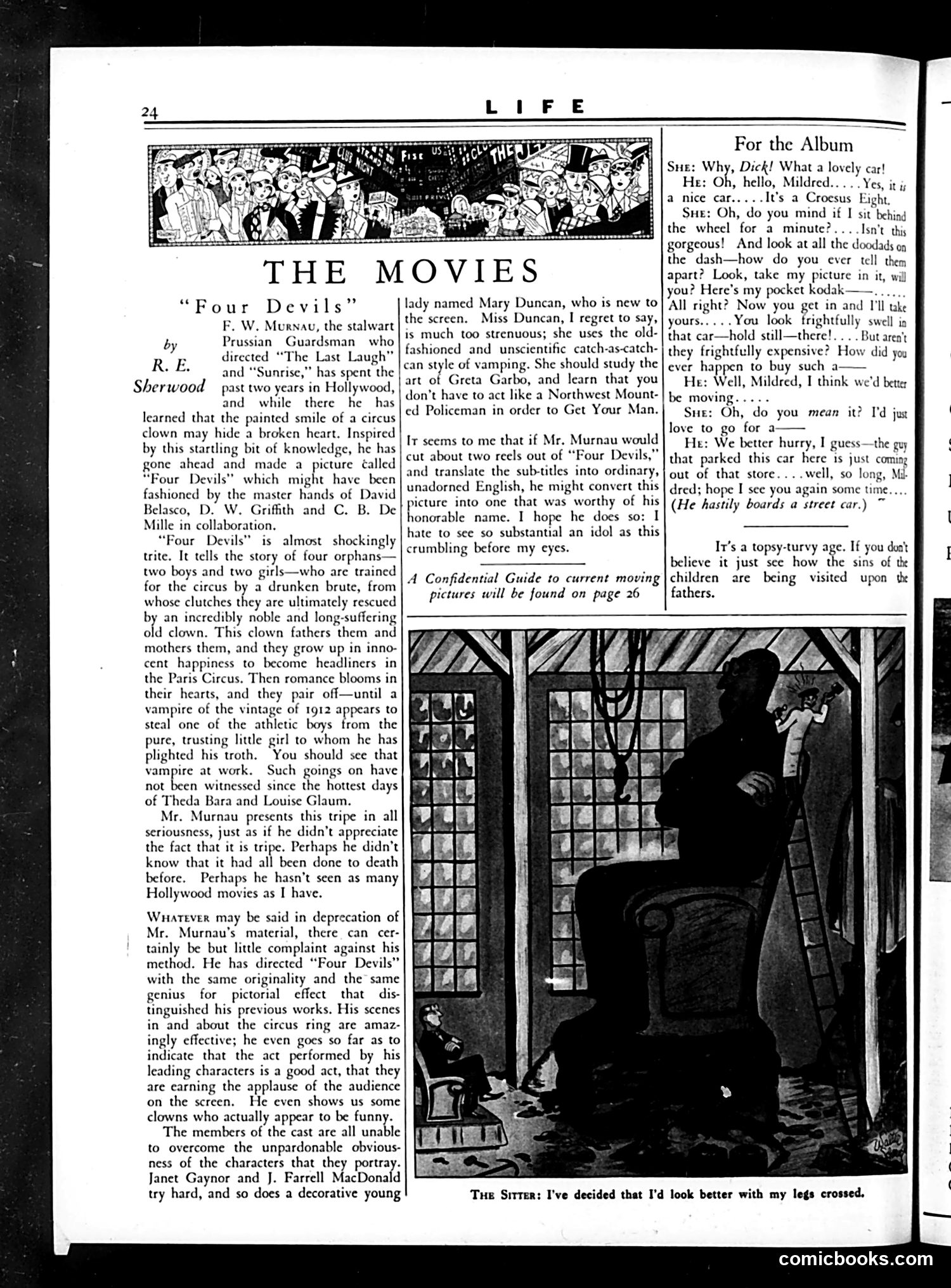
This page contains a **film review by R.E. Sherwood** of F.W. Murnau's movie "Four Devils" (a silent film about circus orphans). Sherwood criticizes the plot as derivative melodrama featuring outdated tropes—a drunken brute, noble clown, and a "vampire" character (seductress) reminiscent of 1910s silent-film stock characters like Theda Bara. He praises Murnau's directorial skill but finds the material trite. The **right column shows a social cartoon** satirizing the era's consumerism and courtship rituals. A woman enthuses over a man's expensive "Croesus Eight" automobile, requesting photos and asking intrusive questions about cost—reducing romantic interest to material display. The humor mocks both women's superficiality and the conspicuous consumption defining 1920s American culture. Together, the page reflects *Life* magazine's dual critique: Hollywood's reliance on worn-out narratives and the shallow materialism of modern social life.
📄 Transcribed text from this page (OCR, searchable)
Machine-transcribed from the original scan — historical spelling and the odd misread are preserved.
THE MOVIES “Four Devils” F. W. Murnau, the stalwart Prussian Guardsman who directed “The Last Laugh” and “Sunrise,” has spent the past two years in Hollywood, and while there he has learned that the painted smile of a circus clown may hide a broken heart. Inspired by this startling bit of knowledge, he has gone ahead and made a picture éalled “Four Devils" which might have been fashioned by the master hands of David Belasco, D. W. Grifith and C. B. De Mille in collaboration. “Four Devils” is almost shockingly trite, It tells the story of four orphans— two boys and two girls—who are trained for the circus by a drunken brute, from whose clutches they are ultimately rescued by an incredibly noble and long-suffering old clown. This clown fathers them and by R. E. Sherwood mothers them, and they grow up in inno- cent happiness to become headliners in the Paris Circus. Then romance blooms in their hearts, and they pair off—until a vampire of the vintage of 1912 appears to steal one of the athletic boys trom the pure, trusting little girl to whom he has plighted his troth. You should see that vampire at work. Such goings on have not been witnessed since the hottest days of Theda Bara and Louise Glaum. Mr. Murnau presents this tripe in all seriousness, just as if he didn’t appreciate the fact that it is tripe. Perhaps he didn’t know that it had all been done to death before. Perhaps he hasn't seen as many Hollywood movies as I have. Wuatever may be said in deprecation of Mr. Murnau’s material, there can cer- tainly be but little complaint against his method. He has directed “Four Devils” with the same originality and the same genius for pictorial effect that dis- tinguished his previous works. His scenes in and about the circus ring are amaz- ingly effective; he even goes so far as to indicate that the act performed by his leading characters is a good act, that they are earning the applause of the audience on the screen. He even shows us some clowns who actually appear to be funny. The members of the cast are all unable to overcome the unpardonable obvious- ness of the characters that they portray. Janet Gaynor and J. Farrell MacDonald try hard, and so does a decorative young lady named Mary Duncan, who is new to the screen. Miss Duncan, I regret to say, is much too strenuous; she uses the old- fashioned and unscientific catch-as-catch- can style of vamping. She should study the art of Greta Garbo, and learn that you don’t have to act like a Northwest Mount- ed Policeman in order to Get Your Man. Ir seems to me that if Mr. Murnau would cut about two reels out of “Four Devils,” and translate the sub-titles into ordinary, unadorned English, he might convert this picture into one that was worthy of his honorable name. I hope he does so: I hate to see so substantial an idol as this crumbling before my eyes. A Confidential Guide to current moving pictures will be found on page 26 For the Album Sue: Why, Dick! What a lovely car! He: Oh, hello, Mildred... .. Yes, it js a nice car.....It’s a Croesus Eight. Sue: Oh, do you mind if I sit behind Isn't this gorgeous! And look at all the doodads on the dash—how do you ever tell them apart? Look, take my picture in it, wil you? Here's my pocket kodak—..... All right? Now you get in and I'll take yours.....You look frightfully swell is that car—hold still—there!. . . . But aren't they frightfully expensive? How did you ever happen to buy such a He: Well, Mildred, I think we'd better be moving Sue: Oh, do you mean it? I'd jus love to go for a—— He: We better hurry, I guess—the guy that parked this car here is just coming out of that store... .well, so long, Mi- dred; hope I see you again some time... (He hastily boards a street car.) ~ It’s a topsy-turvy age. If you doa’ believe it just see how the sins of th children are being visited upon the fathers. IN ZN ol os 1g ESS SSeS a4 A eS 1 Tue Srrter: I've decided that I'd look better with my legs crossed. comicbooks.com