
A complete issue · 36 pages · 1928
Life — August 2, 1928
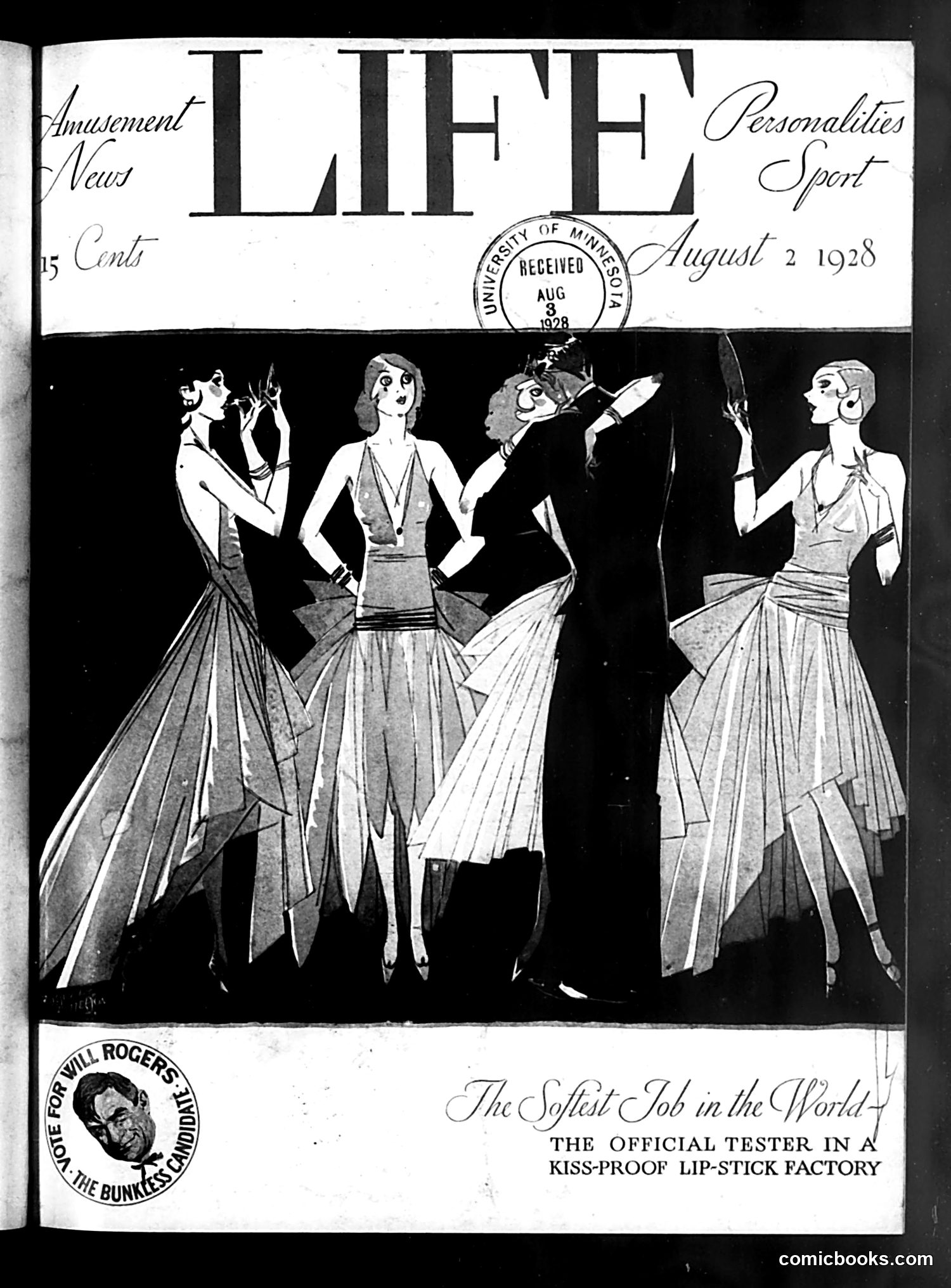
This page is primarily **advertising**, not political satire. The illustration shows five stylishly dressed women in 1920s fashion, depicted in an art deco style typical of the era. The ad promotes "The Softest Job in the World—The Official Tester in a Kiss-Proof Lip-Stick Factory," presenting a humorous fantasy job for women. The accompanying Will Rogers medallion (visible lower left) suggests Rogers may have endorsed or commented on the advertisement. The joke reflects 1920s consumer culture and the emerging cosmetics industry, playing on the novelty of "kiss-proof" makeup—a genuine product innovation of that period. The advertisement targets women by suggesting a frivolous, glamorous occupation, typical of how cosmetics were marketed during the Jazz Age.
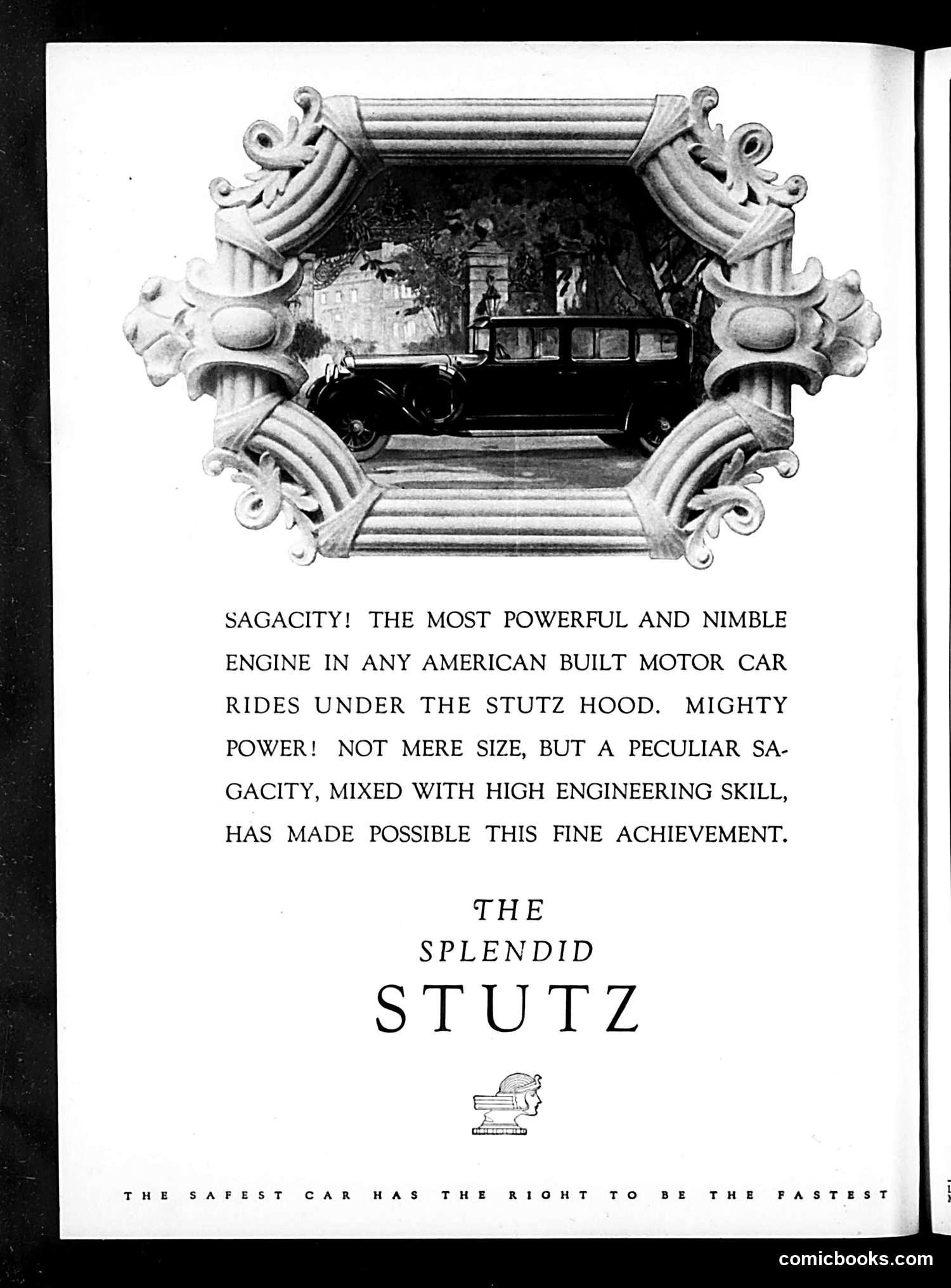
This is primarily a **commercial advertisement**, not political satire. It promotes the Stutz automobile, a luxury car brand popular in the 1910s-1920s. The ornate decorative frame surrounding the car image suggests sophistication and prestige. The ad claims the Stutz possesses "the most powerful and nimble engine in any American built motor car"—emphasizing engineering prowess over mere size. The tagline "The safest car has the right to be the fastest" represents typical automotive advertising rhetoric of the era, attempting to resolve the tension between safety and performance concerns that worried early-twentieth-century consumers. There is **no political cartoon or satire present** on this page—it's straightforward period advertising aimed at affluent buyers.
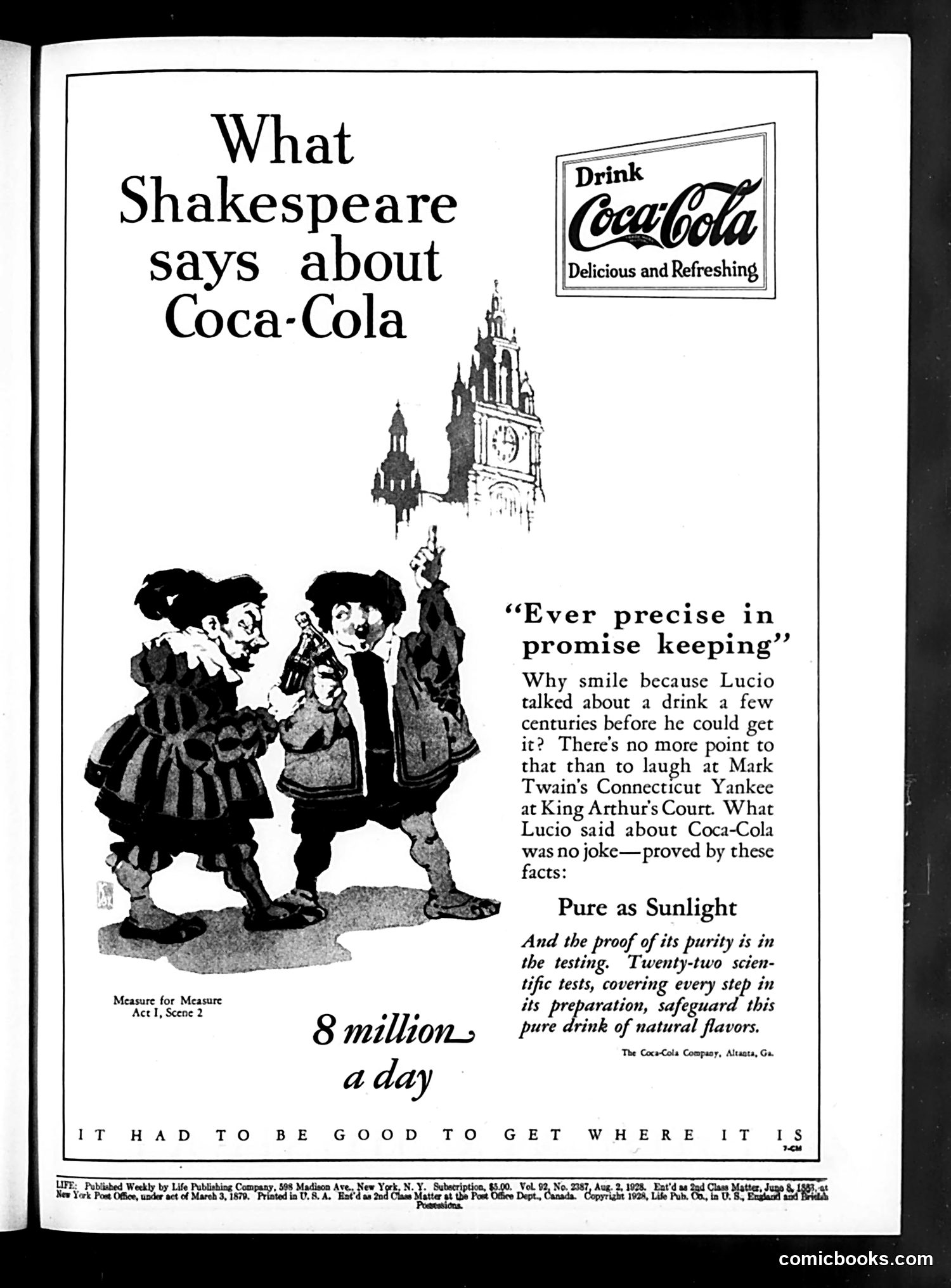
This is primarily a **Coca-Cola advertisement** disguised as editorial content, using Shakespeare to sell the product. The page claims Shakespeare's quote "Ever precise in promise keeping" endorses Coca-Cola's reliability. The cartoon depicts **characters from Shakespeare's "Measure for Measure"** (Act 1, Scene 2), humorously reimagined discussing Coca-Cola centuries before its invention. The joke relies on anachronism—treating the impossibility as amusing rather than logical. The advertisement emphasizes Coca-Cola's purity through "twenty-two scientific tests" and notes the staggering consumption figure of "8 million a day," attempting to validate the product through both scientific authority and mass popularity. This represents early 20th-century advertising strategy: leveraging cultural prestige (Shakespeare) and pseudo-scientific claims to build brand credibility.
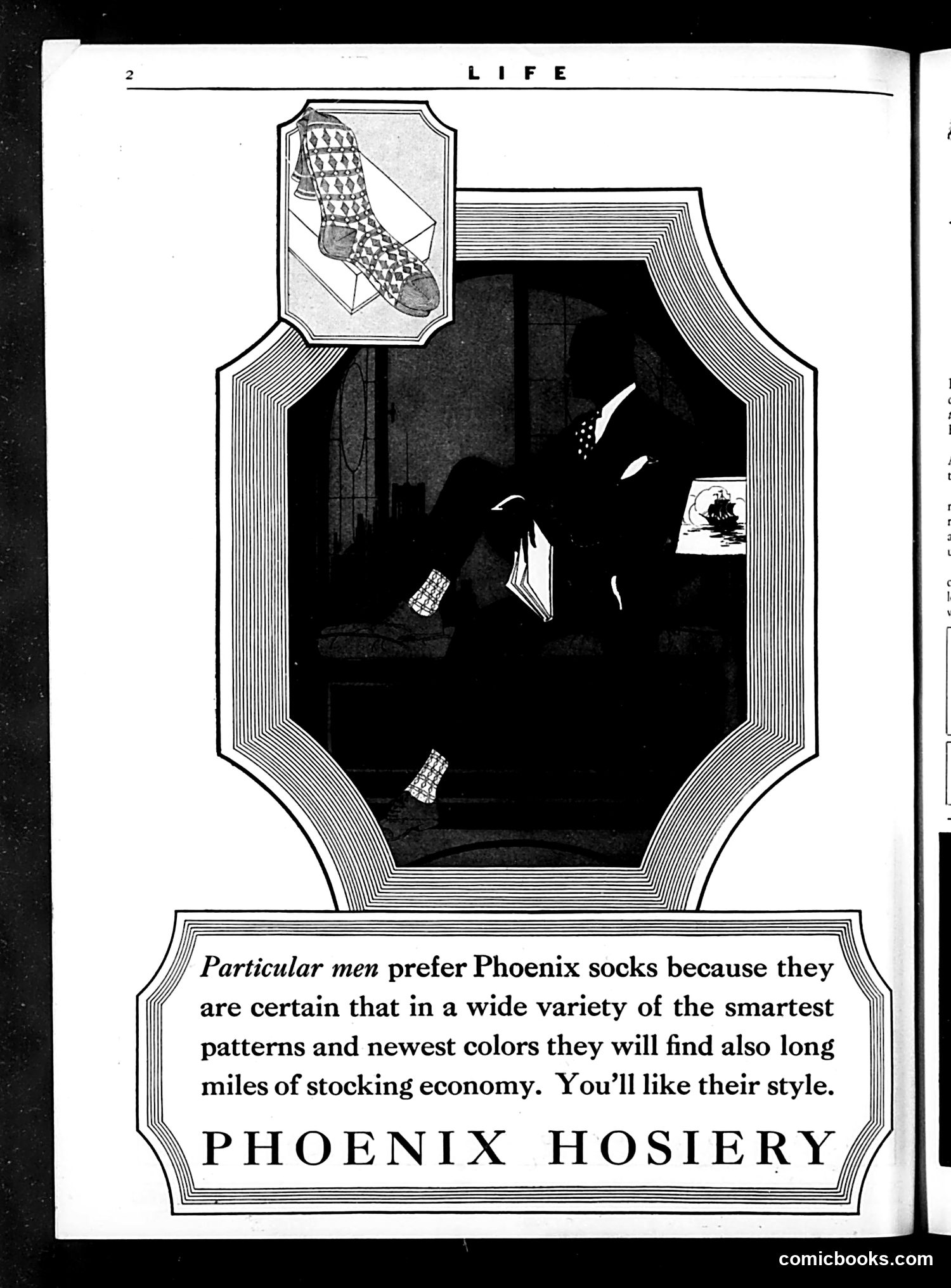
This page is primarily a **product advertisement** for Phoenix Hosiery, not political satire. The ad features a silhouetted interior scene showing a man and woman in what appears to be an intimate domestic moment. The inset illustration at top displays patterned socks. The advertisement's pitch emphasizes that Phoenix socks offer both style ("smartest patterns and newest colors") and durability ("long miles of stocking economy"). The phrase "Particular men prefer Phoenix socks" targets male consumers by appealing to masculine discernment and value-consciousness. This represents typical 1920s-era magazine advertising, using romantic domestic imagery to market men's hosiery to middle-class consumers concerned with both appearance and practical economy.
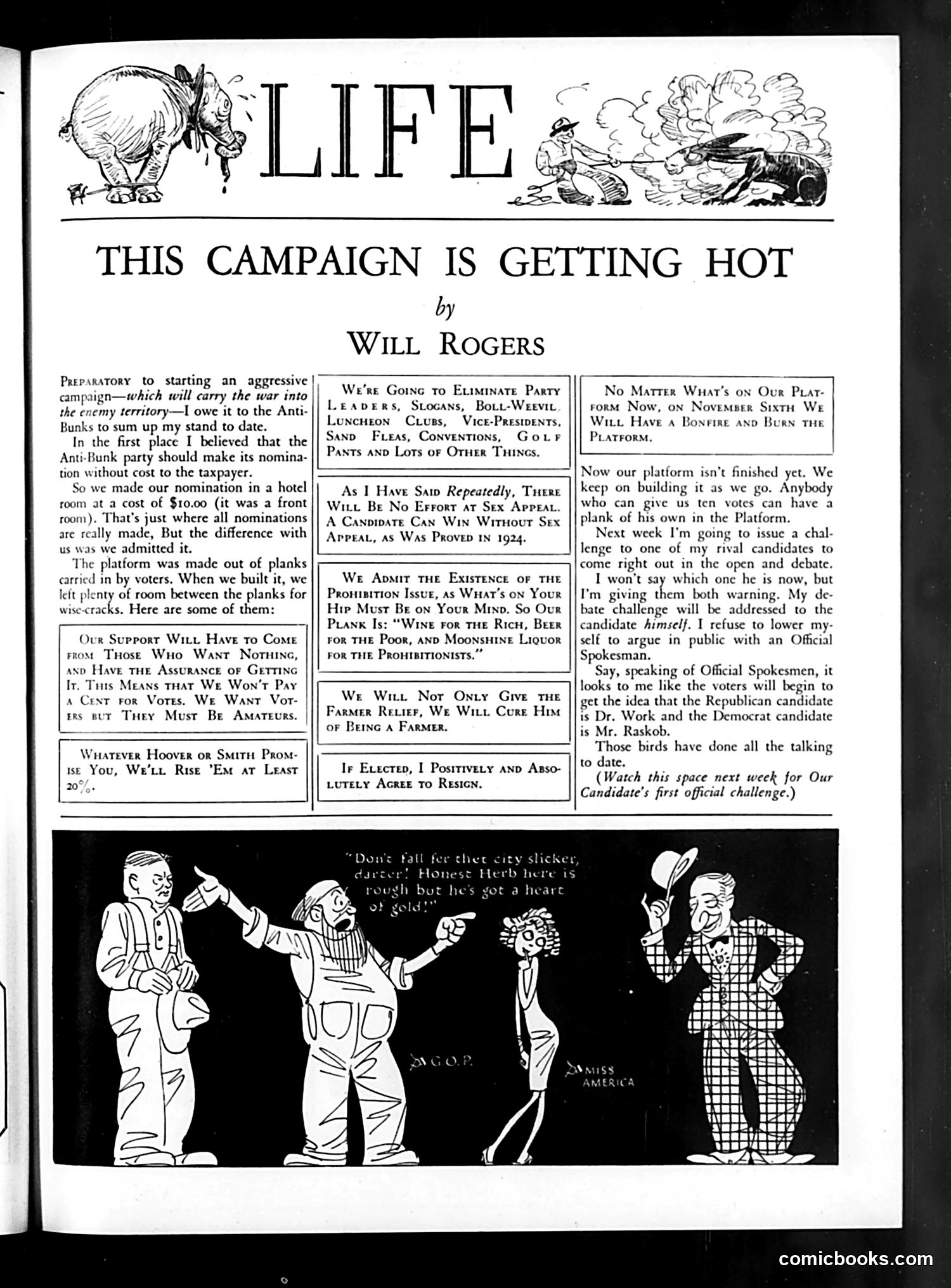
This 1928 Life magazine page satirizes the presidential campaign through Will Rogers' commentary. The article attacks anti-Prohibition Republicans planning to eliminate party planks on temperance while secretly supporting alcohol—particularly targeting wealthy interests ("wine for the rich, beer for the poor"). Rogers mocks the hypocrisy of candidates who publicly deny the Prohibition issue while privately accommodating both prohibitionists and drinkers. References to "Hoover or Smith" suggest this covers the 1928 election between Herbert Hoover and Alfred E. Smith, with Smith being the wet candidate opposing Prohibition. The cartoon below illustrates a farmer being pitched conflicting campaign promises—the satire being that politicians offer empty rhetoric while ignoring genuine farmer relief concerns. Rogers promises to challenge candidates openly on their actual positions.
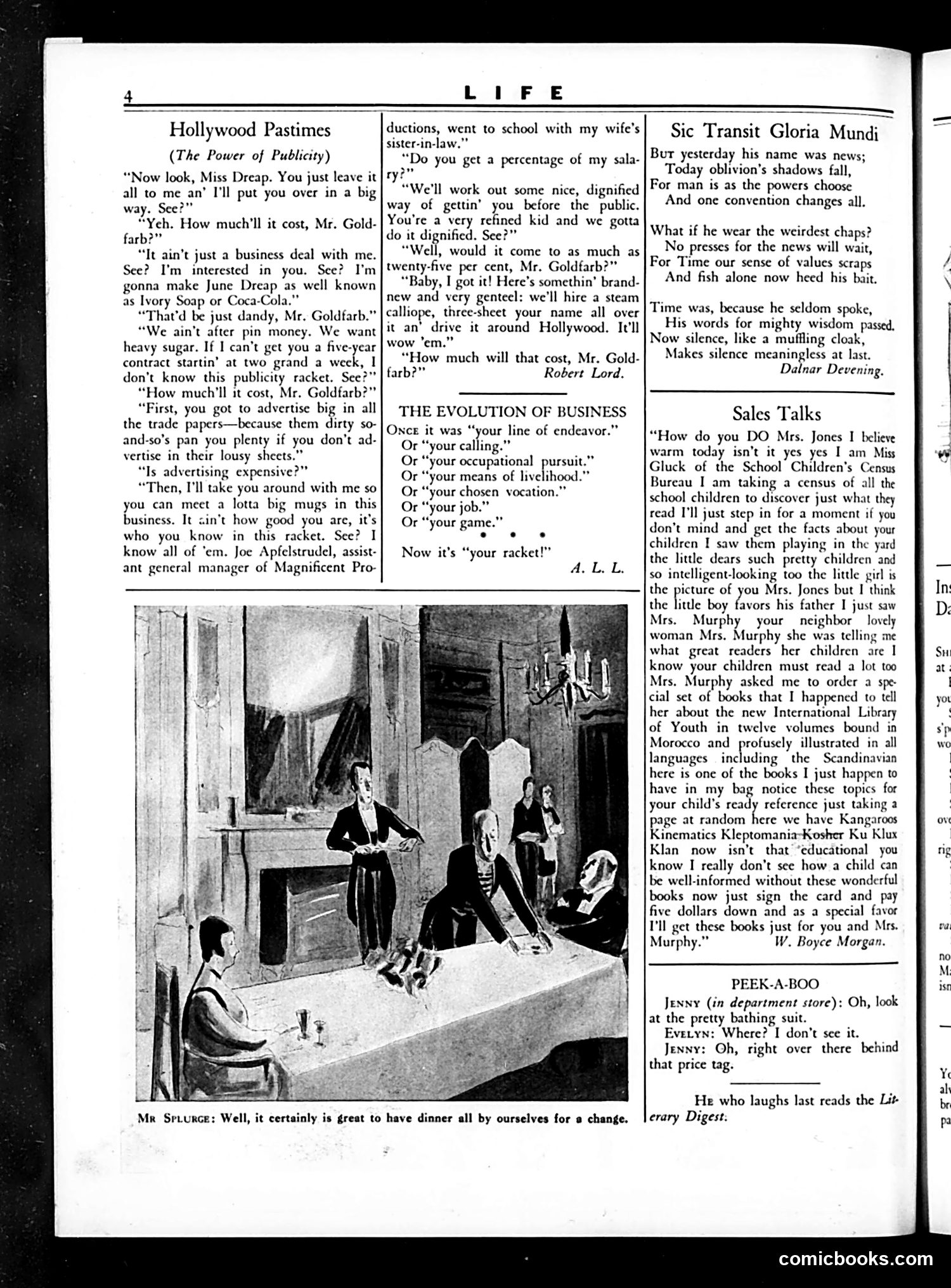
This page contains three separate satirical pieces: **"Hollywood Pastimes"** mocks the film industry's commercialism. A character named "Mr. Goldfar" (likely representing a Hollywood producer) discusses turning actress "June Dreap" into a marketable commodity—hiring her name on billboards and demanding advertising in trade papers. The satire targets how studios reduced actors to commercial products rather than artists. **"The Evolution of Business"** humorously traces how job terminology evolved from dignified terms ("calling," "vocation") to the blunt modern phrase "your racket," reflecting cynicism about commercial enterprise. The illustration shows what appears to be a restaurant scene with patrons dining, captioned with Mrs. Splurge's comment about dining alone—likely satirizing wealthy leisure activities. The other sections contain lighter social commentary and humor pieces typical of Life magazine's satirical format.
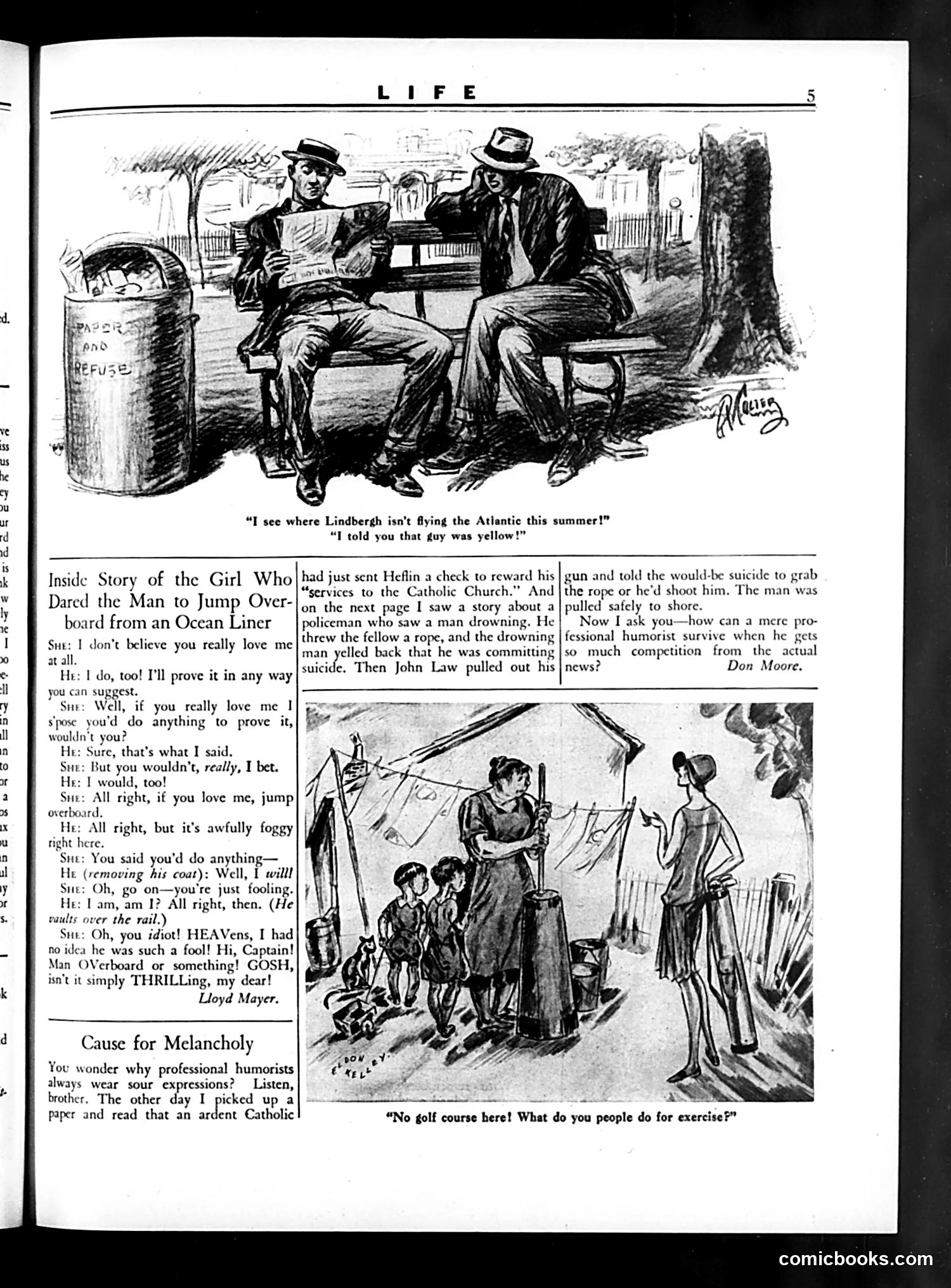
**Top Cartoon:** Two men in a park discuss Lindbergh's absence from Atlantic flying. One reads a newspaper while the other comments negatively on someone being "yellow" (cowardly). This references Charles Lindbergh, the famous aviator, likely satirizing public speculation about why he wasn't attempting a particular flight or achievement during this period. **Middle Story:** "Inside Story of the Girl Who Dared the Man to Jump Overboard from an Ocean Liner" presents a dramatic dialogue where a woman challenges a man to prove his love by jumping overboard. The satire mocks masculine bravado and the foolishness of proving devotion through dangerous stunts—a common trope in romance narratives. **Bottom Cartoon:** Shows laundry on a clothesline with the caption mocking exercise habits, a gentle social observation about leisure activities.
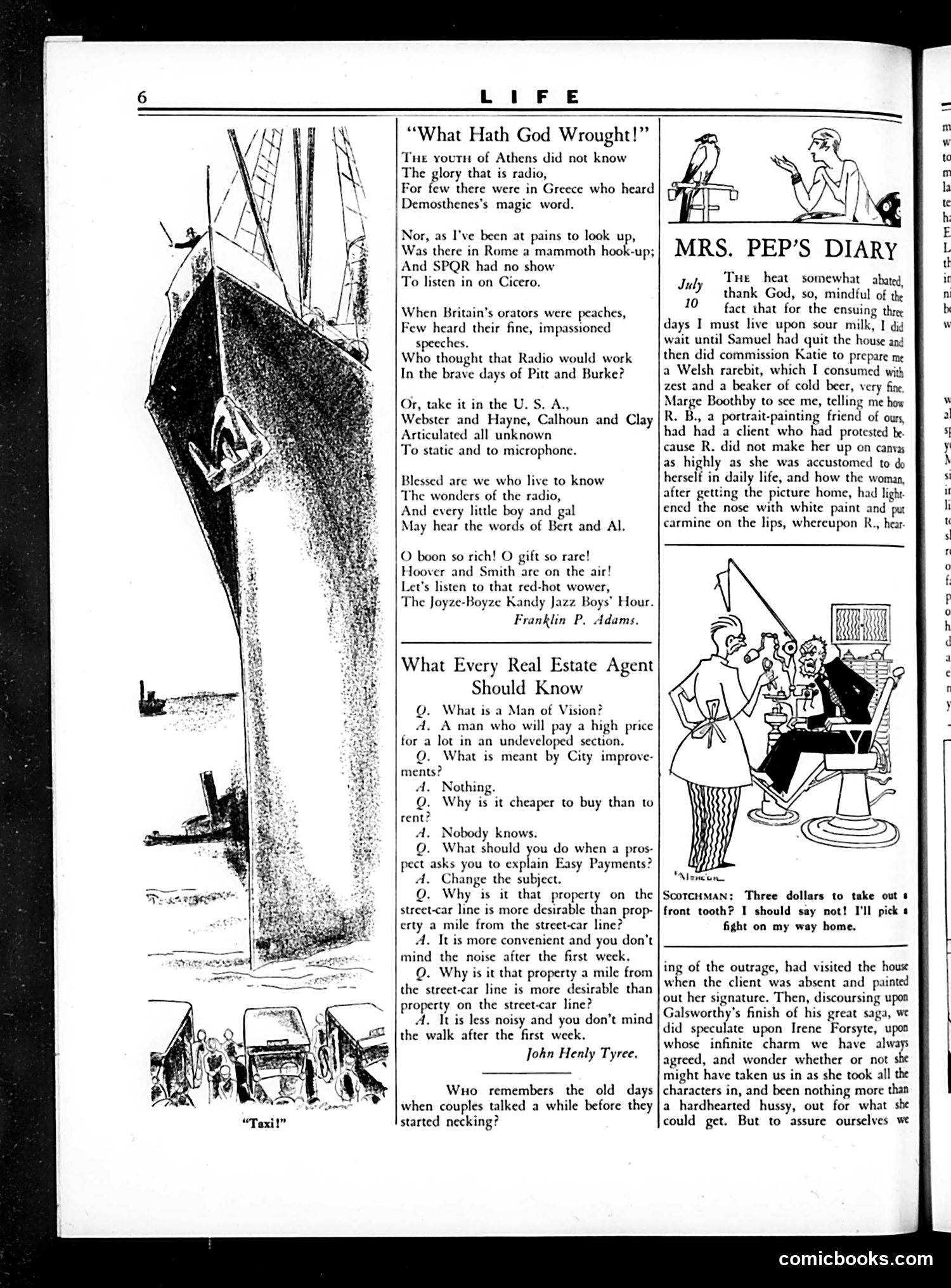
This page contains three separate pieces of satire: 1. **"What Hath God Wrought!"** (poem by Franklin P. Adams): A nostalgic critique lamenting that ancient orators like Demosthenes and Cicero are overshadowed by modern radio personalities—Webster, Hayne, Calhoun, and Clay are "unknown" compared to radio stars Hoover and Smith. The satire mocks how radio has democratized fame, making mediocre broadcasters more celebrated than historically great speakers. 2. **"What Every Real Estate Agent Should Know"**: A Q&A mockery of real estate jargon, exposing how agents use euphemisms ("Man of Vision," "City Improvements") to disguise undesirable properties and justify high prices near noisy streetcar lines. 3. **"Mrs. Pep's Diary"** and **"Taxi!"**: Brief humor pieces about domestic and urban life. The overall theme criticizes modern commercial culture and its linguistic deceptions.
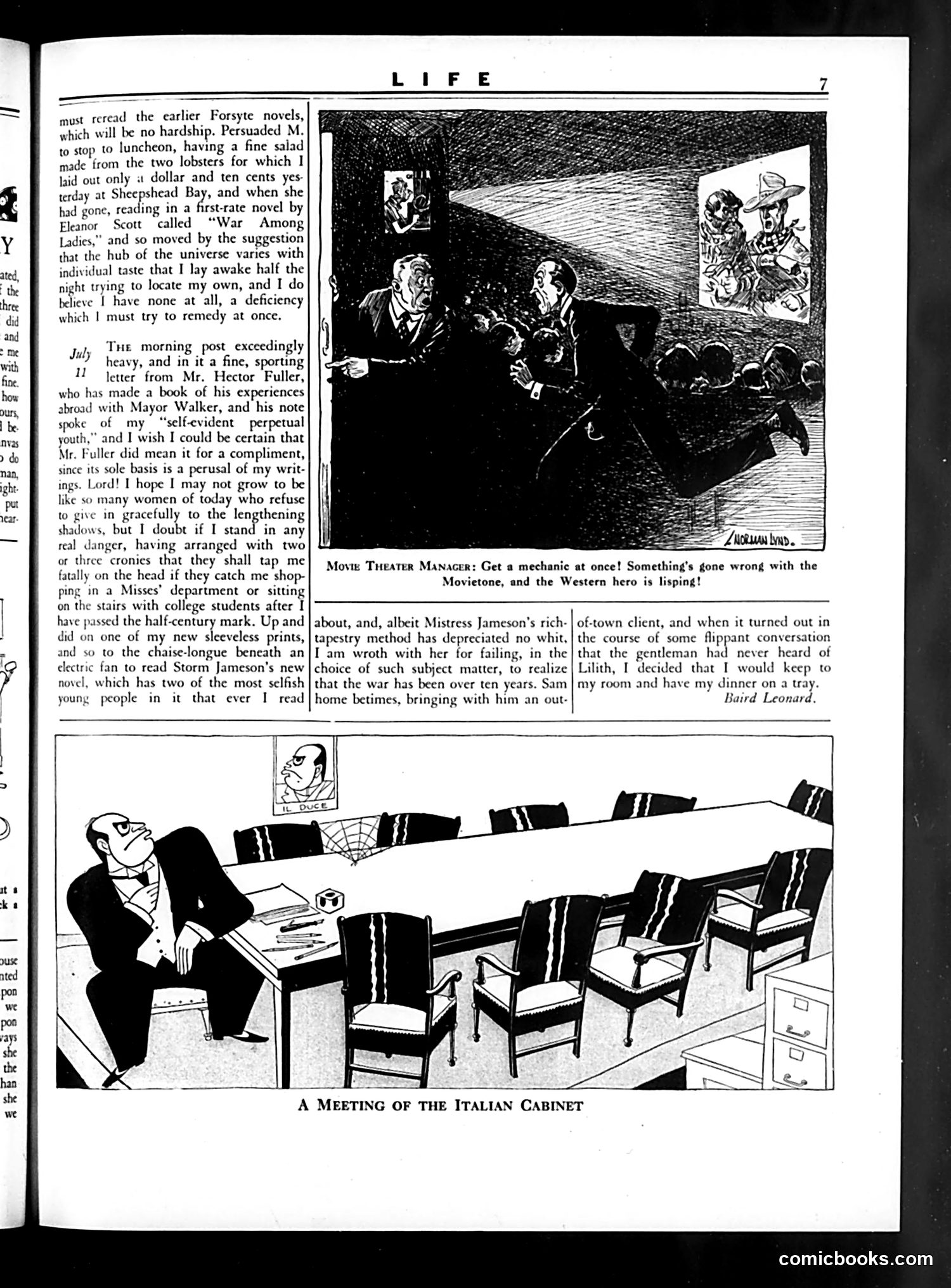
This political cartoon satirizes Italy's government, likely from the 1920s-1930s based on the magazine's era. The image shows a lone figure in a formal suit sitting at a large conference table with many empty chairs—a visual joke about governmental dysfunction or absence of meaningful leadership. The caption's irony suggests Italy's cabinet meetings were either sparsely attended, ineffectual, or controlled by a single dominant figure (possibly Mussolini, who consolidated power during this period). The empty chairs emphasize either lack of participation, decision-making authority concentrated in one person, or general governmental incompetence. The cartoon mocks Italian political governance through visual exaggeration of institutional emptiness.
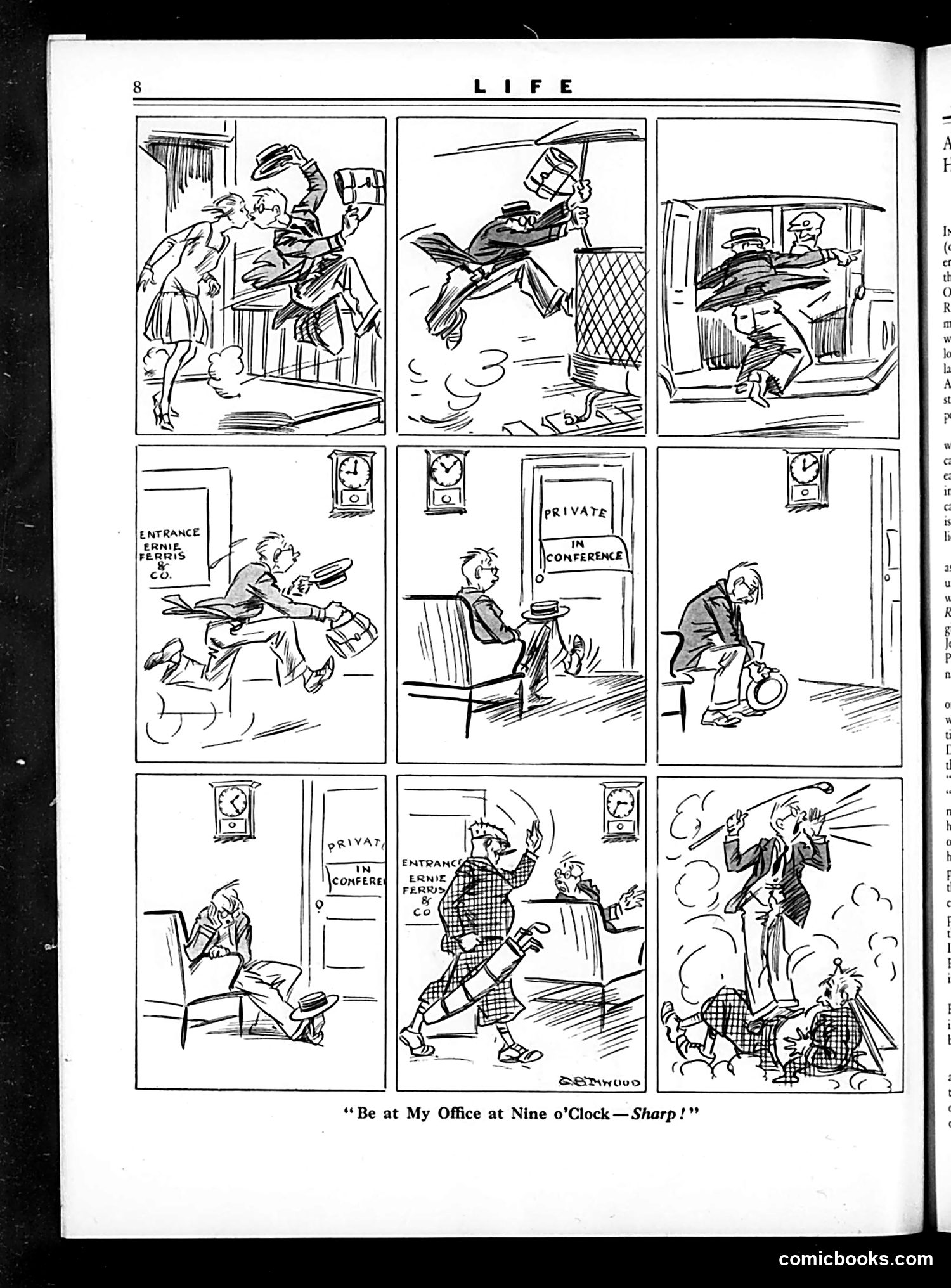
This is a humorous comic strip about someone's frantic attempt to keep a 9 AM appointment. The narrative shows: 1. **Setup**: A man receives urgent summons to be at an office promptly at nine 2. **Escalating chaos**: Despite his efforts, he encounters mounting obstacles—oversleeping, struggling with clothing, traffic delays, and other mishaps 3. **The punchline**: He arrives spectacularly late and disheveled, having apparently fallen down stairs or been ejected from a building with dogs chasing him The satire targets the universal anxiety of punctuality in business culture—the impossible gap between good intentions and reality. The comedy derives from physical slapstick showing how countless small failures compound, making the "sharp" deadline ultimately unachievable. This reflects early 20th-century American workplace comedy, where rigid business schedules clashed with human incompetence.
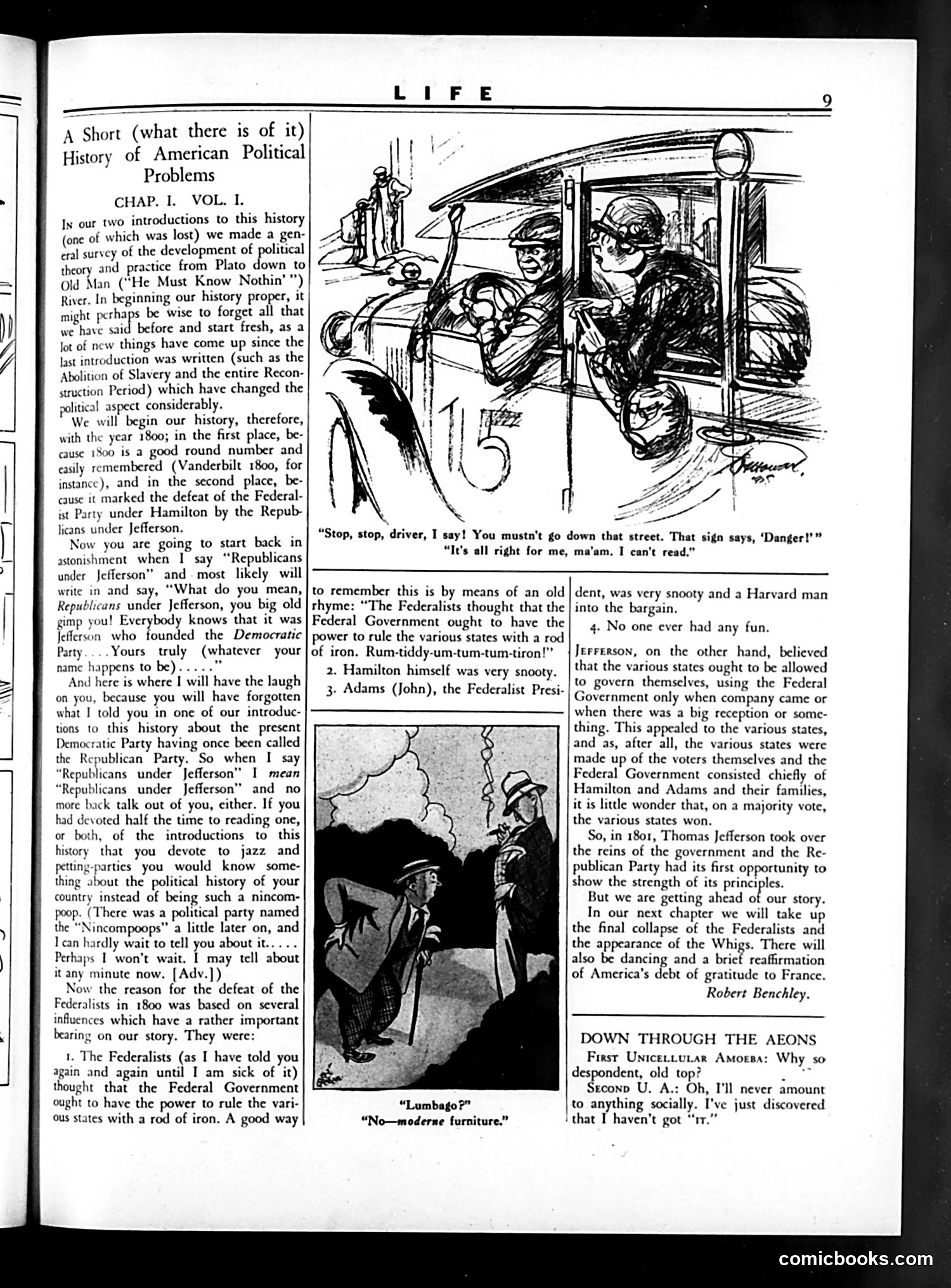
The top cartoon depicts a car driver stopping a passenger from exiting onto a dangerous street. The sign reads "Danger," but the passenger insists "It's all right for me, ma'am. I can't read." This satirizes **illiteracy in early 20th-century America**—a social problem the accompanying article addresses. The joke's dark humor comes from the passenger's casual acceptance of danger due to inability to read warning signs, implying illiteracy made people vulnerable to harm. The lower cartoon shows two men discussing "Lumbago" and "moderne furniture," likely mocking pretentious adoption of modern design terminology among the upper classes. Both cartoons exemplify *Life* magazine's approach: using humor to critique social problems and class affectation of the era.
The page contains a satirical article about Colonel Stimson and Filipino economic development. The small cartoon showing two childlike figures appears to illustrate the article's argument about the Philippines' relationship to American capitalism. The text criticizes Filipino concerns about economic "serfdom" under American industrial standards. Stimson argues Filipinos must industrialize and adopt American-style mass consumption ("acquire things in quantity") to develop economically and find their "proper place in the market of the world." The cartoon likely depicts this paternalistic dynamic—the contrast between Western industrial power and the Philippines' status as a developing territory. The imagery reinforces the article's ironic tone about American cultural and economic dominance being presented as benevolent guidance rather than imperial imposition.
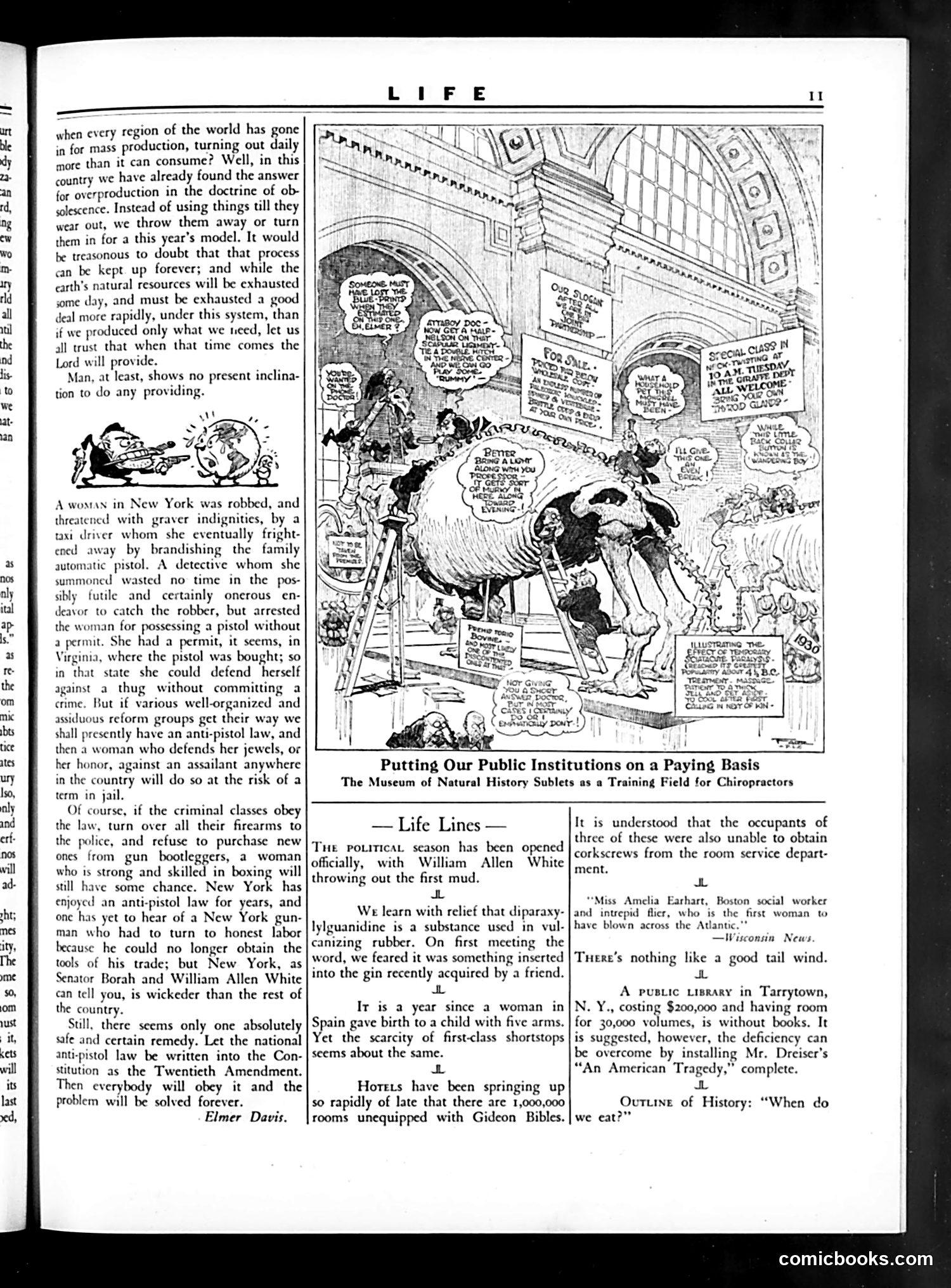
This cartoon satirizes proposals to commercialize public museums by having them generate revenue. The detailed illustration shows the Museum of Natural History converted into a "training field for chiropractors"—the skeleton displays being used for spinal manipulation instruction. The satire mocks the absurdity of turning educational institutions into profit-making ventures. The various speech bubbles show entrepreneurs pitching commercial uses for museum spaces, suggesting that financial desperation could justify degrading these institutions' original purposes. The article by Elmer Davis below supports this critique, arguing that such commercialization represents a dangerous abandonment of public institutions' social mission, comparable to abandoning the Constitution itself. The cartoon visualizes the ridiculousness of this trajectory through exaggerated commercial exploitation.
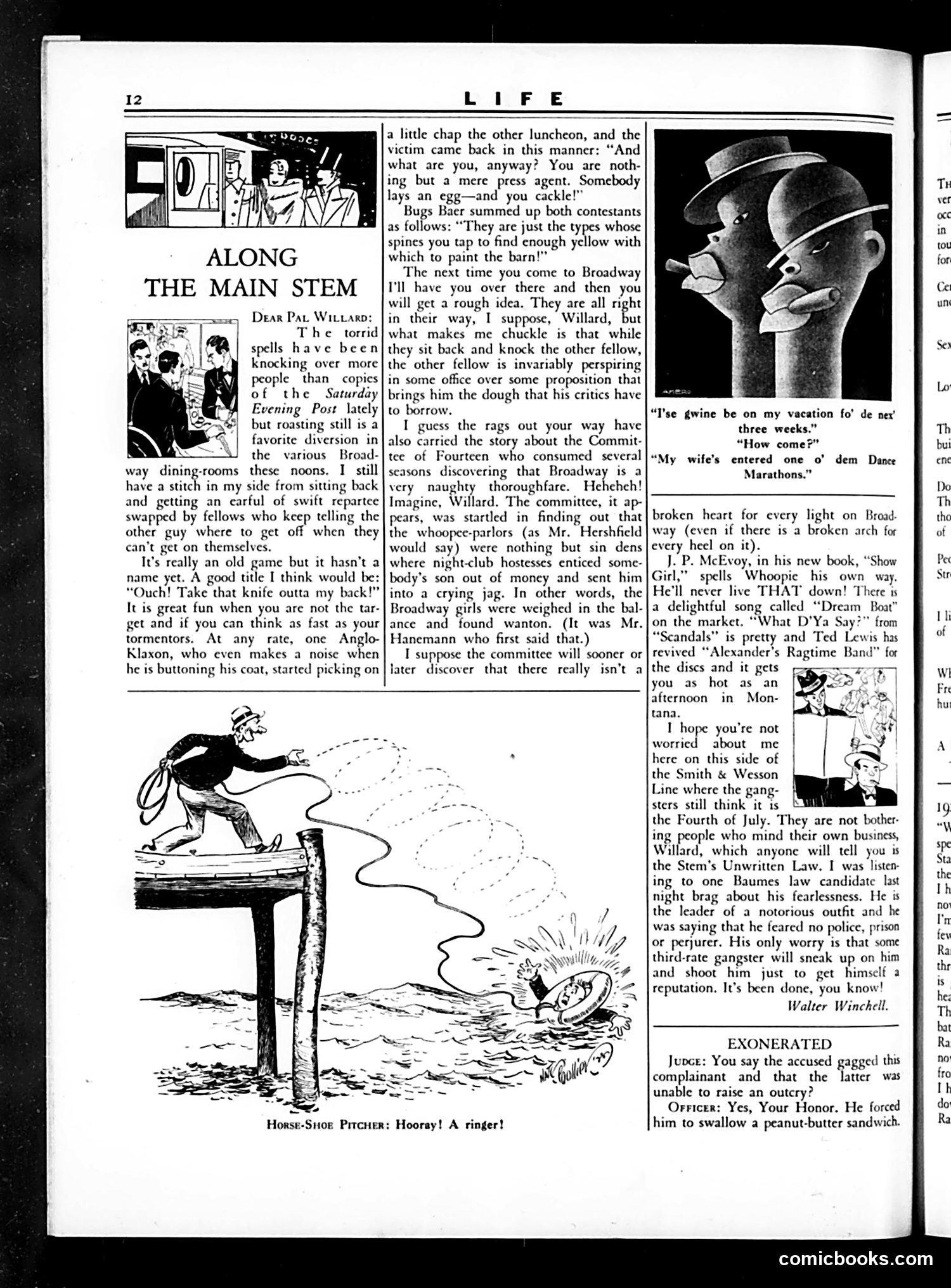
This page contains humor columns and cartoons about Broadway theater life. The main cartoon "Horse-Shoe Pitcher: Hooray! A ringer!" shows a figure attempting a horseshoe toss, appearing to accidentally hit someone below instead of the target—a visual pun on "ringer" (a successful horseshoe throw). The text columns mock Broadway culture: committee members tasting Broadway shows, chorus girls' antics, and references to gangsters on "Smith & Wesson Line." One anecdote satirizes a criminal claiming fearlessness while worrying about his reputation—social commentary on underworld figures' vanity. The photographs show men in hats, typical Broadway/urban characters of the era. Overall, the page satirizes 1920s-30s theater culture, criminal underworld presence in New York, and masculine posturing.
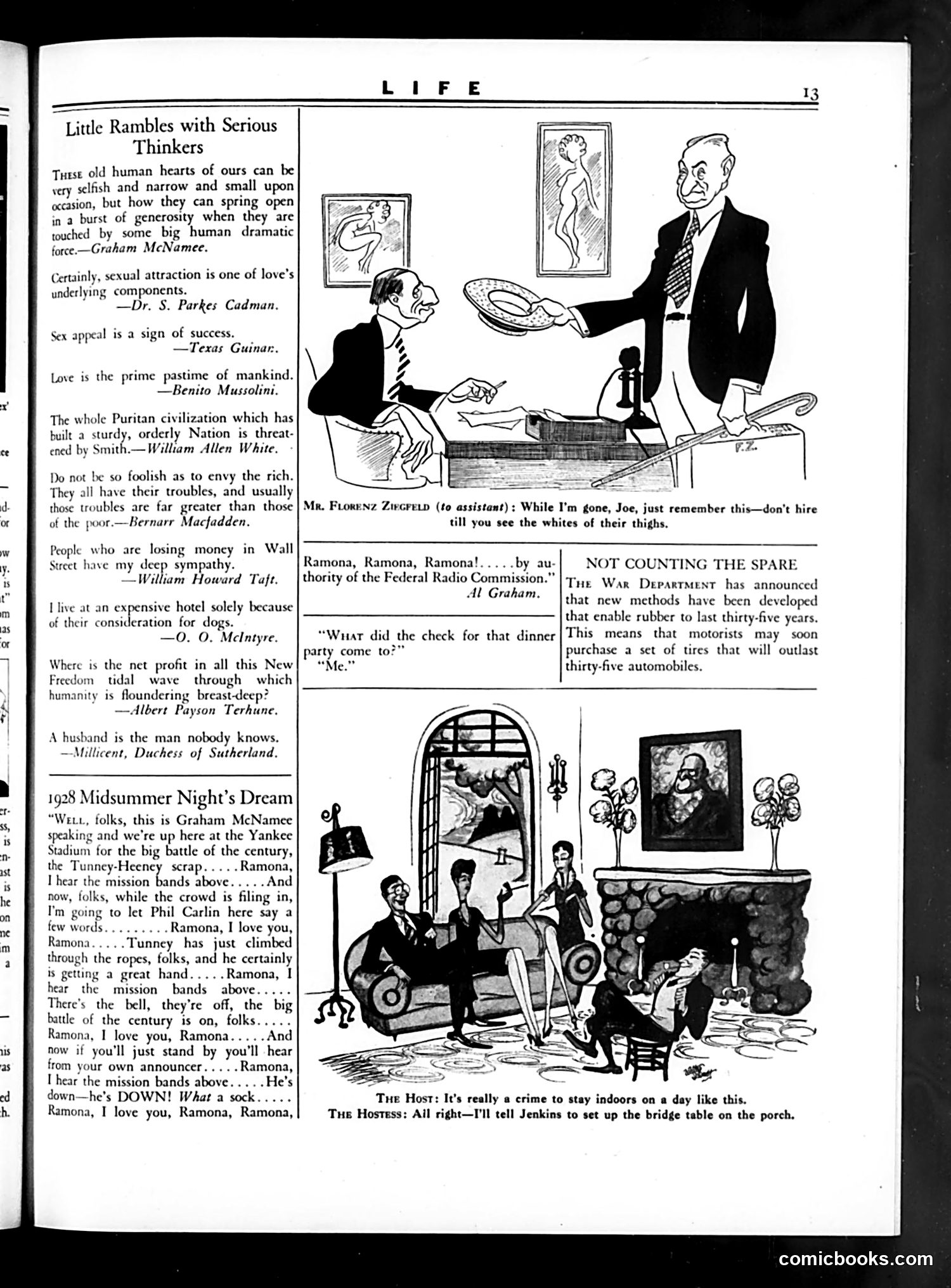
This page contains two distinct cartoons satirizing 1920s American life. **Top cartoon**: A businessman instructs his assistant Joe not to hire "the whites of their thighs"—a crude reference to women's newly visible legs during the flapper era. The satire mocks both sexual hypocrisy (the boss's own lascivious interest) and the conservative anxiety about women's changing fashion and social freedoms. **Bottom cartoon** ("1928 Midsummer Night's Dream"): References a baseball game (Tunney-Heeney fight, mission bands, Phil Carlin broadcast). The hostess complains about staying indoors while guests listen to the radio broadcast. This satirizes how radio broadcasting was capturing public attention and disrupting traditional social activities, even on pleasant summer days. Both cartoons lampoon contemporary social anxieties about modernity.
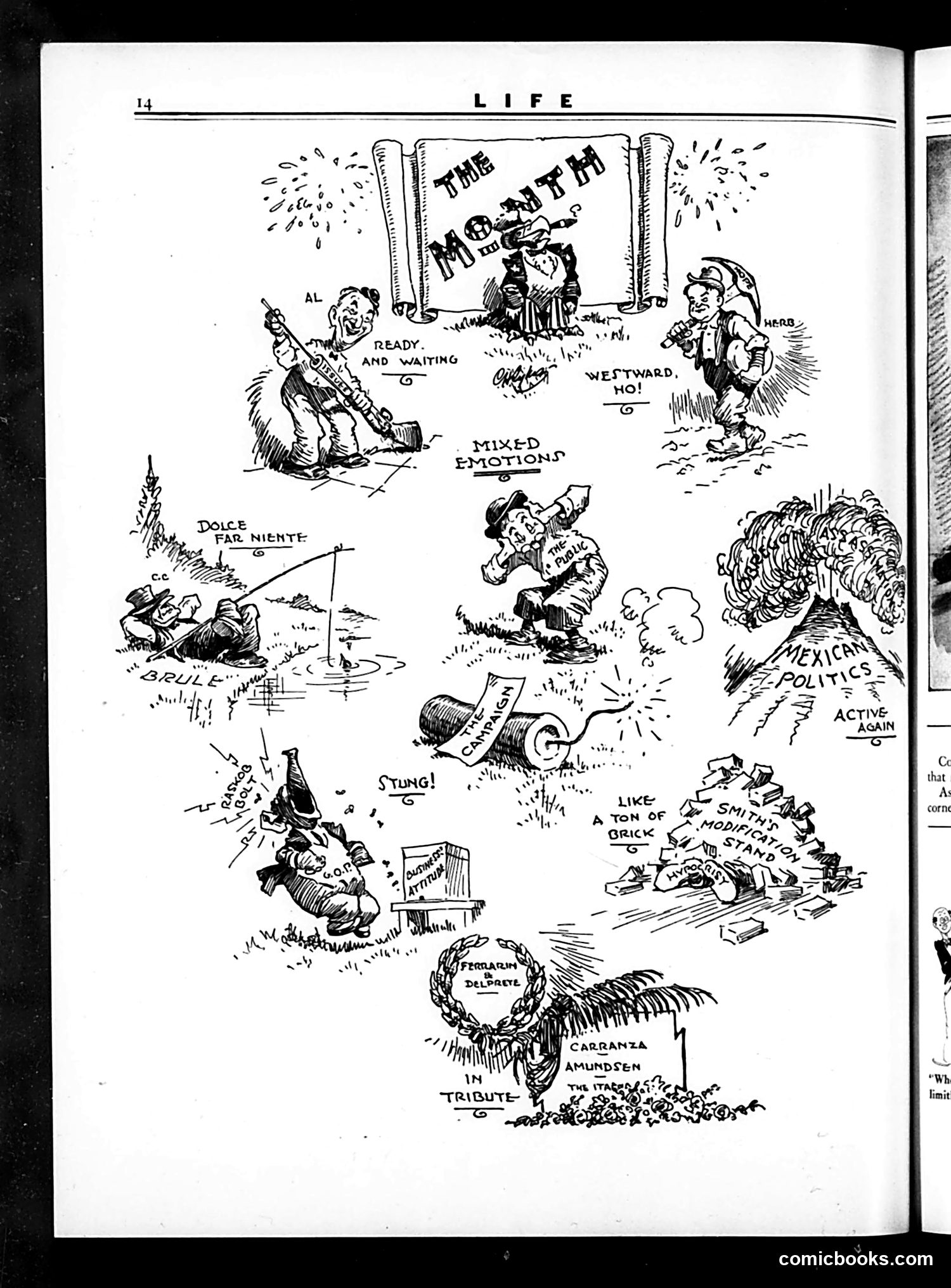
This satirical cartoon from *Life* magazine depicts multiple scenes of political turmoil, apparently related to Mexican politics (labeled "Mexican Politics - Active Again"). The central banner reads "The Moshti Ho" (likely a transliteration attempting humor). Various vignettes show figures engaged in chaotic activities: "Ready and Waiting," "Westward, Ho!," "Mixed Expeditions," "Dolce Far Niente" (sweet idleness), "Stung!," and "Like a Ton of Brick." The bottom tribute references "Carbanza Amundsen the Itascan Delegate," suggesting a specific political figure or event. The overall composition mocks Mexican political instability through exaggerated caricatures and physical comedy—people falling, fighting, and causing disruption. The satire targets the perceived chaos and incompetence of Mexican governance during this period.
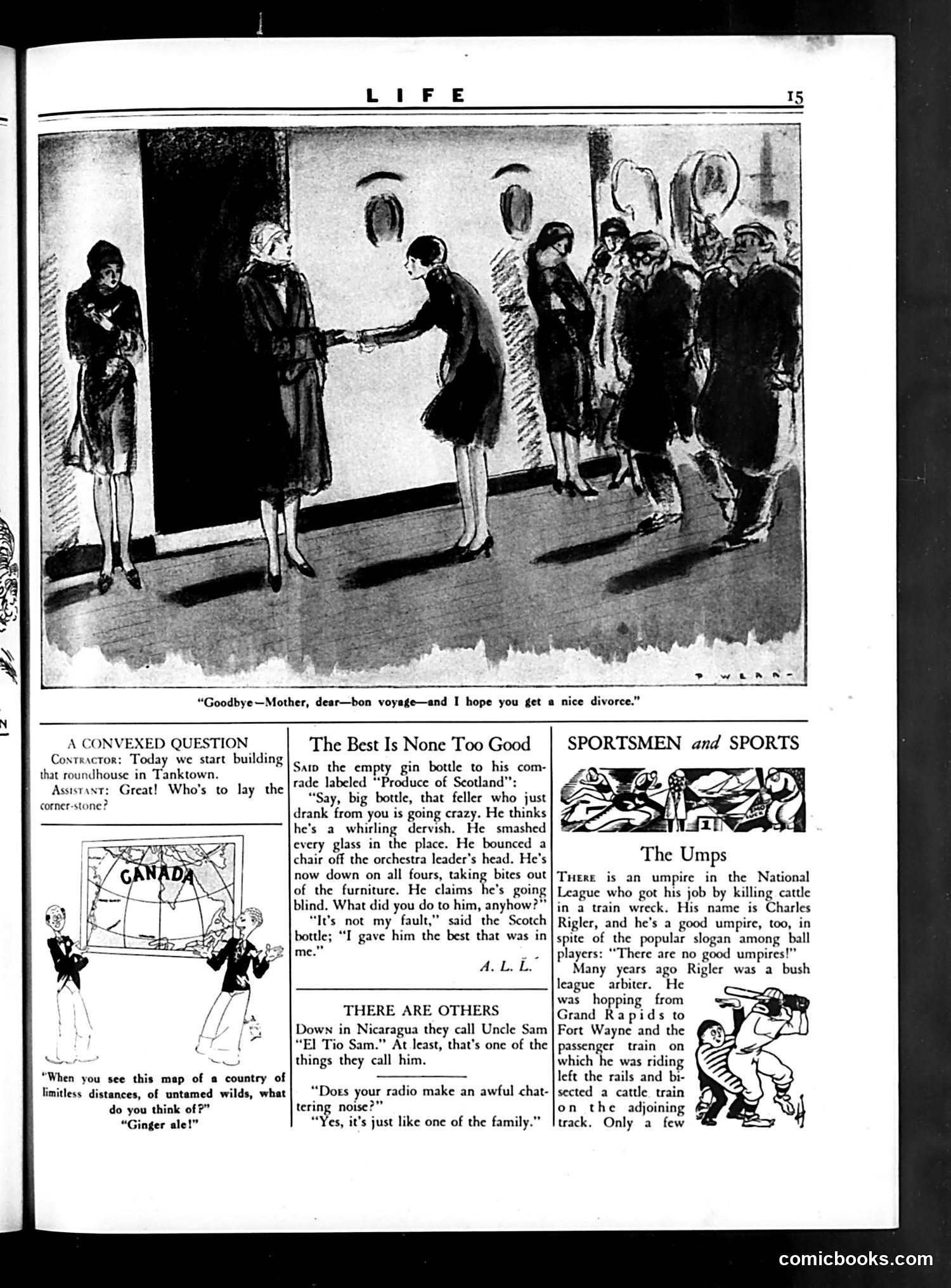
**Main Cartoon (top):** A satirical scene of a woman's farewell to her mother at what appears to be a social gathering. The caption—"Goodbye—Mother, dear—bon voyage—and I hope you get a nice divorce"—jokes darkly about divorce as a casual, expected outcome. This reflects 1920s-30s anxieties about rising divorce rates and changing social norms around marriage. **Sidebar Cartoons:** Include humorous anecdotes about Scottish drinking culture and radio noise complaints, plus a section on "The Umps" discussing baseball umpires, specifically noting Charles Rigler's long career as a league arbiter. **"Convexed Question" section:** A joke about Canadian geography, playing on the vast, remote nature of Canada to outsiders. The page uses humor to comment on contemporary social changes and domestic life.
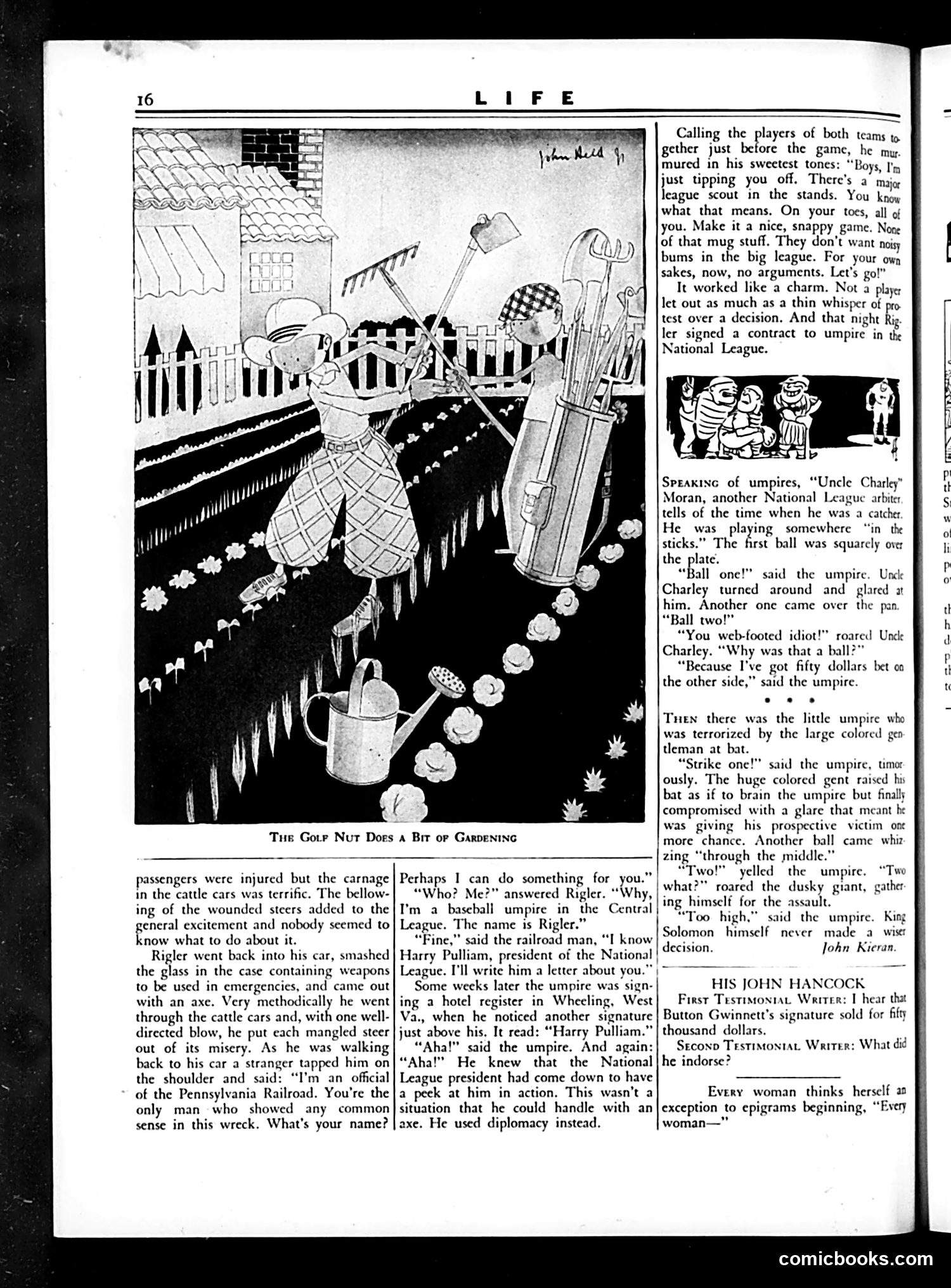
This cartoon satirizes the obsession of golf enthusiasts by depicting a man gardening with golf clubs and equipment instead of proper tools. The figure uses a putter as a rake, carries golf clubs as a watering can, and arranges what appear to be golf balls among flowers and plants. The joke is straightforward: the golfer is so consumed by his hobby that he cannot perform ordinary domestic tasks without mentally substituting golf equipment. This reflects early 20th-century middle-class anxieties about golf becoming a time-consuming passion that distracted men from family responsibilities and normal life. The accompanying text discusses baseball umpires, appearing unrelated to the cartoon.
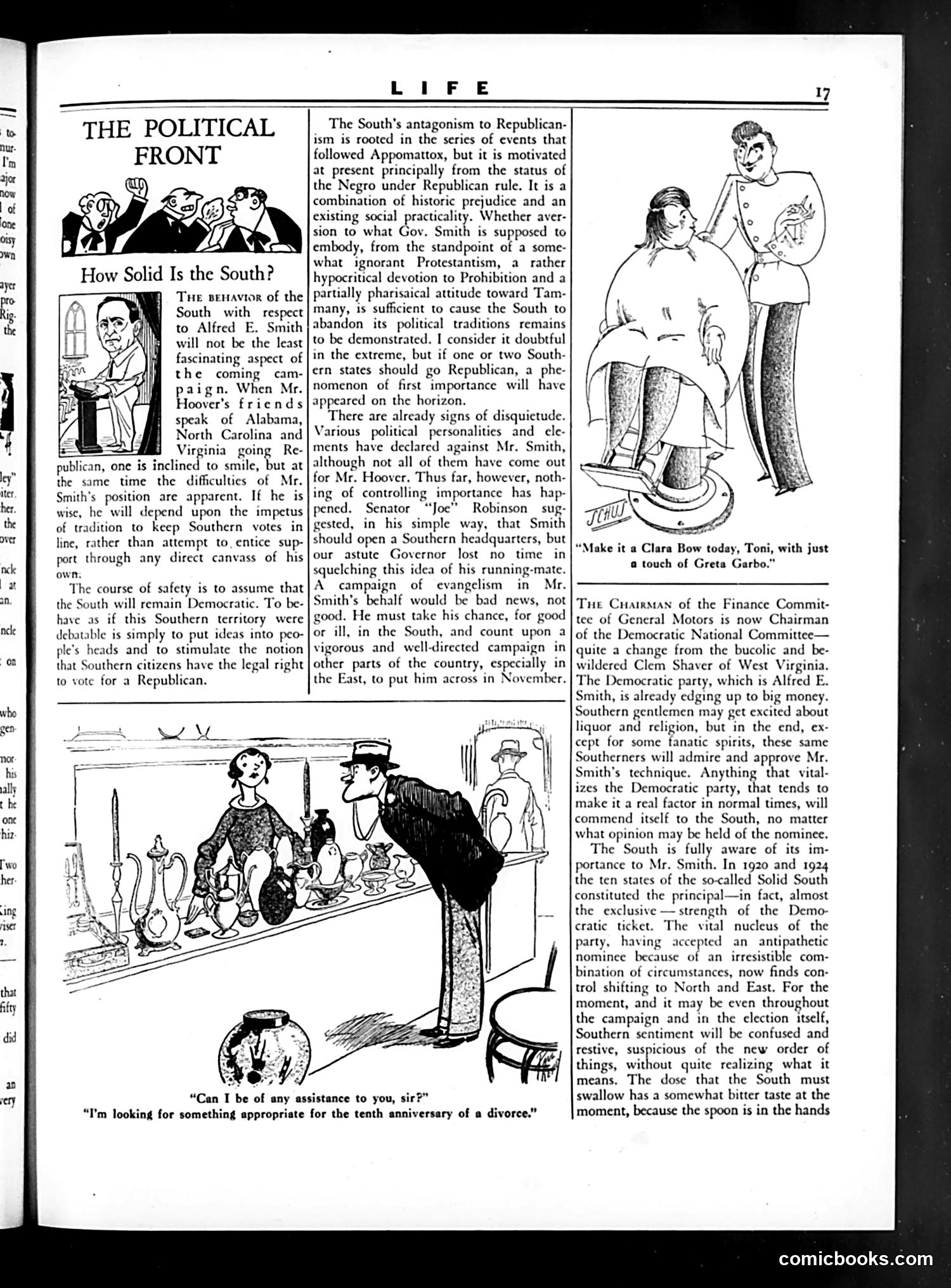
This page examines Southern Democratic resistance to Republican candidates, particularly regarding Alfred E. Smith's 1928 presidential campaign. The top cartoon satirizes Smith's efforts to appeal to the South despite his positions on Prohibition and his perceived "Protestantism" concerns—likely referencing anti-Catholic bias of the era. The lower cartoon depicts a man seeking "something appropriate for the tenth anniversary of a divorce" as a gift, mocking marital instability. The article argues the South will remain Democratic despite disaffection, noting Smith must campaign vigorously to win Southern states. References to "Joe Robinson" suggest Democratic strategy to retain regional support. The page reflects early 20th-century partisan politics and regional divisions that defined American elections.
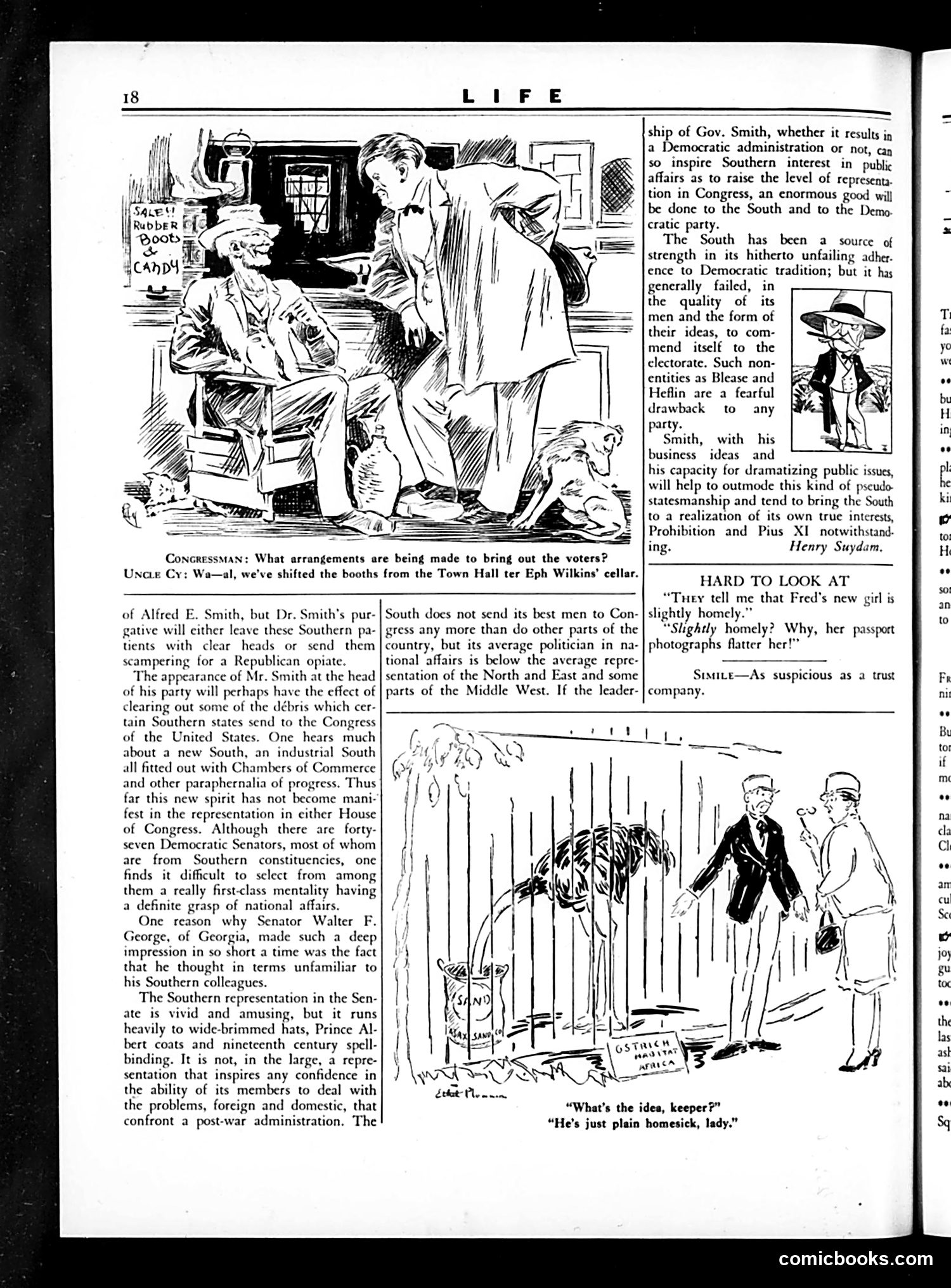
**Top Cartoon:** A congressman questions "Uncle Cy" (representing a rural Southern politician) about voter turnout. Uncle Cy's response—that voting booths have been moved to "Eph Wilkins' cellar"—satirizes election manipulation and fraud, likely voter suppression tactics common in the Jim Crow South. The humor is dark: the "arrangement" is transparently corrupt. **Accompanying Article:** The text criticizes Southern Democratic congressmen as intellectually inferior and poorly qualified, citing politicians like Blease and Heflin as liabilities to the party. It expresses hope that Governor Alfred E. Smith's leadership might elevate Southern political standards. **Bottom Cartoon:** An unrelated joke about a homesick ostrich—purely comedic filler with no political content. The page reflects 1920s-era criticism of Southern political corruption and the perceived incompetence of Southern representatives, while advocating for Democratic Party reform.
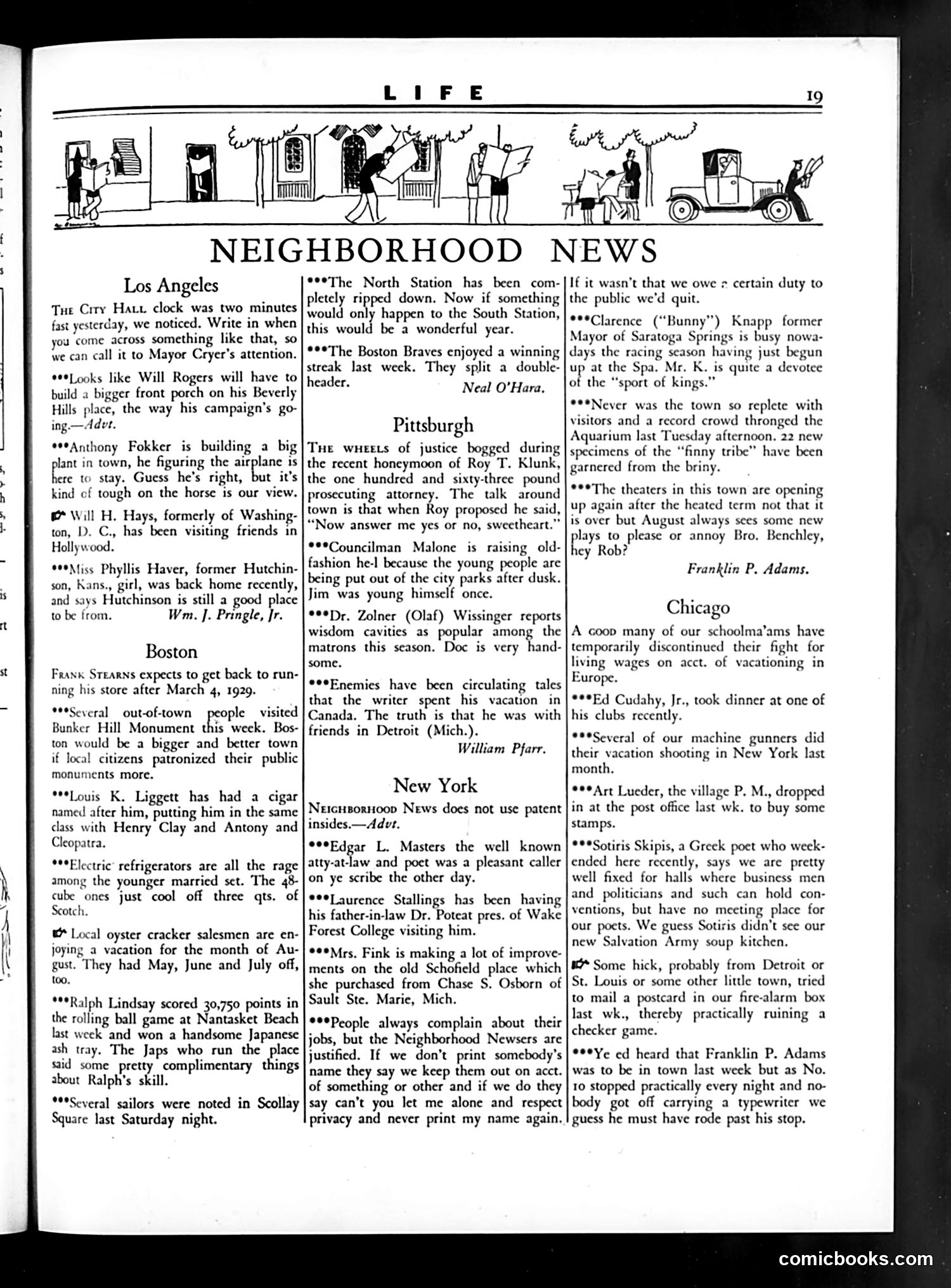
This page from Life magazine presents humorous, gossipy tidbits about notable people and trivial occurrences in various American cities. The cartoon header depicts a street scene with everyday activities. The satire works on multiple levels: 1. **Mocking local journalism**: Life parodies small-town gossip columns by reporting absurdly trivial matters (a City Hall clock being two minutes fast) alongside celebrity news. 2. **Social commentary**: References to Prohibition appear obliquely—the Scotch joke suggests illegal alcohol consumption was common even among respectable classes. 3. **Celebrity mockery**: Will Rogers' expanding porch reflects his growing popularity; the cigar named after Louis K. Liggett humorously elevates a businessman to historical company with Henry Clay and Antony/Cleopatra. 4. **Ironic editorial voice**: The final New York item satirizes the impossible position of neighborhood columnists—criticized equally for including or excluding names. The overall joke: Life ridicules both small-town preoccupation with minor local details and the vanity of people desperate for any public mention.
This page consists entirely of **local society gossip and humor columns** from various North American cities (Louisville, Quebec, Spokane, Cincinnati, Detroit, and Birmingham). There are **no political cartoons**. The content reflects early 1920s American life: references to Prohibition law enforcement, post-WWI veterans (Gen. James E. Stuart), local celebrities, and social activities. Notable details include mentions of "home-brew camps" along the Ohio River (illegal alcohol production during Prohibition), automobile dealers, and leisure activities like boat excursions. The humor is gentle and provincial—celebrating local writers, joking about town gossip, and poking fun at minor figures (a mayor acting too officially, poets being lazy). Bylines like "Ye Scribe" and "Ye Editor" indicate this was a regular column featuring anonymous correspondents from different cities contributing humorous observations about their neighbors and local happenings. This represents Life's lighter, satirical side focused on small-town Americana rather than serious political commentary.
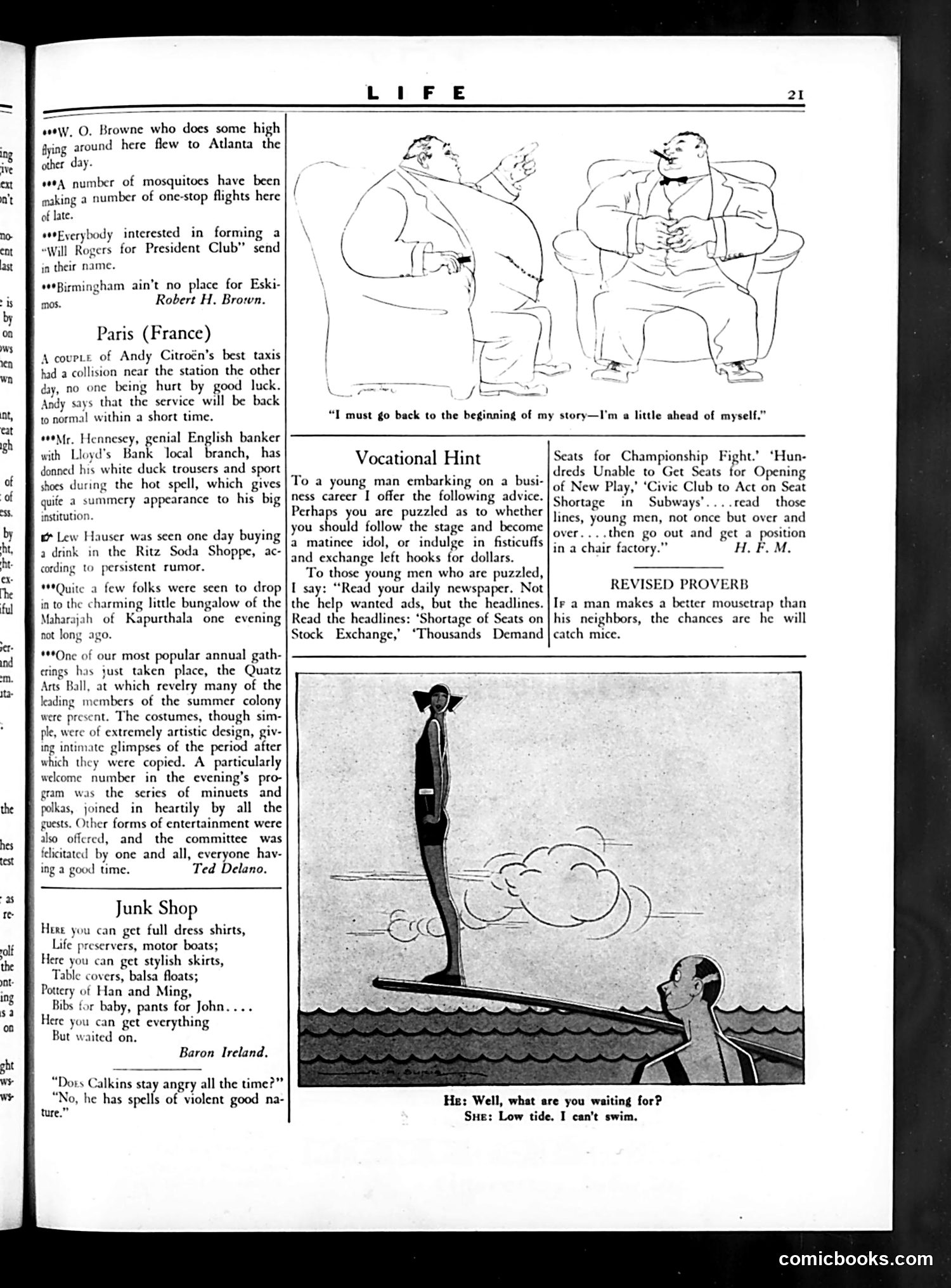
This page from *Life* magazine (a satirical weekly) contains miscellaneous humor pieces typical of the era: **Top cartoon**: Three men in conversation; one explains he's "a little ahead of [him]self" in his story—a gentle joke about narrative impatience or rambling conversation. **"Vocational Hint"**: Satirizes job-seeking advice by observing that newspaper headlines consistently mention "shortage of seats"—at stock exchanges, sporting events, theaters, and subways. The absurdist punchline: get a job in a chair factory. This mocks both the redundancy of news coverage and the illogic of taking obvious "lessons" from headlines. **Beach cartoon**: A man in a boat encounters a woman standing in shallow water. His "Well, what are you waiting for?" receives her reply: "Low tide. I can't swim"—humor based on her literally waiting for conditions to change rather than taking action. **Lower sections** include gossip from Paris and social commentary ("Junk Shop" poem mocking stores selling everything but service). The satire targets everyday absurdities: news cycles, career advice, human inertia.
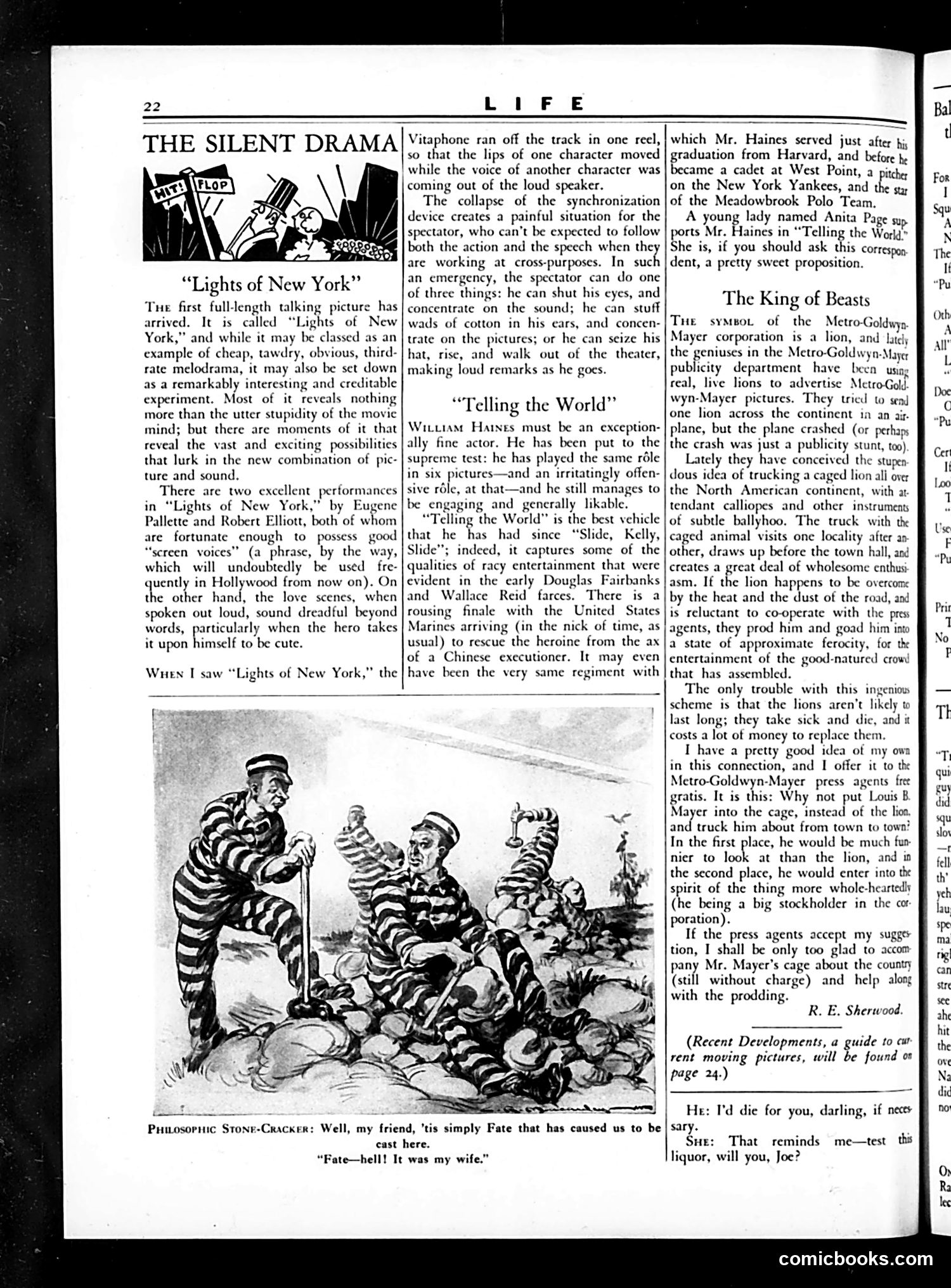
This page reviews early talking pictures ("talkies"), a revolutionary but imperfect technology. The main cartoon depicts convicts in striped uniforms—a visual joke about synchronization failure in the film "Lights of New York." When the Vitaphone sound system malfunctioned, actors' lip movements didn't match dialogue, creating absurd results the review compares to watching prisoners. The reviews discuss three films: "Lights of New York" (praised as interesting despite being cheap melodrama), "Telling the World" (featuring actor William Haines), and "The King of Beasts" (mocking Metro-Goldwyn-Mayer's promotional stunt of trucking a caged lion across North America to advertise their films). The satire targets both early talking picture technology's technical unreliability and Hollywood's desperate, elaborate publicity schemes. The tone is witty but affectionate toward cinema's experimental phase.
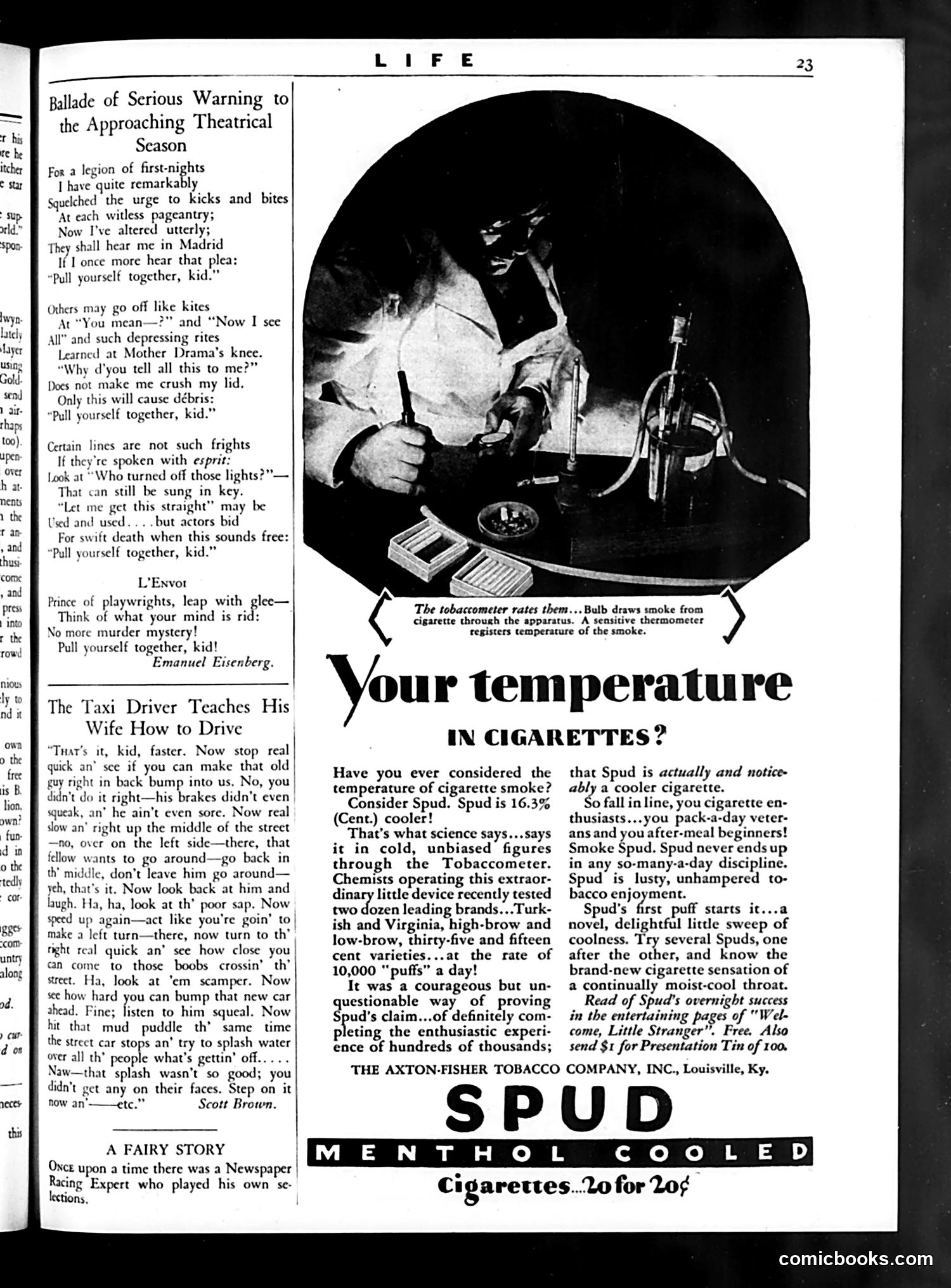
This page contains three distinct pieces: **"Ballade of Serious Warning to the Approaching Theatrical Season"** (poem by Emanuel Eisenberg): A satirical poem mocking theatrical clichés, particularly the overworn line "Pull yourself together, kid." The poet expresses exasperation at repetitive dramatic conventions in stage plays. **"The Taxi Driver Teaches His Wife How to Drive"** (attributed to Scott Brown): Humorous monologue depicting aggressive, reckless driving behavior as normal—speeding, cutting off pedestrians, splashing water on people. The satire likely critiques dangerous urban driving habits and masculine bravado common to the era. **SPUD Cigarettes Advertisement**: A full-page ad promoting Spud as a "cooler" cigarette (16.3% cooler, per a "Tobaccometer" device). The ad claims scientific validation through testing of leading brands. This represents typical early-20th-century cigarette marketing that made health-related claims now considered fraudulent. The page mixes literary satire and humor with period advertising reflecting attitudes toward smoking and driving of that era.
This page from *Life* magazine presents a satirical "Confidential Guide" to current theatrical and literary attractions. The header illustration depicts showgirls and entertainment venues in a stylized, tongue-in-cheek manner typical of 1920s *Life* humor. The content consists of brief, witty reviews of books and plays. Notable entries include: - **Mae West** in *Diamond Lil*—The review dismisses it as "old-fashioned ham melodrama" that gained popularity among "knowing ones," subtly mocking both the play and its audience's questionable taste. - Reviews acknowledge shows like *Porgy* (praised as depicting "Negro life...with great distinction") and O'Neill's *Strange Interlude* (noting audiences may be "irritated" by its five-hour length but "doubtful that you will be bored"). The satire works by employing deadpan, backhanded compliments—praising mediocre works with faint damning, suggesting readers' sophistication while questioning their judgment. This reflected *Life*'s role as arbiter of cultural taste for educated audiences.
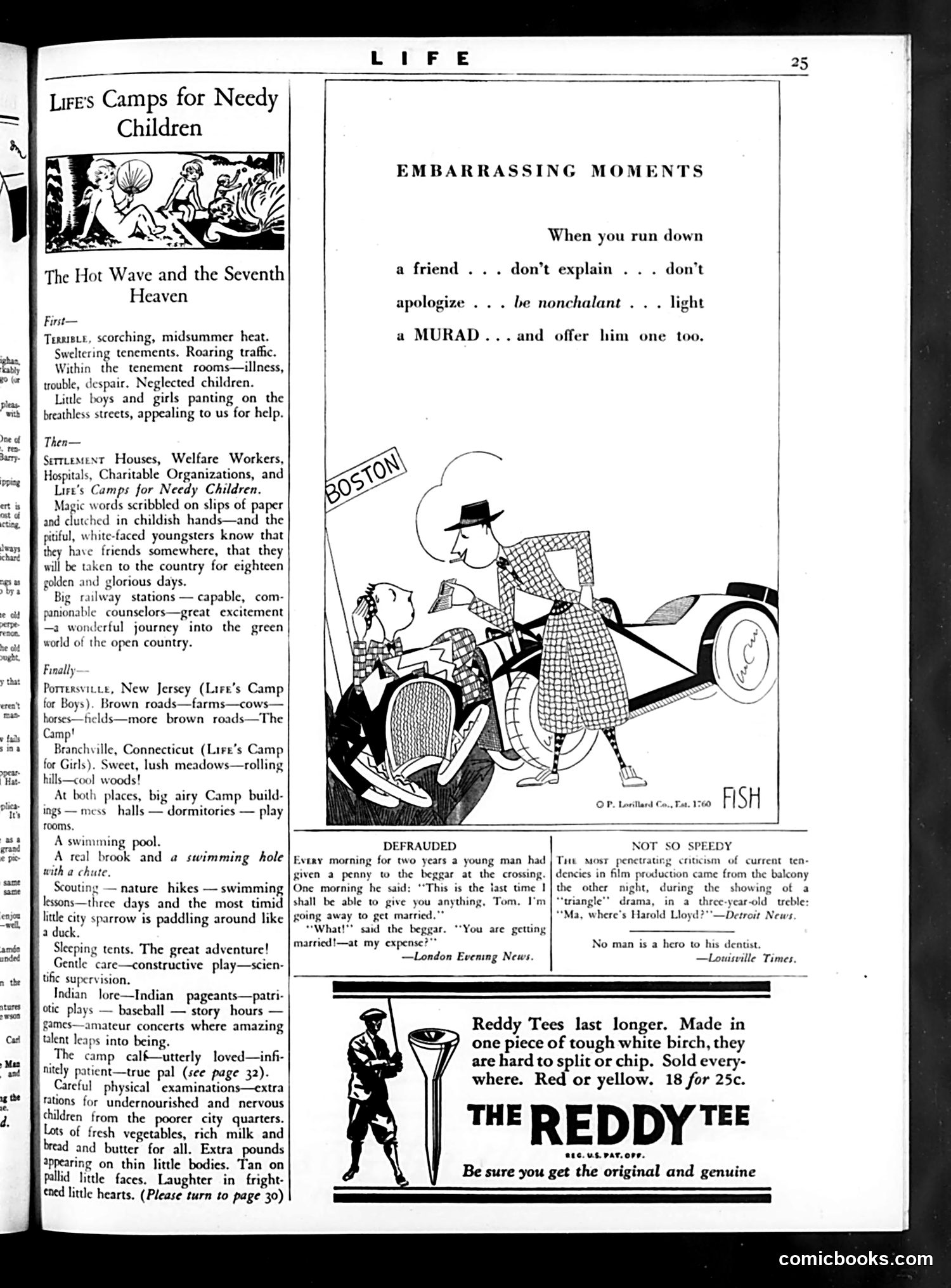
This page features a satirical cartoon about social etiquette. The main illustration shows two men meeting on a Boston street—one appearing to rush past the other while offering a cigarette (a "Murad" brand, prominently advertised). The joke concerns how to handle an awkward encounter with someone you know. The text advises: when you accidentally "run down a friend," don't explain or apologize. Instead, remain casual ("nonchalant") and offer them a cigarette as if nothing happened. This reflects early 20th-century social conventions where offering a cigarette served as a smoothing-over gesture—a way to reset an uncomfortable social moment through casualness rather than direct acknowledgment. The humor lies in the absurdity of pretending to ignore the rudeness while performing a small courtesy. The cartoon is essentially product placement wrapped in etiquette humor, using social anxiety as a vehicle to advertise Murad cigarettes to Life magazine's middle-class readers.
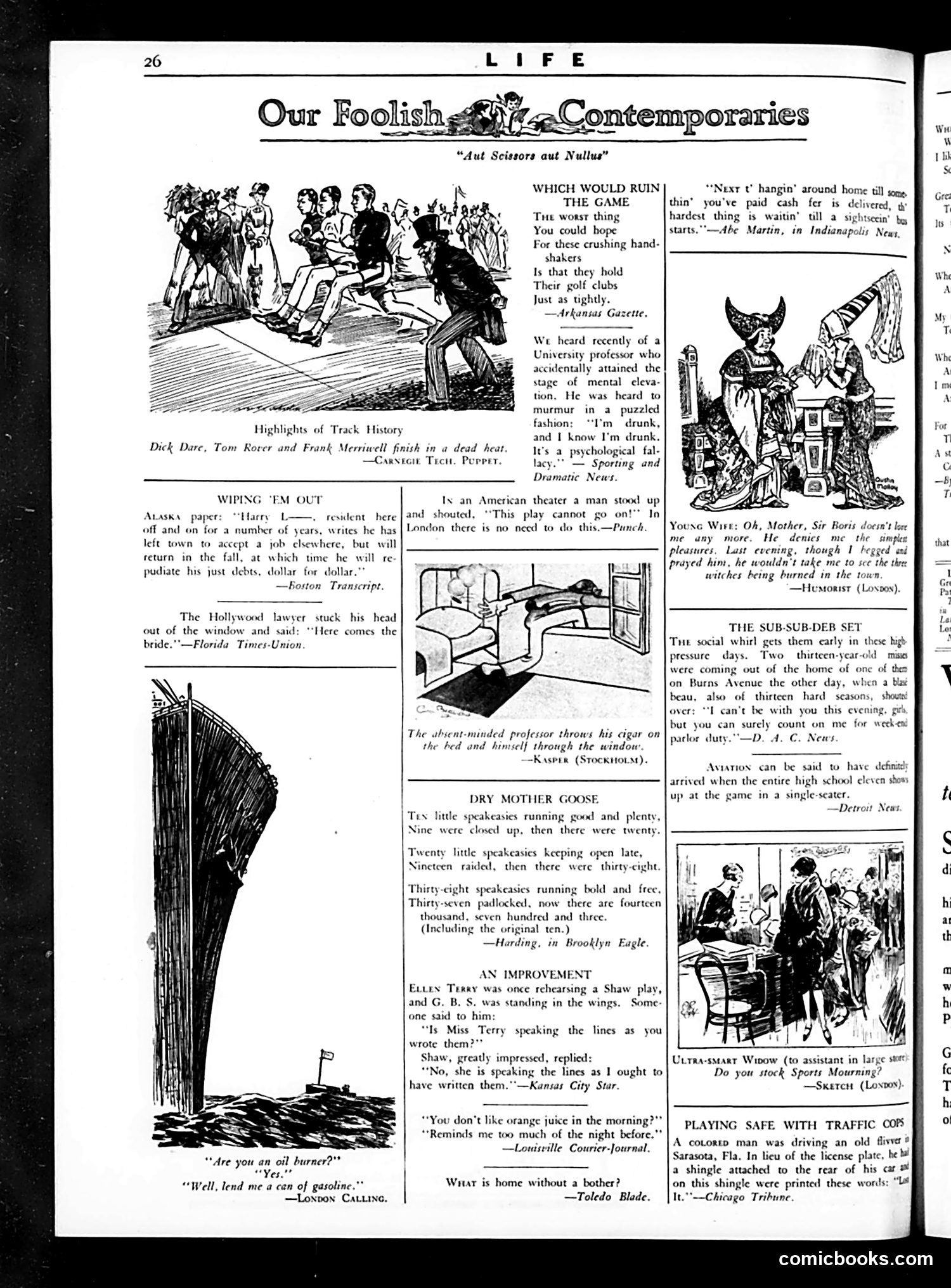
This page from *Life* magazine (undated but early-to-mid 20th century based on references) collects humorous short anecdotes and jokes organized under "Our Foolish Contemporaries." **Key satirical targets include:** - **Prohibition enforcement**: The "Dry Mother Goose" section mocks the apparent futility of closing speakeasies—the numbers keep growing despite raids, suggesting Prohibition's failure. - **Social pretension**: The "Sub-Sub-Deb Set" ridicules young teenagers mimicking adult dating rituals and social hierarchies prematurely. - **Absent-minded intellectuals**: Multiple jokes target university professors and theatrical types portrayed as impractical or eccentric. - **Modern absurdities**: References to "oil burners," traffic enforcement, and the disconnect between aspirations and reality reflect contemporary urban life. The cartoons accompanying these are simple line drawings illustrating specific jokes. The overall tone is lighthearted mockery of contemporary social behavior, economic realities (debts, poverty), and the ongoing cultural tensions of the era—particularly Prohibition's ineffectiveness.
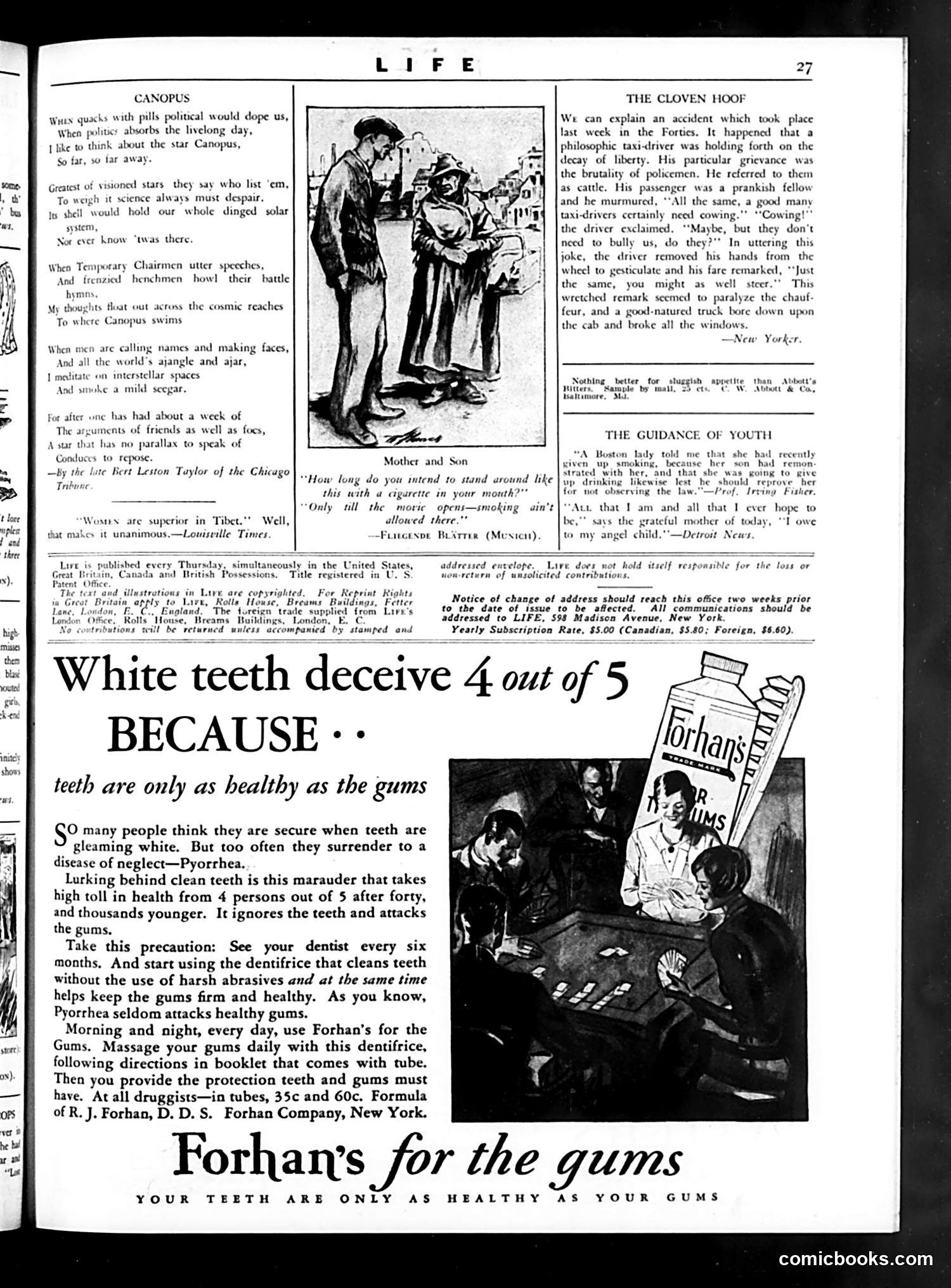
This page contains several satirical pieces typical of Life's content circa early 20th century: **"Canopus" poem**: A whimsical escape fantasy where the narrator retreats mentally to a distant star whenever politicians deliver speeches or people quarrel—suggesting contemporary political discourse was tedious and worth avoiding. **"Mother and Son" cartoon**: Shows a mother criticizing her son's cigarette smoking, reflecting period concerns about youth and moral decline. **"The Cloven Hoof"**: A brief anecdote mocking both taxi drivers' complaints about police brutality and passengers' tactless remarks, illustrating social friction in urban life. **"The Guidance of Youth"**: Quotes about children's influence, likely satirizing sentimental parenting attitudes. **The Forhan's advertisement** (lower half) is a significant portion, warning that white teeth deceive—gum disease ("pyorrhea") lurks beneath clean teeth. This reflects genuine health concerns of the era and aggressive early 20th-century dental marketing. The page blends satire, humor, and advertising typical of Life's format.
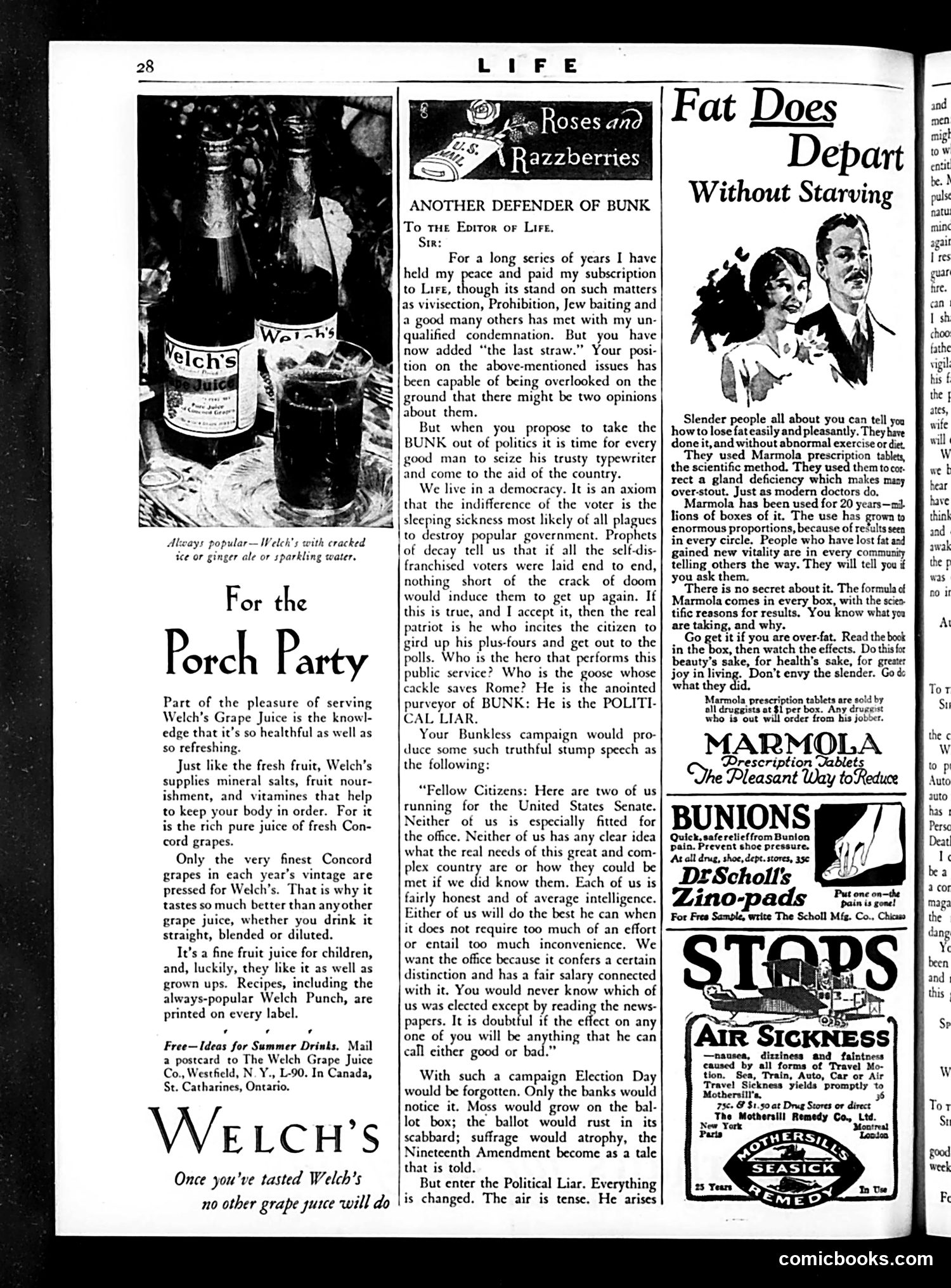
This letter to *Life*'s editor defends political lying as necessary to democracy. The writer argues that *Life* magazine's campaign against "bunk" (falsehoods) in politics is misguided and dangerous. The satire's premise: voters are naturally apathetic. Only sensational political rhetoric—exaggeration, emotional appeals, dishonesty—can motivate citizens to vote and participate. A truthful campaign speech admitting candidates are mediocre and self-interested would bore everyone; election turnout would collapse and democratic institutions atrophy. The letter mocks this logic by proposing absurdly honest political speech, then contrasts it with "the Political Liar" who excites the electorate through deception. The piece satirizes both cynical political operators who weaponize misinformation *and* citizens' susceptibility to manipulation—suggesting American democracy depends on con artists to function. It's commentary on the gap between democratic ideals (informed citizenry) and cynical reality (voters motivated by theater, not facts).
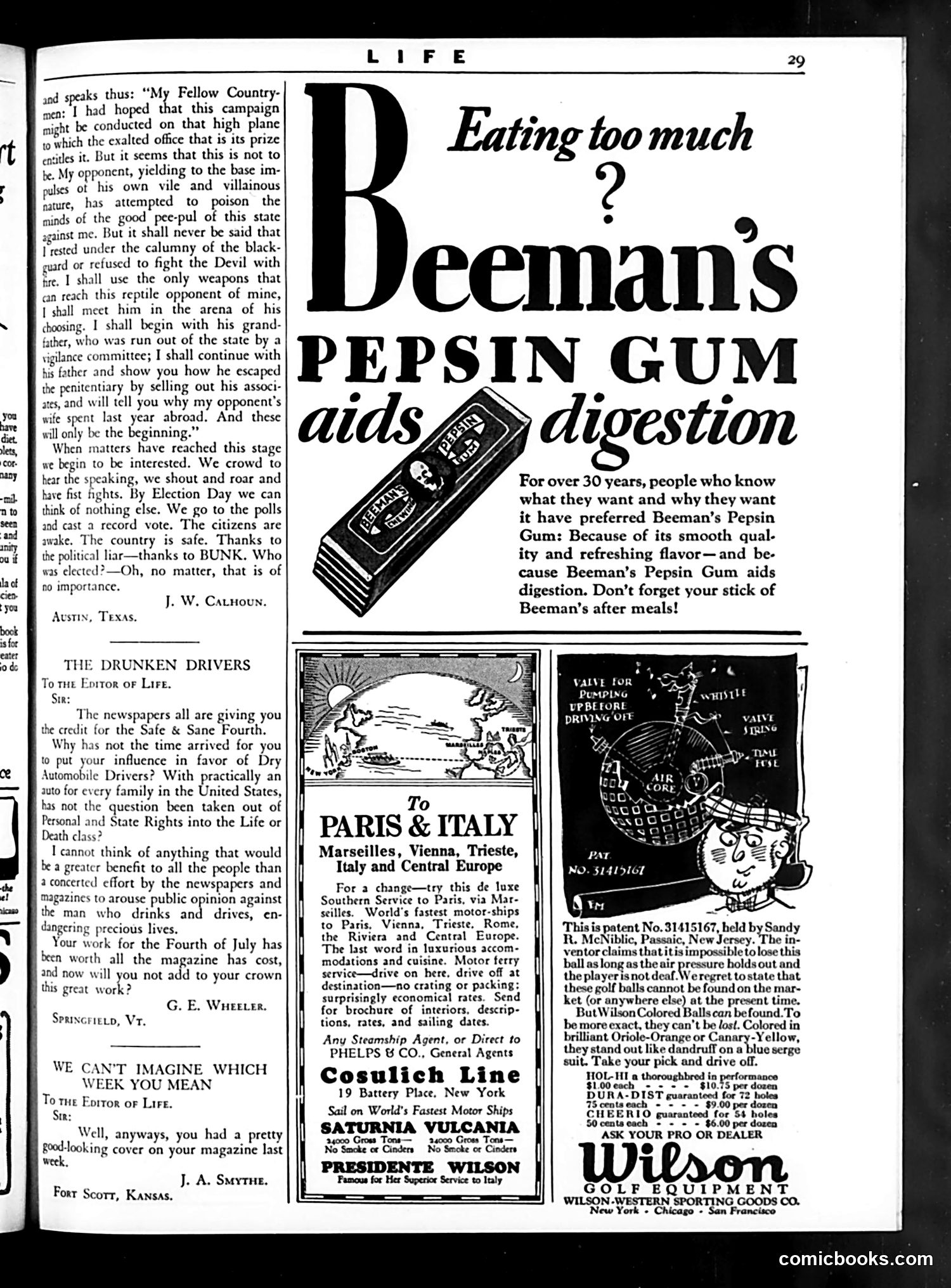
This page contains **reader letters and advertisements** rather than editorial cartoons. The main satirical content is the opening letter from J.W. Calhoun (Austin, Texas), which mocks political campaigning. It describes a candidate who, after claiming he'd conduct a "high plane" campaign, then descends into personal attacks—threatening to expose his opponent's grandfather's expulsion from the state, his father's criminal past, and his wife's year abroad. The satire's point: politicians claim dignity but resort to "BUNK" (lies and scandal-mongering), yet voters remain fascinated and engaged. Calhoun cynically observes that such spectacle—while unethical—actually drives civic participation and election turnout, making the country "safe" through sheer distraction. The second letter advocates for drunk-driving awareness, and a third offers vague praise for Life's cover. The remainder is **period advertising**: Beeman's Pepsin Gum (claiming digestive benefits), steamship travel to Europe, and Wilson golf equipment—typical commercial content of the era.
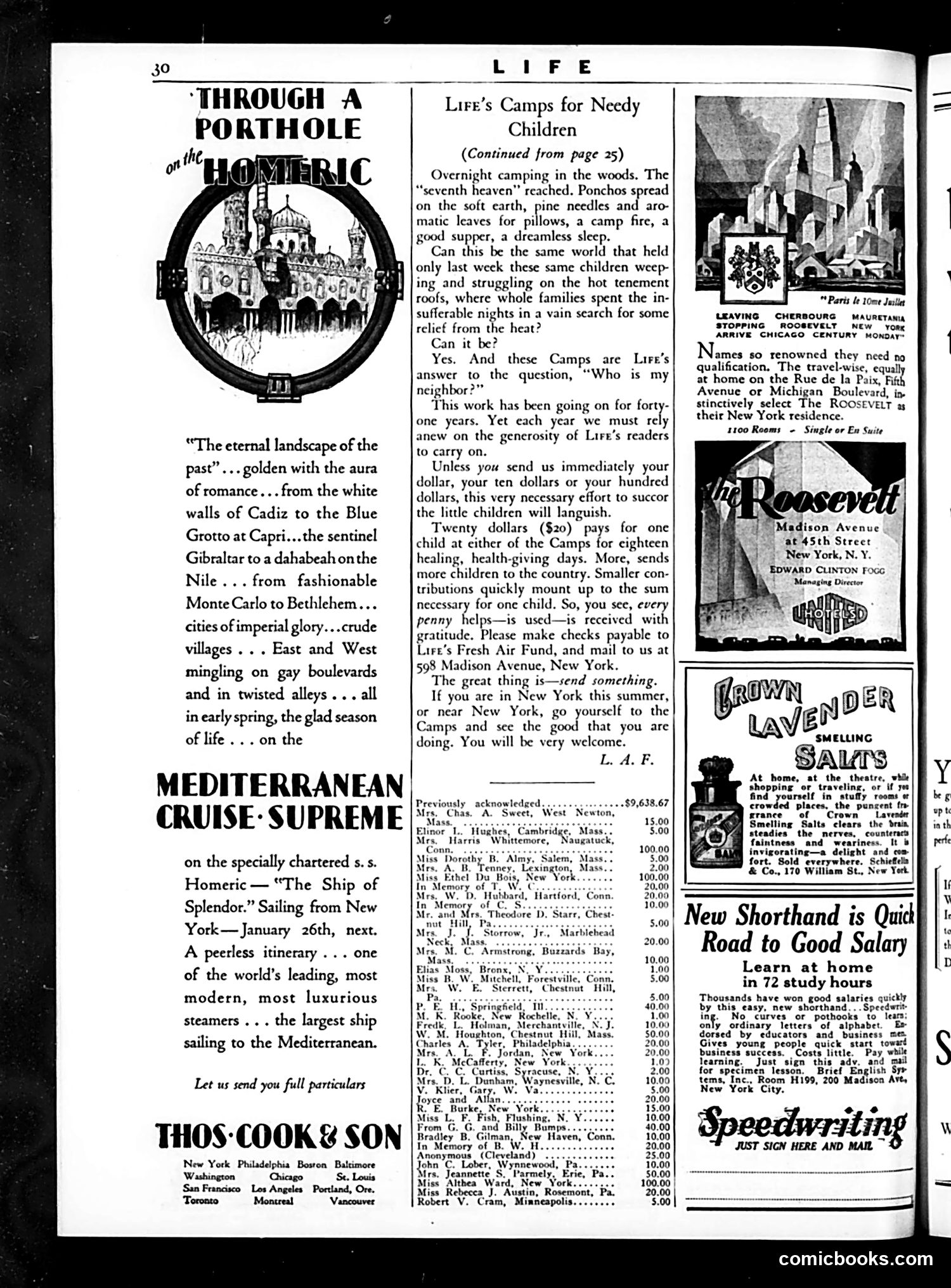
This page combines commercial advertising with charitable solicitation, typical of 1920s Life magazine. **Left side**: A Thomas Cook & Son cruise advertisement uses romantic, orientalist language ("golden with the aura of romance") to market Mediterranean travel aboard the S.S. Homeric, departing January 26th. The "porthole" framing device creates an exotic viewing experience for wealthy travelers. **Right side**: Life's Fresh Air Fund solicitation appeals for donations to send poor urban children to summer camps. The contrast is stark—it describes tenement children suffering on hot roofs versus the "seventh heaven" of woodland camping. The text explicitly addresses the moral obligation ("Who is my neighbor?"), requesting contributions ($20 sponsors one child for 18 days). **The implicit satire**: The juxtaposition itself carries critique—while wealthy readers contemplate Mediterranean luxury, impoverished children desperately need basic relief from summer heat. Life positions itself as mediating between these worlds, appealing to readers' charitable impulses through uncomfortable contrast.
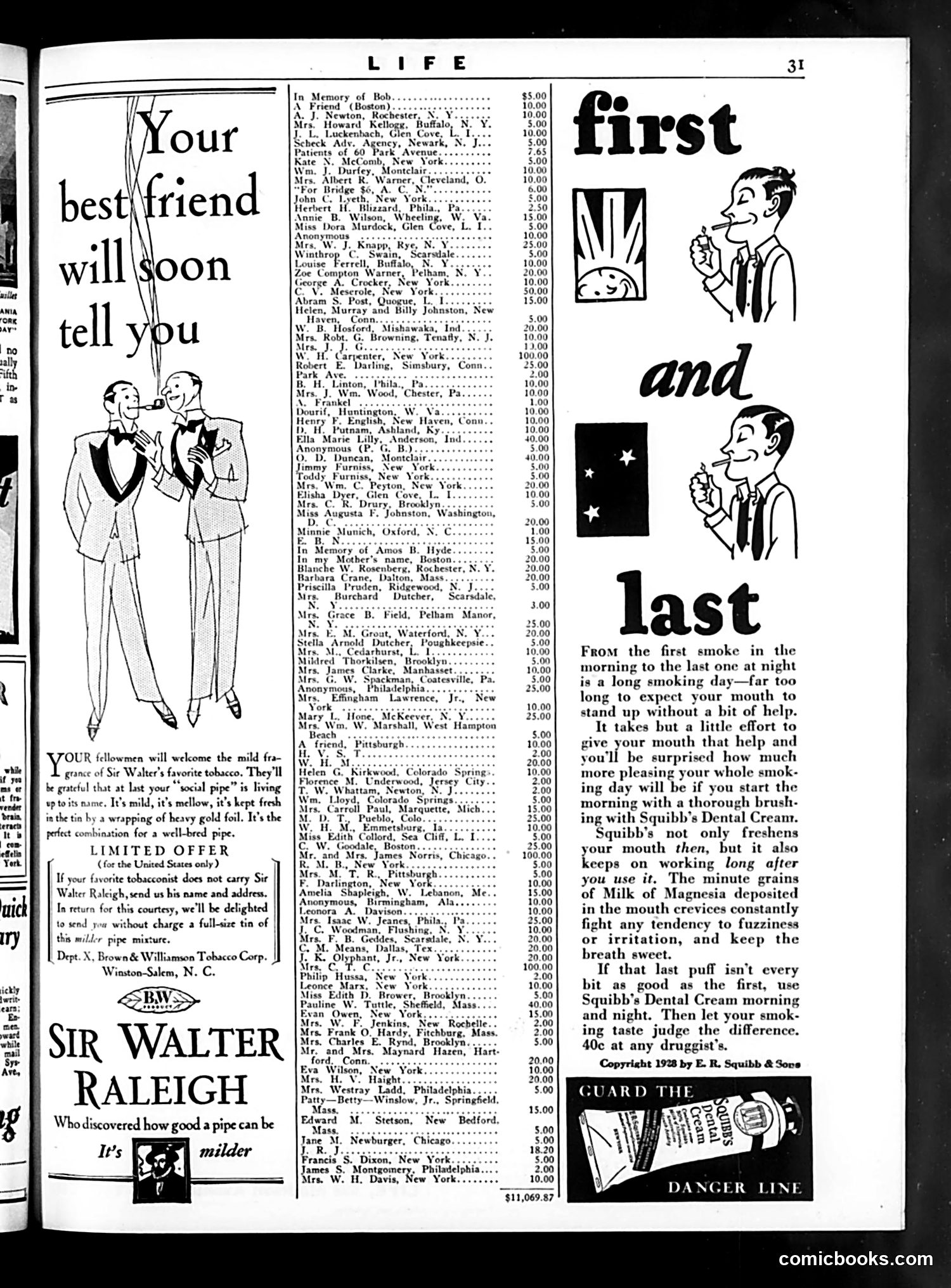
This page is primarily **memorial donations and advertisements** rather than political satire. The left column lists names of donors contributing to memorials for deceased individuals (Bob, Amos B. Hyde, and others), typical of *Life* magazine's practice of publishing charitable contributions. The advertisements feature: 1. **"Your best friend will soon tell you"** — promoting Sir Walter Raleigh pipe tobacco, with illustrations of well-dressed men. The ad emphasizes the tobacco's mildness and the product's packaging quality. 2. **"First and Last"** — a Squibb's Dental Cream advertisement targeting smokers, arguing that tobacco users need oral care to maintain fresh breath and mouth health throughout a long smoking day. These ads reflect **1920s consumer culture** aimed at affluent male smokers. There is no political cartoon or satire visible on this page—it's a straightforward commercial and memorial page from the magazine.
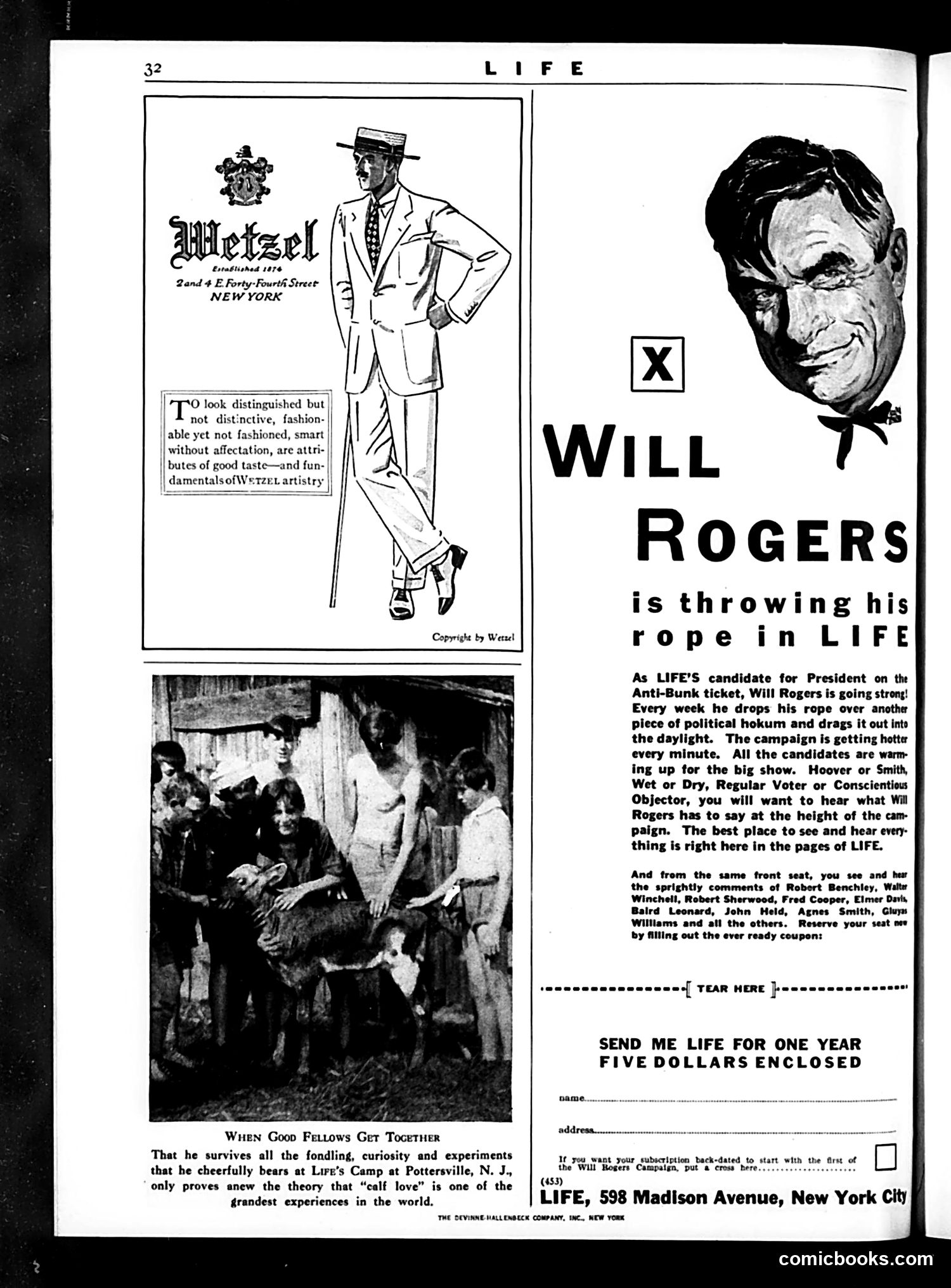
This is primarily a **subscription advertisement** for *Life* magazine, leveraging Will Rogers as a satirical political figure. **The Content:** The page features a Wetzel menswear ad (left) and a prominent subscription pitch (right) announcing that Will Rogers is *Life*'s "candidate for President on the Anti-Bunk ticket." Rogers, the famous humorist and social commentator, is positioned as symbolically "throwing his rope" over pieces of political "hokum"—using his lasso (his signature prop) to wrangle and expose political nonsense into daylight. **The Political Context:** This appears timed to a presidential election cycle (likely 1928, given the reference to "Hoover or Smith"). Rogers' candidacy is satirical—*Life* is using his credibility as a plain-spoken critic of political pretense to market the magazine as a source of sharp political commentary during campaign season. **The Satire:** The joke relies on Rogers' reputation as someone who deflated pomposity and called out political absurdity, positioning *Life* as the magazine for readers seeking intelligent critique rather than political spin.
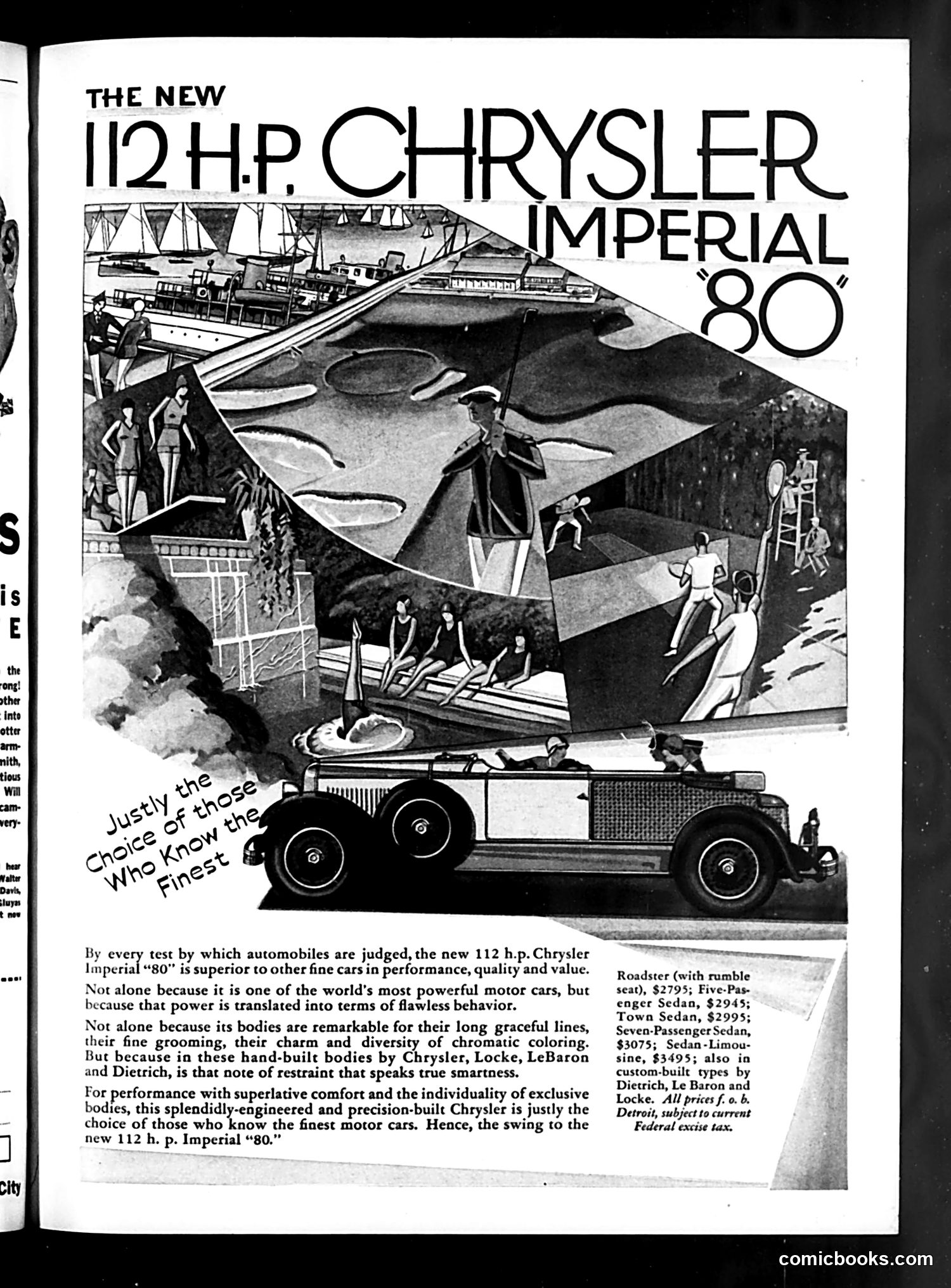
This is **not a cartoon or satire**—it's a straightforward **automobile advertisement** for the 1930 Chrysler Imperial "80" luxury car. The elaborate illustration depicts an aspirational lifestyle scene: wealthy passengers enjoying leisure activities (boating, swimming, socializing) while a gleaming roadster sits prominently in the foreground. The imagery sells not just the vehicle's 112 horsepower and technical specs, but an entire social status. The advertising copy emphasizes "exclusivity," "restraint," and "smartness"—coded language suggesting the car appeals to discerning, sophisticated buyers who "know the finest motor cars." The hand-built bodies by luxury coachbuilders (Chrysler, Locke, LeBaron, Dietrich) reinforced premium positioning. The tagline "Just the choice of those who know the finest" made ownership itself a status marker during the Great Depression's early stages, when such luxury cars remained symbols of wealth and refinement.
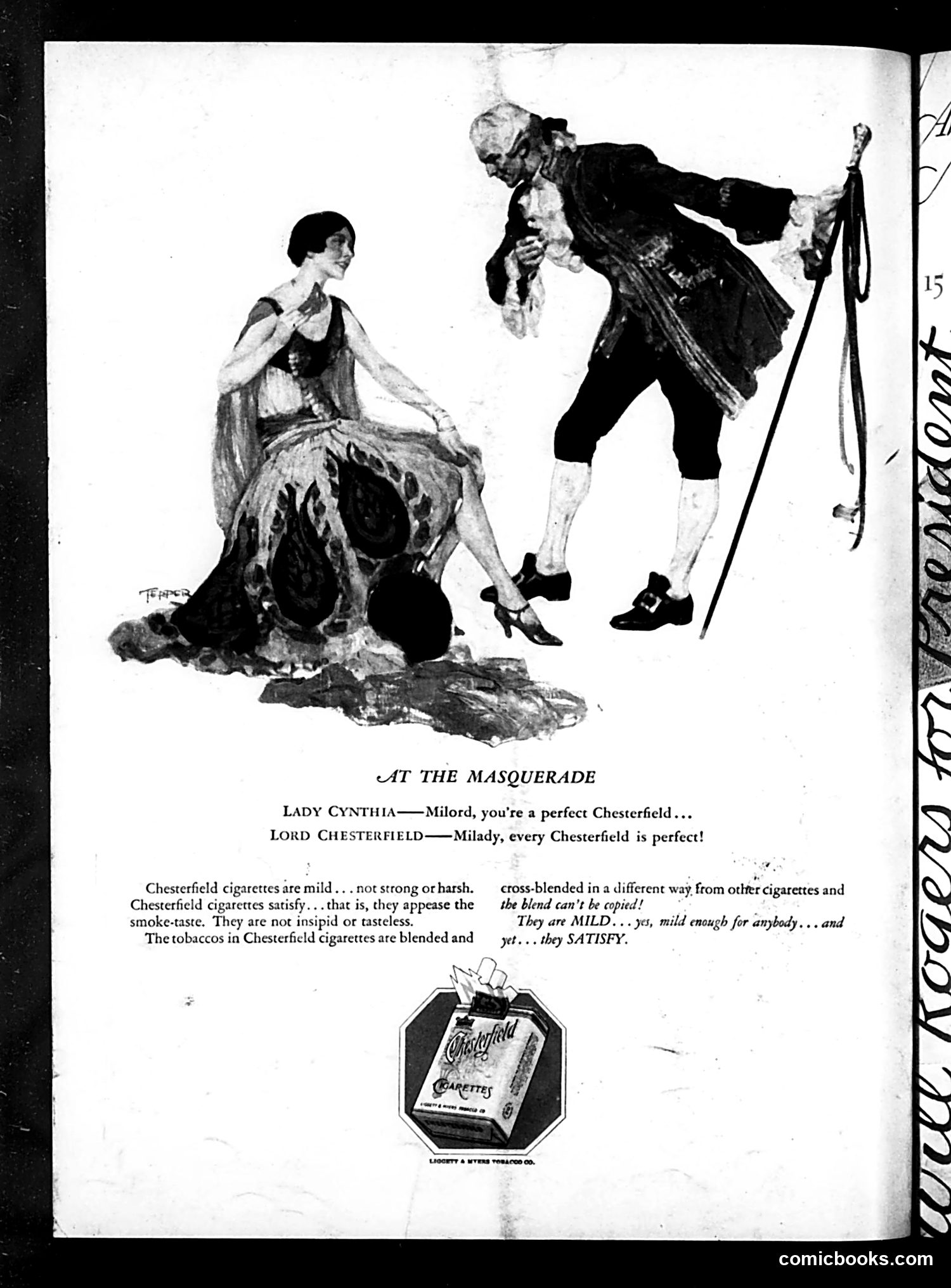
This is a **cigarette advertisement** disguised as a joke cartoon, not political satire. The setup is a masquerade ball where "Lady Cynthia" compliments "Lord Chesterfield," who responds that all Chesterfields are perfect—a pun playing on the cigarette brand name. The "joke" relies on the double meaning: the aristocratic character "Lord Chesterfield" shares a name with Chesterfield cigarettes. The masquerade setting allows the brand to be personified as a gentleman. The advertising text emphasizes that Chesterfield cigarettes are "mild" yet "satisfying"—marketed as a balanced, refined choice. The claim that "the blend can't be copied" suggests competitive advantage. This reflects early 20th-century advertising strategy: embedding product promotion within entertainment content. Modern readers would recognize this as what we'd now call native advertising.