
Life, 1928-08-02 · page 19 of 36
Life — August 2, 1928 — page 19: what you’re looking at
What you’re looking at
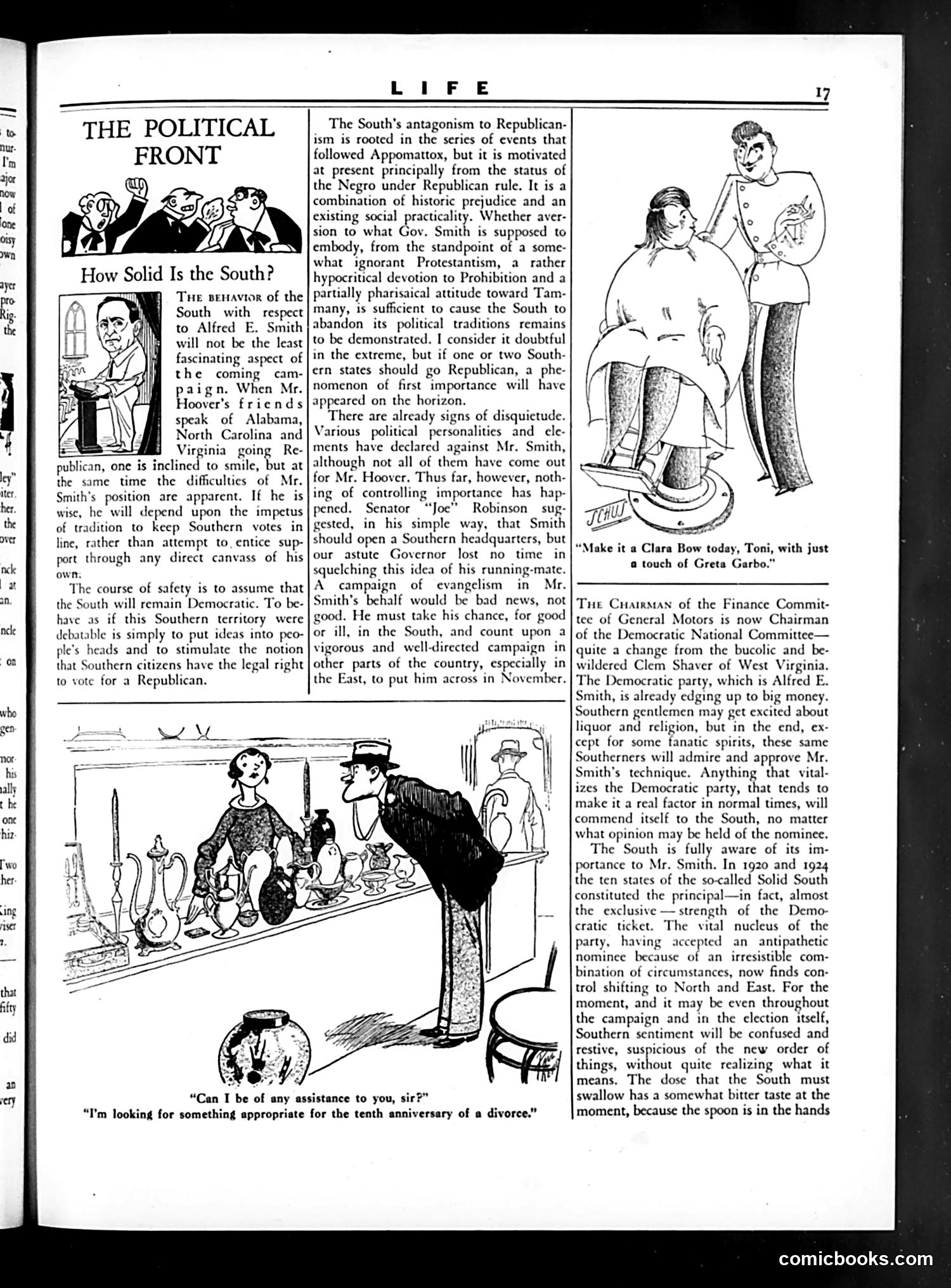
This page examines Southern Democratic resistance to Republican candidates, particularly regarding Alfred E. Smith's 1928 presidential campaign. The top cartoon satirizes Smith's efforts to appeal to the South despite his positions on Prohibition and his perceived "Protestantism" concerns—likely referencing anti-Catholic bias of the era. The lower cartoon depicts a man seeking "something appropriate for the tenth anniversary of a divorce" as a gift, mocking marital instability. The article argues the South will remain Democratic despite disaffection, noting Smith must campaign vigorously to win Southern states. References to "Joe Robinson" suggest Democratic strategy to retain regional support. The page reflects early 20th-century partisan politics and regional divisions that defined American elections.
📄 Transcribed text from this page (OCR, searchable)
Machine-transcribed from the original scan — historical spelling and the odd misread are preserved.
LIFE ~ THE POLITICAL Tue Benavtor of the South with respect to Alfred E. Smith will not be the least fascinating aspect of the coming cam- paign. When Mr. Hoover's friends speak of Alabama, North Carolina and Virginia going Re- publican, one is inclined to smile, but at the same time the difficulties of Mr. Smith’s position are apparent. If he is wise, he will depend upon the impetus of tradition to keep Southern votes in line, rather than attempt to, entice sup- port through any direct canvass of his own: The course of safety is to assume that the South will remain Democratic. To be- have as if this Southern territory were debatable is simply to put ideas into peo- ple’s heads and to stimulate the notion that Southern citizens have the legal right to vote for a Republican. The South's antagonism to Republican- ism is rooted in the series of events that followed Appomattox, but it is motivated at present principally from the status of the Negro under Republican rule. It is a combination of historic prejudice and an existing social practicality. Whether aver- sion to what Gov. Smith is supposed to embody, from the standpoint of a some- what ignorant Protestantism, a rather hypocritical devotion to Prohibition and a partially pharisaical attitude toward Tam- many, is sufficient to cause the South to abandon its political traditions remains to be demonstrated. I consider it doubtful in the extreme, but if one or two South- ern states should go Republican, a phe- nomenon of first importance will have appeared on the horizon. There are already signs of disquietude. Various political personalities and cle- ments have declared against Mr. Smith, although not all of them have come out for Mr. Hoover. Thus far, however, noth- ing of controlling importance has hap- pened. Senator “Joc’’ Robinson sug- gested, in his simple way, that Smith should open a Southern headquarters, but our astute Governor lost no time in squelching this idea of his running-mate. A campaign of evangelism in Mr. Smith’s behalf would be bad news, not good. He must take his chance, for good or ill, in the South, and count upon a vigorous and well-directed campaign in other parts of the country, especially in the East, to put him across in November. Sed “Can I be of any assistance to you, sir?” “I'm looking for something appropriate for the tenth anniversary of a divorce.” “Make it a Clara Bow today, Toni, with just a touch of Greta Garbo.” Tue Cyaan of the Finance Commit- tee of General Motors is now Chairman of the Democratic National Committee— quite a change from the bucolic and be- wildered Clem Shaver of West Virginia. The Democratic party, which is Alfred E. Smith, is already edging up to big money. Southern gentlemen may get excited about liquor and religion, but in the end, ex- cept for some fanatic spirits, these same Southerners will admire and approve Mr. Smith's technique. Anything that vital- izes the Democratic party, that tends to make it a real factor in normal times, will commend itself to the South, no matter what opinion may be held of the nominee. The South is fully aware of its im- portance to Mr. Smith. In 1920 and 1924 the ten states of the so-called Solid South constituted the principal—in fact, almost the exclusive — strength of the Demo- cratic ticket. The vital nucleus of the party, having accepted an antipathetic nominee because of an irresistible com- bination of circumstances, now finds con- trol shifting to North and East. For the moment, and it may be even throughout the campaign and in the election itself, Southern sentiment will be confused and restive, suspicious of the new order of things, without quite realizing what it means. The dose that the South must swallow has a somewhat bitter taste at the moment, because the spoon is in the hands comicbooks.com