
Life, 1928-08-02 · page 24 of 36
Life — August 2, 1928 — page 24: what you’re looking at
What you’re looking at
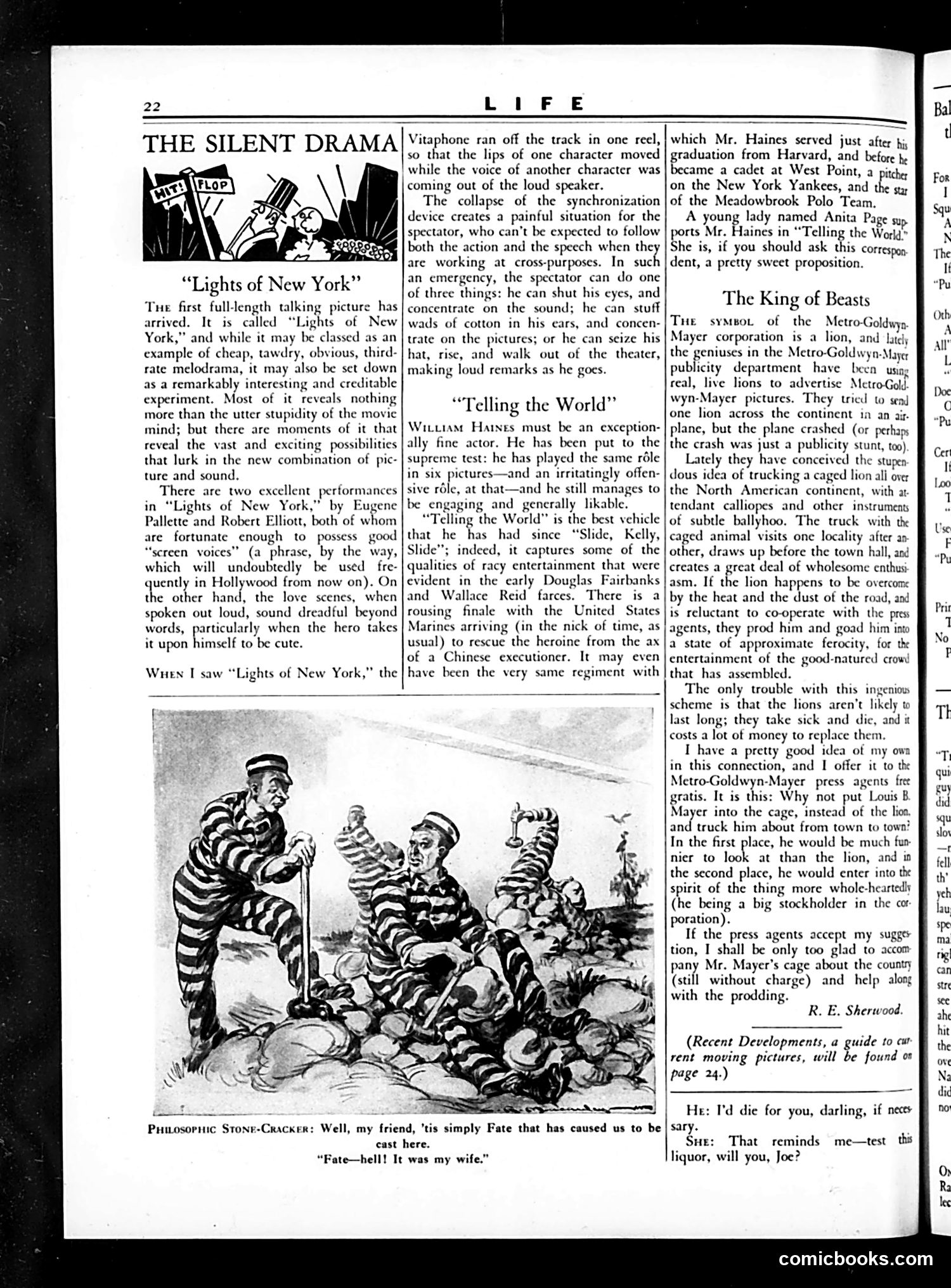
This page reviews early talking pictures ("talkies"), a revolutionary but imperfect technology. The main cartoon depicts convicts in striped uniforms—a visual joke about synchronization failure in the film "Lights of New York." When the Vitaphone sound system malfunctioned, actors' lip movements didn't match dialogue, creating absurd results the review compares to watching prisoners. The reviews discuss three films: "Lights of New York" (praised as interesting despite being cheap melodrama), "Telling the World" (featuring actor William Haines), and "The King of Beasts" (mocking Metro-Goldwyn-Mayer's promotional stunt of trucking a caged lion across North America to advertise their films). The satire targets both early talking picture technology's technical unreliability and Hollywood's desperate, elaborate publicity schemes. The tone is witty but affectionate toward cinema's experimental phase.
📄 Transcribed text from this page (OCR, searchable)
Machine-transcribed from the original scan — historical spelling and the odd misread are preserved.
THE SILENT DRAMA “Lights of New York” Tue first full-length talking picture has arrived. It is called “Lights of New York,” and while it may be classed as an example of cheap, tawdry, obvious, third- rate melodrama, it may also be set down as a remarkably interesting and creditable experiment. Most of it reveals nothing more than the utter stupidity of the movie mind; but there are moments of it that reveal the vast and exciting possibilities that lurk in the new combination of pic- ture and sound, There are two excellent performances in “Lights of New York,” by Eugene Pallette and Robert Elliott, both of whom are fortunate enough to possess good “screen voices” (a phrase, by the way, which will undoubtedly be used fre- quently in Hollywood from now on). On the other hand, the love scenes, when spoken out loud, sound dreadful beyond words, particularly when the hero takes it upon imself to be cute. Wuen I saw “Lights of New York,” the Vitaphone ran off the track in one reel, so that the lips of one character moved while the voice of another character was coming out of the loud speaker. The collapse of the synchronization device creates a painful situation for the spectator, who can’t be expected to follow both the action and the speech when the are working at cross-purposes. In suc an emergency, the spectator can do one of three things: he can shut his eyes, and concentrate on the sound; he can stuff wads of cotton in his ears, and concen- trate on the pictures; or he can seize his hat, rise, and walk out of the theater, making loud remarks as he goes. “Telling the World” Witiiam Haines must be an exception- ally fine actor. He has been put to the supreme test: he has played the same réle in six pictures—and an irritatingly offen- sive réle, at that—and he still manages to be engaging and generally likable. “Telling the World” is the best vehicle that he has had since “Slide, Kelly, Slide”; indeed, it captures some of the qualities of racy entertainment that were evident in the early Douglas Fairbanks and Wallace Reid farces. There is a rousing finale with the United States Marines arriving (in the nick of time, as usual) to rescue the heroine from the ax of a Chinese executioner. It may even have been the very same regiment with cast here. “Fate—hell! It was my wife.” which Mr. Haines served just after hi graduation from Harvard, and before he became a cadet at West Point, a pitcher on the New York Yankees, and the su of the Meadowbrook Polo Team. A young lady named Anita Page sy ports Mr. Haines in “Telling the World.” She is, if you should ask this correspon dent, a pretty sweet proposition. The King of Beasts Tue symbot of the Metro-Goldwyn. Mayer corporation is a lion, and lately the geniuses in the Metro-Goldwyn-Mayer publicity department have been using real, live lions to advertise Metro-Gold. wyn-Mayer pictures. They tried to send one lion across the continent in an ais. plane, but the plane crashed (or pethaps the crash was just a publicity stunt, too) Lately they have conceived the stupen dous idea of trucking a caged lion ali over the North American continent, with at- tendant calliopes and other instruments of subtle ballyhoo. The truck with the caged animal visits one locality after ap. other, draws up before the town hall, and creates a great deal of wholesome enthus: asm. If the lion happens to be overcome by the heat and the dust of the road, and is reluctant to co-operate with the pres agents, they prod him and goad him into a state of approximate ferocity, for the entertainment of the good-natured crowd that has assembled. The only trouble with this ingeniow scheme is that the lions aren't likely to last long; they take sick and dic, and it costs a lot of money to replace them. I have a pretty good idea of my owa in this connection, and I offer it to the Metro-Goldwyn-Mayer press agents free gratis. It is this: Why not put Louis B Mayer into the cage, instead of the lion, and truck him about from town to town? In the first place, he would be much fun- nier to look at than the lion, and in the second place, he would enter into th spirit of the thing more whole-heartedly (he being a big stockholder in the cor poration). If the press agents accept my sugges tion, I shall be only too glad to accom pany Mr. Mayer’s cage about the county (still without charge) and help along with the prodding. R. E, Sherwood. (Recent Developments, a guide to cut rent moving pictures, will be found ot page 24.) He: I'd die for you, darling, if neces sary. Sue: That reminds me—test thi liquor, will you, Joe? comicbooks.com