
Life, 1928-08-02 · page 20 of 36
Life — August 2, 1928 — page 20: what you’re looking at
What you’re looking at
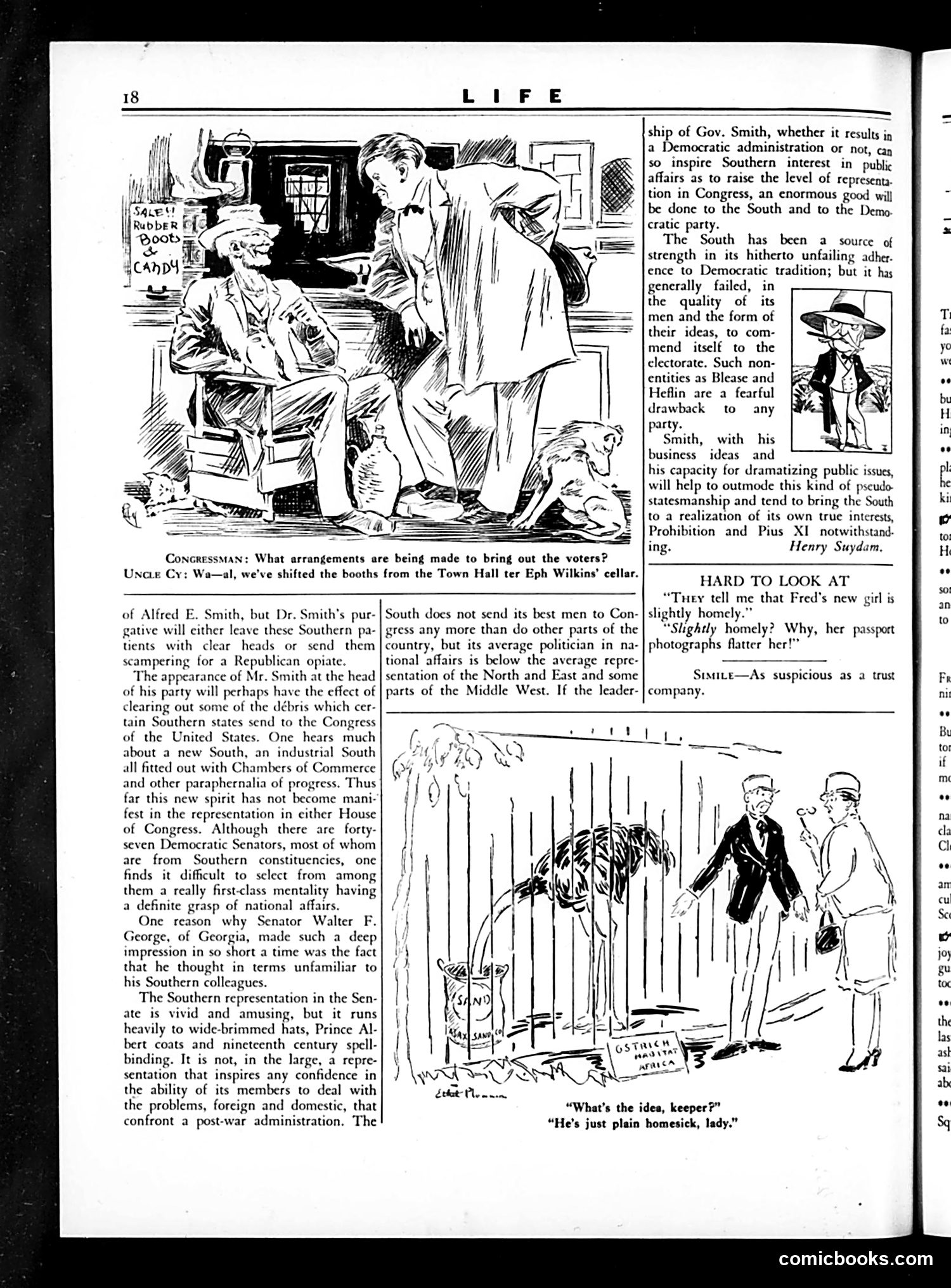
**Top Cartoon:** A congressman questions "Uncle Cy" (representing a rural Southern politician) about voter turnout. Uncle Cy's response—that voting booths have been moved to "Eph Wilkins' cellar"—satirizes election manipulation and fraud, likely voter suppression tactics common in the Jim Crow South. The humor is dark: the "arrangement" is transparently corrupt. **Accompanying Article:** The text criticizes Southern Democratic congressmen as intellectually inferior and poorly qualified, citing politicians like Blease and Heflin as liabilities to the party. It expresses hope that Governor Alfred E. Smith's leadership might elevate Southern political standards. **Bottom Cartoon:** An unrelated joke about a homesick ostrich—purely comedic filler with no political content. The page reflects 1920s-era criticism of Southern political corruption and the perceived incompetence of Southern representatives, while advocating for Democratic Party reform.
📄 Transcribed text from this page (OCR, searchable)
Machine-transcribed from the original scan — historical spelling and the odd misread are preserved.
ConcressMAN: What arrangements are being made to bring out the voters? Uncie Cy: Wa—al, we've shifted the booths from the Town Hall ter Eph Wilkins’ cellar. of Alfred E. Smith, but Dr. Smith's pur- gative will either leave these Southern pa- tients with clear heads or send them scampering for a Republican opiate. The appearance of Mr. Smith at the head of his party will perhaps have the effect of clearing out some of the débris which cer- tain Southern states send to the Congress of the United States. One hears much about a new South, an industrial South all fitted out with Chambers of Commerce and other paraphernalia of progress. Thus far this new spirit has not become mani- fest in the representation in cither House of Congress. Although there are forty- seven Democratic Senators, most of whom are from Southern constituencies, one finds it difficult to select from among them a really first-class mentality having a definite grasp of national affairs. One reason why Senator Walter F. George, of Georgia, made such a deep impression in so short a time was the fact that he thought in terms unfamiliar to his Southern colleagues. The Southern representation in the Sen- ate is vivid and amusing, but it runs heavily to wide-brimmed hats, Prince Al- bert coats and nineteenth century spell- binding. It is not, in the large, a repre- sentation that inspires any confidence in the ability of its members to deal with the problems, foreign and domestic, that confront a post-war administration. The South does not send its best men to Con- gress any more than do other parts of the country, but its average politician in na- tional affairs is below the average repre- sentation of the North and East and some parts of the Middle West. If the leader- ship of Gov. Smith, whether it results in a Democratic administration or not, can so inspire Southern interest in public affairs as to raise the level of representa. tion in Congress, an enormous good will be done to the South and to the Demo. cratic party. The South has been a source of strength in its hitherto unfailing adher. ence to Democratic tradition; but it has generally failed, in the quality of its men and the form of their ideas, to com- mend _ itself to the electorate. Such non- entities as Blease and Heflin are a fearful drawback to any party. Smith, business with his ideas and his capacity for dramatizing public issues, will help to outmode this kind of pseudo- statesmanship and tend to bring the South to a realization of its own true interests, Prohibition and Pius XI notwithstand- ing. Henry Suydam, HARD TO LOOK AT “Tuey tell me that Fred's new girl is slightly homely.” “Slightly homely? Why, her passport photographs flatter her!” Stite—As suspicious as a trust company. “What's the idea, keeper?” “He's just plain homesick, lady.” comicbooks.com