
Life, 1928-08-02 · page 11 of 36
Life — August 2, 1928 — page 11: what you’re looking at
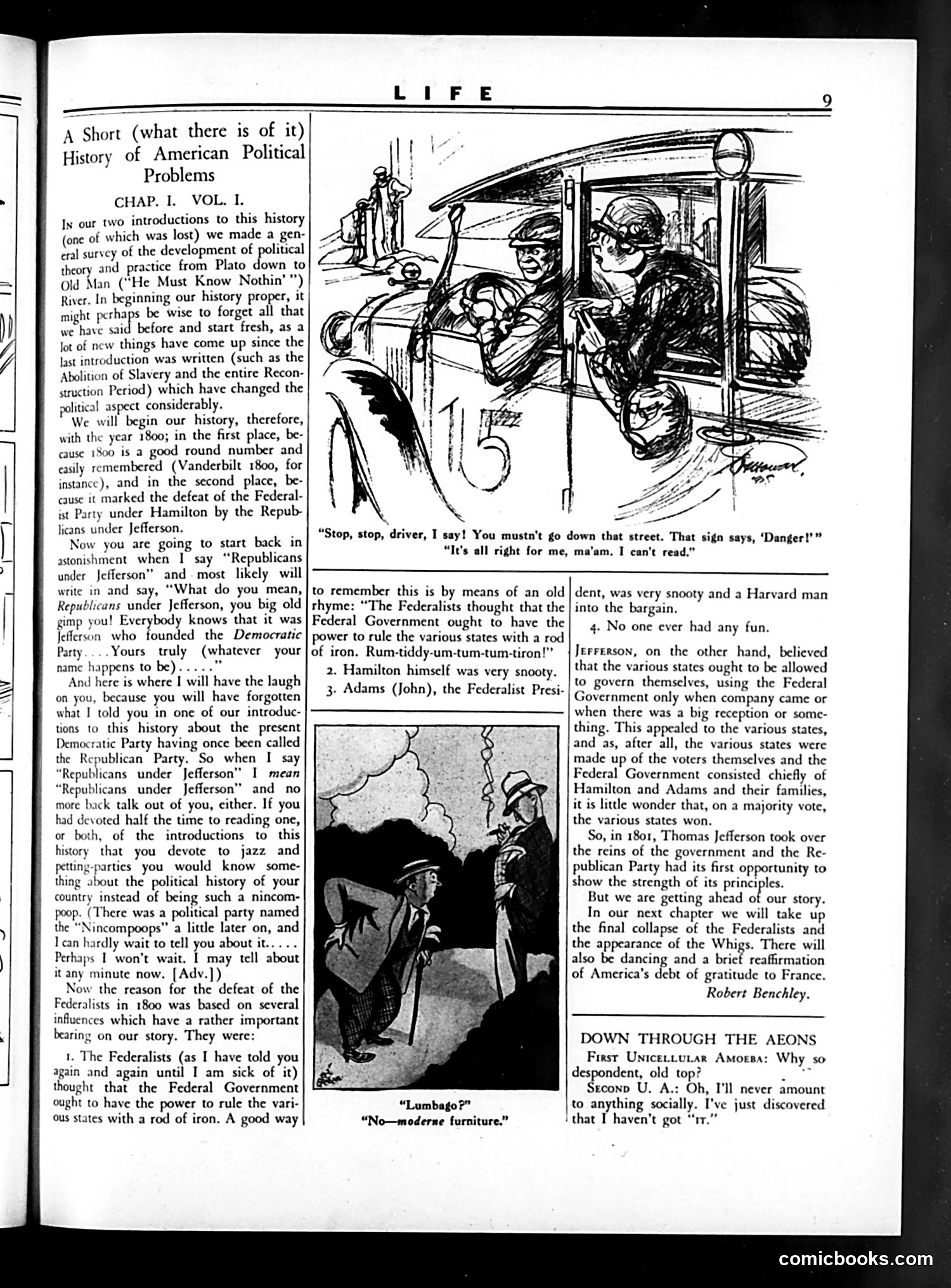
What you’re looking at
The top cartoon depicts a car driver stopping a passenger from exiting onto a dangerous street. The sign reads "Danger," but the passenger insists "It's all right for me, ma'am. I can't read." This satirizes **illiteracy in early 20th-century America**—a social problem the accompanying article addresses. The joke's dark humor comes from the passenger's casual acceptance of danger due to inability to read warning signs, implying illiteracy made people vulnerable to harm. The lower cartoon shows two men discussing "Lumbago" and "moderne furniture," likely mocking pretentious adoption of modern design terminology among the upper classes. Both cartoons exemplify *Life* magazine's approach: using humor to critique social problems and class affectation of the era.
📄 Transcribed text from this page (OCR, searchable)
Machine-transcribed from the original scan — historical spelling and the odd misread are preserved.
A Short (what there is of it) History of American Political Problems CHAP. I. VOL. I. Ix our two introductions to this history (one of which was lost) we made a gen- eral survey of the development of political theory and practice from Plato lown to Old Man (“He Must Know Nothin’ ”) River. In beginning our history proper, it might perha be wise to forget all that we have said before and start fresh, as a Jot of new things have come up since the last introduction was written (such as the Abolition of Slavery and the entire Recon- struction Period) which have changed the political aspect considerably. We will begin our history, therefore, with the year 1800; in the first place, be- cause 1800 is a good round number and easily remembered (Vanderbilt 1800, for instance), and in the second place, be- cause it marked the defeat of the Federal- ist Party under Hamilton by the Repub- licans under Jefferson. . Now you are going to start back in astonishment when I say “Republicans under Jefferson” and most likely will write in and say, “What do you mean, Republicans under Jefferson, you big old gimp you! Everybody knows that it was Jeflerson who founded the Democratic Party Yours truly (whatever your name happens to be) " And here is where I will have the laugh on you, because you will have forgotten what I told you in one of our introduc- tions to this history about the present Democratic Party having once been called the Republican Party. So when I say “Republicans under Jefferson” I mean “Republicans under Jefferson” and no more back talk out of you, either. If you had devoted half the time to reading one, or both, of the introductions to this history that you devote to jazz and petting-parties you would know some- thing about the political history of your country instead of being such a nincom- poop. (There was a political party named the “Nincompoops” a little later on, and Ican hardly wait to tell you about it... .. Perhaps I won't wait. I may tell about it any minute now. [Adv.]) Now the reason for the defeat of the Federalists in 1800 was based on several influences which have a rather important bearing on our story. They were: 1. The Federalists (as I have told you again and again until I am sick of it) thought that the Federal Government ought to have the power to rule the vari- ous states with a rod of iron. A good way “Stop, stop, driver, I say! You mustn't go down that street. That sign says, ‘Danger!’” “It's all right for me, ma’am. I can't read.” to remember this is by means of an old rhyme: “The Federalists thought that the Federal Government ought to have the power to rule the various states with a rod of iron. Rum-tiddy-um-tum-tum-tiron!” 2. Hamilton himself was very snooty. 3. Adams (John), the Federalist Presi- “Lumbago?” “No—moderne furniture.” dent, was very snooty and a Harvard man into the bargain. 4- No one ever had any fun. Jerrerson, on the other hand, believed that the various states ought to be allowed to govern themselves, using the Federal Government only when company came or when there was a big reception or some- thing. This appealed to the various states, and as, after all, the various states were made up of the voters themselves and the Federal Government consisted chiefly of Hamilton and Adams and their families, it is little wonder that, on a majority vote, the various states won. So, in 1801, Thomas Jefferson took over the reins of the government and the Re- publican Party had its first opportunity to show the strength of its principles. But we are getting ahead ol ir story. In our next chapter we will take up the final collapse of the Federalists and the appearance of the Whigs There will also be dancing and a brief reaffirmation of America’s debt of gratitude to France. Robert Benchley. DOWN THROUGH THE AEONS First Unicettutar Amoesa: Why so despondent, old top? 2 8 Stcono U. A.: Oh, I'll never amount to anything socially. I've just discovered ‘that T haven't got “tr.” comicbooks.com