
Life, 1928-08-02 · page 18 of 36
Life — August 2, 1928 — page 18: what you’re looking at
What you’re looking at
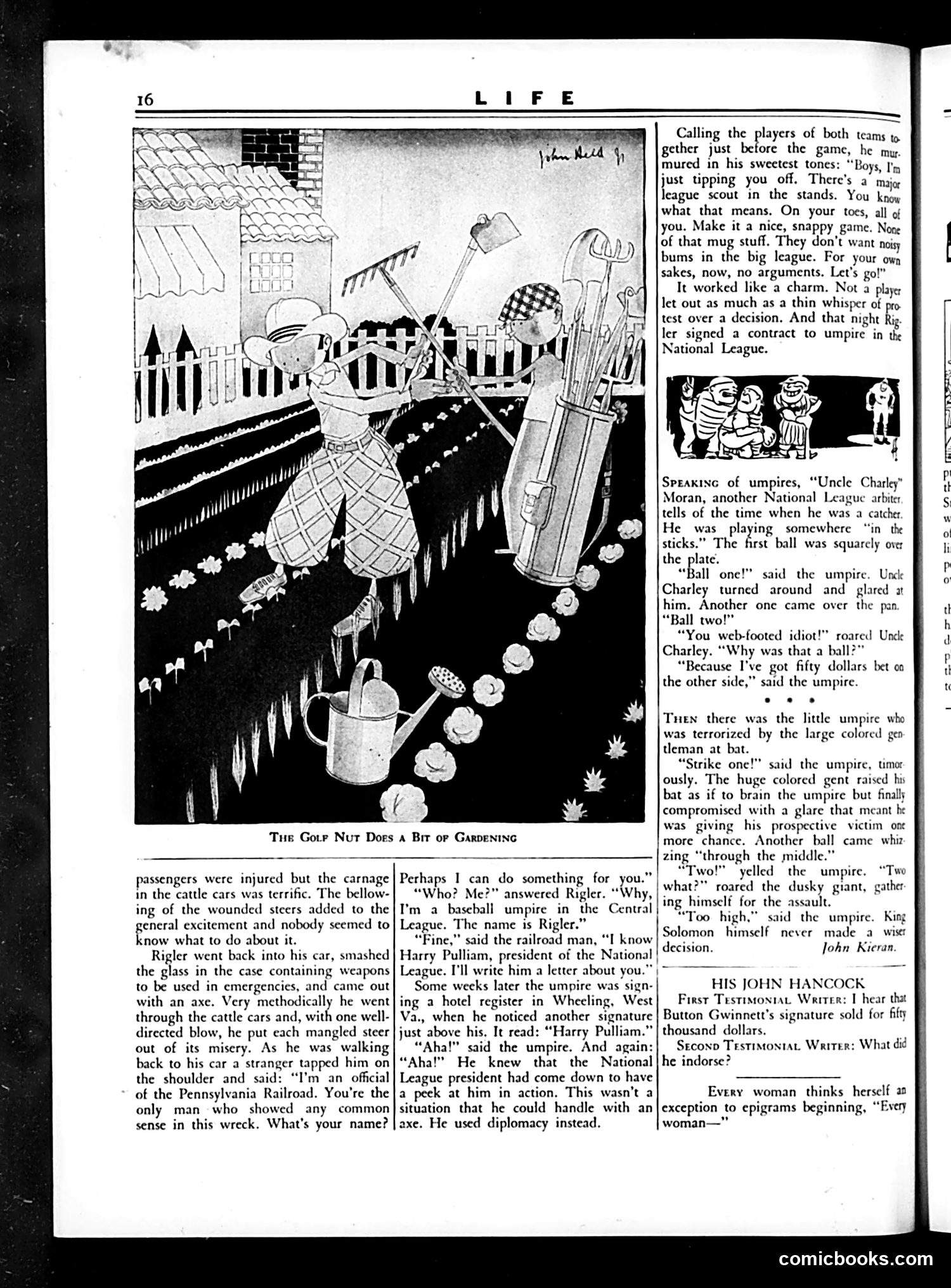
This cartoon satirizes the obsession of golf enthusiasts by depicting a man gardening with golf clubs and equipment instead of proper tools. The figure uses a putter as a rake, carries golf clubs as a watering can, and arranges what appear to be golf balls among flowers and plants. The joke is straightforward: the golfer is so consumed by his hobby that he cannot perform ordinary domestic tasks without mentally substituting golf equipment. This reflects early 20th-century middle-class anxieties about golf becoming a time-consuming passion that distracted men from family responsibilities and normal life. The accompanying text discusses baseball umpires, appearing unrelated to the cartoon.
📄 Transcribed text from this page (OCR, searchable)
Machine-transcribed from the original scan — historical spelling and the odd misread are preserved.
Tue Goce Nut Does a Brt op GarveNtnc passengers were injured but the carnage in the cattle cars was terrific. The bellow- ing of the wounded steers added to the general excitement and nobody seemed to know what to do about it. Rigler went back into his car, smashed the glass in the case containing weapons to be used in emergencies, and came out with an axe. Very methodically he went through the cattle cars and, with one well- directed blow, he put each mangled steer out of its misery. As he was walking back to his car a stranger tapped him on the shoulder and said: “I’m an official of the Pennsylvania Railroad. You're the only man who showed any common sense in this wreck. What's your name? Perhaps I can do something for you.” “Who? Me?” answered Rigler. “Why, I'm a baseball umpire in the Central League. The name is Rigler.” “Fine,” said the railroad man, “I know Harry Pulliam, president of the National League. I'll write him a letter about you.” | ~ Some weeks later the umpire was sign- ing a hotel register in Wheeling, West Va., when he noticed another signature just above his. It read: “Harry Pulliam.” “Aha!” said the umpire. And again: “Aha!” He knew that the National League president had come down to have a peek at him in action. This wasn’t a situation that he could handle with an axe. He used diplomacy instead. — Calling the players of both teams tp gether just before the game, he my. mured in his sweetest tones: “Boys, I'm just tipping you off. There's a Major league scout in the stands. You know what that means. On your toes, all of you. Make it a nice, snappy game. None of that mug stuff. They don’t want noisy bums in the big league. For your own sakes, now, no arguments. Let's go!” It worked like a charm. Not a player let out as much as a thin whisper of pro test over a decision. And that night Rig ler signed a contract to umpire in the National League. Speaxinc of umpires, “Uncle Charley” Moran, another National League arbiter tells of the time when he was a catcher, He was playing somewhere “in the sticks.” The ise ball was squarely over the plate. “Bal one!” said the umpire. Uncle Charley turned around and_ glared a him. Another one came over the pan “Ball two!” “You web-footed idiot!” roared Unde Charley. “Why was that a ball?” “Because I've got fifty dollars bet on the other side,” said the umpire. 7 8 6 Tuen there was the little umpire who was terrorized by the large colored gen deman at bat. “Strike one!" said the umpire, tumor ously, The huge colored gent raised his bat as if to brain the umpire but finally compromised with a glare that meant he was giving his prospective victim on more chance. Another ball came whiz zing “through the middle.” “Two!” yelled the umpire. “Two | what?” roared the dusky grant, gather ing himself for the assault. “Too high,” said the umpire. King Solomon himself never made a wist decision. John Kieran. HIS JOHN HANCOCK First Testisoniac Wrrrer: I hear that Button Gwinnett’s signature sold for fifty thousand dollars. Secon Testimontat. Writer: What did he indorse? Every woman thinks herself ao exception to epigrams beginning, “Every woman—”" comicbooks.com