
Life, 1928-08-02 · page 12 of 36
Life — August 2, 1928 — page 12: what you’re looking at
What you’re looking at
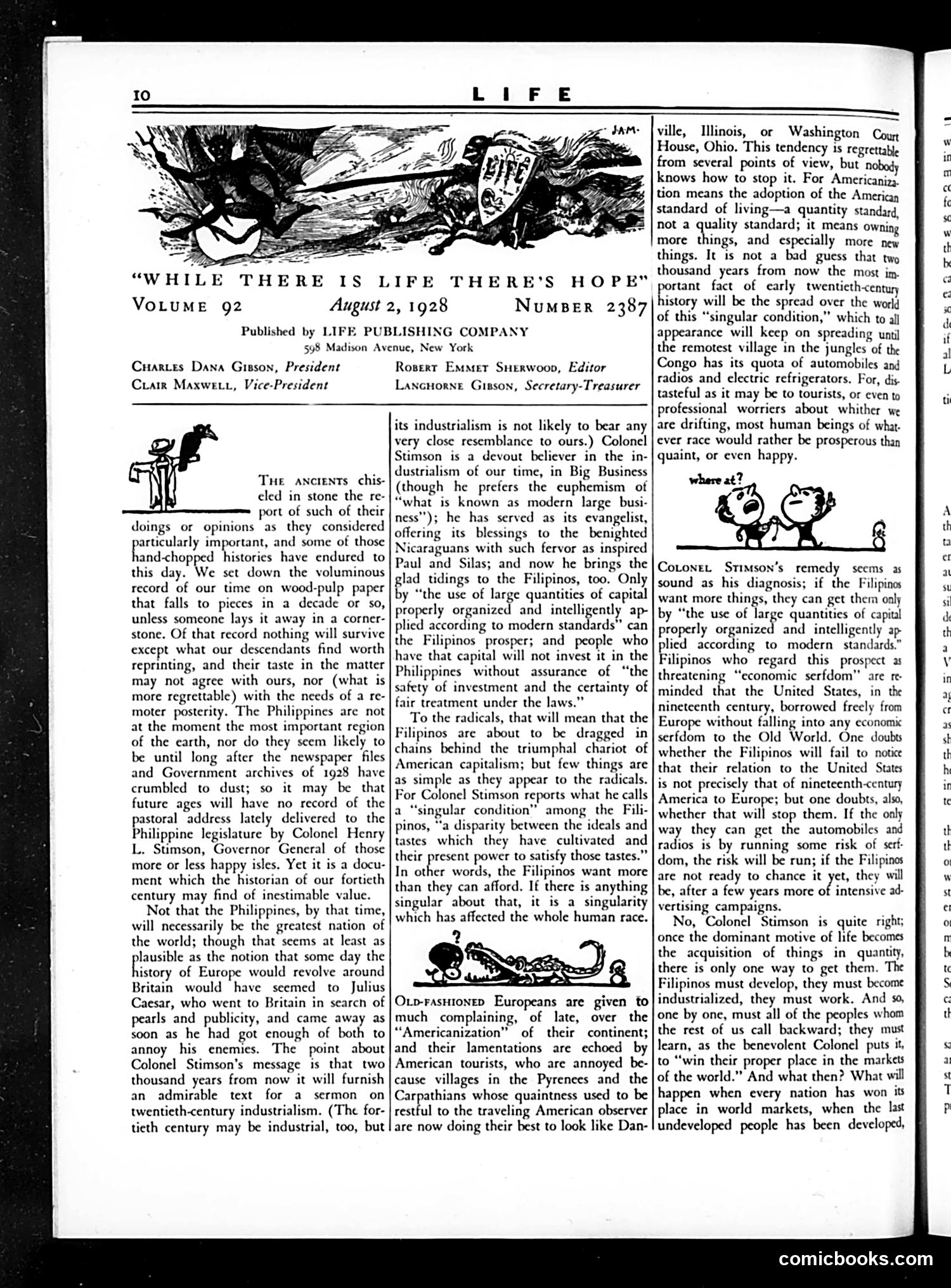
The page contains a satirical article about Colonel Stimson and Filipino economic development. The small cartoon showing two childlike figures appears to illustrate the article's argument about the Philippines' relationship to American capitalism. The text criticizes Filipino concerns about economic "serfdom" under American industrial standards. Stimson argues Filipinos must industrialize and adopt American-style mass consumption ("acquire things in quantity") to develop economically and find their "proper place in the market of the world." The cartoon likely depicts this paternalistic dynamic—the contrast between Western industrial power and the Philippines' status as a developing territory. The imagery reinforces the article's ironic tone about American cultural and economic dominance being presented as benevolent guidance rather than imperial imposition.
📄 Transcribed text from this page (OCR, searchable)
Machine-transcribed from the original scan — historical spelling and the odd misread are preserved.
VOLUME 92 August 2, 1928 NuMBER 2387 Published by LIFE PUBLISHING COMPANY 598 Madison Avenue, New York Curartes Dana Ginson, President Cra Maxwetr, Vice-President Rosert Emmet Suerwooo, Editor Lancuorne Gisson, Secretary-Treasurer Tue anctents chis- eled in stone the re- port of such of their doings or opinions as they considered particularly important, and some of those hand-chopped histories have endured to this day. We sect down the voluminous record of our time on wood-pulp paper that falls to pieces in a decade or so, unless someone lays it away in a corner- stone. Of that record nothing will survive except what our descendants find worth reprinting, and their taste in the matter may not agree with ours, nor (what is more regrettable) with the needs of a re- moter posterity. The Philippines are not at the moment the most important region of the earth, nor do they seem likely to be until long after the newspaper files and Government archives of 1928 have crumbled to dust; so it may be that future ages will have no record of the pastoral address lately delivered to the Philippine legislature by Colonel Henry L. Stimson, Governor General of those more or less happy isles. Yet it is a docu- ment which the historian of our fortieth century may find of inestimable value. Not that the Philippines, by that time, will necessarily be the greatest nation of the world; though that seems at least as plausible as the notion that some day the Fistory of Europe would revolve around Britain would have seemed to Julius Caesar, who went to Britain in searcn of pearls and publicity, and came away as soon as he had got enough of both to annoy his enemies. The point about Colonel Stimson’s message is that two thousand years from now it will furnish an admirable text for a sermon on twentieth-century industrialism. (The for- tieth century may be industrial, too, but its industrialism is not likely to bear any very close resemblance to ours.) Colonel Stimson is a devout believer in the in- dustrialism of our time, in Big Business (though he prefers the cuphemism of “what is known as modern large busi- ness”); he has served as its evangelist, offering its blessings to the benighted Nicaraguans with such fervor as inspired Paul and Silas; and now he brings the glad tidings to the Filipinos, too. Only by “the use of large quantities of capital properly organized and intelligently ap- plied according to modern standards” can the Filipinos prosper; and people who have that capital will not invest it in the Philippines without assurance of “the safety of investment and the certainty of fair treatment under the laws.” To the radicals, that will mean that the Filipinos are about to be dragged in chains behind the triumphal chariot of American capitalism; but few things are as simple as they appear to the radicals. For Colonel Stimson reports what he calls a “singular condition” among the Fili- pinos, “‘a disparity between the ideals and tastes which they have cultivated and their present power to satisfy those tastes.” In other words, the Filipinos want more than they can afford. If there is anything singular about that, it is a singularity which has affected the whole human race. 2 Otp-rasHtonep Europeans are given to much complaining, of late, over the “Americanization” of their continent; and their lamentations are echoed by American tourists, who are annoyed be- cause villages in the Pyrenees and the Carpathians whose quaintness used to be restful to the traveling American observer are now doing their best to look like Dan- ville, Illinois, or Washington Court House, Ohio. This tendency 1s regrettable from several points of view, but knows how to stop it. For Americaniz3. tion means the adoption of the American standard of living—a quantity standard, not a quality standard; it means owning more things, and especially more new things. It is not a bad guess that two thousand years from now the most im. porn fact of carly twentieth<enn istory will be the spread over the world of this “singular condition,” which to al] appearance will keep on spreading until the remotest village in the jungles of the Congo has its quota of automobiles and radios and electric refrigerators. For, dis. tasteful as it may be to tourists, or even to professional worriers about whither we are drifting, most human beings of what- ever race would rather be prosperous than quaint, or even happy. where at? 0 @ R Coronet Stimson’s remedy seems as sound as his diagnosis; if the Filipinos want more things, they can get them only by “the use of ange quantities of capital properly organized and intelligently ap lied according to modern standards.” “ilipinos who regard this prospect as threatening “economic serfdom" are re- minded that the United States, in the nineteenth century, borrowed freely from Europe without falling into any economic serfdom to the Old World. One doubts whether the Filipinos will fail to notice that their relation to the United States is not precisely that of nineteenth-century America to Europe; but one doubts, also, whether that will stop them. If the only way they can get the automobiles and radios is by running some risk of serf- dom, the risk will be run; if the Filipinos are not ready to chance it yet, they will be, after a few years more of intensive ad- vertising campaigns. No, Colonel Stimson is quite right; once the dominant motive of life becomes the acquisition of things in quantity, there is only one way to get them. The Filipinos must develop, they must become industrialized, they must work. And 0, one by one, must all of the peoples whom the rest of us call backward; they must learn, as the benevolent Colonel puts it, to “win their proper place in the markets of the world.” And what then? What will happen when every nation has won its place in world markets, when the last undeveloped people has been developed, comicbooks.com