
A complete issue · 34 pages · 1928
Life — March 29, 1928
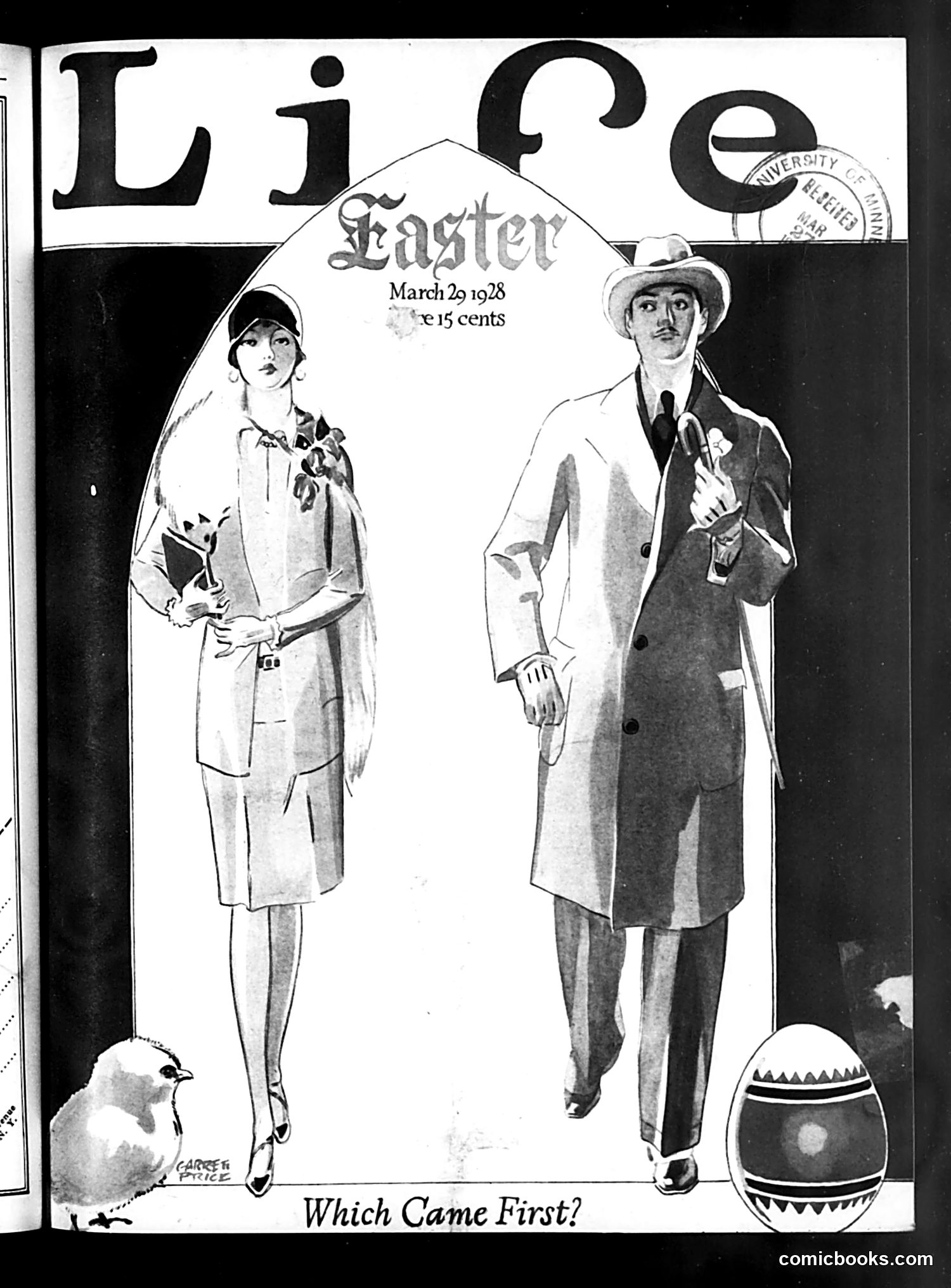
This is a Life magazine Easter cover featuring fashion illustrations with the playful caption "Which Came First?" — a visual pun referencing the classic philosophical riddle about the chicken and egg. The cover shows two fashionably dressed figures in 1920s attire (appropriate to the magazine's Easter issue), flanked by a chick and a decorated Easter egg. The illustration appears to be showcasing spring/Easter fashion trends of the period. The joke is straightforward: the cover humorously applies the ancient "chicken or egg" paradox to Easter imagery, combining the holiday's traditional symbols (eggs, chicks) with contemporary fashion commentary. This type of visual wordplay was typical of *Life*'s satirical approach during the Jazz Age.
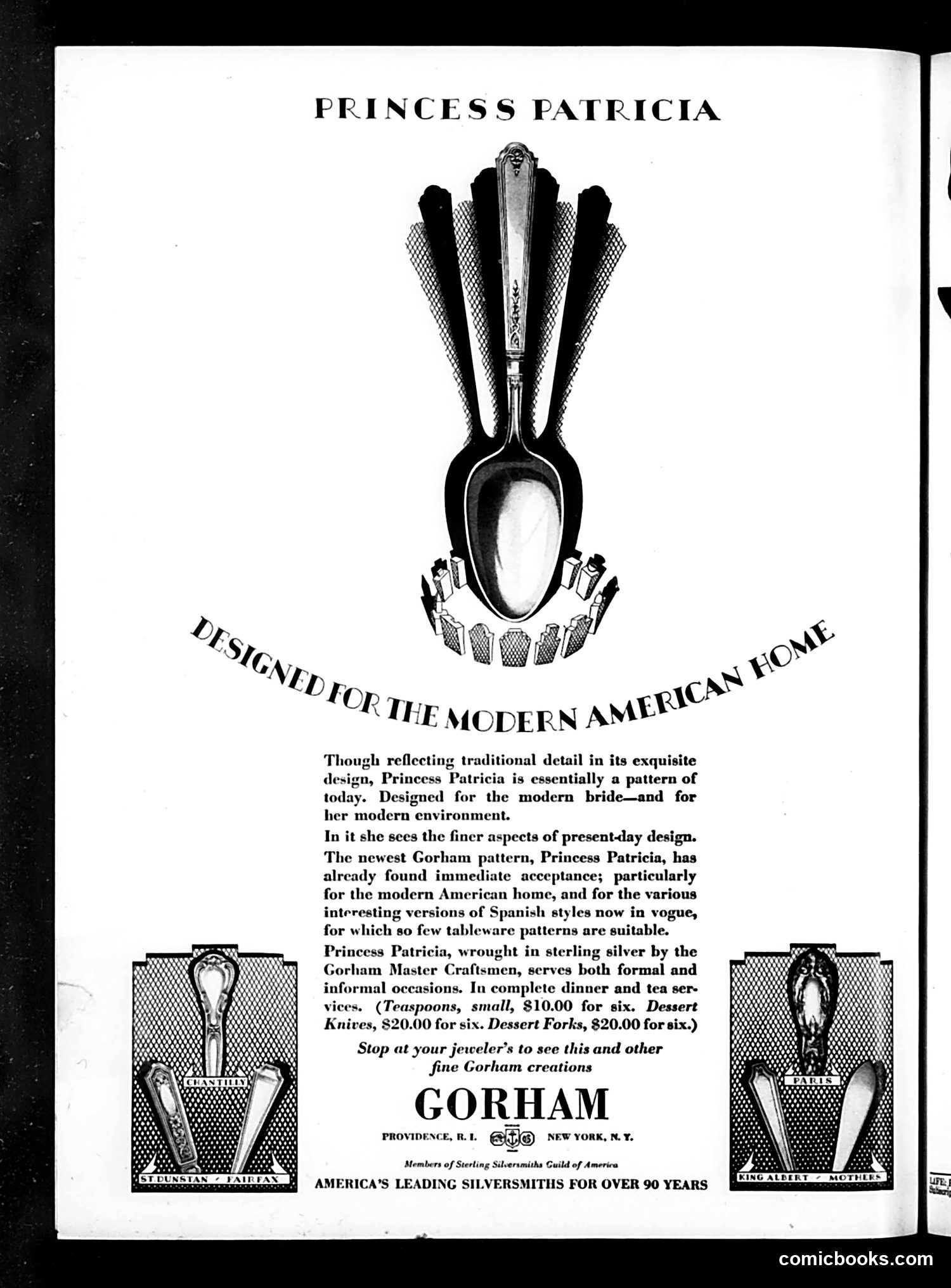
This page is **primarily a advertisement**, not political satire or comedy content. It promotes Gorham silverware's "Princess Patricia" flatware pattern. The ad emphasizes the pattern's suitability for "the modern American home" and "the modern bride," positioning traditional sterling silver design as contemporary and relevant to 1920s-30s consumers. The decorative illustrations show spoons, forks, and knives featuring ornamental handles. The text stresses Gorham's established reputation ("over 90 years") and membership in the Sterling Silversmiths Guild of America, appealing to quality-conscious buyers. Prices are listed for different utensil sets. There is no political cartoon or satire present on this page—it is purely a consumer goods advertisement typical of the era's magazine marketing.
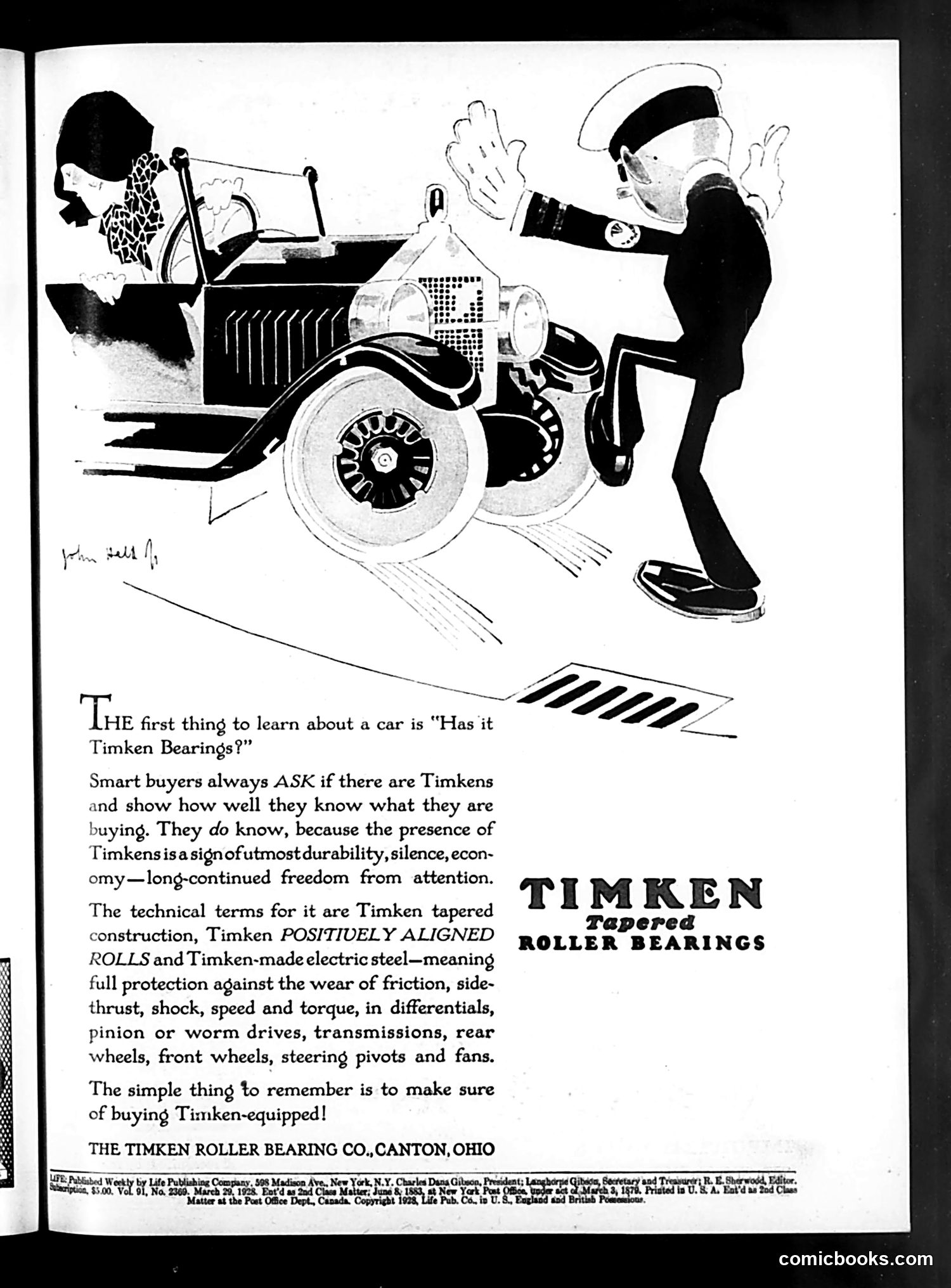
This page is primarily a **product advertisement** for Timken Tapered Roller Bearings, not political satire. The cartoon illustrates a humorous sales pitch rather than commentary on current events. The illustration shows two figures examining an automobile—a common 1920s-era car. The figure on the right appears to be a knowledgeable buyer or salesman gesturing approvingly, while the left figure operates or inspects the vehicle. The caption jokes that the "first thing to learn about a car is 'Has it Timken Bearings?'" The ad uses this playful scenario to convey a serious message: smart purchasers ask about bearing quality because Timken bearings signify durability and reliability. The advertisement emphasizes technical specifications and durability claims to business-minded consumers evaluating vehicle purchases.
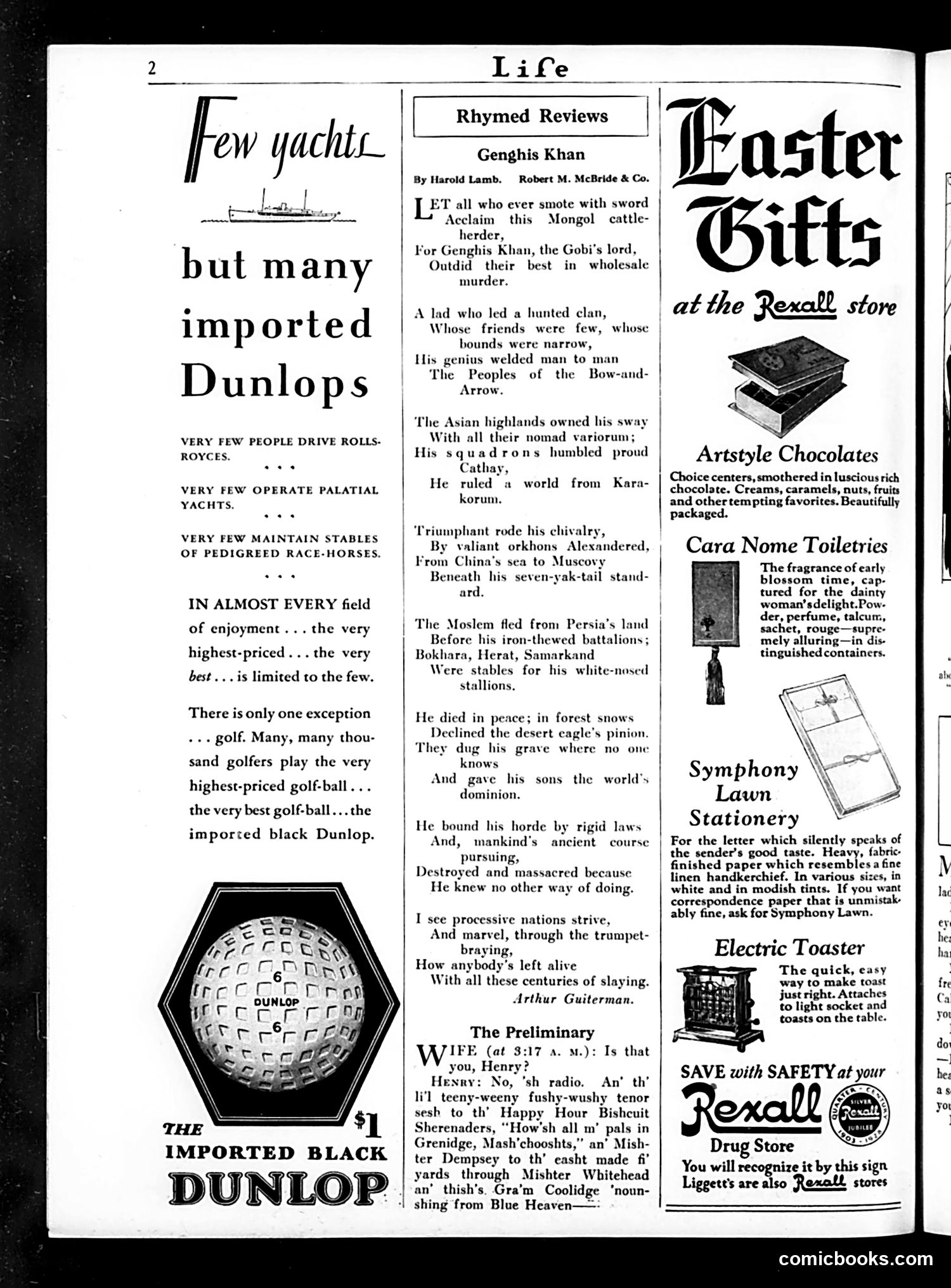
This page is primarily **advertising and light editorial content** rather than political satire. The left side features an advertisement for imported Dunlop golf balls, emphasizing their exclusivity and high cost. The accompanying text jokes that while yachts, Rolls-Royces, and other luxury items are rare among the wealthy, golf balls are the true exception—"many thousand golfers play the very highest-priced golf-ball...the very best golf-ball...the imported black Dunlop." The center section contains "Genghis Khan," a humorous rhymed review poem by Harold Lamb about the historical Mongol leader, treating his conquests with mock-heroic tone. The right side displays **Easter gift advertisements**: Artstyle Chocolates, Cara Nome Toiletries, Symphony Lawn Stationery, and an Electric Toaster, all sold at Rexall drug stores. The satirical element is minimal—primarily the golf ball advertisement's gentle mockery of conspicuous consumption among the wealthy.
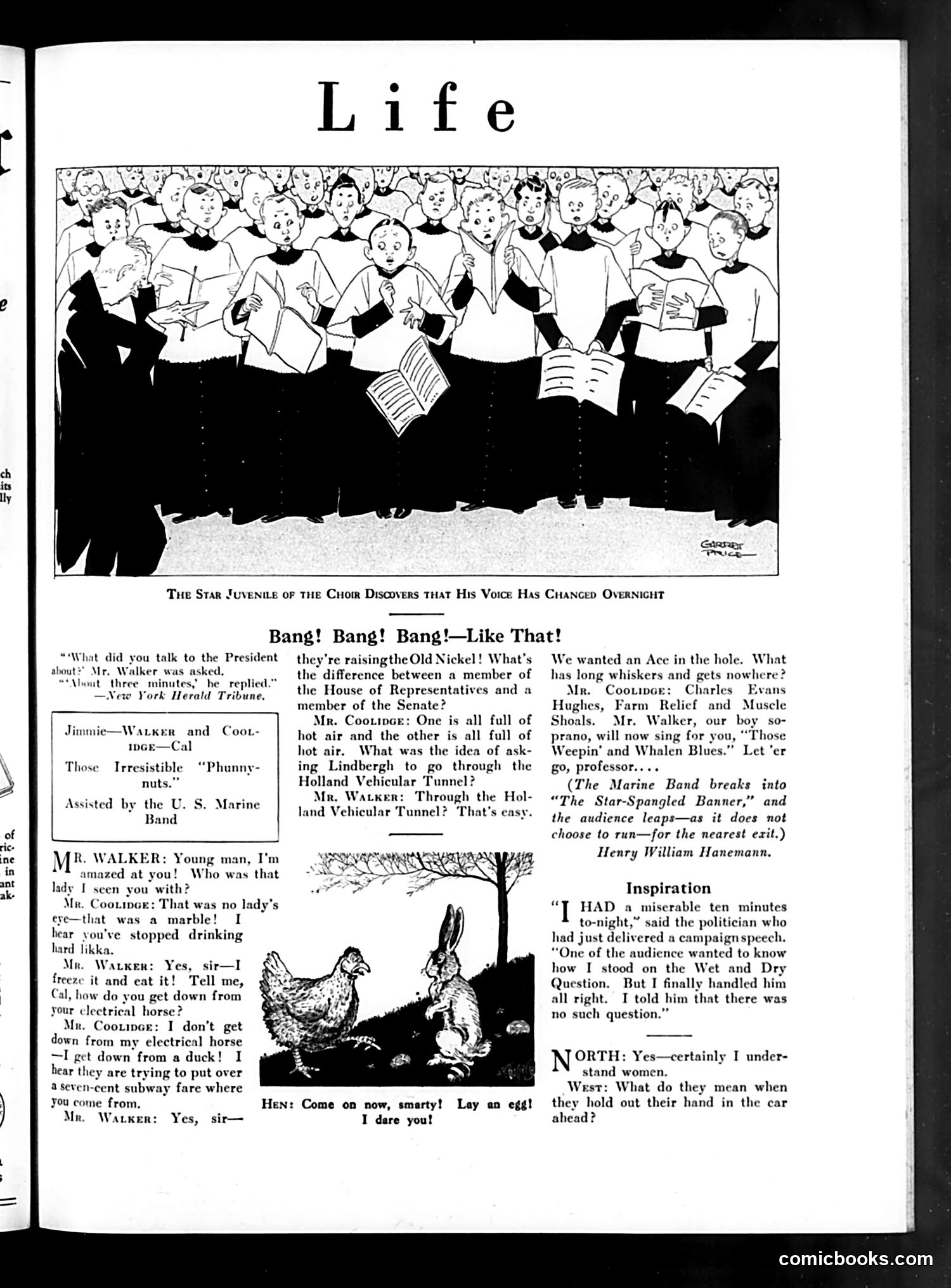
**Main Cartoon:** Depicts a choir discovering a young singer whose voice has "changed overnight"—likely a puberty joke about a boy's voice breaking. **"Bang! Bang! Bang!—Like That!" Dialogue:** Features Mr. Walker and Mr. Coolidge (appears to reference President Calvin Coolidge, "Cool-idge"). The humor involves wordplay about electrical horses, subway fares, and Lindbergh's Holland Vehicular Tunnel—contemporary 1920s references to infrastructure projects. The dialogue is absurdist humor typical of Life's satirical style. **"Inspiration" and "North" Sections:** Brief humorous anecdotes about politicians and social observations. The page satirizes 1920s American life through wordplay, puns, and topical references to contemporary figures and events, using the casual comedic style Life magazine was known for.
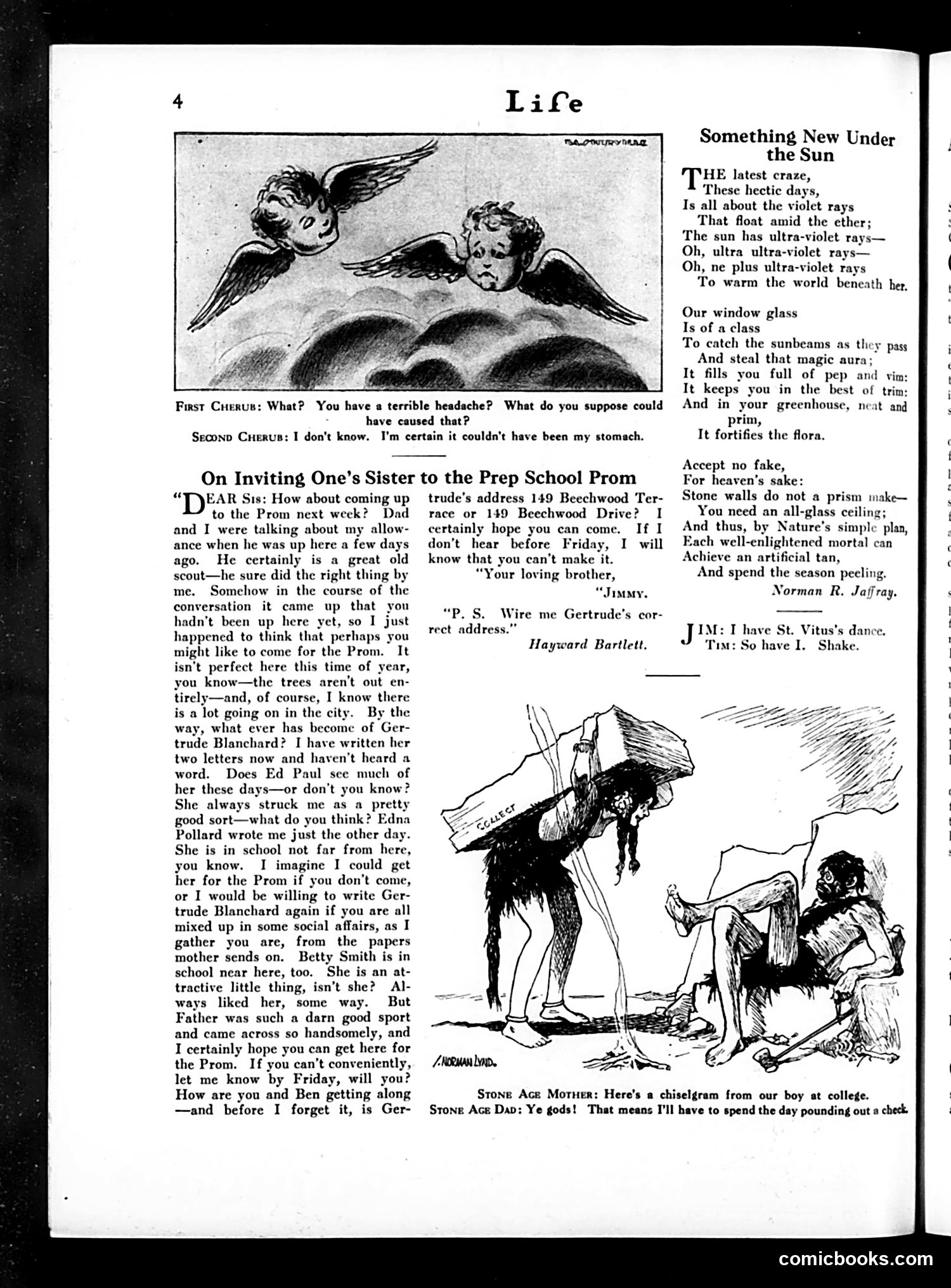
This page contains three separate humor pieces typical of 1920s Life magazine: 1. **Top cartoon**: Two cherubs discussing a headache, making light of physical ailments. 2. **Middle article**: "On Inviting One's Sister to the Prep School Prom" — a humorous letter from a boy to his friend, describing social awkwardness about bringing his sister to a school dance. It references specific locations (Beechwood Drive, St. Vitus's dance) suggesting upper-class preparatory school culture. 3. **Bottom cartoon**: "Stone Age Mother and Dad" — a humorous prehistory scene where a parent complains about a college boy's chiseled assignment, making a pun about "pounding out a check." It satirizes the expense of higher education. The humor targets upper-middle-class social conventions and family dynamics of the era.
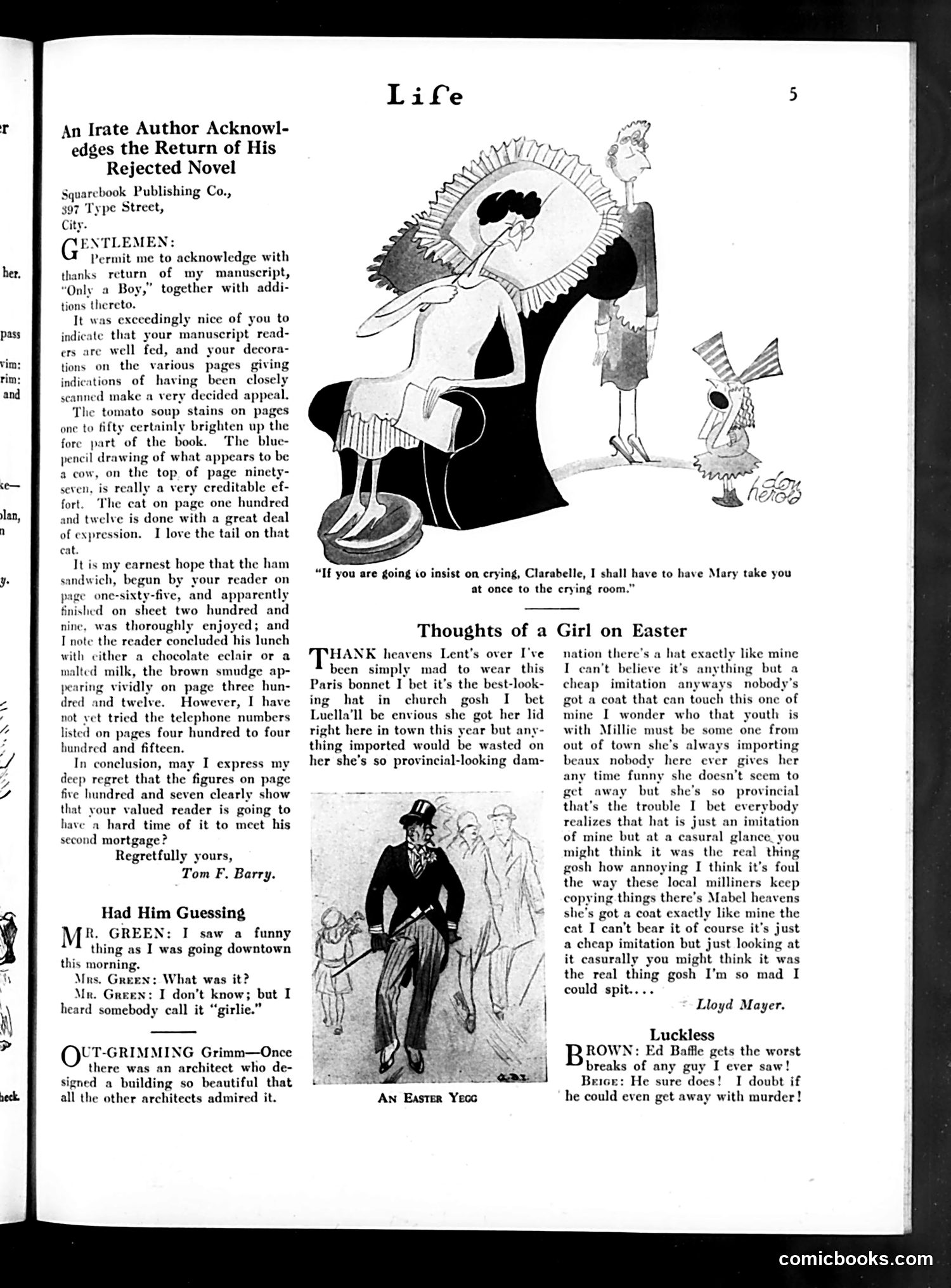
This cartoon depicts a well-dressed woman in an Easter bonnet being accosted by a male figure in dark clothing—a "yegg" (period slang for a burglar or criminal). The satire plays on the contrast between Easter's association with springtime finery and renewal versus urban crime. The accompanying text "An Easter Yegg" identifies the joke: a criminal targeting fashionable Easter-goers. The woman's elaborate hat and coat represent the expensive displays typical of Easter Sunday promenading, making her an obvious robbery target. This reflects early 20th-century urban anxieties about street crime in cities, where holiday celebrations—particularly Easter's showcase of seasonal fashion—created opportunities for theft. The cartoon satirizes both the vulnerability of wealthy Easter celebrants and the persistent urban crime problem.
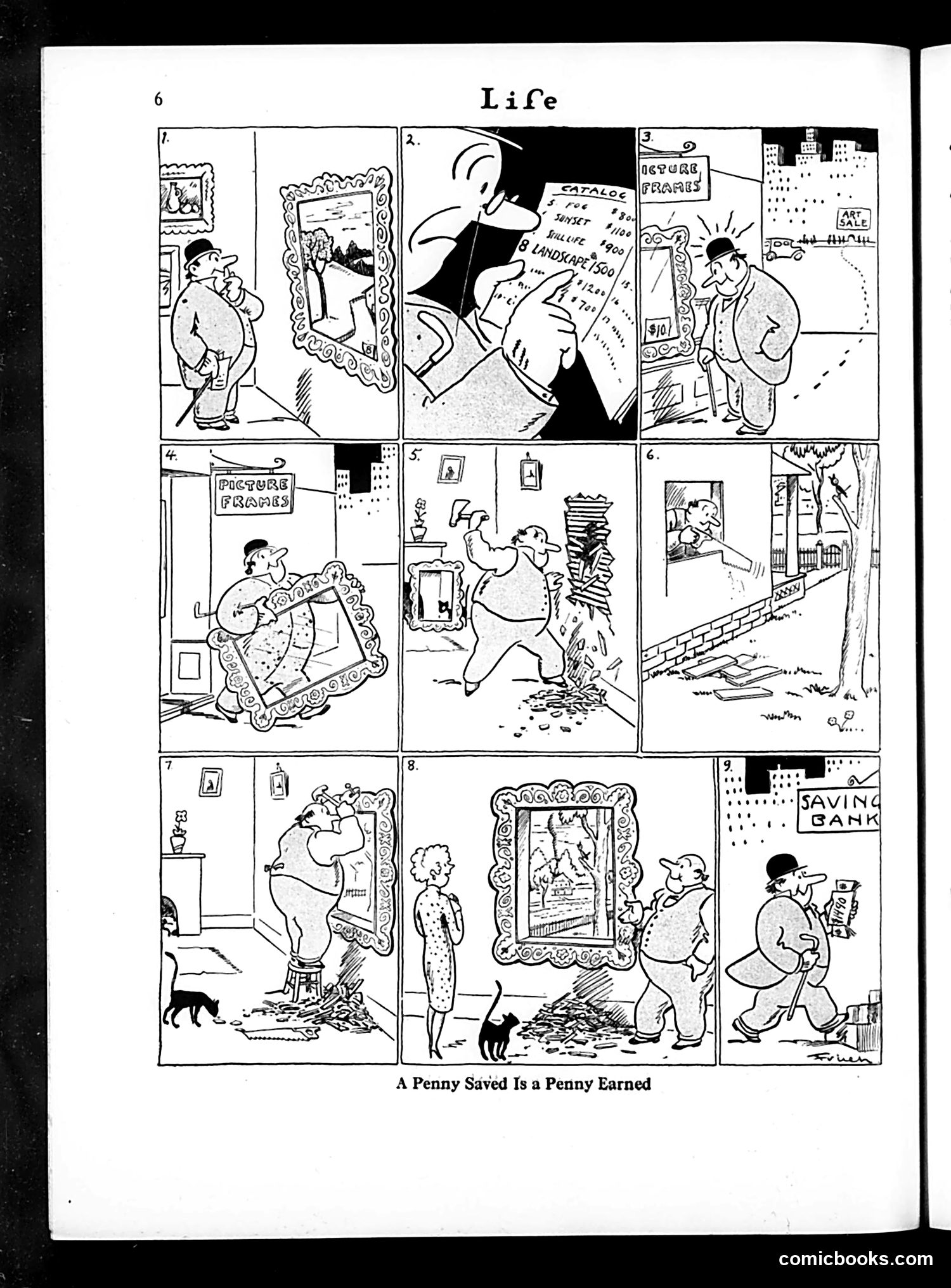
This nine-panel comic strip satirizes American consumer culture and financial irresponsibility. The narrative shows a portly man viewing expensive art and home furnishings in galleries and shops, tempted by luxury goods. He eventually succumbs to purchases, his home becomes cluttered with acquisitions, and the final panels show him visiting a savings bank—apparently broke after his spending spree. The title invokes Benjamin Franklin's famous maxim about thrift, which the comic ironically demonstrates being violated. The satire targets the contradiction between traditional American values of frugality and the era's emerging consumer culture and advertising-driven spending habits. The man's physical transformation—growing larger with consumption—visualizes his financial and moral excess.
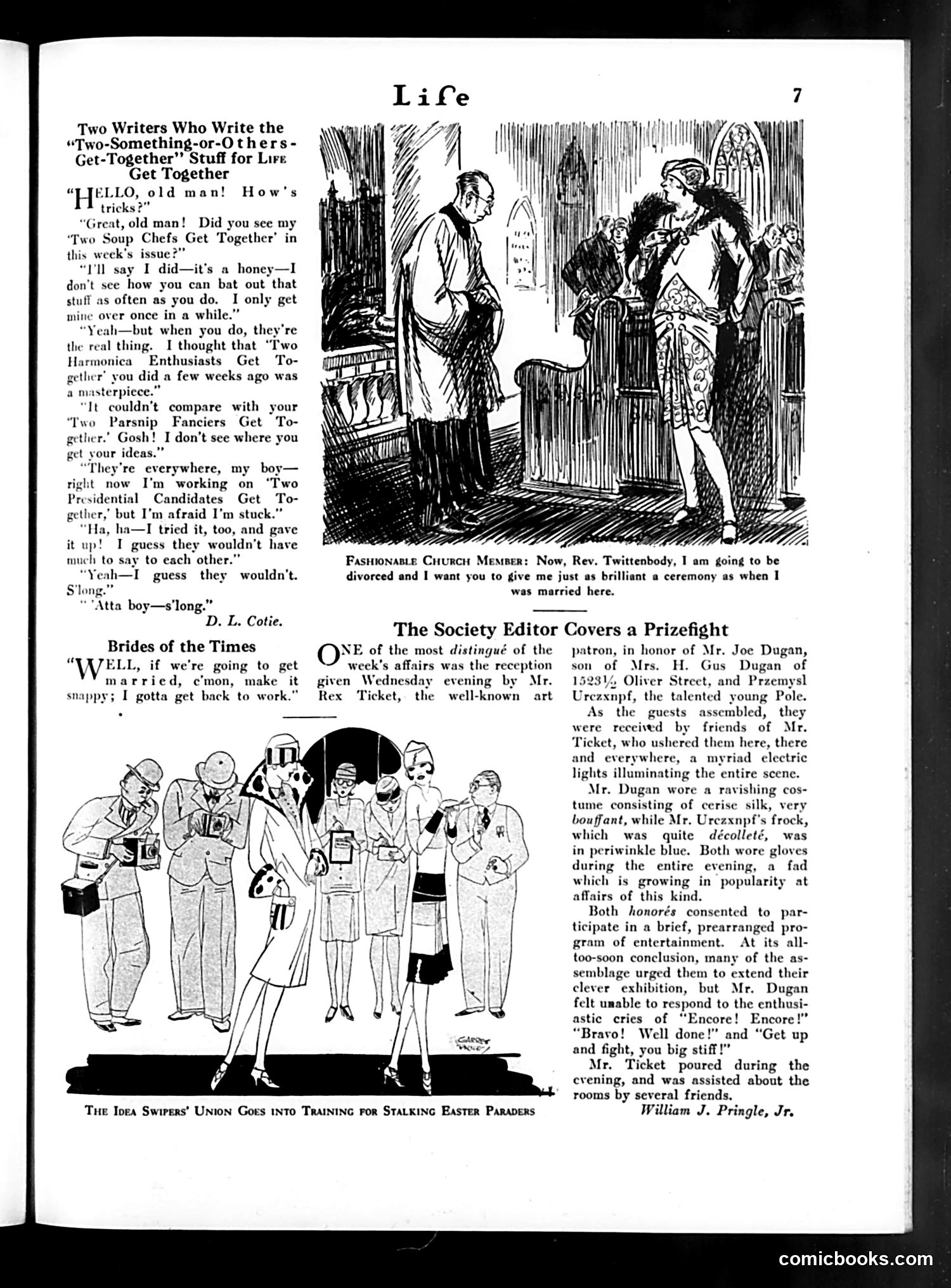
This page contains three distinct items: 1. **"Two Writers Who Write the 'Two-Something-or-Others-Get-Together' Stuff"** — A humorous column by D.L. Cofie mocking writers who produce formulaic stories with predictable titles about pairs getting together (like "Two Harmonica Enthusiasts Get Together"). The satire targets repetitive, mass-produced magazine fiction. 2. **"Brides of the Times"** — A brief joke about marriage announcements, featuring an illustration of well-dressed couples. 3. **"The Society Editor Covers a Prizefight"** — An article describing a high-society reception where wealthy patrons (Mr. Joe Dugan and Mr. Rex Ticket) hosted an art exhibition. The humor likely derives from contrasting elegant society etiquette with the rough sport of boxing, though the specific "prizefight" reference remains unclear from the visible text.
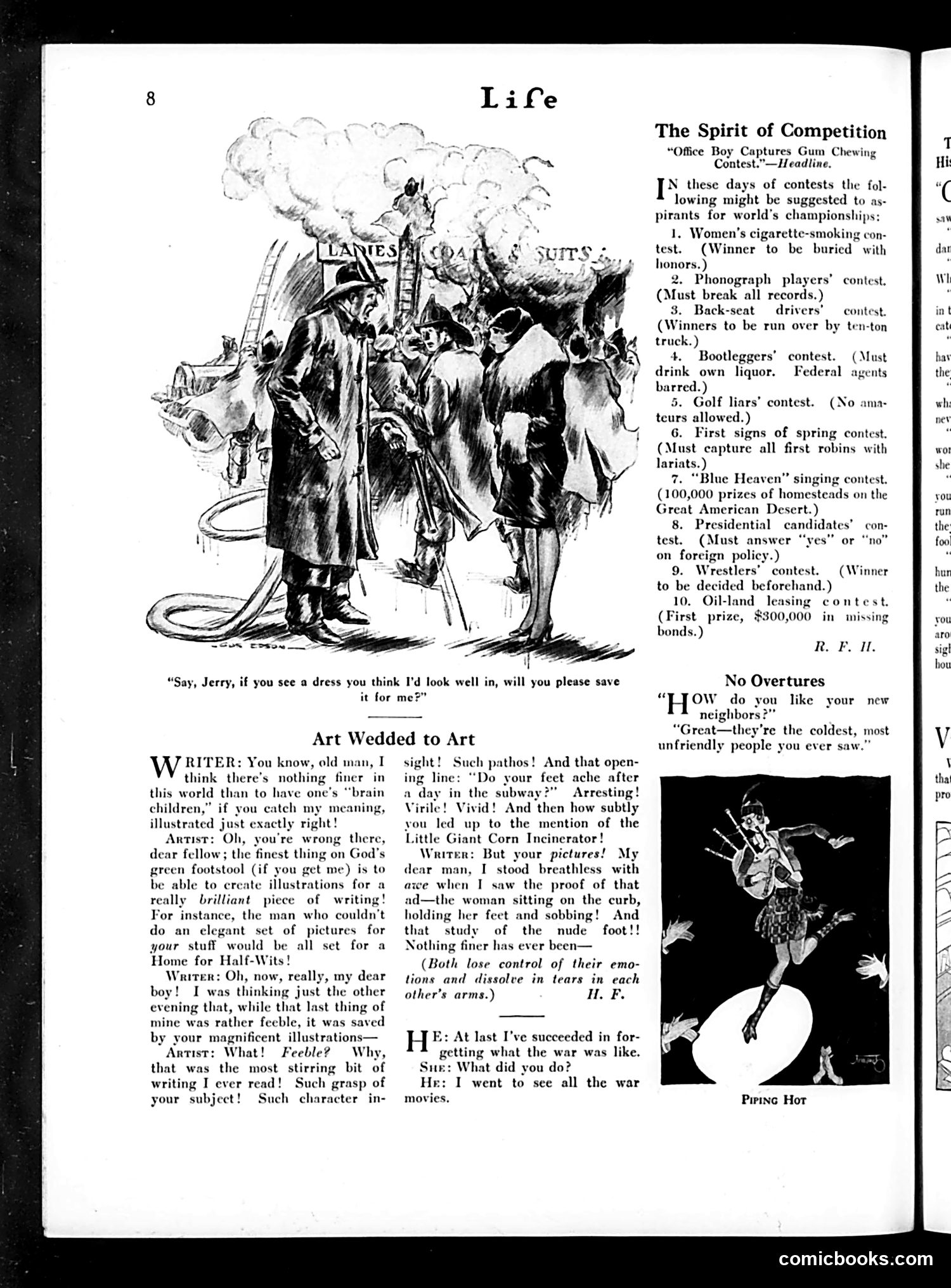
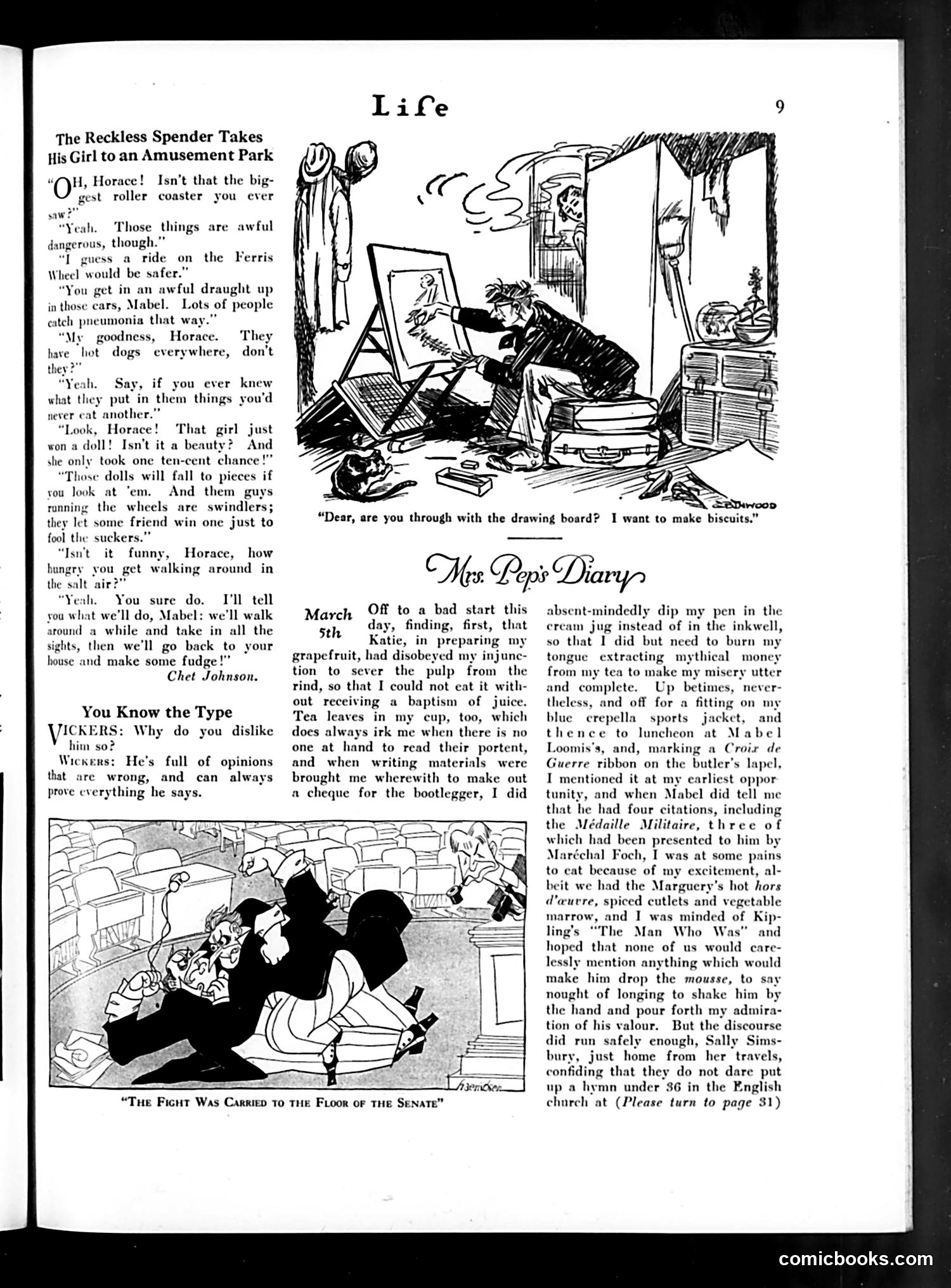
This page contains three distinct humor pieces: 1. **"The Reckless Spender Takes His Girl to an Amusement Park"**: A dialogue satirizing amusement park dangers and costs, with a man and woman discussing roller coasters and Ferris wheels. The joke targets the expense and risks of early 20th-century amusement rides. 2. **"You Know the Type"**: A brief joke about someone who expresses strong opinions on everything, presented as social commentary on argumentative personalities. 3. **"Miss Pep's Diary"** (March 5th): A humorous diary entry describing an accident with a drawing board and subsequent social embarrassments at lunch. The diary format was a popular satirical device in Life magazine for social observation. The cartoons and text together mock everyday American leisure activities and social pretensions of the era.
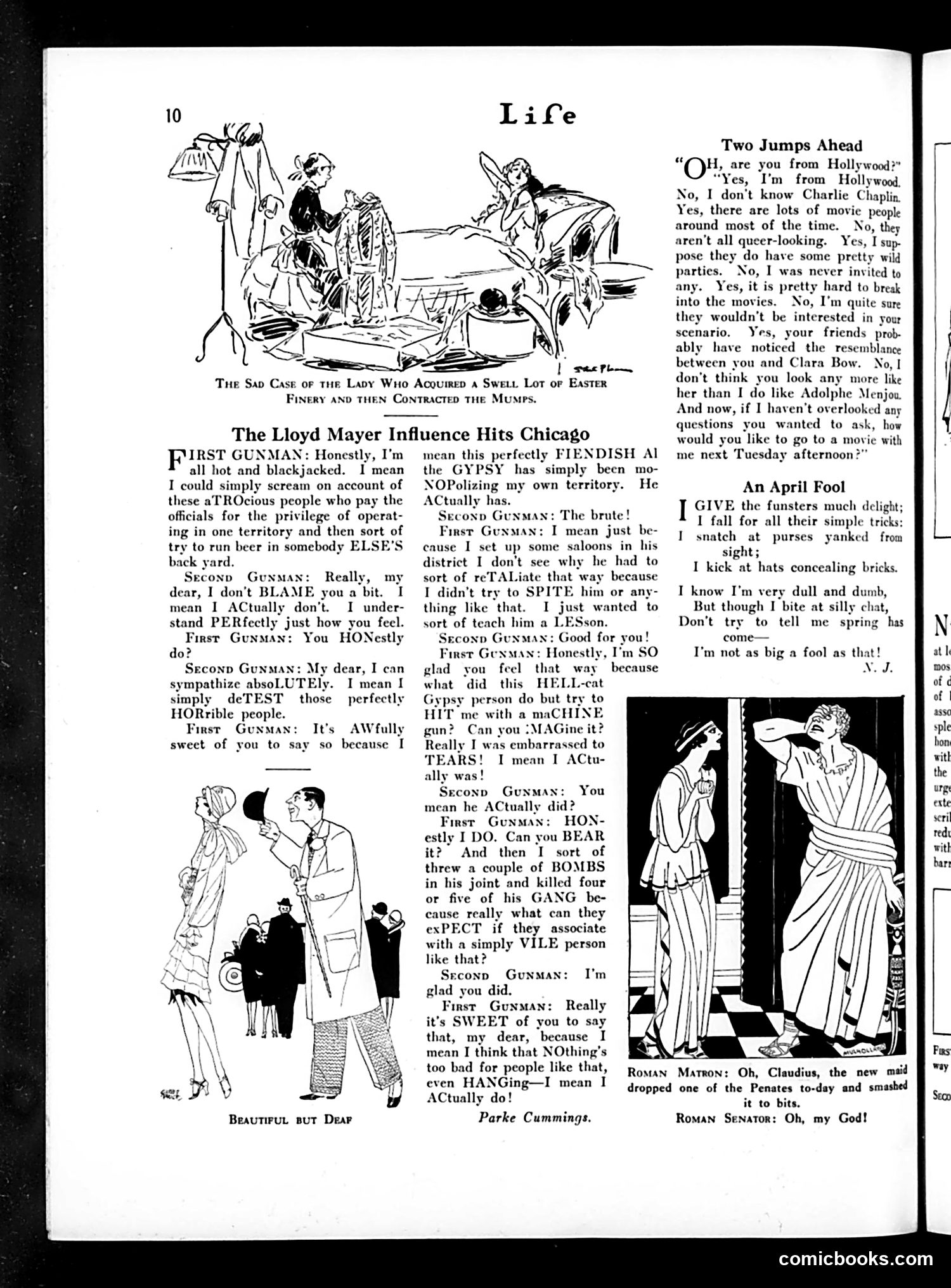
This page contains three satirical pieces from Life magazine's humor section: 1. **"The Sad Case of the Lady Who Acquired a Swell Lot of Easter Finery"** — A cartoon mocking conspicuous consumption, showing a woman who bought fancy Easter clothes but then contracted the mumps, rendering her unable to display her purchases. 2. **"The Lloyd Mayer Influence Hits Chicago"** — A dialogue between two gangsters debating whether to retaliate violently against rivals. The satire targets Chicago's organized crime problem of the Prohibition era, mocking the casual brutality and twisted logic of gangsters. 3. **"An April Fool"** and **"Beautiful but Deaf"** — Shorter humorous pieces about foolish behavior and romantic miscommunication. The page reflects 1920s-era American concerns: wealth, fashion, urban crime, and social awkwardness.
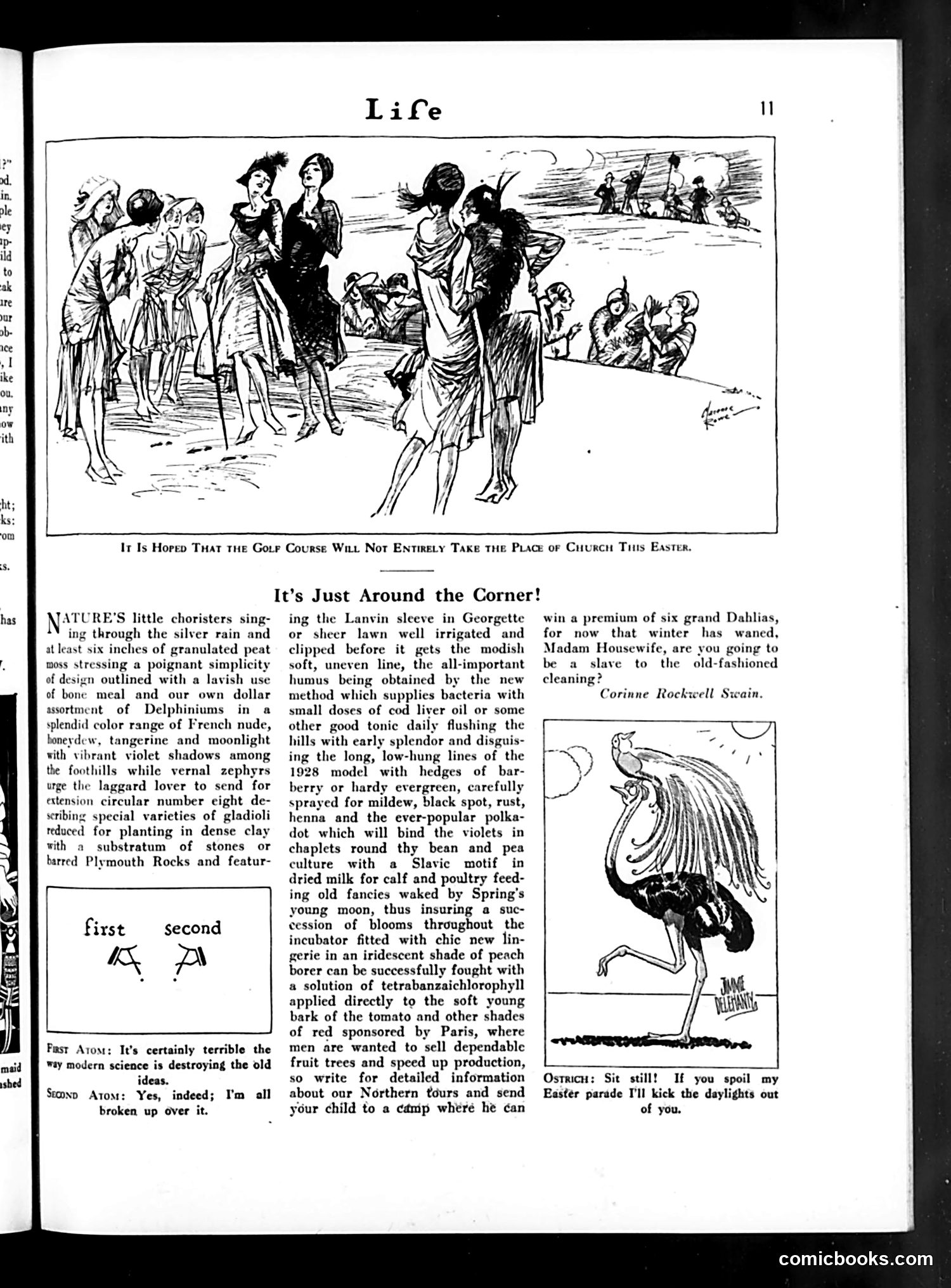
This satirical cartoon criticizes the growing popularity of golf among the leisure class, particularly on Easter—traditionally a major Christian holiday requiring church attendance. The illustration shows fashionable women at a beach resort choosing recreational activities over religious observance. The joke targets the perceived secularization of American society and the displacement of traditional religious practice by modern leisure pursuits. Golf, still a relatively new and fashionable sport in the early 20th century, symbolizes wealthy, frivolous distraction from spiritual duties. The cartoon's title expresses mock concern that holiday traditions are being abandoned for recreation—a common theme in Life magazine's social satire of the period.
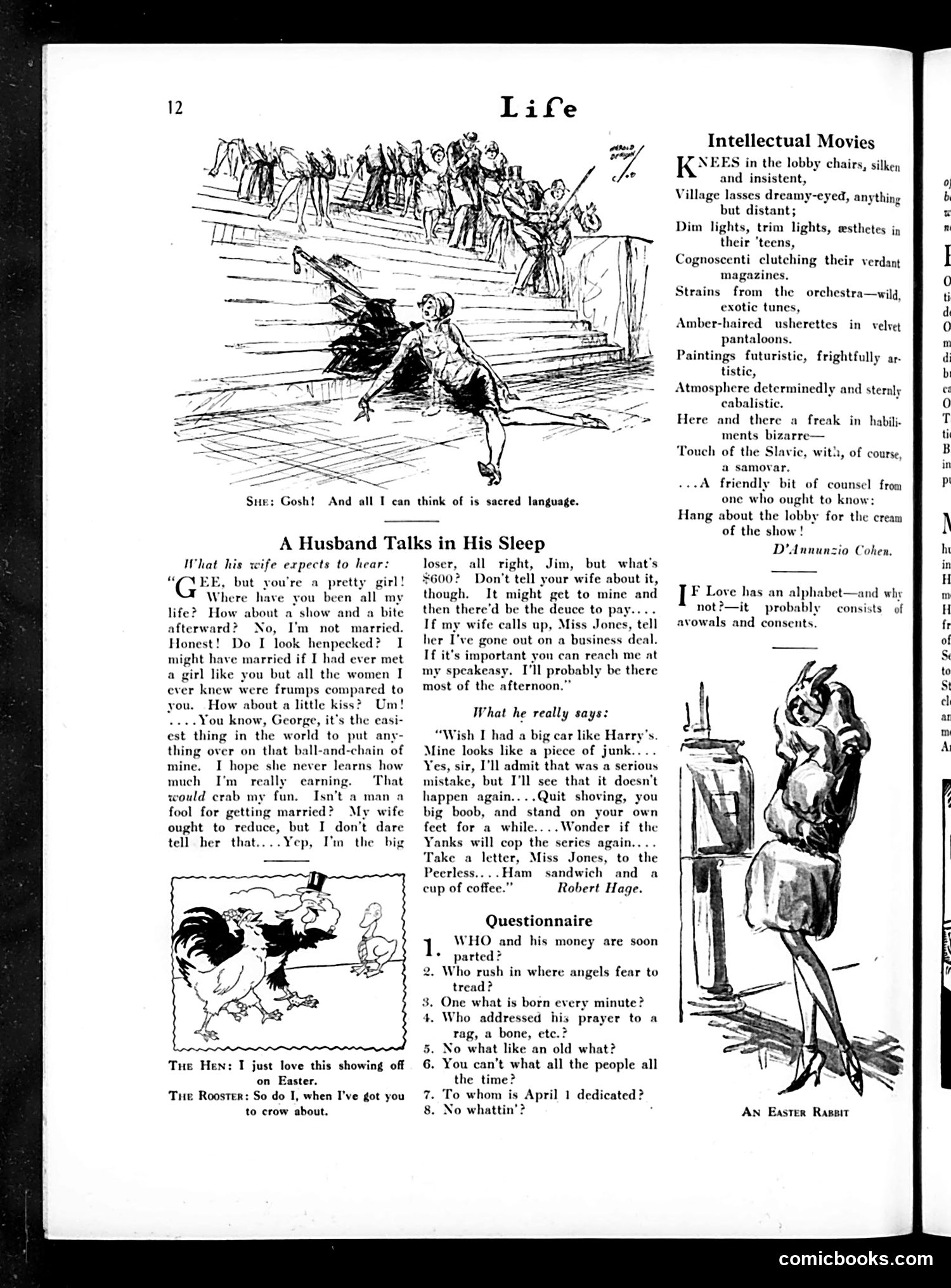
This page contains humorous domestic satire typical of early 20th-century Life magazine. **"A Husband Talks in His Sleep"** presents a contrast between what a wife *expects* to hear (romantic compliments, declarations of fidelity) versus what he *actually says* (mundane talk about baseball, business deals, and eating). The joke mocks husbands' apparent indifference to romance and their preoccupation with trivial male concerns. **"Intellectual Movies"** satirizes pretentious art-house cinema and its typical audience—thin, affected urbanites affected by obscure European films with "wild, exotic tunes." The cartoon illustrations and accompanying hen/rooster dialogue provide visual comedy about gender expectations and marital dynamics, common Life magazine themes mocking bourgeois American domestic life.
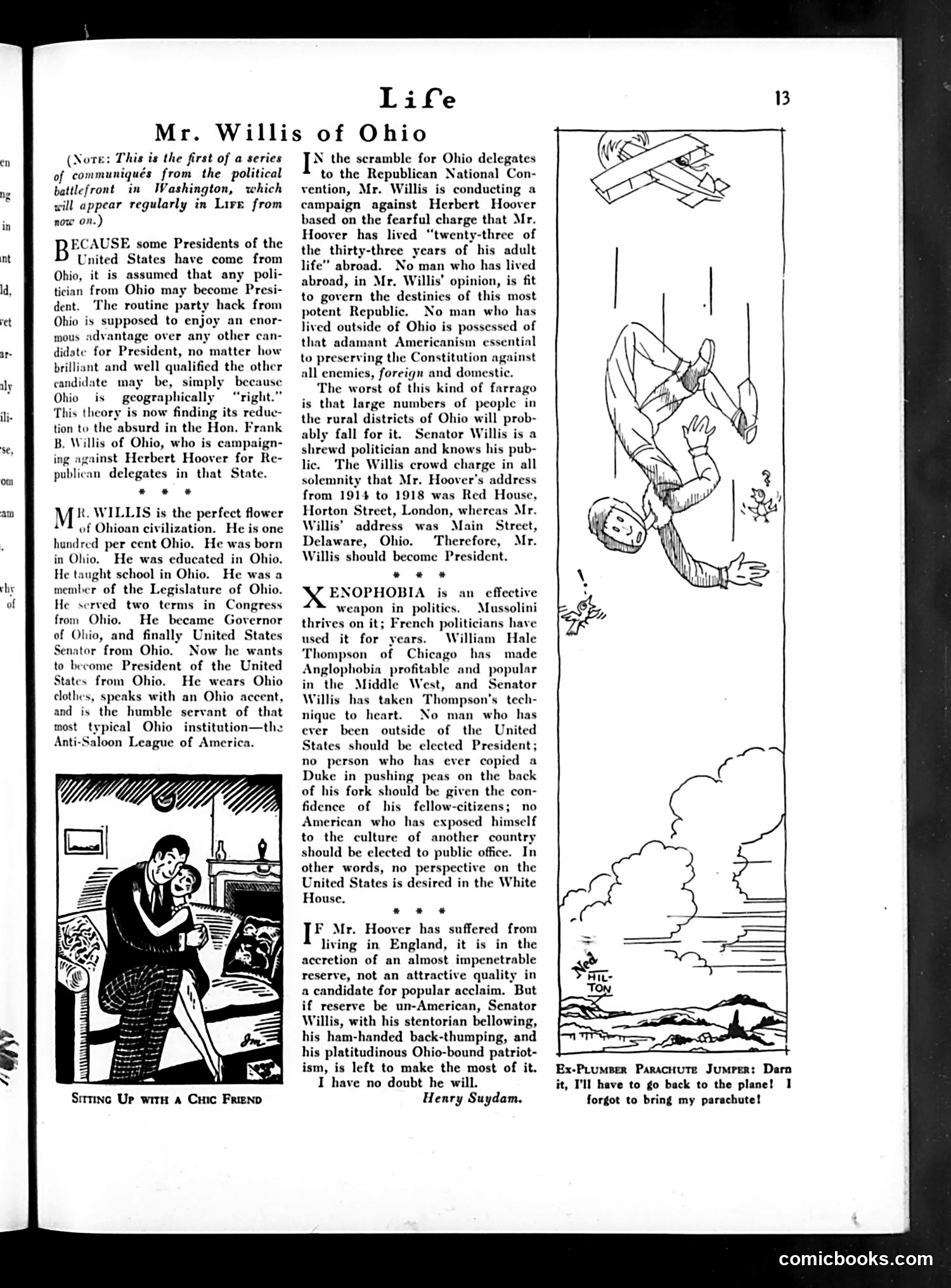
This page attacks **Mr. Willis of Ohio**, a Republican politician backing Herbert Hoover for president in the 1928 election. The author (Henry Suydam) argues Willis should become president instead, sarcastically praising Ohio's supposed advantage in producing presidents. The main cartoon "Sitting Up with a Chic Friend" (lower left) depicts a woman flirting with a man reading political documents—likely mocking Willis's political ambitions as distraction from serious governance. The right-side cartoon "Ex-Plumber Parachute Jumper" shows a figure falling, captioning a joke about forgetting a parachute—possibly satirizing the recklessness of Hoover or Willis's political positions. The text emphasizes xenophobia as political strategy, attacking Hoover's time living abroad in England as disqualifying for the presidency.
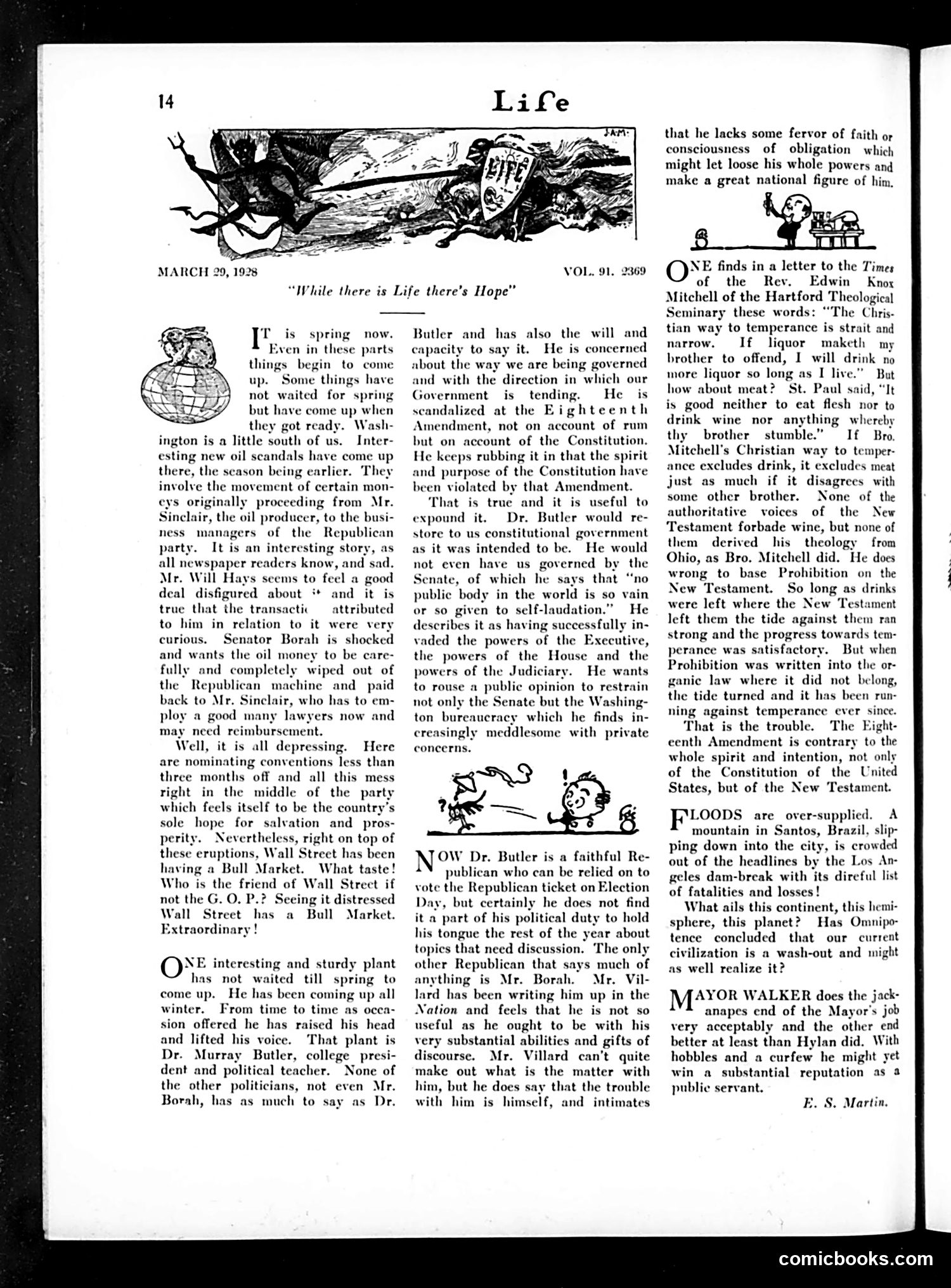
This page contains editorial commentary on spring politics rather than visual cartoons. The main subjects are: **Dr. Murray Butler** — a college president and Republican figure criticized for his political activism. The writer notes Butler maintains influence over Republican party direction despite holding no elected office, and questions whether his involvement serves the party's interests. **Mr. Borah** — a Republican politician the text suggests is more forthright than Butler, though still problematic. **Mr. Villard** — criticized for writing about Republicans in *The Nation* magazine. The commentary expresses frustration with unelected figures wielding significant political power within the Republican Party during the 1928 election season. Additional brief items discuss flooding in Brazil and Mayor Walker's job performance in New York.
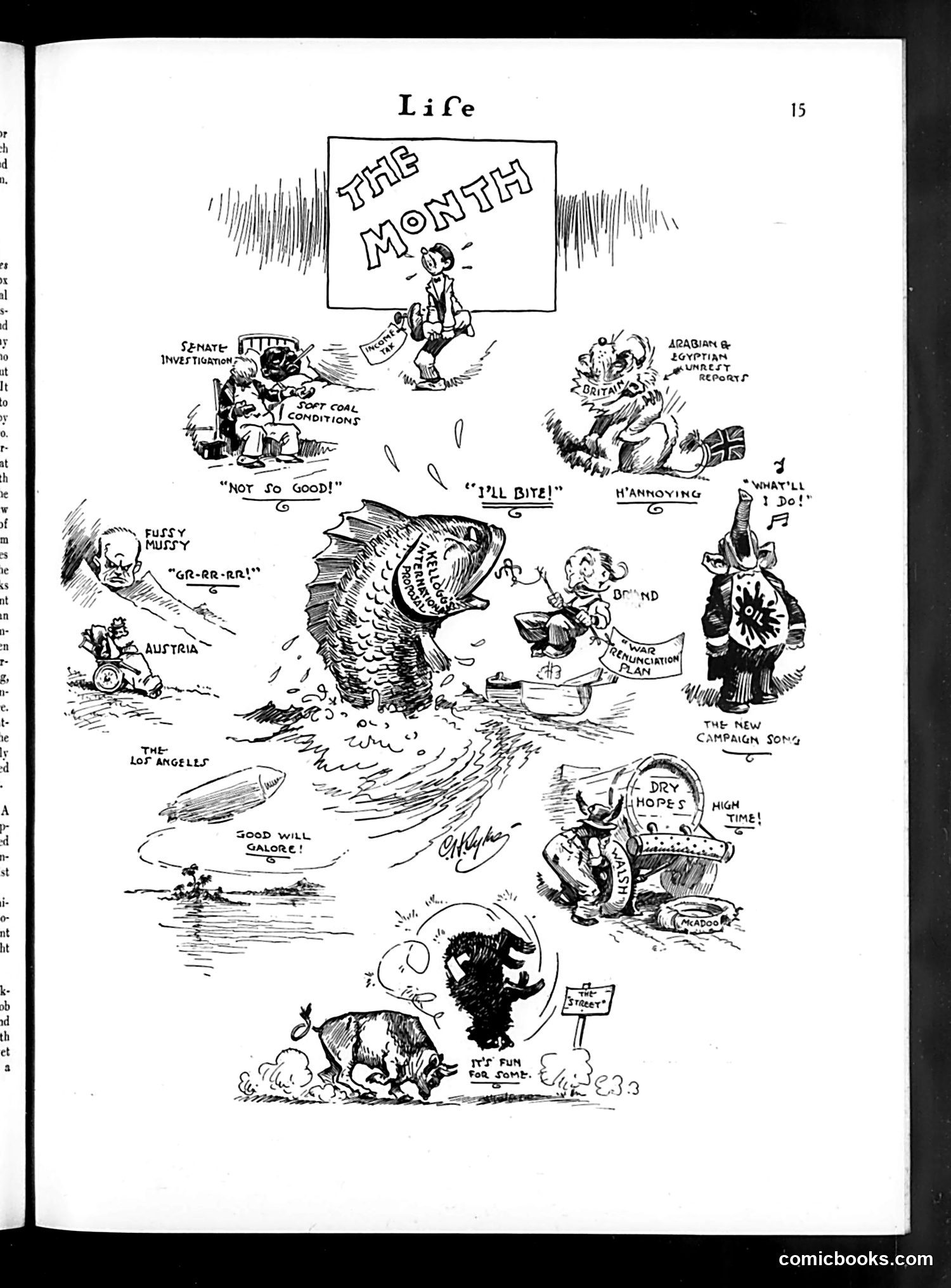
This is a satirical overview cartoon from *Life* magazine depicting major news events of a particular month. The central figure is a large, menacing fish labeled with what appears to be a European power or conflict reference, surrounded by smaller vignettes representing different crises: - **Senate Investigation** ("Not so good!") - **Coal Conditions** - **Arabian & Egyptian Unrest** - **Austria** (labeled "Fuzzy Muzzy") - **The Los Angeles** ("Good will galore!") - **Dry Hopes** and **Campaign Song** - Bottom panel references street conditions and urban issues The cartoon uses exaggerated caricatures and anthropomorphized creatures to mock political incompetence and international turmoil. The overall message satirizes multiple simultaneous crises overwhelming the nation, rendered through dark humor typical of early 20th-century *Life* magazine commentary.
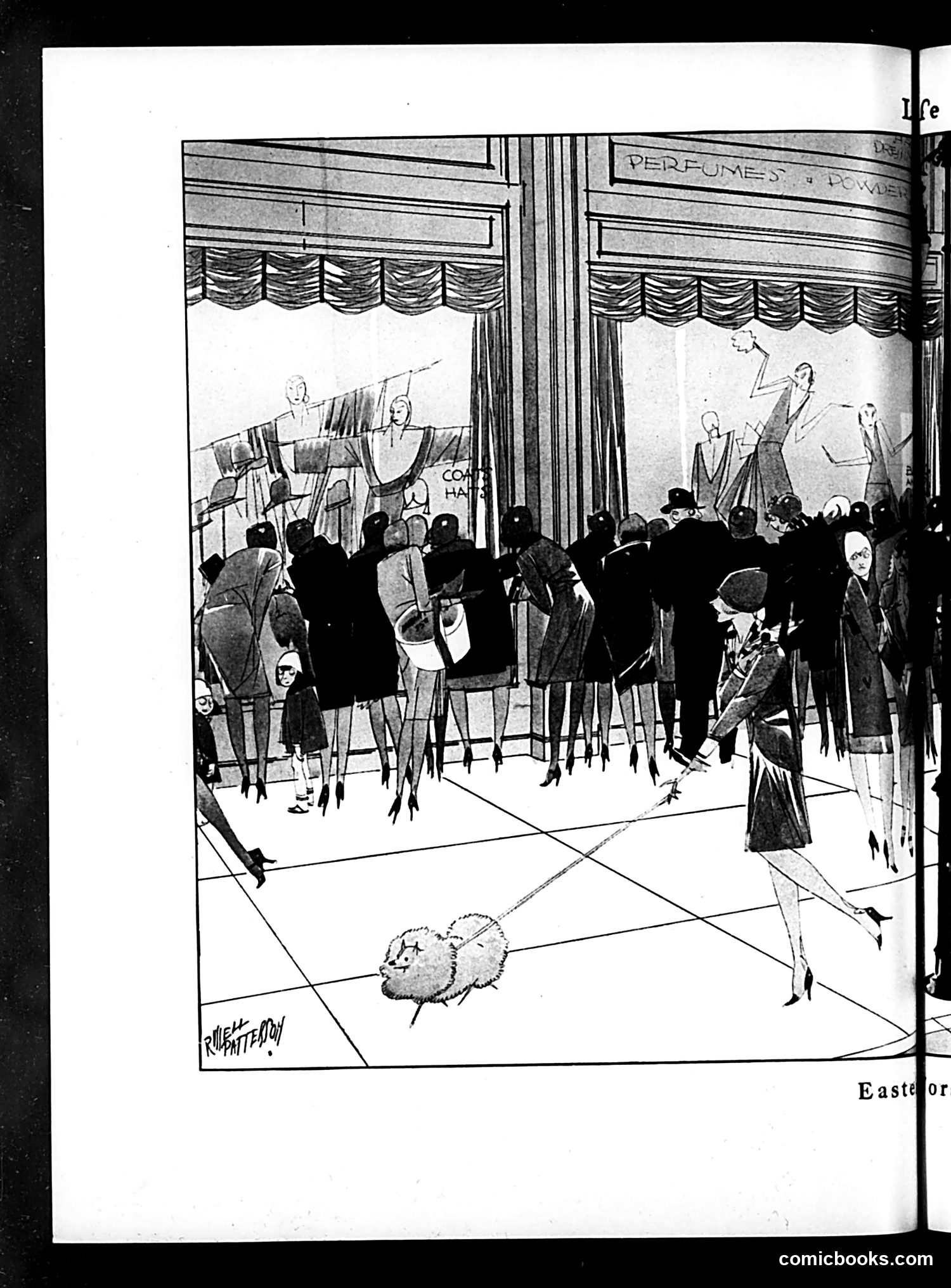
This cartoon by Ralph Barton depicts a fashionable department store window display featuring "Perfumes & Powders." The satire centers on a small, fluffy dog that has wandered into the elegant shopping scene, appearing completely out of place among the well-dressed women and mannequins in the storefront windows. The humor lies in the contrast: while sophisticated female shoppers admire refined beauty products and fashions, a common lap dog sits obliviously on the polished floor. This likely mocks the pretentiousness of high-end cosmetics marketing—suggesting that even the most elaborate perfumes and powders cannot match nature's simple appeal, or satirizing how absurdly seriously consumers take luxury beauty goods when more basic, authentic things (like a pet's natural charm) go unnoticed.
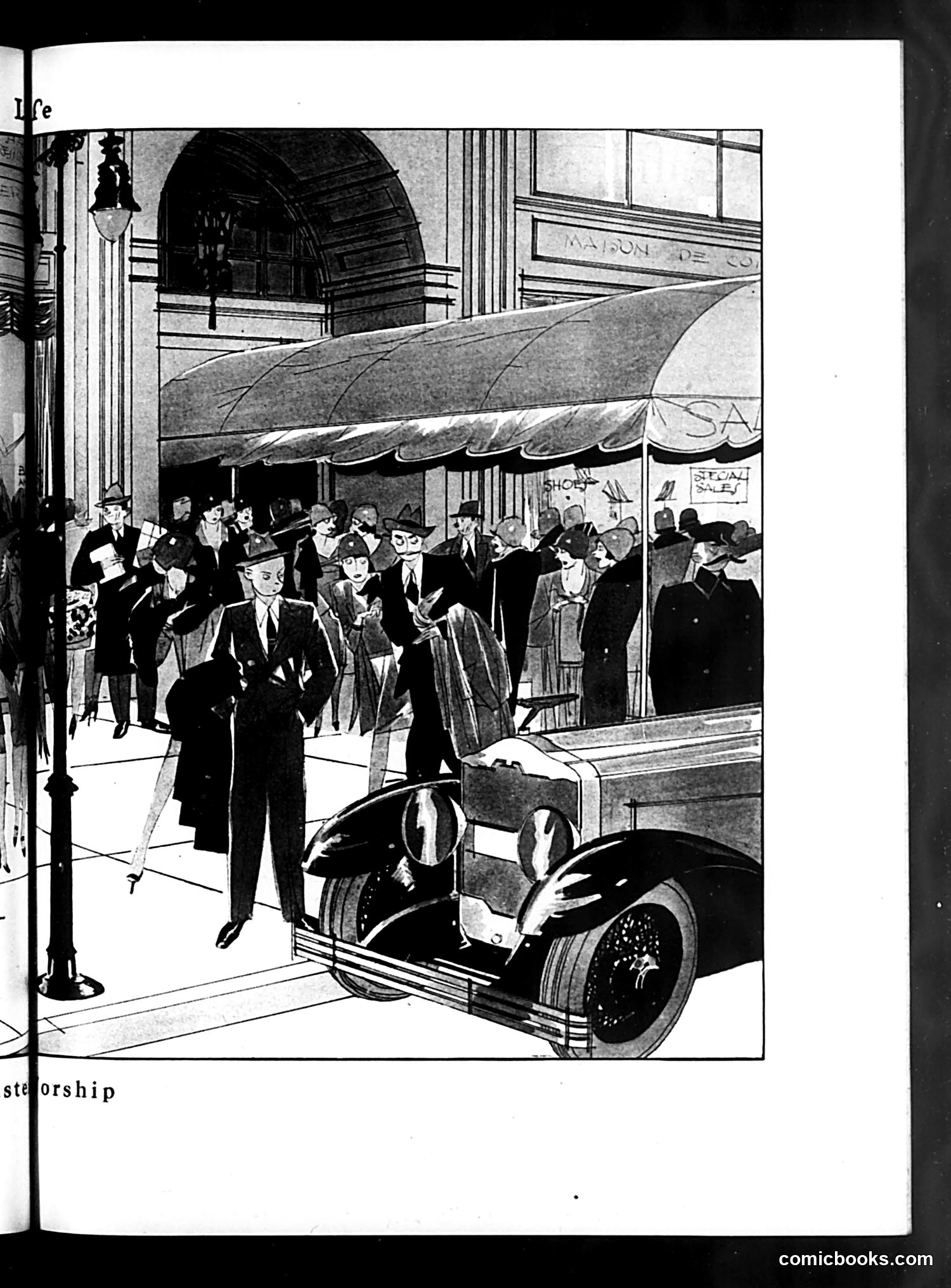
This illustration depicts an elegant urban street scene from what appears to be the 1920s-1930s era, showing well-dressed pedestrians and an automobile outside a storefront. The word "storship" appears at the bottom left, though its meaning is unclear from the visible text. The scene satirizes wealth and consumerism during the prosperous interwar period. The fashionably dressed crowd, luxury automobile, and upscale retail environment (note the "MAISON" storefront sign suggesting French boutique shopping) represent urban affluence. The large awning and crowded storefront suggest commercial spectacle and consumer culture. Without additional OCR text or caption visible, the specific satirical target remains unclear—whether it mocks materialism, class display, or particular commercial practices of the era.
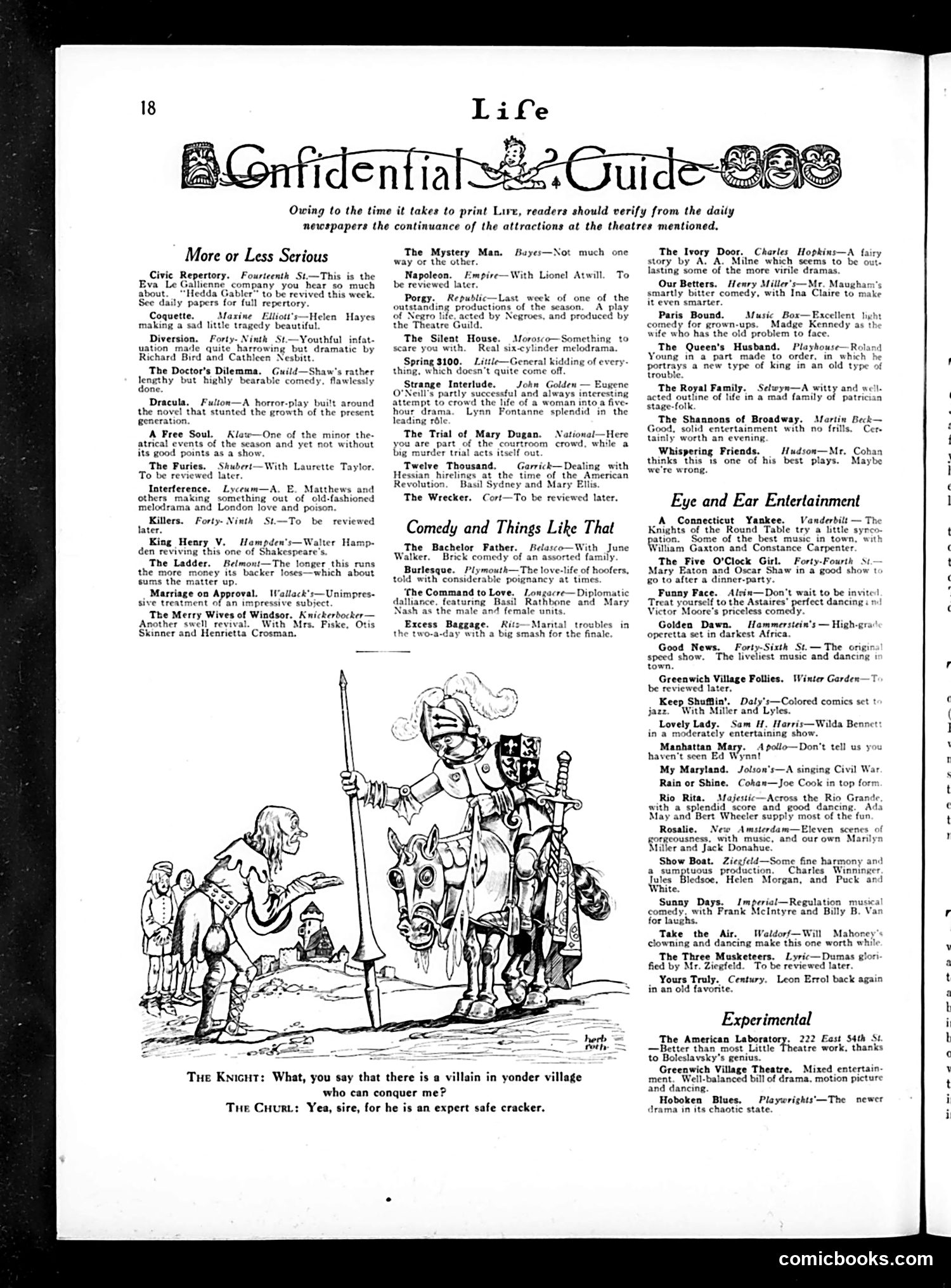
This page from *Life* magazine presents theater reviews alongside a satirical cartoon. The main illustration depicts a medieval knight on horseback confronted by a small figure, accompanying a joke about conquering a villain who is actually "an expert safe cracker." The humor contrasts medieval chivalric fantasy with modern criminality—the knight expects a traditional adversary but discovers contemporary crime instead. This reflects 1920s satire mocking anachronistic ideals versus modern reality. The page itself is primarily a theater guide reviewing Broadway productions of the era, including plays like *Porgy* (noted as featuring Black actors and produced by the Theatre Guild), *Strange Interlude*, and *The Merry Wives of Windsor* with Mrs. Fiske. The reviews are brief, witty assessments typical of *Life*'s entertainment criticism. This appears to be a standard entertainment section rather than primarily political commentary.
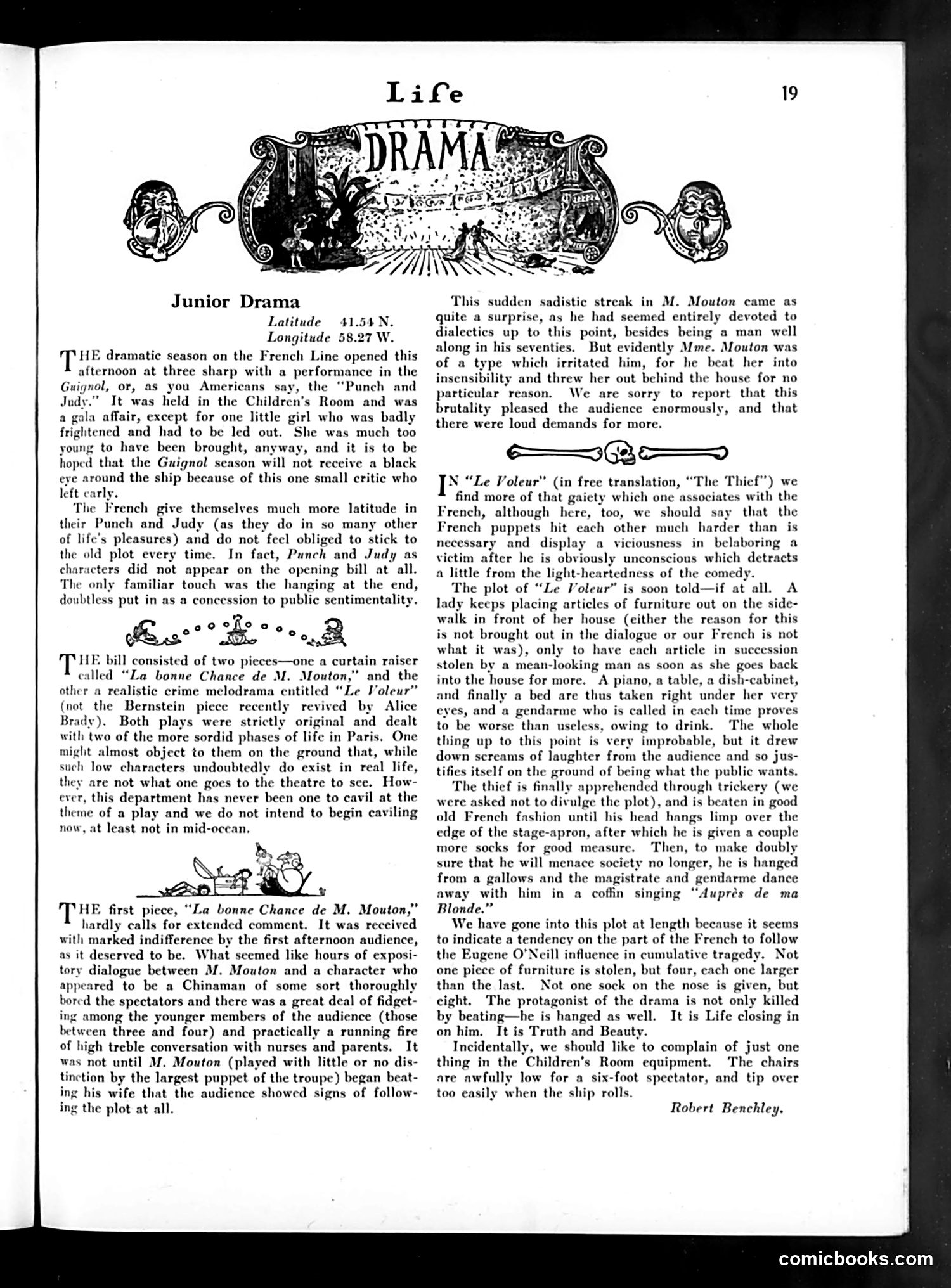
This is a theater review of a children's puppet show (Guignol—the French equivalent of Punch and Judy) performed aboard a French ocean liner. The critic describes two crude melodramas featuring violence and criminality. The satire targets French culture's tolerance for crude entertainment and the audience's (including children's) appetite for brutality. The reviewer notes with dry disapproval that the first play's only successful moment came when the puppet M. Mouton beat his wife into unconsciousness—which "pleased the audience enormously." The second play, "Le Voleur" (The Thief), depicts slapstick theft and violence. The critic's tone is sardonic, suggesting these performances reveal something unflattering about French theatrical tastes and parental judgment in exposing young children to such material. The piece functions as both entertainment review and social commentary on transatlantic cultural differences regarding what constitutes appropriate amusement.
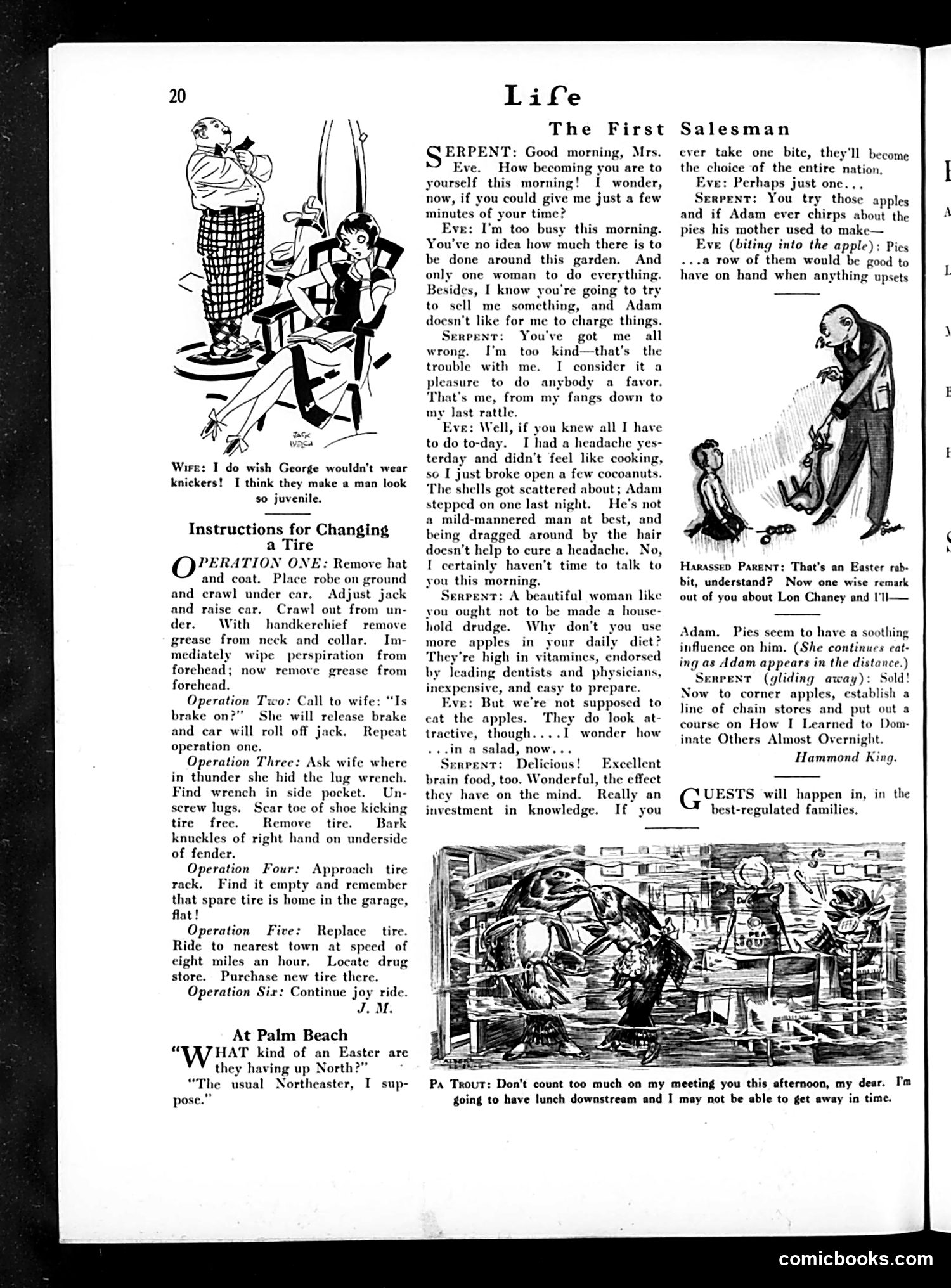
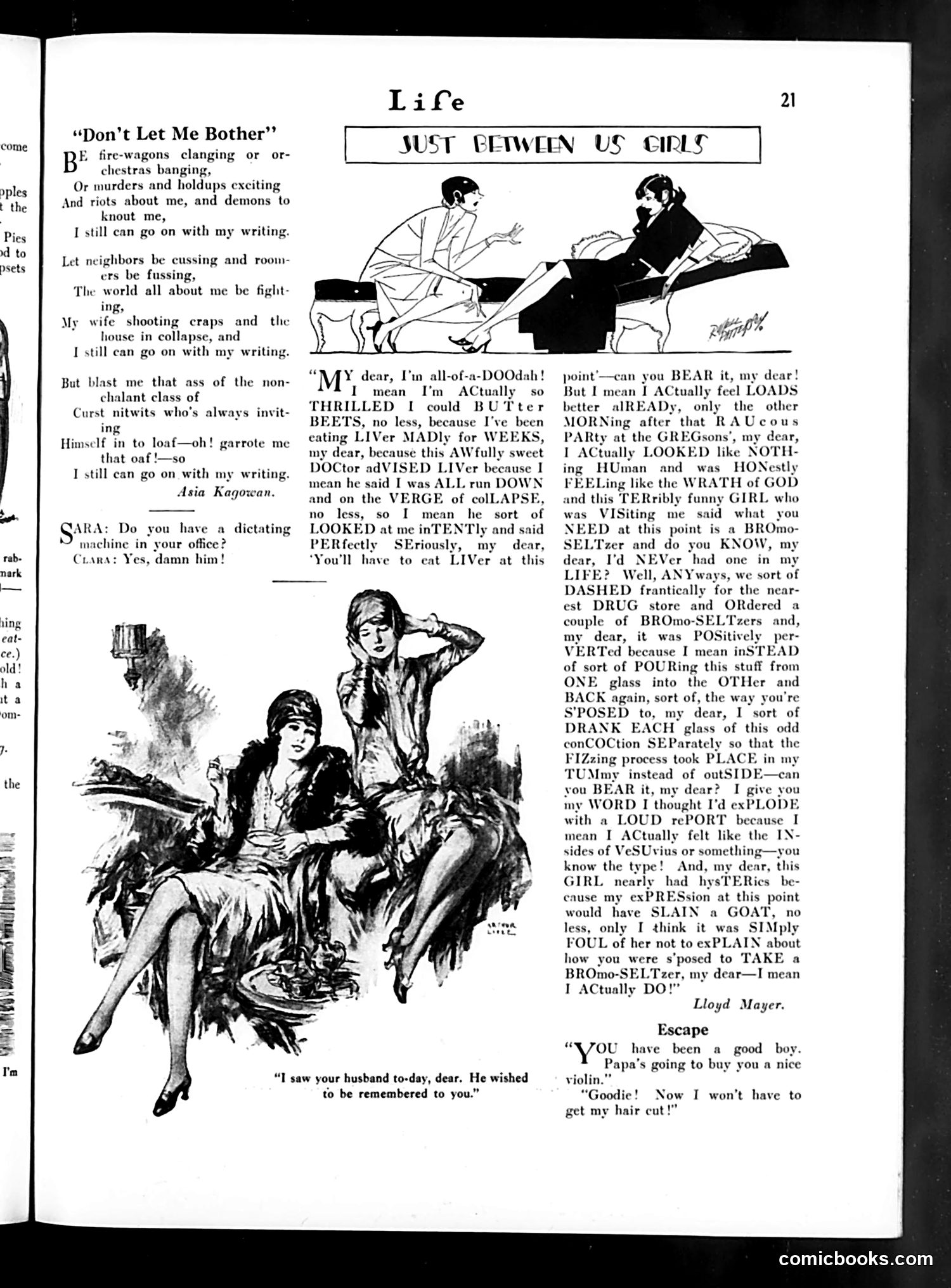
This page contains multiple satirical pieces typical of early 20th-century Life magazine: **"The First Salesman"** (main feature): A biblical allegory where the Serpent tempts Eve to eat apples through manipulative sales tactics—praising her beauty, claiming health benefits endorsed by dentists, and positioning apples as an investment in knowledge. The satire mocks aggressive advertising and sales manipulation of the era. Eve's concerns about household duties and Adam's temper highlight women's domestic constraints. The Serpent's final monologue reveals cynical business strategy: corner the market through chain stores and dominate consumers. **"Instructions for Changing a Tire"**: Humorous step-by-step guide satirizing men's incompetence and vanity during car maintenance, including absurdities like removing hats before getting dirty and repeatedly crawling under the car. **"At Palm Beach"**: A brief joke about regional weather differences—Northeasters (storms) versus Easter celebrations. The page satirizes early consumer culture, gender roles, and masculine pretense.
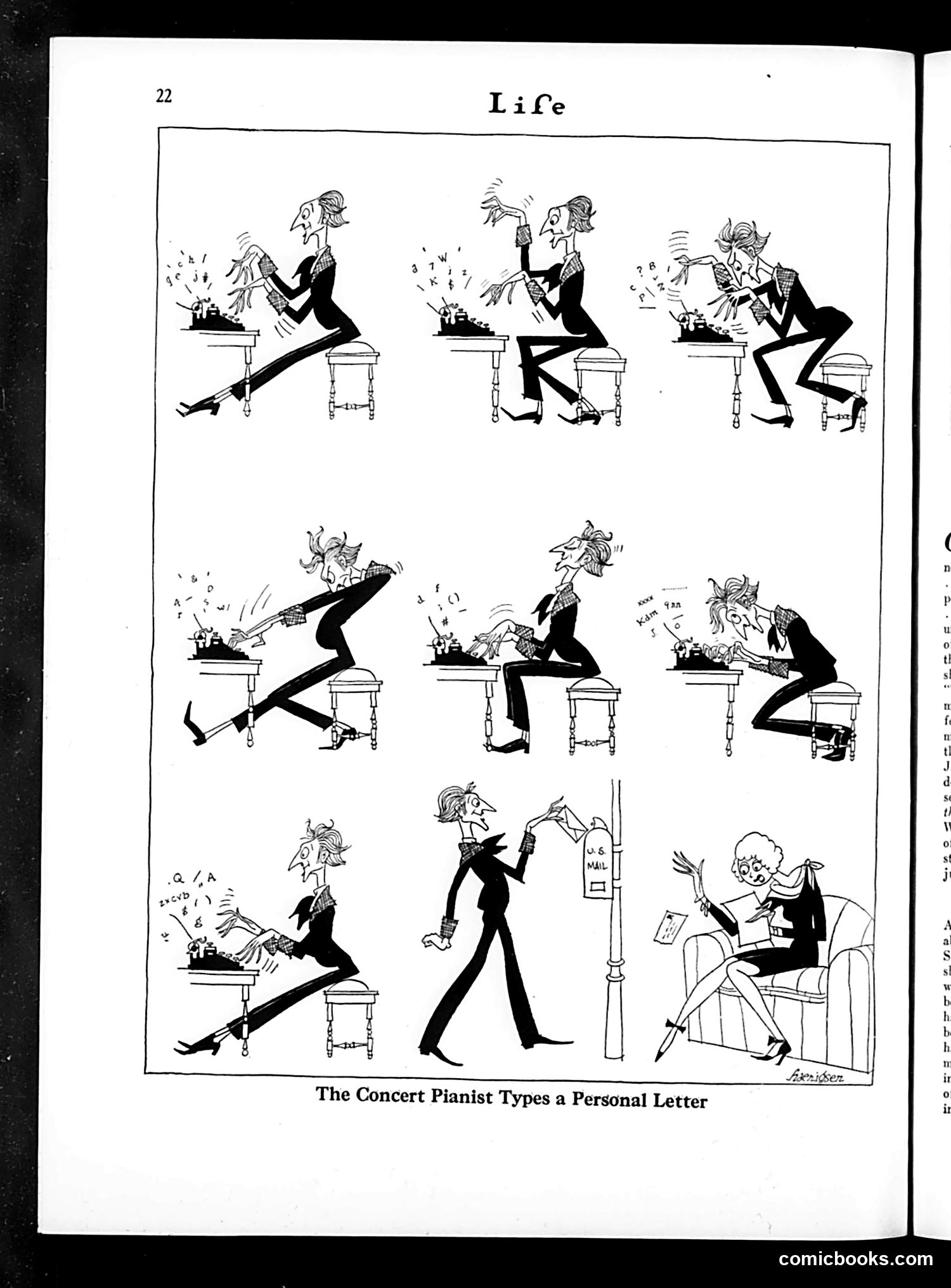
This is a humorous comic strip satirizing the affectations of concert pianists typing personal letters. The sequence shows an exaggerated male pianist at a desk with a typewriter, dramatically gesturing and contorting his body with each keystroke—flailing his legs, throwing his head back, and making theatrical motions as if performing at a piano concert rather than simply typing. The joke mocks the stereotype of classical concert pianists as overly dramatic and self-important performers who cannot help but treat even mundane tasks with operatic flair. Each panel escalates the absurdity, culminating in an image of the pianist relaxing in a chair, finally composed. The satire targets both the perceived pretentiousness of high-culture musicians and the gap between their stage personas and ordinary life.
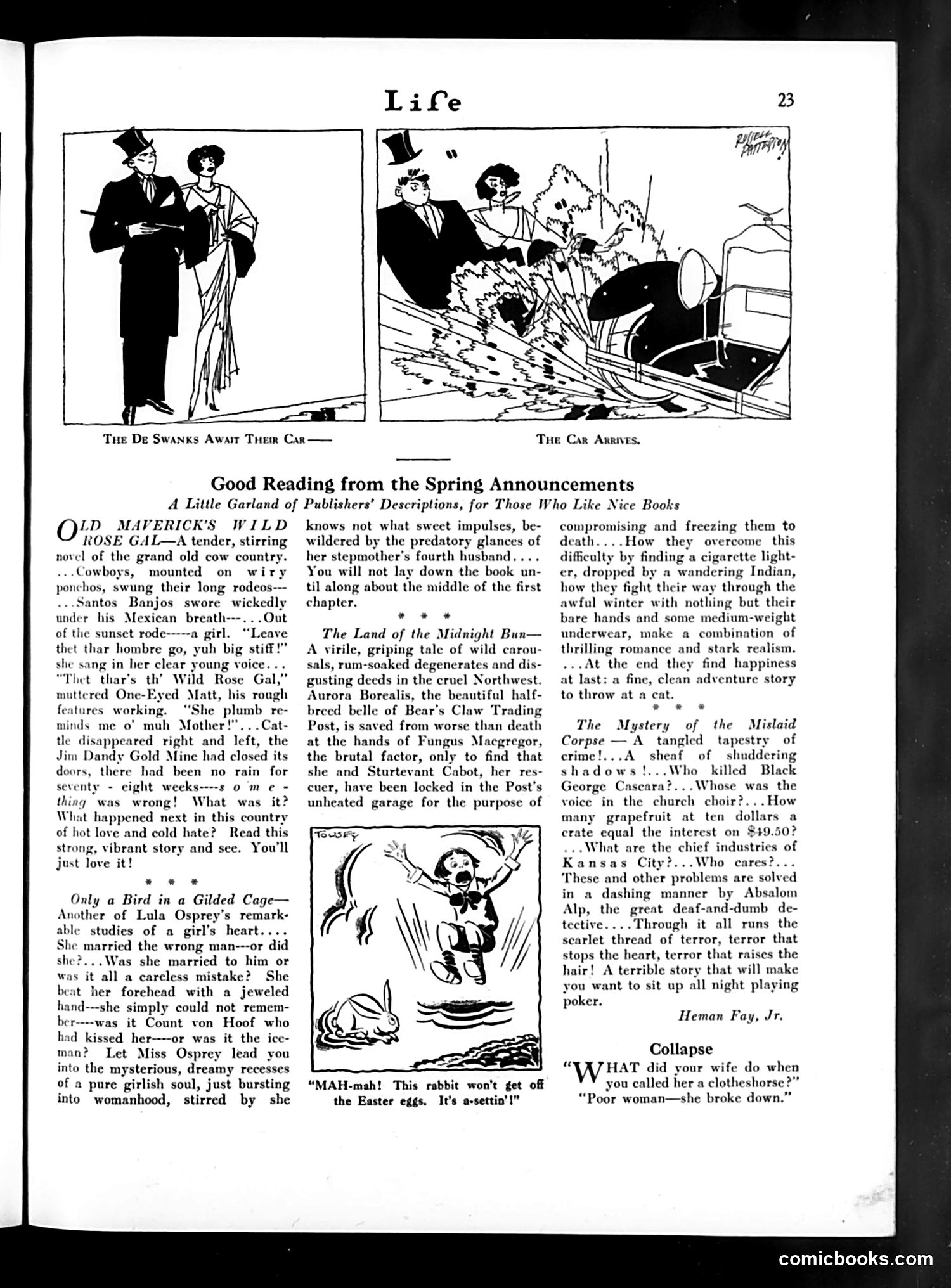
This page satirizes overwrought, melodramatic pulp fiction advertisements common in early 20th-century publishing. The "Good Reading from the Spring Announcements" section mocks breathless publisher copy through exaggerated, absurd plot descriptions. The reviews parody several conventions: romantic Western novels ("Wild Rose Gal"), confused society dramas ("Only a Bird in a Gilded Cage" with its ridiculous premise of a woman forgetting who kissed her), and overwrought adventure tales ("Land of the Midnight Bun" featuring improbable survival via a dropped cigarette lighter). The humor targets both flowery descriptive language and implausible, sensational plots marketed to eager readers. References to "Fungus Macgregor" and "Absalom Alp, the great deaf-and-dumb detective" exemplify the absurdist exaggeration. The cartoons above show a fashionable couple awaiting their car, which arrives explosively—visual humor about automobile novelty and unpredictability. Below, the Easter egg joke is straightforward domestic humor.
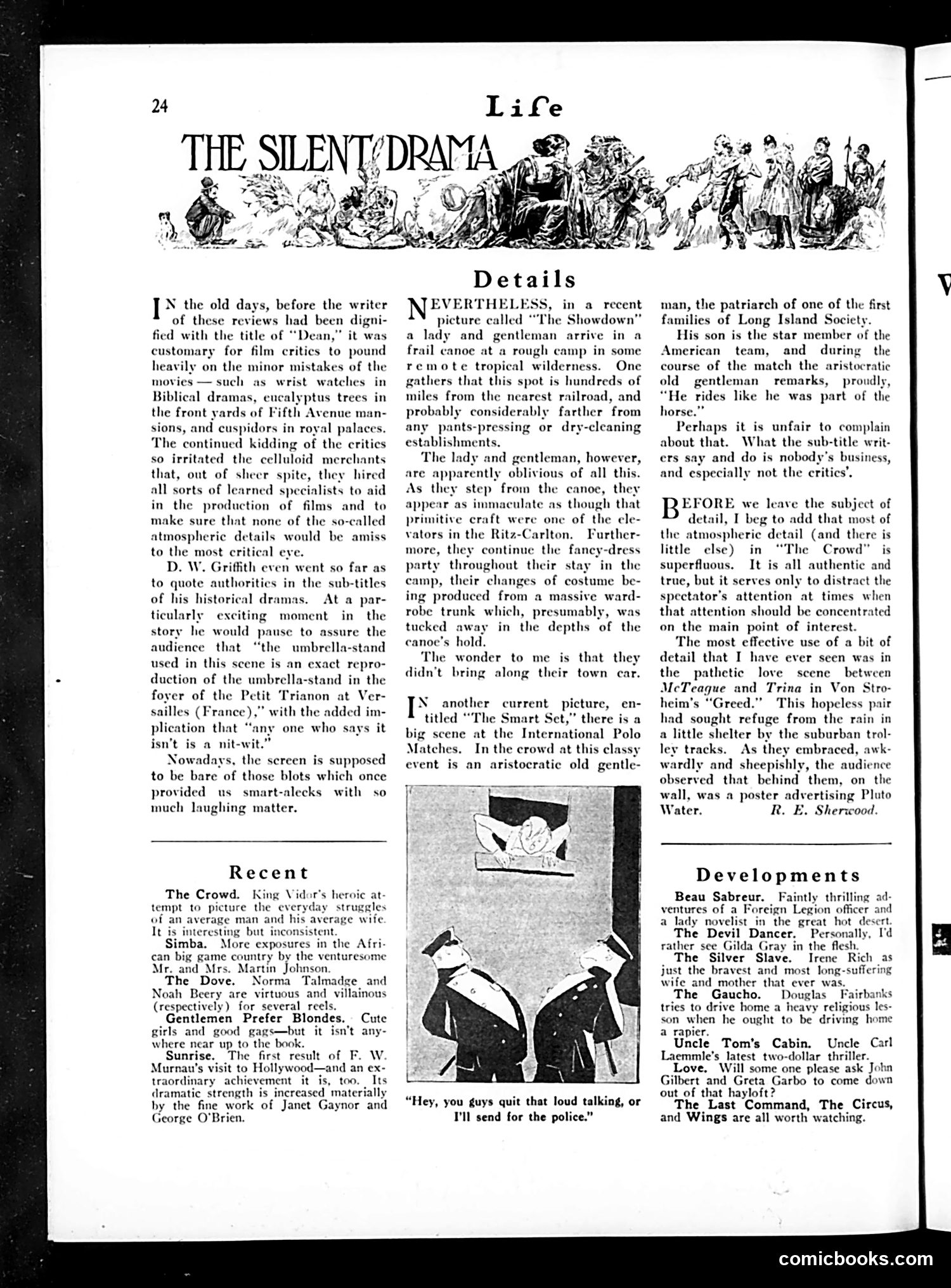
This page critiques 1920s silent filmmakers' obsessive attention to minor atmospheric details in movies. The writer notes that film critics once mocked historical inaccuracies (like wristwatches in Biblical dramas), so producers hired specialists to ensure perfect authenticity—even D.W. Griffith paused narratives to verify prop accuracy. The central joke: The cartoon caption shows a well-dressed couple at a tropical camp, with the caption "Hey, you guys quit that loud talking, or I'll send for the police"—illustrating the absurdity of maintaining refined urban behavior in remote wilderness settings. The writer mocks a film where passengers arrive by canoe in pristine formal wear with full wardrobes, as if they brought their town car. The reviewer argues this obsessive detail work often distracts rather than enhances storytelling. The "Recent" section reviews contemporary films including *Sunrise* and *Gentlemen Prefer Blondes*, showing this was timely film criticism from the mid-to-late 1920s.
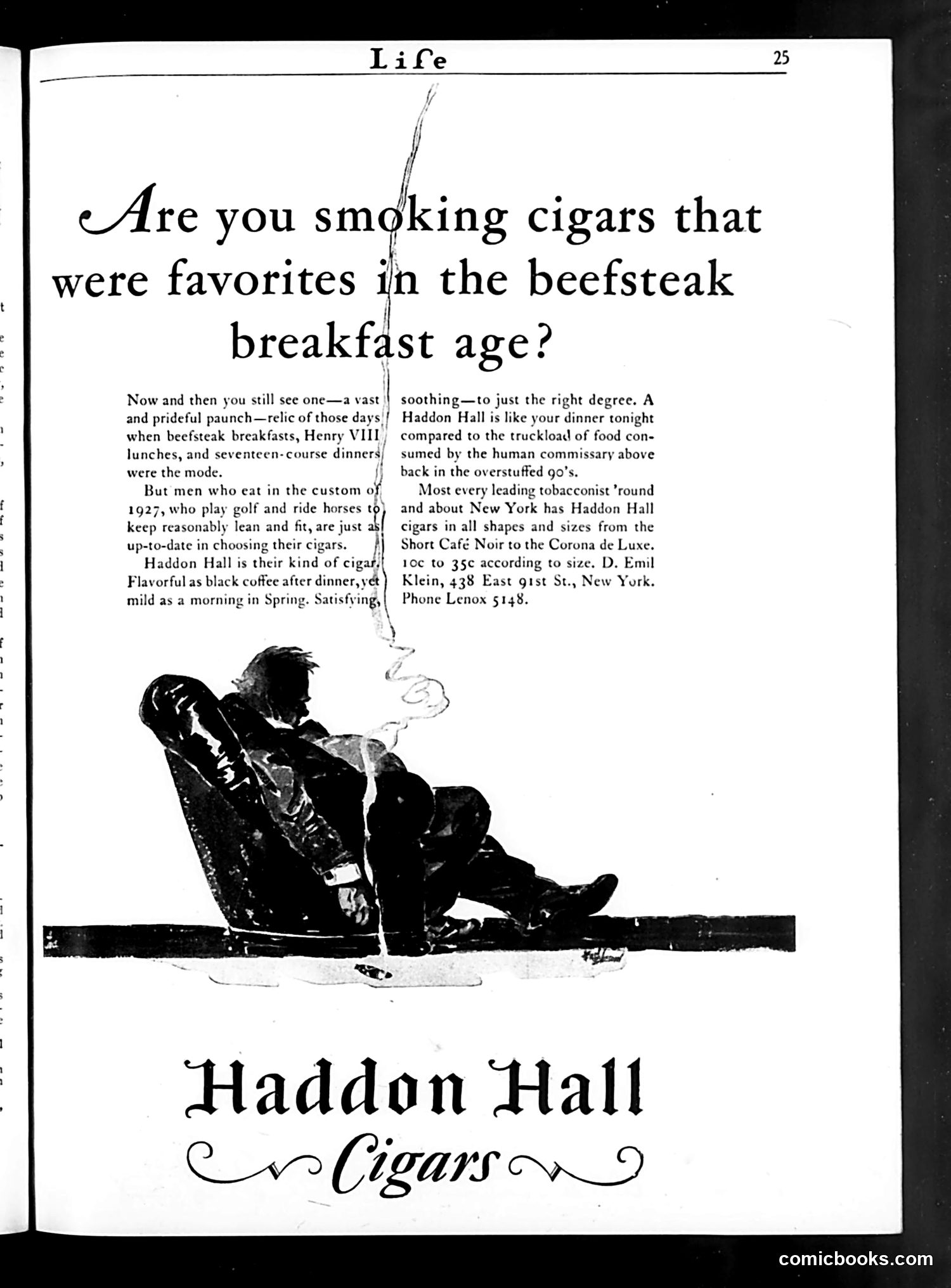
This is a **cigar advertisement**, not political satire. The "joke" targets changing social attitudes about excess and masculinity between generations. The cartoon depicts a corpulent man smoking—representing the "beefsteak breakfast age" when Henry VIII-style multi-course feasting was fashionable. The ad contrasts this outdated indulgence with 1927 modernity: men now "play golf and ride horses to keep reasonably lean and fit." The satirical point: contemporary gentlemen are sophisticated enough to choose *refined* pleasures (a mild, flavorful cigar) over crude gluttony. Haddon Hall cigars suit the modern man's restrained lifestyle—they're "flavorful as black coffee" and "mild as a morning in Spring," not heavy or excessive. The text mocks the overstuffed past while celebrating 1920s leisure-class values: fitness, golf, refined taste. It's marketing through social commentary on generational change and masculine self-improvement.
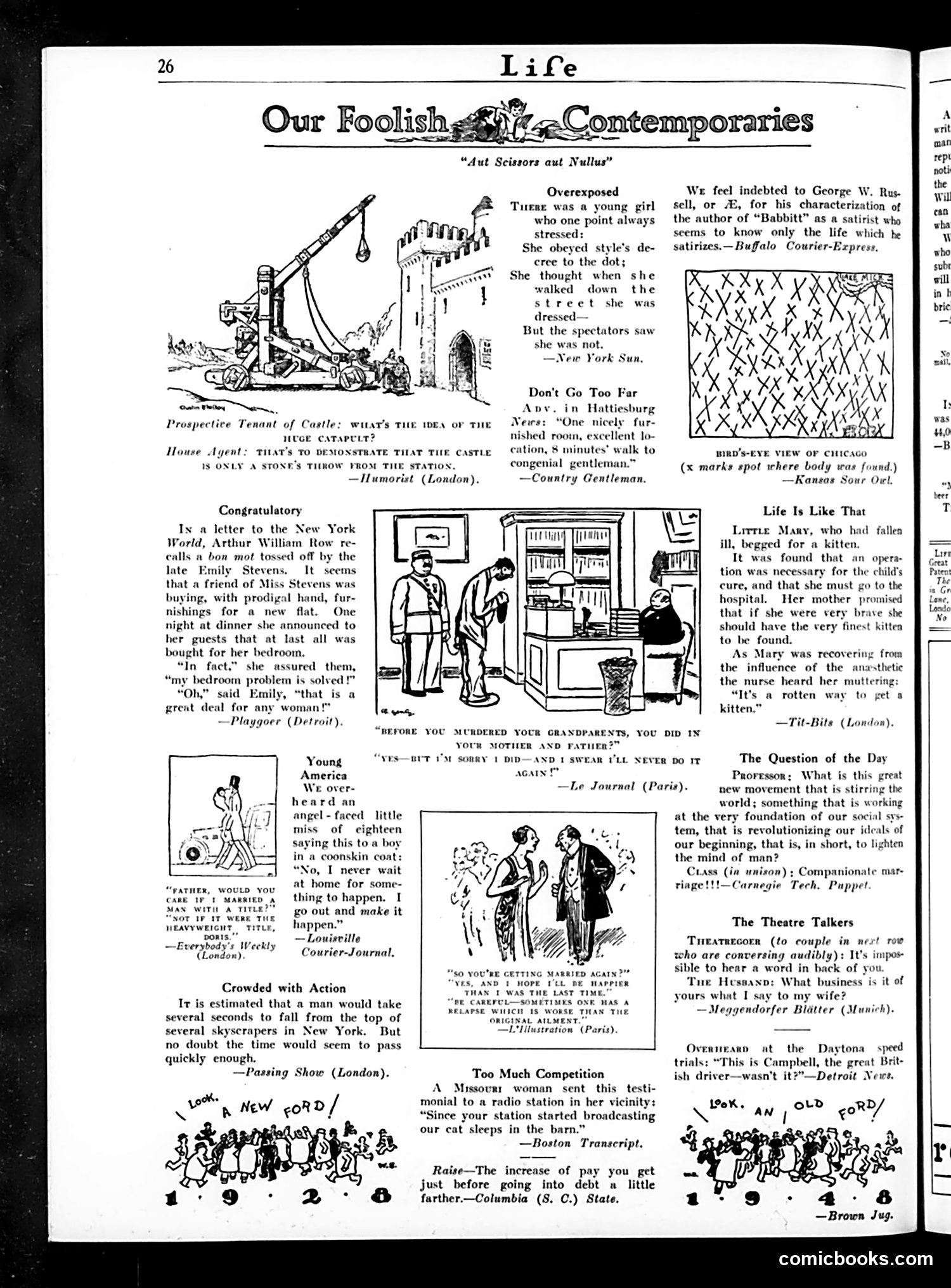
This page from *Life* magazine collects brief satirical items mocking contemporary social foibles. Key observations: **The cartoons satirize**: - Real estate agents' deceptive language ("stone's throw from the station" while showing a catapult) - Young women obsessed with fashion who dress immodestly while claiming elegance - Serial marriage as a form of addiction ("relapse") - Advertising absurdity (a radio station's broadcast allegedly drove cats away) - Urban crime (Chicago's "bird's-eye view" marking a murder location) **Social commentary targets**: - Class pretension (men with mere "heavyweight" titles) - Women's changing independence (the 18-year-old who makes things happen rather than waiting) - Marriage's declining stability ("companionate marriage" as a revolutionary movement) - Patriarchal assumptions (husbands dismissing wives' autonomy) The items, sourced from newspapers and magazines worldwide, treat modern society as inherently ridiculous—particularly around gender roles, materialism, and rapid social change. The humor depends on readers recognizing these as contemporary absurdities worth mocking.
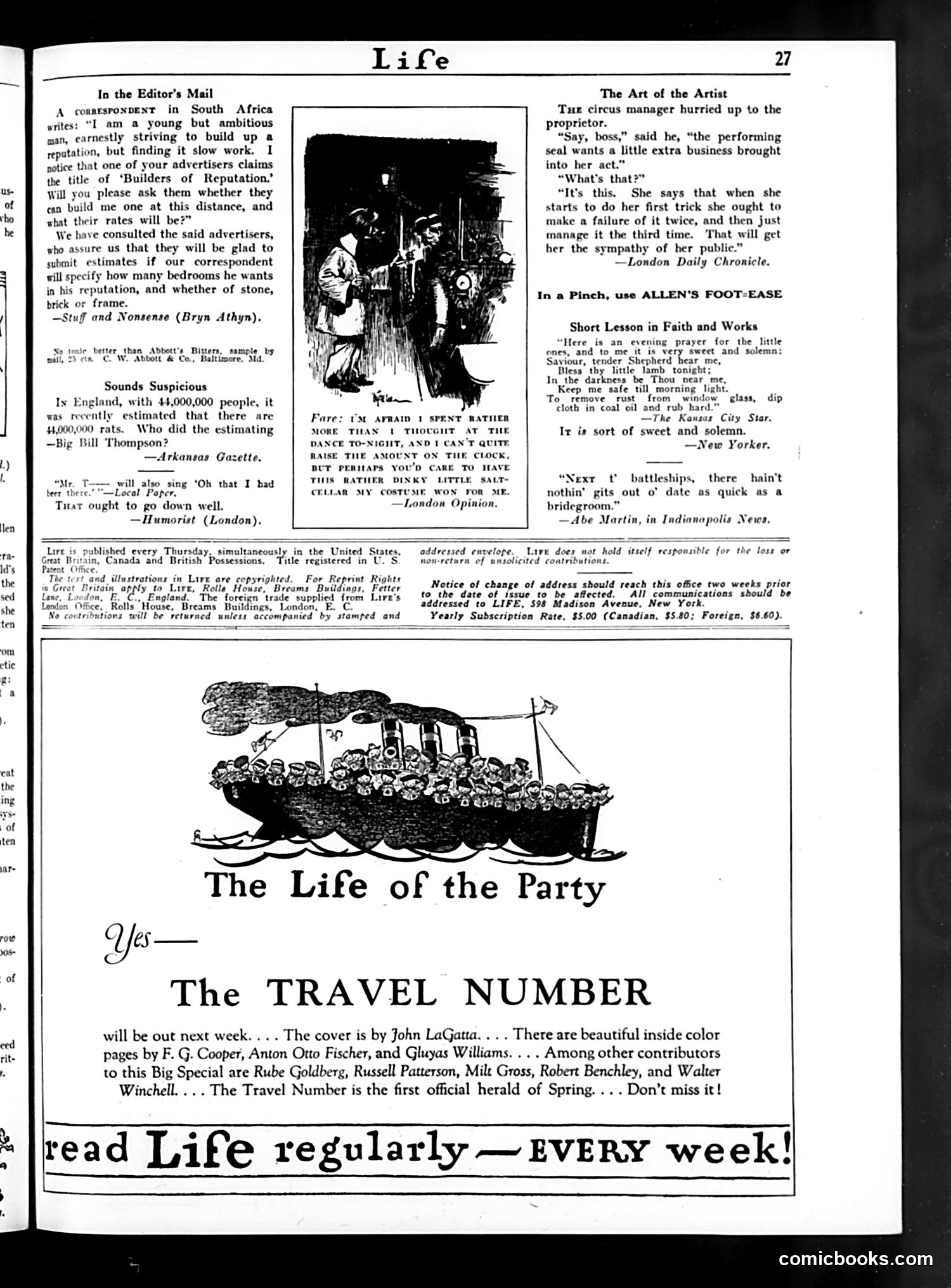
This is primarily a **letters-to-editor and humor page** from Life magazine's satirical section, with advertisement for an upcoming travel issue. The main satirical items include: 1. **"Builders of Reputation"** - A joke mocking advertising claims. A South African reader asks if advertisers can build his reputation remotely; Life's editors sardonically reply by asking how many "bedrooms" he wants in his reputation, treating abstract concepts as physical construction. 2. **"Sounds Suspicious"** - A jab at Chicago's "Big Bill" Thompson (mayor), implying he couldn't accurately count or estimate anything—here, the rat population matching the human population seems suspiciously convenient. 3. **Circus seal anecdote** - Mocking theatrical sentimentality: the seal wants to deliberately fail twice before succeeding to earn audience sympathy, satirizing performers' manipulation of emotions. 4. **Bridegroom joke** - A folksy observation that bridegrooms become obsolete/irrelevant quickly—a dig at married life. The page demonstrates Life's typical approach: urbane mockery of advertising, politics, and social pretense, aimed at educated readers.
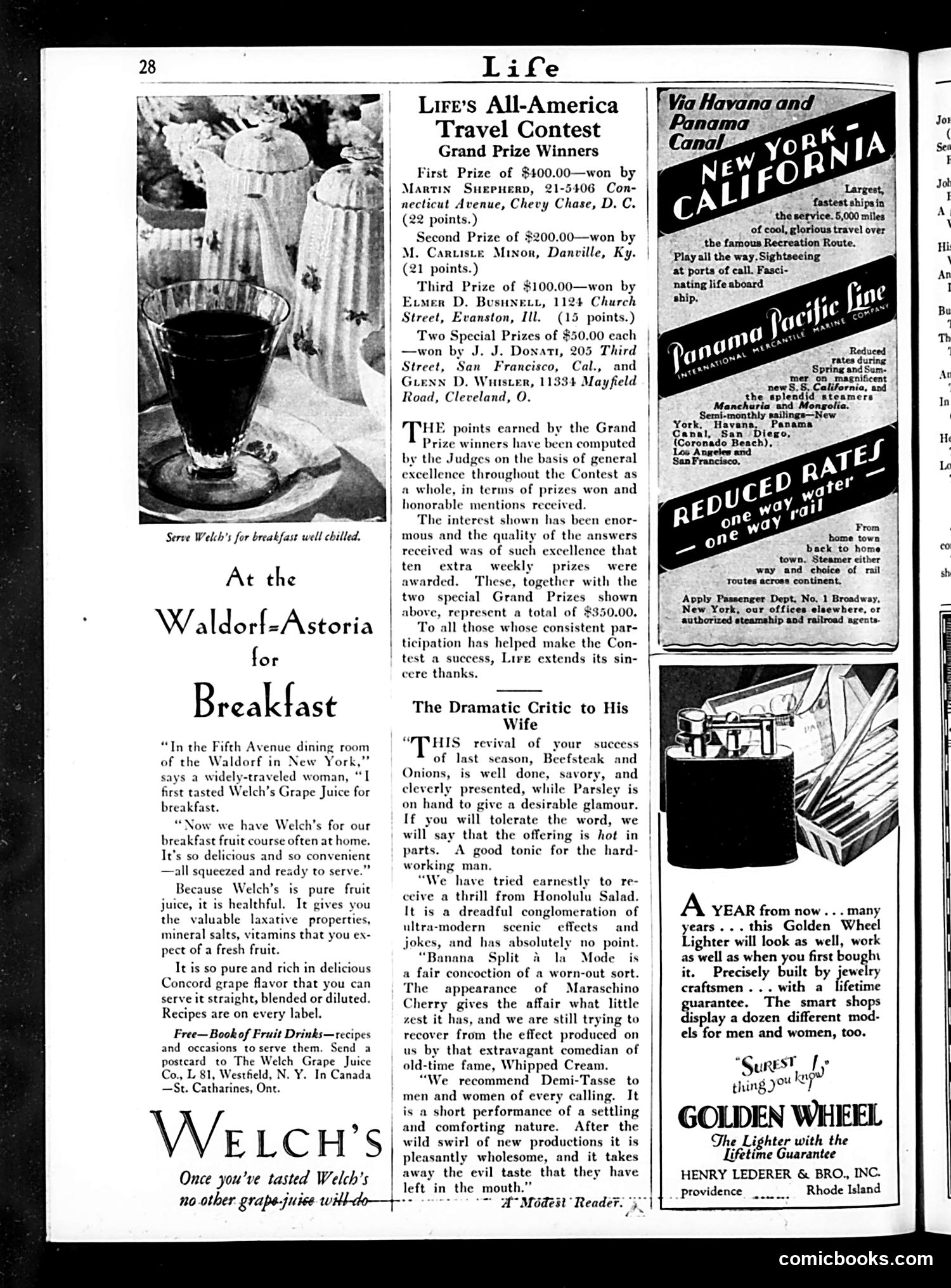
This page is primarily **advertising and contest announcements**, not satire or political commentary. The main content includes: - **Welch's Grape Juice ad** featuring a testimonial from a wealthy woman about serving it at the Waldorf-Astoria hotel—positioning the product as fashionable and health-conscious - **Life's All-America Travel Contest results** announcing prize winners for a travel-themed competition - **"The Dramatic Critic to His Wife"**—a humorous piece using restaurant dishes as theatrical metaphors (Beefsteak and Onions as a "revival," Honolulu Salad as poorly constructed, etc.), poking gentle fun at both dramatic criticism and cooking The page reflects 1920s consumer culture: aspirational advertising, travel contests, and light domestic humor. There are no political cartoons or caricatures present. The satire is mild and lifestyle-focused rather than socially pointed.
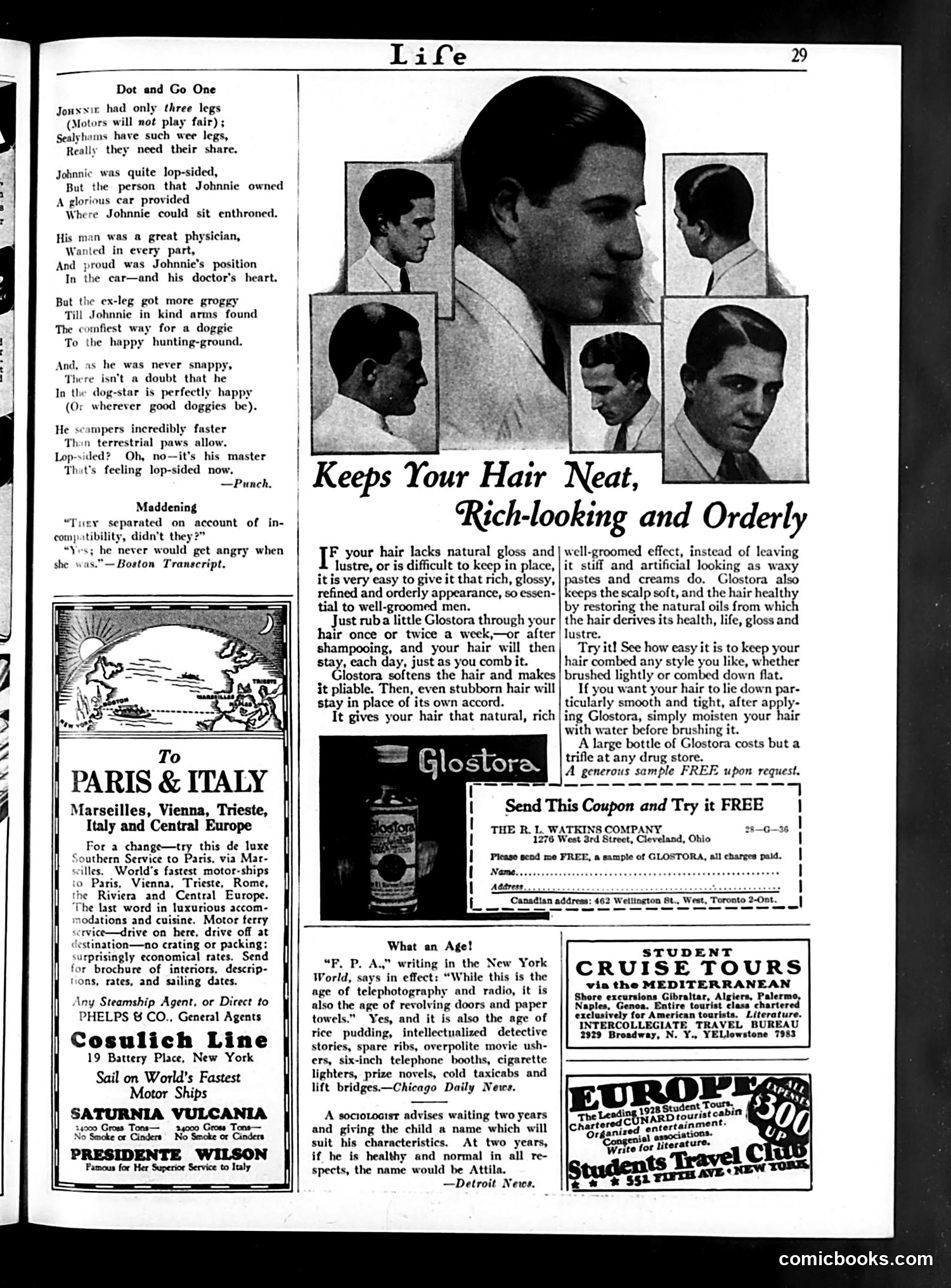
This page is primarily **advertising** with one notable literary piece. The main content is a sentimental poem titled "Dot and Go One" (reprinted from *Punch*), which tells of Johnnie, a three-legged dog owned by a wealthy person with a fine car and physician. The poem describes how the disabled dog rides in this car, lives comfortably, then eventually passes away—leaving his master feeling emotionally "lop-sided." The piece is touching animal sentiment—typical early 20th-century magazine fare—rather than satire or political commentary. The remaining page consists of travel advertisements (steamship lines to Europe), a hair product ad (Glostora), and brief humorous social observations under "What an Age!" The photos show men's hairstyles demonstrating the product's effect.
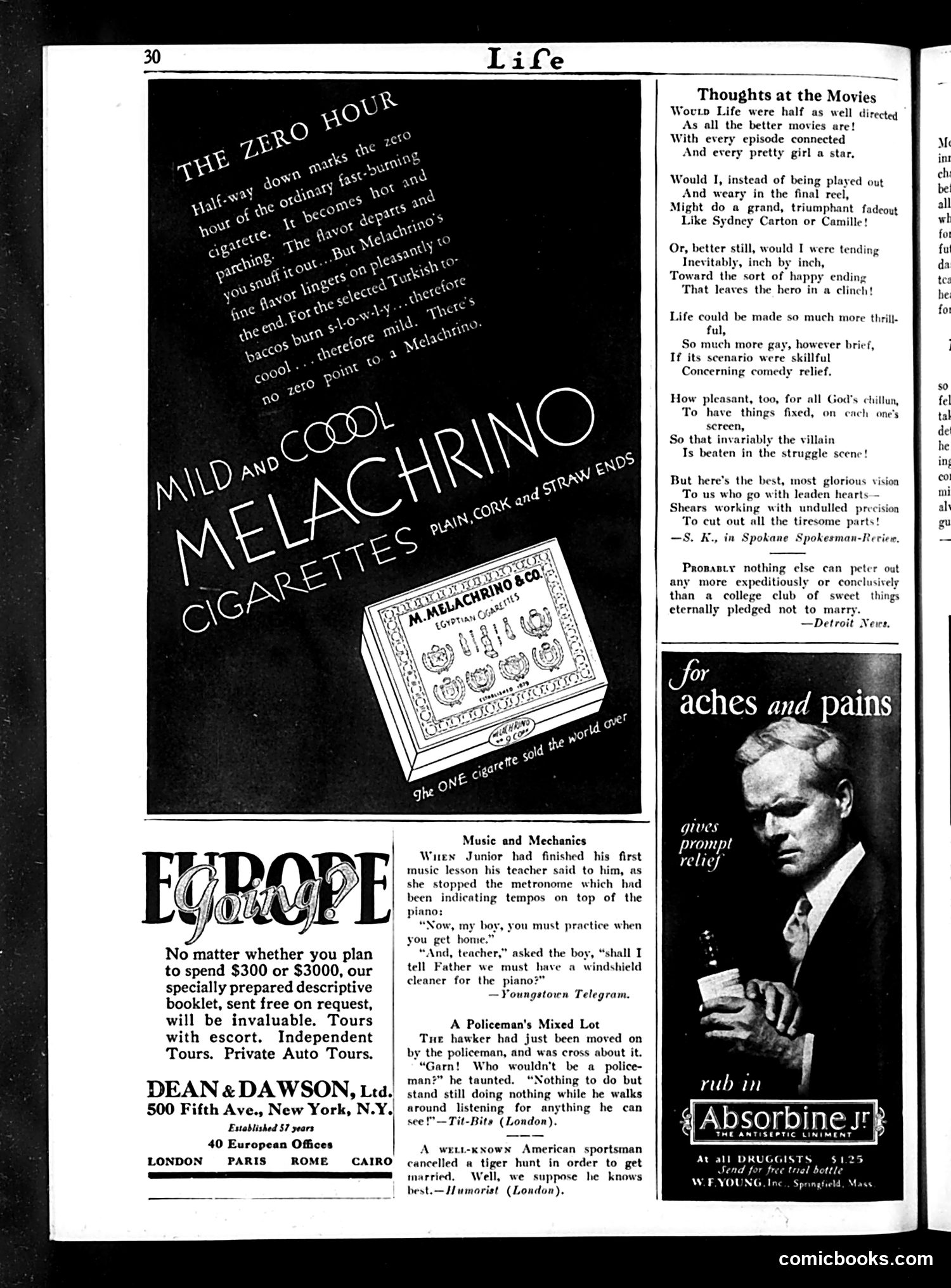
This page contains mixed content: **advertisements, humorous anecdotes, and poetry** rather than political cartoons. The **Melachrino cigarette ad** (top) uses period-typical advertising language, emphasizing smoothness and flavor as selling points. The **three brief humorous pieces** are typical of Life's satirical format: - "Music and Mechanics" jokes about a child asking if pianos need windshield wipers (comparing them to automobiles—likely reflecting 1920s-30s fascination with cars) - "A Policeman's Mixed Lot" satirizes police work as boring - A sportsman cancels tiger hunting to marry The **"Thoughts at the Movies"** poem expresses a common sentiment: life should be as well-constructed as cinema, with clear heroes, villains, romance, and edited-out "tiresome parts." This reflects early cinema's influence on public imagination. The **final quip** satirizes college social clubs requiring women members to remain unmarried. The **Absorbine Jr. advertisement** promotes a topical pain relief product. The page reflects **1920s-30s popular culture**: automobile prevalence, cinema's cultural dominance, and consumer product advertising.
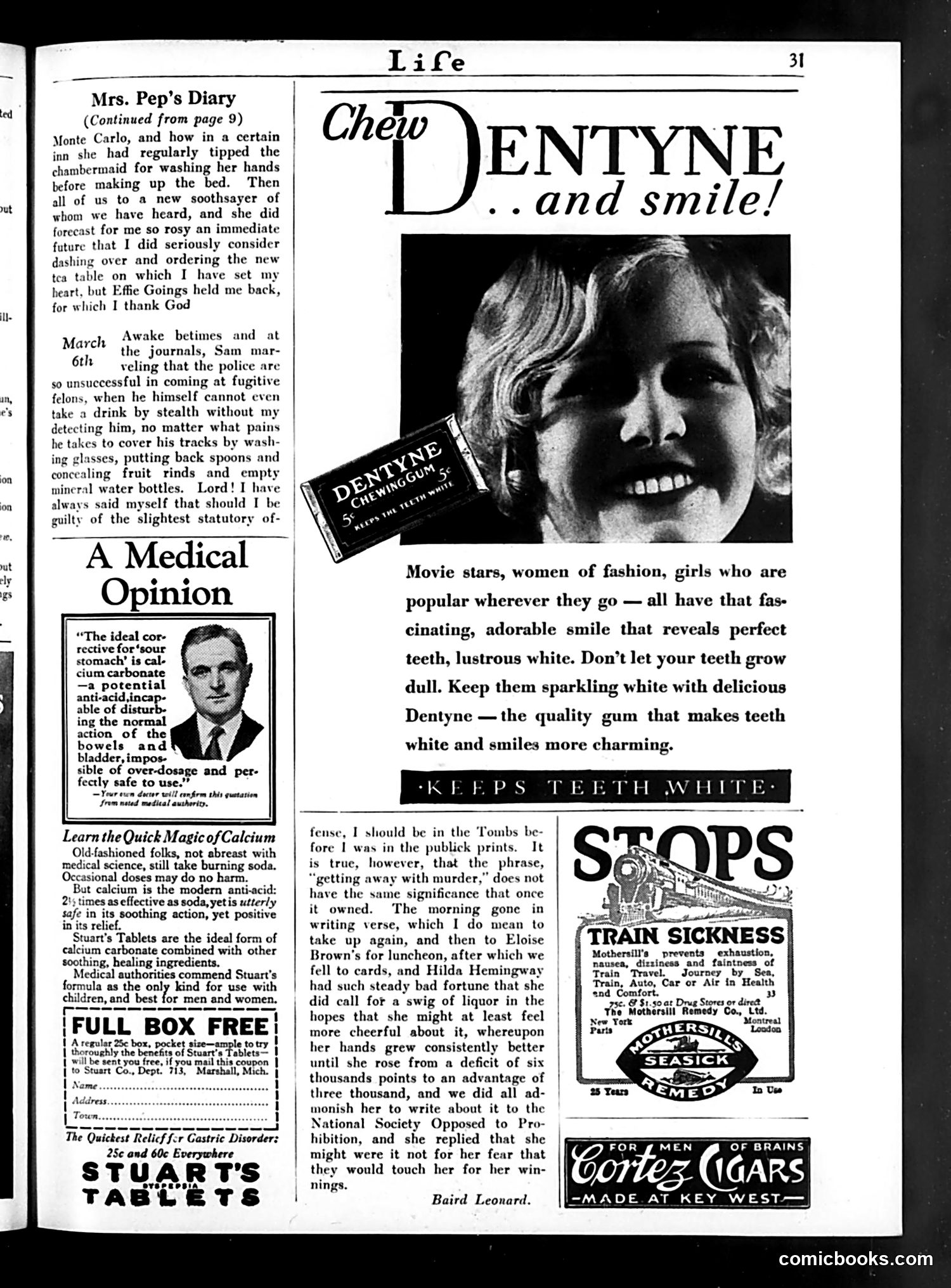
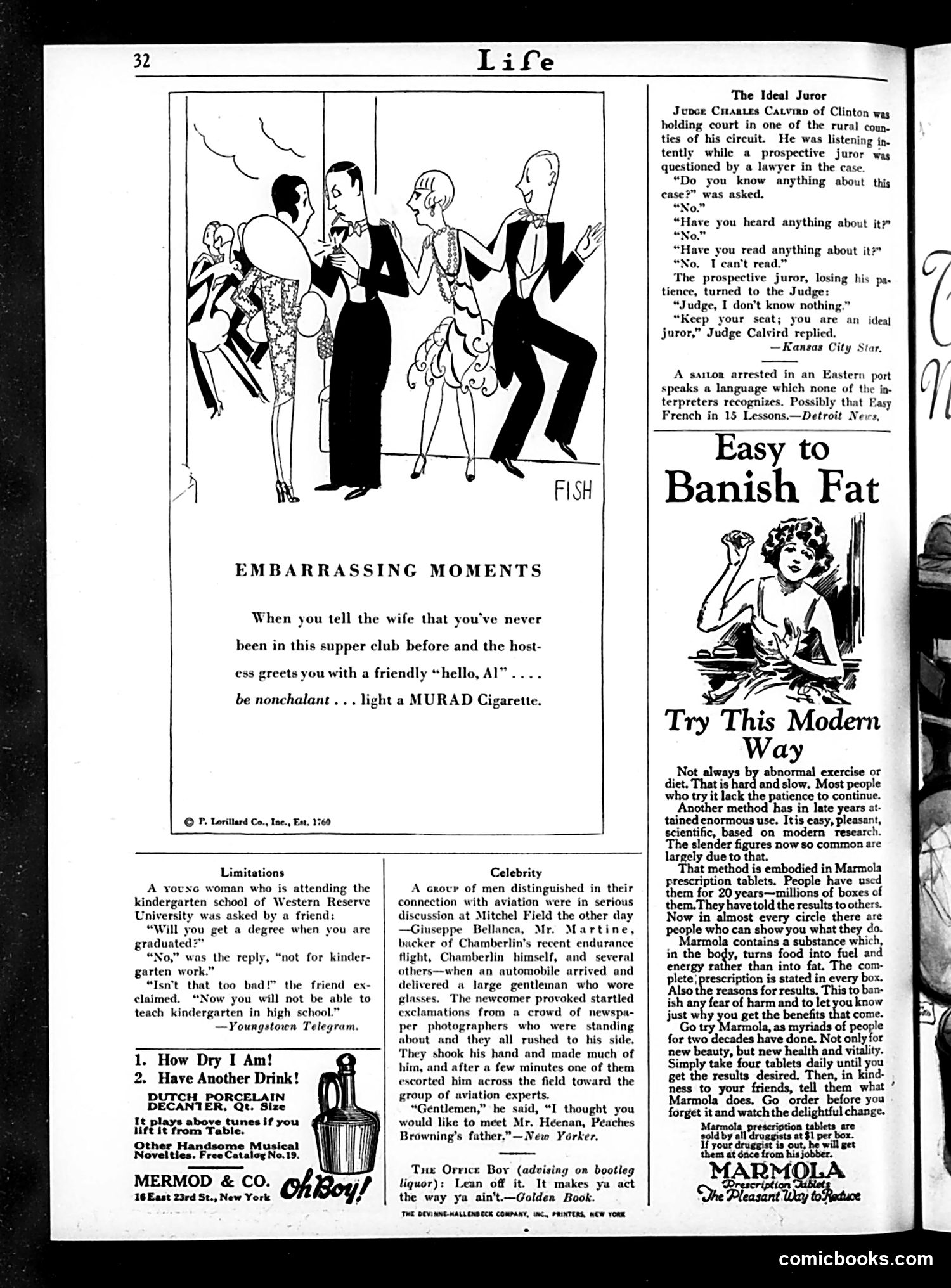
This page contains three separate humorous anecdotes plus advertisements. **"Embarrassing Moments"** depicts a social anxiety joke: a man claims he's never visited a supper club, but the hostess greets him by name ("hello, Al"), exposing his lie to his wife. The solution is to light a Murad cigarette to appear composed. The humor relies on 1920s social embarrassment about infidelity or secret entertainment venues. **"The Ideal Juror"** satirizes rural legal proceedings: a judge praises an illiterate prospective juror who admits knowing nothing about a case as "ideal"—mocking both rural justice systems and the absurdity of selecting uninformed jurors. **Other brief items** mock limitations of education (kindergarten teachers), celebrity culture (mistaking an attendant for aviation celebrities), and Prohibition-era bootleg liquor quality. The advertisements include cigarettes (Murad), a musical decanter, and Marmola weight-loss tablets—typical 1920s consumer products with dubious health claims presented as scientific.