
Life, 1928-03-29 · page 26 of 34
Life — March 29, 1928 — page 26: what you’re looking at
What you’re looking at
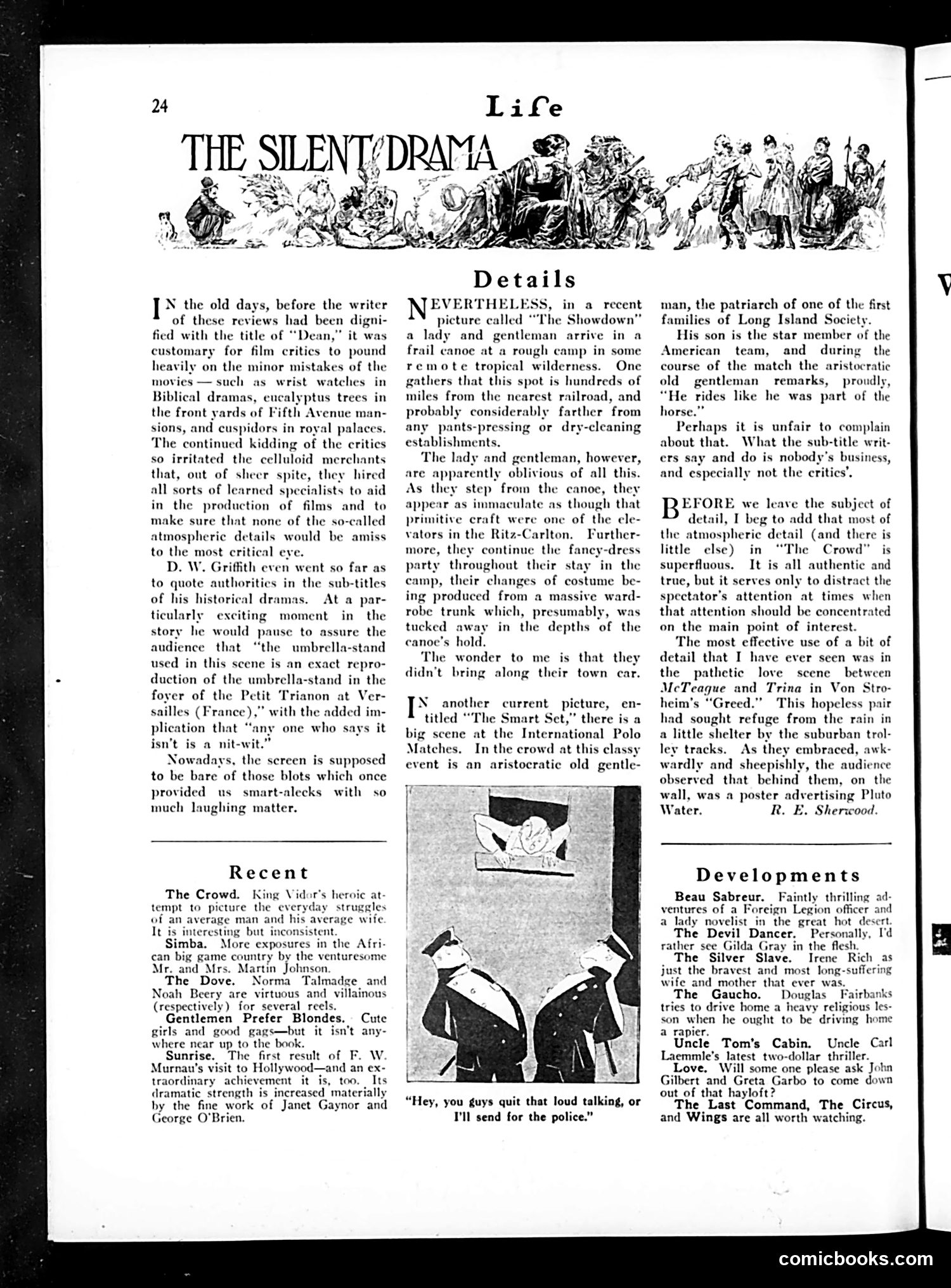
This page critiques 1920s silent filmmakers' obsessive attention to minor atmospheric details in movies. The writer notes that film critics once mocked historical inaccuracies (like wristwatches in Biblical dramas), so producers hired specialists to ensure perfect authenticity—even D.W. Griffith paused narratives to verify prop accuracy. The central joke: The cartoon caption shows a well-dressed couple at a tropical camp, with the caption "Hey, you guys quit that loud talking, or I'll send for the police"—illustrating the absurdity of maintaining refined urban behavior in remote wilderness settings. The writer mocks a film where passengers arrive by canoe in pristine formal wear with full wardrobes, as if they brought their town car. The reviewer argues this obsessive detail work often distracts rather than enhances storytelling. The "Recent" section reviews contemporary films including *Sunrise* and *Gentlemen Prefer Blondes*, showing this was timely film criticism from the mid-to-late 1920s.
📄 Transcribed text from this page (OCR, searchable)
Machine-transcribed from the original scan — historical spelling and the odd misread are preserved.
I ys, before the writer of these reviews had been dign ficd with the title of “De i customary for film critics to pound heavily on the minor mistakes of the movies — such as wrist watches in Biblical dramas, eucalyptus trees i the front yards of Fifth Avenue man- sions, and cuspidors in royal pala The continued kidding of the critics so irritated the celluloid merchants that, out of sheer spite, they hired all sorts of learned specialists to aid in the production of films and to make sure that none of the so-called atmospheric details would be amiss to the most critical eye. D. W. Griffith even went so far as to quote authorities in the sub-titles of his histori At a par- ticularly exciting moment in the story he would pause to assure the audience that “the umbrella-stand used in this scene is an exact repro- duction of the umbrella-stand in the foyer of the Petit Trianon at Ver- sailles (France),” with the added im- plication that one who says it isn’t is a nit-wit. Nowadays, the screen is supposed to be bare of those blots which once provided us smart-alecks with so much laughing matter. 1 dramas. Recent The Crowd. King Vidor's heroic at- tempt to picture the everyday struggles of an ave > man and his average wife. It is interesting but inconsistent. Simba. More exposures in the Afri- can big game country by the venturesome Mr. and Mrs. Martin Johnson. The Dove. Norma Talmadge and Noah Beery are virtuous and villainous (respectively) for several reels. Gentlemen Prefer Blondes. Cute girls and good gags—but it isn’t any- where near up_to the book. Sunrise. The first result of F. W. Murnau’s visit to Hollywood—and an ex- traordinary achievement it is, too. Its dramatic strength is increased materially by the fine work of Janet Gaynor and George O'Brien. Details EVERTHELESS, in a recent picture called “The Showdown” a lady and gentleman arrive in a frail canoe at a rough camp in some remote tropical wilderness. One gathers that this spot is hundreds of miles from the nearest railroad, and probably considerably farther from any pants-pressing or dry-cleaning establishments, The 1 and gentleman, however, are apparently oblivious of all thi As they step from the canoe, they appear as immaculate as though that primitive craft were one of the ele- vators in the Ritz-Carlton. Further- more, they continue the faney-dress party throughout their stay in the amp, their changes of costume be- ing produced from a massive ward- robe trunk which, presumably, was tucked away in the depths of the canoe’s hold. The wonder to me is that they didn’t bring along their town car. [IS another current picture, en- titled “The Smart Sct,” there is a big scene at the International Polo Matches. In the crowd at this classy event is an aristocratic old gentle- | | | } | | “Hey, you guys quit that loud talking, or I'll send for the police.” man, the patriarch of one of the first families of Long Island Society. His son is the star member of the American team, and during the course of the match the aristocratic old gentleman remarks, proudly, “He rides like he was part of the horse Perhaps it is unfair to complain about that. What the sub-title writ- ers say and do is nobody's business, and especially not the critics’. EFORE we leave the subject of detail, I beg to add that most of the atmospheric detail (and there is little else) in “The Crowd” is superfluous. It is all authentic and true, but it serves only to distract the spectator’s attention at times when that attention should be concentrated on the main point of interest. The most effective use of a bit of detail that I have ever seen was in the pathetic love scene between McTeague and Trina in Von Stro- heim’s “Greed.” This hopeless pair had sought refuge from the rain in a little shelter by the suburban trol- ley tracks. As they embraced, awk- wardly and sheepishly, the audience observed that behind them, on the wall, was a poster advertising Pluto Water. R. E. Sherwood. Developments Beau Sabreur. Faintly thrilling ad- ventures of a Foreign Legion officer and a lady novelist_in the great hot desert. The Devil Dancer. Personally, I'd rather see Gilda Gray in the flesh The Silver Slave. Irene Rich as just the bravest and most long-suffering wife and mother that ever was. The Gaucho. Douglas Fairbanks tries to drive home a heavy religious les- son when he ought to be driving home a rapier. Uncle Tom’s Cabin. Uncle Carl Laemmle's latest two-dollar thriller. Love. Will some one please ask John Gilbert and Greta Garbo to come down out of that hayloft? The Last Command, The Circus, and Wings are all worth watching. comicbooks.com