
Life, 1928-03-29 · page 21 of 34
Life — March 29, 1928 — page 21: what you’re looking at
What you’re looking at
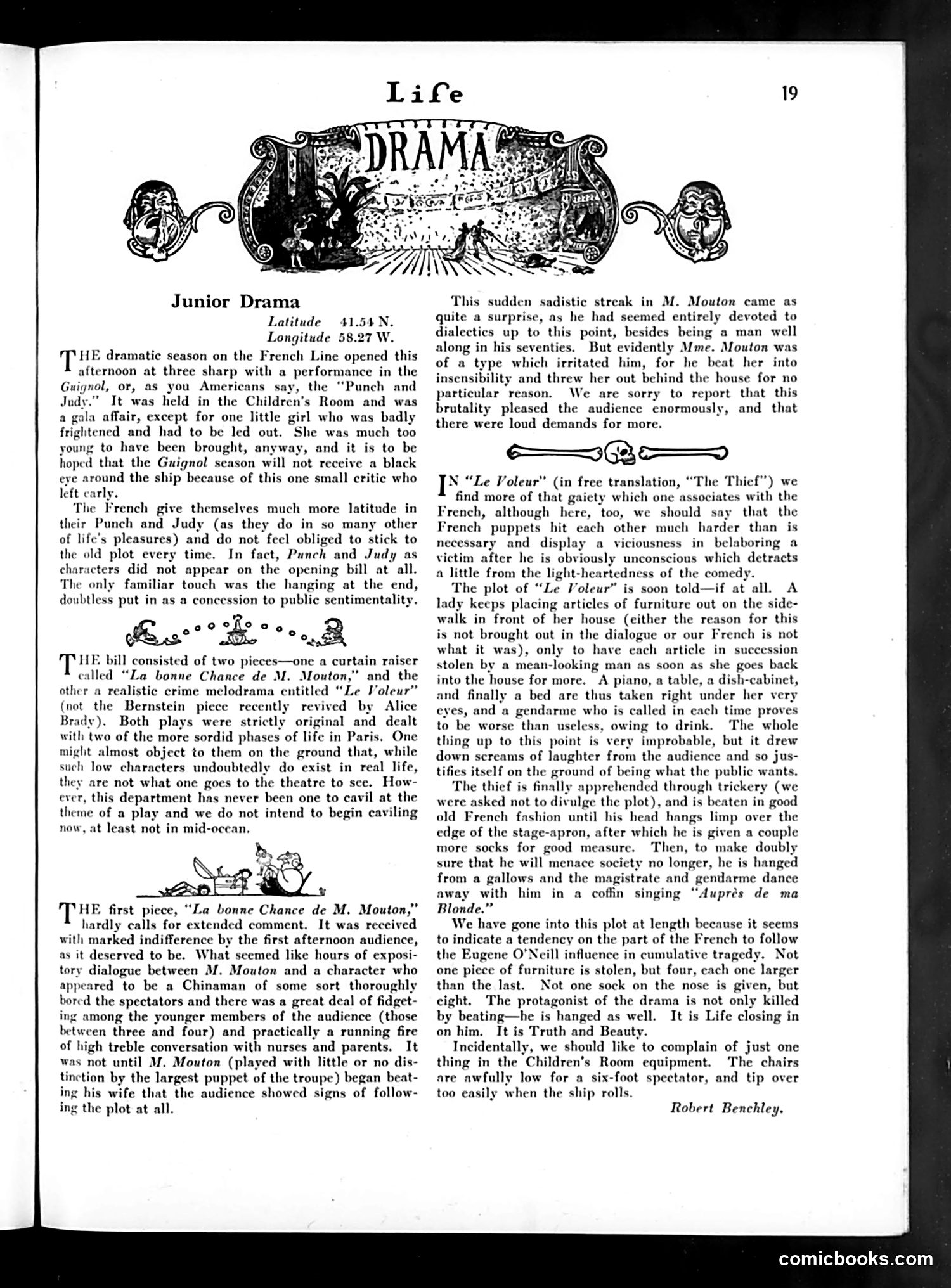
This is a theater review of a children's puppet show (Guignol—the French equivalent of Punch and Judy) performed aboard a French ocean liner. The critic describes two crude melodramas featuring violence and criminality. The satire targets French culture's tolerance for crude entertainment and the audience's (including children's) appetite for brutality. The reviewer notes with dry disapproval that the first play's only successful moment came when the puppet M. Mouton beat his wife into unconsciousness—which "pleased the audience enormously." The second play, "Le Voleur" (The Thief), depicts slapstick theft and violence. The critic's tone is sardonic, suggesting these performances reveal something unflattering about French theatrical tastes and parental judgment in exposing young children to such material. The piece functions as both entertainment review and social commentary on transatlantic cultural differences regarding what constitutes appropriate amusement.
📄 Transcribed text from this page (OCR, searchable)
Machine-transcribed from the original scan — historical spelling and the odd misread are preserved.
Junior Drama Latitude 41.54.N. Longitude 58.27 W. THE dramatic season on the French Line opened this afternoon at three sharp with a performance in the Guignol, or, as you Americans say, the “Punch and Judy.” It was held in the Children’s Room and was a gala affair, except for one little girl who was badly frightened and had to be led out. She was much too young to have been brought, anyway, and it is to be hoped that the Guignol season will not receive a black eye around the ship because of this one small critic who left carly. The French give themselves much more latitude in their Punch and Judy (as they do in so many other of life’s pleasures) and do not fecl obliged to stick to the old plot every time. In fact, Punch and Judy as characters did not appear on the opening bill at all. The only familiar touch was the hanging at the end, doubtless put in as a concession to public sentimentality. HE bill consisted of two pieces—one a curtain raiser called “La bonne Chance de M. Mouton,” and the other a realistic crime melodrama entitled “Le Voleur” (not the Bernstein piece re: ived by Alice Brady). Both plays were st inal and dealt with two of the more sordid phases of life in Paris. One might almost object to them on the ground that, while such low characters undoubtedly do exist in real life, they are not what one goes to the theatre to see. How- ever, this department has never been one to cavil at the theme of a play and we do not intend to begin caviling now, at least not in mid-ocean, HE first piece, hardly calls for extended comment. It was received with marked indifference by the first afternoon audience, as it deserved to be. What seemed like hours of exposi- tory dialogue between M. Mouton and a character who appeared to be a Chinaman of some sort thoroughly bored the spectators and there was a great deal of fidget- ing among the younger members of the audience (those between three and four) and practically a running fire of high treble conversation with nurses and parents. It was not until M. Mouton (played with little or no dis- tinction by the largest puppet of the troupe) began beat- ing his wife that the audience showed signs of follow- ing the plot at all. This sudden sadistic streak in M. Mouton came as quite a surprise, as he had seemed entirely devoted to dialectics up to this point, besides being a man well along in his seventies. But evidently Mme. Mouton was of a type which irritated him, for he beat her into insensibility and threw her out behind the house for no particular reason. We are sorry to report that this brutality pleased the audience enormously, and that there were loud demands for more. — 33> N “Le Voleur” (in free translation, “The Thief”) we find more of that gaiety which one associates with the French, although here, too, we should say that the French puppets hit each other much harder than is necessary and display a viciousness in belaboring a im after he is obviously unconscious which detracts a little from the light-heartedness of the comedy. The plot of “Le Voleur” is soon told—if at all. A lady keeps placing articles of furniture out on the side- walk in front of her house (either the reason for this is not brought out in the dialogue or our French is not what it was), only to have each article in succession stolen by a mean-looking man as soon as she goes back into the house for more. A piano, a table, a dish-cabinet, and finally a bed are thus taken right under her very eyes, and a gendarme who is called in each time proves to be worse than useless, owing to drink. The whole thing up to this point is very improbable, but it drew down screams of laughter from the audience and so jus- tifies itself on the ground of being what the public wants. The thief is finally apprehended through trickery (we were asked not to divulge the plot), and is beaten in good old French fashion until his head hangs limp over the edge of the stage-apron, after which he is given a couple more socks for good measure. Then, to make doubly sure that he will menace society no longer, he is hanged from a gallows and the magistrate and gendarme dance away with him in a coffin singing “Auprés de ma Blonde.” We have gone into this plot at length because it seems to indicate a tendency on the part of the French to follow the Eugene O'Neill influence in cumulative tragedy. Not one piece of furniture is stolen, but four, each one larger than the last. Not one sock on the nose is given, but eight. The protagonist of the drama is not only killed by beating—he is hanged as well. It is Life closing in on him. It is Truth and Beauty. Incidentally, we should like to complain of just one thing in the Children’s Room equipment. The chairs are awfully low for a six-foot spectator, and tip over too easily when the ship rolls. Robert Benchley. comicbooks.com