
A complete issue · 35 pages · 1928
Life — February 9, 1928
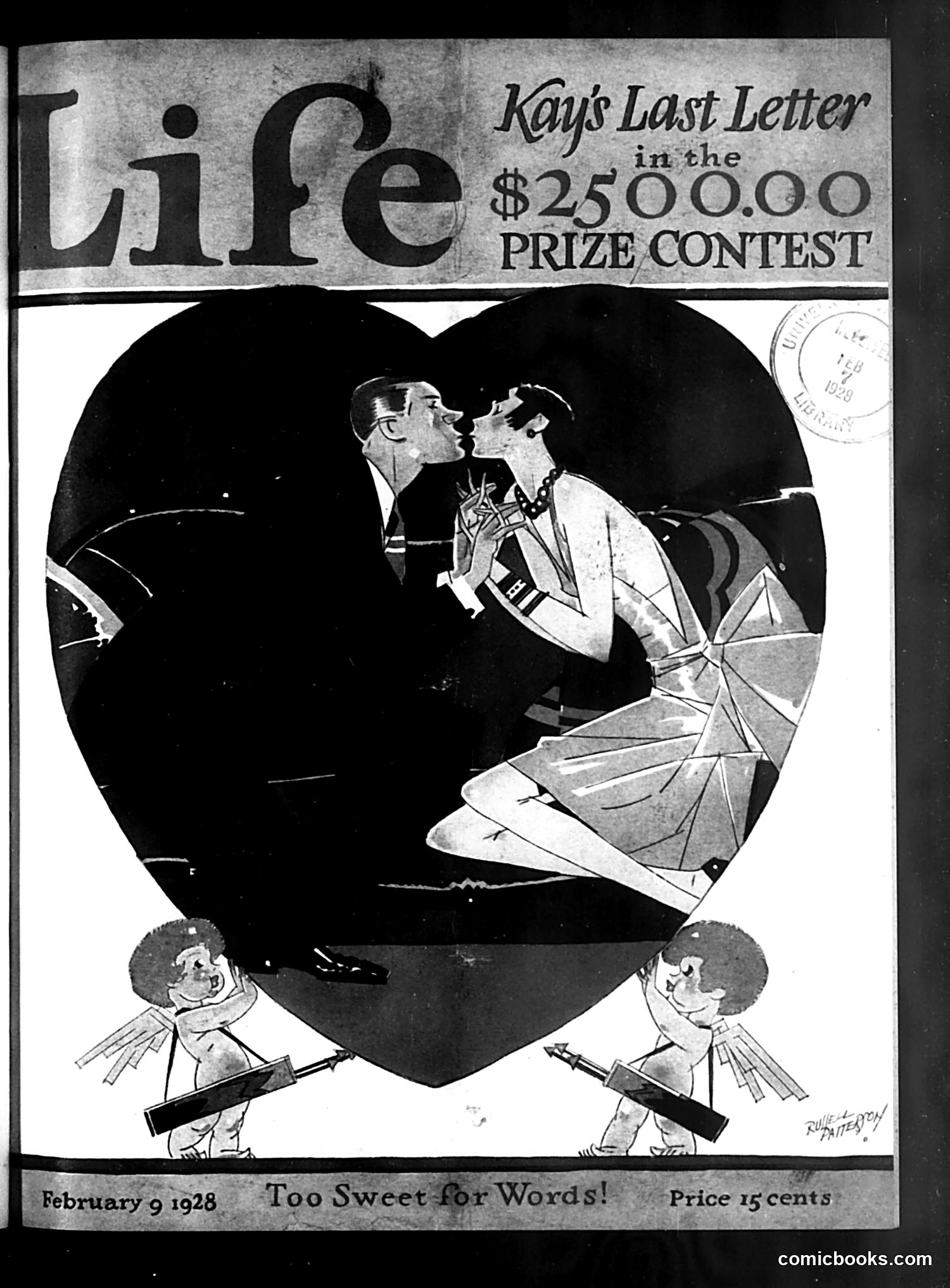
This is a **Life magazine cover** advertising "Kay's Last Letter," a romantic story featured in that issue, with a $2,500 prize contest attached. The central image shows a couple about to kiss inside a large heart shape. The man wears a suit; the woman wears a decorative dress with what appears to be military medals or honors. Two cherub figures at the bottom hold arrows (Cupid iconography), reinforcing the romantic theme. The caption reads "Too Sweet for Words!" — a pun suggesting the romance is so perfect it defies description, while simultaneously promoting the contest asking readers to write Kay's final letter. This is primarily **magazine promotion** rather than political satire, using sentimental romance imagery typical of 1920s mass-market entertainment.
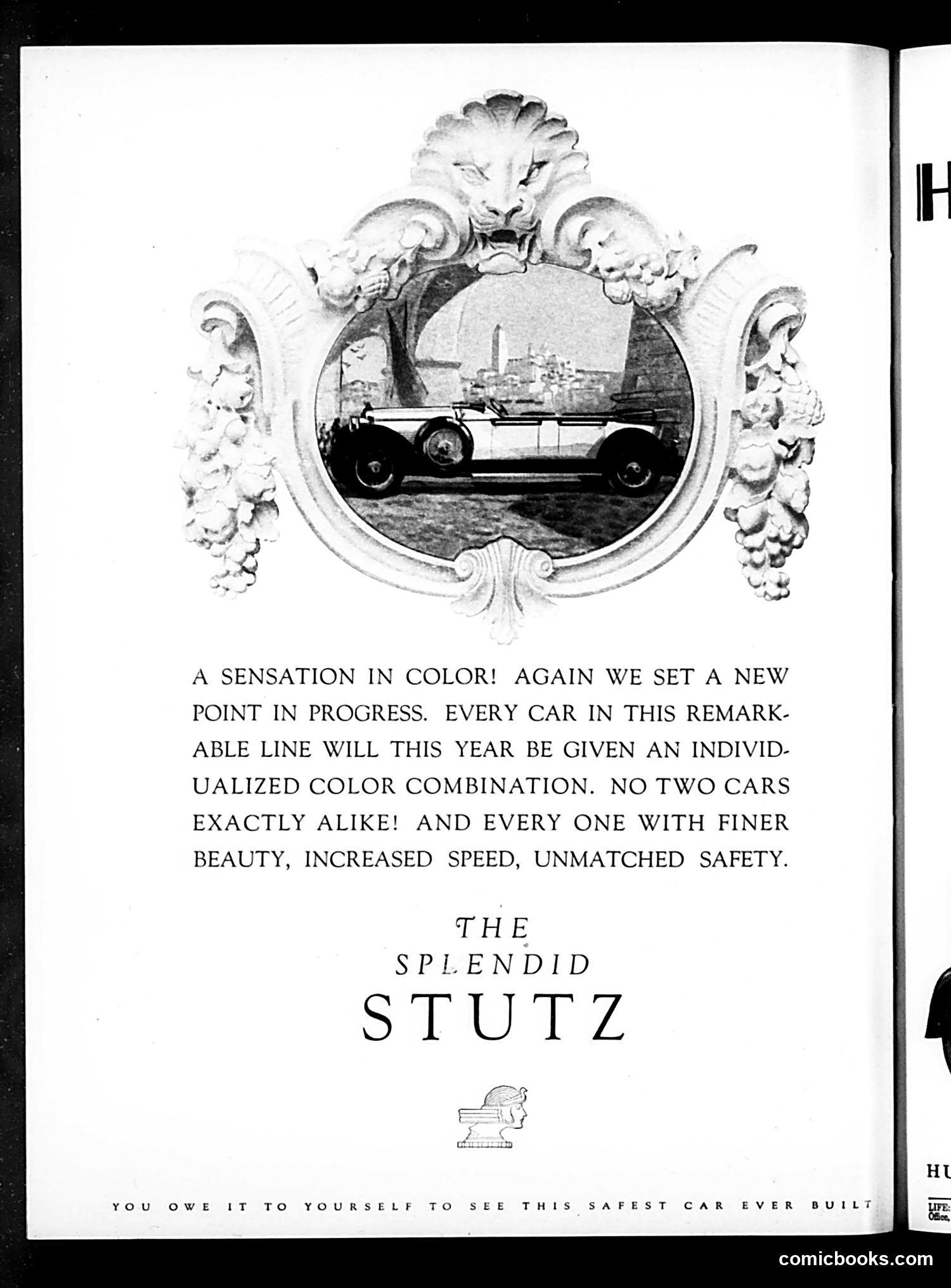
This is a vintage automobile advertisement, not political satire. It promotes the Stutz car brand, emphasizing luxury features marketed to wealthy buyers of the era (likely 1920s-1930s based on styling). The ornate decorative frame—featuring a lion's head, cherubs, and scrollwork—uses classical heraldry aesthetics to suggest prestige and exclusivity. The silhouetted car positioned within this coat-of-arms-like design reinforces the message that owning a Stutz signals high social status. The text emphasizes individualized color combinations, speed, safety, and beauty as selling points. The tagline "You owe it to yourself to see this safest car ever built" uses aspirational messaging common in Depression-era luxury marketing, appealing to consumers' desires for distinction and reliability.
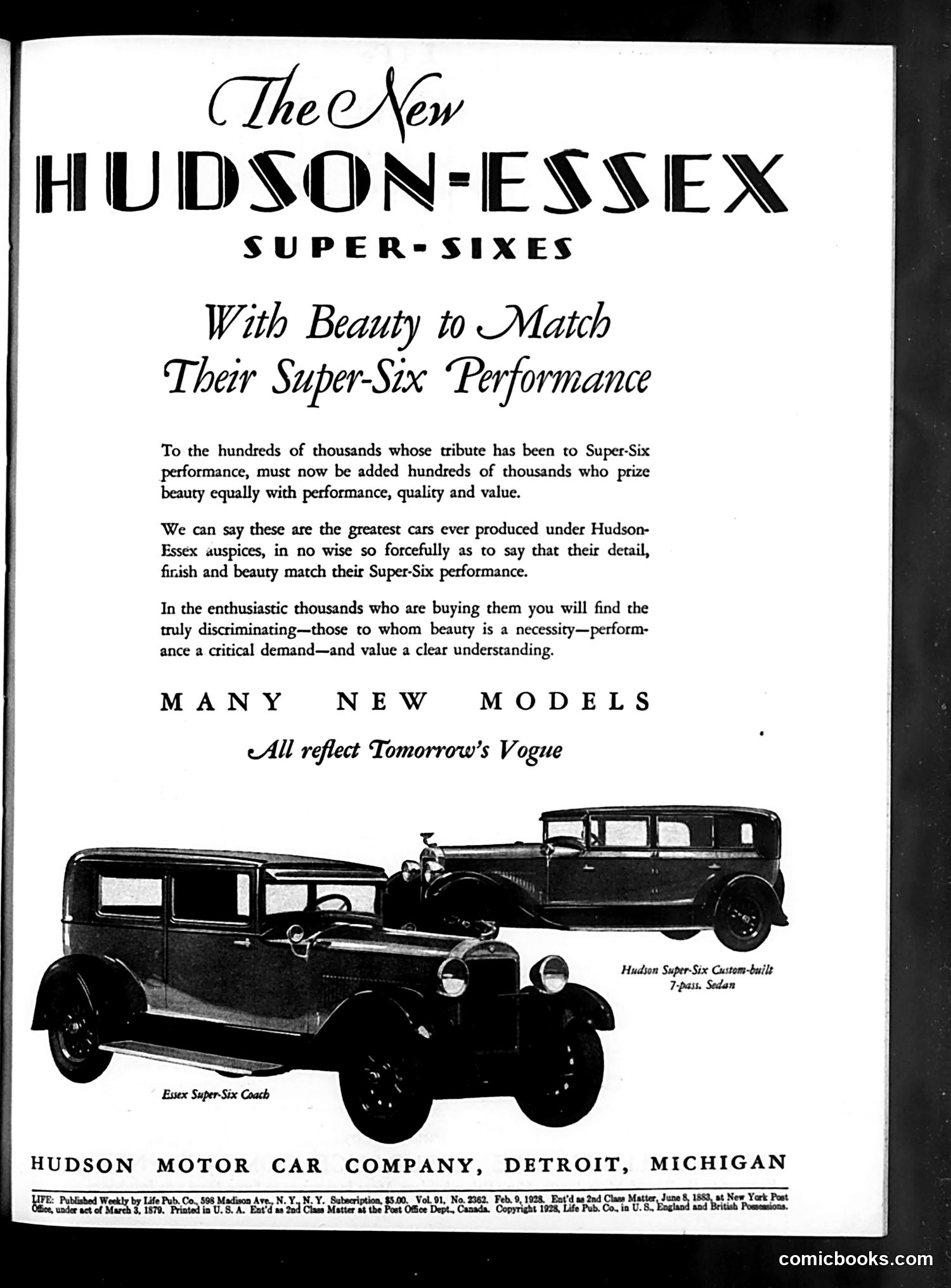
This is **not a political cartoon or satire** — it's a straightforward automobile advertisement from Life magazine (dated June 9, 1928, based on the footer). The page advertises Hudson-Essex "Super-Sixes," a line of cars manufactured by Hudson Motor Car Company in Detroit. The ad emphasizes that these vehicles combine both performance ("Super-Six performance") and aesthetic appeal ("beauty to match"). Three car models are illustrated, representing the range available. The headline "All reflect Tomorrow's Vogue" appeals to buyers' desire for fashionable, modern automobiles. This represents typical 1920s automotive marketing: emphasizing luxury, style, and technological superiority to compete in the growing consumer car market. There is no satirical content present — it's period commercial advertising.
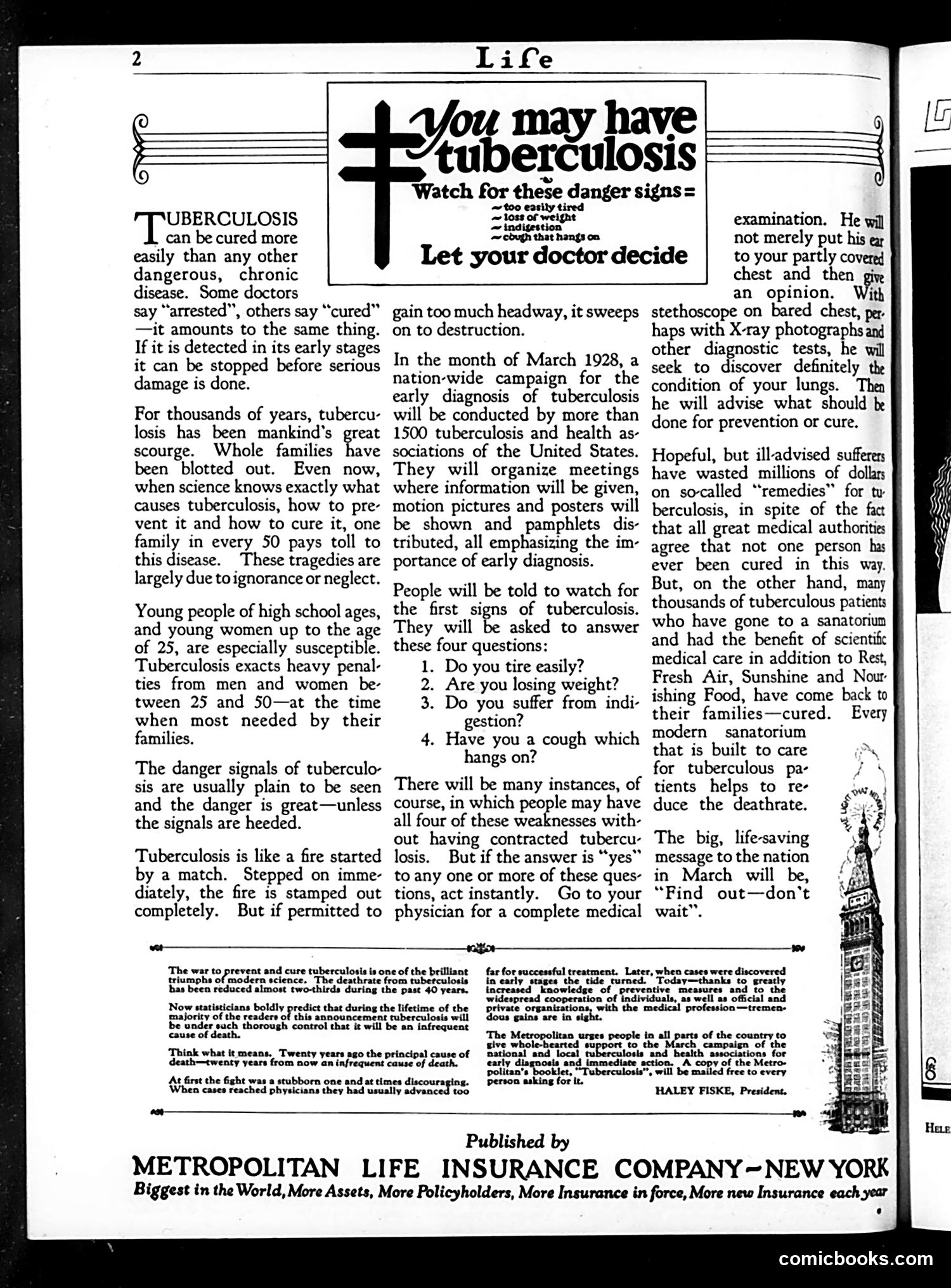
This page is **not satirical content** but rather **public health advertising**—specifically a 1928 tuberculosis awareness campaign sponsored by Metropolitan Life Insurance Company. The prominent boxed advertisement warns readers to watch for TB danger signs: fatigue, weight loss, indigestion, and persistent cough. It directs people to consult doctors for diagnosis. The accompanying article explains that TB, once a major killer, can now be arrested if caught early. It notes a nationwide March 1928 campaign by 1,500 TB and health associations to promote early diagnosis through public meetings, educational materials, and posters. The target audience is young people aged 15-25, identified as especially susceptible. The message emphasizes that while TB was historically devastating, proper medical care—sanatoriums offering rest, fresh air, and nourishing food—has proven effective for recovery. This reflects Progressive Era public health advocacy.
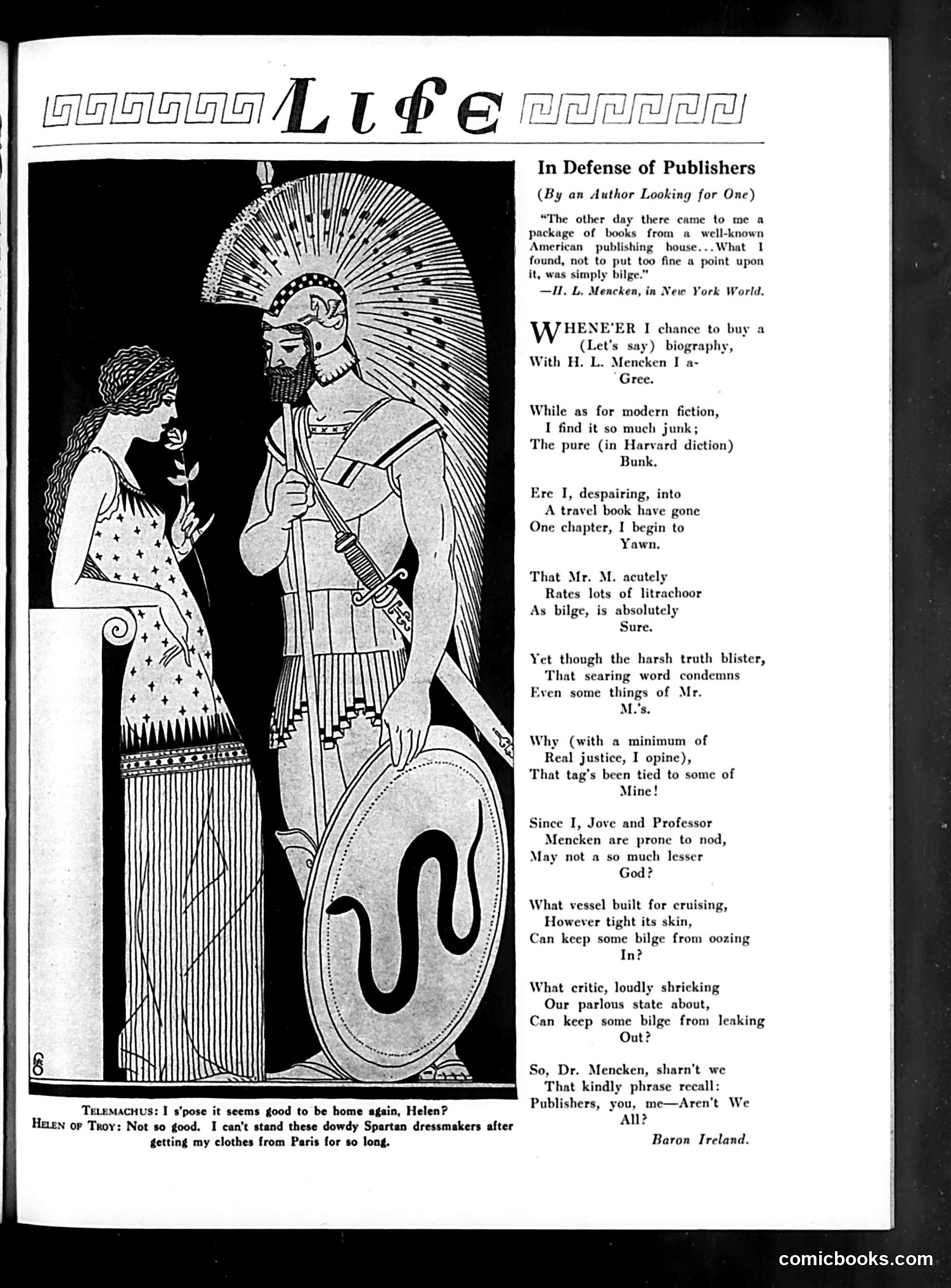
This page satirizes literary criticism and publishing standards of the era. The main illustration depicts a classical Greek warrior (representing traditional, canonical literature) conversing with a modern woman (representing contemporary readers or modern fiction). The accompanying poem "In Defense of Publishers" by Baron Ireland critiques H.L. Mencken's harsh book reviews. Mencken, a prominent literary critic, apparently condemned books as "bilge." The author defends publishers against such scathing criticism, suggesting Mencken's standards are unreasonably harsh. The classical imagery contrasts "pure" traditional literature with what the author sees as unfairly dismissed modern works. The satire suggests that even imperfect contemporary books deserve consideration—that publishers shouldn't be condemned simply because their offerings don't meet elite critical standards.
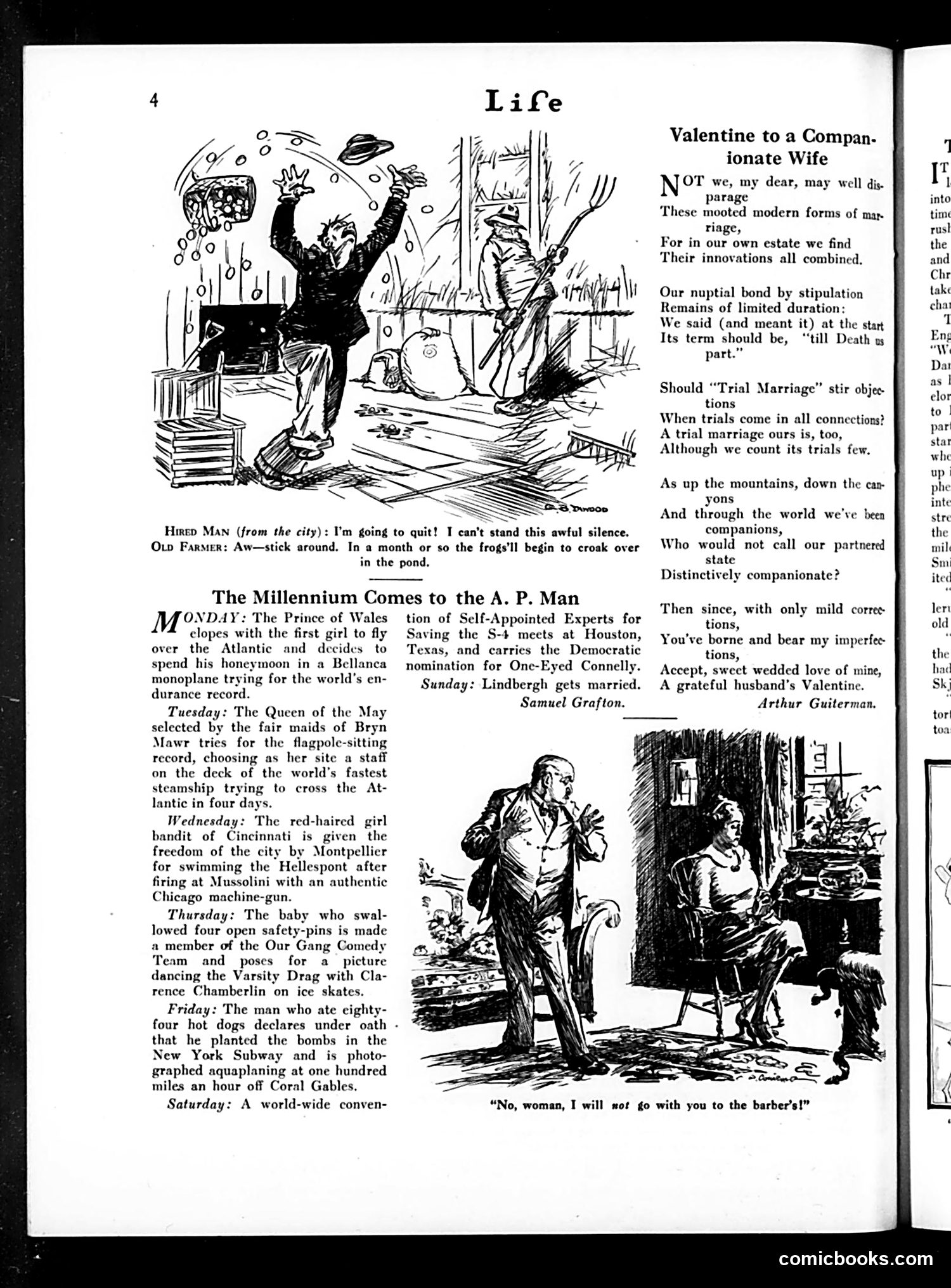
**Top Cartoon:** Shows a "Hired Man (from the city)" threatening to quit farm work over "awful silence," while an Old Farmer responds with pragmatic rural humor about frogs croaking in the pond. This satirizes the culture clash between urban workers and rural life—a common theme during early 20th-century industrialization when city people attempted farm labor. **"The Millennium Comes to the A.P. Man":** A satirical week of absurdist predictions (Prince of Wales flying across Atlantic, Queen selected by beauty contest, red-haired girl swimming the Hellespont, etc.). This mocks the Associated Press and sensationalist journalism's tendency toward increasingly outlandish reporting. **Bottom cartoon:** A domestic dispute where a man refuses to accompany his wife to the barber's, illustrating gender-role tensions in marriage.
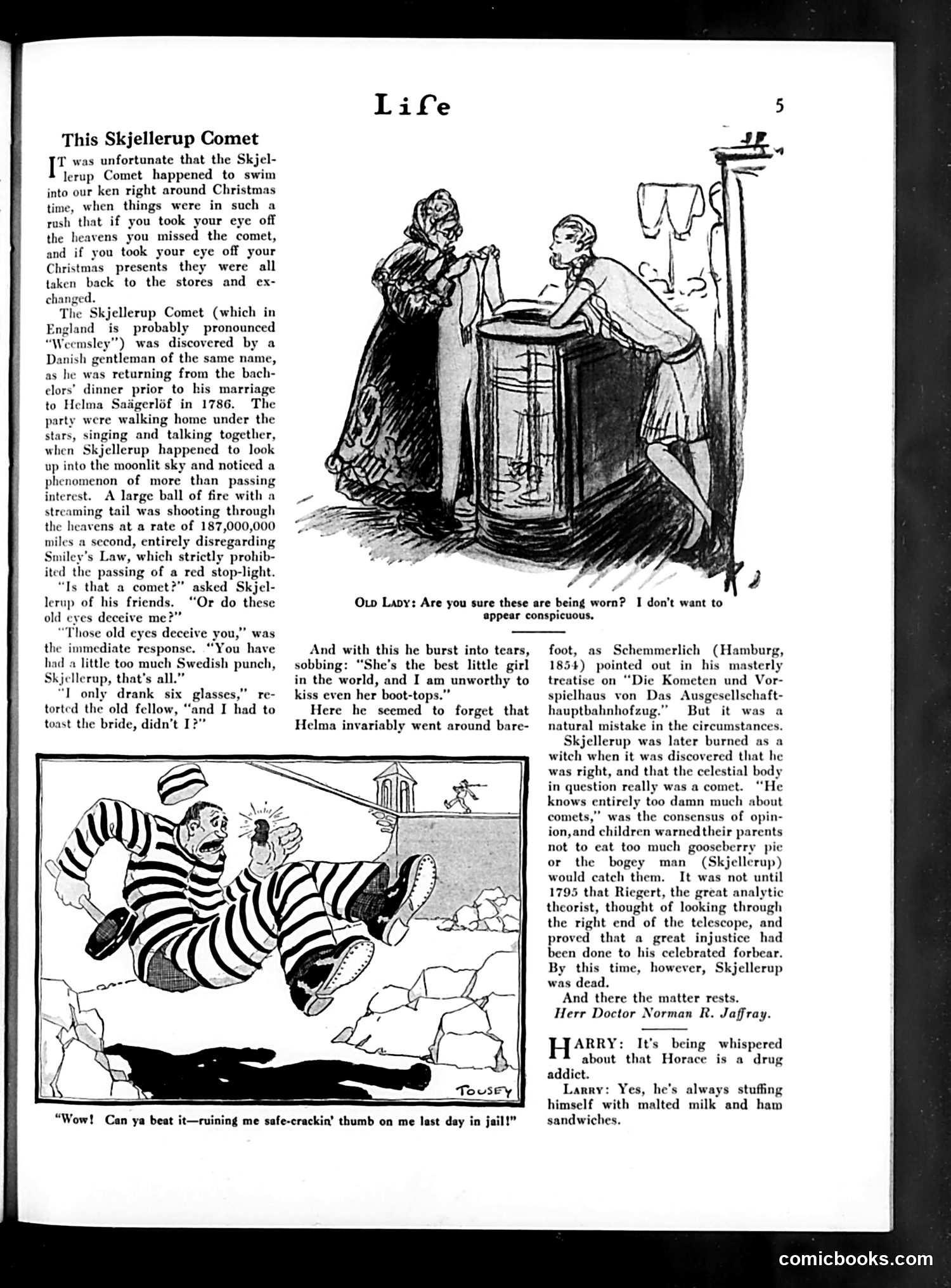
This page from *Life* magazine contains two distinct items: **"This Skjellerup Comet"** is a humorous historical anecdote about a 1786 comet discovery that disrupted a Danish gentleman's wedding plans. The text satirizes superstitious beliefs—people thought the comet was an ill omen, and later a woman was burned as a "witch" when the comet was mistakenly identified. The joke mocks both past superstition and the groom's self-centered response to celestial events. **The cartoon below** by Tousey shows a man in striped clothing tumbling through snow, with the caption about ruining his thumb in jail. The satire appears to mock someone's misfortune or clumsiness. **The dialogue at bottom** between Harry and Larry references "Horace" being a "drug addict" who consumes malted milk and sandwiches—light social commentary on dietary habits, likely poking fun at contemporary food trends or a recognizable figure.
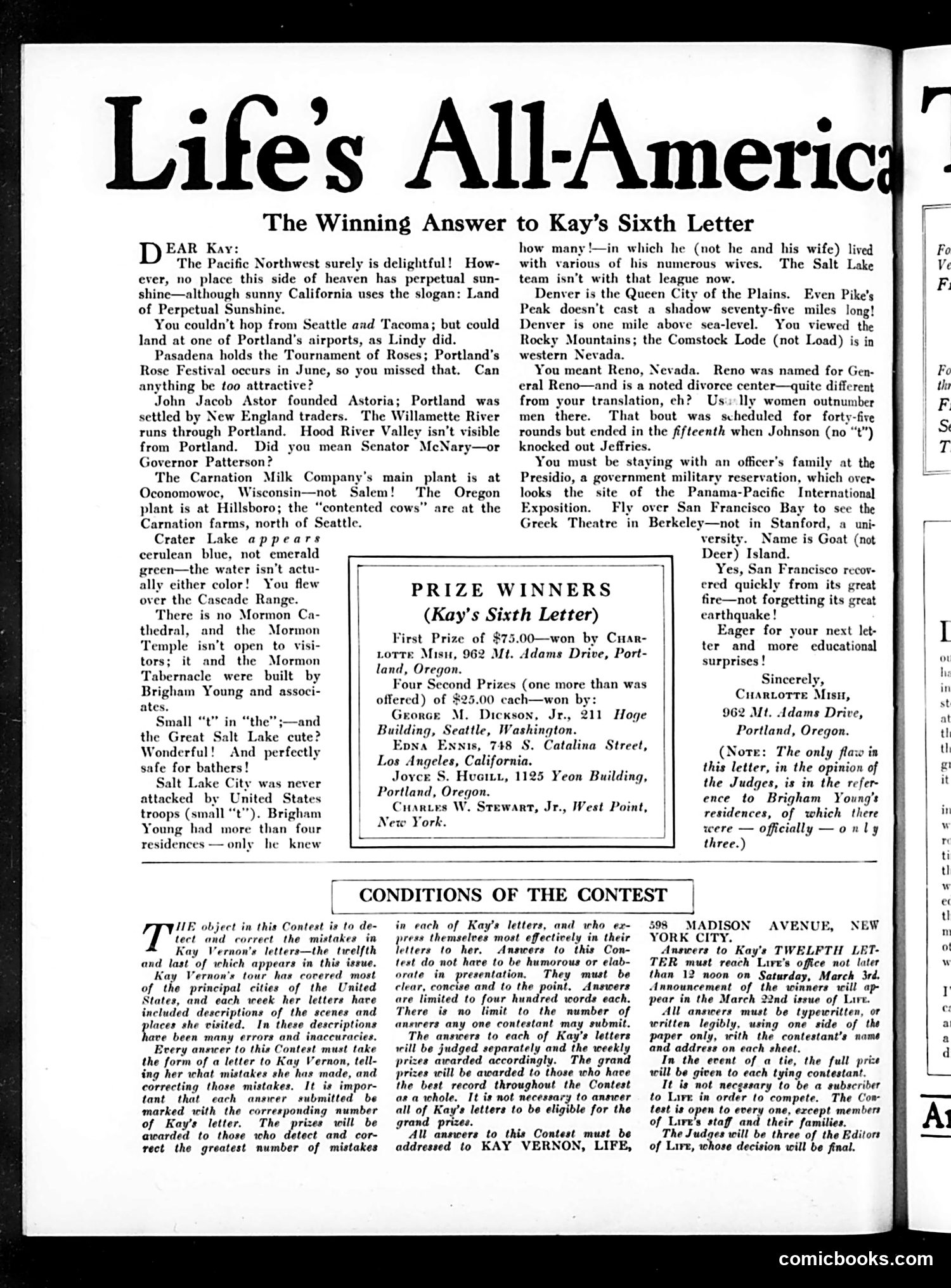
This page announces a geography contest called "Life's All-America: The Winning Answer to Kay's Sixth Letter." The main content is a reader-submitted letter from Charlotte Mish of Portland, Oregon, who won first prize ($75) by correctly answering a geography trivia question about American locations. The letter humorously corrects common misconceptions about various U.S. cities and landmarks—for example, clarifying that Portland's Rose Festival occurs in June, not that it's in California, and that Crater Lake appears blue-green rather than blue. Below are the official contest rules and a box listing prize winners. This appears to be part of Life's regular humorous educational features designed to entertain readers while teaching American geography.
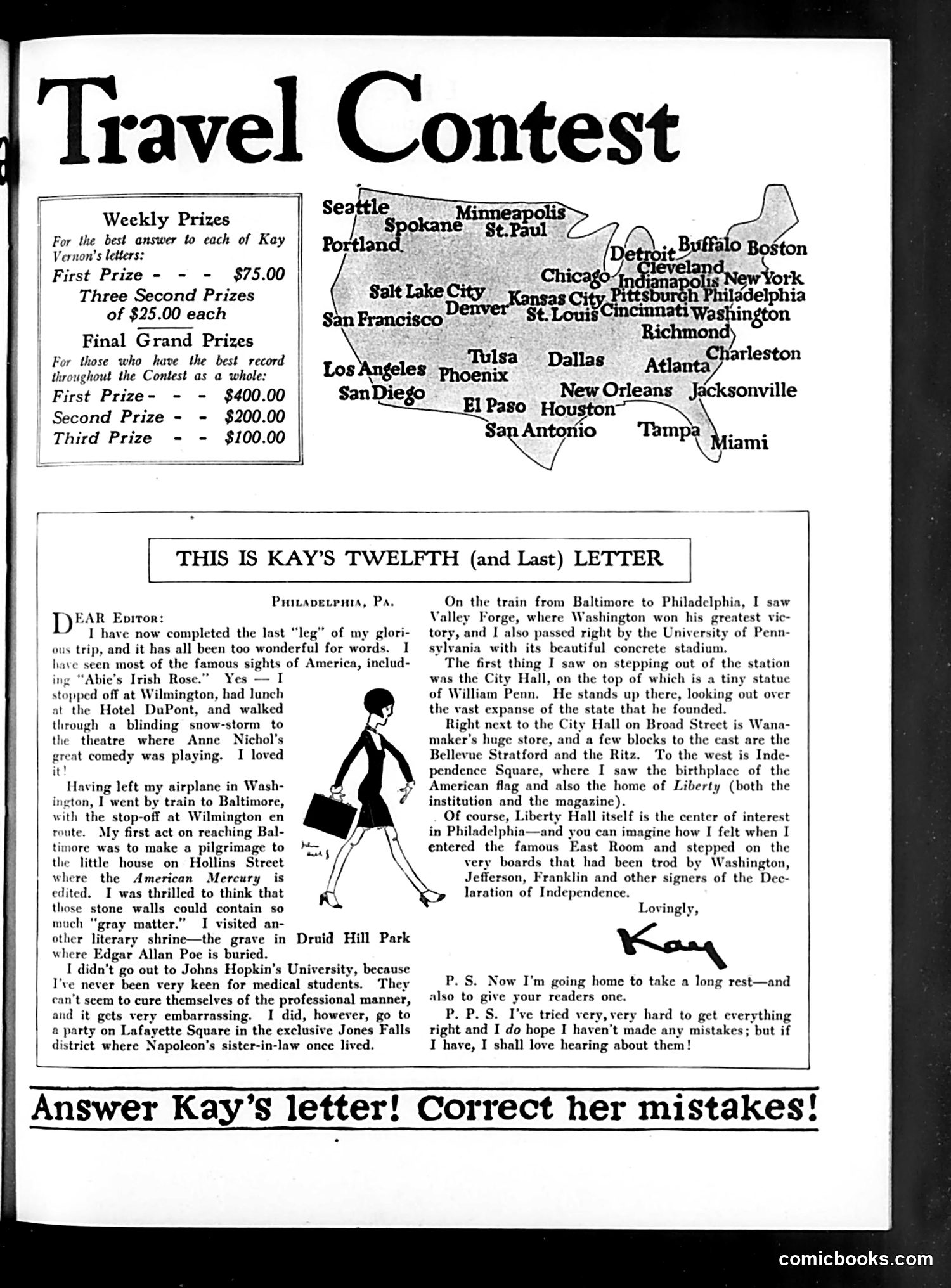
This is a contest page from *Life* magazine featuring a travel-themed competition. Readers were invited to identify factual errors in "Kay's" twelfth and final letter describing a trip across America. Kay's letter describes visiting Philadelphia landmarks including Valley Forge, City Hall, Independence Square, Liberty Hall, and sites associated with the Declaration of Independence signers. The letter mentions taking trains between Baltimore and Philadelphia, visiting the *American Mercury* offices, and touring historical sites. The implicit satire appears to be testing readers' geographical and historical knowledge of American landmarks. The "contest" format—asking readers to find mistakes in Kay's account—was a popular interactive feature in *Life*. The drawing of a traveling figure reinforces the journey theme.
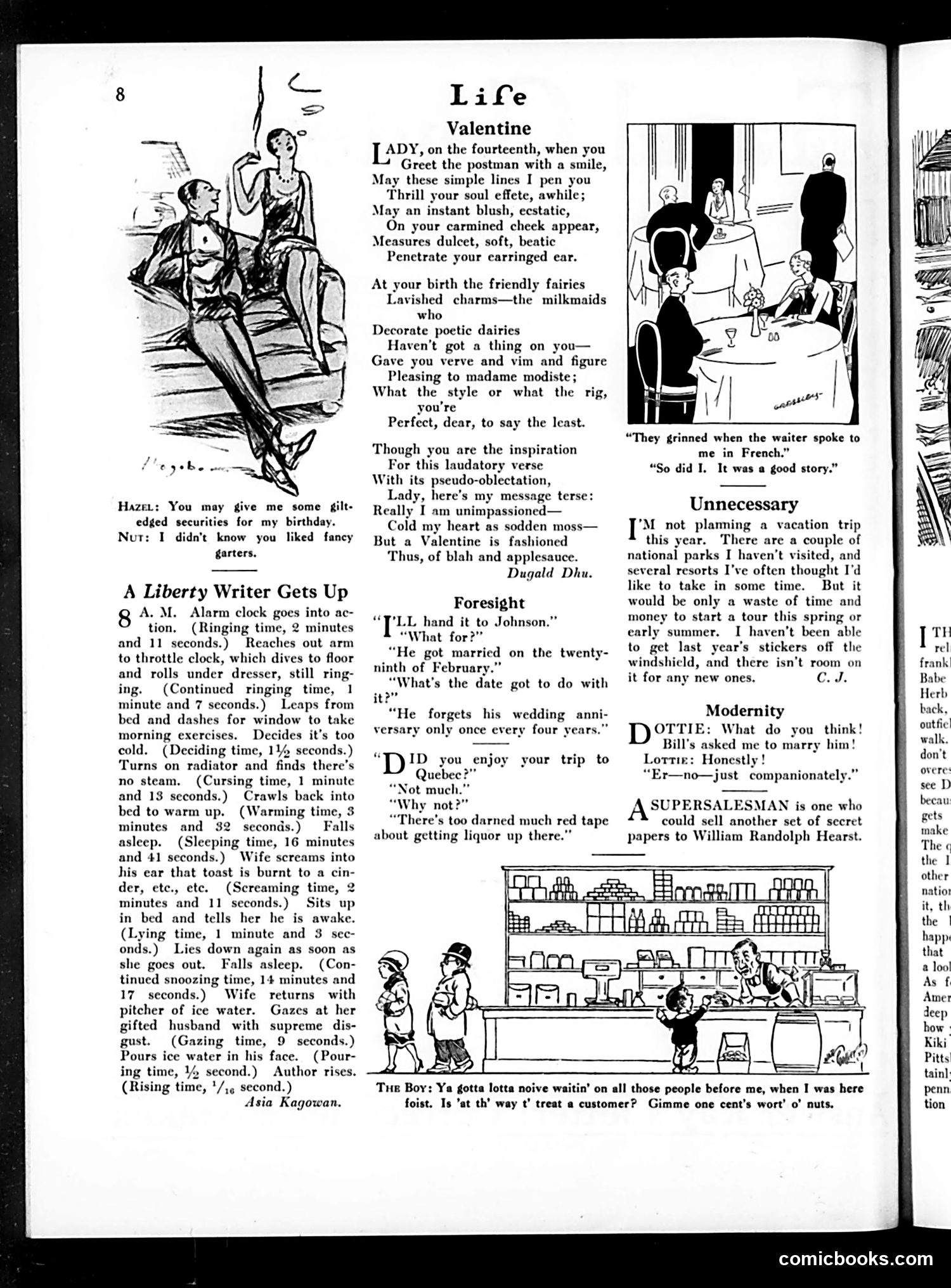
This page contains several humorous sketches targeting early 20th-century social conventions and behavior. **"A Liberty Writer Gets Up"** mocks the chaotic morning routine of a busy writer, cataloging absurdly detailed timings for each mundane activity—a satire on obsessive efficiency culture and the frantic pace of modern life. **"Valentine"** is a romantic poem poking fun at love declarations and courtship rituals, while the sketch shows couples in social settings. **"Unnecessary"** satirizes the pointlessness of vacation planning when one hasn't even caught up on local attractions. **"Modernity"** and **"Supersalesman"** appear to mock contemporary business culture and sales tactics, though details are unclear from the visible text. The bottom cartoon depicts a grocery store scene, with the caption suggesting commentary on consumer behavior and retail interactions, though the specific satire isn't fully legible.
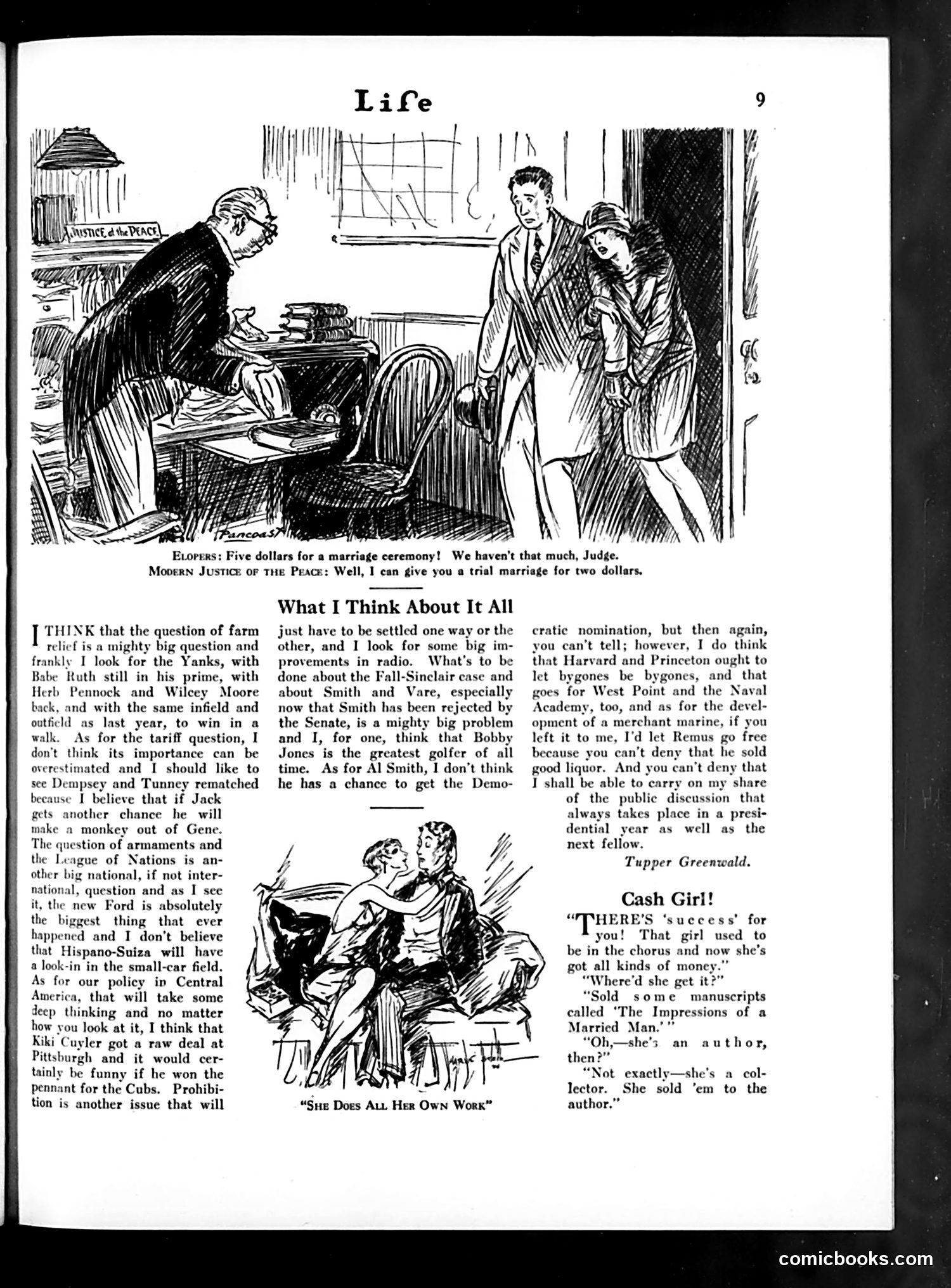
**Top Cartoon**: A justice of the peace performs a budget marriage ceremony for five dollars. The humor satirizes both rapid, commercialized marriages and the casual attitude toward matrimony—reducing a legal union to a quick transaction by a minor official. **"What I Think About It All"** (by Tupper Greenwald): Opinion piece discussing farm relief, tariffs, the Fall-Sinclair case, Smith and Vare's Senate rejection, Bobby Jones (golf), and the new Ford automobile. These appear to be contemporary political/sports topics of the era. **"Cash Girl!" cartoon**: Shows a woman who sold manuscripts titled "The Impressions of a Married Man" to a publisher. The joke plays on her being a "collector" rather than the author—satirizing either plagiarism or women's limited authorial recognition in publishing.
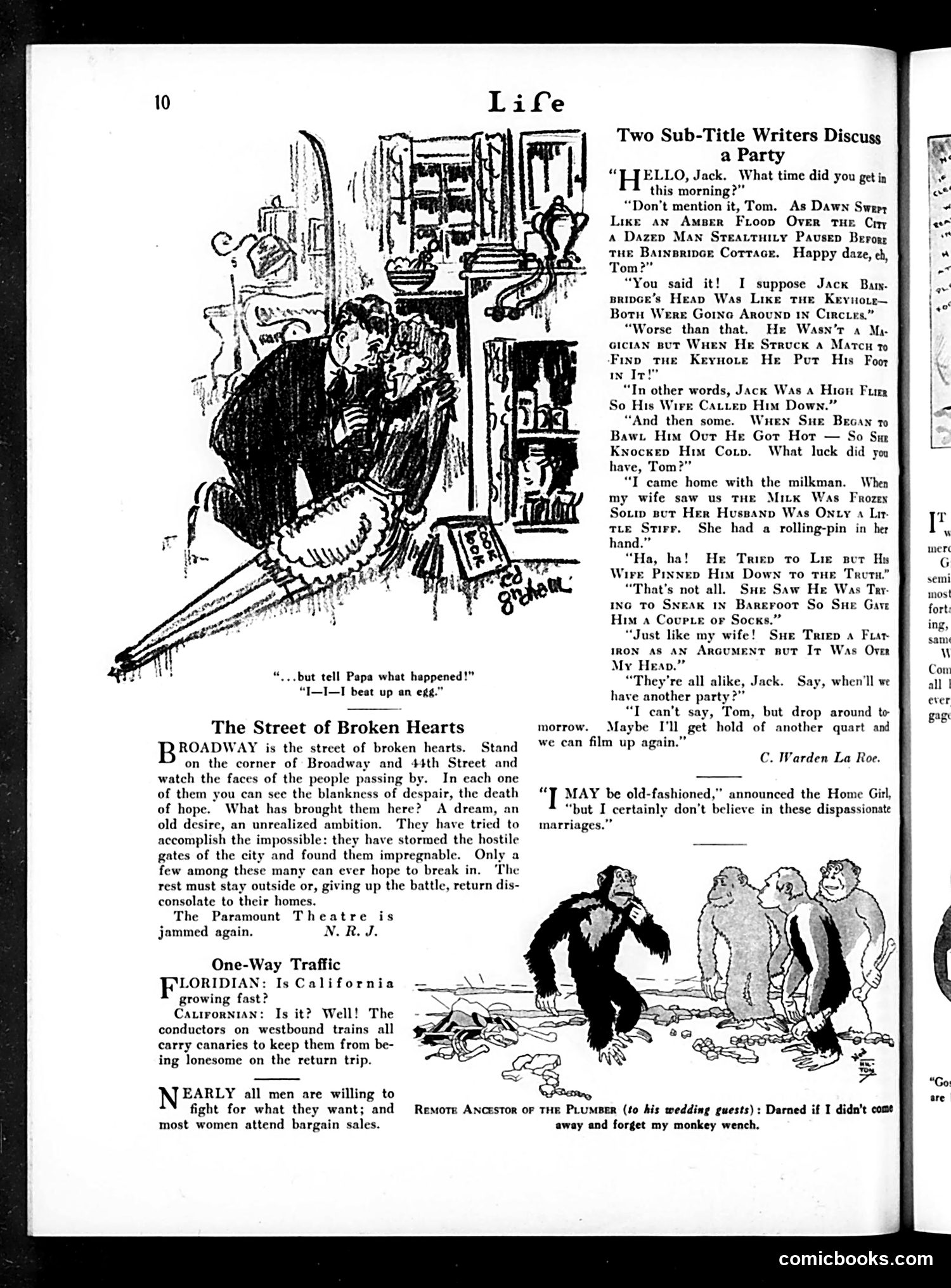
This page contains three distinct pieces of satirical humor: 1. **"Two Sub-Title Writers Discuss a Party"** (top): A dialogue mocking film title card writers who create increasingly absurd, exaggerated subtitles for silent films. The joke escalates from mundane events ("got in this morning") to ridiculous elaborations ("Jack Bainbridge's Head Was Like the Keyhole—Both Were Going Around in Circles"). This satirizes the verbose, melodramatic style of silent film intertitles. 2. **"The Street of Broken Hearts"** (middle left): Commentary on Broadway's theatrical district and struggling performers. The cynical observation reflects post-WWI disillusionment about failed dreams. 3. **Bottom cartoon**: Apes labeled "Remote Ancestor of the Plumber" forgetting a monkey wrench—a visual gag about human forgetfulness mirrored in our evolutionary past. The magazine targets entertainment industry conventions and early 20th-century urban anxieties.
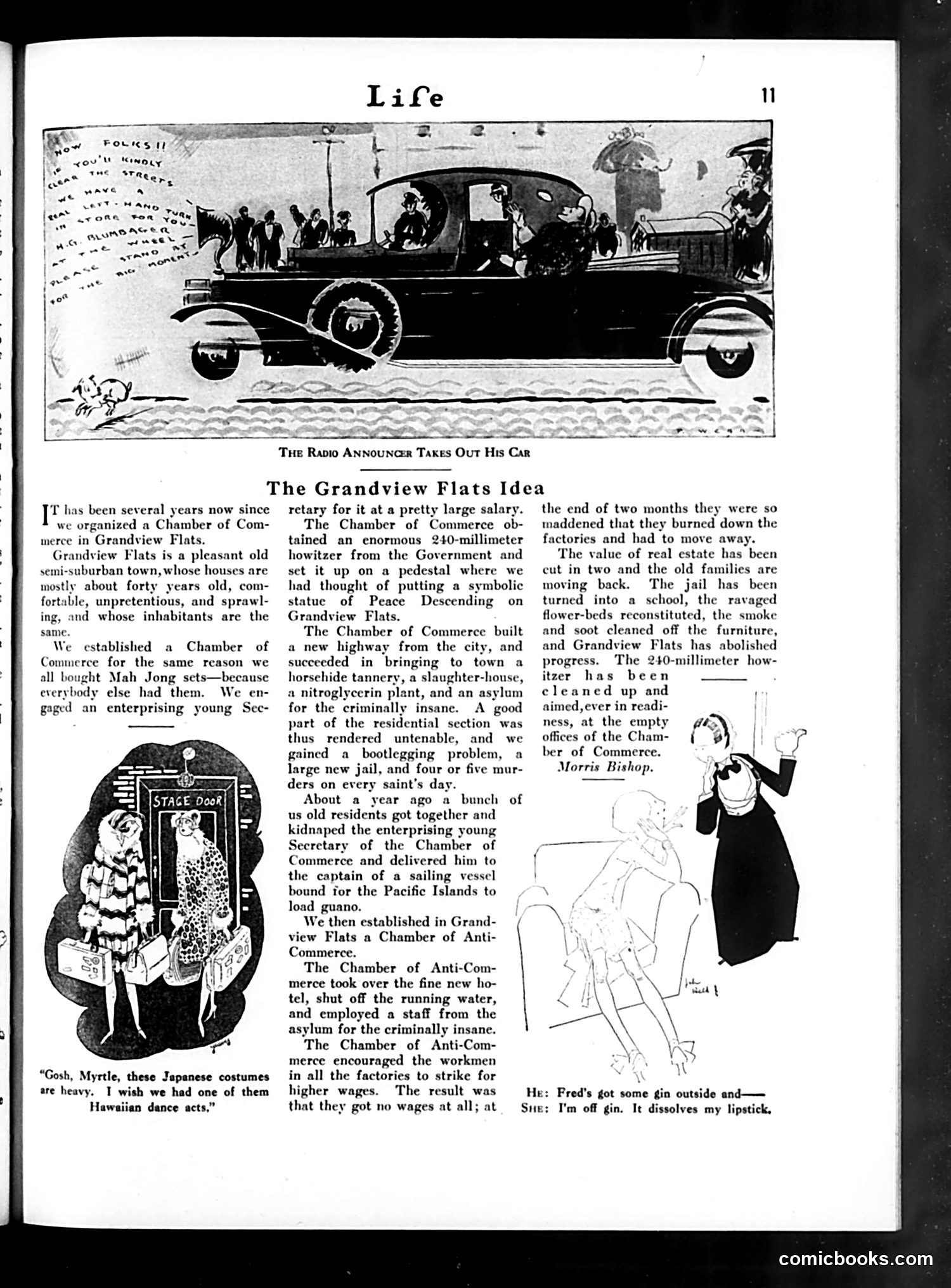
This article satirizes well-intentioned civic improvement efforts in a town called Grandview Flats. The Chamber of Commerce acquired land and built infrastructure (highway, tannery, slaughterhouse, asylum) expecting industrial development and progress. Instead, the article describes darkly comic consequences: increased crime, murders, overcrowded jails, and social problems. When residents kidnapped the Chamber Secretary and demanded higher wages, the Chamber created an anti-Commerce chamber—essentially admitting defeat. The satire mocks naive boosterism and municipal pride, suggesting that hastily pursued "progress" often backfires spectacularly. The cartoon at top shows a radio announcer in a fancy car, likely representing media hype promoting such schemes. The humor depends on readers recognizing small-town American Chamber of Commerce mentality—promoting growth without considering actual consequences.
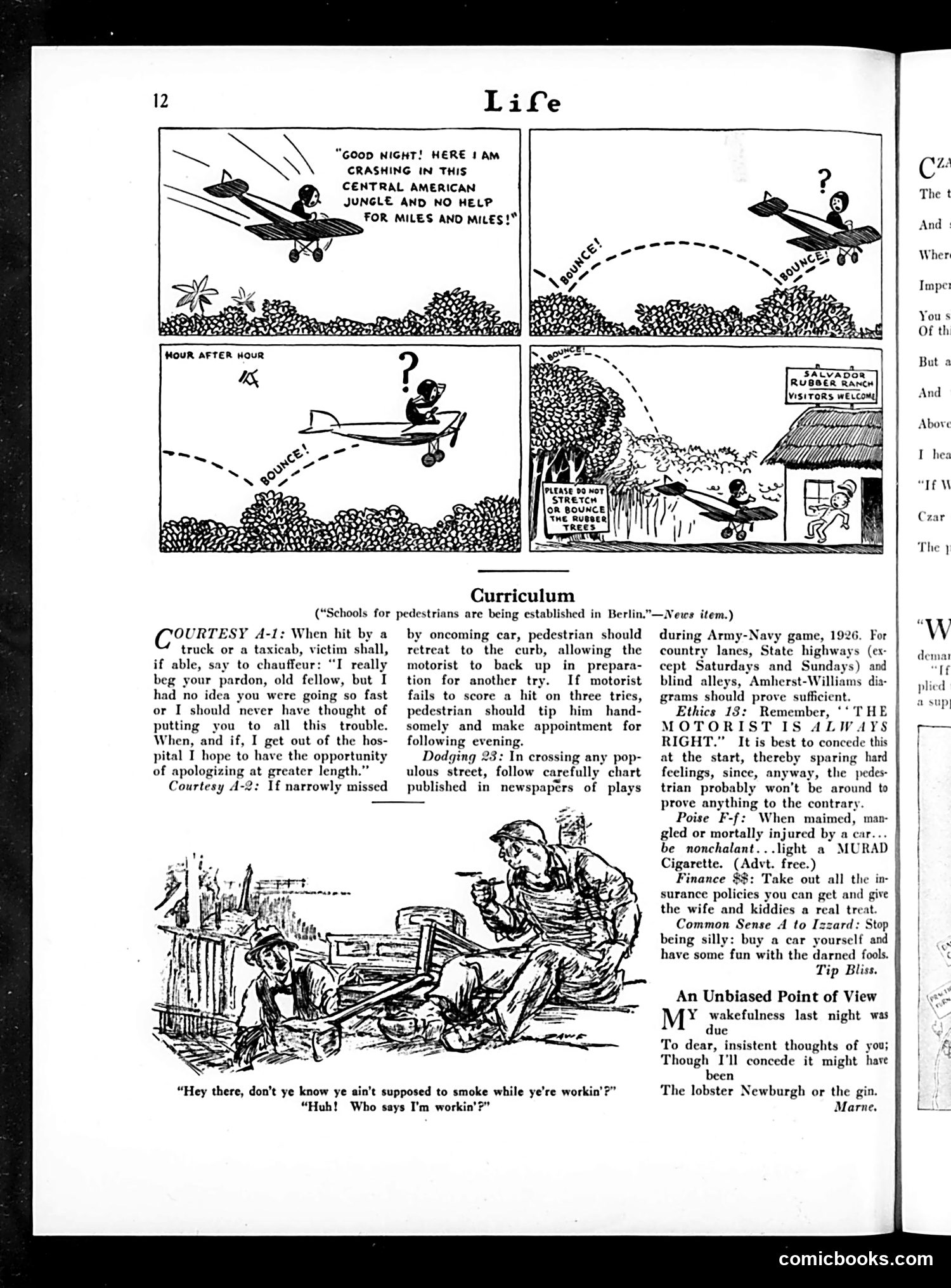
The top comic strip depicts an airplane crash in a Central American jungle, with the pilot repeatedly bouncing off rubber trees at a "Salvados Rubber Ranch." The humor relies on the absurd premise that rubber's elasticity allows the aircraft and pilot to survive multiple impacts unharmed. Below this is a "Curriculum" section satirizing automotive safety through mock etiquette lessons for pedestrians and motorists. It mocks the era's cavalier attitude toward traffic dangers—suggesting pedestrians should "tip" drivers who hit them and advising motorists they're "always right." The bottom cartoon shows workers apparently smoking while laboring, with one claiming "I ain't supposed to smoke while we're workin'" and another responding "Who says I'm workin'?"—a joke about workplace laziness and rule-breaking.
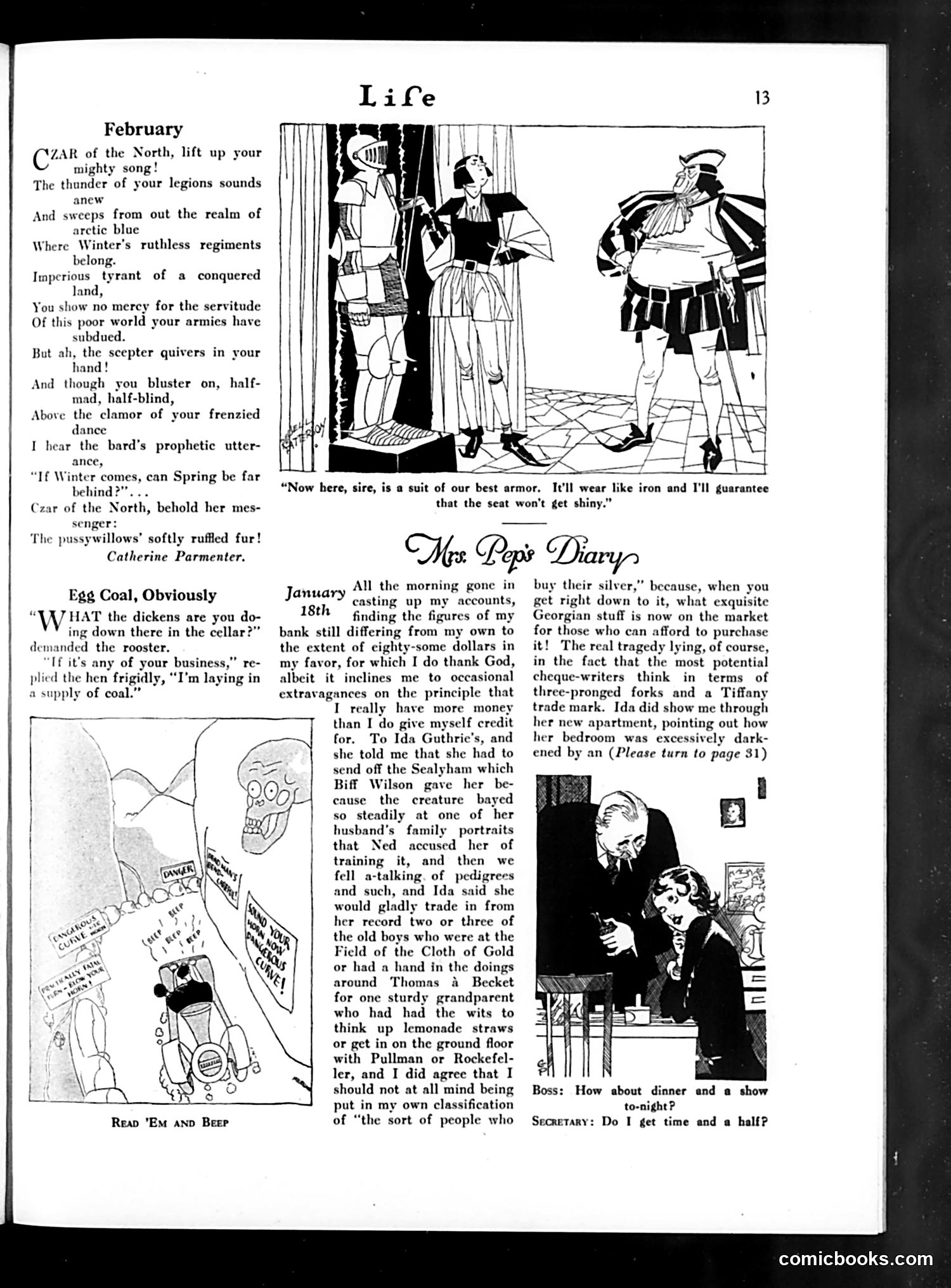
This page contains three distinct pieces of humor content: 1. **"February" poem** by Catherine Parmenter: A satirical verse addressing the "Czar of the North," likely Tsar Nicholas II of Russia, mocking his military ambitions and winter hardships. The "bard's prophetic utterance" about Spring following Winter contains political commentary on Russian imperial overreach. 2. **"Egg Coal, Obviously"**: A brief dialogue joke about hens laying coal instead of eggs—a nonsensical pun playing on wartime resource scarcity or inflation concerns. 3. **"Mrs. Pep's Diary"** and **"Read 'Em and Beef"**: Satirical commentary on inflation and financial instability. Mrs. Pep discusses accounting discrepancies and depreciated assets, while the cartoon shows economic confusion. The accompanying office scene depicts workplace interactions about wages and employment. The overall theme addresses early 20th-century economic anxieties and international tensions.
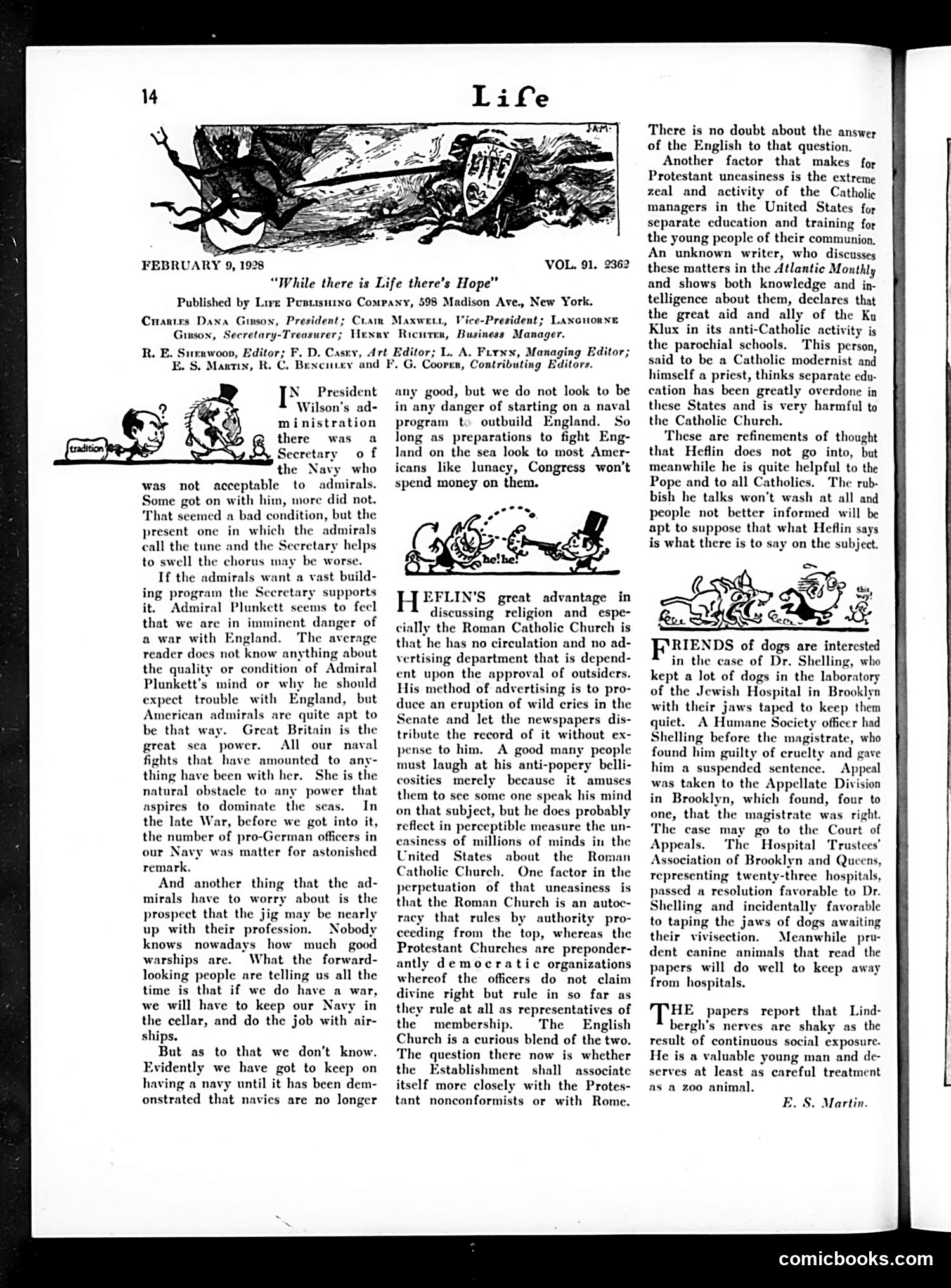
The page contains two editorial cartoons addressing British naval policy and American military preparedness. The first cartoon depicts President Wilson's administration facing criticism from admirals about naval building programs. The accompanying text discusses whether Congress should fund military expansion, with the satirical point being that American admirals support large military budgets while politicians remain hesitant about expenditures. The second cartoon (less clearly visible) appears related to similar military-preparedness debates of the period. The editorial also addresses religious controversy regarding Catholic education in America and discusses Lindbergh's recent nervous condition—likely referencing his ongoing public stress following his son's kidnapping case (1932 context unclear from this 1928 date). The satire targets military-industrial pressure and political indecision about defense spending.
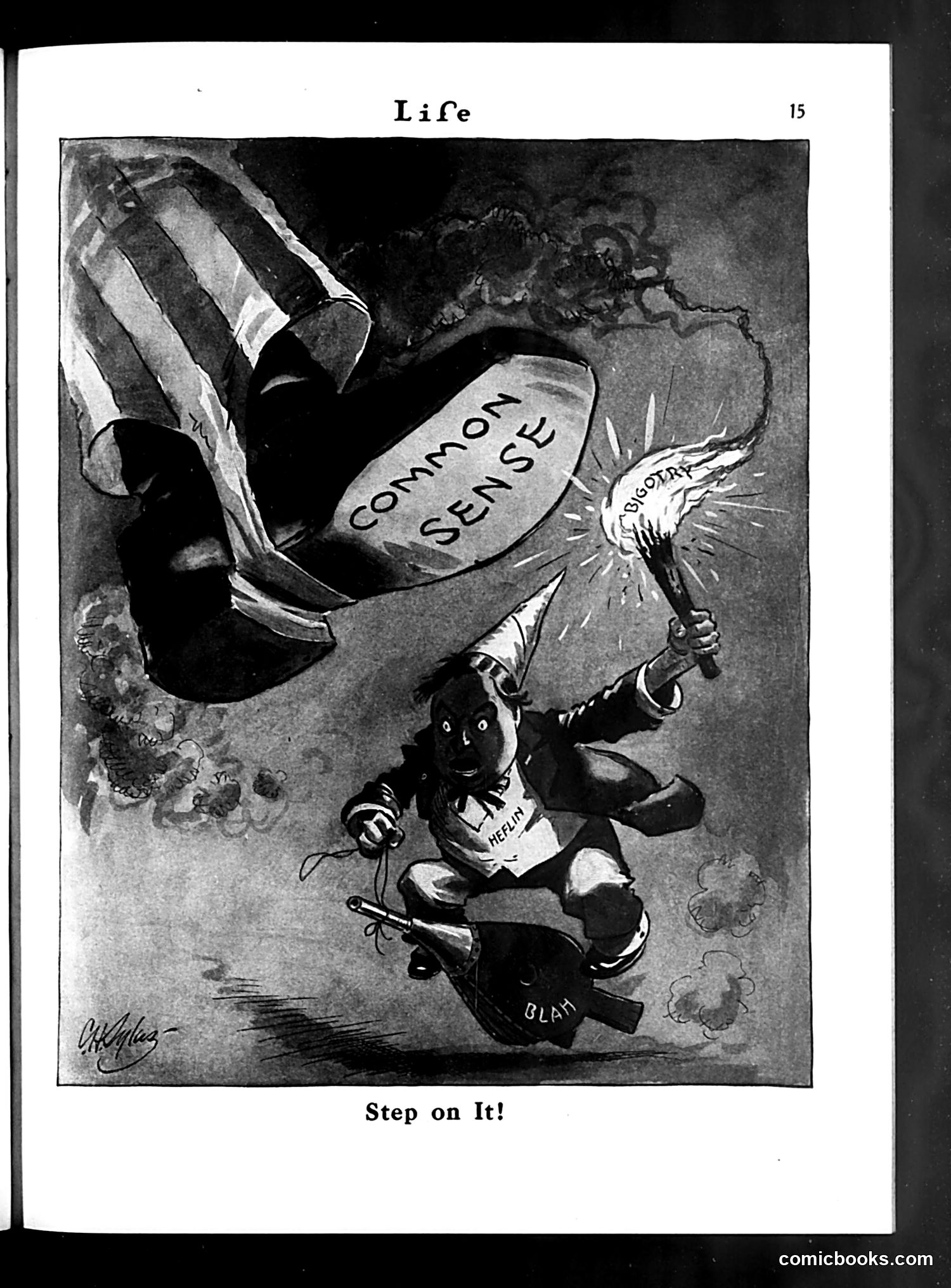
This is a WWI-era satirical cartoon from *Life* magazine. A small figure labeled "BERLIN" (representing Germany) holds a torch while being crushed beneath a large boot stamped "GLAU" (unclear—possibly a misspelling or abbreviation). Above, an American flag-decorated barrel and what appears to be Allied military equipment descend menacingly. The cartoon's message: "Step on It!" urges Americans to intensify military pressure against Germany. The visual metaphor depicts Germany as an insignificant pest to be stamped out by superior American/Allied force. The scale—tiny Berlin figure versus massive military equipment—emphasizes American military dominance. This reflects the propagandistic tone of American media encouraging military action during World War I.
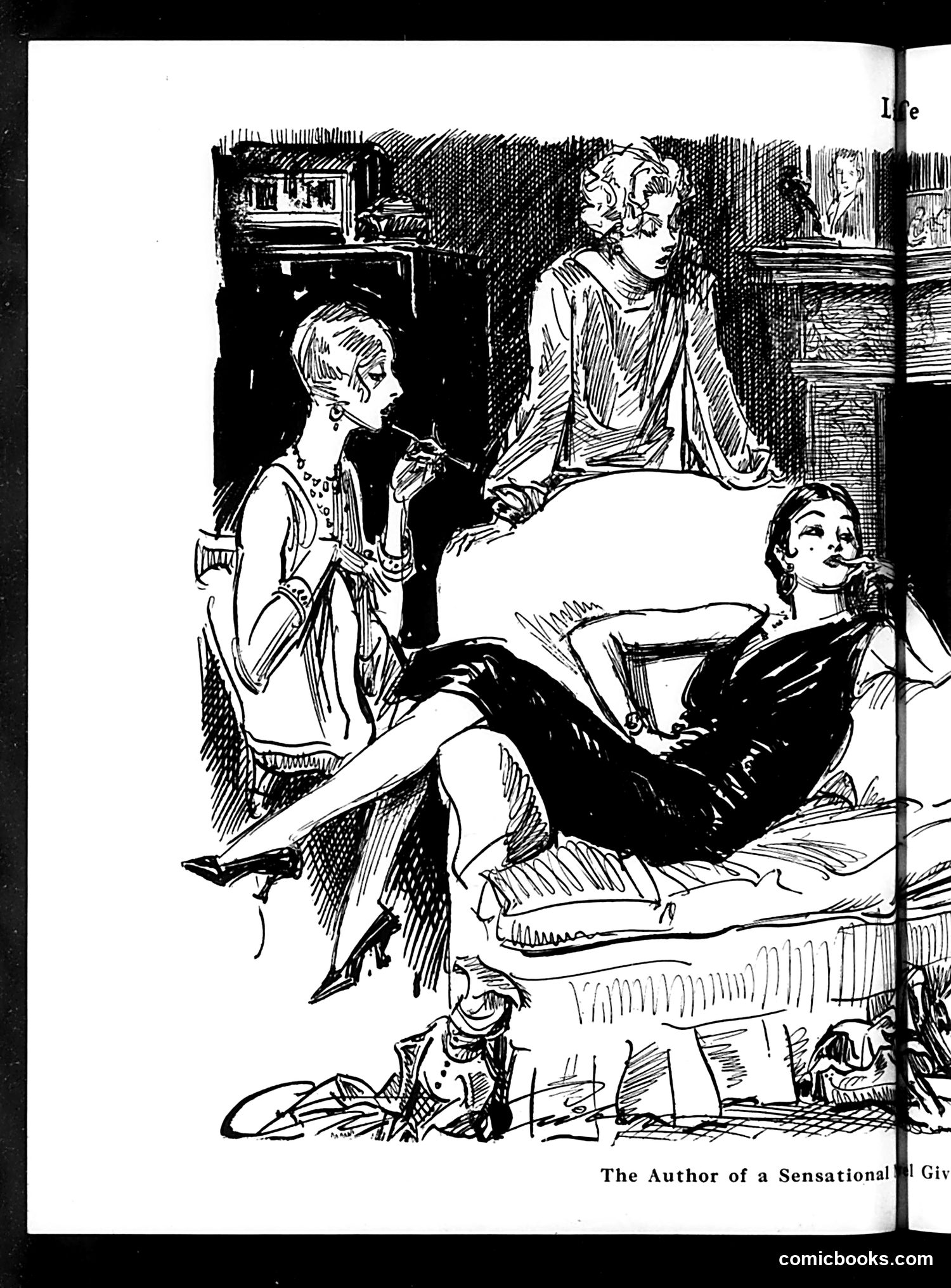
This illustration depicts "The Author of a Sensational Novel" (visible in the caption). The cartoon satirizes the literary world, showing a woman reclined on a bed in what appears to be a bedroom scene, while two other figures attend to her. The composition suggests she's either ill or dramatically posed—a visual pun on "sensational" fiction of the era. The satire likely mocks two things: (1) the melodramatic nature of popular fiction, and (2) possibly the lifestyle or affectations of female authors who wrote such works. The bedroom setting and her theatrical posture emphasize the overwrought, exaggerated nature of "sensational" novels—pulp fiction known for lurid plots and dramatic excess that was popular in late 19th/early 20th-century publishing.
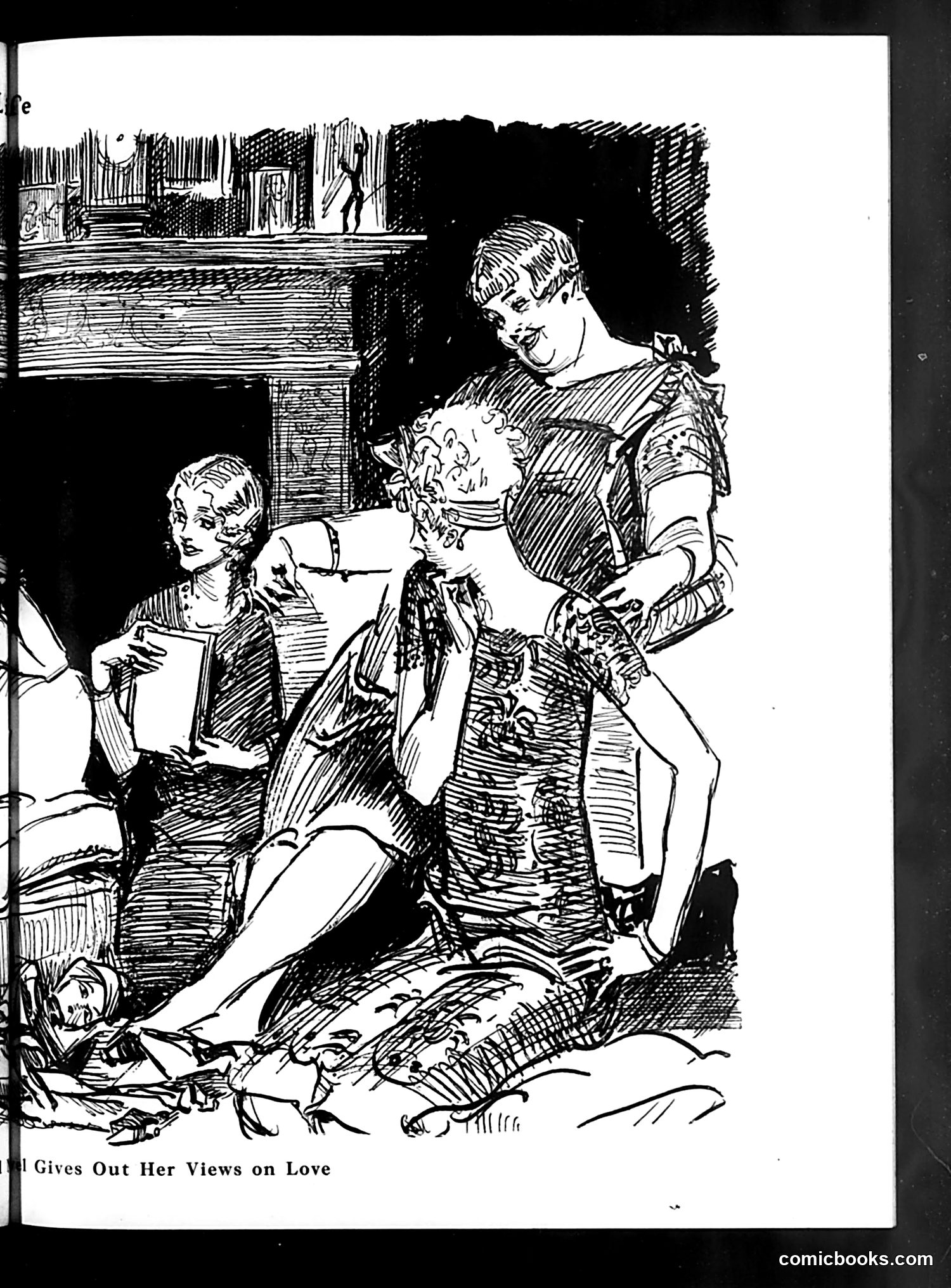
This is a satirical illustration titled "Gives Out Her Views on Love," showing three figures in what appears to be an interior domestic scene. The central seated woman is presenting her romantic philosophy to two other women—one seated on the left holding what looks like a notepad or document, and one standing on the right. The satire targets early 20th-century women who publicly dispensed advice or opinions on romantic matters, likely mocking the trend of female advice columnists or social commentators of the era. The illustration's casual domestic setting and the note-taking figure suggest this woman is being interviewed or documented sharing her views, poking fun at the fashion for women openly discussing love and relationships—a relatively novel topic for public discourse at that time.
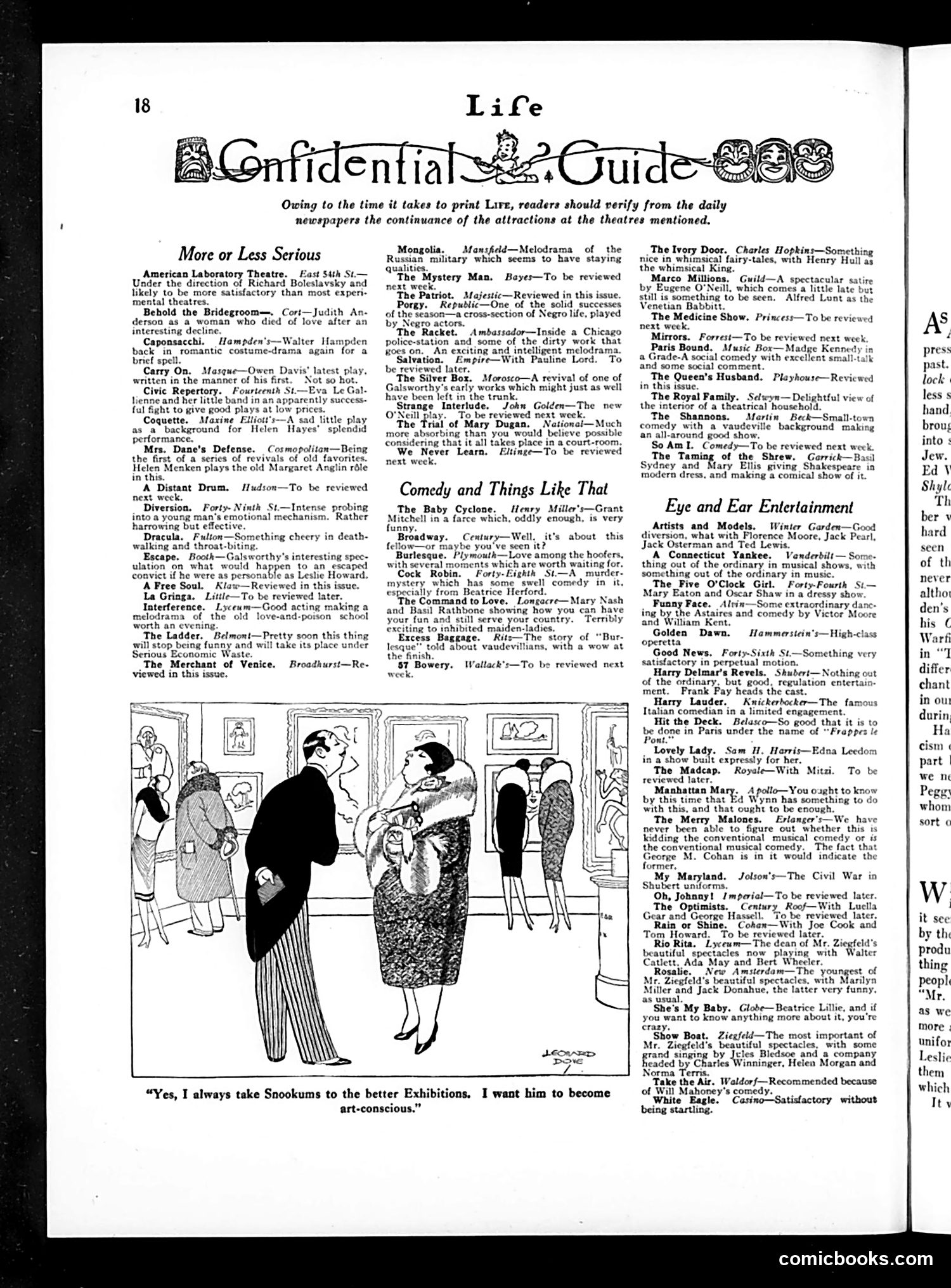
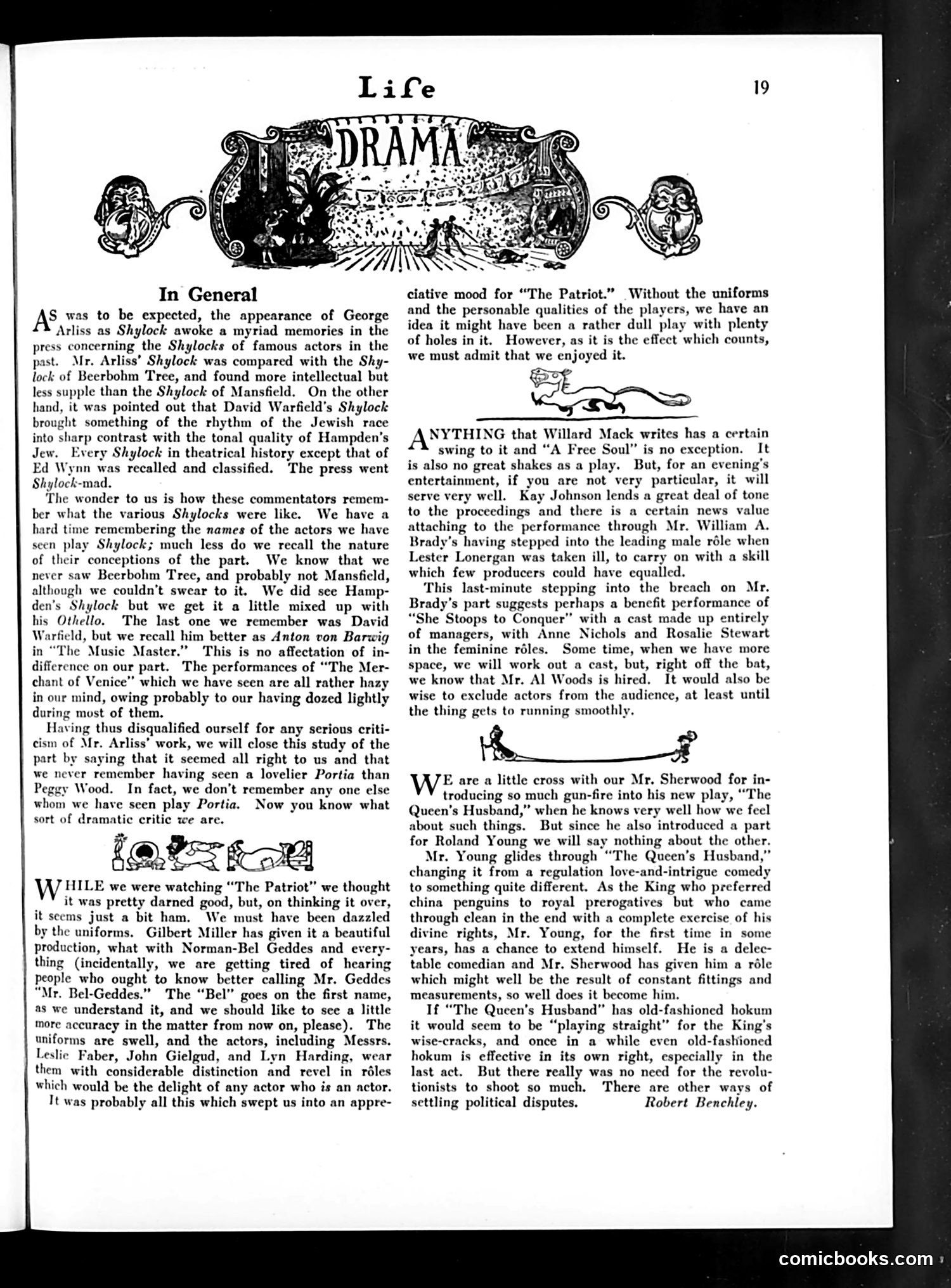
This page contains theater reviews by Life's drama critic, likely Robert Benchley (bylined at bottom). The critic discusses three Broadway productions with characteristic self-deprecating humor: **"The Merchant of Venice"**: George Arliss plays Shylock. The critic admits complete inability to remember previous productions of this play, confessing they dozed through performances and can barely recall actors' names. They praise Peggy Wood as Portia while acknowledging their incompetence as a critic. **"The Patriot"**: A production by Gilbert Miller featuring John Gielgud and others. The critic admits the play seems "ham" upon reflection, but was initially impressed by elaborate Norman-Bel Geddes sets and handsome uniforms. The satire: superficial production values fooled them into enjoying a weak script. **"A Free Soul"**: By Willard Mack, starring Kay Johnson. Notable for William A. Brady stepping in as leading man when the original actor became ill—the critic jokingly suggests this demonstrates managers could perform better than professional actors. The humor relies on the critic's self-aware admission of shallow judgment based on spectacle rather than dramatic merit.
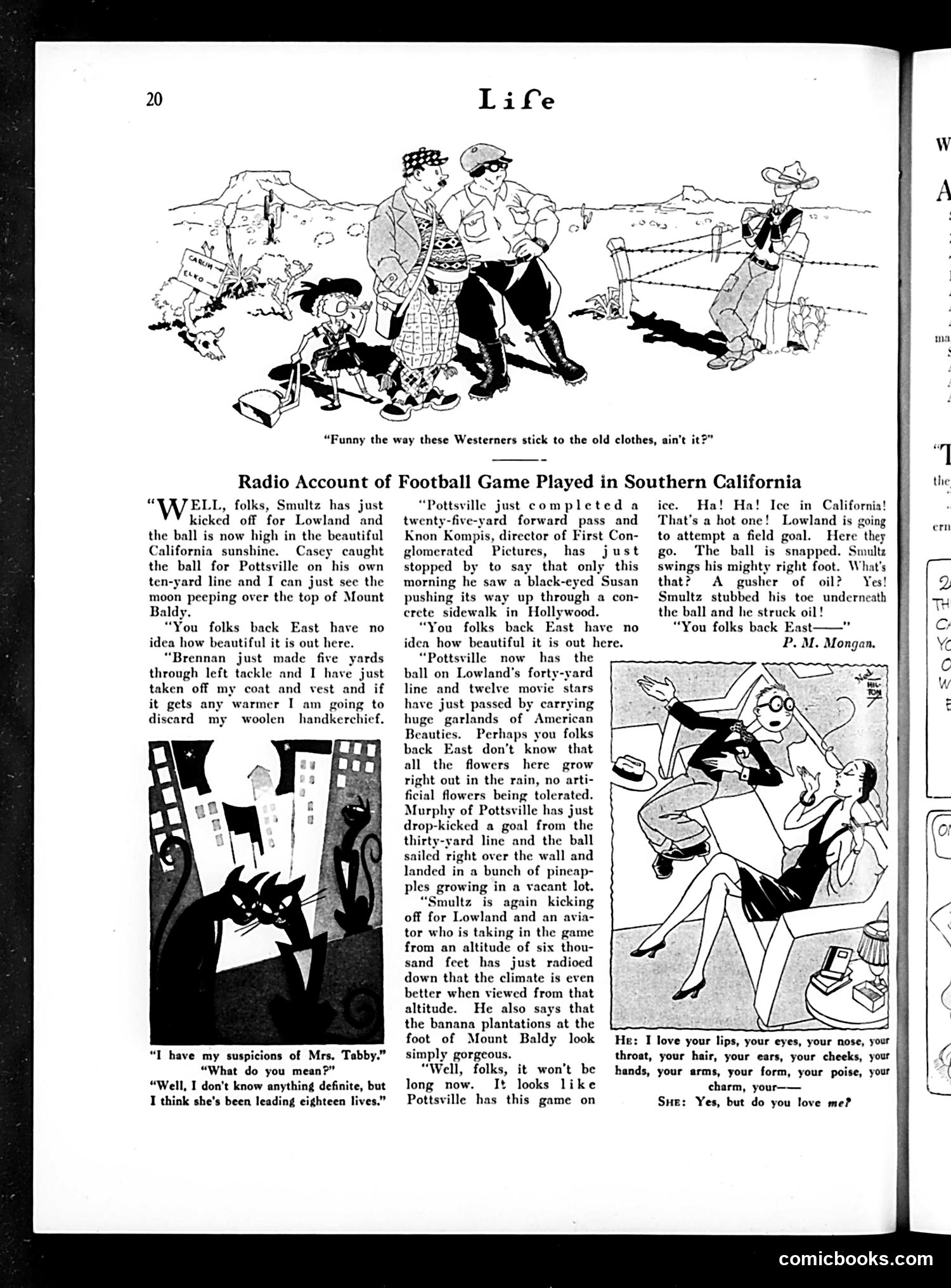
This page satirizes radio sports broadcasting and California boosterism circa the 1920s-30s. **The Main Cartoon (top):** A radio announcer's play-by-play account of a football game devolves into breathless promotion of Southern California's climate and attractions—flowers, mountains, movie stars, oil wells. The joke is that the announcer keeps forgetting the game itself to tout California's wonders. The opening cartoon mocks Westerners' attachment to old-fashioned clothing despite the supposedly perfect weather. **The Side Cartoons:** - A domestic joke about a cat ("Mrs. Tabby") with multiple lives - A flirtation scene satirizing romantic dialogue ("do you love me?") **The Satire:** Life is mocking 1920s-30s California hype and promotional culture—how boosters obsessively marketed the state's climate and natural resources. The absurd details (radio from an airplane, oil gushing from a football field) exaggerate this tendency. This was relevant when California actively marketed itself to attract Eastern residents and investment during rapid growth periods.
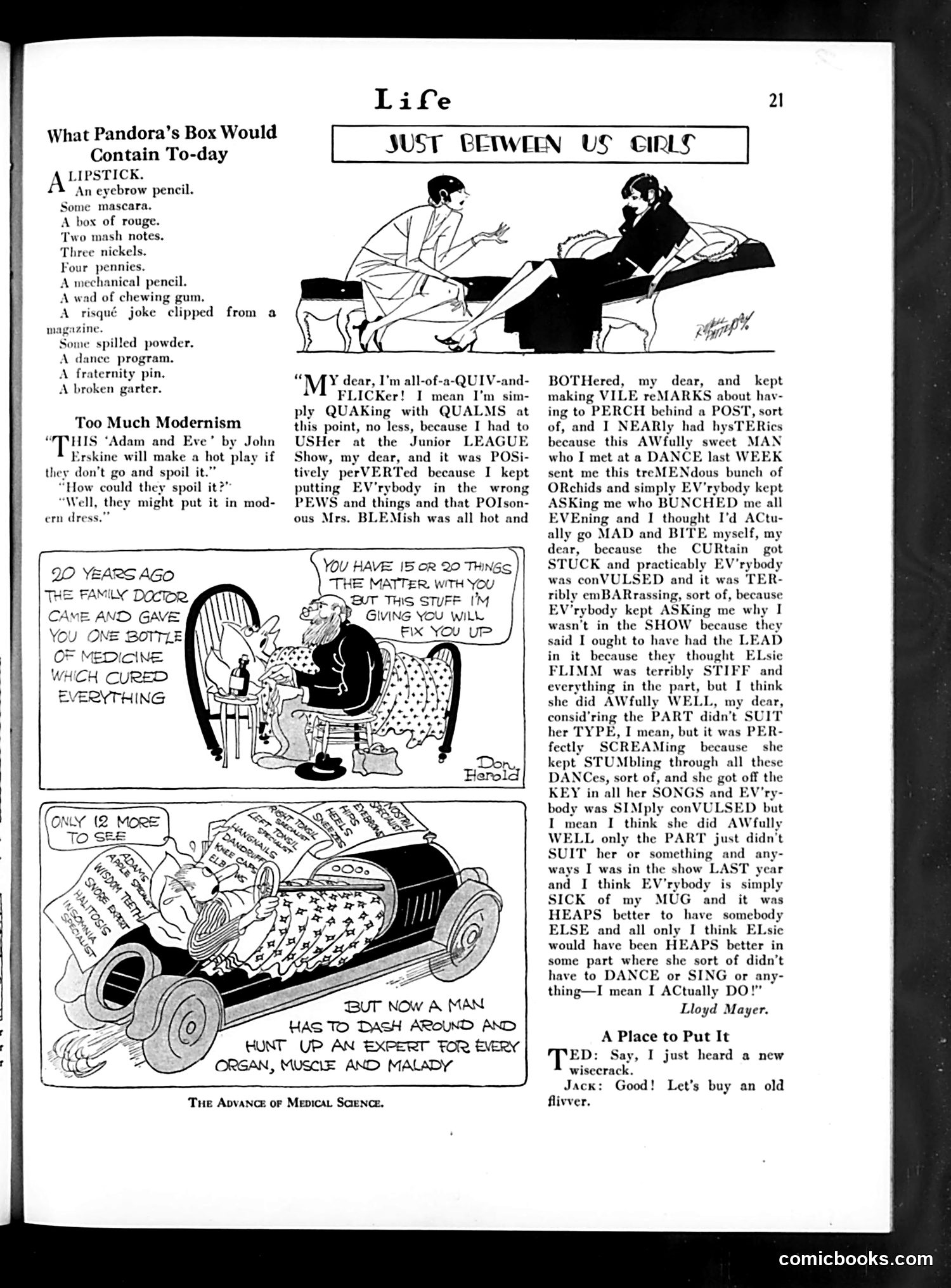
This page satirizes 1920s youth culture and medical advancement through three distinct pieces: **"What Pandora's Box Would Contain To-day"** lists items found in a young woman's purse—cosmetics, dance cards, fraternity pins, broken garters—mocking the modern flapper's preoccupations with appearance and dating. **"Too Much Modernism"** jokes that a classical play would be ruined by staging it in contemporary dress rather than period costume, reflecting anxiety about modernization. **The main cartoon** depicts a woman's breathless account of attending a Junior League show, with random capitalized words suggesting her scattered, gossipy speech pattern. She obsesses over social mishaps, romantic attention, and theatrical drama—satire of how modern women supposedly prioritize trivial social concerns. **"The Advance of Medical Science"** contrasts old medicine (one cure-all bottle) with modern medicine's complexity, requiring specialists for every ailment—satirizing how progress created new problems. The overall theme: modern life, particularly for young women, has become anxious, overstimulated, and superficial.
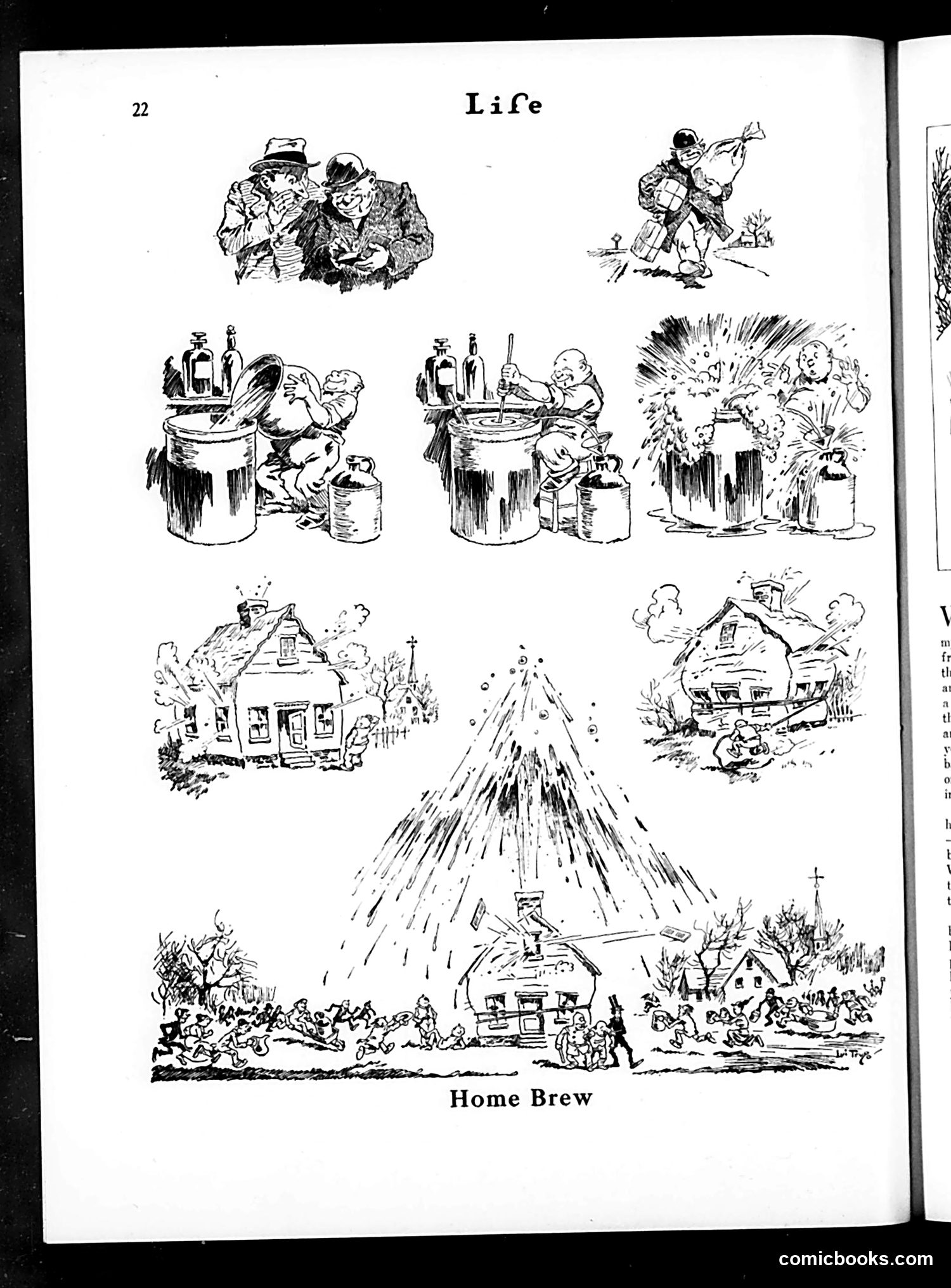
This page satirizes illegal alcohol production during Prohibition (1920-1933). The sequential comic panels show the escalating chaos of amateur "home brewing": It begins with ordinary citizens concocting liquor in household containers, progresses through increasingly explosive accidents (depicted with bursting pots and flying debris), and culminates in a massive volcanic eruption destroying entire neighborhoods. The satire targets the absurdity and danger of Prohibition's unintended consequences: rather than eliminating drinking, the law drove alcohol production underground into untrained hands, creating hazardous conditions. The exaggerated "volcano" finale emphasizes how dangerous and destructive this illicit activity had become to communities. The cartoon mocks both the government policy and citizens' determined efforts to circumvent it, suggesting Prohibition created worse public safety problems than the drinking it aimed to prevent.
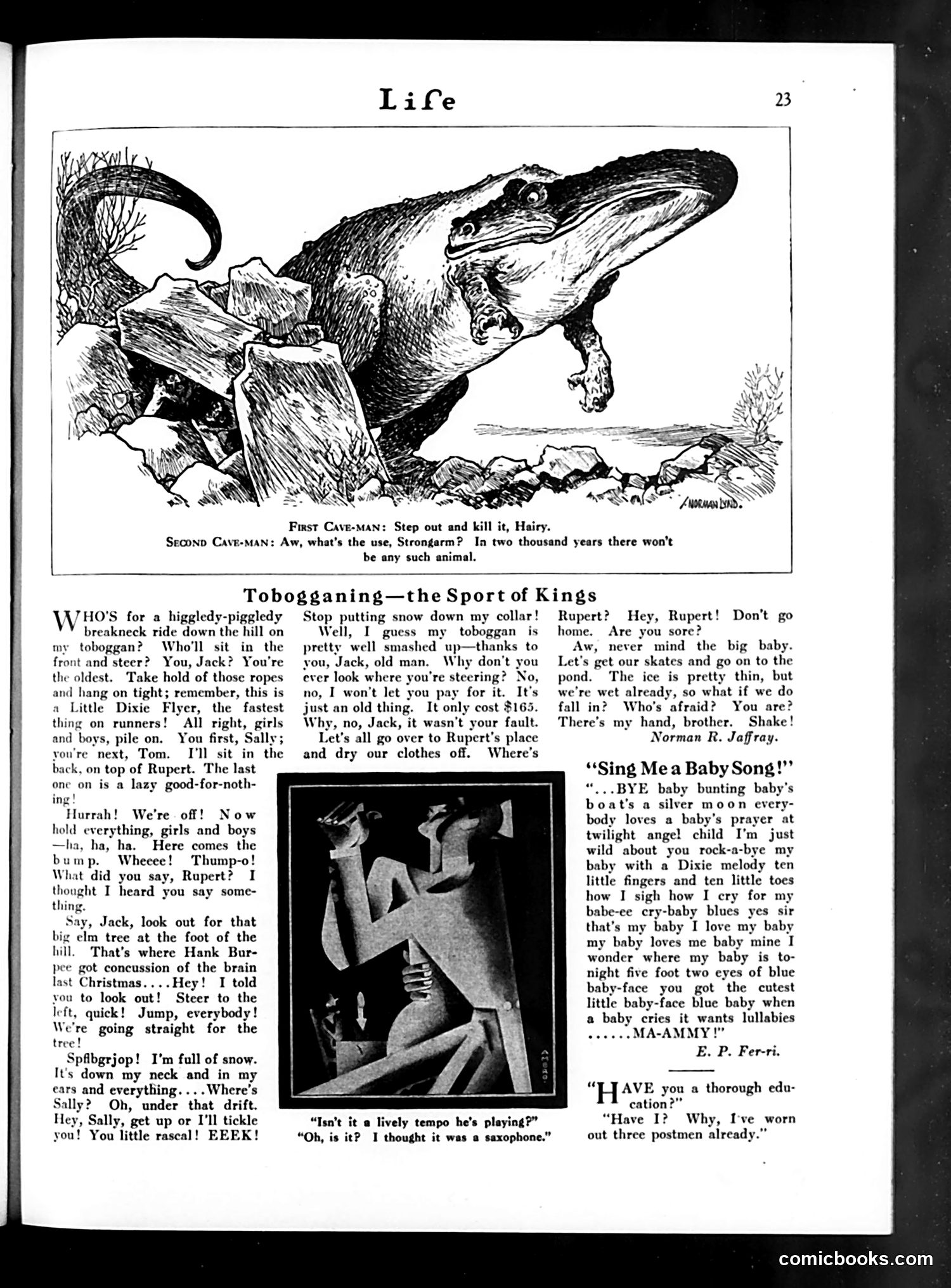
**Top Cartoon (Cave-Man Dialogue):** This is a prehistoric joke about fatalism. One caveman tells another to kill an animal they've encountered, but the second caveman dismisses the effort—in two thousand years, that species won't exist anyway. The satire targets modern pessimism and defeatist attitudes: even in primitive times, someone is apathetic about the future, suggesting this attitude is timeless rather than modern. **"Tobogganing—the Sport of Kings":** A humorous narrative account of upper-class winter recreation gone chaotic. Children toboggan recklessly downhill, crash into trees, injure themselves, yet immediately suggest equally dangerous activities (thin ice skating). The satire mocks wealthy parents' cavalier attitudes toward children's safety and the casual acceptance of injury among the privileged class, who can afford expensive sleds ($165) yet treat them with indifference. **Bottom Items:** Minor humor pieces: one about mistaking a saxophone for lively piano tempo, another parodying sentimental baby songs with overlapping lyrics, and a joke about education (wearing out postmen—unclear reference, possibly mail carriers delivering educational materials).
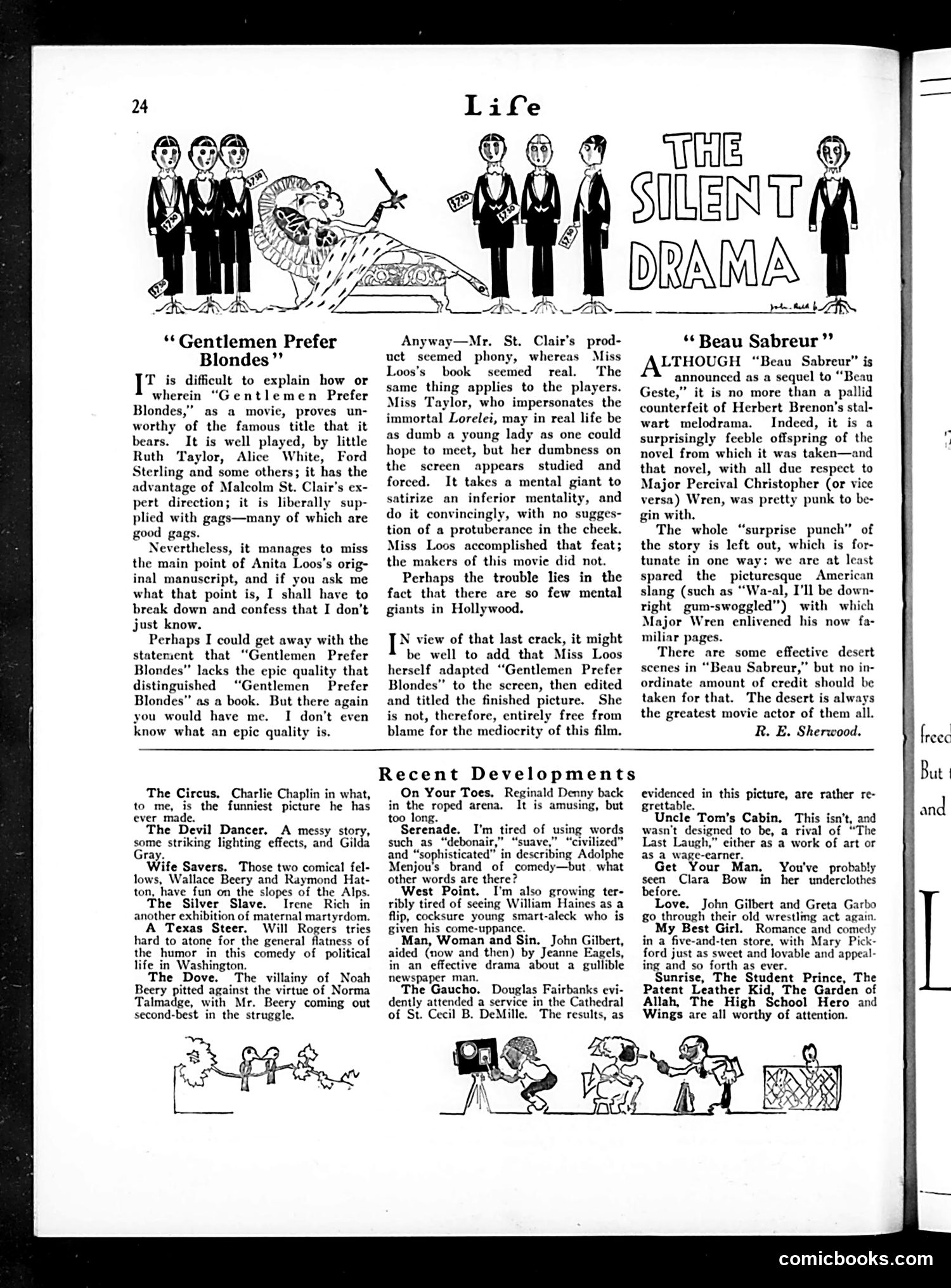
This page contains film reviews from *Life* magazine's entertainment section. The critic (R.E. Sherwood) reviews several silent films, primarily attacking the movie adaptation of "Gentlemen Prefer Blondes"—based on Anita Loos's popular novel—for losing the satirical bite of the original work. He argues the film's portrayal of dimwittedness appears forced rather than genuinely comic, and blames Hollywood's lack of intellectual talent. The cartoon at top depicts the film industry as a spectacle, with suited figures (likely studio executives or stars) alongside an absurdist monster or creature, suggesting the satirical view of cinema-making as chaotic or ridiculous. Other brief reviews praise Charlie Chaplin's *The Circus* as his funniest film, while dismissing "Beau Sabreur" as an inferior sequel. The section also notes comedies featuring Wallace Beery, Will Rogers, and romantic dramas with established stars of the era.
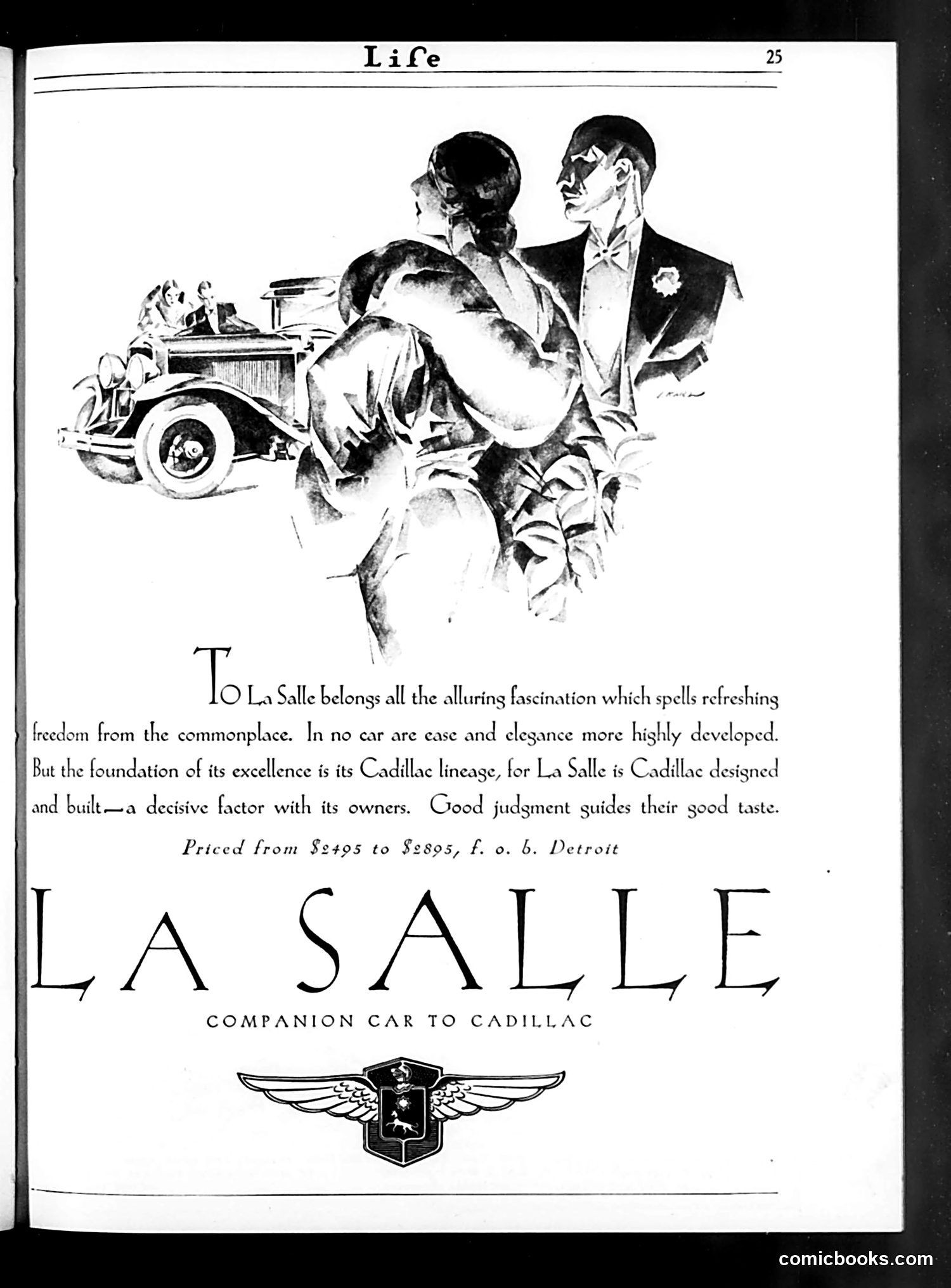
This is **not a political cartoon or satire**—it's a **luxury automobile advertisement** for La Salle, a Cadillac companion brand. The illustration depicts well-dressed, affluent figures (a man in tuxedo and women in elegant dress) near a La Salle automobile, emphasizing sophistication and status. The ad copy claims La Salle offers "ease and elegance" built on Cadillac engineering, marketed as a symbol of refined taste. The prices ($2,495–$2,895) and Detroit location indicate this is from the 1920s–early 1930s American automobile boom, when cars signified wealth and modernity. The ad targets upscale consumers by associating the vehicle with social prestige and "good judgment." This represents mainstream commercial messaging rather than satirical content.
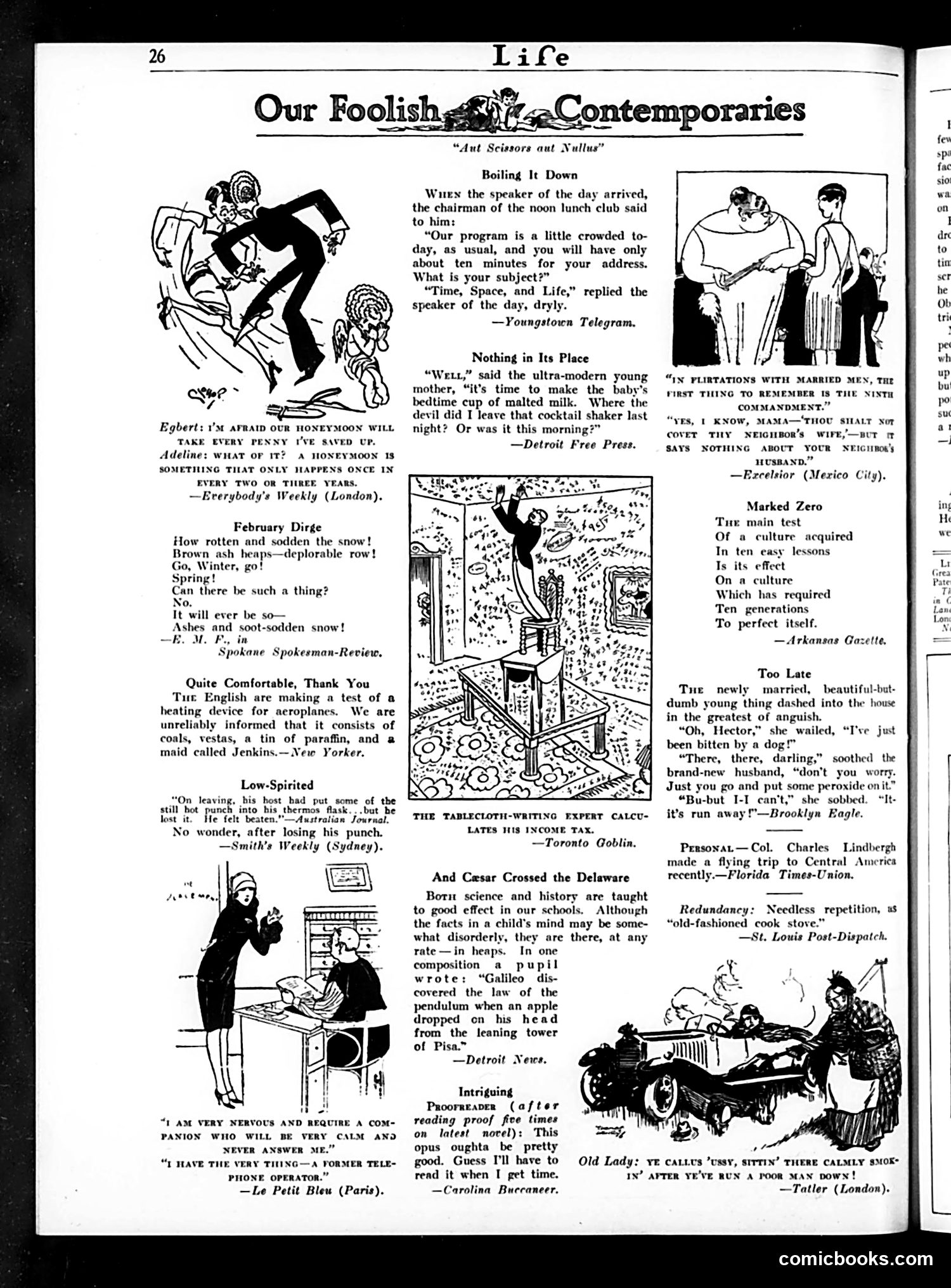
This is a "humor page" from *Life* magazine featuring brief jokes and witticisms from various newspapers and publications, rather than political cartoons. The content satirizes early-20th-century social absurdities: a newlywed woman searching for a "cocktail shaker" to make her baby's milk (mocking modern mothers), a pupil confusing historical facts by claiming Galileo was hit by an apple at the Tower of Pisa (educational incompetence), and a "dumb young thing" unable to apply peroxide to a dog bite because the dog ran away (mocking foolish newlyweds). One cartoon shows a man calculating taxes while writing on a tablecloth—satirizing both tax complexity and modern informality. Another depicts flirtation advice ironically citing the Ninth Commandment while conspicuously avoiding the Tenth. The overall tone mocks contemporary modern life: hasty communication, shallow education, foolish youth, and the chaos of "ultra-modern" living. These pieces represent genteel, middlebrow satire typical of 1920s-30s American magazines.
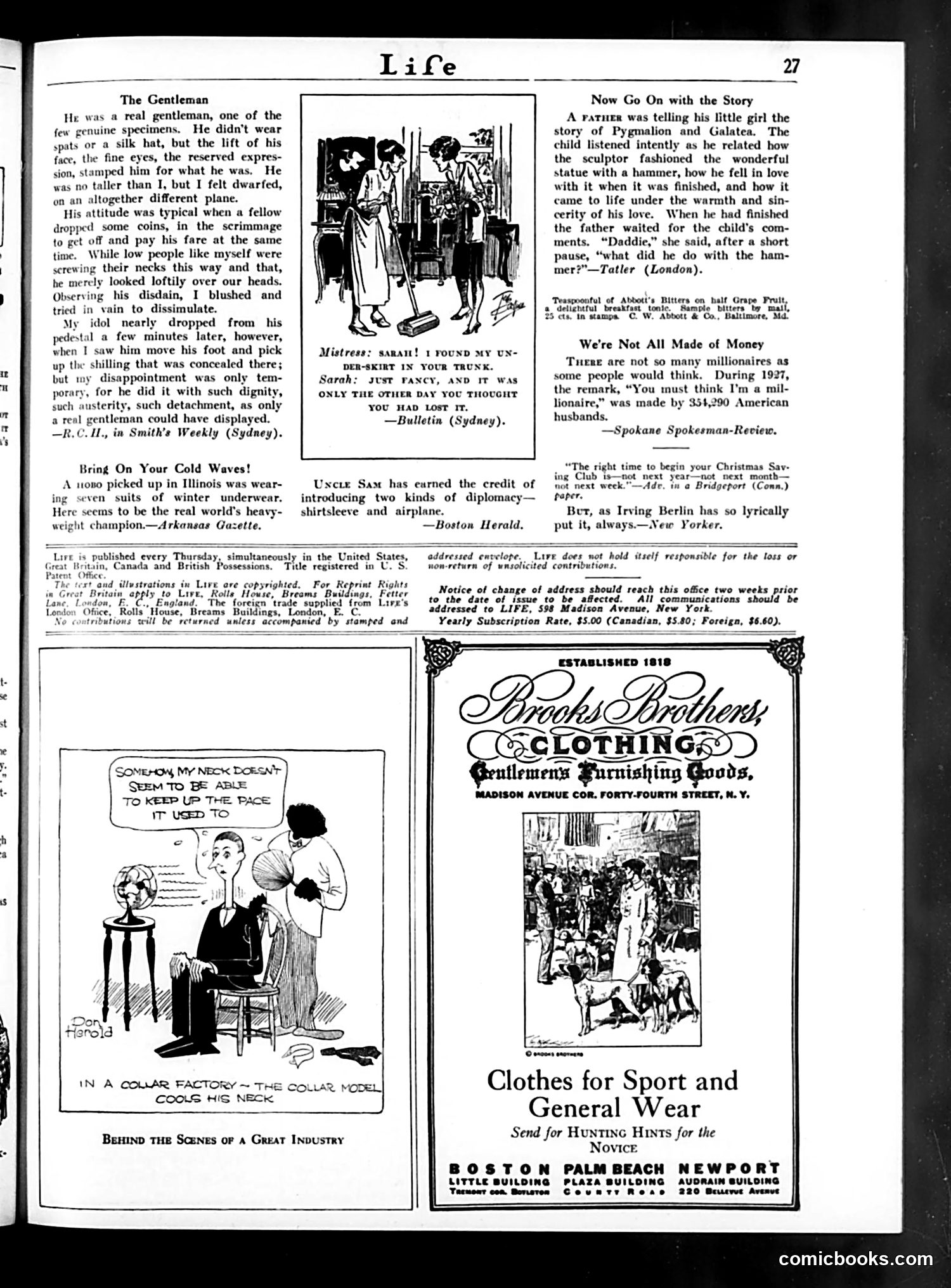
This page contains several short humorous pieces typical of Life's satirical format: **"The Gentleman"** presents an anecdote about class and dignity. A well-dressed man maintains composure while others scramble for coins, but then hypocritically picks up money from the floor—though he does so with such dignified detachment that his gentleman status survives intact. The satire targets pretentious gentility and the gap between appearance and behavior. **"Now Go On with the Story"** is a children's joke: a father finishes telling his daughter the Pygmalion myth but she asks the pragmatic question, "what did he do with the hammer?"—deflating romantic storytelling with literal-minded reality. **"Behind the Scenes of a Great Industry"** is a cartoon about collar manufacturing: a worker's neck cannot keep pace with the factory's collar production, implying both the speed of modern industry and the physical toll on workers. Other brief items mock wealth disparities and modern life. The page also contains Brooks Brothers clothing advertisements.
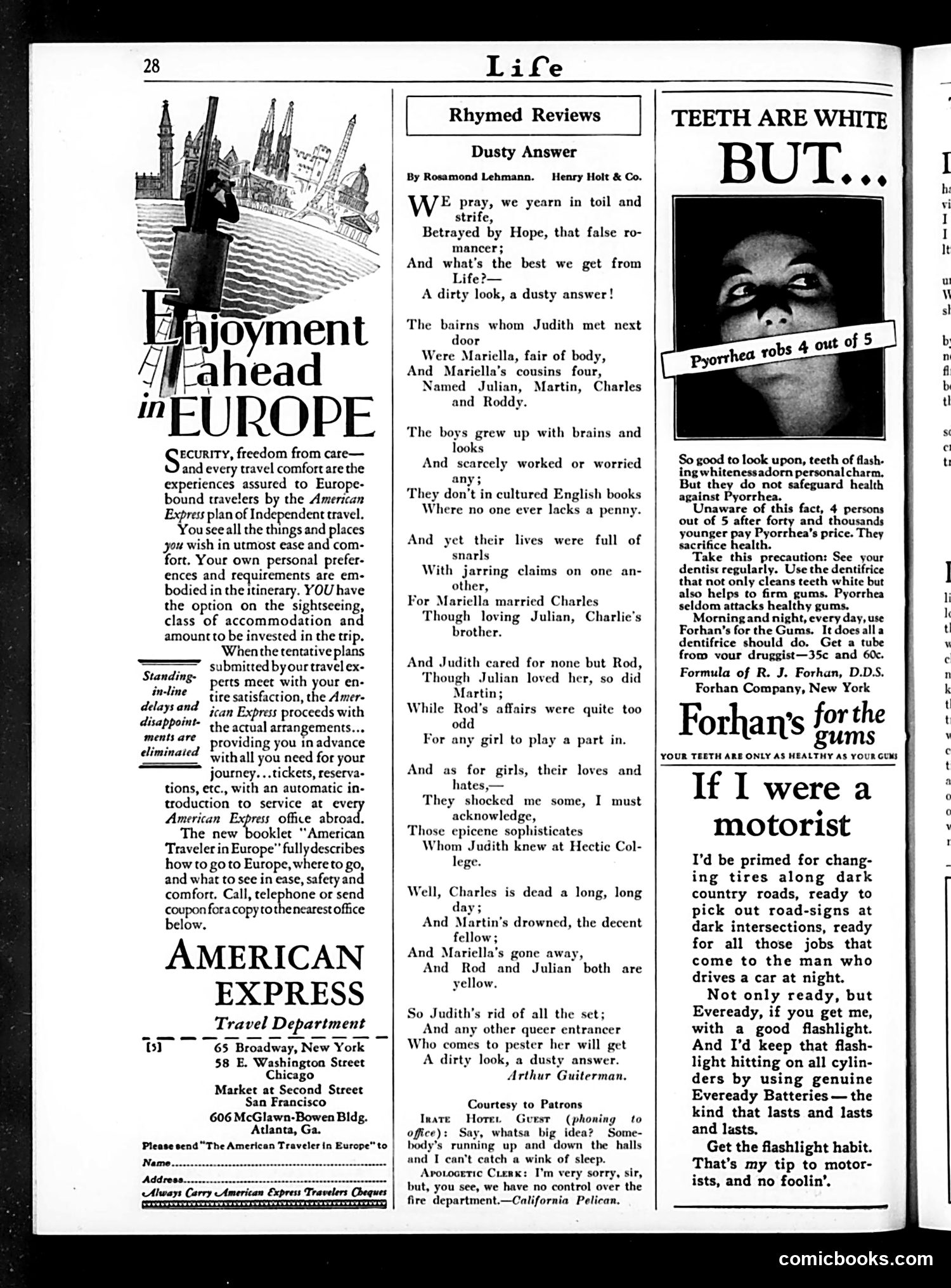
This page mixes editorial content with advertising typical of 1920s Life magazine. **"Dusty Answer" Review**: A poem-format book review by Arthur Guiterman critiques Rosamond Lehmann's novel. The repeated phrase "dusty answer" (meaning unsatisfying response) refers to life's disappointments. The plot involves tangled romantic relationships among young British adults—Judith, Mariella, and four men named Julian, Martin, Charles, and Roddy—where passion leads to tragic outcomes (death, drowning, emotional emptiness). **Advertisements**: The page features multiple ads: - American Express travel services promoting European vacations with personalized itineraries - Forhan's dentifrice (toothpaste) warning about pyorrhea (gum disease) affecting people over 40 - A humorous "If I were a motorist" piece promoting Eveready batteries The "Hotel Guest" joke depicts a frustrated patron calling management about noise from the fire department—absurdist humor emphasizing the hotel's lack of control.
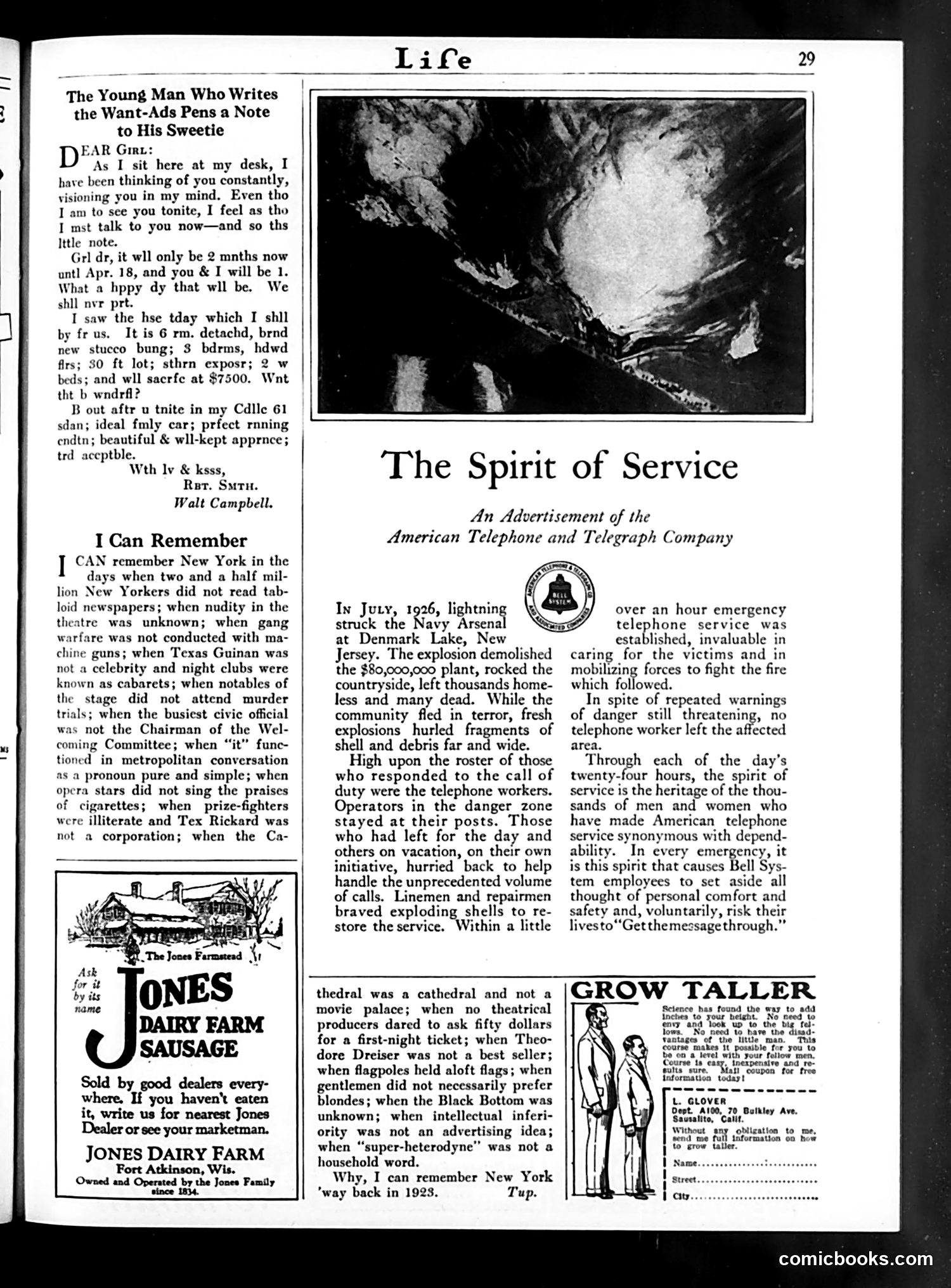
This page contains three distinct satirical pieces: **"The Young Man Who Writes Want-Ads"** mocks a suitor who writes his love note entirely in want-ad abbreviations (hppy dy, wll nvr prt, etc.). The humor lies in the contrast between romantic sentiment and classified-ad shorthand—suggesting his job has consumed his ability to communicate normally. **"I Can Remember"** is nostalgic satire about 1920s social changes. The author claims to remember New York before tabloids, nudity in theater, gang violence, and celebrity culture—then punchlines it by saying he recalls New York "way back in 1923," implying these changes happened almost overnight. It's social commentary on how rapidly American culture shifted in the Jazz Age. **"The Spirit of Service"** is a sincere (non-satirical) AT&T advertisement about telephone workers heroically staying at their posts during a 1926 Navy Arsenal explosion in New Jersey, positioning the company as trustworthy and civic-minded. The page juxtaposes humor with earnest corporate messaging, typical of Life's mixed editorial/advertising format.
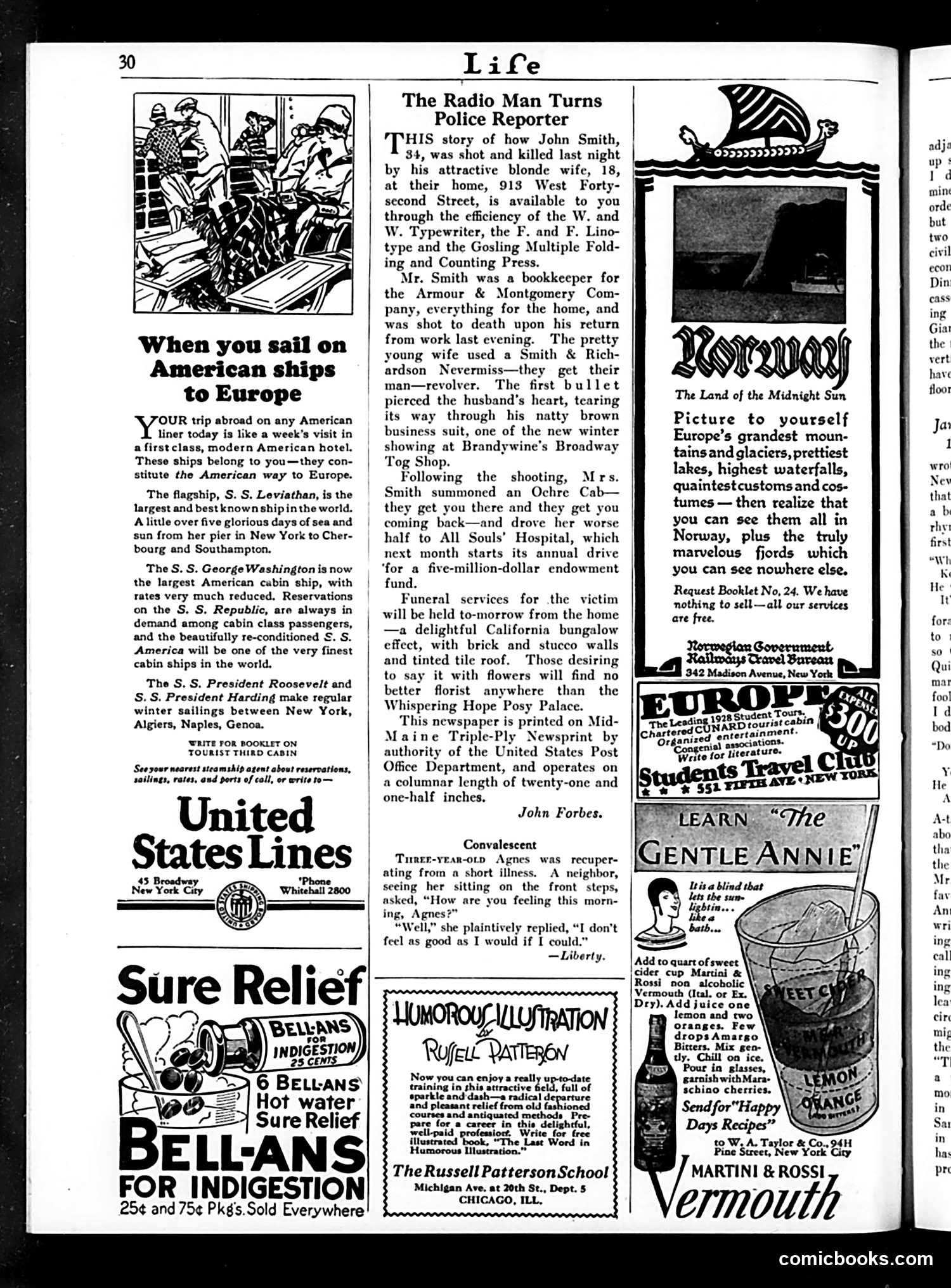
This page is primarily **advertising**, not satirical content. The dominant feature is a travel/shipping advertisement for United States Lines promoting American ocean liners to Europe (the S.S. Leviathan, George Washington, etc.). The only satirical piece is "The Radio Man Turns Police Reporter" by John Forbes—a brief joke about newspaper sensationalism. It mockingly describes a murder story while *inserting advertisements* for the products used to report it: typewriters, printing equipment, taxi services, hospitals, florists, and newsprint. The satire targets how newspapers shamelessly embed commercial plugging throughout news coverage, treating a tragedy as a vehicle for product promotion. The absurd catalog of brand-name sponsorships for each element of the crime story illustrates the era's aggressive advertising infiltration of journalism. The page also contains product ads (Bellans indigestion remedy, Martini & Rossi vermouth) and a humorous illustration by Russell Patterson.
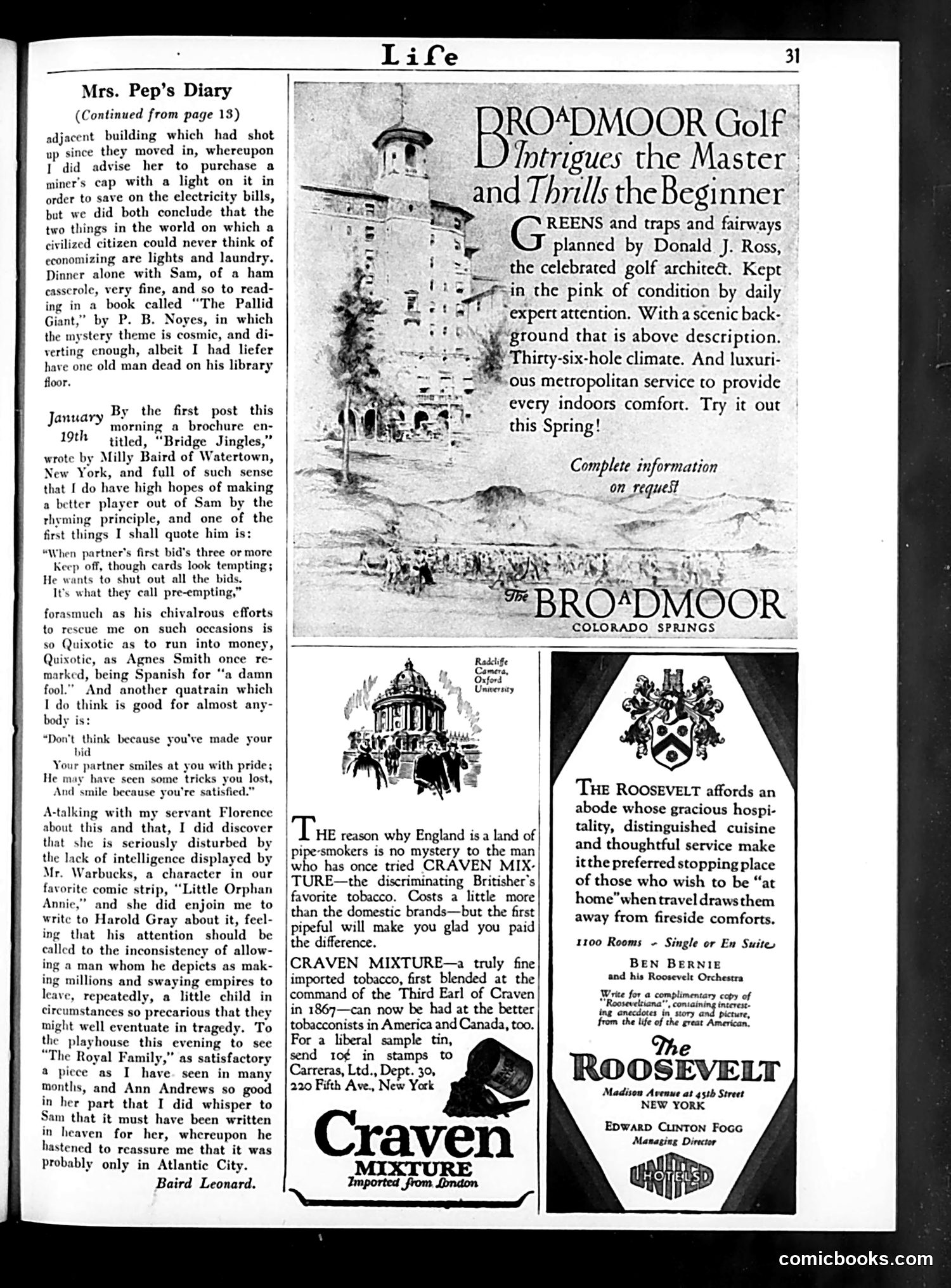
This page is primarily **advertising with a diary column**—not political satire. The diary ("Mrs. Pep's Diary") records mundane domestic observations: a woman notes her neighbor's dark apartment, reads a bridge strategy book, discusses the inconsistency of a comic-strip character (Little Orphan Annie's Mr. Warbucks), and sees a Broadway play. The advertisements promote luxury destinations and tobacco: - **Broadmoor Golf Course** in Colorado Springs - **Craven Mixture** tobacco, positioned as superior British import - **The Roosevelt Hotel** in New York The humor is gentle and domestic rather than political—it satirizes upper-middle-class concerns (lighting bills, bridge etiquette, servant conversations). The diary's closing joke about "The Royal Family" being "probably only in Atlantic City" is typical period wit. There is **no cartoon** on this page; it's typical 1920s Life magazine mixing lifestyle commentary with branded advertisements aimed at affluent readers.
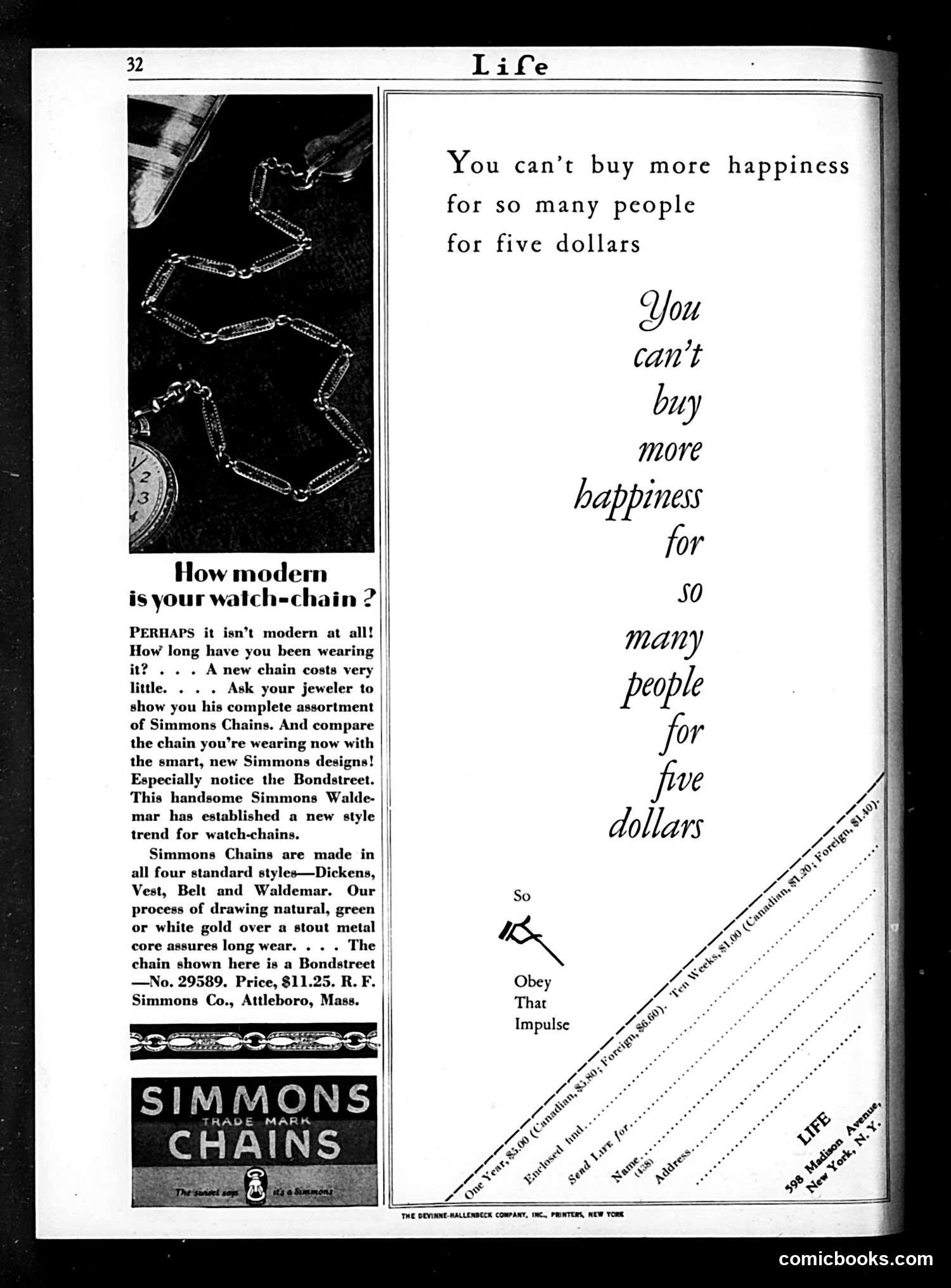
This page contains **two distinct advertisements**, not political cartoons. **Left side:** A Simmons Chains watch-chain advertisement asking "How modern is your watch-chain?" It urges readers to update their outdated chains with newer Simmons designs (Bondstreet, Waldemar styles), emphasizing that modernization is affordable—a new chain "costs very little." **Right side:** An advertisement (likely for a charitable cause or impulse purchase product) uses clever wordplay. The large text repeats "You can't buy more happiness for so many people for five dollars," then smaller text says the opposite: "You can't buy more happiness for so many people for five dollars." The final phrase "Obey That Impulse" suggests encouraging spontaneous giving or purchasing. Both ads reflect early 20th-century consumer culture: the emphasis on fashion updates and affordable luxury, and the appeal to impulse spending as a path to happiness or virtue.

I can see this is a very dark, low-contrast image from Life magazine that appears to show some illustrated content on the right side with spiral or circular design elements, but the image quality and darkness make it extremely difficult to discern specific details, figures, or text clearly. The left side appears mostly blank/black, and while there are some spiral motifs visible on the right, I cannot reliably identify any specific political figures, caricatures, or cartoon subjects with confidence. Without being able to read the accompanying text clearly or identify distinct visual elements, I cannot accurately explain what satire or political/social commentary this page contains. A higher-contrast or clearer version of this image would be needed for proper analysis.