
Life, 1928-02-09 · page 16 of 35
Life — February 9, 1928 — page 16: what you’re looking at
What you’re looking at
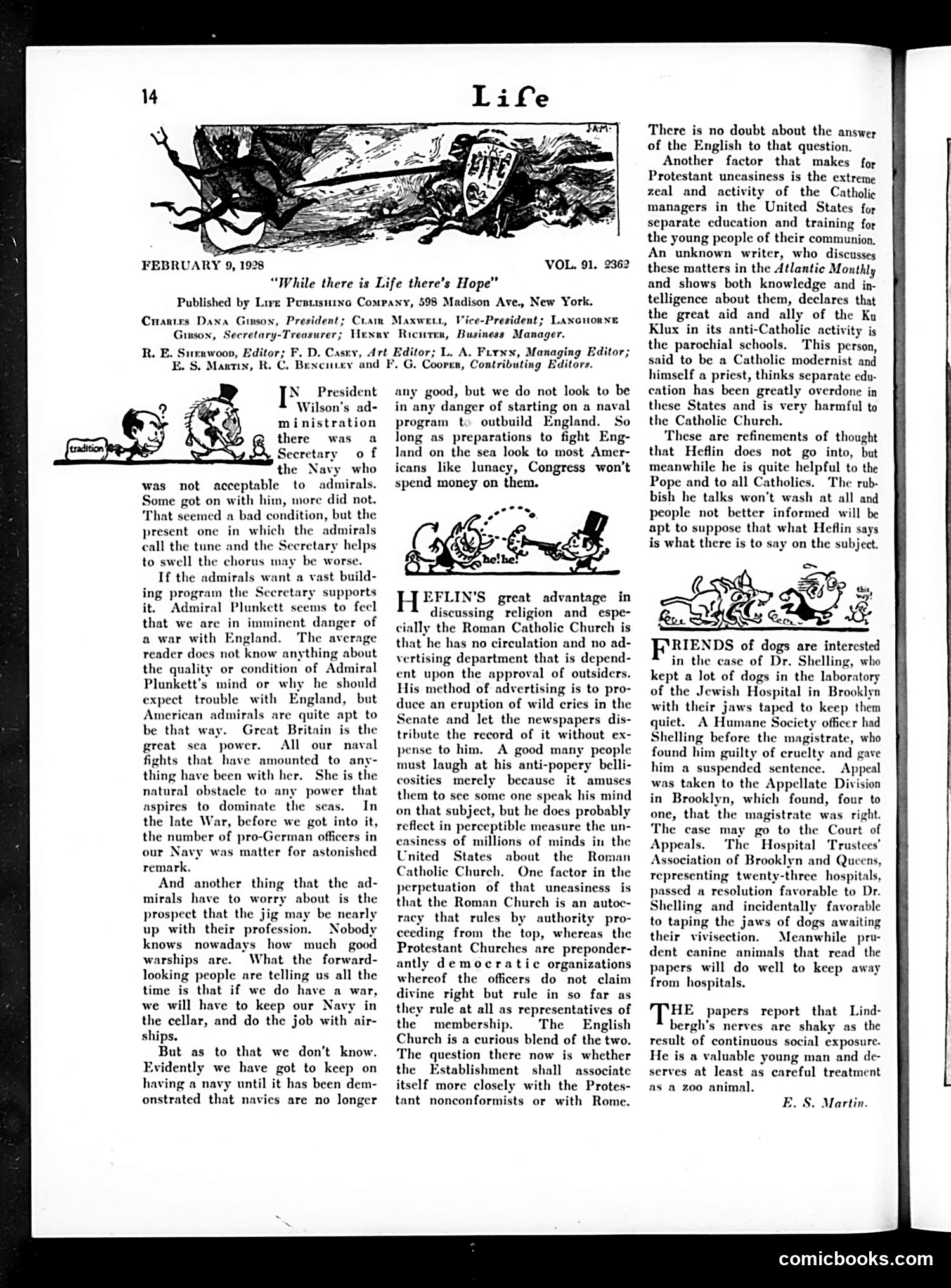
The page contains two editorial cartoons addressing British naval policy and American military preparedness. The first cartoon depicts President Wilson's administration facing criticism from admirals about naval building programs. The accompanying text discusses whether Congress should fund military expansion, with the satirical point being that American admirals support large military budgets while politicians remain hesitant about expenditures. The second cartoon (less clearly visible) appears related to similar military-preparedness debates of the period. The editorial also addresses religious controversy regarding Catholic education in America and discusses Lindbergh's recent nervous condition—likely referencing his ongoing public stress following his son's kidnapping case (1932 context unclear from this 1928 date). The satire targets military-industrial pressure and political indecision about defense spending.
📄 Transcribed text from this page (OCR, searchable)
Machine-transcribed from the original scan — historical spelling and the odd misread are preserved.
FEBRUARY 9, 1928 VOL. 91. 2362 “While there is Life there’s Hope” Published by Lire Pcstisuixc Company, 598 Madison Ave., New York. Crantrs Dana Ginson, President; Cram Maxwett, Vice-President; Laxouorne Ginsox, Secretary-Treasurer; Hexny Ricuter, Business Manager. R. E. Surrrwoop, E. S, Mantin, R. C. N_ President Wilson’s ad- ministration there was a Secretary of the Navy who was not acceptable to admirals. Some got on with him, more did not. That seemed a bad condition, but the present one in which the admirals call the tune and the Secretary helps to swell the chorus may be worse. If the admirals want a vast build- ing program the Secretary supports it. Admiral Plunkett seems to feel that we are in imminent danger of a war with England. The average reader does not know anything about the quality or condition of Admiral Plunkett’s mind or why he should expect trouble with England, but American admirals are quite apt to be that way. Great Britain is the great sea power. All our naval fights that have amounted to any- thing have been with her. She is the natural obstacle to any power that aspires to dominate the seas. In the late War, before we got into it, the number of pro-German officers in our Navy was matter for astonished remark. And another thing that the ad- mirals have to worry about is the prospect that the jig may be nearly up with their profession. Nobody knows nowadays how much good warships are. What the forward- looking people are telling us all the time is that if we do have a war, we will have to keep our Navy in the cellar, and do the job with air- ships. But as to that we don’t know. Evidently we have got to keep on having a navy until it has been dem- onstrated that navies are no longer sxy, Art Editor; L. A. Furxx, Managing Editor; tev and F, G. Coorrr, Contributing Editors. yy good, but we do not look to be in any danger of starting on a naval program t: outbuild England. So long as preparations to fight Eng- land on the sea look to most Amer- icans like lunacy, Congress won't spend money on them. EFLIN’S great advantage in discussing religion and espe- cially the Roman Catholic Church is that he has no circulation and no ad- vertising department that is depend- ent upon the approval of outsiders. His method of advertising is to pro- duce an eruption of wild cries in the Senate and let the newspapers dis- tribute the record of it without ex- pense to him. A good many people must laugh at his anti-popery belli- cosities merely because it amuses them to see some one speak his mind on that subject, but he does probably reflect in perceptible measure the un- easiness of millions of minds in the United States about the Roman Catholic Church. One factor in the perpetuation of that uneasiness is that the Roman Church is an autoc- racy that rules by authority pro- ceeding from the top, whereas the Protestant Churches are preponder- antly democratic organizations whereof the officers do not claim divine right but rule in so far as they rule at all as representatives of the membership. The English Church is a curious blend of the two. The question there now is whether the Establishment shall associate itself more closely with the Protes- tant nonconformists or with Rome. There is no doubt about the answer of the English to that question. Another factor that makes for Protestant uncasiness is the extreme zeal and activity of the Catholic managers in the United States for separate education and training for the young people of their communion. An unknown writer, who discusses these matters in the Atlantic Monthl and shows both knowledge and in- telligence about them, declares that the great aid and ally of the Ku Klux in its anti-Catholic activity is the parochial schools. This person, said to be a Catholic modernist and himself a priest, thinks separate edu- cation has been greatly overdone in these States and is very harmful to the Catholic Church. These are refinements of thought that Heflin does not go into, but meanwhile he is quite helpful to the Pope and to all Catholics. The rub- bish he talks won't wash at all and people not better informed will be apt to suppose that what Heflin says is what there is to say on the subject. ~ a oe RIENDS of dogs are interested in the case of Dr. Shelling, who kept a lot of dogs in the laboratory of the Jewish Hospital in Brooklyn with their jaws taped to keep them quiet. A Humane Society officer had Shelling before the magistrate, who found him guilty of cruelty and gave him a suspended sentence. Appeal was taken to the Appellate Division in Brooklyn, which found, four to one, that the magistrate was right. The case may go to the Court of Appeals. The Hospital Trustees’ Association of Brooklyn and Queens, representing twenty-three hospitals, passed a resolution favorable to Dr. Shelling and incidentally favorable to taping the jaws of dogs awaiting their vivisection. Meanwhile pru- dent canine animals that read the papers will do well to keep away from hospitals. HE papers report that Lind- bergh’s nerves are shaky as the result of continuous social exposure. He is a valuable young man and de- serves at least as careful treatment as a zoo animal. E. 8. Martin. comicbooks.com