
Life, 1928-02-09 · page 26 of 35
Life — February 9, 1928 — page 26: what you’re looking at
What you’re looking at
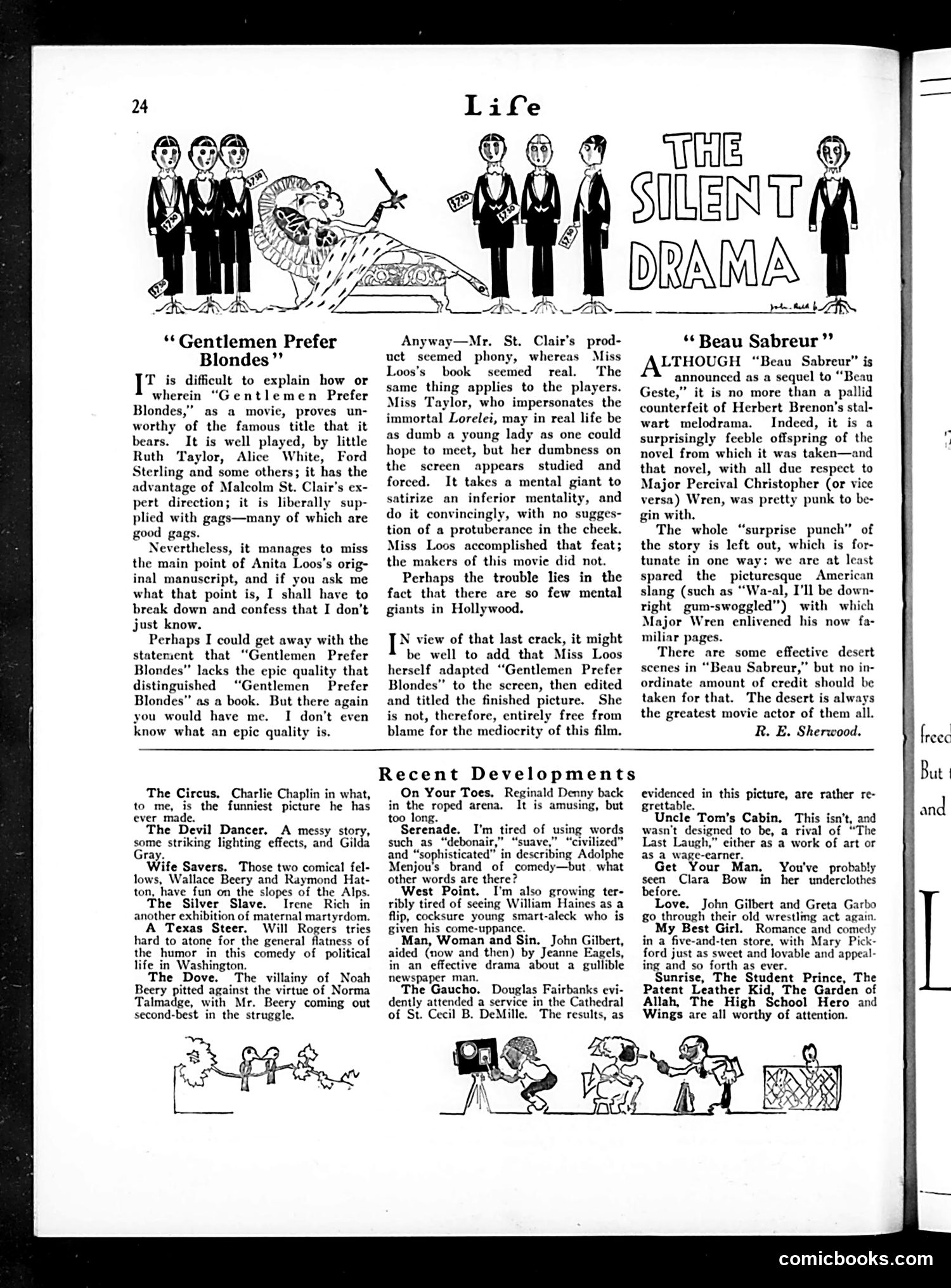
This page contains film reviews from *Life* magazine's entertainment section. The critic (R.E. Sherwood) reviews several silent films, primarily attacking the movie adaptation of "Gentlemen Prefer Blondes"—based on Anita Loos's popular novel—for losing the satirical bite of the original work. He argues the film's portrayal of dimwittedness appears forced rather than genuinely comic, and blames Hollywood's lack of intellectual talent. The cartoon at top depicts the film industry as a spectacle, with suited figures (likely studio executives or stars) alongside an absurdist monster or creature, suggesting the satirical view of cinema-making as chaotic or ridiculous. Other brief reviews praise Charlie Chaplin's *The Circus* as his funniest film, while dismissing "Beau Sabreur" as an inferior sequel. The section also notes comedies featuring Wallace Beery, Will Rogers, and romantic dramas with established stars of the era.
📄 Transcribed text from this page (OCR, searchable)
Machine-transcribed from the original scan — historical spelling and the odd misread are preserved.
‘*Gentlemen Prefer Blondes”’ T is difficult to explain how or wherein “Gentlemen Prefer Blondes,” as a movie, proves un- worthy of the famous title that it bears. It is well played, by little Ruth Taylor, Alice White, Ford Sterling and some others; it has the advantage of Malcolm St. Clair’s ex- pert direction; it is liberally sup- plied with gags—many of which are good gags. Nevertheless, it manages to miss the main point of Anita Loos’s orig- inal manuscript, and if you ask me what that point is, I shall have to break down and confess that I don’t just know. Perhaps I could get away with the statement that “Gentlemen Prefer Blondes” lacks the epic quality that distinguished “Gentlemen Prefer Blondes” as a book. But there again you would have me. I don’t even know what an epic quality is. Anyway—Mr. St. Clair’s prod- uct seemed phony, whereas Miss Loos’s book seemed real. The same thing applies to the players. Miss Taylor, who impersonates the immortal Lorelei, may in real life be as dumb a young lady as one could hope to meet, but her dumbness on the screen appears studied and forced. It takes a mental giant to satirize an inferior mentality, and do it convincingly, with no sugges- tion of a protuberance in the cheek. Miss Loos accomplished that feat; the makers of this movie did not. Perhaps the trouble lies in the fact that there are so few mental giants in Hollywood. I< view of that last crack, it might be well to add that Miss Loos herself adapted “Gentlemen Prefer Blondes” to the sereen, then edited and titled the finished picture. She is not, therefore, entirely free from blame for the mediocrity of this film. ‘Beau Sabreur” LTHOUGH “Beau Sabreur” is announced as a sequel to “Beau Geste,” it is no more than a pallid counterfeit of Herbert Brenon’s stal- wart melodrama. Indeed, it is a surprisingly feeble offspring of the novel from which it was taken—and that novel, with all due respect to Major Percival Christopher (or vice versa) Wren, was pretty punk to be- gin with, The whole “surprise punch” of the story is left out, which is for- tunate in one way: we are at least spared the picturesque American slang (such as “Wa-al, I'll be down- right gum-swoggled”) with which Major Wren enlivened his now fa- miliar pages. There are some effective desert scenes in “Beau Sabreur,” but no in- ordinate amount of credit should be taken for that. The desert is always the greatest movie actor of them all. R. E. Sherwood. The Circus, Charlie Chaplin in what, to me, is the funniest picture he has ever made. The Devil Dancer. A messy story, some striking lighting effects, and Gilda Gray. Wife Savers. Those two comical fel- lows, Wallace Beery and Raymond Hat- ton, have fun on the slopes of the Alps. The Silver Slave. Irene Rich in another exhibition of maternal martyrdom. A Texas Steer. Will Rogers tries hard to atone for the general flatness of the humor in this comedy of political life in Washington. ‘he Dove. The villainy of Noah Beery pitted against the virtue of Norma Talmadge, with Mr. Beery coming out second-best in the struggle. Recent Developments On Your Toes. Reginald Denny back in the roped arena. It is amusing, but too long. Serenade. I'm tired of using words such as “debonair,” “suave,” “civilized” and “sophisticated” in describing Adolphe Menjou's brand of comedy—but what other words are there? West Point. I'm also growing ter- ribly tired of seeing William Haines as a flip, cocksure young smart-aleck who is given his come-uppance. Man, Woman and Sin. _John Gilbert, aided (now and then) by Jeanne Eagels, in an effective drama about a gullible newspaper man. The Gaucho. Douglas Fairbanks evi- dently attended a service in the Cathedral of St. Cecil B. DeMille. The results, as evidenced in this picture, are rather re- grettable. Uncle Tom’s Cabin. This isn’t, and wasn't designed to be, a rival of “The Last Laugh,” cither as a work of art or as a wage-carner. Get Your Man. You've probably seen Clara Bow in her underclothes before. Love. John Gilbert and Greta Garbo go through their old wrestling act again. My Best Girl. Romance and comedy in a five-and-ten store, with Mary Pick- ford just as sweet and lovable and appeal- ing and so forth as ever. Sunrise, The Student Prince, The Patent Leather Kid, The Garden of Allah, The High School Hero and Wings are all worthy of attention. freec . But | and comicbooks.com