
Life, 1928-02-09 · page 21 of 35
Life — February 9, 1928 — page 21: what you’re looking at
What you’re looking at
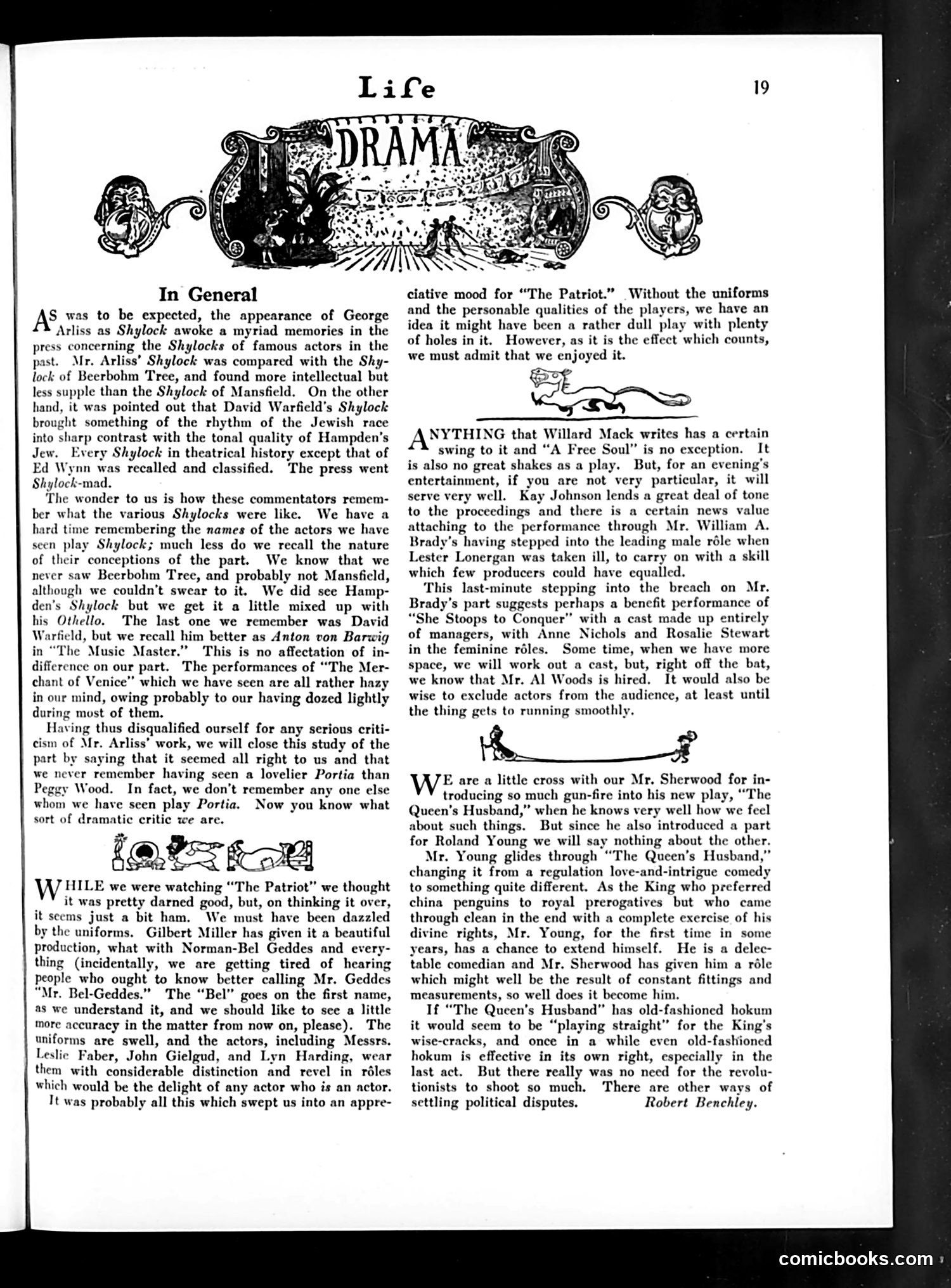
This page contains theater reviews by Life's drama critic, likely Robert Benchley (bylined at bottom). The critic discusses three Broadway productions with characteristic self-deprecating humor: **"The Merchant of Venice"**: George Arliss plays Shylock. The critic admits complete inability to remember previous productions of this play, confessing they dozed through performances and can barely recall actors' names. They praise Peggy Wood as Portia while acknowledging their incompetence as a critic. **"The Patriot"**: A production by Gilbert Miller featuring John Gielgud and others. The critic admits the play seems "ham" upon reflection, but was initially impressed by elaborate Norman-Bel Geddes sets and handsome uniforms. The satire: superficial production values fooled them into enjoying a weak script. **"A Free Soul"**: By Willard Mack, starring Kay Johnson. Notable for William A. Brady stepping in as leading man when the original actor became ill—the critic jokingly suggests this demonstrates managers could perform better than professional actors. The humor relies on the critic's self-aware admission of shallow judgment based on spectacle rather than dramatic merit.
📄 Transcribed text from this page (OCR, searchable)
Machine-transcribed from the original scan — historical spelling and the odd misread are preserved.
In General AS was to be expected, the appearance of George Arliss as Shylock awoke a myriad memories in the press concerning the Shylocks of famous actors in the past. Mr. Arliss’ Shylock was compared with the Shy- lock of Beerbohm Tree, and found more intellectual but less supple than the Shylock of Mansfield. On the other hand, it was pointed out that David Warfield’s Shylock brought something of the rhythm of the Jewish race into sharp contrast with the tonal quality of Hampden’s Jew. Every Shylock in theatrical history except that of Ed Wynn was recalled and classified. The press went Shylock-mad, The wonder to us is how these commentators remem- ber what the various Shylocks were like. We have a hard time remembering the names of the actors we have seen play Shylock; much less do we recall the nature of their conceptions of the part. We know that we never saw Beerbohm Tree, and probably not Mansfield, although we couldn’t swear to it. We did see Hamp- den's Shylock but we get it a little mixed up with his Othello, The last one we remember was David Warfield, but we recall him better as Anton von Barwig in “The Music Master.” This is no affectation of in- difference on our part. The performances of “The Mer- chant of Venice” which we have seen are all rather hazy in our mind, owing probably to our having dozed lightly during most of them. Having thus disqualified ourself for any serious criti- cism of Mr. Arliss’ work, we will close this study of the part by saying that it seemed all right to us and that we never remember having seen a lovelier Portia than Peggy Wood. In fact, we don’t remember any one else whom we have seen play Portia. Now you know what sort of dramatic critic we are. L@2= ha HILE we were watching “The Patriot” we thought it was pretty darned good, but, on thinking it over, it seems just a bit ham. We must have been dazzled by the uniforms. Gilbert Miller has given it a beautiful production, what with Norman-Bel Geddes and every- thing (incidentally, we are getting tired of hearing people who ought to know better calling Mr. Geddes “Mr. Bel-Geddes.” The “Bel” goes on the first name, as we understand it, and we should like to see a little more accuracy in the matter from now on, please). The uniforms are swell, and the actors, including Messrs. Leslic Faber, John Gielgud, and Lyn Harding, wear them with considerable distinction and revel in réles which would be the delight of any actor who is an actor. It was probably all this which swept us into an appre- ciative mood for “The Patriot.” Without the uniforms and the personable qualities of the players, we have an idea it might have been a rather dull play with plenty of holes in it. However, as it is the effect which counts, we must admit that we enjoyed it. nD Spain, NYTHING that Willard Mack writes has a certain swing to it and “A Free Soul” is no exception. It is also no great shakes as a play. But, for an evening's entertainment, if you are not very particular, it will serve very well. Kay Johnson lends a great deal of tone to the proceedings and there is a certain news value attaching to the performance through Mr. William A. Brady's having stepped into the leading male réle when Lester Lonergan was taken ill, to carry on with a skill which few producers could have equalled. This last-minute stepping into the breach on Mr. Brady’s part suggests perhaps a benefit performance of “She Stoops to Conquer” with a cast made up entirely of managers, with Anne Nichols and Rosalie Stewart in the feminine réles. Some time, when we have more space, we will work out a cast, but, right off the bat, we know that Mr. Al Woods is hired. It would also be wise to exclude actors from the audience, at least until the thing gets to running smoothly, as E are a little cross with our Mr. Sherwood for in- troducing so much gun-fire into his new play, “The Queen’s Husband,” when he knows very well how we feel about such things. But since he also introduced a part for Roland Young we will say nothing about the other. Mr. Young glides through “The Queen’s Husband,” changing it from a regulation love-and-intrigue comedy to something quite different. As the King who preferred china penguins to royal prerogatives but who came through clean in the end with a complete exercise of his divine rights, Mr. Young, for the first time in some years, has a chance to extend himself. He is a delec- table comedian and Mr. Sherwood has given him a réle which might well be the result of constant fittings and measurements, so well does it become him. If “The Queen’s Husband” has old-fashioned hokum it would seem to be “playing straight” for the King’s wise-cracks, and once in a while even old-fashioned hokum is effective in its own right, especially in the last act. But there really was no need for the revolu- tionists to shoot so much. There are other ways of settling political disputes, Robert Benchley. comicbooks.com :