
Life, 1928-02-09 · page 7 of 35
Life — February 9, 1928 — page 7: what you’re looking at
What you’re looking at
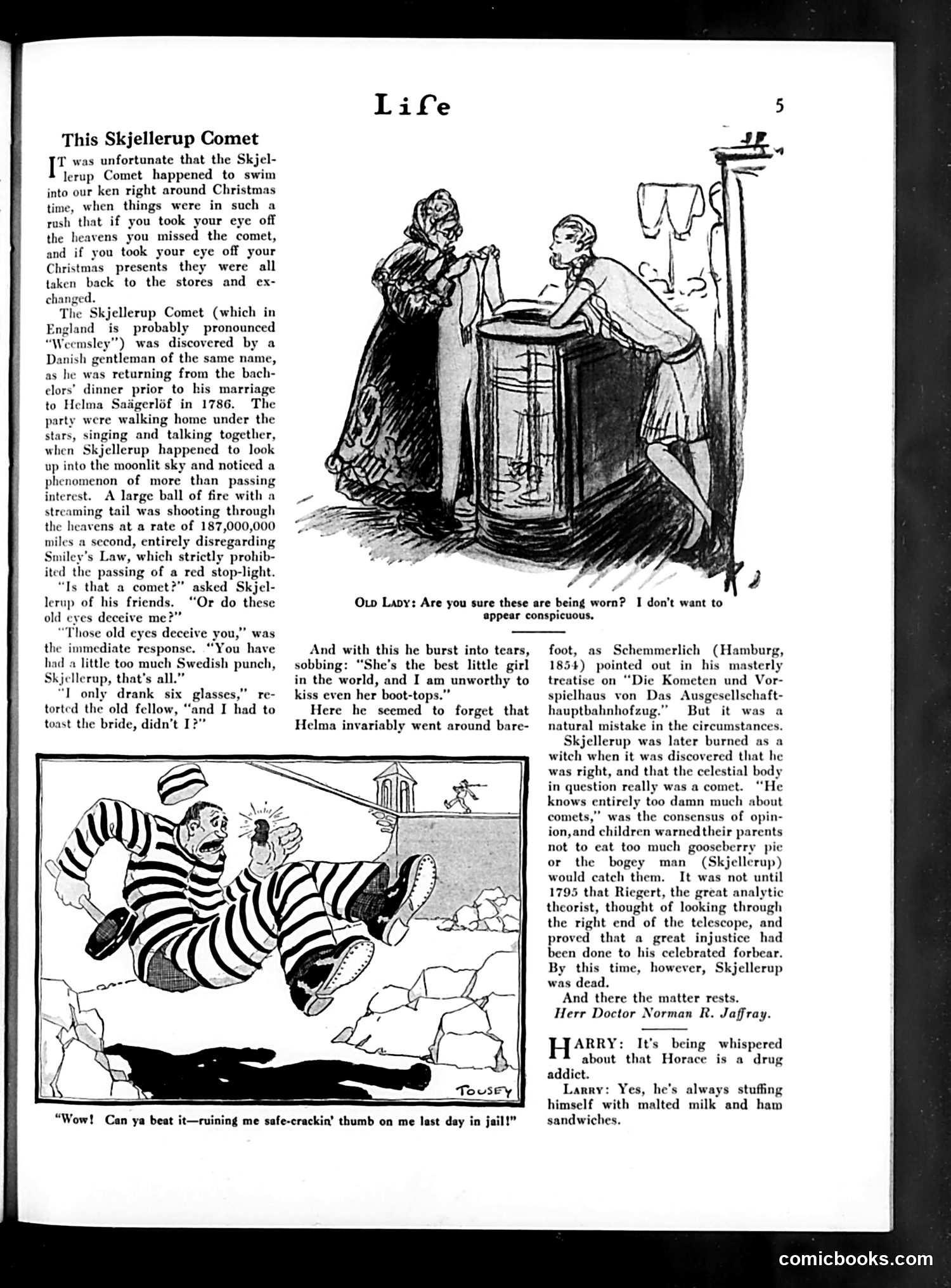
This page from *Life* magazine contains two distinct items: **"This Skjellerup Comet"** is a humorous historical anecdote about a 1786 comet discovery that disrupted a Danish gentleman's wedding plans. The text satirizes superstitious beliefs—people thought the comet was an ill omen, and later a woman was burned as a "witch" when the comet was mistakenly identified. The joke mocks both past superstition and the groom's self-centered response to celestial events. **The cartoon below** by Tousey shows a man in striped clothing tumbling through snow, with the caption about ruining his thumb in jail. The satire appears to mock someone's misfortune or clumsiness. **The dialogue at bottom** between Harry and Larry references "Horace" being a "drug addict" who consumes malted milk and sandwiches—light social commentary on dietary habits, likely poking fun at contemporary food trends or a recognizable figure.
📄 Transcribed text from this page (OCR, searchable)
Machine-transcribed from the original scan — historical spelling and the odd misread are preserved.
This Skjellerup Comet T was unfortunate that the Skjel- lerup Comet happened to swim into our ken right around Christmas time, when things were in such a rush that if you took your eye off the heavens you missed the comet, and if you took your eye off your Christmas presents they were all taken back to the stores and ex- d jellerup Comet (which in a is probably pronounced -msley”) was discovered by a Danish gentleman of the same name, as he was returning from the bach- elors’ dinner prior to his marriage to Helma Saiigerléf in 1786. The party were walking home under the stars, singing and talking together, when Skjellerup happened to look up into the moonlit sky and noticed a phenomenon of more than passing interest. A large ball of fire with a streaming tail was shooting through the heavens at a rate of 187,000,000 miles a second, entirely disregarding Smiley’s Law, which strictly prohib- ited the passing of a red stop-light. “Is that a comet?” asked Skjel- lerup of his friends. “Or do these old eyes deceive me “I only glasses,” re- torted the old fellow, “and I had to toast the bride, didn’t I?” Otp Lapy: Are you sure these are being worn? I don’t want to appear conspicuous, And with this he burst into tears, sobbing: “She's the best little girl in the world, and I am unworthy to kiss even her boot-tops.” Here he seemed to forget that Helma invariably went around bare- “Wow! Can ya beat it—ruining me safe-crackin’ thumb on me last day in jail!” foot, as Schemmerlich (Hamburg, 1854) pointed out in his masterly treatise on “Die Kometen und Vor- spiclhaus von Das Ausgesellsch hauptbahnhofzug.” But _ it natural mistake in the circumstances. Skjellerup was later burned as a witch when it was discovered that he was right, and that the celestial body in question really was a comet. “He knows entirely too damn much about comets,” was the consensus of opin- ion,and children warned their parents not to eat too much gooseberry pic or the bogey man (Skjellerup) would catch them. It was not until 1795 that Riegert, the great analytic theorist, thought of looking through the right end of the telescope, and proved that a great injustice had been done to his celebrated forbear. By this time, however, Skjellerup was dead. And there the matter rests. Herr Doctor Norman R. Jaffray. ARRY: It’s being whispered about that Horace is a drug addict. Larry: Yes, he’s always stuffing himself h malted milk and ham sandwiches. comicbooks.com