
A complete issue · 34 pages · 1928
Life — January 5, 1928
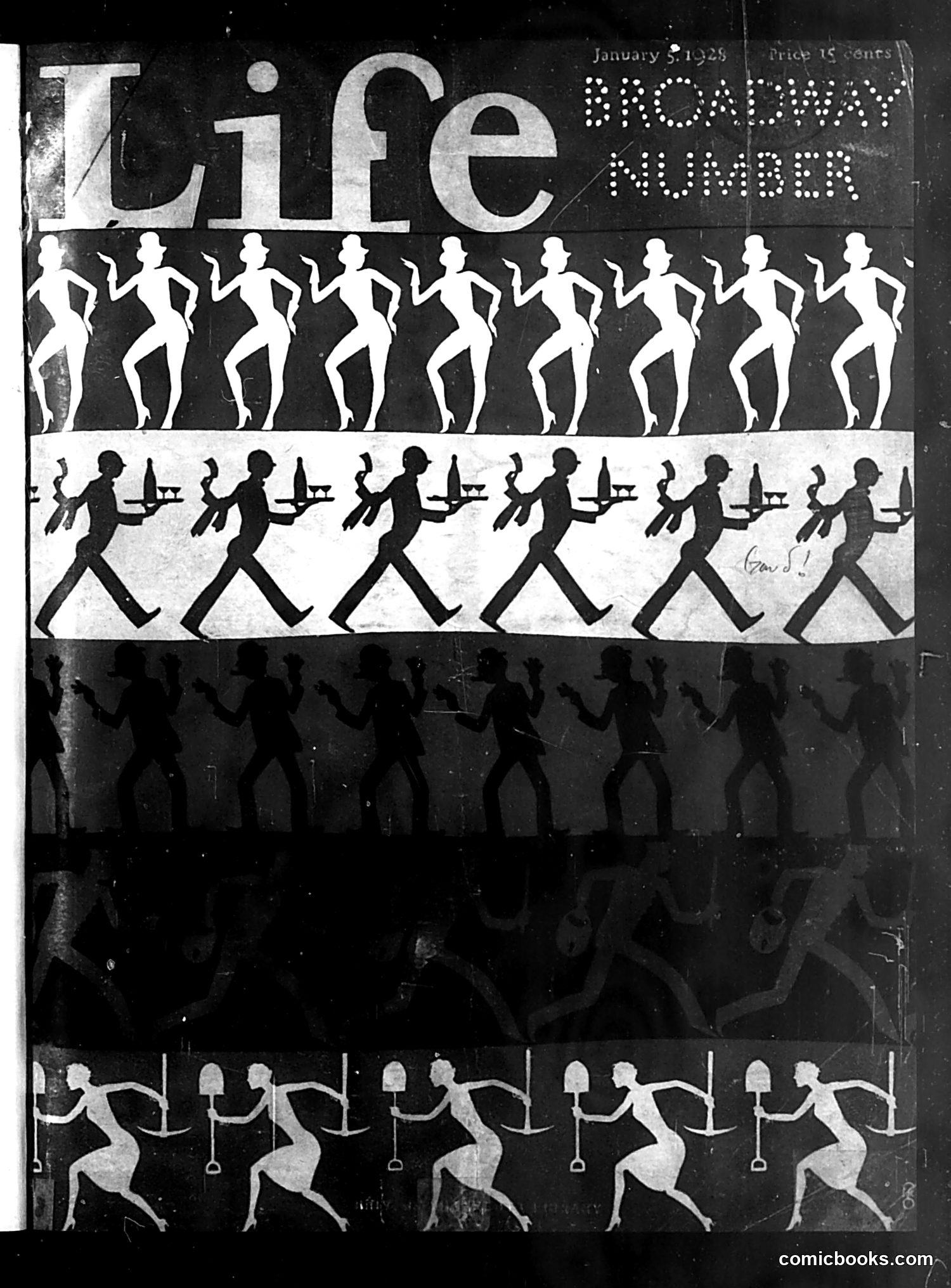
This cover satirizes the "Roaring Twenties" through sequential bands depicting modern leisure activities: bathing beauties, waiters serving drinks, silhouettes of dancers, and women playing golf. The repetitive parade format emphasizes the era's focus on pleasure, entertainment, and leisure—particularly new freedoms for women. The imagery reflects Jazz Age anxieties: women smoking, drinking, and engaging in athletics challenged traditional gender roles. The stylized, dehumanized silhouettes suggest mass consumption and conformity despite apparent liberation. Published during Prohibition (alcohol ban), the waiters carrying drinks mock enforcement challenges. The overall message critiques both the superficiality of modern life and society's obsession with entertainment and excess during this prosperous but morally contested decade.
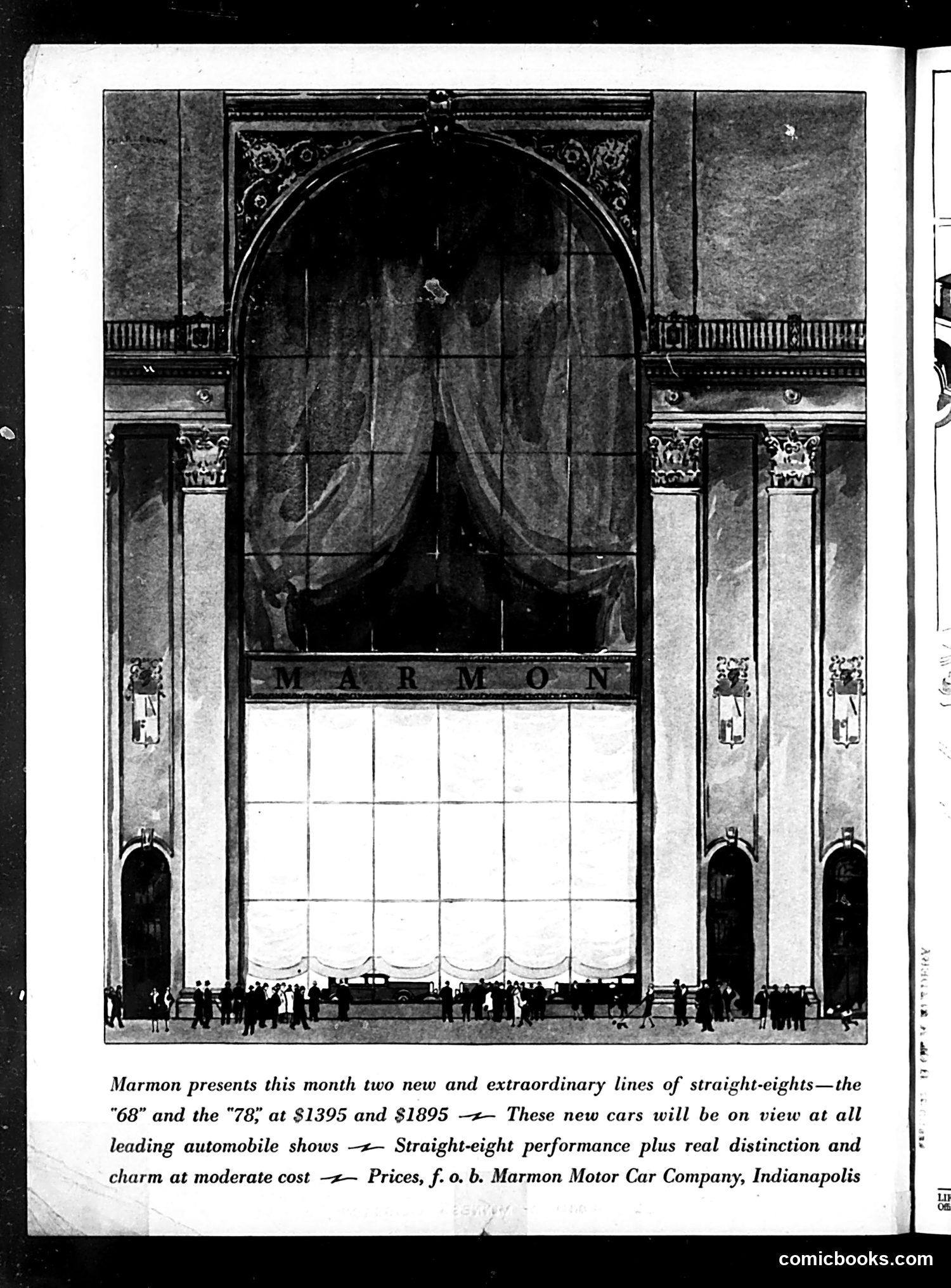
This page is primarily a **Marmon Motor Car Company advertisement**, not political satire. The image shows the grand entrance to what appears to be an automobile showroom or exhibition space, with an enormous circular mirror dominating the facade and classical architectural columns flanking the entrance. The ad announces two new Marmon straight-eight automobile models—the "68" and "78"—priced at $1395 and $1895 respectively. It emphasizes these vehicles will be displayed at "all leading automobile shows" and highlights their appeal: "straight-eight performance plus real distinction and charm at moderate cost." This reflects the 1920s-30s era when automobile advertising emphasized both luxury aspirations and affordability for middle-class consumers.
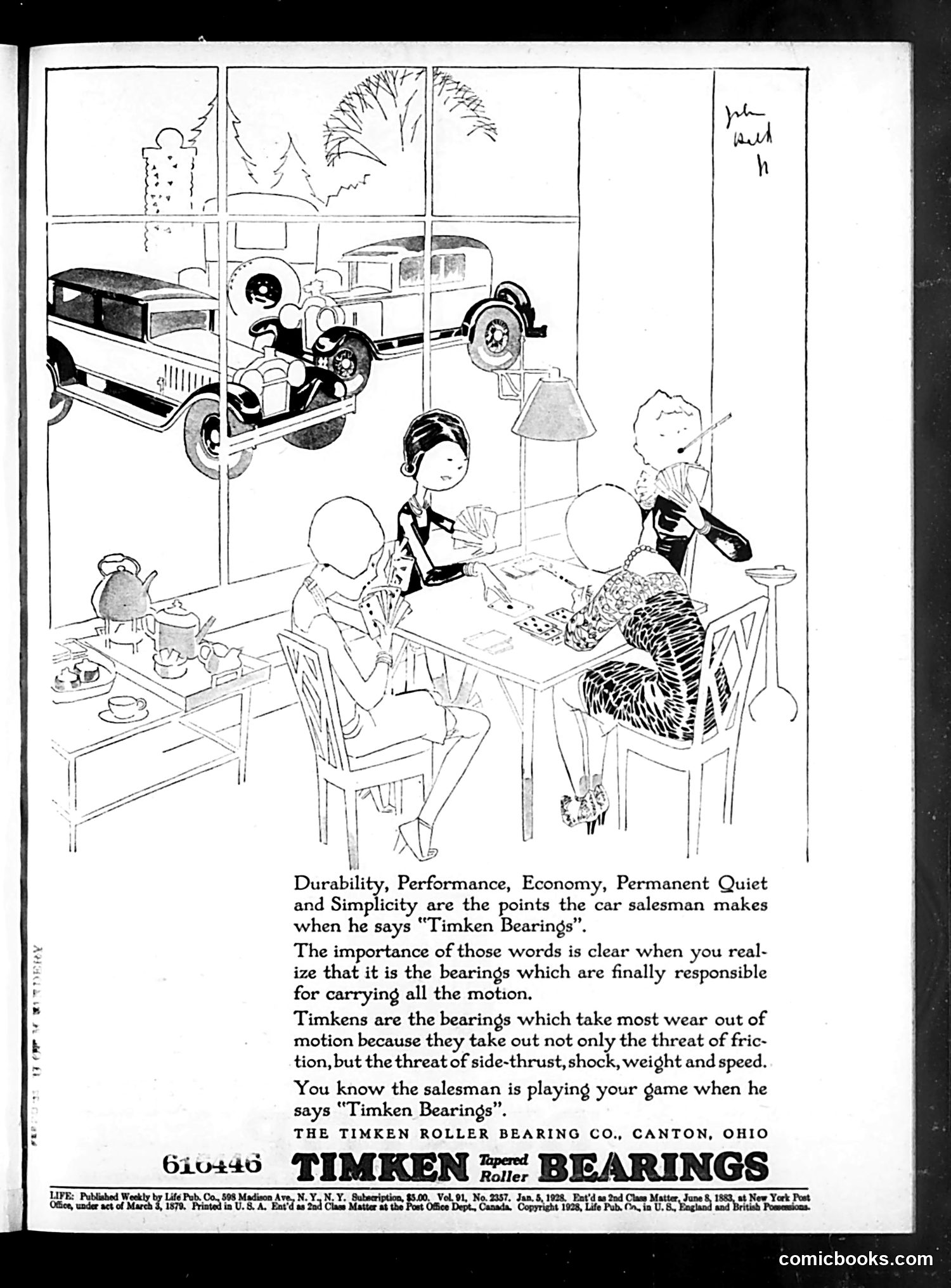
This is primarily a **commercial advertisement**, not satire or political commentary. The illustration shows a domestic scene: women having tea/coffee while viewing automobiles through a window—a 1920s marketing appeal to female consumers during the automobile boom. The advertising copy emphasizes Timken Bearings' five key selling points: durability, performance, economy, quiet operation, and simplicity. The text argues that bearings are crucial car components, enduring wear from friction, side-thrust, shock, weight, and speed. By claiming "the salesman is playing your game" when pitching Timken Bearings, the ad suggests the manufacturer understands consumer priorities. This represents typical 1920s-era advertising strategy: targeting middle-class families with lifestyle imagery while explaining technical product benefits in accessible language.
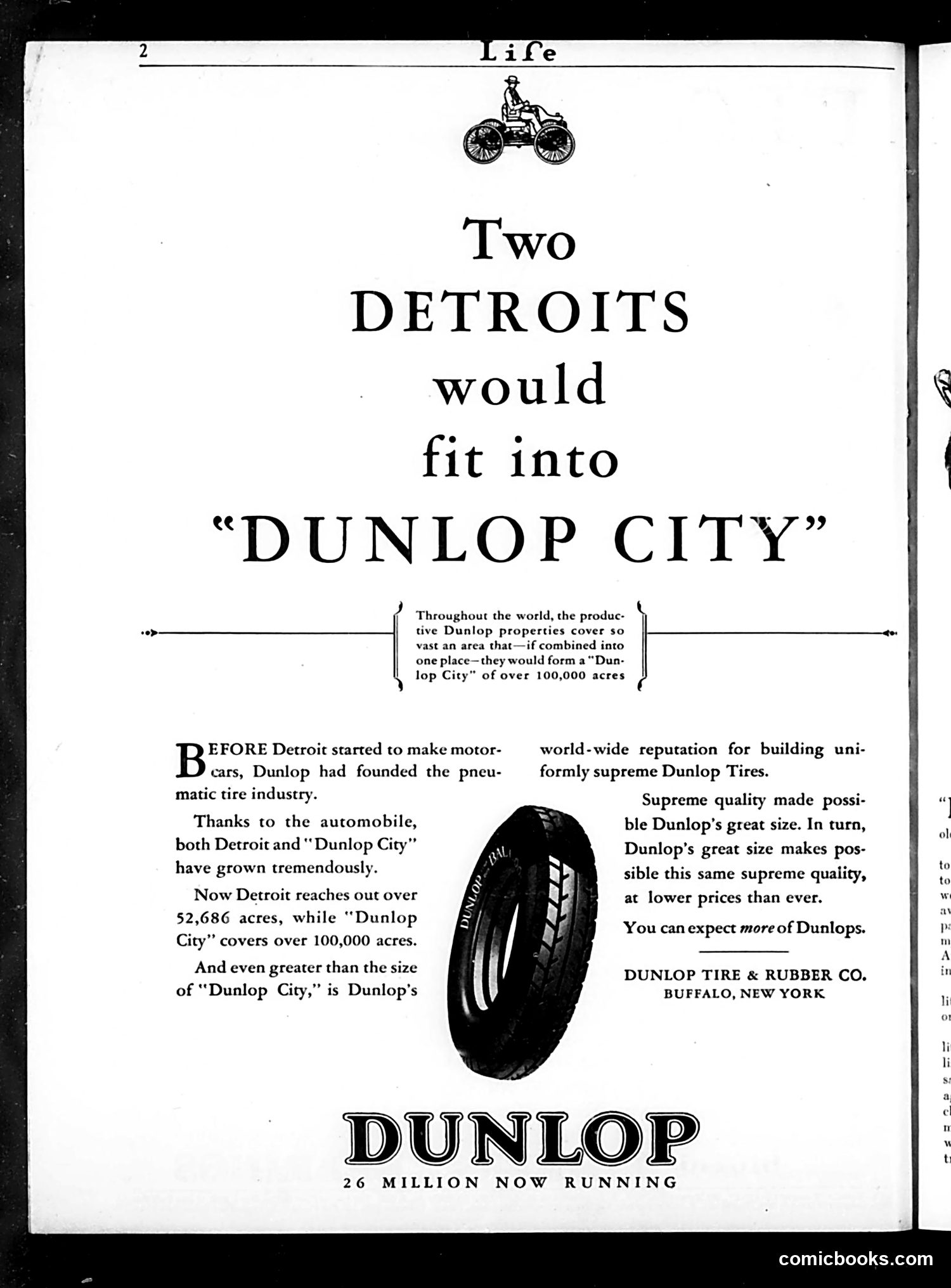
This is primarily **advertising content, not satire or editorial cartoon**. The page features a Dunlop Tire advertisement from Life magazine (page 2). At the top is a small illustration of an early automobile. The main visual is a large photograph of a Dunlop tire. The ad's central conceit is wordplay: it claims that two Detroits (the city, symbolizing the automobile industry's growth) would fit into the vast global area covered by Dunlop tire manufacturing properties—humorously termed "Dunlop City" at over 100,000 acres. The message emphasizes Dunlop's dominance in tire production and quality, noting that 26 million Dunlop tires were "now running." The company is based in Buffalo, New York. This reflects early 20th-century industrial advertising celebrating corporate scale and manufacturing prowess.
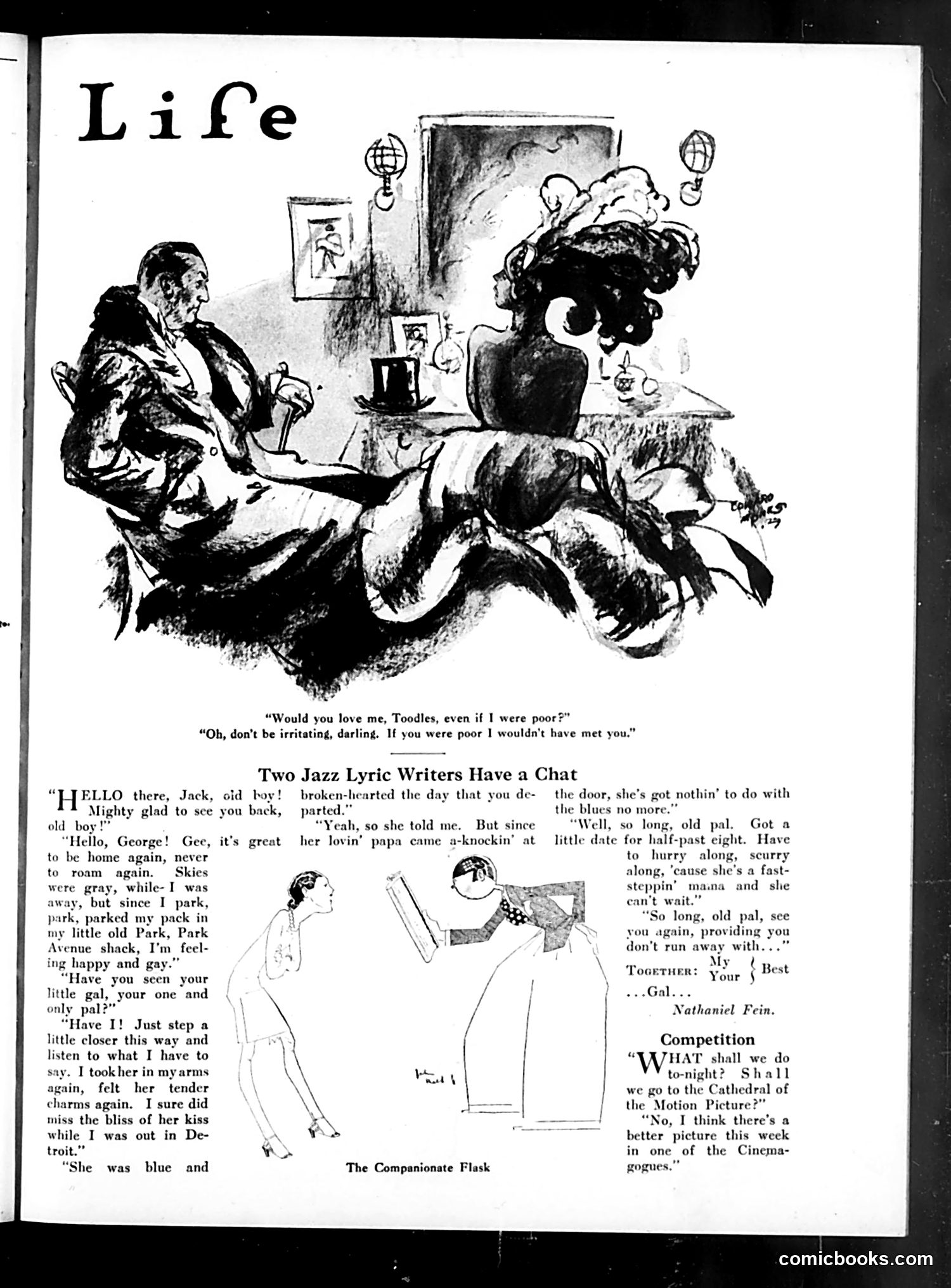
This page contains three separate humor pieces typical of early 20th-century Life magazine: 1. **Top cartoon**: A wealthy man questions a woman about loving him if he were poor; she responds she wouldn't have met him then. The satire mocks both superficial romance and class-based relationships. 2. **"Two Jazz Lyric Writers Have a Chat"**: Two men exchange nostalgic reminiscences about past romantic interests and city life. This appears to satirize sentimental jazz culture and the romantic mythology surrounding it, with characters speaking in period slang ("old pal," "gal"). 3. **"The Companionate Flask"**: A minimalist illustration of someone with a flask, likely referencing Prohibition-era drinking culture. 4. **"Competition"**: A brief dialogue about attending cinema—reflecting growing entertainment options of the era. The overall tone targets romantic sentimentality, class pretense, and emerging popular culture.
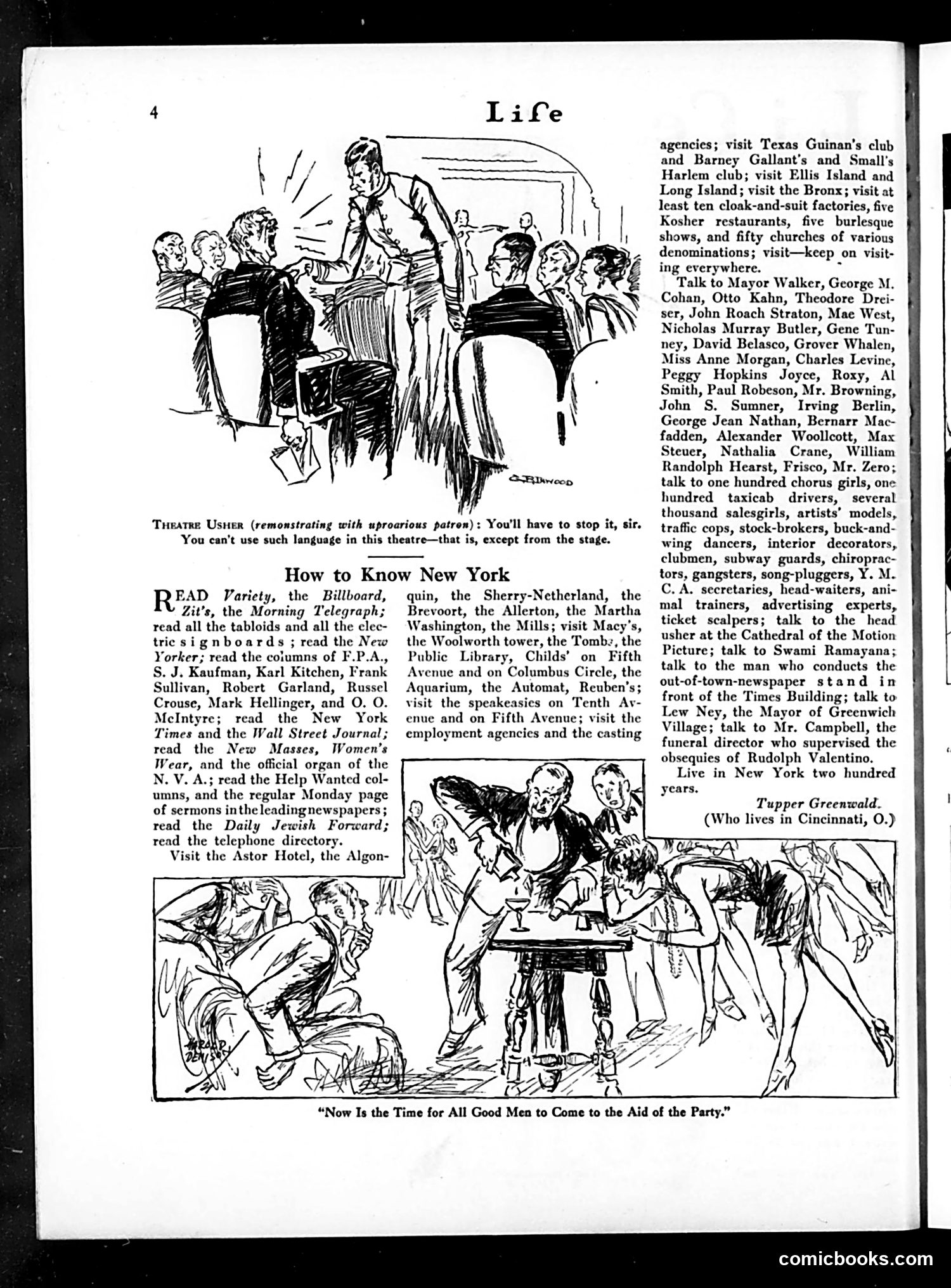
This page from *Life* magazine contains two satirical cartoons about New York City tourism and social life, circa early 20th century. The **top cartoon** depicts a theatre usher confronting well-dressed patrons about their language, captioned "THEATRE USHER (remonstrating with uproarious patrons)." The joke targets wealthy New Yorkers' supposed rudeness in public venues—even the refined theatre-going class needed correction for inappropriate conduct. The **bottom cartoon**, captioned "Now Is the Time for All Good Men to Come to the Aid of the Party," shows a chaotic social gathering. The satirical point mocks New York's social scene and party culture, suggesting that even "good men" feel obligated to attend fashionable events, regardless of their actual desire. Both cartoons gently ridicule New York elite society's pretensions and behavioral standards.
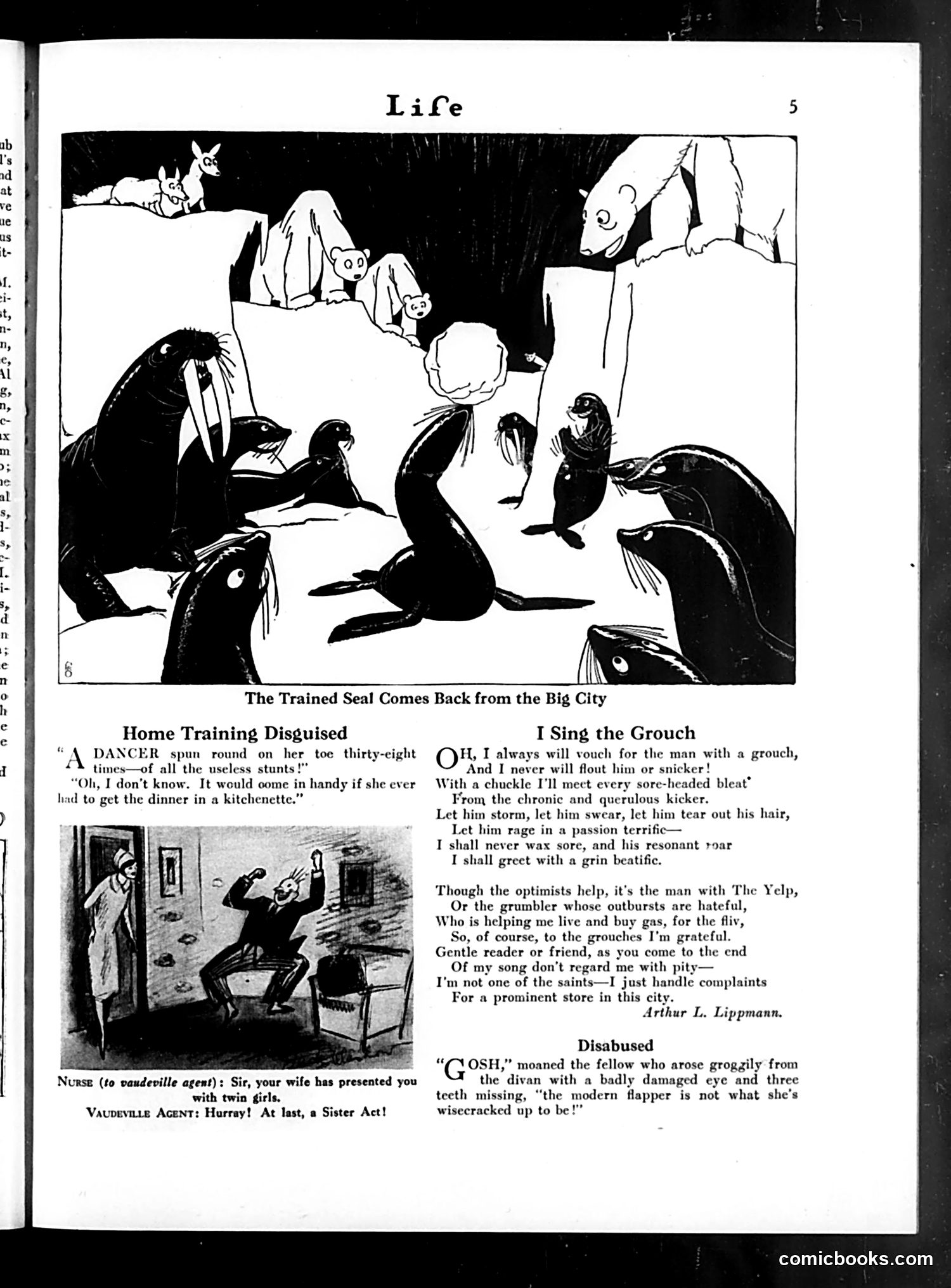
The top illustration depicts seals performing in a circus or zoo setting, with human onlookers above. The title suggests satire about an animal trained in urban environments returning to its natural habitat. Below are three separate humor pieces: 1. **"Home Training Disguised"**: A joke about a dancer with thirty-eight "turns-of-all" who doesn't know basic domestic skills like cooking dinner. 2. **"I Sing the Grouch"**: A poem by Arthur L. Lippmann celebrating complaint and negativity as a survival strategy in city life—praising the "grumbler" and "Yelp" (likely referring to vocal complaint) over optimism. 3. **"Disabused"**: A short joke mocking a "modern flapper" for being physically damaged and not meeting romantic expectations. These pieces satirize modern urban life, gender roles, and social changes of the era.
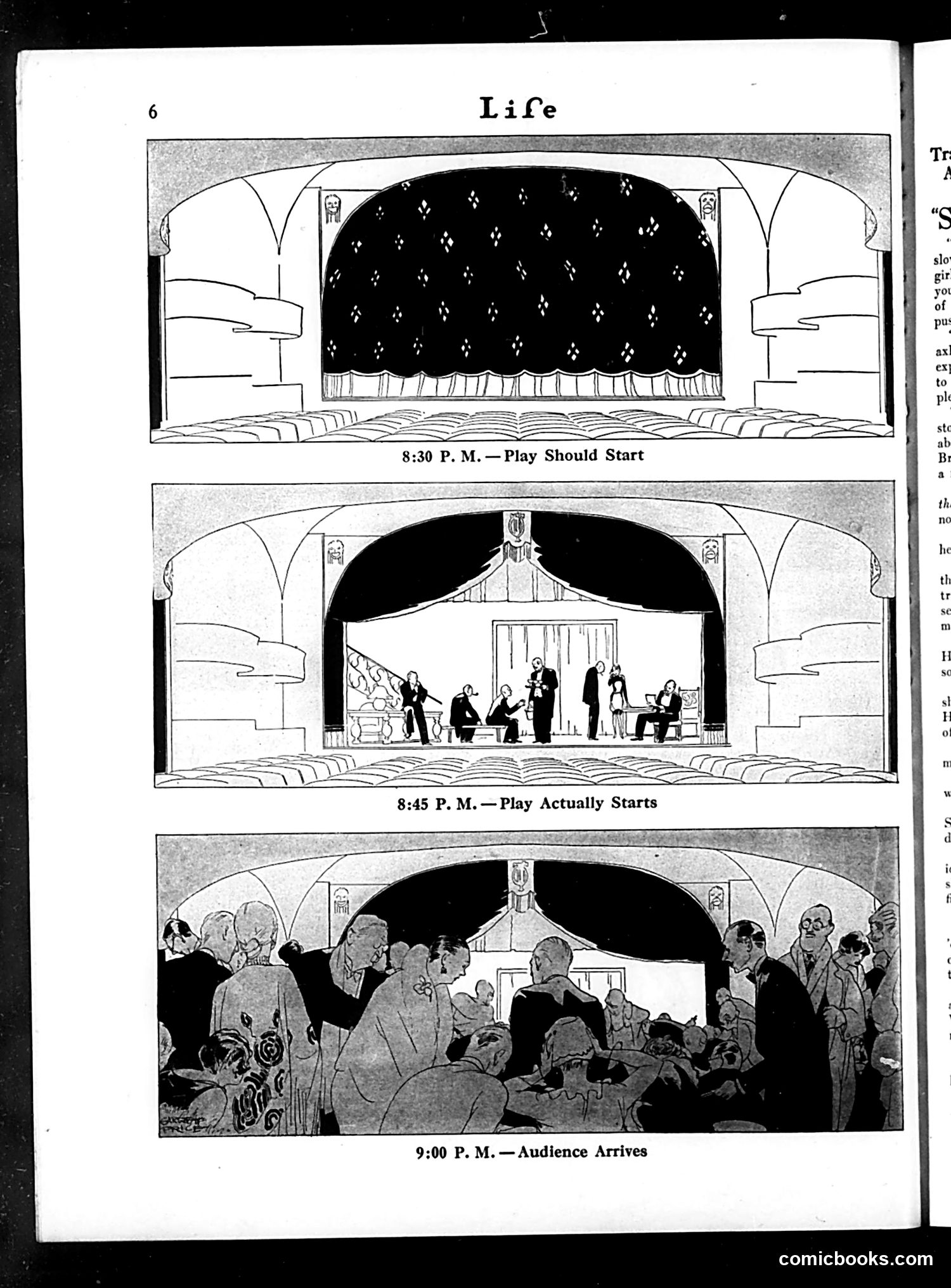
This is a three-panel satirical comic about theater-going customs, specifically mocking the notorious lateness of Broadway audiences. The progression shows: 1. **8:30 P.M. — Play Should Start**: An empty theater with closed curtain, ready for performance. 2. **8:45 P.M. — Play Actually Starts**: The curtain rises to actors on stage, but the orchestra pit remains empty—suggesting the show begins without full preparation. 3. **9:00 P.M. — Audience Arrives**: The theater is now crowded with arriving patrons, arriving 30+ minutes after the scheduled start time. The joke satirizes wealthy New York theater audiences' chronic lateness as a status symbol or social norm. Despite scheduled curtain times, fashionable patrons regularly arrived late, forcing productions to delay or proceed incomplete. This mocks both audience rudeness and theater management's inability to enforce punctuality.
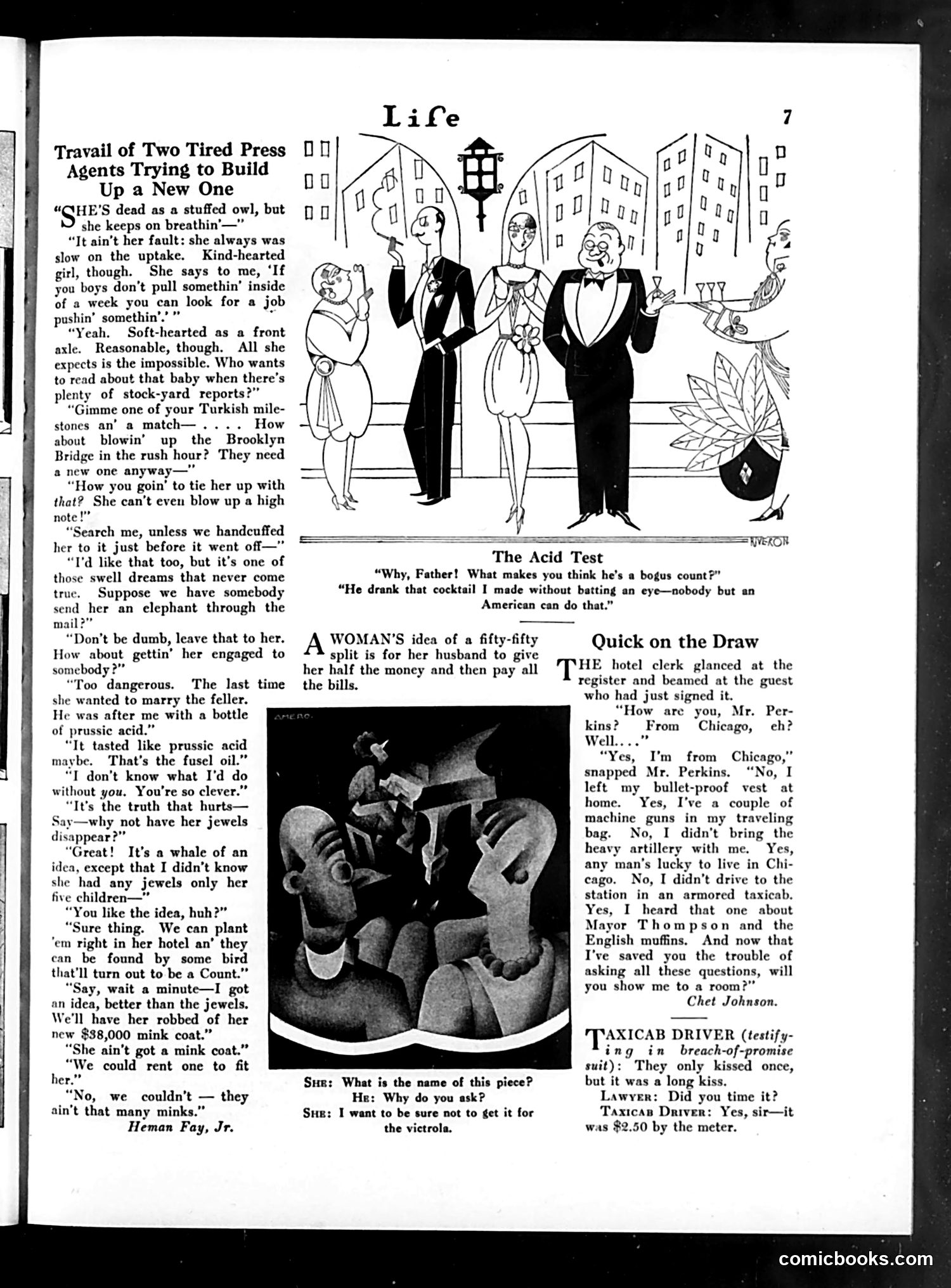
This page contains three humor pieces satirizing early 20th-century social attitudes: **"Travail of Two Tired Press Agents"** mocks the absurd ideas publicity agents propose. The dialog reveals their desperation: suggesting an orphaned baby or an elephant through the mail as publicity stunts. The satire targets both the agents' lack of ethics and the public's appetite for sensational stories. **"The Acid Test"** cartoon jokes about a husband's cocktail-making prowess, with the caption suggesting only an American could create such a drink. **"Quick on the Draw"** features a guest (Mr. Perkins from Chicago) humorously over-explaining his lack of weapons and military equipment to a skeptical hotel clerk—likely satirizing post-WWI paranoia or the unusual need to clarify one isn't armed.
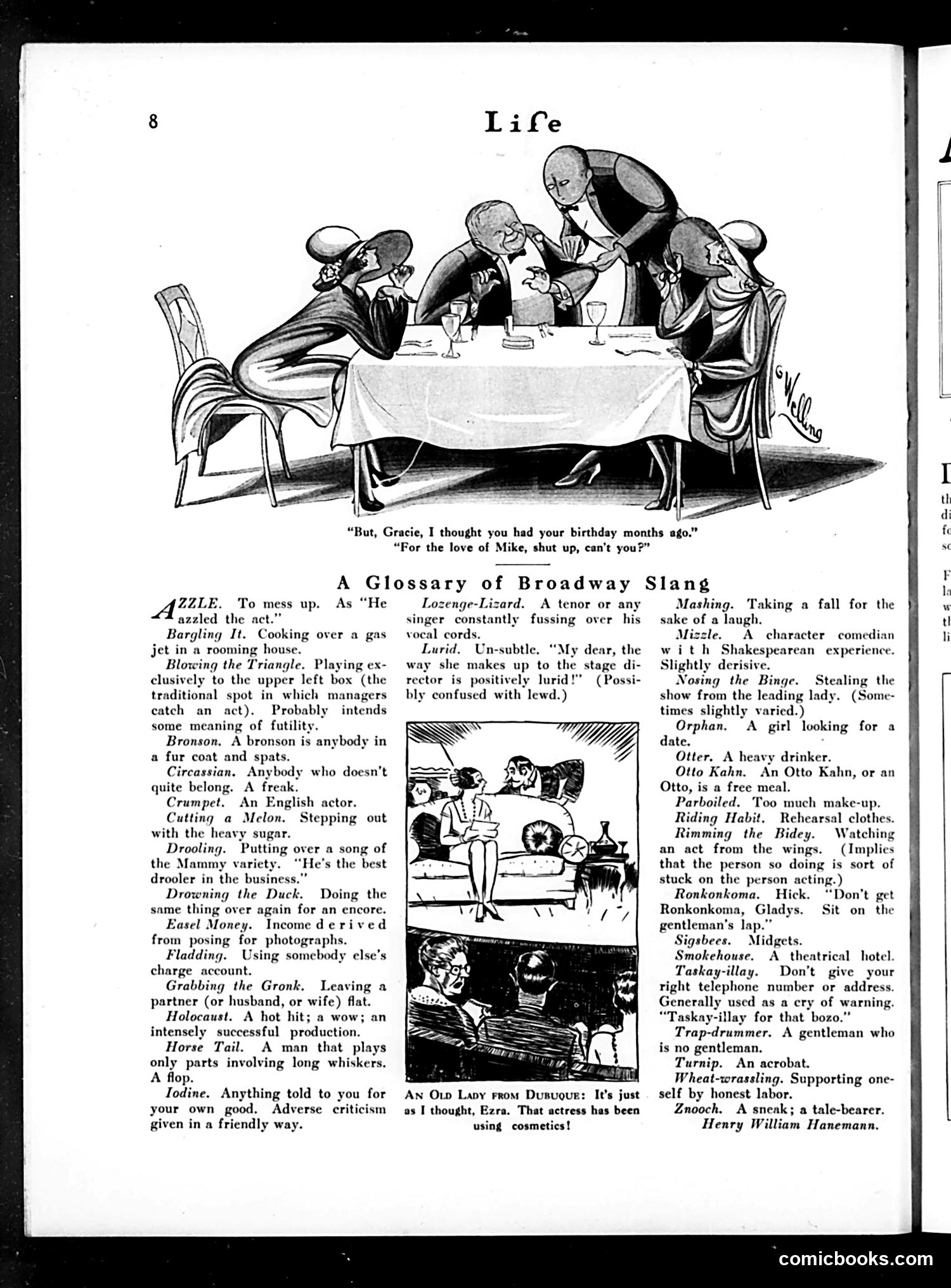
The main cartoon depicts a dinner party where a woman is confronted about her birthday—the man says "But, Gracie, I thought you had your birthday months ago. For the love of Mike, shut up, can't you?" **The joke:** The woman (Gracie) appears to be constantly mentioning or celebrating her birthday repeatedly, suggesting she's obsessed with age or seeking attention/gifts. The man's exasperated response mocks women who allegedly overemphasize their birthdays. The page's lower half is "A Glossary of Broadway Slang"—definitions of theatrical jargon and slang terms used by performers and theater workers. Terms include "Azzle" (mess up), "Bronson" (bronchitis from stage drafts), and "Tasking-illay" (don't give your phone number—a warning cry). **Context:** This reflects 1920s-era theater culture and attitudes toward women's vanity.
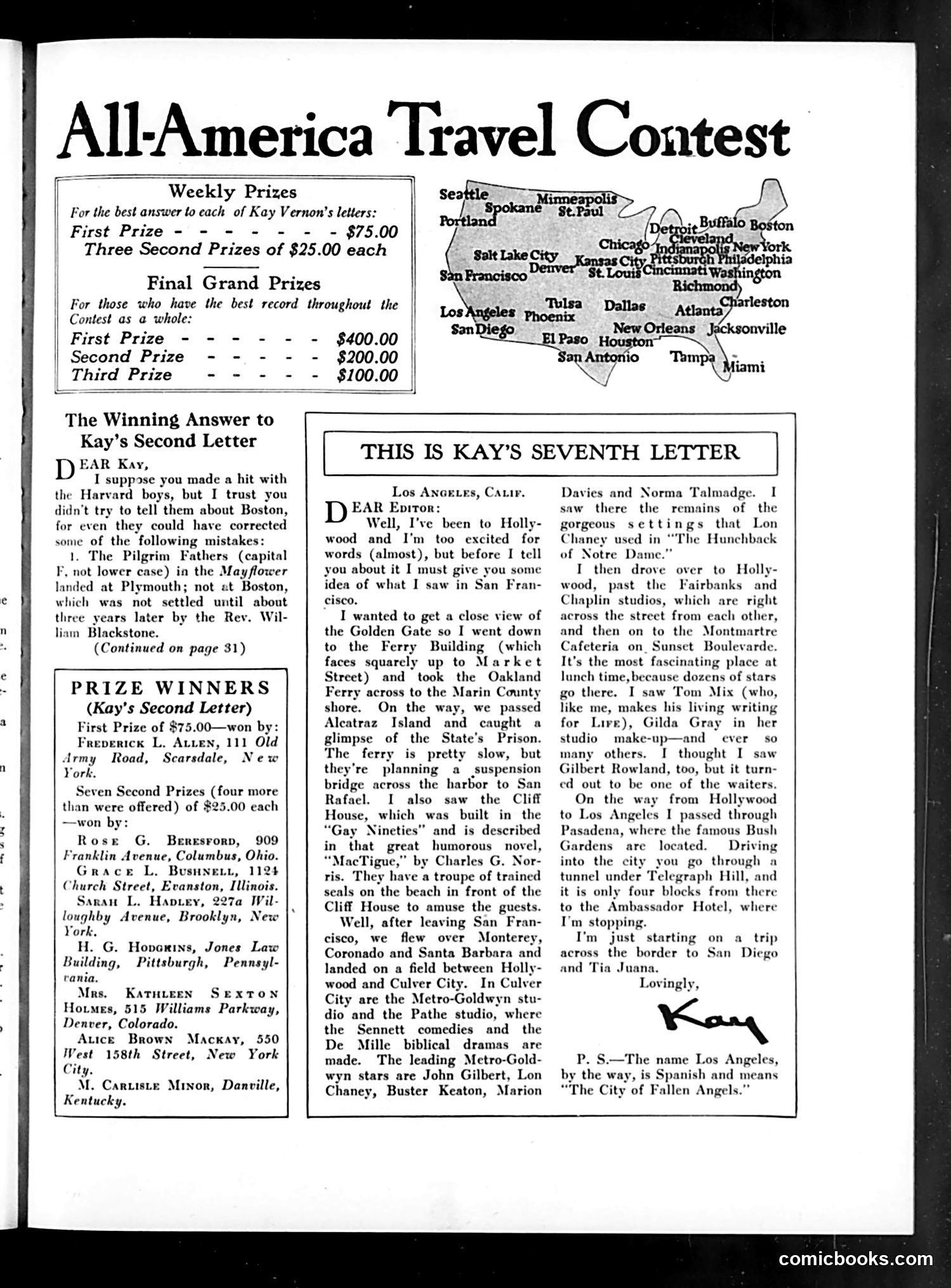
This page presents a travel writing contest hosted by Life magazine, not a political cartoon. Readers submitted letters describing American destinations for weekly prizes ($75 first prize, three $25 second prizes) and grand final prizes up to $400. The featured winning entry is Kay's seventh letter, describing a California trip visiting Hollywood studios (Fairbanks, Chaplin), the Golden Gate Ferry, and San Francisco landmarks. The writer mentions famous Metro-Goldwyn-Mayer stars including John Gilbert, Lon Chaney, and Buster Keaton. The page demonstrates Life's mid-20th century focus on American travel, entertainment industry celebrity culture, and reader engagement through interactive contests—reflecting the magazine's role in promoting tourism and Hollywood glamour to its audience.
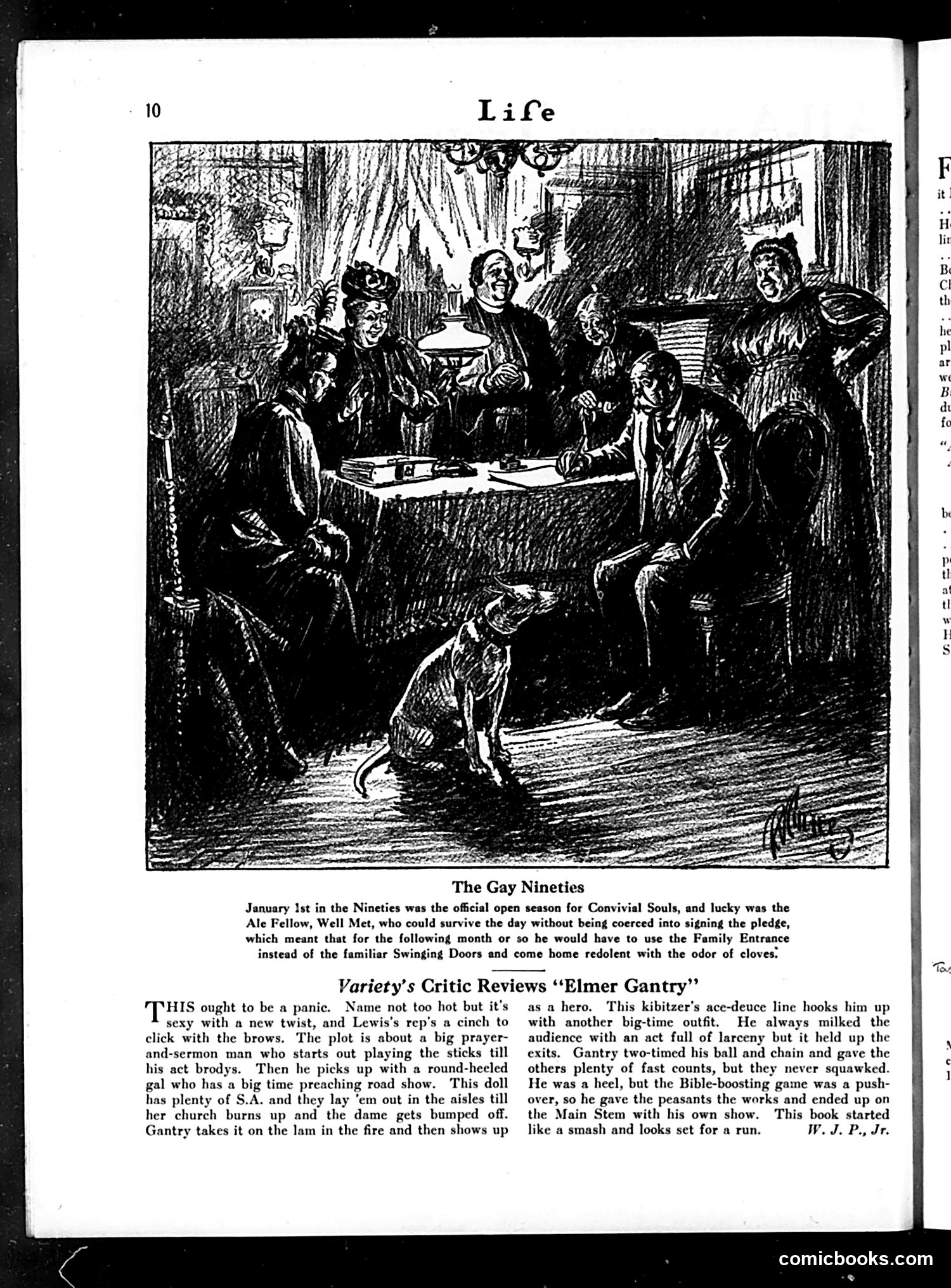
This illustration satirizes social behavior during the 1890s ("Gay Nineties"). The scene depicts well-dressed men gathered around a table, apparently coercing a reluctant companion into signing a pledge—likely a temperance or moral commitment. The text explains that January 1st opened "Convivial Souls" season, and avoiding the pledge-signing meant using servants' entrances for a month, returning "redolent with the odor of cloves" (masking alcohol on one's breath). The satire targets the era's hypocrisy: respectable society publicly embraced moral pledges while privately maintaining drinking habits. The accompanying review of "Elmer Gantry" reinforces this theme of religious pretense masking vice, mocking fraudulent preachers and their congregations' willingness to be duped.
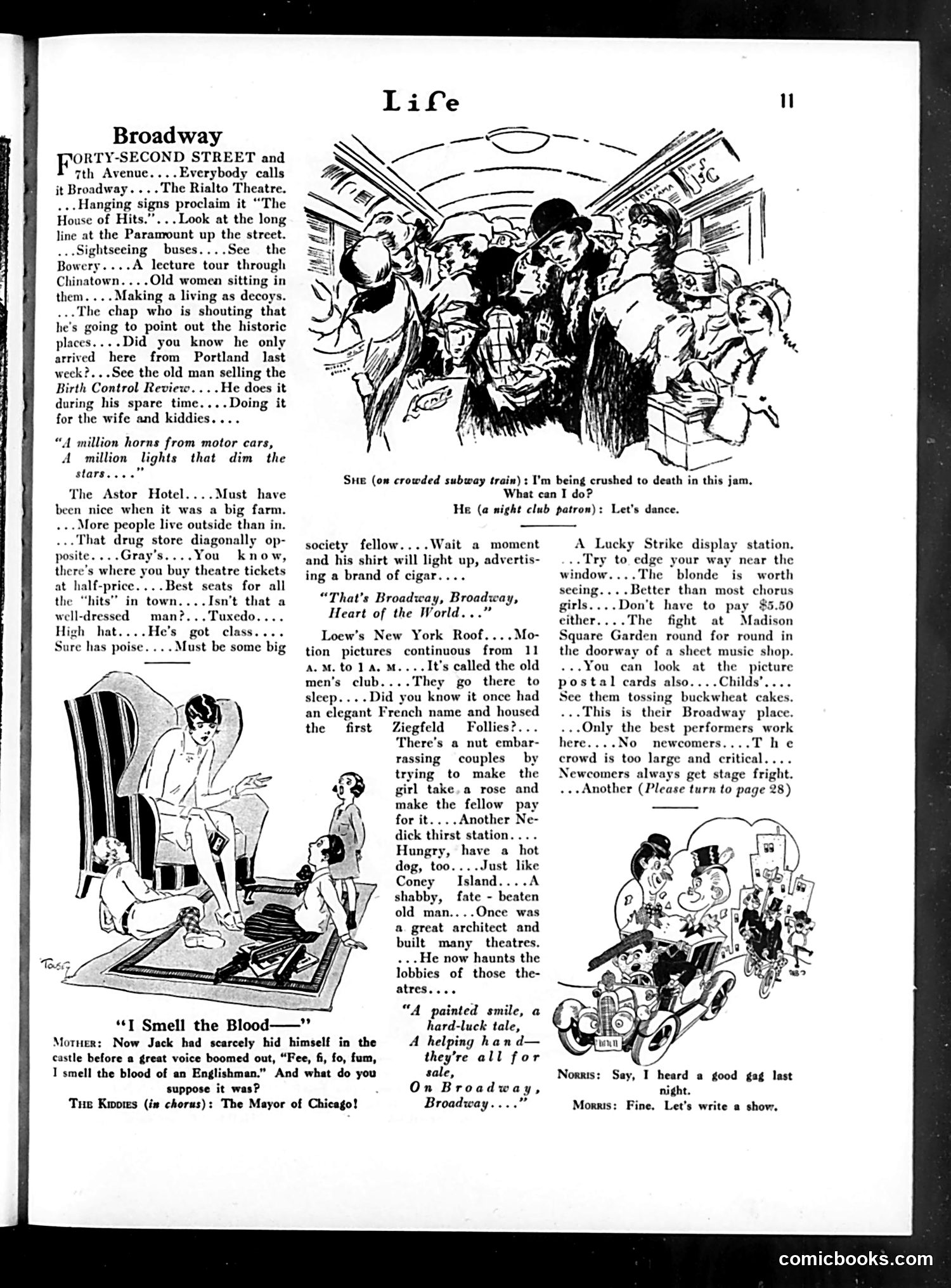
This page satirizes Broadway in the 1920s, depicting the crowded, chaotic street scene and theatrical culture. The main cartoon shows a packed subway train where a woman says "I'm being crushed to death in this jam. What can I do?" and a man replies "Let's dance"—mocking how Broadwaygoers remain obsessed with nightlife despite urban congestion. The left sidebar humorously catalogs Broadway attractions: the Rialto Theatre, sightseeing buses, old street vendors, and the Astor Hotel. It references the "House of Hits" and mentions Ziegfeld Follies, establishing this as 1920s entertainment culture. The text ridicules the commercialization of Broadway—dance halls, hot dogs, postal cards—suggesting the street has become a superficial tourist attraction where authentic culture has been replaced by commerce and spectacle.
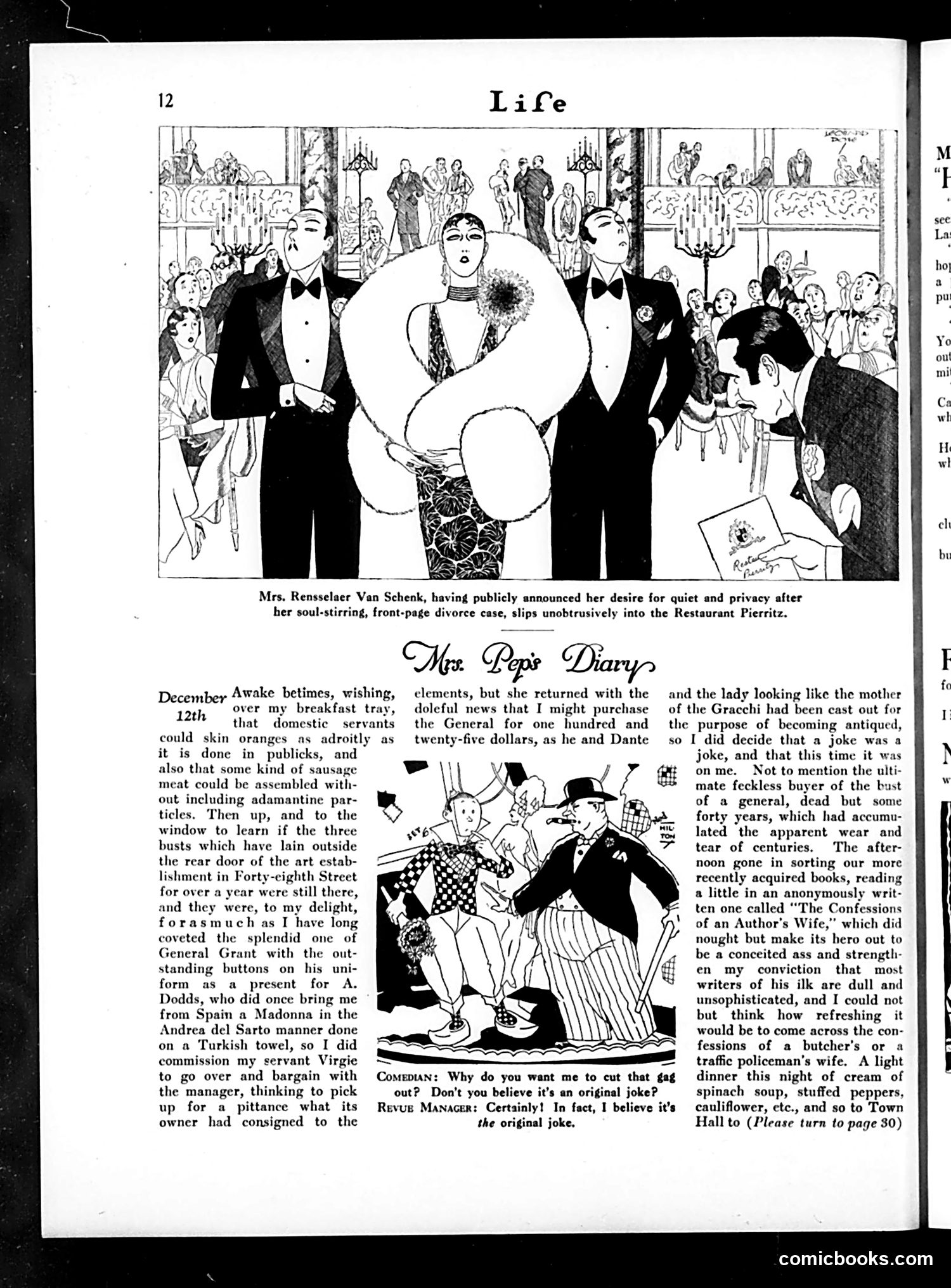
**Top Cartoon:** Satirizes **Mrs. Rensellaer Van Schenk**, a wealthy socialite who publicly announced her desire for "quiet and privacy" after her high-profile divorce, yet is immediately spotted at the fashionable Restaurant Pieritz in an eye-catching outfit, surrounded by onlookers. The joke mocks the contradiction between her stated wish for discretion and her ostentatious public appearance. **"Mrs. Pep's Diary" (below):** A comedic domestic anecdote about acquiring surplus Spanish art and furniture, featuring a dialogue about a supposedly "original" joke that the revue manager insists on cutting. The humor derives from the mundane complaints of wealthy individuals about servants, purchases, and theatrical productions. Both pieces target upper-class social pretension and hypocrisy.
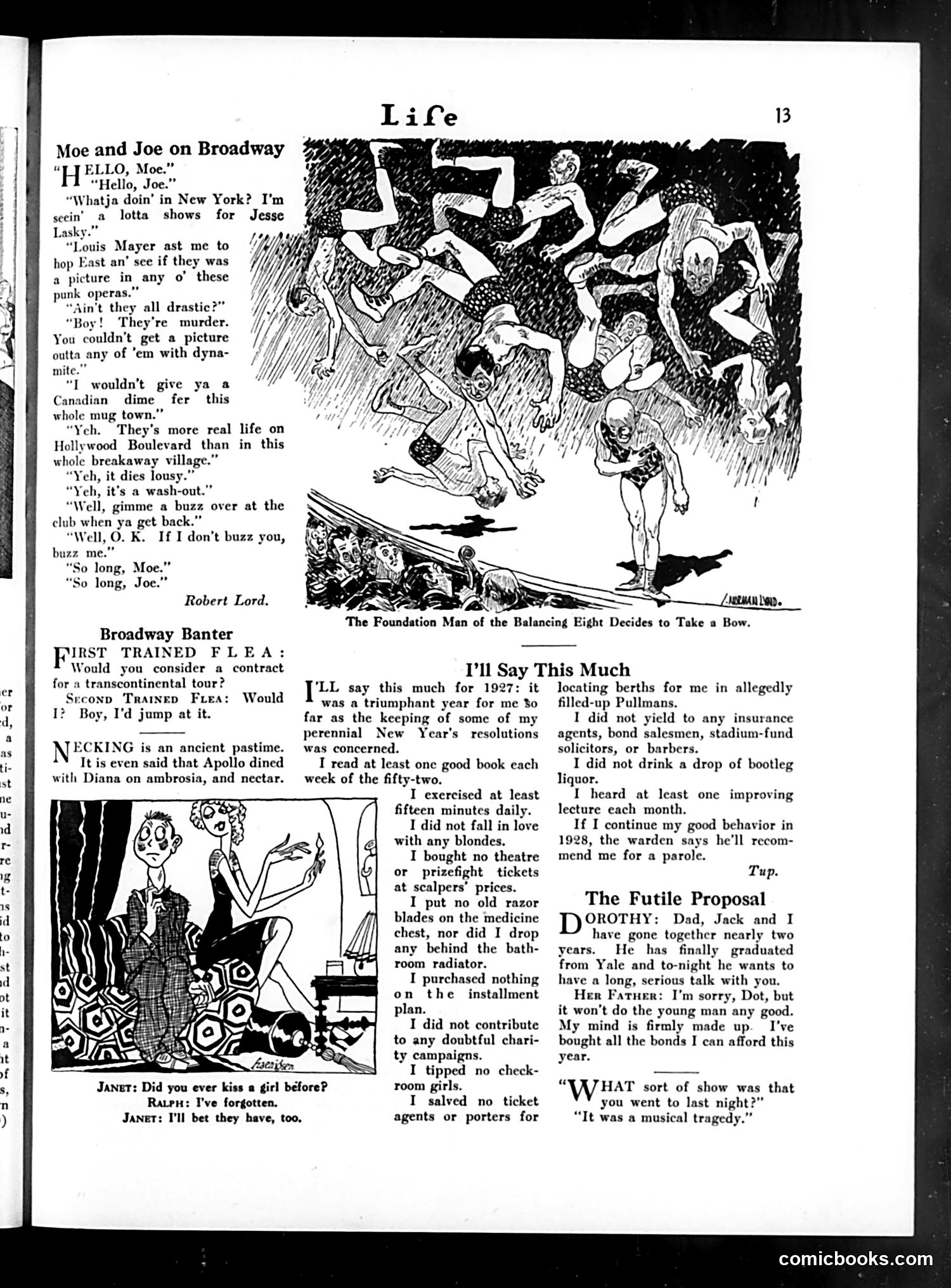
This page contains three separate humorous pieces typical of 1920s Life magazine: 1. **"Moe and Joe on Broadway"** (top): A dialogue joke where two characters discuss seeing shows on Broadway, with the punchline about getting "a buzz" when returning home—likely referencing Prohibition-era speakeasies. 2. **"Broadway Banter"**: A joke about trained fleas contracting for a transcontinental tour, satirizing vaudeville's absurd entertainment acts. 3. **Cartoon with Janet and Ralph**: A flirtatious exchange where Ralph claims to have forgotten kissing a girl before, and Janet responds skeptically—a commentary on dating behavior and male unreliability. 4. **"I'll Say This Much"** and **"The Futile Proposal"**: Personal essays reflecting on 1928 resolutions and romance, representing typical magazine filler content. The humor targets Broadway culture, dating conventions, and entertainment industry absurdities.
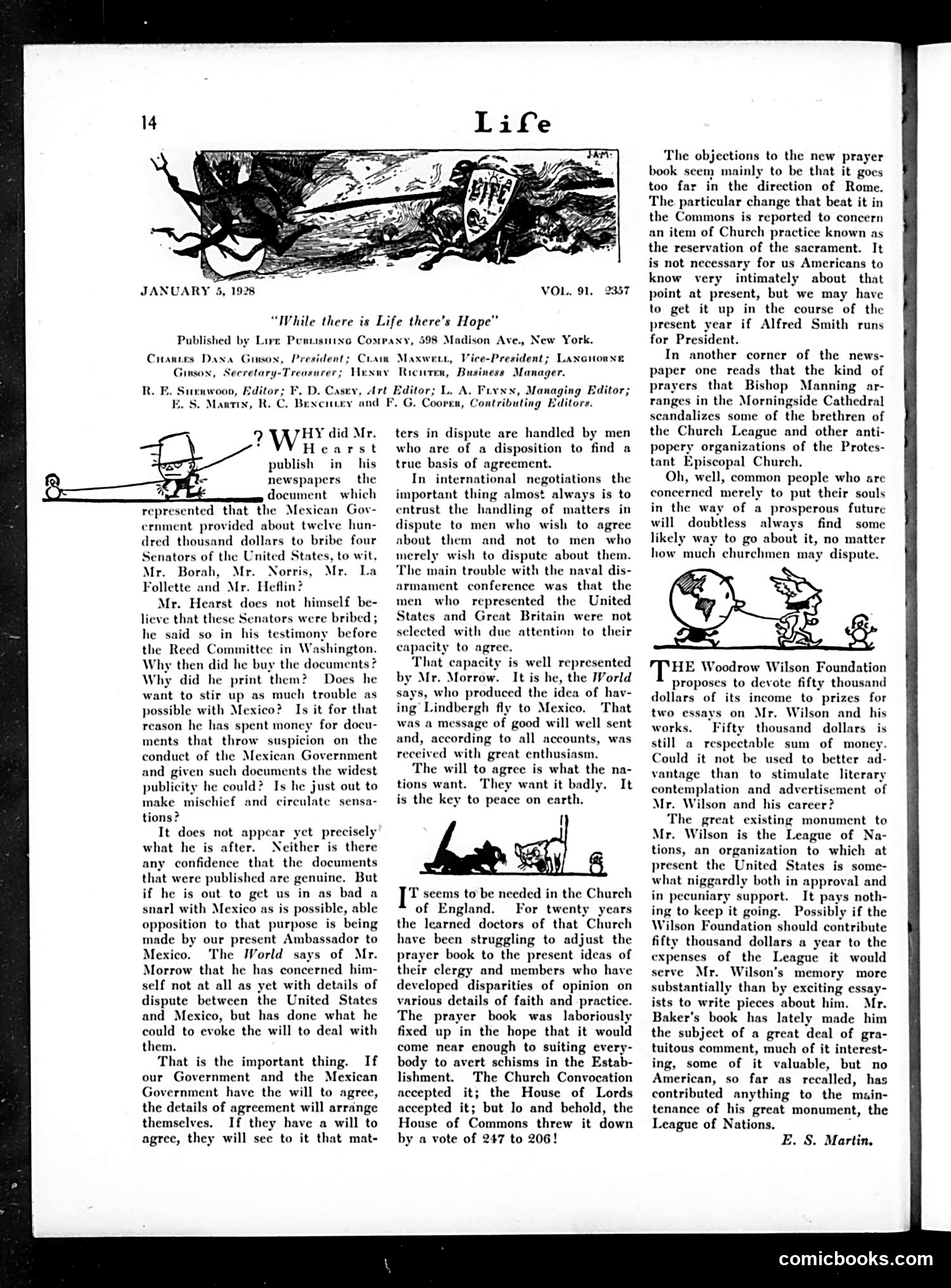
The page contains two editorial cartoons addressing political corruption and diplomatic disputes. The first cartoon depicts Mr. Hearst (the newspaper publisher) questioning why Mexican government officials were bribed with thousands of dollars to influence U.S. senators. The cartoon satirizes potential corruption involving senators Borah, Norris, La Follette, and Heflin, suggesting they may have accepted bribes that Hearst's newspapers publicized. The second cartoon shows figures handling a globe, likely referencing international naval disarmament negotiations. The satire appears to criticize how diplomats from the United States and Great Britain were inadequately prepared or positioned to reach agreement on arms control. Both cartoons target political corruption and diplomatic incompetence as contemporary problems.
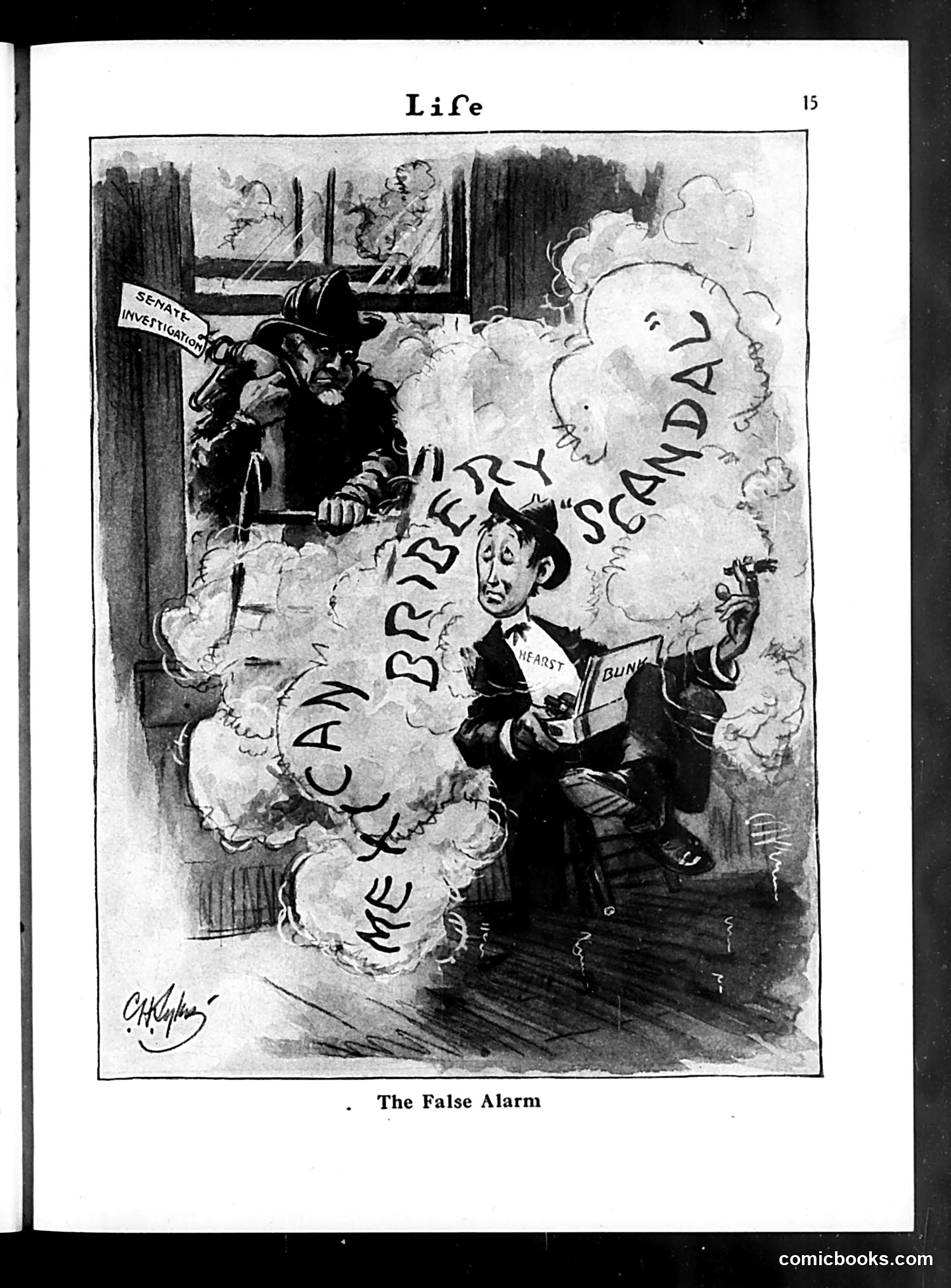
This Life magazine cartoon satirizes public panic about a Senate investigation. A frightened figure labeled "Hearst Bunk" holds a megaphone spreading exaggerated warnings ("Scare," "Scandal") depicted as large clouds of smoke/hysteria. Above, a senator peers through a "Senate Investigation" window, apparently investigating Hearst's sensationalist journalism. The cartoon mocks William Randolph Hearst's newspaper empire for creating false alarms and public fear through inflammatory reporting. The "false alarm" refers to Hearst's tendency to sensationalize stories—presenting them as catastrophic scandals when they lack substance. The senator's investigation suggests scrutiny of these journalistic practices, while the cartoon ridicules both the exaggerated warnings and those who spread them, implying the "scandal" is merely theatrical hysteria rather than genuine concern.
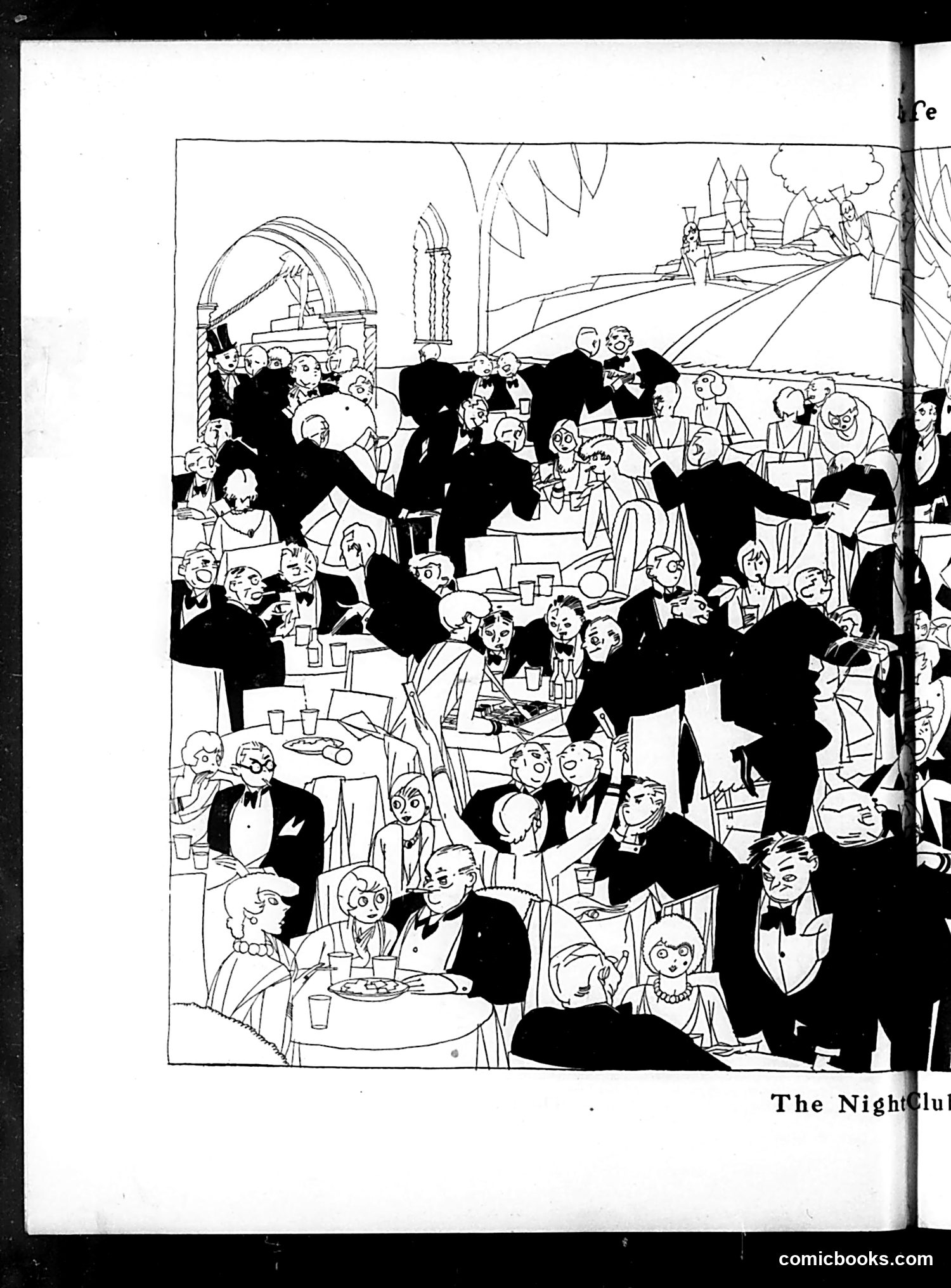
This illustration depicts an elegant formal gathering at what appears to be an upscale nightclub or restaurant. The scene shows well-dressed patrons in tuxedos and formal wear seated at tables, with waiters circulating among them. The architectural setting features Gothic or castle-like elements visible through windows in the background. The satire likely comments on the social pretensions and formality of exclusive nightclub culture—the exaggerated elegance and rigid dress codes that governed such venues. The crowded, somewhat chaotic composition of formally-dressed figures might mock either the artificiality of such social settings or the desperate pursuit of sophistication by the leisure class. Without additional context from the full article, the specific political or social commentary remains unclear, though the tone appears gently satirical of high-society nightlife.
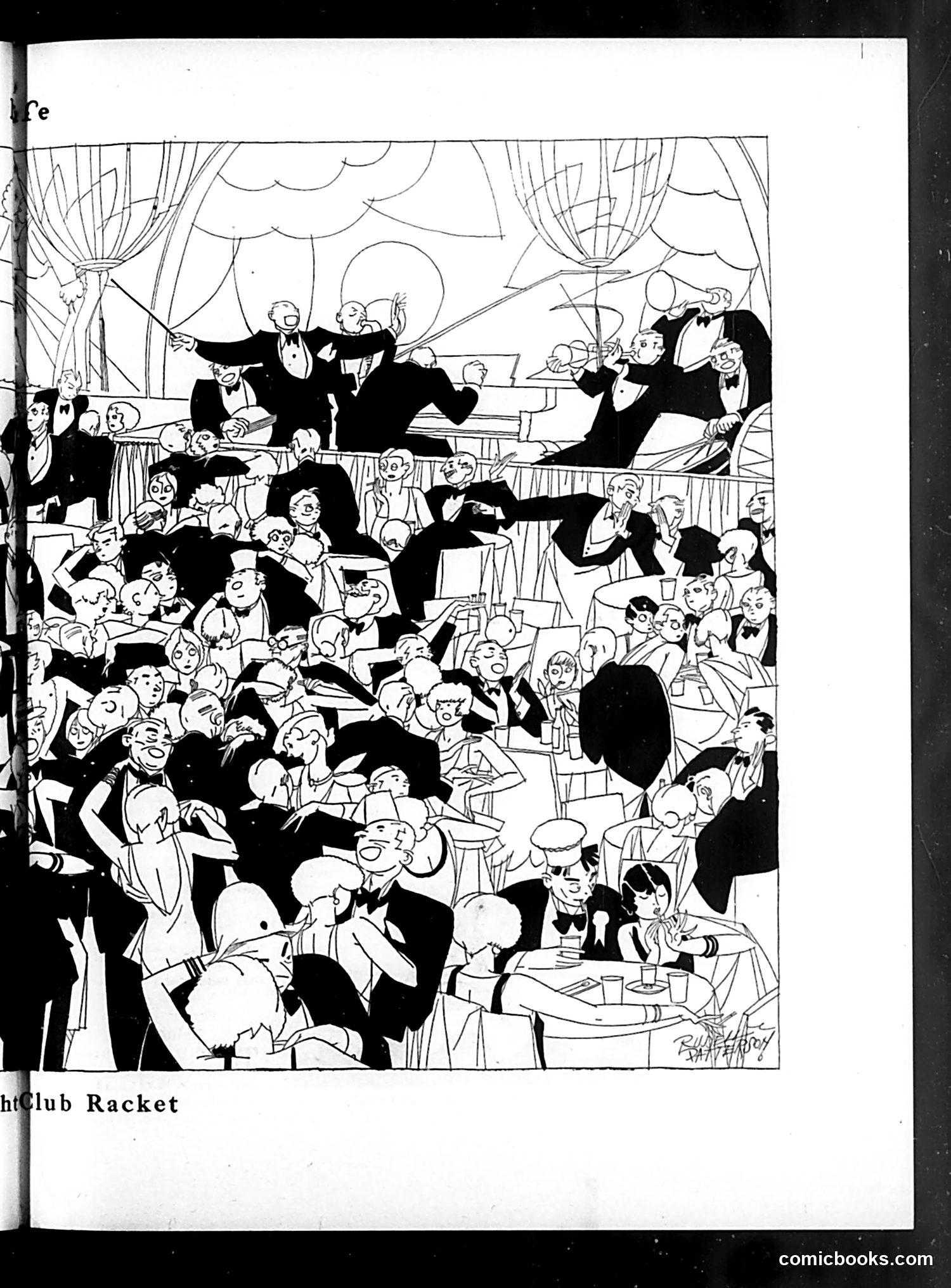
This cartoon satirizes the chaos and rowdiness of 1920s nightclub culture, likely during Prohibition when illegal speakeasies flourished. The packed venue shows formally-dressed patrons (in tuxedos and evening wear) in a state of wild disorder—fighting, drinking, and generally misbehaving beneath an ornate ceiling and draped curtains. The satire targets the hypocrisy of respectable society: wealthy, well-dressed people abandoning propriety in illegal drinking establishments. The "racket" refers both to the literal noise and to the organized crime networks running bootleg operations. The artist mocks how Prohibition, meant to enforce morality, instead created venues where the upper classes engaged in unseemly conduct.
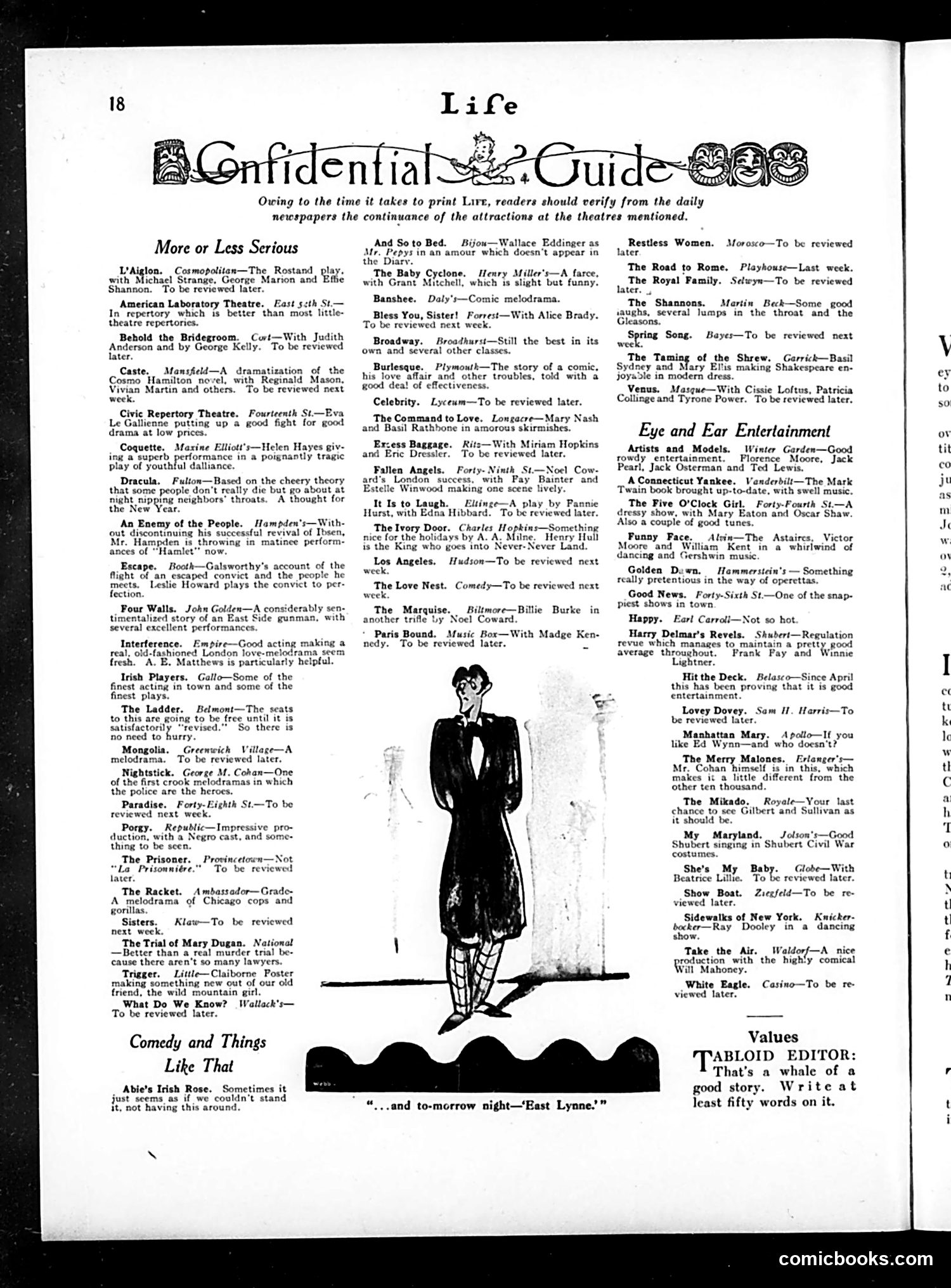
This page is a **theater review guide** from Life magazine, not a political cartoon. It lists current Broadway and off-Broadway productions with brief critical notes—marking shows as "to be reviewed later" or offering quick assessments. The single illustration shows a **fashionably dressed woman in 1920s attire** (cloche hat, dropped waistline dress, long legs) with the caption "...and to-morrow night—East Lynne!" This is satirical commentary: "East Lynne" was a Victorian melodrama of the 1800s, famous for emotional excess and dated conventions. The joke implies that despite modern theatrical sophistication, audiences still crave old-fashioned, overwrought plays—the fashionable modern woman will abandon her contemporary aesthetic to watch yesterday's sentimental drama. The guide itself reflects 1920s theater culture: Abie's Irish Rose (a popular comedy), Porgy with an all-Black cast, and Noel Coward's sophisticated comedies represent the era's theatrical diversity.
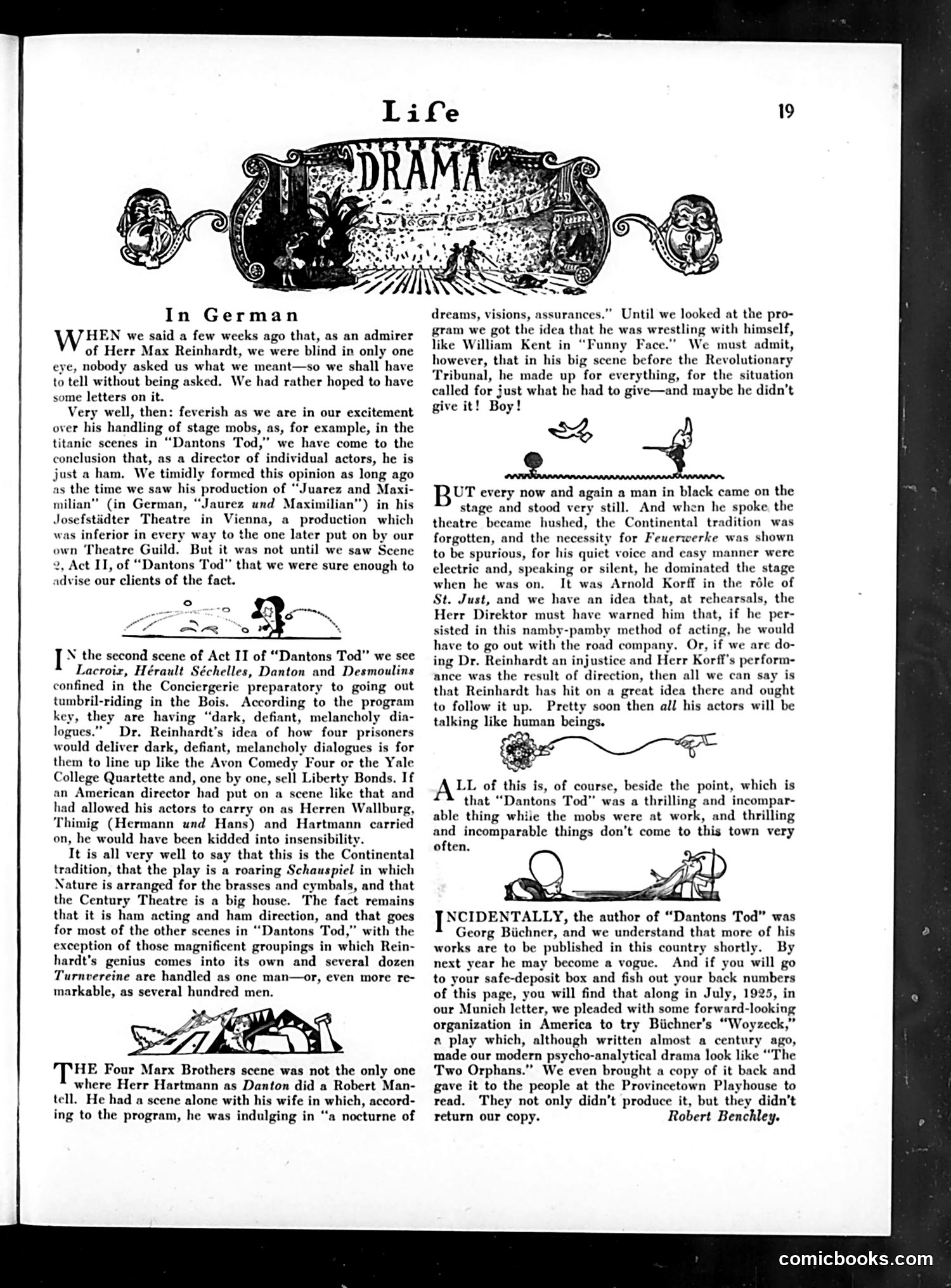
This page critiques **Max Reinhardt**, the famous German theater director, and his 1927 production of "Dantons Tod" (Danton's Death) at New York's Century Theatre. **The Main Argument:** The critic praises Reinhardt's skill directing crowd scenes but attacks his direction of individual actors, calling it "ham" acting. He highlights absurd staging choices—prisoners in a dungeon scene performing like the "Avon Comedy Four" or Yale barbershop quartet, essentially selling Liberty Bonds rather than delivering dark, defiant dialogue. **The Exception:** Actor **Arnold Korff**, playing St. Just, is praised as the production's standout—his quiet, naturalistic performance dominates scenes despite (or because of) avoiding theatrical excess. **The Satire's Point:** The critic argues Reinhardt confuses spectacle with artistry. Continental theatrical traditions don't excuse poor acting direction. The piece suggests that by accident or design, Korff's understated approach proves superior to Reinhardt's overblown "ham" directing style.
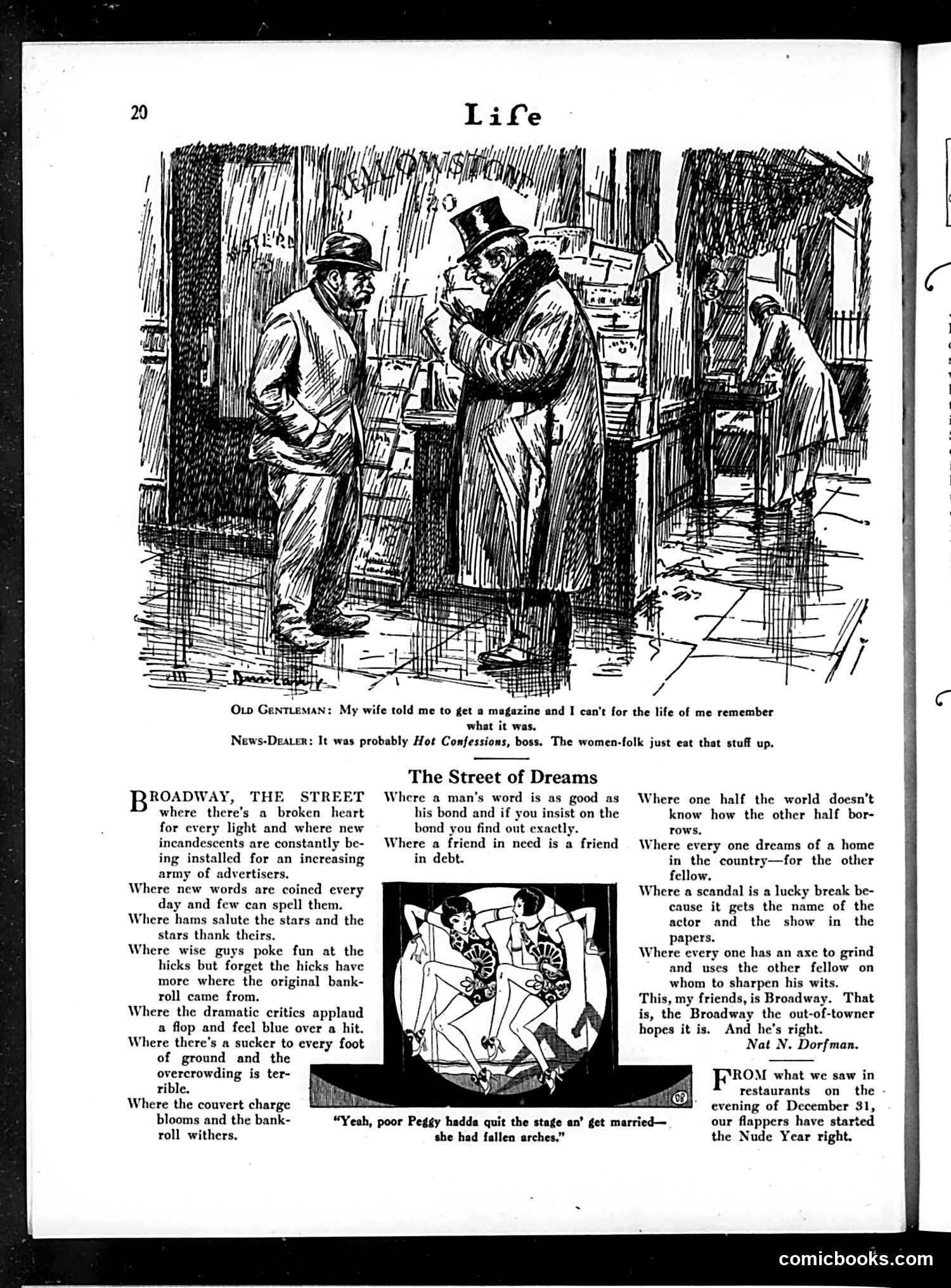
This page contains two satirical pieces about early 1920s American urban life. **Top cartoon**: A news dealer jokes with a customer that his wife probably wanted a "Hot Confessions" magazine—a pulp publication targeting women. The satire mocks both sensationalist magazines and the stereotype that women consume trashy romance content. **"The Street of Dreams"**: Nat N. Dorfman's poem satirizes Broadway as a place of contradictions and illusions. It presents cynical observations: broken hearts, cheap tricks, failed theatrical productions, financial exploitation, and moral compromises. The poem suggests Broadway's glamorous reputation masks corruption and desperation. The accompanying cartoon shows two chorus girls, with a caption about "Peggy" quitting the stage after marriage due to "fallen arches"—medical slang implying she was a prostitute. **Bottom note**: References "the Nude Year" (New Year), satirizing flappers' reportedly scandalous behavior at New Year's Eve celebrations—reflecting 1920s moral panic about women's increasing sexual liberation and public conduct during Prohibition.
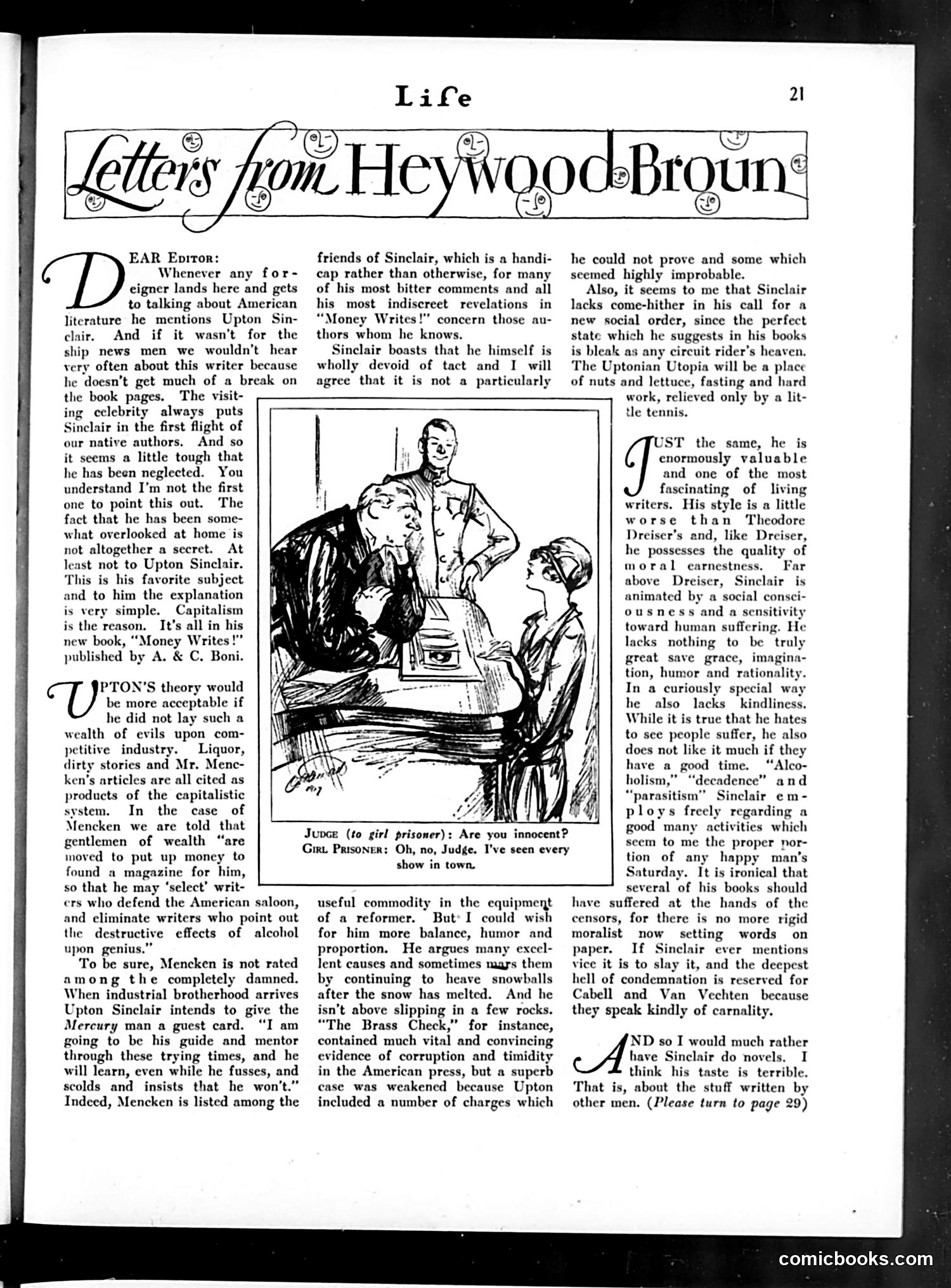
This is a letter to the editor from Heywood Broun (a prominent American journalist and critic) evaluating Upton Sinclair's recent book *"Money Writes!"* **The figures:** Sinclair is the subject; H.L. Mencken appears as a secondary reference—a literary rival whom Sinclair both criticizes and oddly respects. **The satire's point:** Broun acknowledges Sinclair's genuine moral earnestness and social consciousness as admirable, but argues he's a flawed thinker. Sinclair blames capitalism for all societal ills (liquor, salacious literature) and proposes a bleak, joyless utopian alternative of "nuts and lettuce, fasting and hard work." The cartoon shows a judge questioning a girl prisoner, illustrating how Sinclair's rigidly moralistic worldview judges human pleasure as inherently corrupt. **The critique:** Broun suggests Sinclair lacks humor, imagination, and kindliness—he won't let people enjoy themselves, even as he fights for their welfare. His arguments are often weakened by exaggeration and unproven accusations.
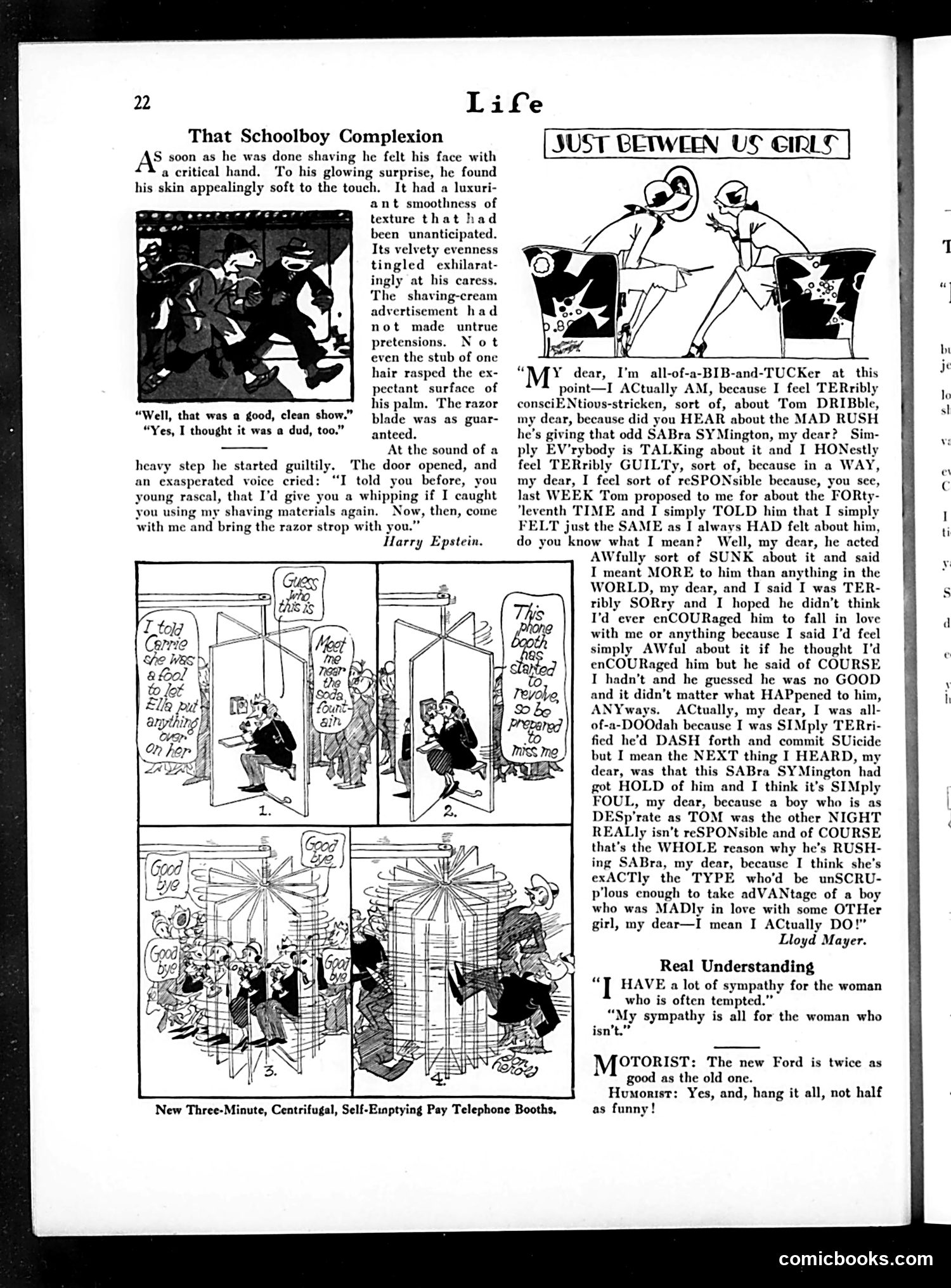
This page contains three satirical pieces typical of 1920s-30s Life magazine humor: **"That Schoolboy Complexion"** mocks shaving-cream advertisements' exaggerated claims about skin softness. A boy sneaks his father's razors, enjoys the advertised results, then is caught and threatened with a beating—undermining the ad's premise that this product brings dignity. **"Just Between Us Girls"** satirizes gossipy women's conversation, using emphatic capitalization to mock their breathless, superficial chatter about romantic drama. The narrator describes her guilt over a suitor (Tom Dribble) who's now pursuing another woman, speaking in performative concern typical of social pretense. **"Real Understanding"** offers quick one-liners about sympathy—the second joke implies the untempted woman deserves sympathy for missing excitement. The **telephone booth cartoon** (caption only visible) appears to satirize new self-service technology, likely mocking mechanical innovation or public behavior changes. The humor targets advertising claims, female gossip culture, and social hypocrisy—common Life magazine subjects reflecting period attitudes.
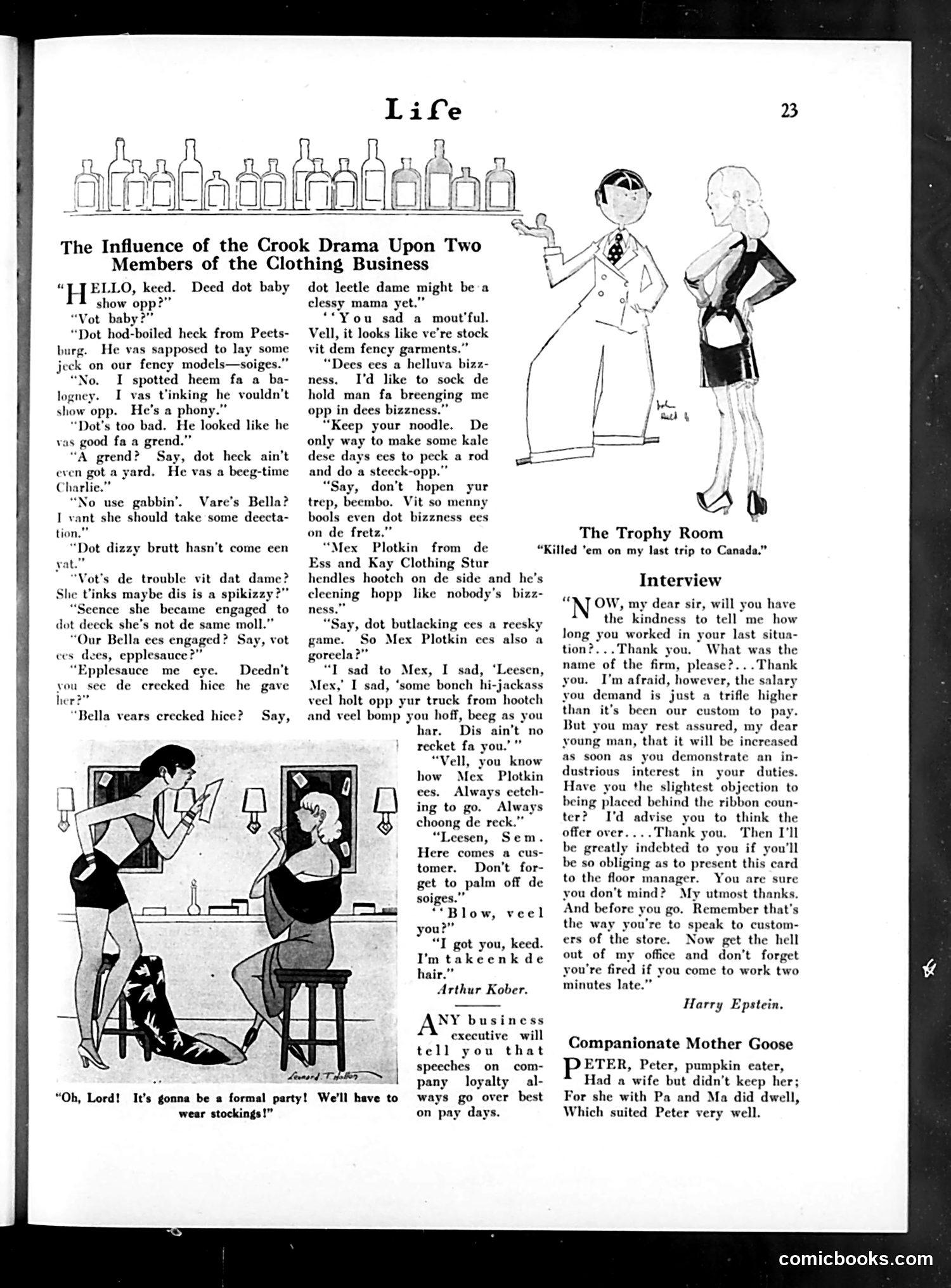
This page contains three distinct satirical pieces: **Main Cartoon: "The Influence of the Crook Drama Upon Two Members of the Clothing Business"** Two garment-industry workers speak in exaggerated Yiddish-inflected English, discussing criminal activity. One mentions a contact from Pittsburgh, references to "laying a jeck" (jack/robbery), and crucially, "Mex Plotkin" who runs bootleg liquor alongside his clothing business and fears hijacking. The satire mocks how 1920s gangster movies and Prohibition-era crime have infiltrated everyday conversation among working-class clothiers—they adopt the slang and paranoid mindset of criminals despite their mundane business. **Secondary Content:** Two brief pieces follow: an "Interview" satirizing a condescending employer's false promises to job applicants, and "Companionate Mother Goose," a parody of the nursery rhyme addressing modern domestic arrangements (in-laws living with couples). The humor targets ethnic stereotyping, organized crime's cultural permeation, labor exploitation, and changing family structures—typical Life magazine social commentary of the Prohibition era.
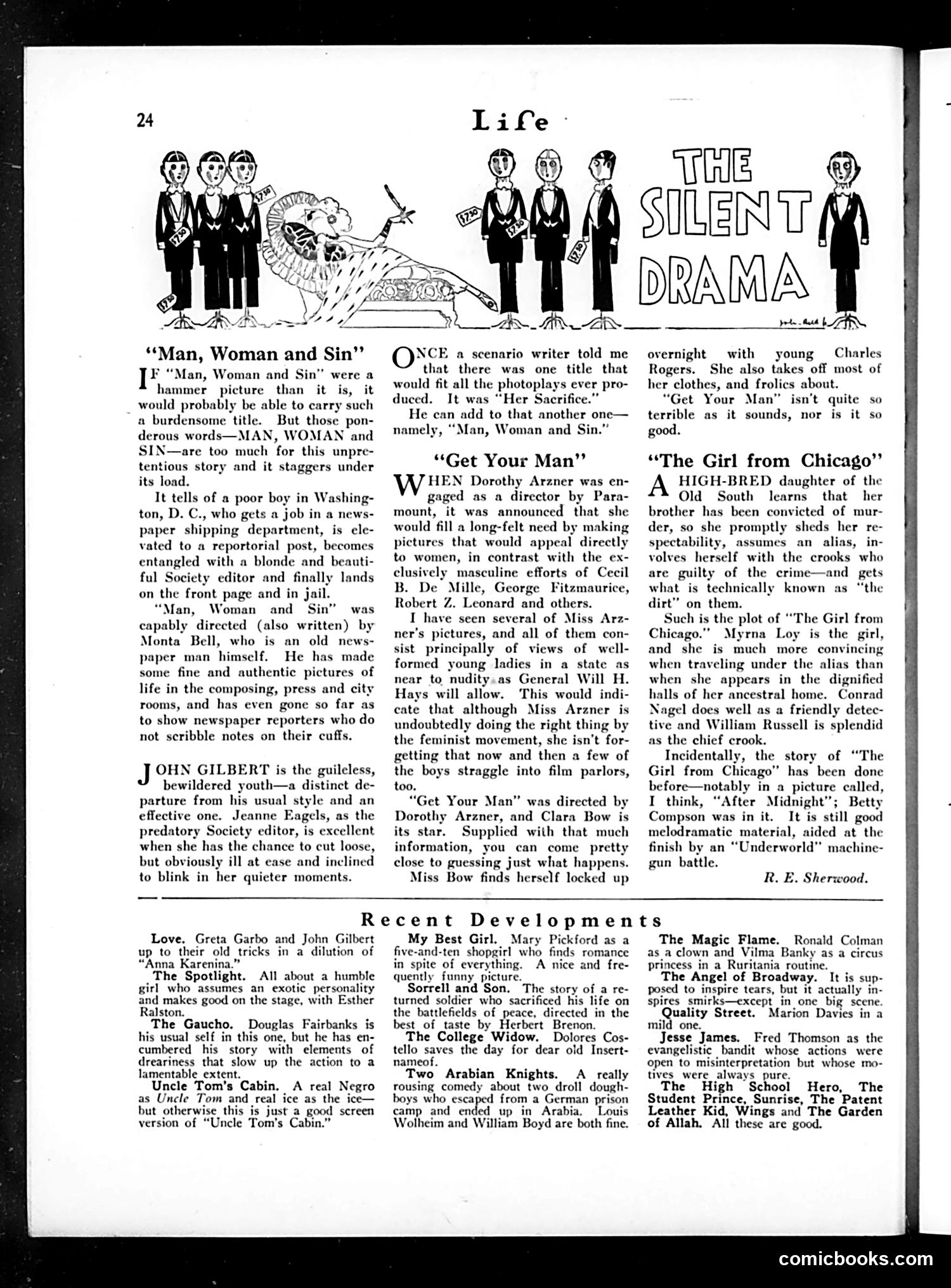
This page contains film reviews from Life magazine's entertainment section. The cartoon at the top satirizes silent film plots as formulaic and interchangeable—the critic notes that nearly every film could be retitled "Her Sacrifice," suggesting studios recycled the same melodramatic storylines endlessly. The reviews critique several 1920s films: "Man, Woman and Sin" is dismissed as a lightweight story burdened by its pretentious title; "Get Your Man," directed by Dorothy Arzner, is mocked for claiming to appeal to women while actually featuring scantily-clad actresses designed to attract male audiences—the reviewer sarcastically notes Arzner champions feminism while exploiting women's bodies; and reviews of other films with similar observations about plot predictability and casting. The tone is witty and cynical about Hollywood's commercial formulas during the silent era.
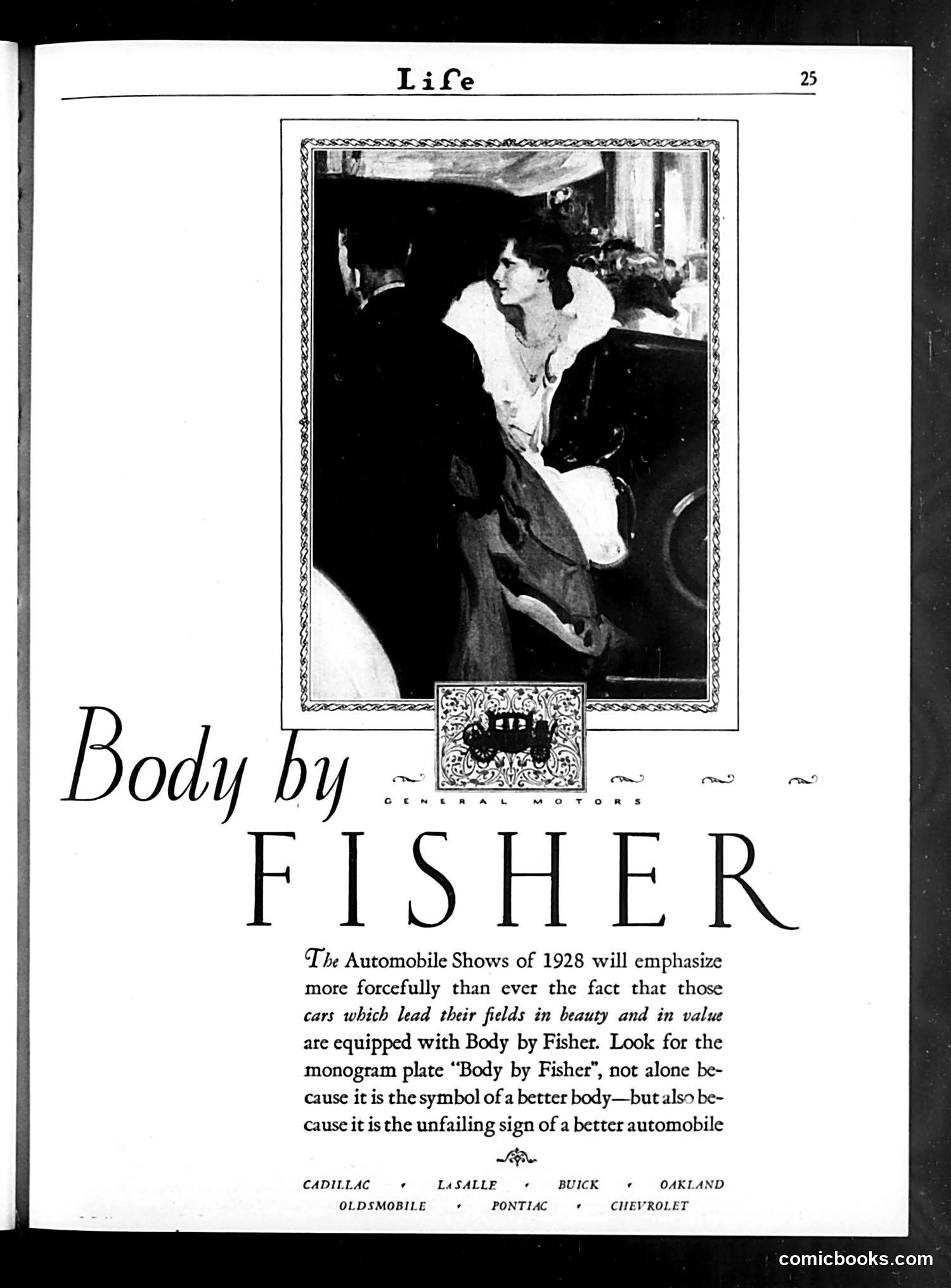
This is primarily a **General Motors advertisement**, not satire or political cartoon. It promotes Fisher Body, GM's coachbuilding subsidiary, ahead of the 1928 automobile shows. The photograph shows a woman in an automobile, displaying the interior styling—the actual "body" being marketed. The ad argues that Fisher Body's monogram plate indicates superior craftsmanship and quality, positioning it as a status symbol and mark of automotive excellence. The text lists GM brands equipped with Fisher bodies: Cadillac, LaSalle, Buick, Oakland, Oldsmobile, Pontiac, and Chevrolet—establishing Fisher as the premium standard across GM's range. For modern readers: this represents early **automotive branding strategy**, where component suppliers (Fisher) leveraged their name as a quality guarantee, similar to today's "Intel Inside" marketing.
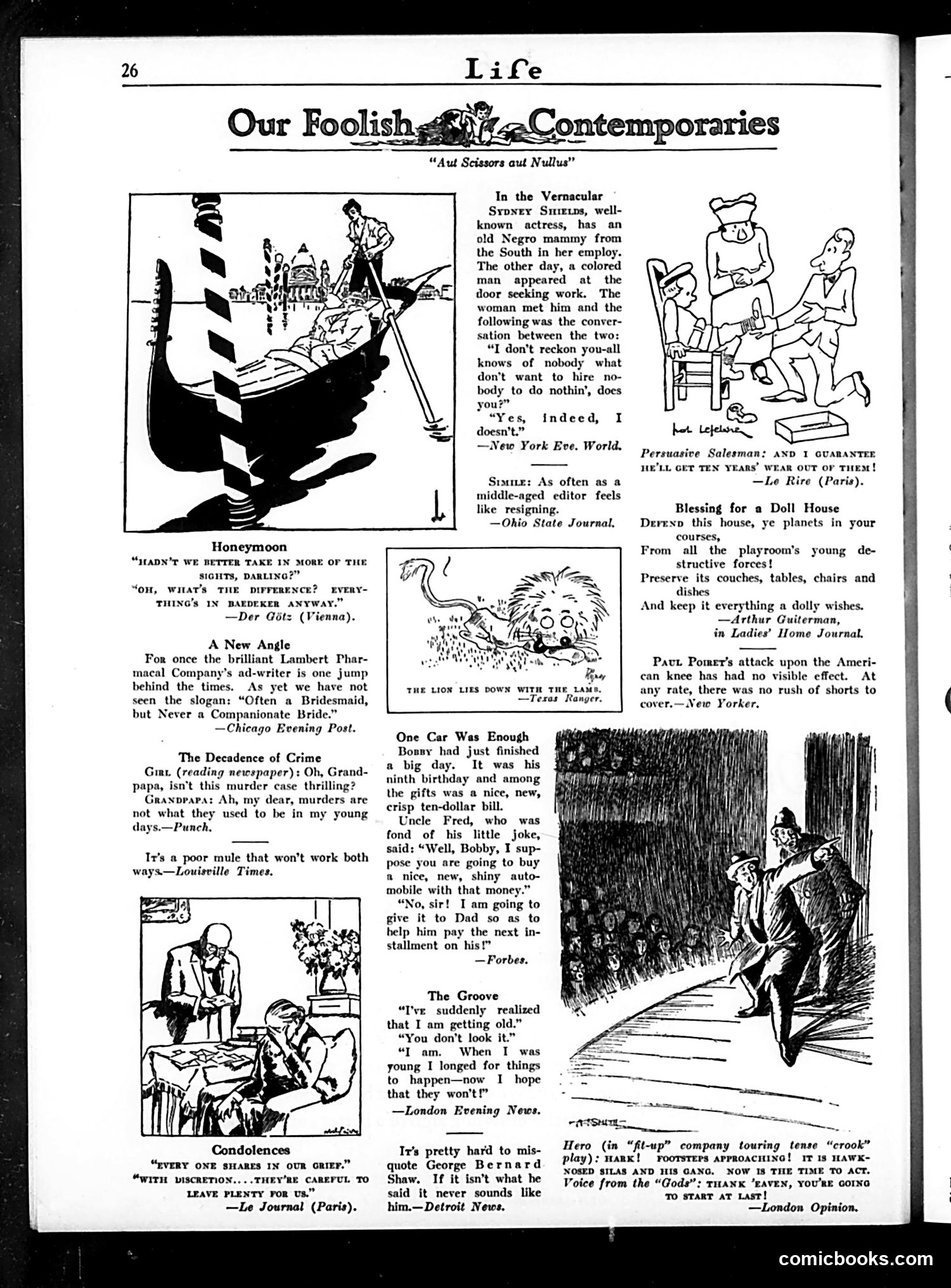
This page collects brief humorous observations and cartoons mocking contemporary social foibles. Key items include: **"Honeymoon"**: A couple on a Venetian gondola; the wife finds sightseeing boring because guidebooks (Baedeker) describe everything already—satirizing mechanical tourism and marital disinterest. **"The Decadence of Crime"**: A grandfather laments that modern murders lack the thrill of crimes in his youth—dark humor about sensationalism and nostalgia. **"Companionate Bride"**: References the 1920s trend of "companionate marriage" (partnership-based rather than traditional), joking that modern women become mistresses but never wives. **"One Car Was Enough"**: A boy receives money but gives it to his father for car payments—satirizing American consumer debt and automobile installment buying, a 1920s phenomenon. Other pieces mock mid-life disillusionment, aging, and Bernard Shaw quotations. The overall tone reflects 1920s Life magazine's urbane, cynical commentary on modern life's absurdities.
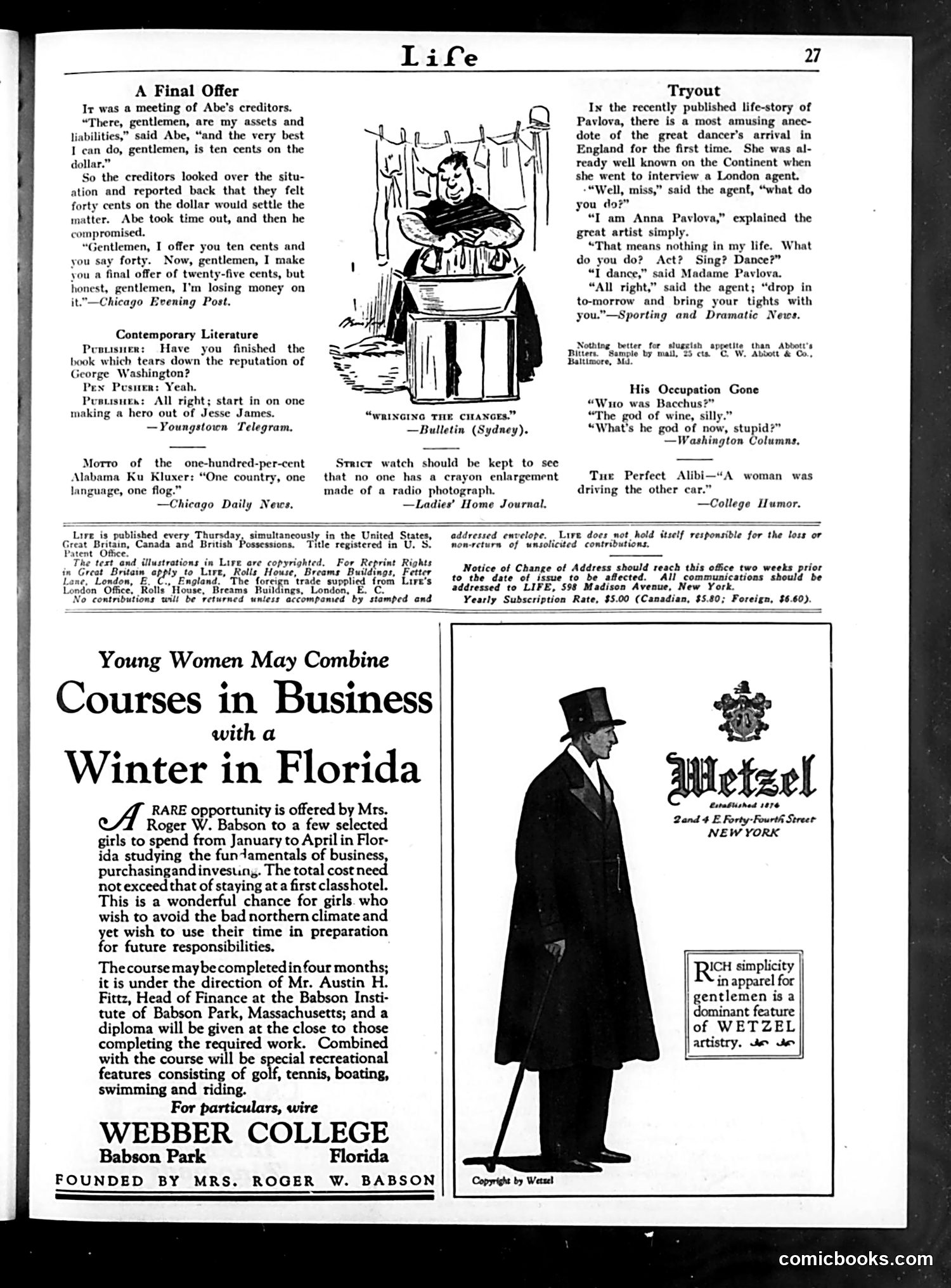
**Main Cartoons/Humor:** The page contains several brief satirical pieces: 1. **"A Final Offer"**: A creditor negotiation joke where "Abe" (likely a generic everyman, possibly alluding to Abraham Lincoln based on context) compromises between offering 10 cents and being offered 40 cents on the dollar, settling at 25 cents—presented as his "honest" loss-making offer. The satire mocks dishonest bankruptcy negotiations. 2. **"Wringing the Oranges"** (Sydney Bulletin cartoon): The accompanying illustration shows a figure squeezing someone in a barrel, satirizing exploitation or extraction of resources/labor. 3. **Minor jokes** about George Washington's reputation being torn down, then Jesse James being made heroic—mocking inconsistent historical revisionism. The page is primarily **advertising** for Webber College in Florida and Wetzel apparel, with the humor pieces serving as filler content typical of Life's satirical format.
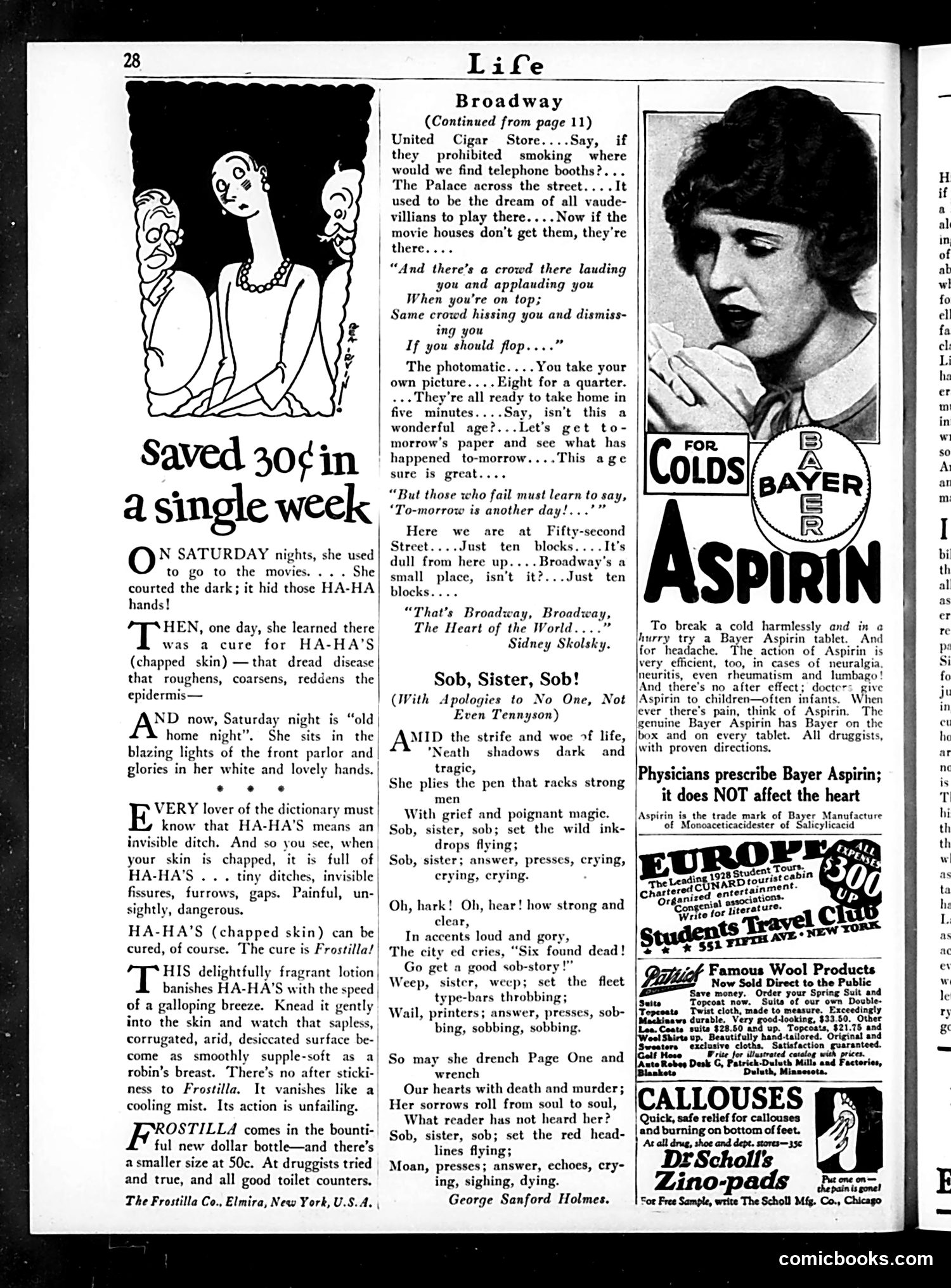
This page contains two main satirical pieces: **"Saved 30¢ in a Single Week"** (left cartoon): A humorous advertisement disguised as editorial content. It mocks consumerism and the marketing of beauty products. A woman with visibly chapped skin ("HA-HA's"—a pun on the skin condition causing laugh lines/dimples) discovers Frostilla lotion. The satire: she now hides her rough hands at movies, but after using the product, proudly displays her "white and lovely hands" at home. It exaggerates how trivial beauty concerns were marketed as life-changing solutions. **"Sob, Sister, Sob!"** (right poem): A satirical attack on sensationalist journalism and "sob sister" reporters—female journalists who wrote emotionally manipulative crime and human-interest stories. The poem mocks reporters who dramatize tragedies ("Six found dead!") purely for sales, treating human suffering as material to exploit. The repeated "sob," "cry," and "moan" emphasize the performative, manipulative nature of this journalism style. The page also includes period advertisements for Bayer Aspirin and other products, typical of 1920s Life magazine.
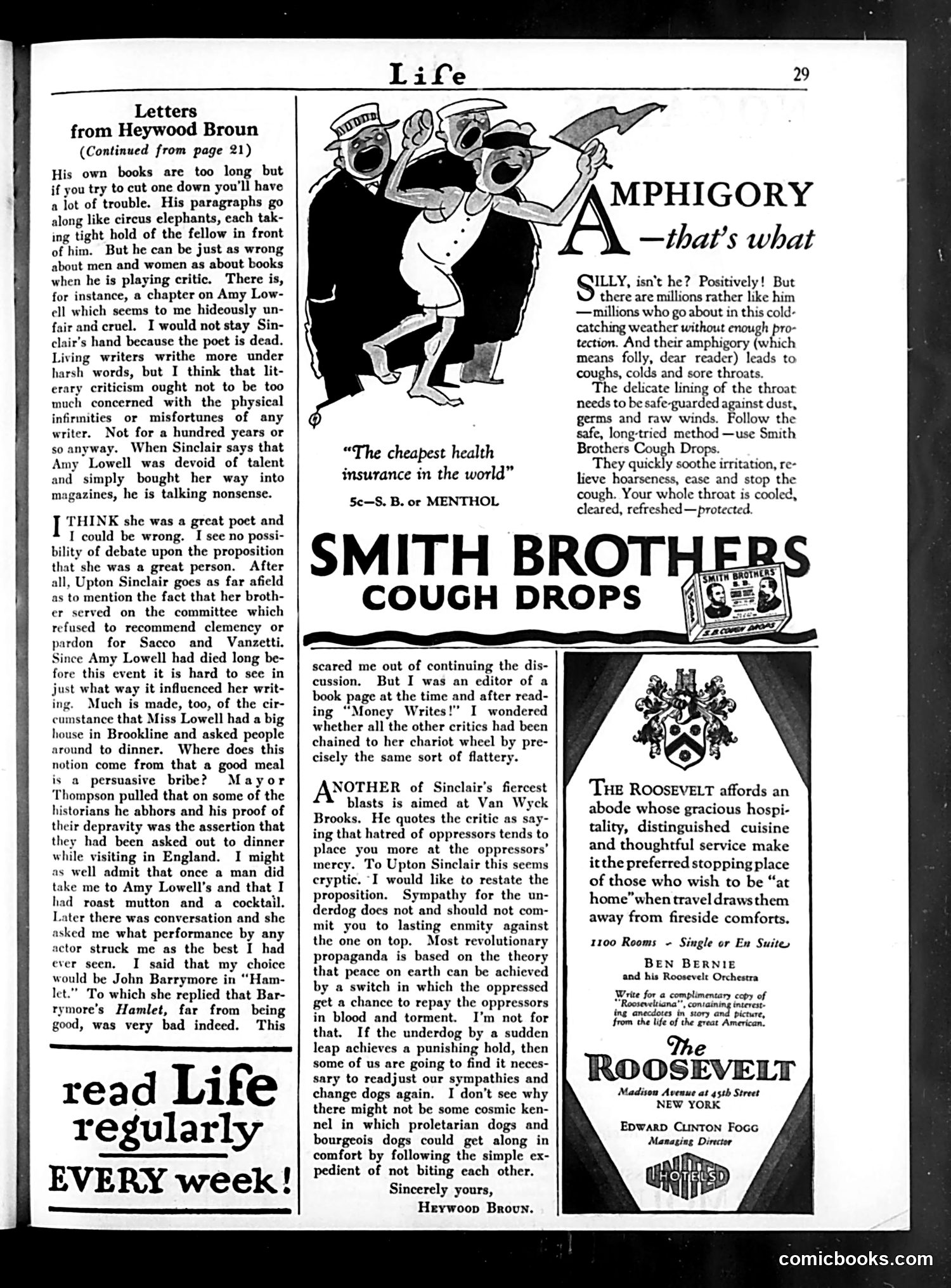
This page features a letter from prominent critic **Heywood Broun** attacking socialist writer **Upton Sinclair's** book "Money Writes!" Broun defends **Amy Lowell** (deceased modernist poet) against Sinclair's accusations that she lacked talent and bought her way into magazines through wealth and entertaining. Broun argues such critiques unfairly exploit her dead status and that her wealth and hospitality don't diminish her literary merit. He sarcastically notes Sinclair even criticized her brother's committee role in the Sacco-Vanzetti case—events occurring after Lowell's death. Broun also criticizes Sinclair's attack on critic **Van Wyck Brooks**, suggesting Sinclair conflates sympathy for the oppressed with endorsing violent revenge against oppressors. The page's subtext reflects 1920s-30s intellectual debates: socialist reformers versus literary establishment figures, questions about wealth's corrupting influence on art, and whether political positions should affect literary judgment. The accompanying **Smith Brothers Cough Drops advertisement** is standard commercial content unrelated to the editorial matter.
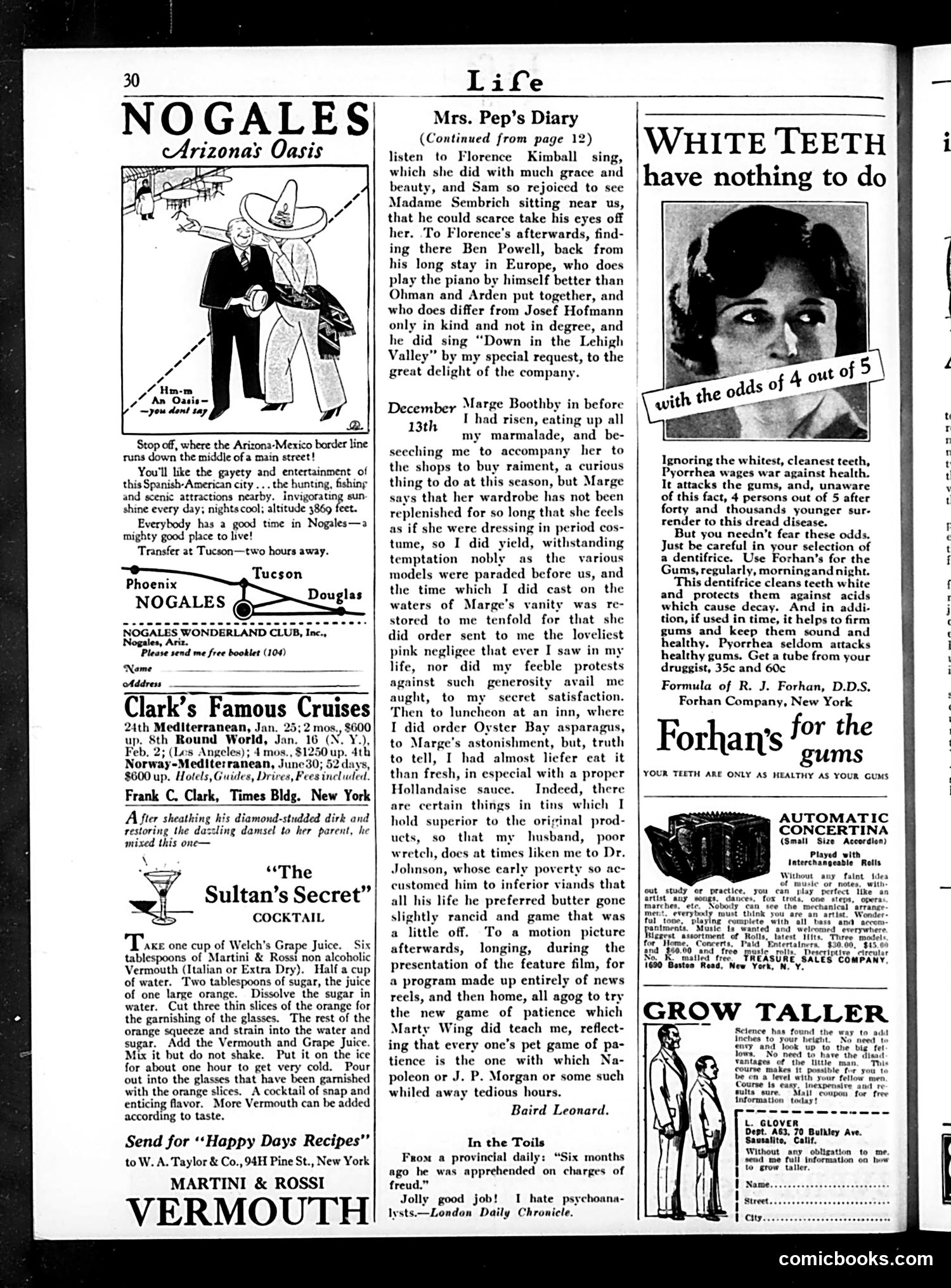
This page is primarily **advertisements and lifestyle content** rather than political satire. The "Nogales, Arizona's Oasis" cartoon (top left) is a light travel advertisement showing a couple at the Arizona-Mexico border town, with minimal satirical content—just gentle humor about the border location. The main text content is "Mrs. Pep's Diary," a society column recounting trivial upper-class activities: attending musical performances by minor celebrities, shopping for clothes, and dining at restaurants. The diary's breathless, affected tone ("I did order," "poor wretch") mildly satirizes society women's pretensions and materialism, though gently. The remaining content consists entirely of **commercial advertisements**: travel cruises, cocktail recipes featuring Martini & Rossi vermouth, teeth-whitening products (Forhan's), height-increase supplements ("Grow Taller"), and other consumer goods. There are no clear political cartoons or significant satirical commentary on this page. It reflects Life's function as a magazine mixing light social humor with commercial content for affluent readers.
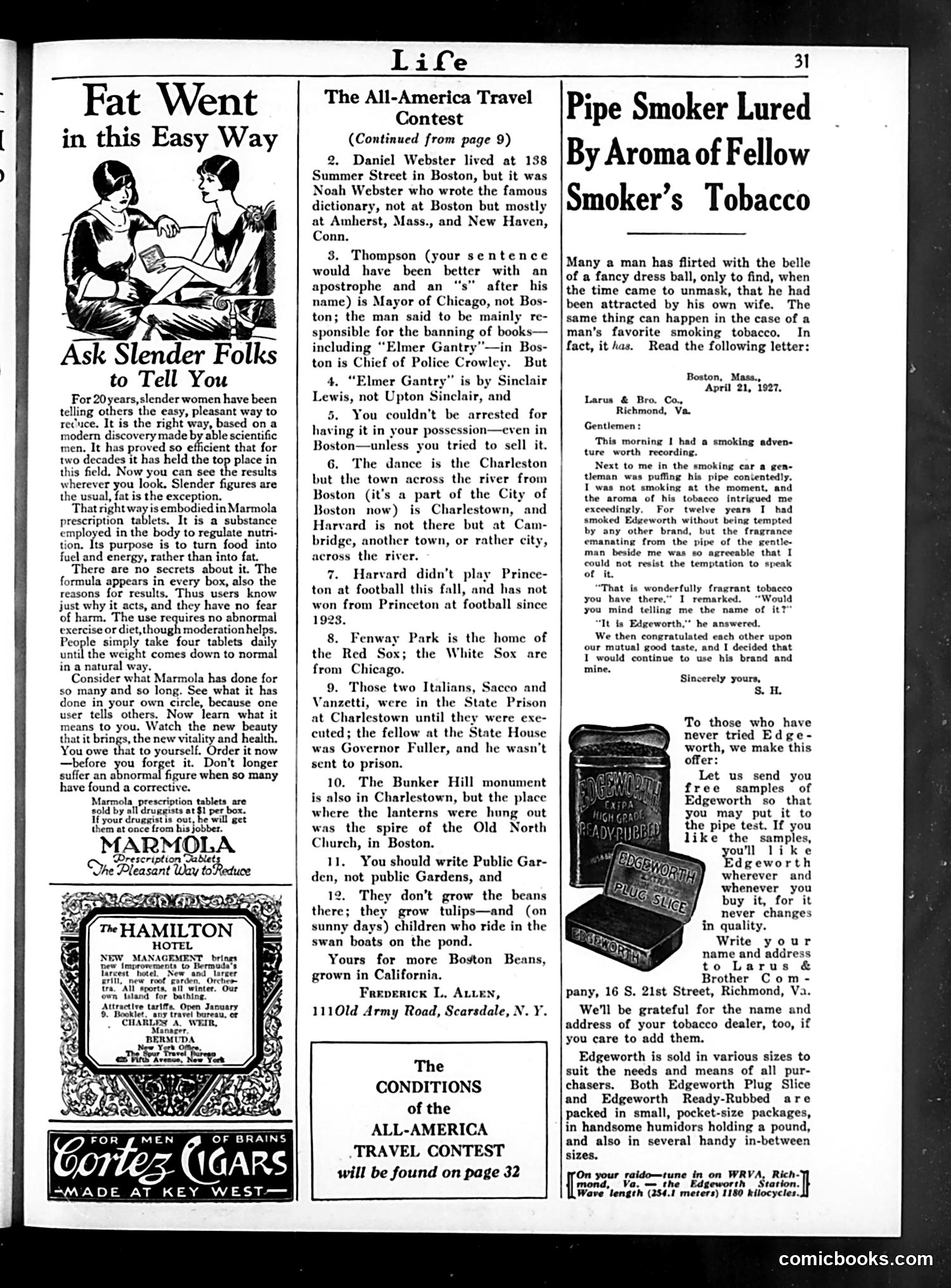
This 1927 page contains three main elements: **Left column:** An advertisement for Marmola weight-reduction tablets, targeting women. The pitch reflects 1920s attitudes about female appearance—promising easy weight loss through a "prescription tablet" with no need for exercise or diet restrictions. The language ("slender figures are the usual, fat is the exception") reveals period anxieties about women's bodies. **Center:** Continuation of "The All-America Travel Contest," correcting readers' answers about Boston geography and history. The corrections are humorous corrections to common mistakes—confusing Daniel and Noah Webster, getting Boston neighborhoods wrong, misidentifying Mayor Thompson. **Right:** A testimonial advertisement for Edgeworth pipe tobacco. A Boston smoker describes being "lured" by a fellow smoker's tobacco aroma, positioning the product as socially desirable and aromatic enough to attract notice. The page is primarily **advertising-driven**, typical of Life magazine's revenue model. The editorial contest content is secondary.
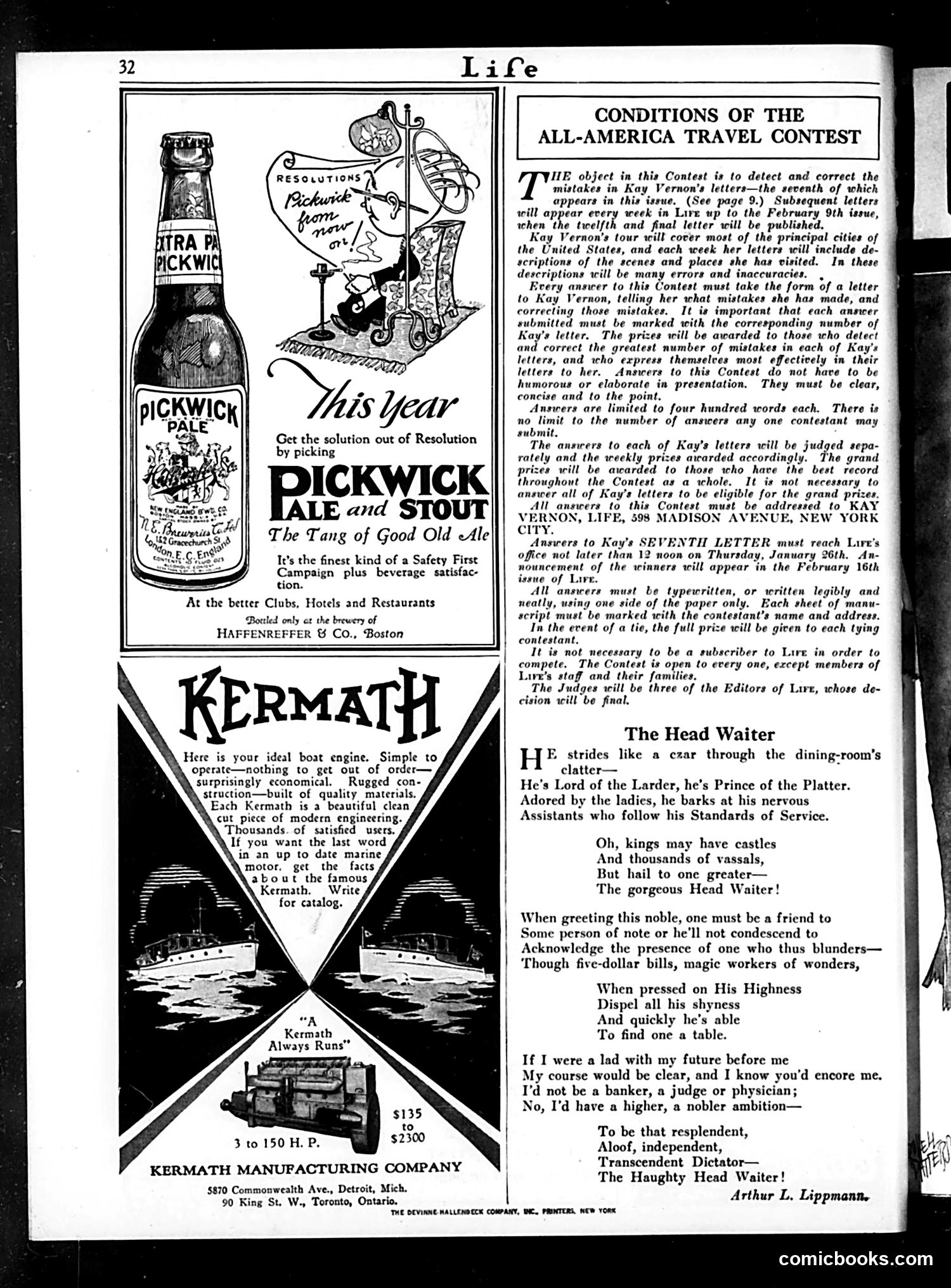
This page is primarily **advertising and contests** with limited satirical content. **Advertisements**: Three major ads occupy the left side—Pickwick Ale (playing on "Pickwick Papers," suggesting whimsical humor), and Kermath boat engines (straightforward product promotion). **Contest**: The right side announces Life's "All-America Travel Contest," where readers spot errors in letters from "Kay Vernon" describing U.S. cities. This is an interactive reader engagement device common to 1920s magazines. **Satire**: The poem "The Head Waiter" (bottom right, attributed to Arthur L. Lippmann) gently mocks restaurant hierarchy—comparing a head waiter's autocratic power over staff to kings and czars, while emphasizing the deference required when approaching this petty tyrant. It's mild workplace satire about service-industry pretension, using mock-heroic language. The overall page reflects Life's mix of advertising revenue, reader contests, and light comedic verses.