
Life, 1928-01-05 · page 16 of 34
Life — January 5, 1928 — page 16: what you’re looking at
What you’re looking at
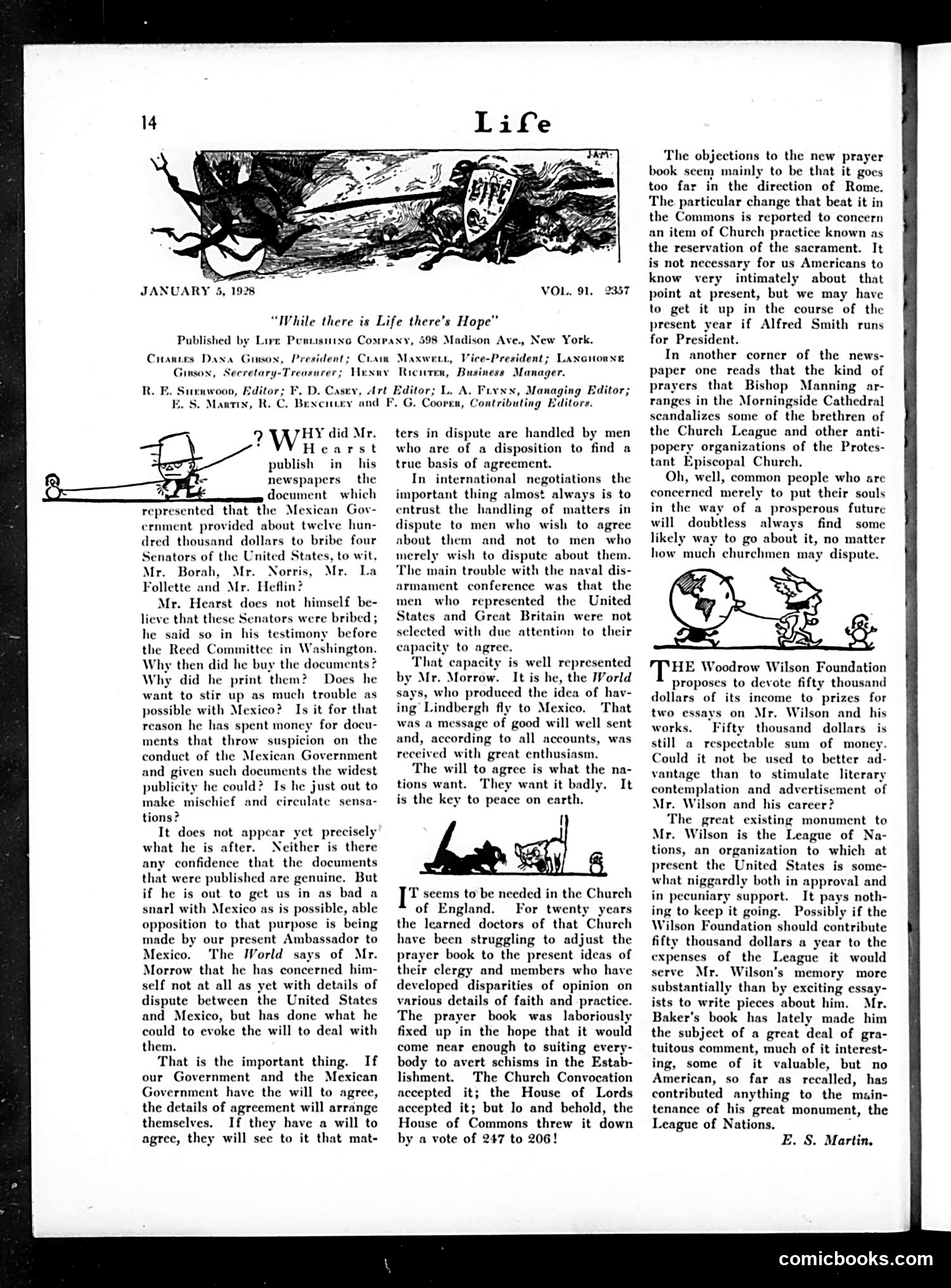
The page contains two editorial cartoons addressing political corruption and diplomatic disputes. The first cartoon depicts Mr. Hearst (the newspaper publisher) questioning why Mexican government officials were bribed with thousands of dollars to influence U.S. senators. The cartoon satirizes potential corruption involving senators Borah, Norris, La Follette, and Heflin, suggesting they may have accepted bribes that Hearst's newspapers publicized. The second cartoon shows figures handling a globe, likely referencing international naval disarmament negotiations. The satire appears to criticize how diplomats from the United States and Great Britain were inadequately prepared or positioned to reach agreement on arms control. Both cartoons target political corruption and diplomatic incompetence as contemporary problems.
📄 Transcribed text from this page (OCR, searchable)
Machine-transcribed from the original scan — historical spelling and the odd misread are preserved.
JANUARY 5, 192 VOL, 91, 2357 “While there is Life there’s Hope” Published b Crantes Daxa Ginsox, Pres Ginsos, R. urnwoon, Editor; F. D. Casey, S. Maatix, R. C. Bexcriee dent; Secretary-Treasurer; 9 HY did Mr. : Hearst publish in his newspapers — the document which represented that the Mexican Gov- ernment provided about twelve hun- dred thousand dollars to bribe four Senators of the United States, to wi Mr. Borah, Mr. Norris, Mr. La Follette and Mr. Heflin? Mr. Hearst does not himself be- lieve that these Senators were bribed ; he said so in his testimony before the Reed Committee in Washington. Why then did he buy the documen Why did he print them? Does he want to stir up as much trouble as possible with Mexico? Is it for that reason he has spent money for docu- ments that throw suspicion on the conduct of the Mexican Government and given such documents the widest publicity he could? Is he just out to make mischief and circulate sensa- tions? It does not appear yet precisely what he is after. Neither is there any confidence that the documents that were published are genuine. But if he is out to get us in as bad a snarl with Mexico as is possible, able opposition to that purpose is being made by our present Ambassador to Mexico. The World says of Mr. Morrow that he has concerned him- self not at all as yet with details of dispute between the United States and Mexico, but has done what he could to evoke the will to deal with them. That is the important thing. If our Government and the Mexican Government have the will to agree, the details of agreement will arrange themselves. If they have a will to agree, they will see to it that mat- y Lire Pususiuixc Comp. Cram Maxw Hesxry Art Editor; L. and F, G. xv, 598 Madison Ave. New York. Vice-President; Laxononse Ricuter, Business Manager. x, Managing Editor; ibuting Editors, ters in dispute are handled by men who are of a disposition to find a true basis of agreement. In international negotiations the important thing almost always is to entrust the handling of matters in dispute to men who wish to agree about them and not to men who merely wish to dispute about them. The main trouble with the naval dis- armament conference was that the men who represented the United States and Great Britain were not selected with due attention to their capacity to agree. That capacity is well represented by Mr. Morrow. It is he, the World says, who produced the idea of hav- ing’ Lindbergh fly to Mexico. That was a message of good will well sent and, according to all accounts, was received with great enthusiasm. The will to agree is what the na- tions want. They want it badly. It is the key to peace on earth. T seems to be needed in the Church of England. For twenty years the learned doctors of that Church have been struggling to adjust the prayer book to the present ideas of their clergy and members who have developed disparities of opinion on various details of faith and practice. The prayer book was laboriously fixed up in the hope that it would come near enough to suiting every- body to avert schisms in the Estab- lishment. The Church Convocation accepted it; the House of Lords accepted it; but lo and behold, the House of Commons threw it down by a vote of 247 to 206! The objections to the new prayer book seem mainly to be that it goes too far in the direction of Rome. The particular change that beat it in the Commons is reported to concern an item of Church practice known as the reservation of the sacrament. It is not necessary for us Americans to know very intimately about that point at present, but we may have to get it up in the course of the present year if Alfred Smith runs for President. In another corner of the news- paper one reads that the kind of prayers that Bishop Manning ar- ranges in the Morningside Cathedral scandalizes some of the brethren of the Church League and other anti- popery organizations of the Protes- tant Episcopal Church. Oh, well, common people who are concerned merely to put their souls in the way of a prosperous future will doubtless always find some likely way to go about it, no matter how much churchmen may dispute. R HE Woodrow Wilson Foundation proposes to devote fifty thousand dollars of its income to prizes for two essays on Mr. Wilson and his works. Fifty thousand dollars is still a respectable sum of money. Could it not be used to better ad- vantage than to stimulate literary contemplation and advertisement of Mr. Wilson and his career? The great existing monument to Mr. Wilson is the League of Na- tions, an organization to which at present the United States is some- what niggardly both in approval and in pecuniary support. It pays noth- ing to keep it going. Possibly if the Yilson Foundation should contribute fifty thousand dollars a year to the expenses of the League it would serve Mr. Wilson’s memory more substantially than by exciting essay- ists to write pieces about him. Mr. Baker’s book has lately made him the subject of a great deal of gra- tuitous comment, much of it interest- ing, some of it valuable, but no American, so far as recalled, has contributed anything to the main- tenance of his great monument, the League of Nations. E. S. Martin. comicbooks.com