
Life, 1928-01-05 · page 31 of 34
Life — January 5, 1928 — page 31: what you’re looking at
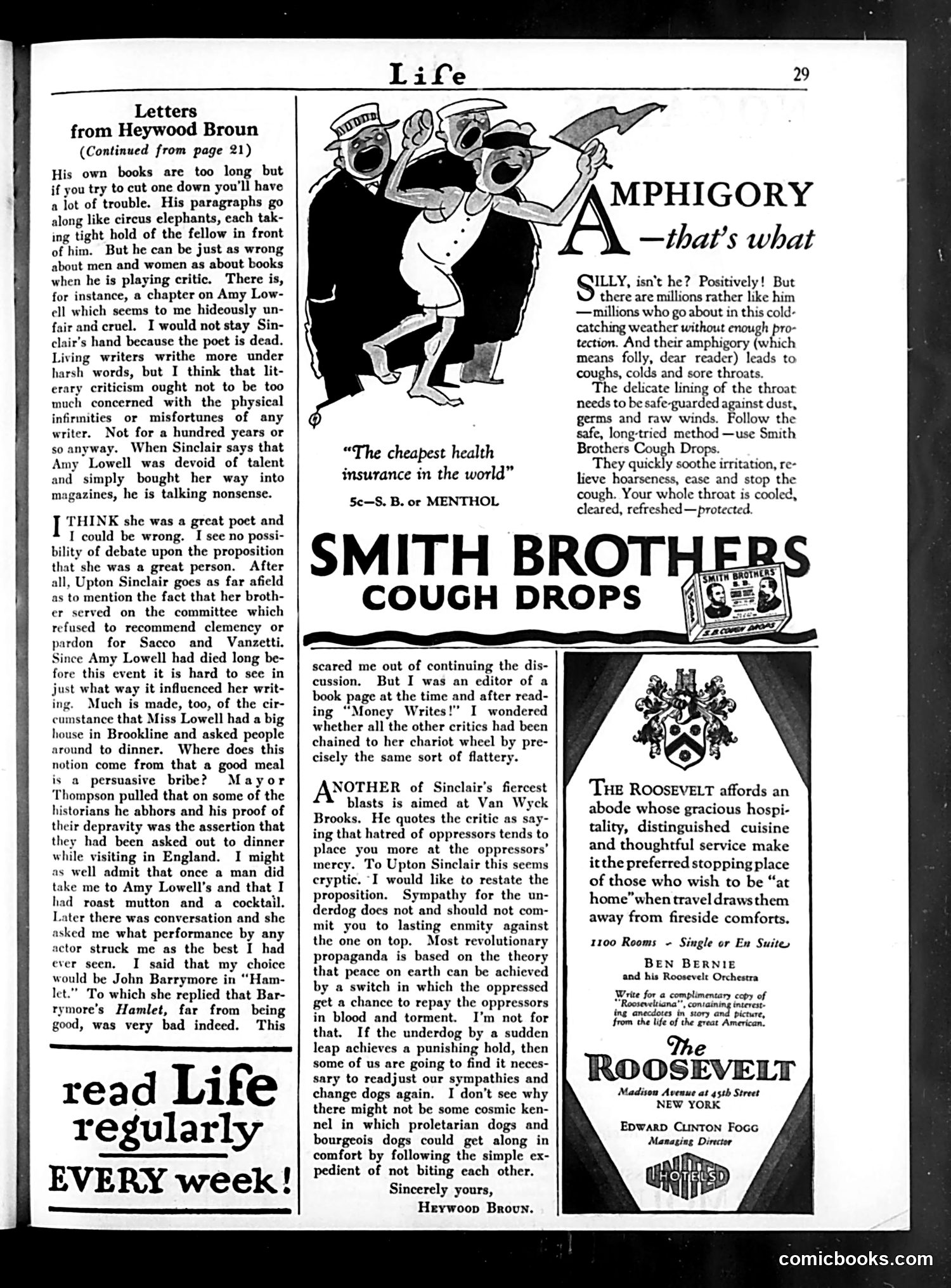
What you’re looking at
This page features a letter from prominent critic **Heywood Broun** attacking socialist writer **Upton Sinclair's** book "Money Writes!" Broun defends **Amy Lowell** (deceased modernist poet) against Sinclair's accusations that she lacked talent and bought her way into magazines through wealth and entertaining. Broun argues such critiques unfairly exploit her dead status and that her wealth and hospitality don't diminish her literary merit. He sarcastically notes Sinclair even criticized her brother's committee role in the Sacco-Vanzetti case—events occurring after Lowell's death. Broun also criticizes Sinclair's attack on critic **Van Wyck Brooks**, suggesting Sinclair conflates sympathy for the oppressed with endorsing violent revenge against oppressors. The page's subtext reflects 1920s-30s intellectual debates: socialist reformers versus literary establishment figures, questions about wealth's corrupting influence on art, and whether political positions should affect literary judgment. The accompanying **Smith Brothers Cough Drops advertisement** is standard commercial content unrelated to the editorial matter.
📄 Transcribed text from this page (OCR, searchable)
Machine-transcribed from the original scan — historical spelling and the odd misread are preserved.
Letters from Heywood Broun (Continued from page 21) His own books are too long but if you try to cut one down you'll have a lot of trouble. His paragraphs go along like circus elephants, each tak- ing tight hold of the fellow in front of him. But he can be just as wrong about men and women as about books when he is playing critic. There is, for instance, a chapter on Amy Low- ell which seems to me hideously un- fair and cruel. I would not stay Sin- clair’s hand because the poet is dead. Living writers writhe more under harsh words, but I think that lit- erary criticism ought not to be too much concerned with the physical infirmities or misfortunes of any writer. Not for a hundred years or so anyway. When Sinclair says that Amy Lowell was devoid of talent and simply bought her way into magazines, he is talking nonsense. I THINK she was a great poct and I could be wrong. I see no possi- bility of debate upon the proposition that she was a great person. After all, Upton Sinclair goes as far afield as to mention the fact that her broth- er served on the committee which refused to recommend clemency or pardon for Sacco and Vanzetti. Since Amy Lowell had died long be- fore this event it is hard to see in just what way it influenced her writ- ing. Much is made, too, of the cir- cumstance that Miss Lowell had a big house in Brookline and asked people around to dinner. Where does this notion come from that a good meal is a persuasive bribe? Mayor Thompson pulled that on some of the historians he abhors and his proof of their depravity was the assertion that they had been asked out to dinner while visiting in England. I might as well admit that once a man did take me to Amy Lowell’s and that I had roast mutton and a cocktail. Later there was conversation and she asked me what performance by any actor struck me as the best I had ever seen. I said that my choice would be John Barrymore in “Ham- let.” To which she replied that Bar- tymore’s Hamlet, far from being good, was very bad indeed. This read Life regularly EVERY week! “The cheapest health insurance in the world” 5e—S. B. or MENTHOL SMITH BROT MPHIGORY —that’s what ILLY, isn’t he? Positively! But there are millions rather like him —nmillions who go about in this cold- catching weather without enough pro- tection. And their amphigory (which means folly, dear reader) leads to coughs, colds and sore throats. The delicate lining of the throat needs to be safe-guarded against dust, germs and raw winds. Follow the safe, long-tried method —use Smith Brothers Cough Drops. They quickly soothe irritation, re- lieve hoarseness, ease and stop the cough. Your whole throat is cooled, cleared, refreshed —protected. Bw -- ITH scared me out of continuing the dis- cussion. But I was an editor of a book page at the time and after read- ing “Money Writes!” I wondered whether all the other critics had been chained to her chariot wheel by pre- cisely the same sort of flattery. NOTHER of Sinclair's fiercest blasts is aimed at Van Wyck Brooks. He quotes the critic as say- ing that hatred of oppressors tends to place you more at the oppressors’ mercy. To Upton Sinclair this seems cryptic. “I would like to restate the proposition. Sympathy for the un- derdog does not and should not com- mit you to lasting enmity against the one on top. Most revolutionary propaganda is based on the theory that peace on earth can be achieved by a switch in which the oppressed get a chance to repay the oppressors in blood and torment. I’m not for that. If the underdog by a sudden leap achieves a punishing hold, then some of us are going to find it neces- sary to readjust our sympathies and change dogs again. I don’t see why there might not be some cosmic ken- nel in which proletarian dogs and bourgeois dogs could get along in comfort by following the simple ex- pedient of not biting each other. Sincerely yours, Heywoop Broun. Tue ROOSEVELT affords an abode whose gracious hospi- tality, distinguished cuisine and thoughtful service make itthe preferred stopping place of those who wish to be “at home” when travel draws them away from fireside comforts. 1100 Rooms ~- Single or En Suites BEN BERNIE and his Roosevelt Orchestra Write f r Nplesetdiiana conten Saree ing anecdotes in story and picture, from the life of the great American. The ROOSEVELT EpwarD CUNTON FocG Managing Director et comicbooks.com