
Life, 1928-01-05 · page 23 of 34
Life — January 5, 1928 — page 23: what you’re looking at
What you’re looking at
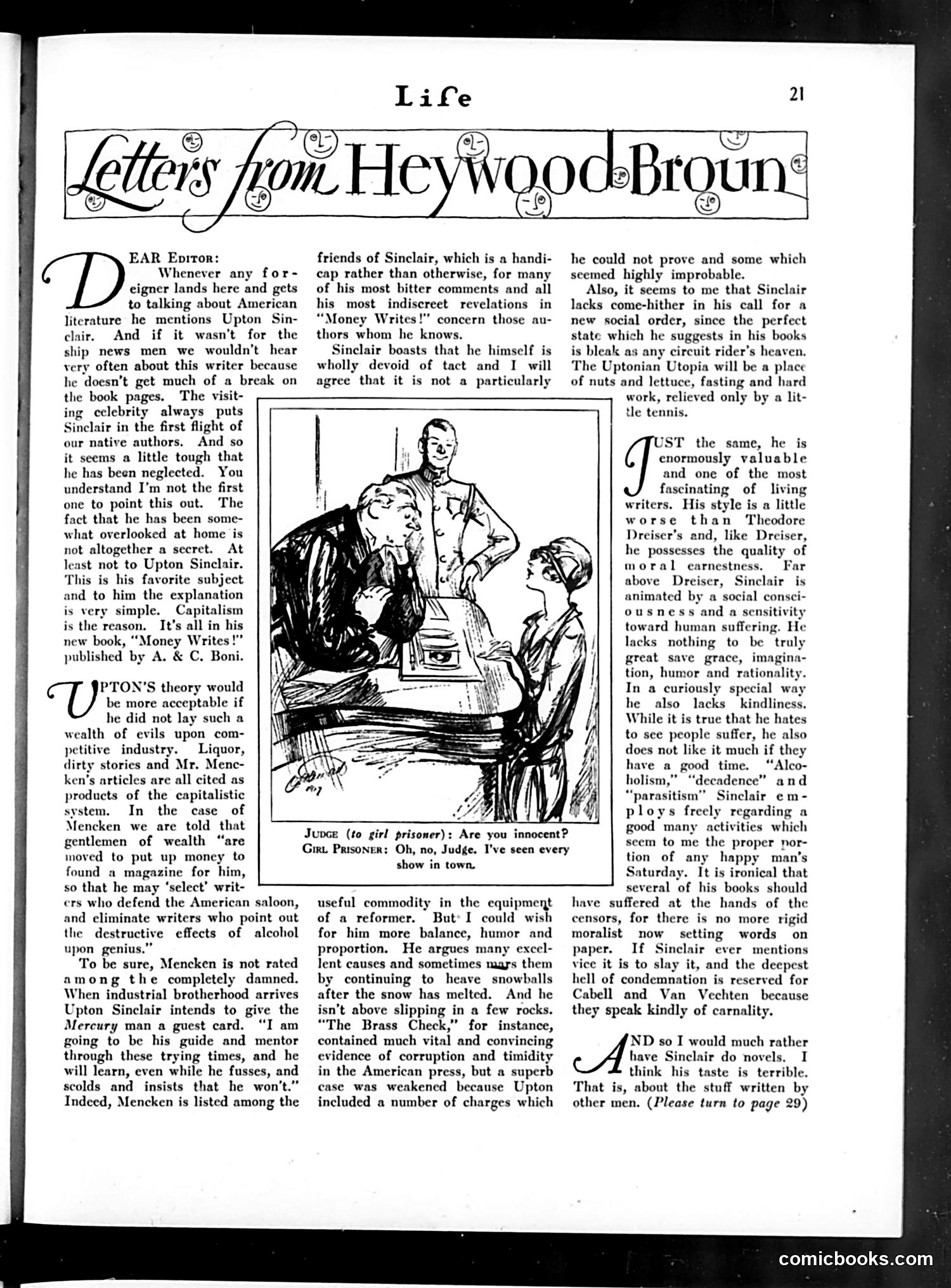
This is a letter to the editor from Heywood Broun (a prominent American journalist and critic) evaluating Upton Sinclair's recent book *"Money Writes!"* **The figures:** Sinclair is the subject; H.L. Mencken appears as a secondary reference—a literary rival whom Sinclair both criticizes and oddly respects. **The satire's point:** Broun acknowledges Sinclair's genuine moral earnestness and social consciousness as admirable, but argues he's a flawed thinker. Sinclair blames capitalism for all societal ills (liquor, salacious literature) and proposes a bleak, joyless utopian alternative of "nuts and lettuce, fasting and hard work." The cartoon shows a judge questioning a girl prisoner, illustrating how Sinclair's rigidly moralistic worldview judges human pleasure as inherently corrupt. **The critique:** Broun suggests Sinclair lacks humor, imagination, and kindliness—he won't let people enjoy themselves, even as he fights for their welfare. His arguments are often weakened by exaggeration and unproven accusations.
📄 Transcribed text from this page (OCR, searchable)
Machine-transcribed from the original scan — historical spelling and the odd misread are preserved.
EAR Epiror: Whenever any for- eigner lands here and gets to talking about American literature he mentions Upton Sin- clair. And if it wasn’t for the ship news men we wouldn't hear very often about this writer because he doesn’t get much of a break on the book pages. The visit- friends of Sinclair, which is a handi- cap rather than otherwise, for many of his most bitter comments and all his most indiscreet revelations in “Money Writes!” concern those au- thors whom he knows. Sinclair boasts that he himself is wholly devoid of tact and I will agree that it is not a particularly ing celebrity always puts Sinclair in the first flight of our native authors. And so it seems a little tough that he has been neglected. You understand I’m not the first one to point this out. The fact that he has been some- what overlooked at home is not altogether a secret. At least not to Upton Sinclair. This is his favorite subject and to him the explanation is very simple. Capitalism is the reason. It’s all in his new book, “Money Writes!” published by A. & C. Boni. PTON'’S theory would be more acceptable if he did not lay such a wealth of evils upon com- petitive industry. Liquor, dirty stories and Mr. Menc- ken’s articles are all cited as products of the capitalistic system. In the case of he could not prove and some which seemed highly improbable. Also, it seems to me that Sinclair lacks come-hither in his call for a new social order, since the perfect state which he suggests in his books is bleak as any circuit rider’s heaven. The Uptonian Utopia will be a place of nuts and lettuce, fasting and hard work, relieved only by a lit- tle tennis. JST the same, he is enormously valuable and one of the most fascinating of living writers. His style is a little than Theodore 's and, like Dreiser, he possesses the quality of moral earnestness. Far above Dreiser, Sinclair is animated by a social consci- ousness and a sensitivity toward human suffering. He lacks nothing to be truly great save grace, imagina- tion, humor and rationality. In a curiously special way he also lacks kindliness. While it is true that he hates to see people suffer, he also does not like it much if they have a good time. ‘‘Alco- holism,” “decadence” and “parasitism” Sinclair em- ploys freely regarding a Mencken we are told that gentlemen of wealth “are moved to put up money to found a magazine for him, so that he may ‘select’ writ- ers who defend the American saloon, and eliminate writers who point out the destructive effects of alcohol upon genius.” To be sure, Mencken is not rated among the completely damned. When industrial brotherhood arrives Upton Sinclair intends to give the Mercury man a guest card. “I am going to be his guide and mentor through these trying times, and he will learn, even while he fusses, and scolds and insists that he won't.” Indeed, Mencken is listed among the innocent P Girt Prisoner: Oh, no, Judge. I've seen every show in town, useful commodity in the equipment of a reformer. But’ I could wish for him more balance, humor and proportion. He argues many excel- lent causes and sometimes mays them by continuing to heave snowballs after the snow has melted. And he isn’t above slipping in a few rocks. “The Brass Check,” for instance, contained much vital and convincing evidence of corruption and timidity in the American press, but a superb case was weakened because Upton included a number of charges which good many activities which seem to me the proper nor- tion of any happy man’s Saturday. It is ironical that several of his books should have suffered at the hands of the censors, for there is no more rigid moralist now setting words on paper. If Sinclair ever mentions vice it is to slay it, and the deepest hell of condemnation is reserved for Cabell and Van Vechten because they speak kindly of carnality. ND so I would much rather have Sinclair do novels, I think his taste is terrible. That is, about the stuff written by other men. (Please turn to page 29) comicbooks.com