
A complete issue · 44 pages · 1927
Life — October 13, 1927
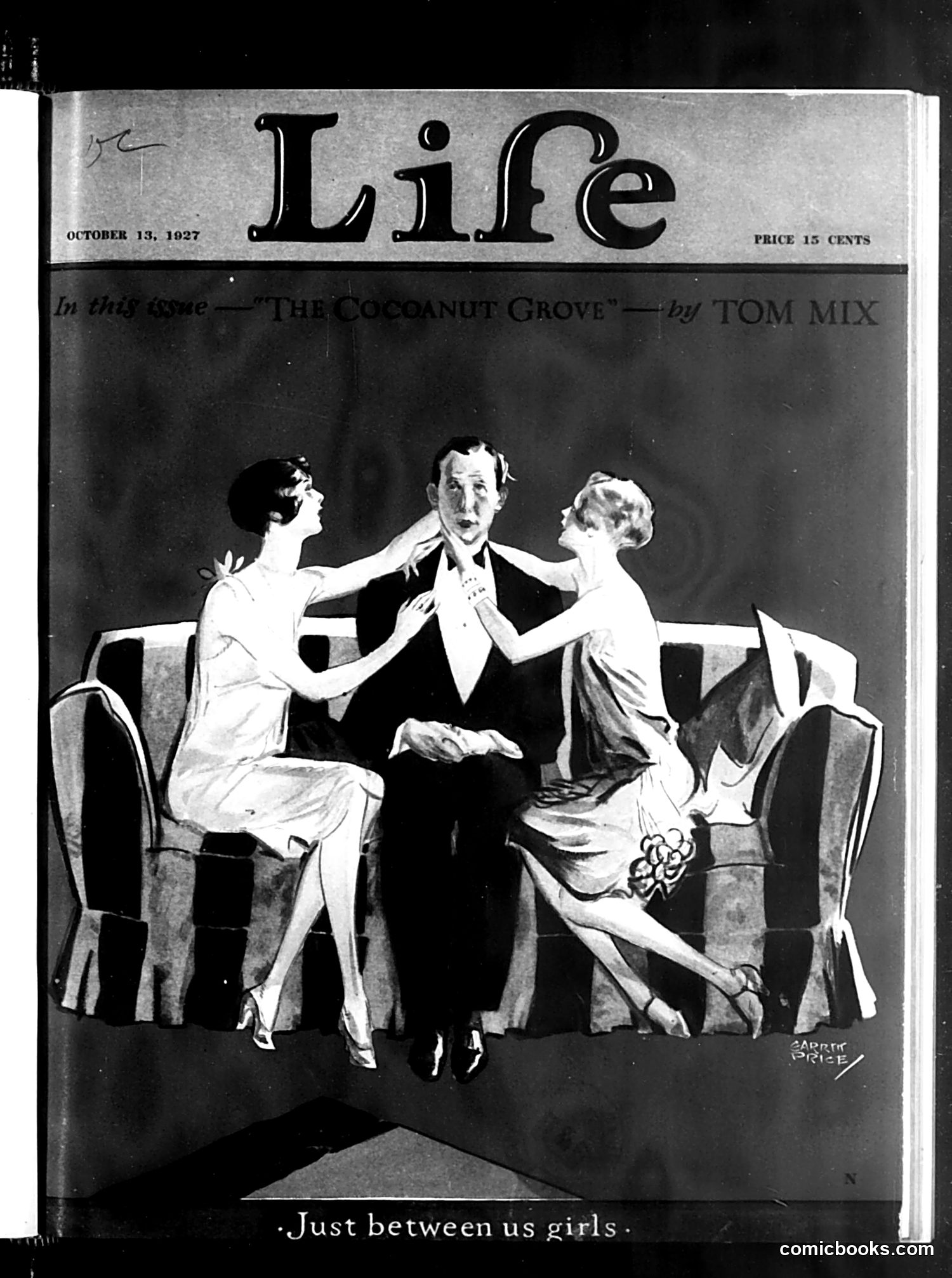
This cover illustrates "The Cocoanut Grove" by Tom Mix, a serialized story featured in that issue. The cartoon depicts a domestic comedy scenario: a man in formal evening wear sits between two women on a couch, both women appearing to flirt with or compete for his attention—one touching his shoulder, the other his arm. The caption "Just between us girls" suggests intimate, conspiratorial conversation. This reflects 1920s themes of romantic entanglement and flirtation. The illustration style and composition are typical of Life's humorous covers from this era, using exaggerated gestures and expressions to comedic effect. The scenario represents period anxieties about changing gender dynamics and dating customs during the Jazz Age.
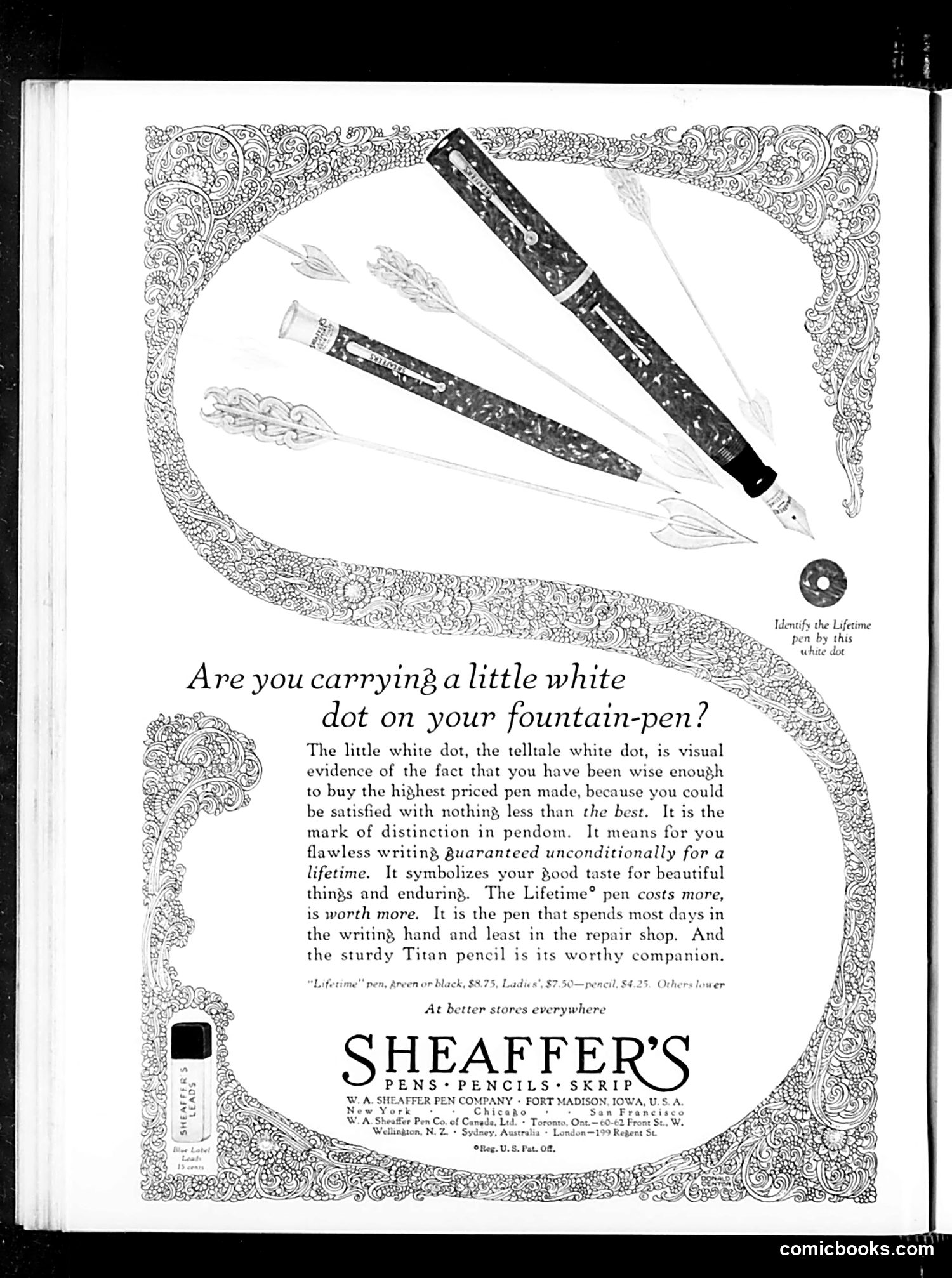
This is **not a cartoon or satire page** — it's a **full-page advertisement for Sheaffer's fountain pens and pencils**, likely from the early-to-mid 20th century. The ad uses a tongue-in-cheek rhetorical question ("Are you carrying a little white dot on your fountain-pen?") to market the Lifetime pen. The "white dot" refers to a quality mark on the pen's clip, presented as a status symbol indicating the owner purchased "the highest priced pen made." The advertisement appeals to **class consciousness and materialism**, suggesting the pen signals good taste, reliability, and financial success. The ornate decorative border reinforces luxury messaging. Pricing information and distribution details for multiple locations (Fort Madison, Chicago, San Francisco, Toronto, etc.) indicate this was a nationally distributed luxury brand advertisement rather than editorial content.
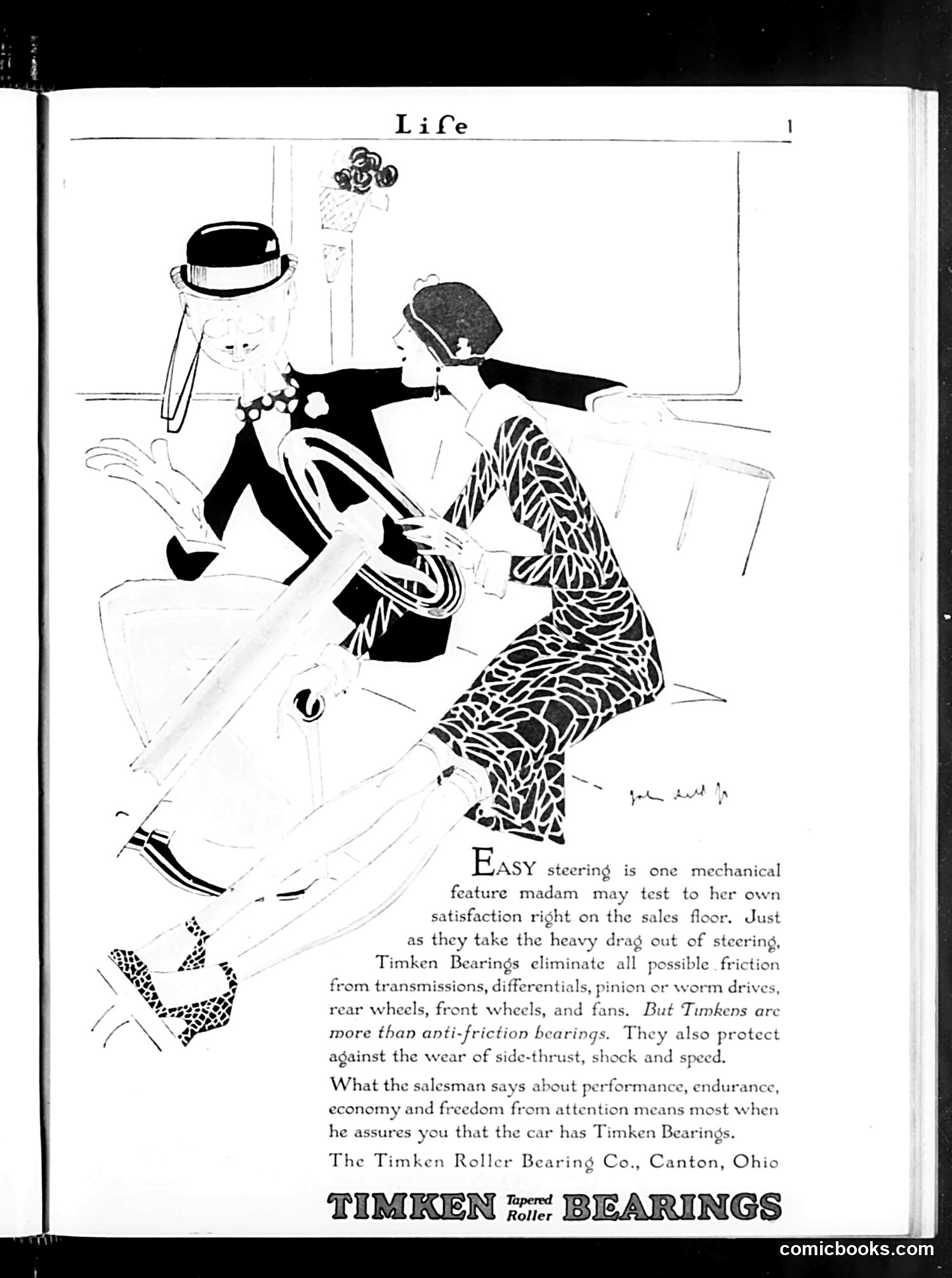
This page is primarily **advertising for Timken Roller Bearings**, not political satire. The illustration shows a fashionable woman at a car's steering wheel, with a male salesman or companion gesturing approvingly beside her. The cartoon illustrates the ad's central claim: that Timken Bearings enable "easy steering," allowing women to test-drive cars confidently on showroom floors. The image plays on 1920s-era gender dynamics—it presents women drivers as a selling point, positioning mechanical ease as empowering. The text emphasizes Timken's technical superiority while the visual reinforces the message that their product makes automobile operation accessible to female consumers, a notably progressive marketing angle for the era.
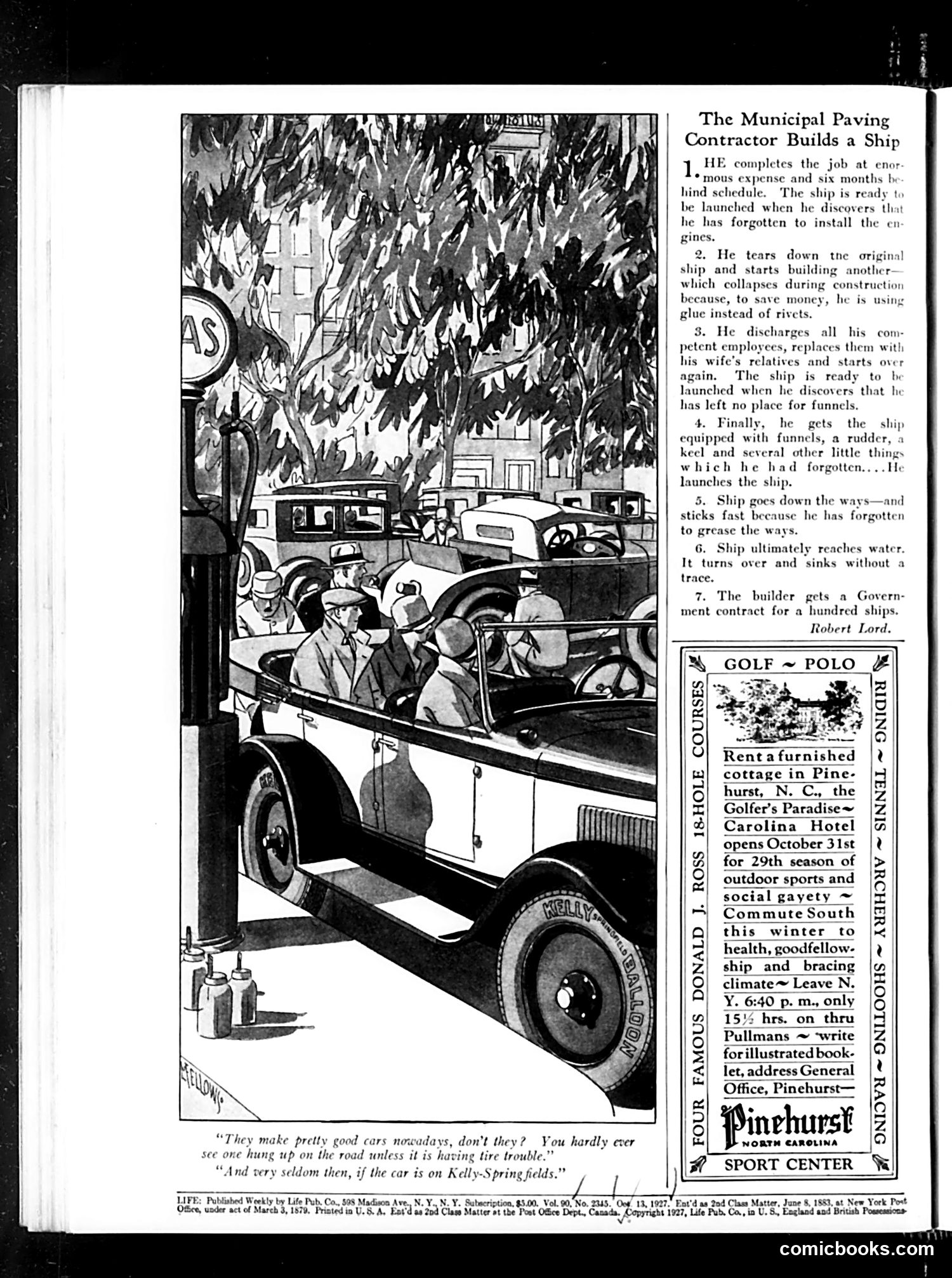
This page contains a satirical cartoon about a municipal paving contractor who attempts to build a ship. The seven-point narrative describes cascading failures: he forgets engines, tears down the first attempt to save money (using glue instead of rivets), replaces skilled workers with relatives, omits funnels and other equipment, fails to grease the ways, and ultimately launches a ship that immediately sinks. The satire critiques incompetence, nepotism, and corner-cutting in construction and municipal contracting—common targets of Progressive-era criticism. The joke's premise is that someone completely unqualified for shipbuilding undertakes the task anyway, with predictable disaster. The caption quotes suggest the humor relies on physical comedy and the absurdity of the situation. The accompanying Pinehurst golf resort advertisement is unrelated content.
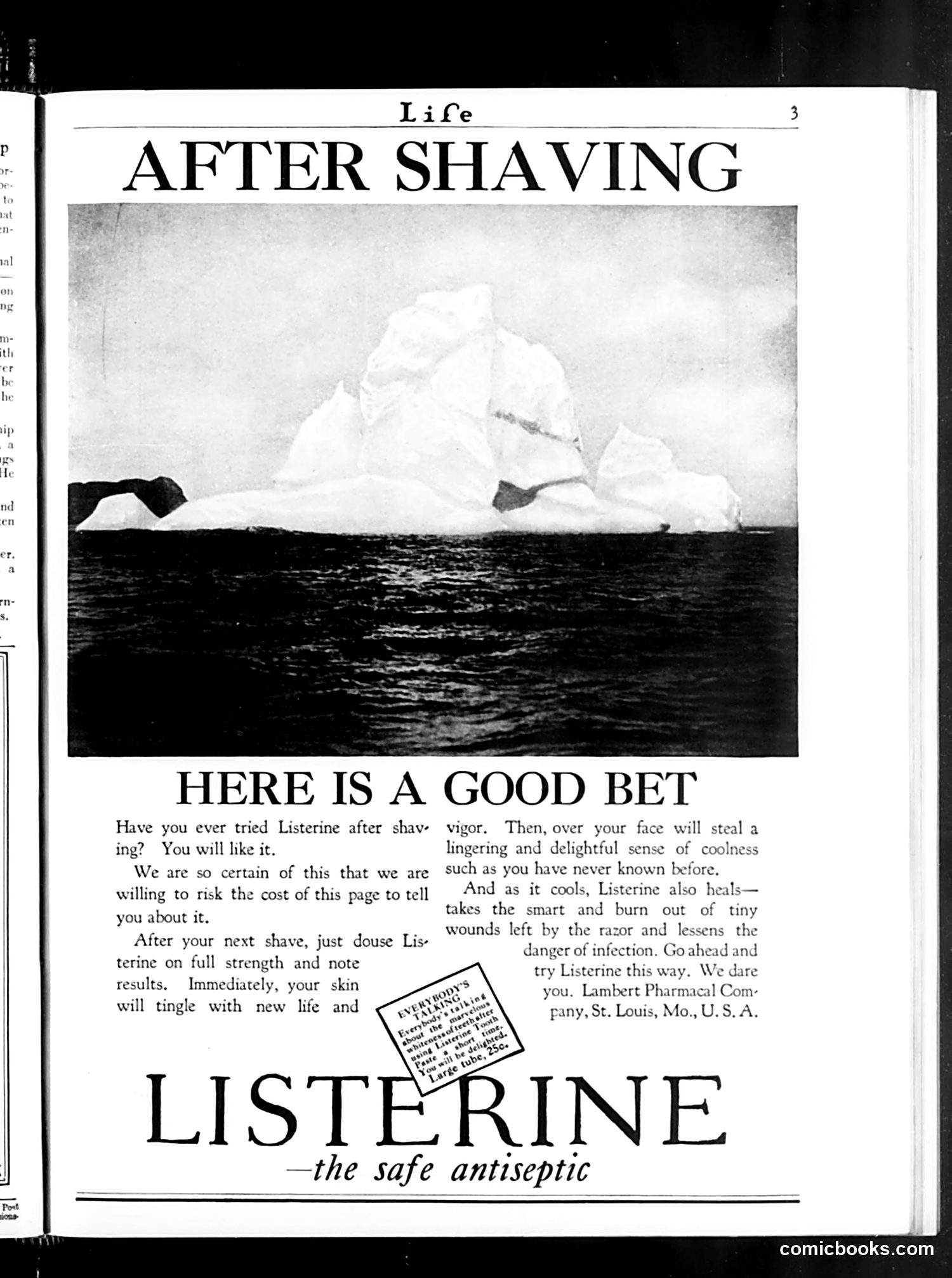
This is primarily a **product advertisement**, not political satire. The page shows an iceberg photograph with the headline "HERE IS A GOOD BET," creating a visual metaphor: just as an iceberg's true bulk lies beneath the surface, Listerine's benefits aren't immediately obvious. The ad promotes using Listerine as an **after-shave antiseptic**. It claims the mouthwash cools the skin, prevents razor wounds from becoming infected, and makes skin "tingle with new life." The Lambert Pharmacal Company positions Listerine beyond its primary use as a rinse, targeting men's grooming routines. This reflects early 20th-century marketing strategy: repurposing existing products for new consumer applications and emphasizing hygiene benefits during an era increasingly conscious of germ theory.
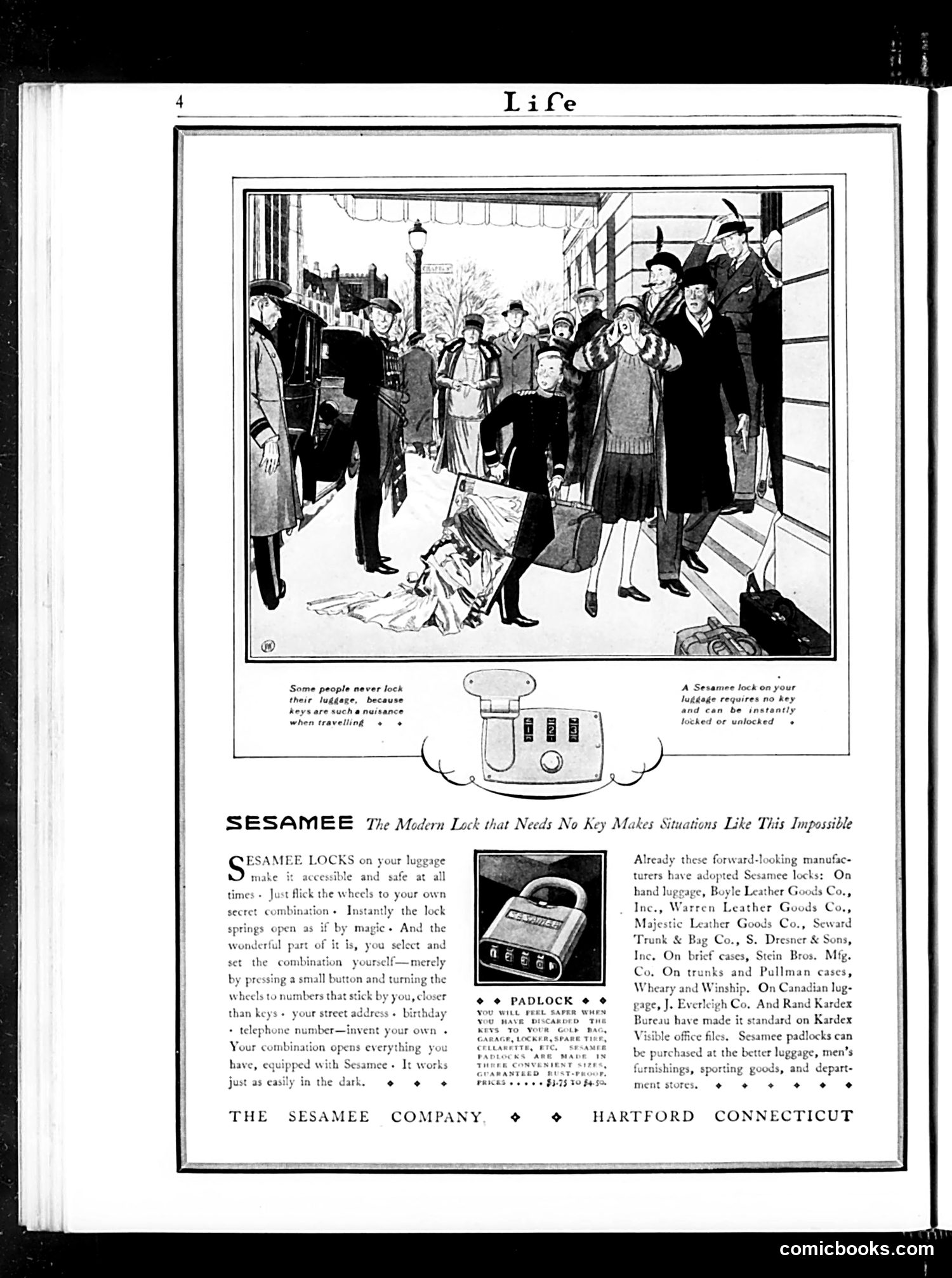
This page is **primarily an advertisement** for Sesamee locks, a luggage security product made by The Sesamee Company of Hartford, Connecticut. The cartoon at top illustrates the product's appeal: a traveler's suitcase lies open on a crowded street while onlookers gather—depicting the vulnerability of luggage to theft during travel. The advertisement's caption ironically notes "Some people never lock their suitcases because keys are such a nuisance when travelling." Sesamee locks solve this problem through a combination dial mechanism requiring no key, allowing travelers to secure luggage conveniently. The ad lists major luggage manufacturers who had adopted the lock by publication date. **The satire is subtle**: the chaos scene suggests travel anxieties of the era, humorously positioning the lock as solving modern inconveniences rather than addressing genuine security concerns.
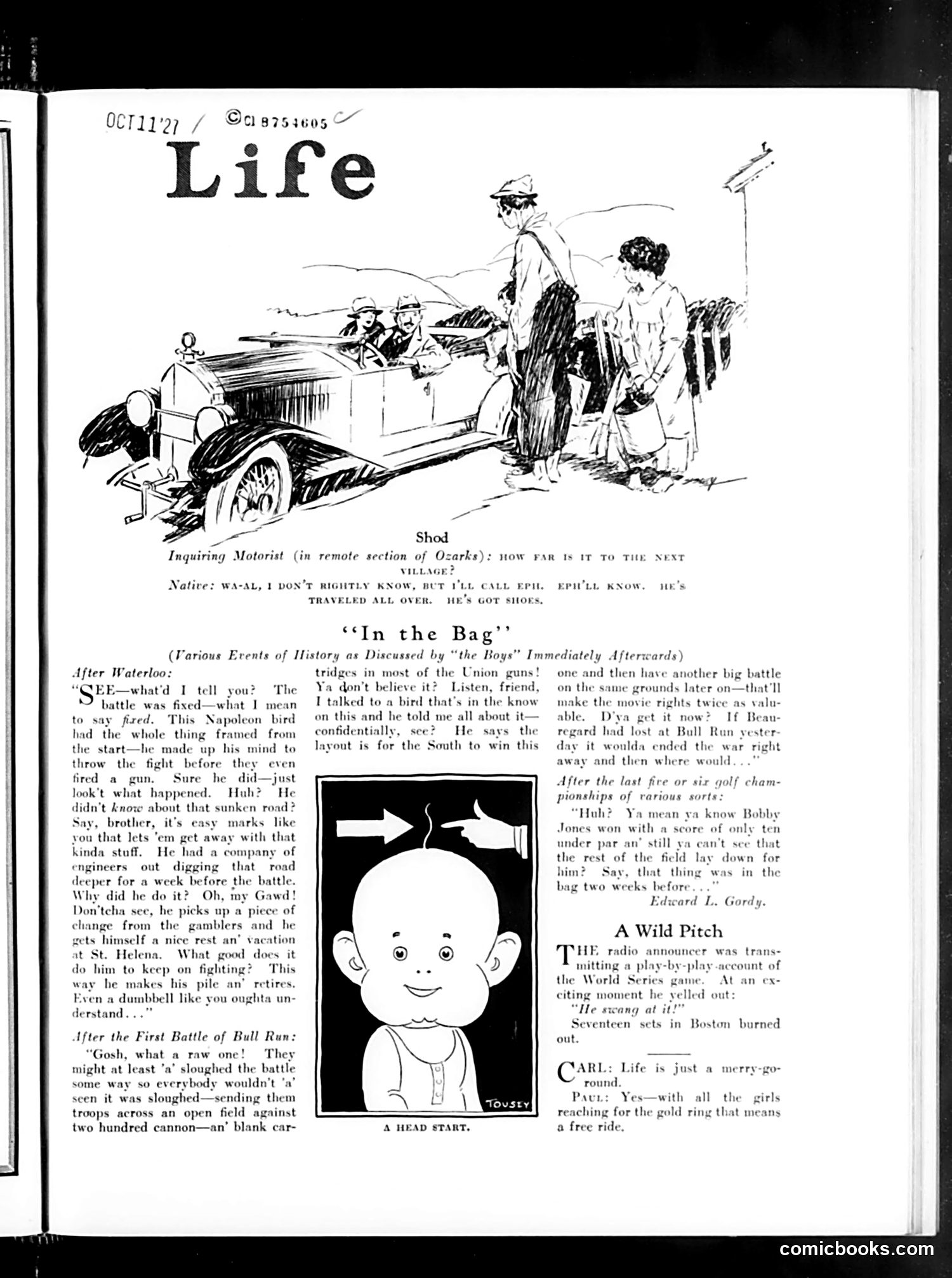
This page from Life magazine contains humor pieces discussing World War I history. The top sketch shows a motorist asking directions to "the next village," with a note that the driver has traveled extensively and worn shoes—likely mocking someone's pretensions or tourist-like wandering during wartime. The main section, "In the Bag," presents boys discussing historical battle details afterward—boys boasting about knowledge of Waterloo, Bull Run, and the World Series. The humor satirizes how children (and adults) confidently recount famous events with incomplete or garbled information. The cartoon "A Wild Pitch" and accompanying dialogue about Life being "a merry-go-round" appear to reference baseball and radio broadcasting, continuing the lighthearted, domestic humor typical of Life's satirical approach during the WWI era.
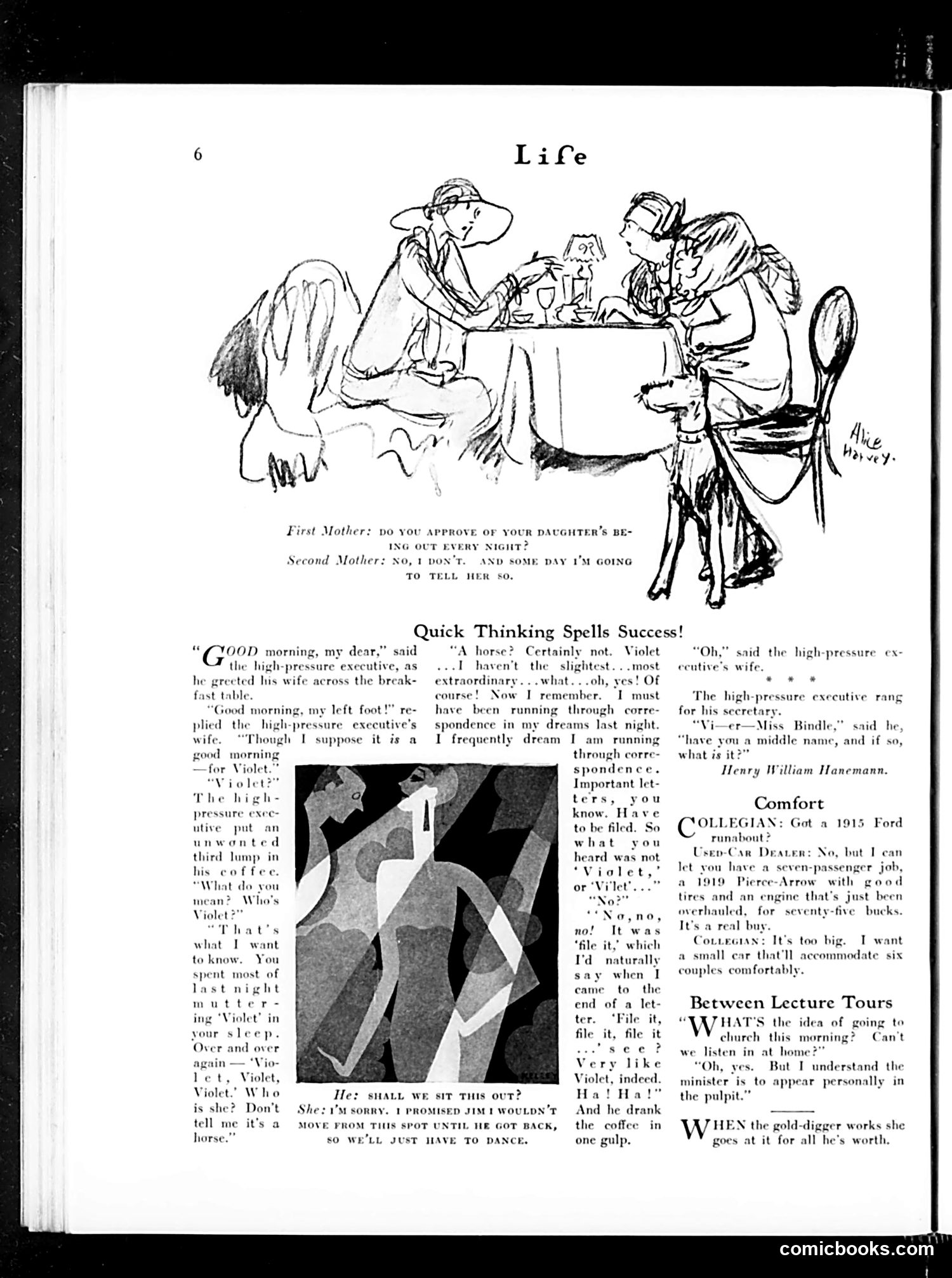
This page contains several short humorous sketches typical of Life magazine's satirical humor. **Top cartoon**: Two mothers discuss parenting standards. The first asks if the second approves of her daughter "being out every night," and the second replies she doesn't—and plans to tell her daughter so eventually. The joke is the first mother's apparent indifference to her daughter's nightlife. **Middle section**: "Quick Thinking Spells Success!" depicts a high-pressure businessman greeting his wife, who mentions "Violet" (apparently an unwanted visitor). His quick thinking involves suggesting they dance to avoid conversation—the satire mocks corporate men's shallow problem-solving. **Bottom sections**: Brief workplace and social comedy sketches about used-car dealers, church attendance, and gold-diggers—standard period humor about middle-class anxieties and dating dynamics.
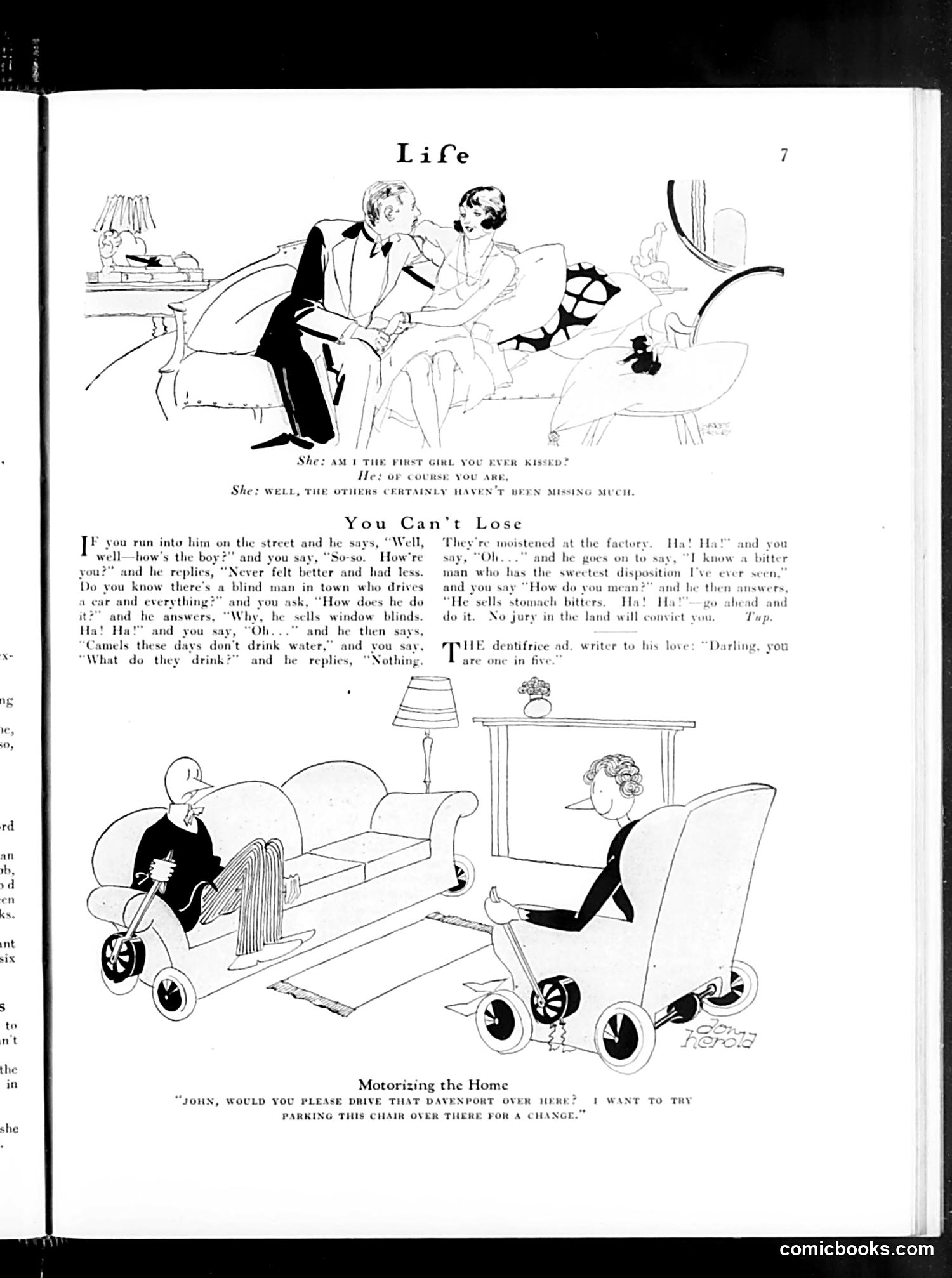
This page contains two distinct satirical cartoons about courtship and domestic life. The upper cartoon, titled "You Can't Lose," depicts a man successfully winning over a woman through practiced small talk—essentially showing how men can succeed romantically through superficial charm and rehearsed lines. The lower cartoon, "Motorizing the Home," satirizes the era's obsession with automobiles and modernization. It shows a woman asking her husband to drive a motorized baby carriage into their living room to "park" it, mocking how contemporary culture was incorporating automotive technology into every aspect of domestic life—reflecting 1920s-era enthusiasm for mechanization extending absurdly into the home. Both cartoons use visual humor to critique social attitudes about romance, consumerism, and changing domestic customs of the period.
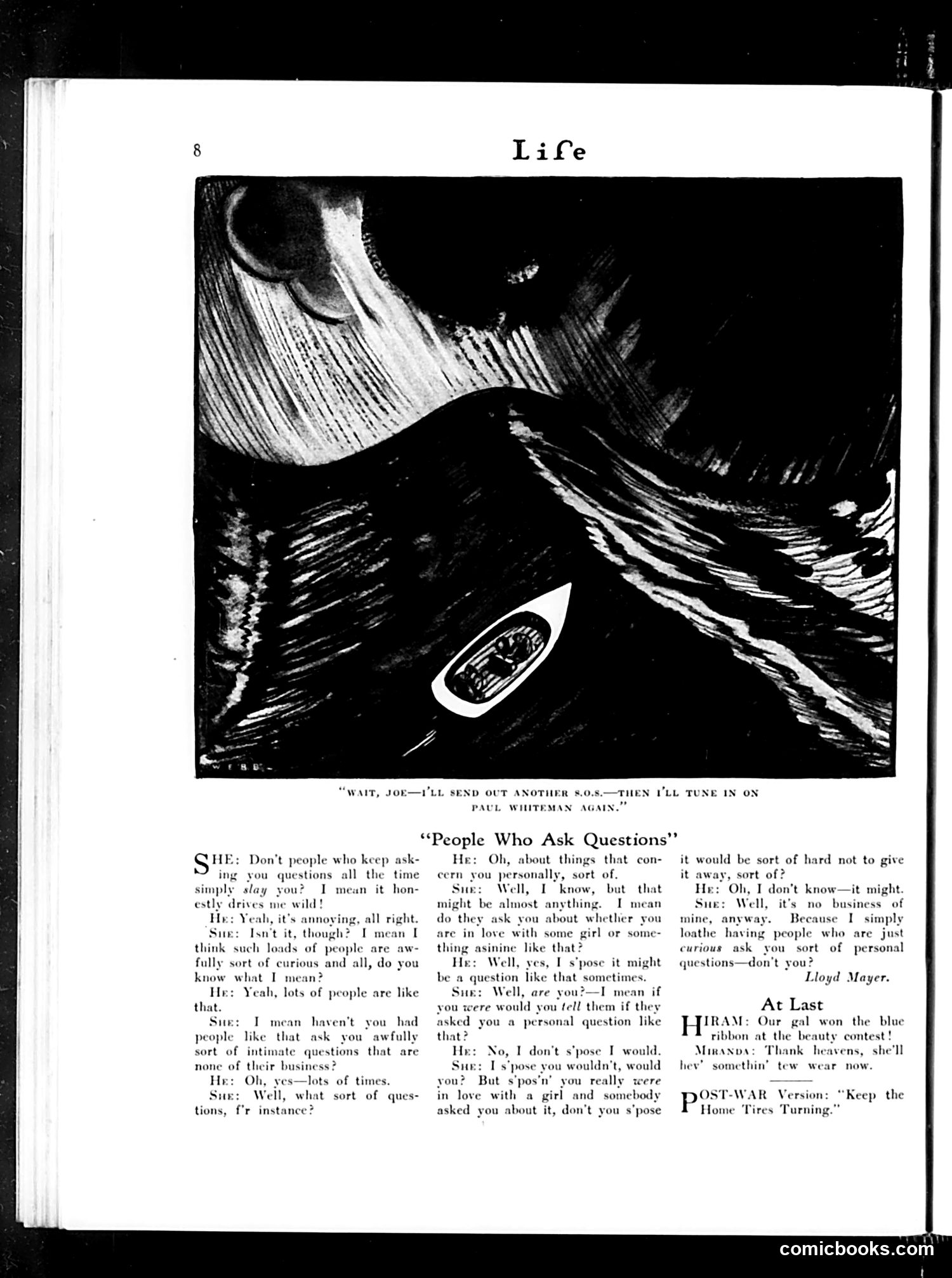
This page contains a dialogue piece titled **"People Who Ask Questions"** attributed to Lloyd Mayer, featuring a comic dispute between "She" and "He" about personal privacy in relationships. The **cartoon at top** shows a small boat in dark waters with a figure, illustrating the caption about sending an "S.O.S." and "tuning in on Paul Whiteman again"—likely a radio reference from the jazz age. The **satire targets** people who ask intrusive personal questions in relationships. "She" defends curiosity as normal; "He" resists, calling it invasive. The piece humorously explores tension between romantic partners over boundaries and disclosure. The **"At Last"** section references post-WWI fashion trends, mentioning blue ribbons and "home tires turning"—appearing to be a wartime/postwar consumer advertisement disguised as editorial content.
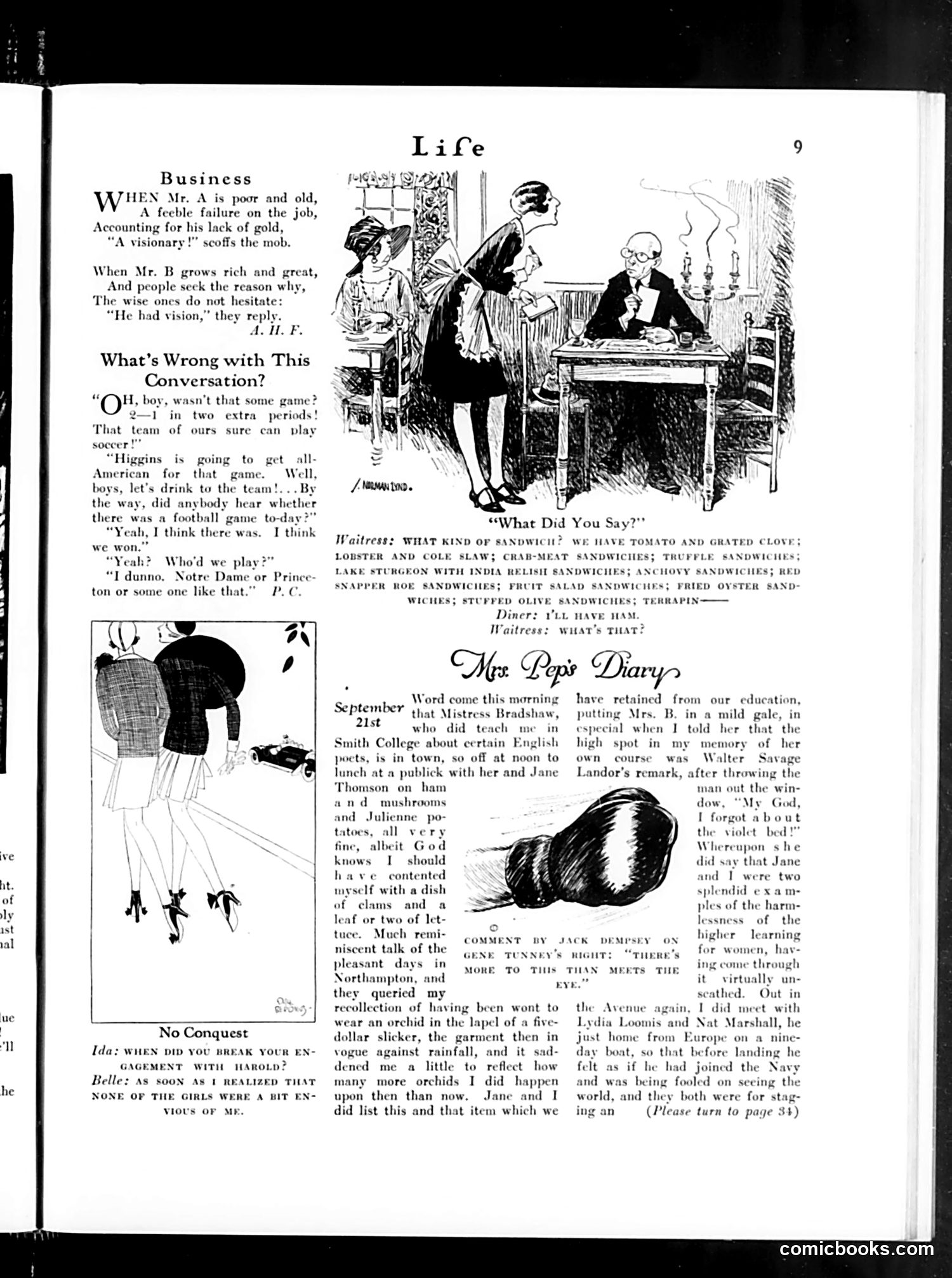
This page contains three distinct pieces of satirical content: 1. **"Business"** (top): A poem mocking the contrast between poor visionaries who fail and rich businessmen who succeed, suggesting their "vision" is merely luck or circumstance rather than merit. 2. **"What's Wrong with This Conversation?"** (middle): A cartoon showing two men discussing a football game, with dialogue suggesting confusion about which sport or team they're discussing—likely satirizing men's casual, inattentive conversation. 3. **"Mrs. Pep's Diary"** (bottom): A humorous diary entry from September 21st about a social outing with a former teacher, featuring anecdotes about clams, orchids, and naval officers—typical society page fodder that Life frequently mocked for its triviality. The overall theme ridicules American business culture, masculine superficiality, and upper-class social pretensions.
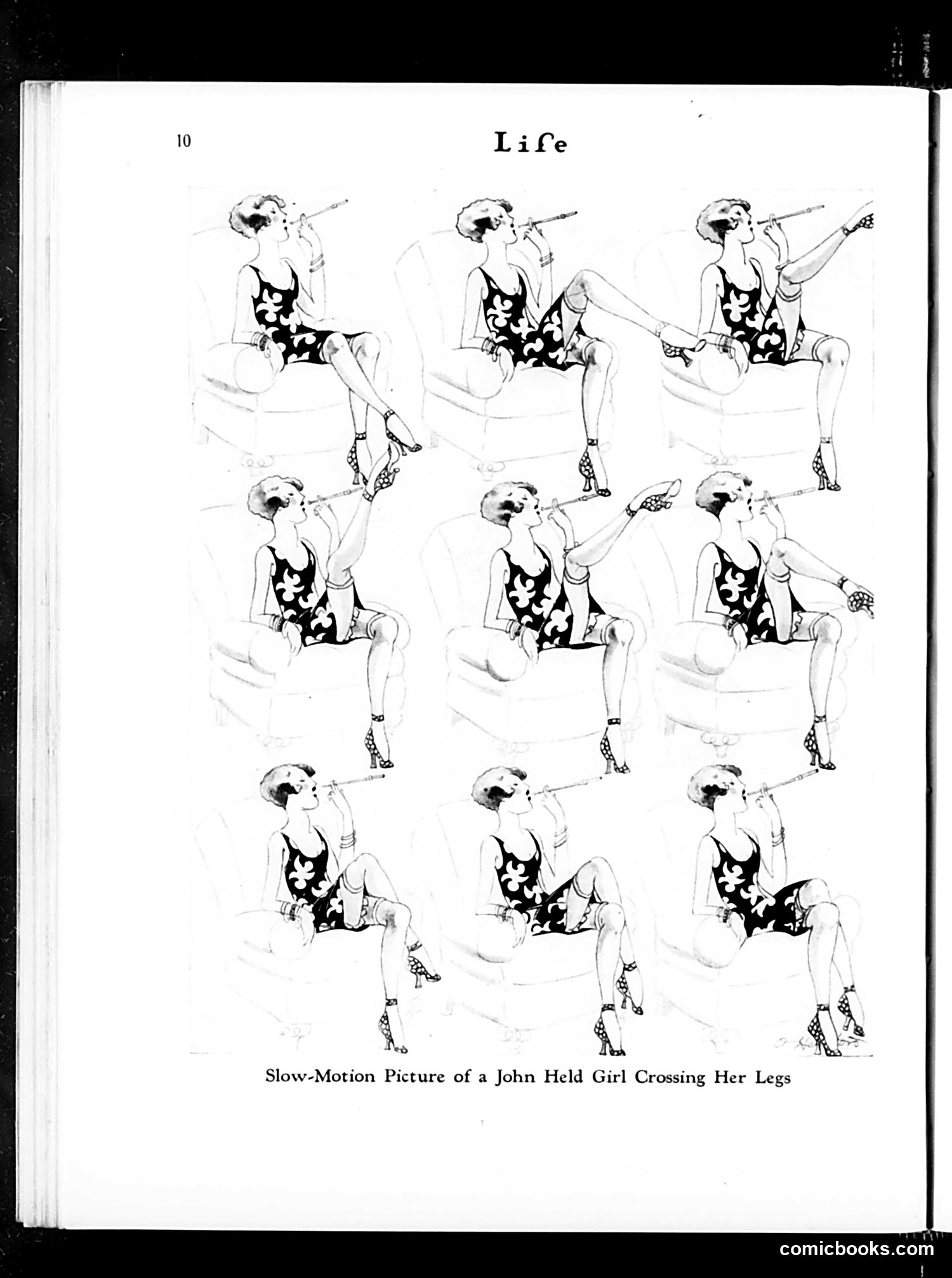
This page from *Life* magazine presents a sequential illustration series titled "Slow-Motion Picture of a John Held Girl Crossing Her Legs." The nine-panel grid shows a fashionably dressed woman in a 1920s flapper outfit—characterized by the short dark dress with geometric patterns, bobbed hair, and decorative heeled shoes—performing the simple action of crossing her legs while seated. The satire targets the exaggerated attention given to women's fashion and movement during the Jazz Age. By breaking down a mundane gesture into granular slow-motion frames, *Life* mocks both the fashion industry's obsession with female bodily movement and the cultural fascination with the "modern woman" of the 1920s. The joke critiques how contemporary media and observers treated even ordinary female actions as spectacles worthy of detailed visual analysis.
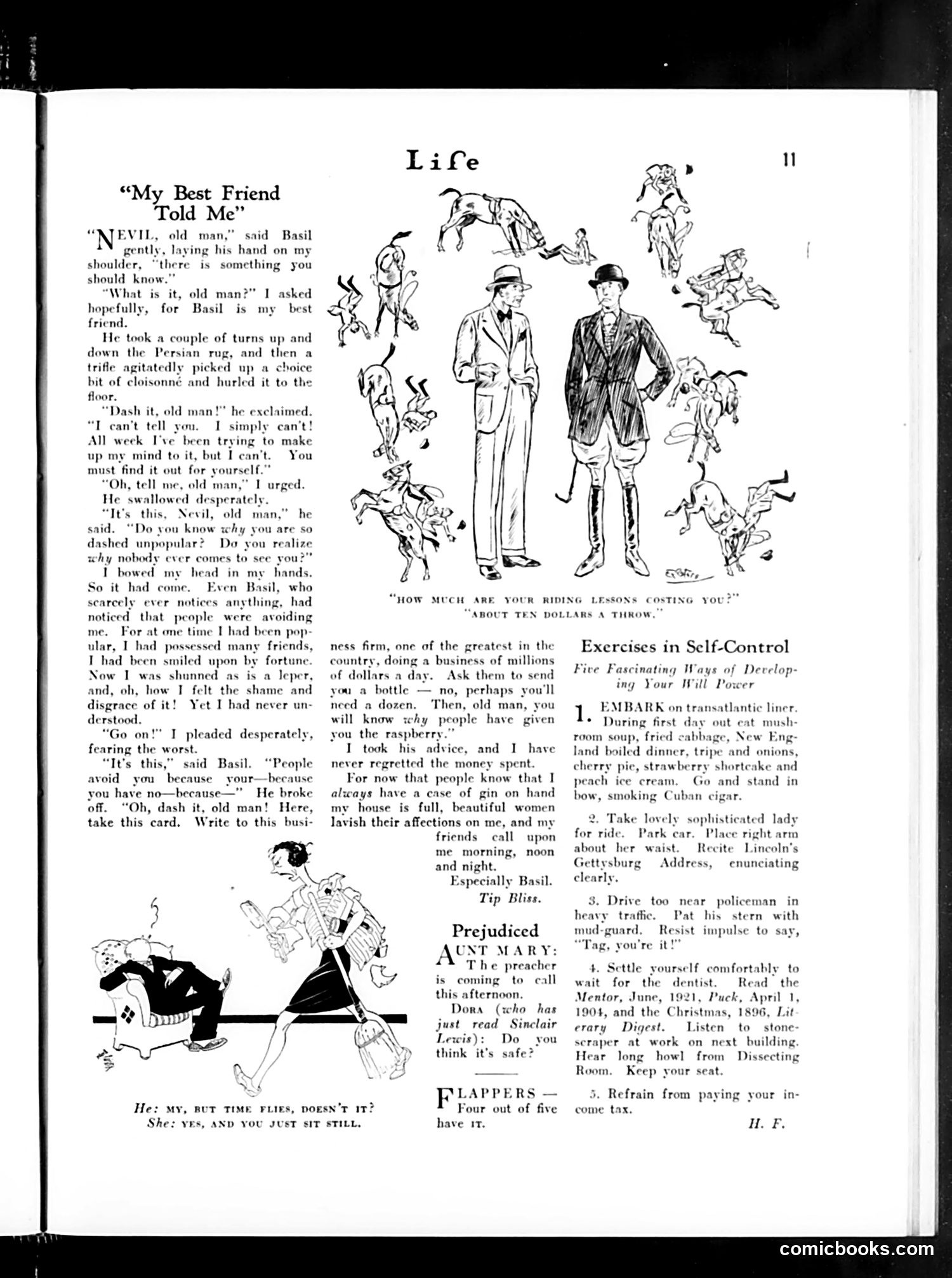
This page contains satirical humor typical of Life magazine's content. The main cartoon "My Best Friend Told Me" depicts a conversation between two men where one reveals an embarrassing secret—that his friend constantly avoids him because he's become unpopular. The joke satirizes social climbing and fair-weather friendships among the wealthy: the narrator once had many friends when he was successful, but lost them when his fortune changed. The accompanying illustrations show upper-class leisure activities (riding lessons costing ten dollars). The "Exercises in Self-Control" section offers humorous etiquette advice for maintaining composure in awkward social situations. Overall, the page mocks bourgeois social pretensions and the superficiality of wealthy circles.
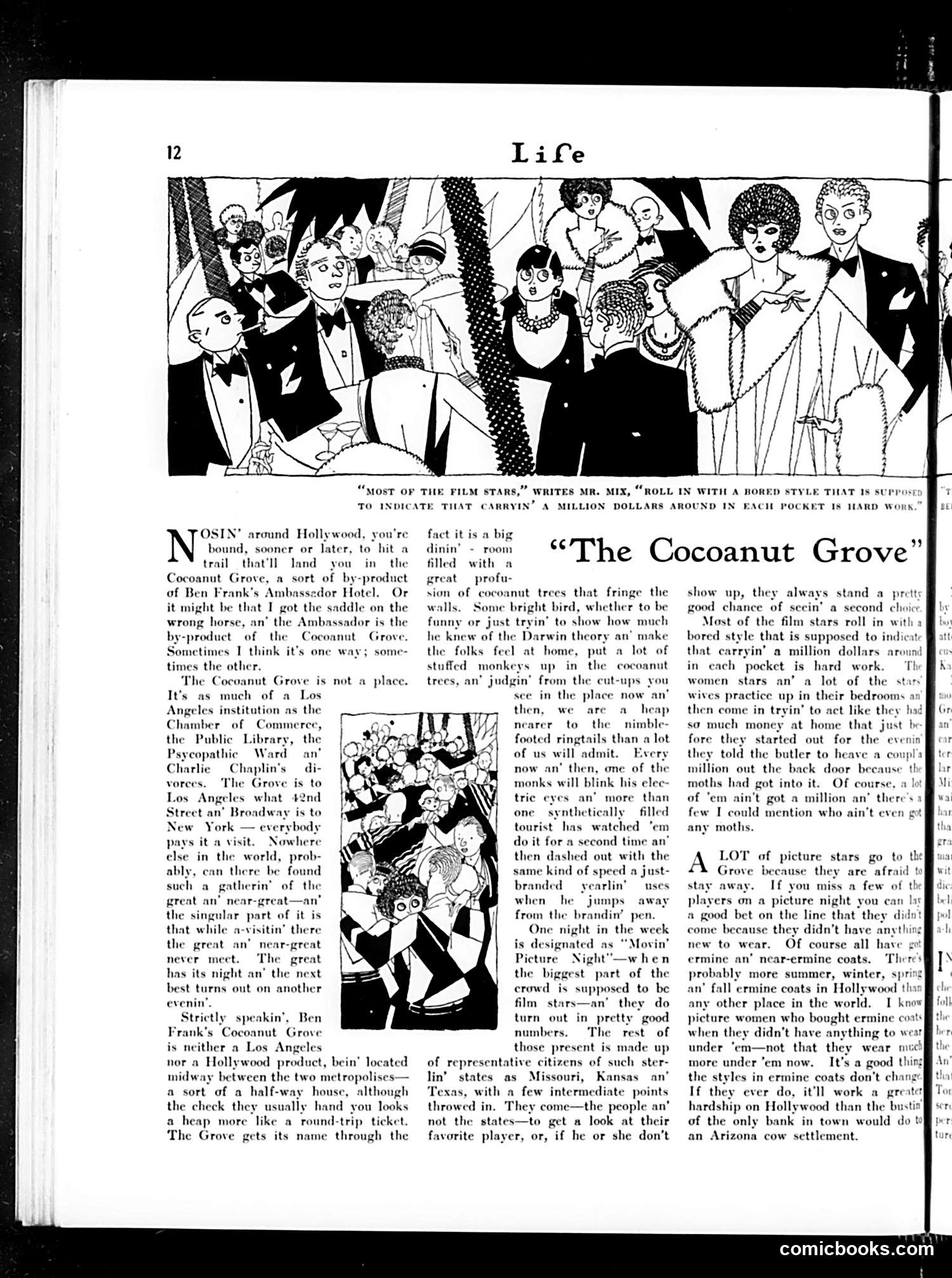
This page satirizes Hollywood's elite social scene at the Cocoanut Grove, a real Los Angeles nightclub. The article mocks film stars who frequent the venue, portraying them as pretentious and status-conscious. The top illustration shows formally dressed patrons; the middle cartoon depicts crowded chaos at the Grove itself. The satire targets several behaviors: stars' fear of missing social events, women purchasing expensive ermine coats to appear fashionable, and the performative nature of celebrity culture. The author humorously notes that most stars "roll in with a bored style" while actually carrying "a million dollars around in each pocket," exposing the contradiction between their affected indifference and genuine wealth. The piece mocks Hollywood's superficiality and the pressure to maintain appearances among the entertainment elite.
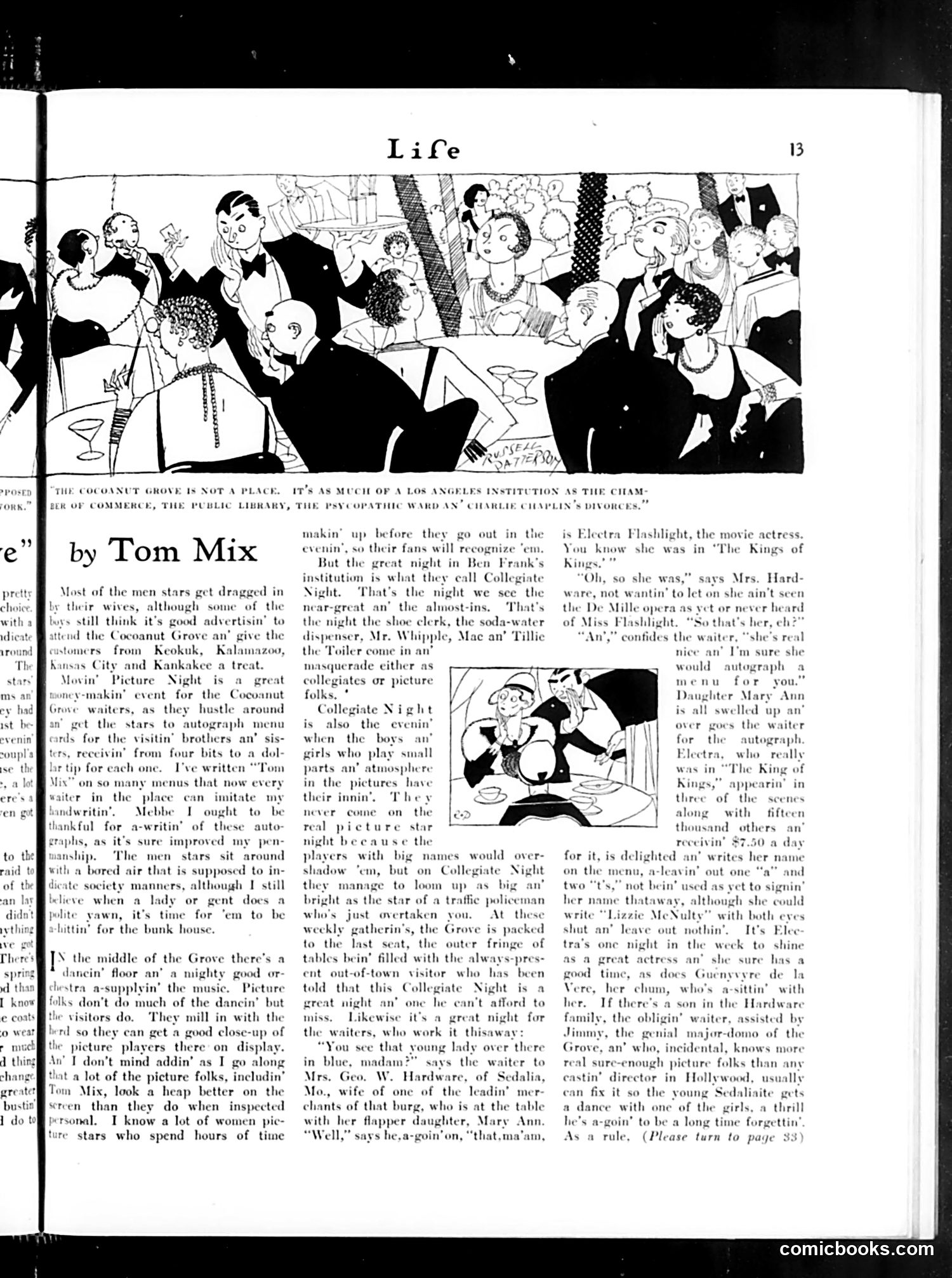
This page from *Life* magazine satirizes the Coconut Grove nightclub in Los Angeles, a fashionable entertainment venue of the era. The article by Tom Mix humorously describes the social dynamics of "Collegiate Night," when young people gather there. The cartoon at top depicts the crowded, lively scene of well-dressed patrons at the Grove. The satire targets the pretensions of the venue: it's marketed as exclusive and sophisticated, yet the text notes it's merely "as much of a Los Angeles institution as the Chamber of Commerce" or public library—mocking how it's become commonplace rather than genuinely elite. The piece gently ridicules both the young attendees seeking sophistication and the nightclub's efforts to maintain an air of exclusivity for ordinary patrons.
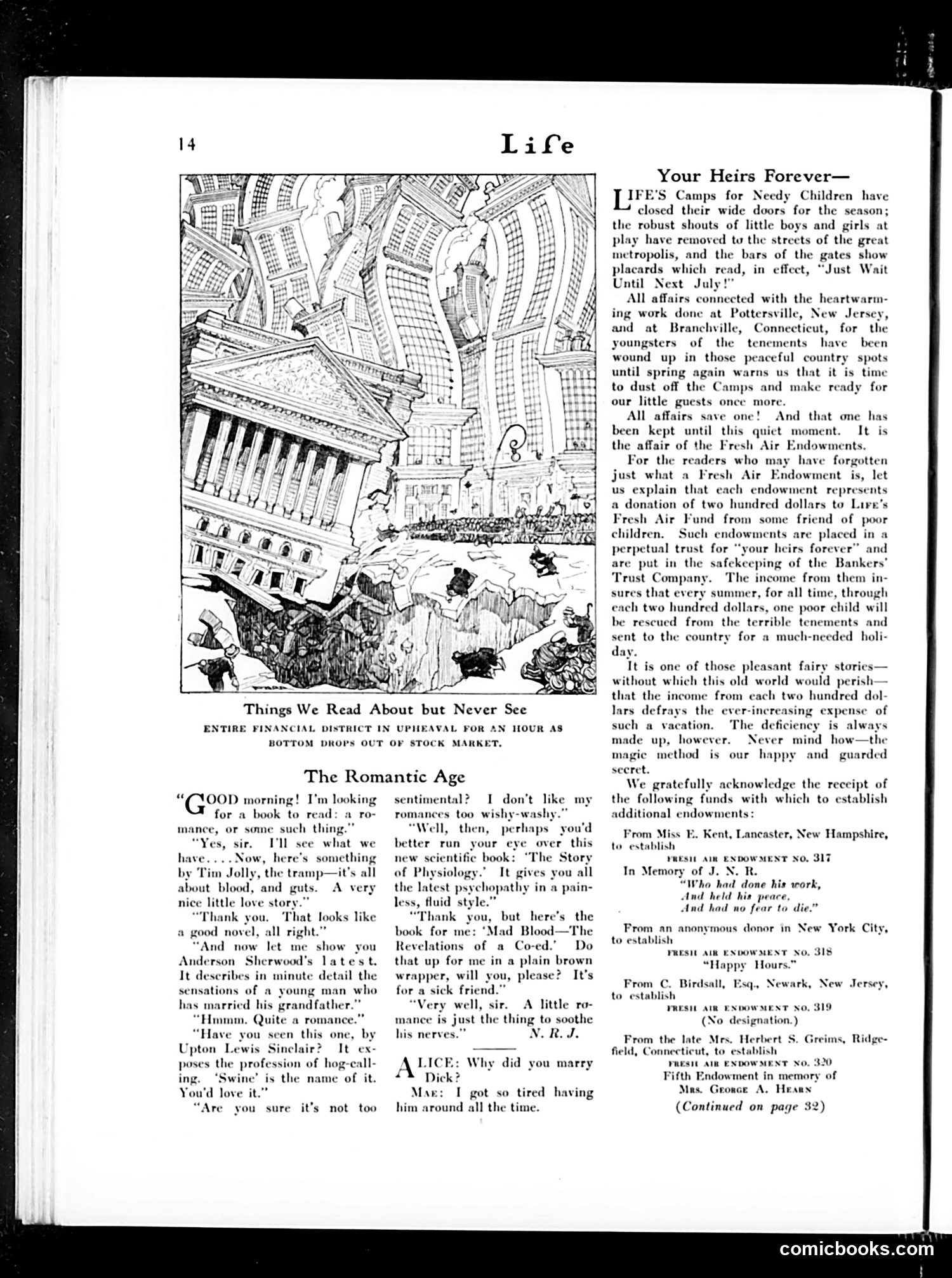
The main illustration titled "Things We Read About but Never See" depicts an aerial view of the entire financial district in upheaval for an hour as the stock market crashes. The cartoon satirizes the stark contrast between reported financial catastrophes and their invisibility to ordinary people—the city streets appear relatively calm despite the supposedly dramatic turmoil occurring in banking offices above. The surrounding text discusses Life magazine's charitable "Fresh Air Endowments" for poor children and includes a satirical dialogue called "The Romantic Age" mocking sentimental book recommendations. The overall page combines social commentary on economic inequality with gentle satire of literary tastes among the middle class.
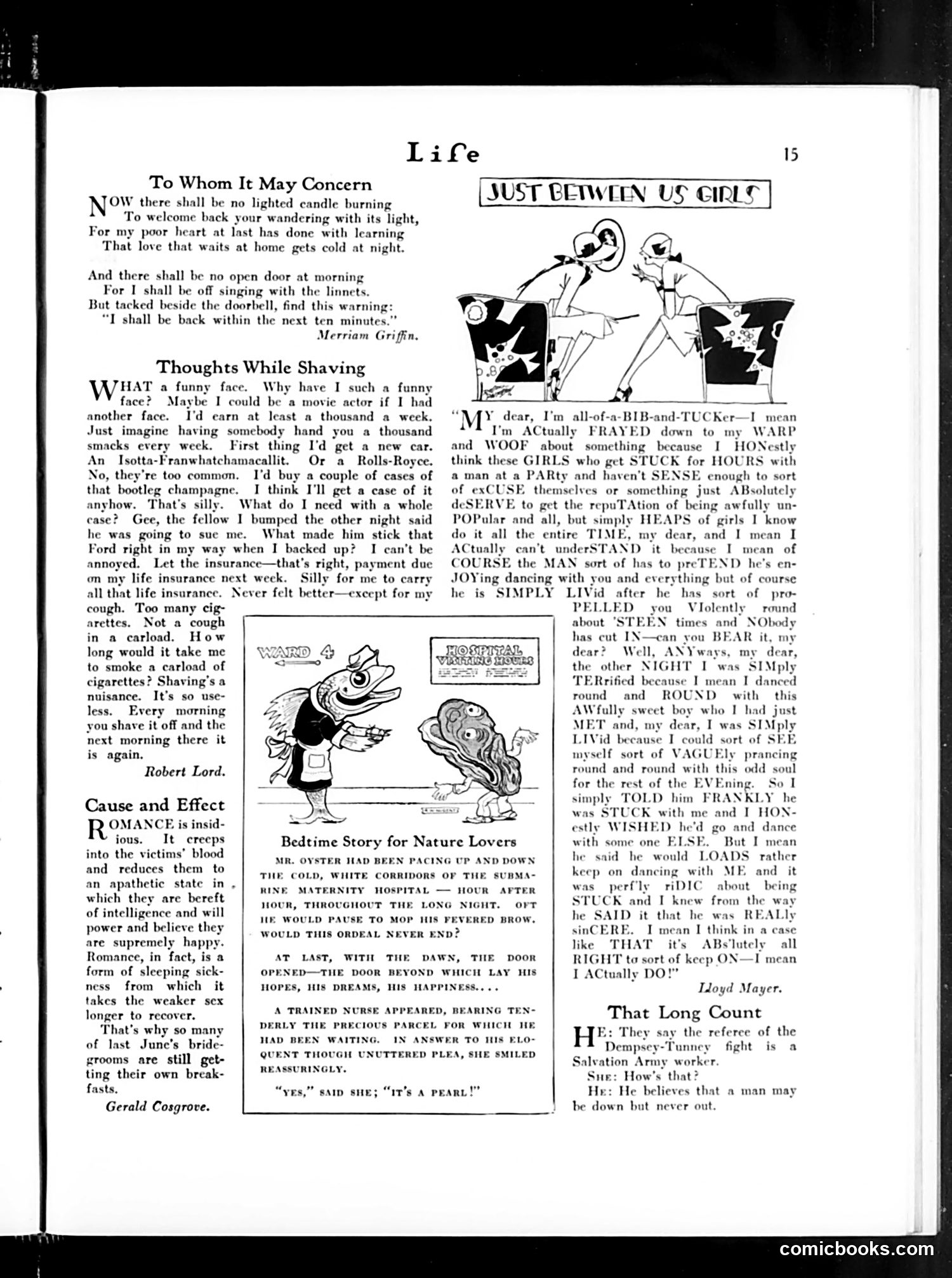
This page contains several humorous columns and cartoons typical of Life's satirical content: **"To Whom It May Concern"** and **"Thoughts While Shaving"** are short comic essays about everyday annoyances—unwelcoming homes and the mundane routine of shaving. **"Just Between Us Girls"** shows two women in conversation, likely satirizing gossip and relationship drama of the era. **"Bedtime Story for Nature Lovers"** features cartoon characters (appears to be a doctor and nurse) with text mocking overly sentimental hospital narratives—a jab at melodramatic storytelling conventions. **"Cause and Effect"** and **"That Long Count"** are brief humorous observations about romance and relationships, using wordplay and ironic reversals typical of Life's style. The overall tone is lighthearted social commentary on domestic life, gender relations, and human foibles rather than political satire.
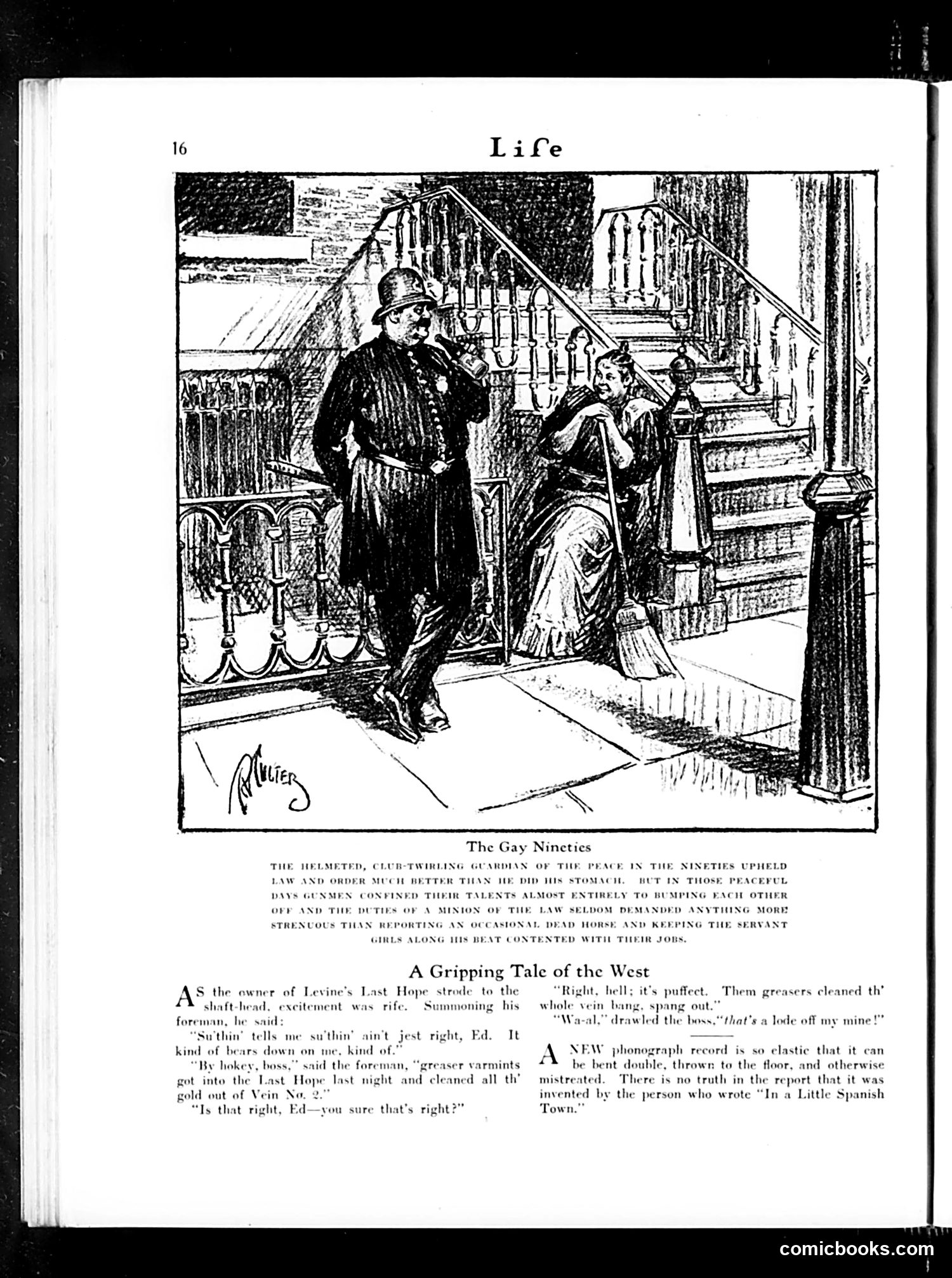
This satirical illustration depicts two figures in 1890s attire on urban steps. The caption explains the cartoon's subject: police officers of that era who were supposedly more concerned with fighting each other and pursuing minor duties than maintaining actual law and order. The text suggests these "helmeted, club-twirling guardians" spent their time "bumping each other" rather than preventing serious crime, and found it easier to report minor infractions (like keeping servant girls employed) than addressing significant wrongdoing. The satire critiques police incompetence and misplaced priorities during the 1890s—poking fun at the period's law enforcement for theatrical posturing over substantive public safety work. The artist's signature appears in the lower left corner.
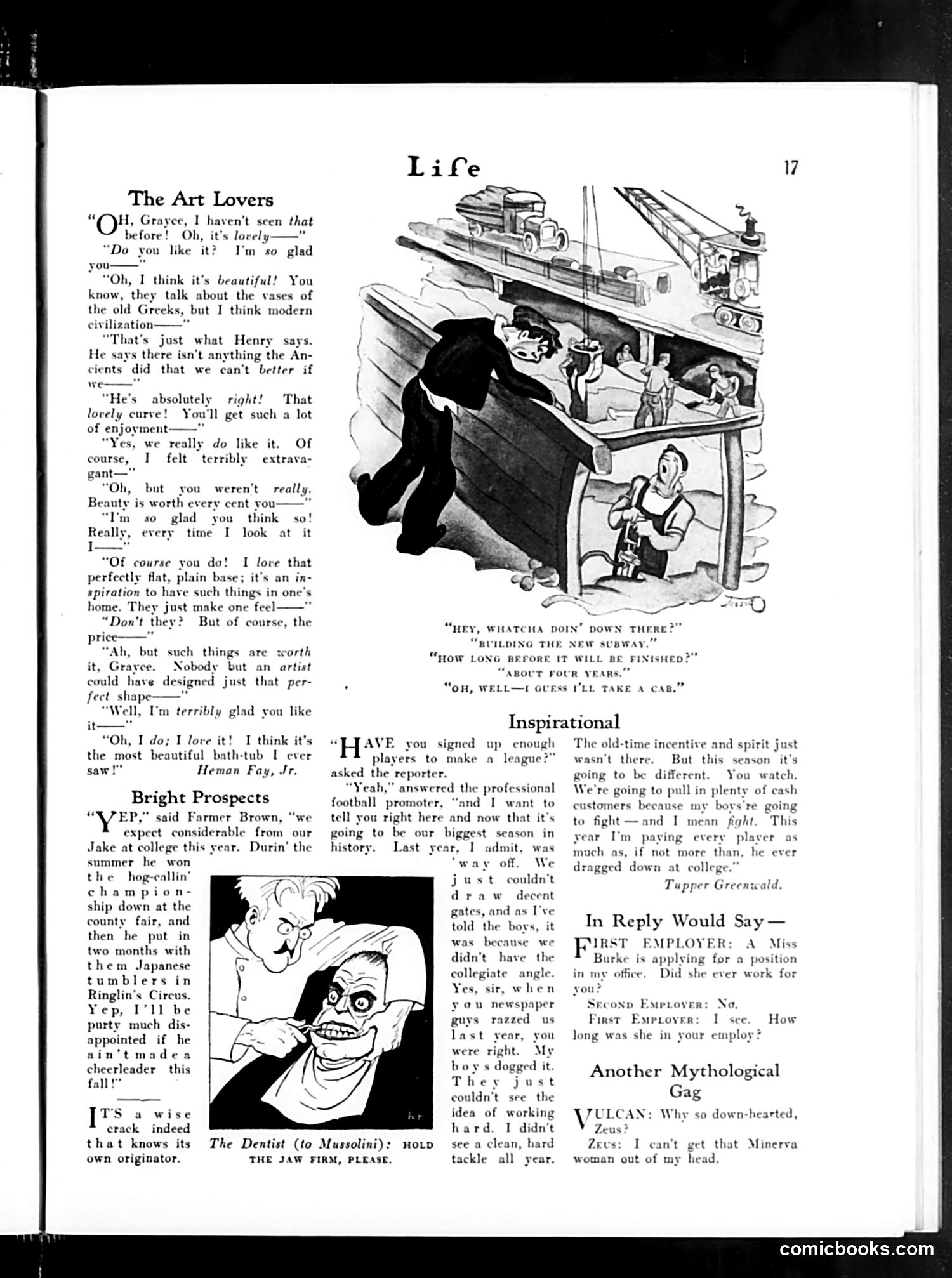
This page contains several humor sections typical of Life magazine's satirical format: **"The Art Lovers"** depicts a conversation between two people discussing modern art versus classical aesthetics—a recurring debate in early 20th-century cultural criticism. **"Bright Prospects"** features Farmer Brown discussing his nephew Jake's summer employment at a circus, with an accompanying caricature labeled "The Dentist (to Mussolini): Hold the Jaw Firm, Please." This appears to be a political jab at Mussolini, though the specific reference is unclear without additional context. **"Inspirational"** discusses organizing a football league with cash incentives—commenting on commercialization of amateur sports. The remaining sections ("In Reply Would Say," "Another Mythological Gag") are brief humor snippets typical of Life's miscellaneous joke format. The overall tone reflects early 20th-century American middle-class concerns and contemporary political figures.
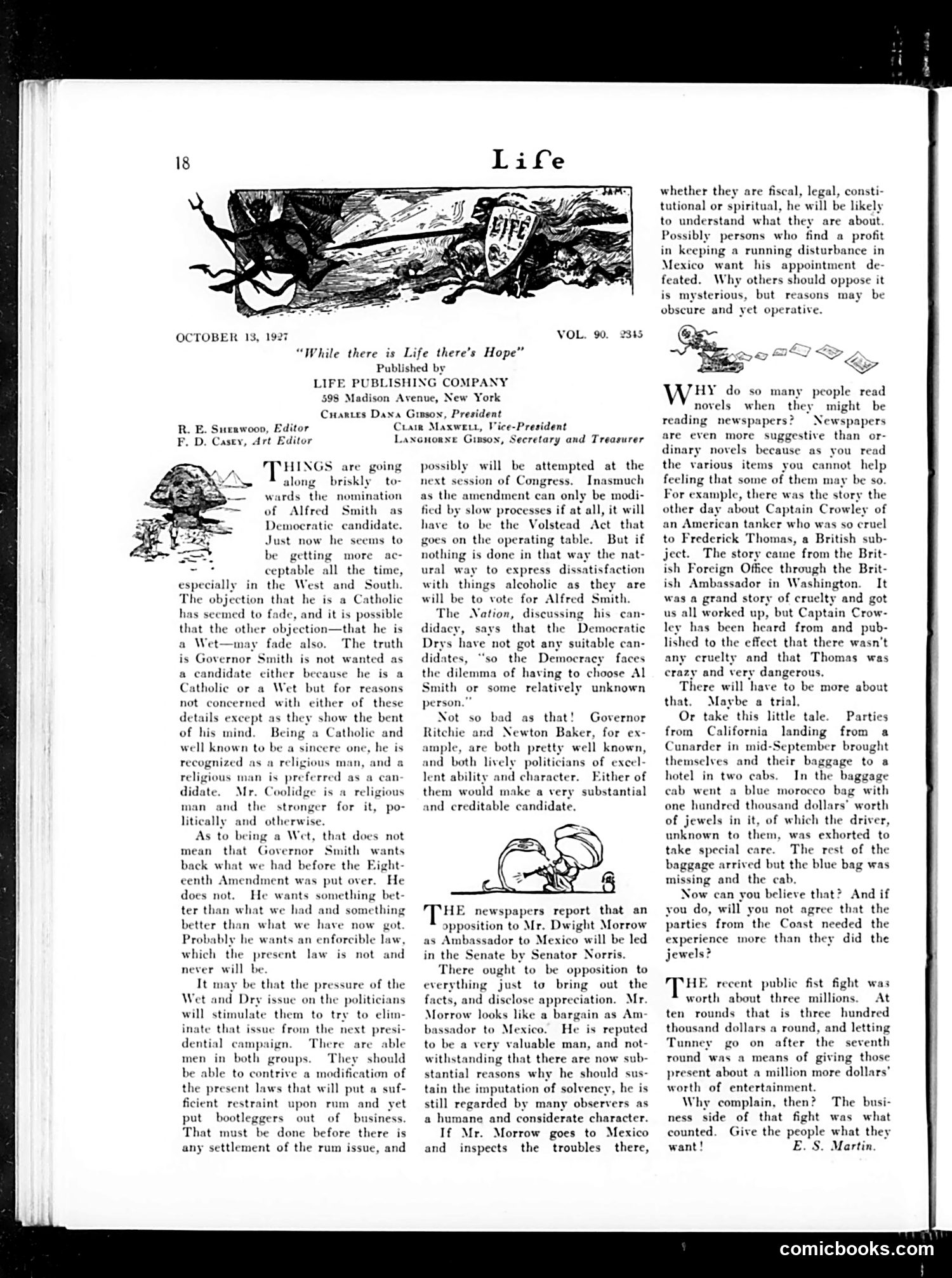
This page contains editorial commentary on 1927 American politics, primarily discussing Alfred Smith's emerging candidacy for the Democratic presidential nomination. **Main Topics:** 1. **Alfred Smith for President**: The editor argues Smith's Catholicism and "Wet" stance (opposing Prohibition) are becoming less objectionable. He suggests Smith wants enforceable alcohol regulation, not repeal of the Eighteenth Amendment. 2. **Prohibition Debate**: The piece advocates for modifying the Volstead Act to balance temperance with eliminating bootlegging—a pragmatic middle ground. 3. **Dwight Morrow as Ambassador to Mexico**: The editor supports Morrow's appointment, suggesting opposition may come from those profiting from Mexico's instability. The editorial tone is moderate and analytical rather than satirical. The small cartoons appear decorative rather than topical. This reflects Life's role as a serious (if witty) commentary magazine on contemporary politics, not primarily a humor publication by modern standards.
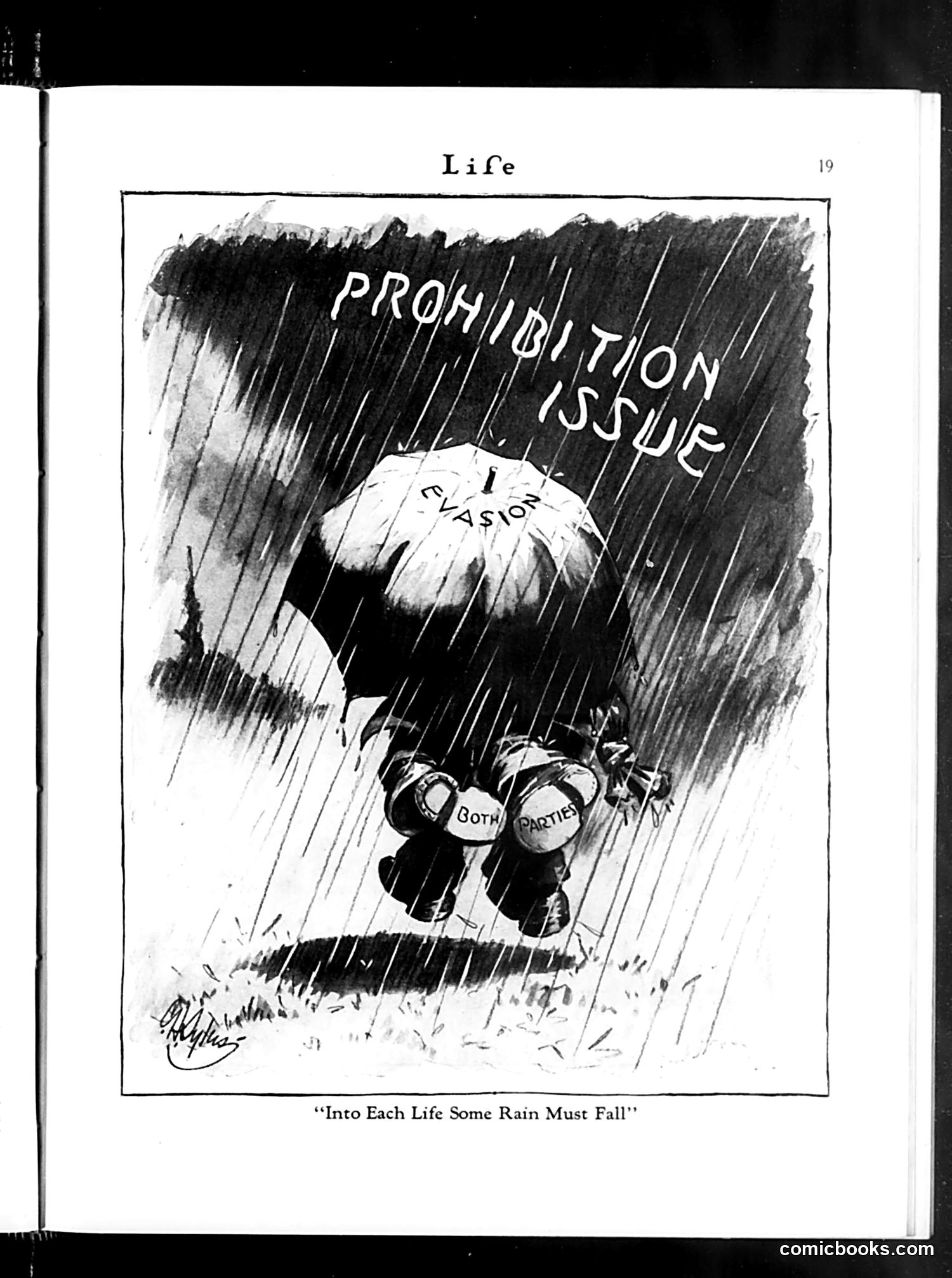
This Life magazine cartoon satirizes the Prohibition debate through stormy weather imagery. A large umbrella labeled "EVASION" shields two figures labeled "BOTH PARTIES" from heavy rain representing the "PROHIBITION ISSUE." The satire suggests that both major political parties are avoiding taking a clear stance on Prohibition—instead of directly addressing the controversial issue, they're using evasion tactics to dodge it. The "rain must fall" caption ironically implies that despite their attempts at shelter, they cannot escape the problem entirely. This reflects the real political tension of the Prohibition era (1920-1933), when the issue deeply divided Americans and parties struggled to maintain broad coalitions by appearing ambiguous rather than committed to either wet or dry positions.
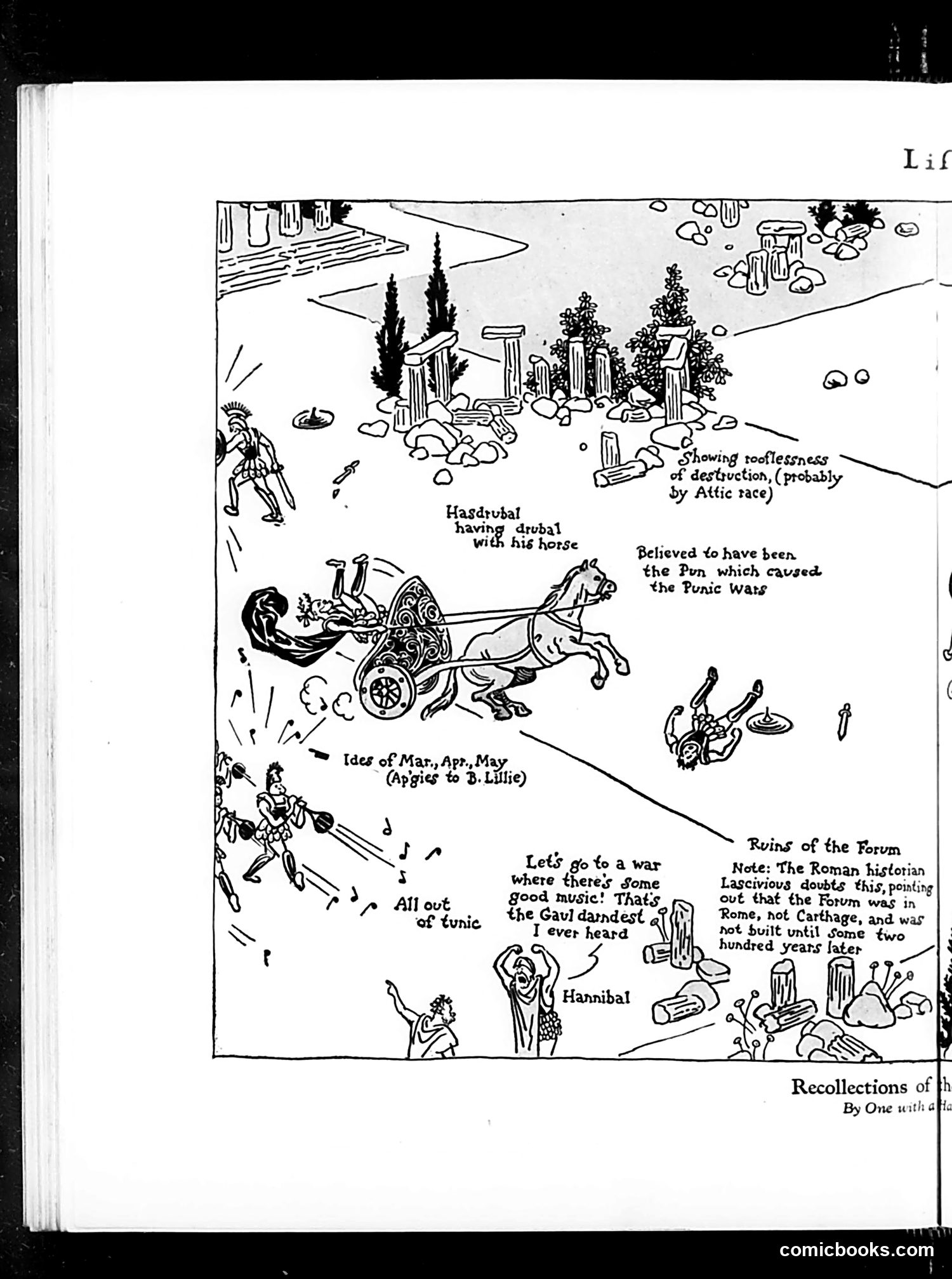
This is a historical satire cartoon depicting ancient Roman and Carthaginian figures and ruins. The scene illustrates classical history through humor: **Key elements:** - **Hasdrubal** (Carthaginian general) appears with his horse, labeled as connected to the Punic Wars - **Hannibal** is shown at bottom, referenced as a famous Carthaginian military leader - **Ides of Mar., Apr., May** references the assassination of Julius Caesar (March 15) - Ruins of the Forum are depicted with a note correcting historical inaccuracy—the Forum was in Rome, not Carthage - A soldier says "Let's go to a war where there's good music"—satirizing military recruitment **The satire's point:** The cartoon mocks both ancient historical figures and contemporary attitudes about war, presenting history as absurd spectacle while also including pedantic historical corrections. It's essentially using classical history as a vehicle for anti-war commentary and gentle historical mockery. The page appears titled "Recollections of..." suggesting this is part of a larger satirical historical piece.
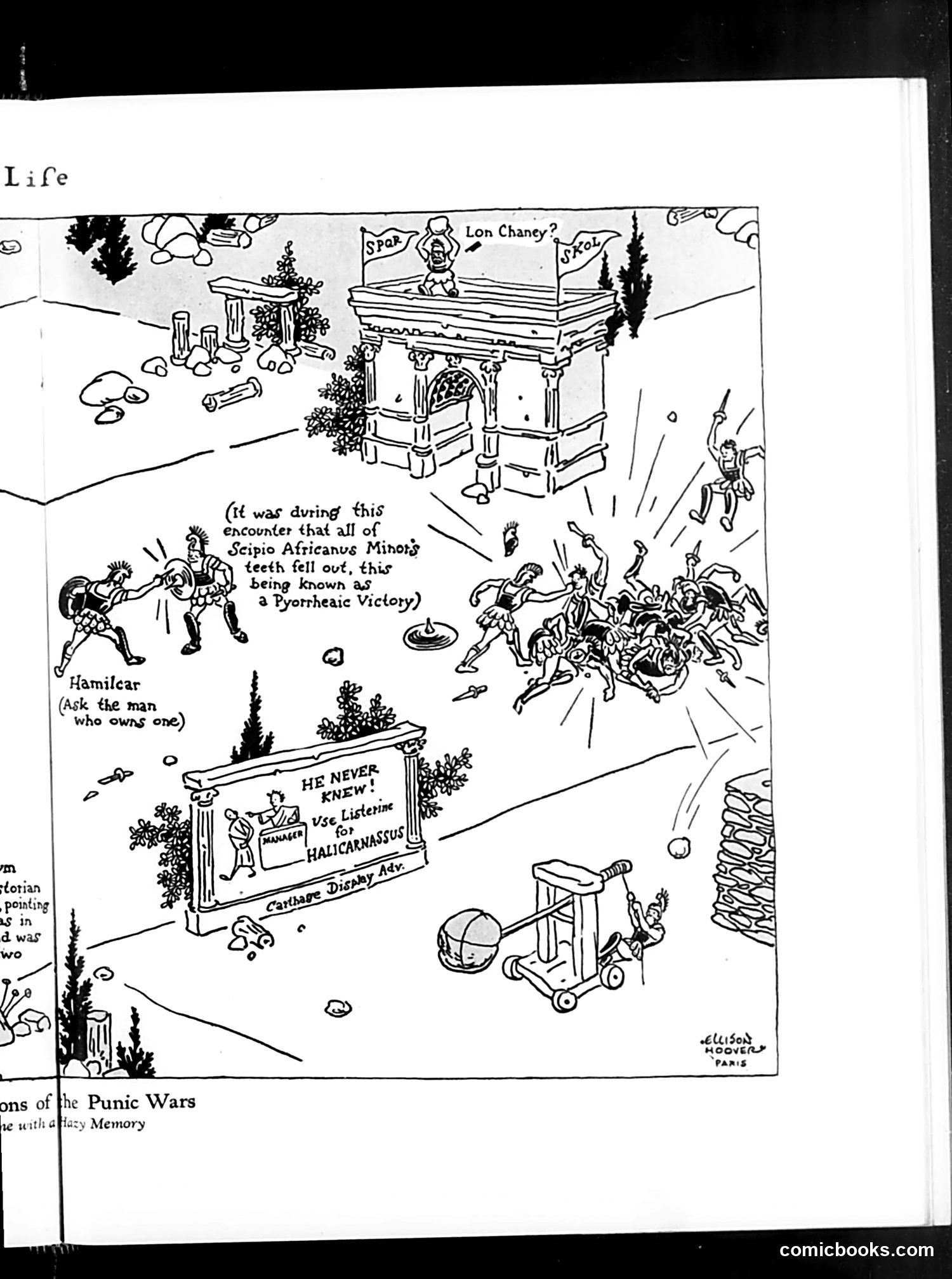
This is a satirical cartoon about the Punic Wars (ancient Rome vs. Carthage). It depicts a battle scene with classical warriors, but overlays it with modern 1920s-30s advertising absurdly placed in an ancient setting. The humor targets two things: First, the "Pyorrheaic Victory" joke mocks Scipio Africanus Minor's teeth falling out during battle—a pun on "pyorrhea" (gum disease). Second, there's a "Halicarnassus" mouthwash advertisement ("HE NEVER KNEW!"), and a "Hamilcar" reference with the phrase "Ask the man who owns one"—mimicking contemporary advertising slogans. The cartoon satirizes both the pretension of classical history lessons and the absurdity of modern consumer advertising, suggesting ads would be hilariously out of place in ancient times. It's a common Life magazine technique: anachronistic humor mixing high history with low commerce.
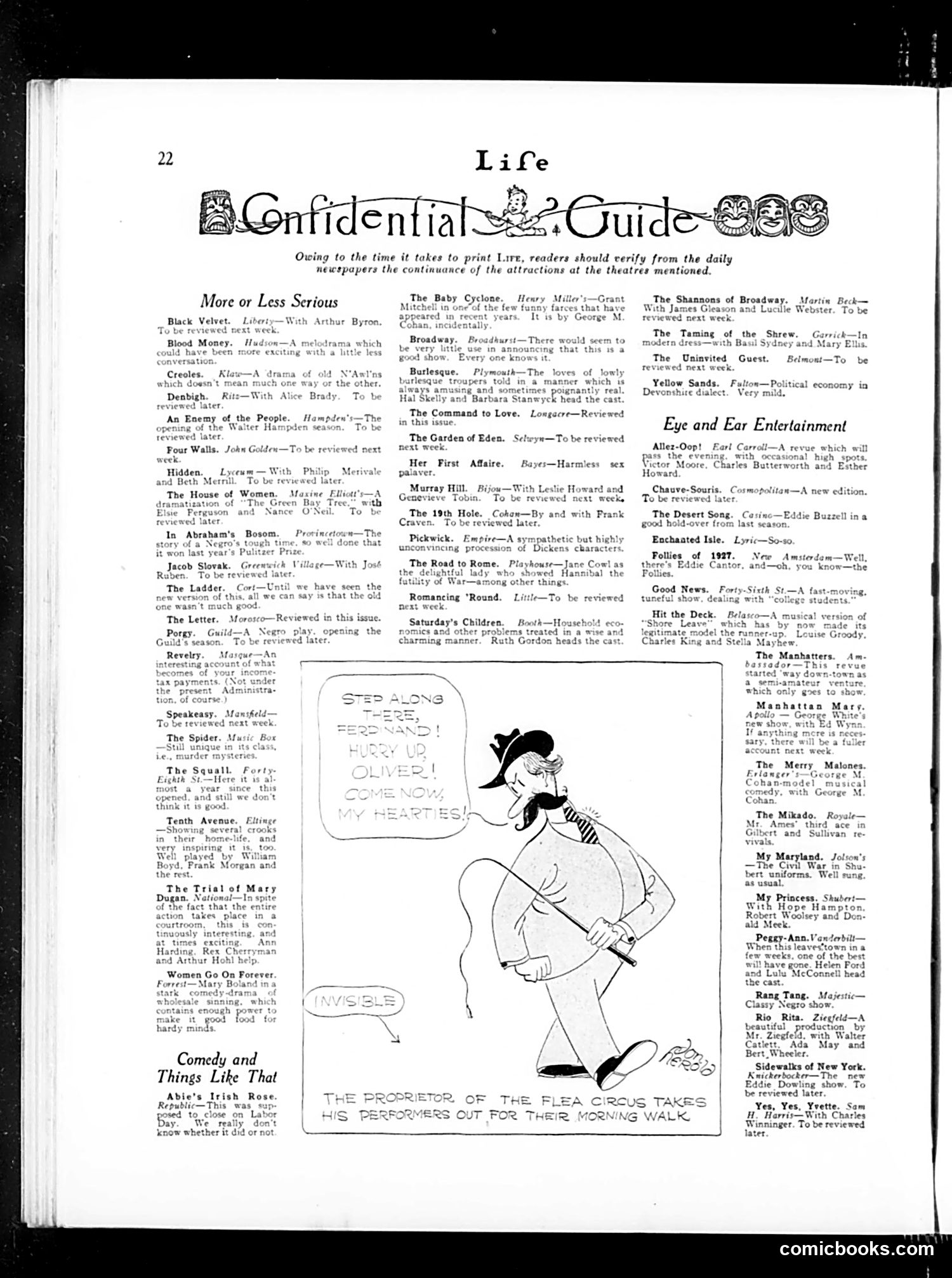
This page is a **theater listings and reviews section** from Life magazine's "Confidential Guide," typical of the 1920s entertainment press. The main cartoon depicts **a rotund man labeled "The Proprietor of the Flea Circus"** taking his performers out for their morning walk—the joke being the absurd literalism of managing performers so tiny they require a "flea circus." The surrounding text catalogs Broadway shows, musicals, and theatrical productions of the era, with brief critical notes ("To be reviewed next week," "Harmless sex farce," etc.). Notable titles include *Abie's Irish Rose*, *The Squall*, and *The Taming of the Shrew*—representing the mix of popular comedies, dramas, and classical adaptations typical of 1920s theater. The cartoon's humor relies on the incongruity of treating microscopic circus fleas as professional performers requiring ordinary management practices—a genteel absurdist joke typical of Life's satirical style.
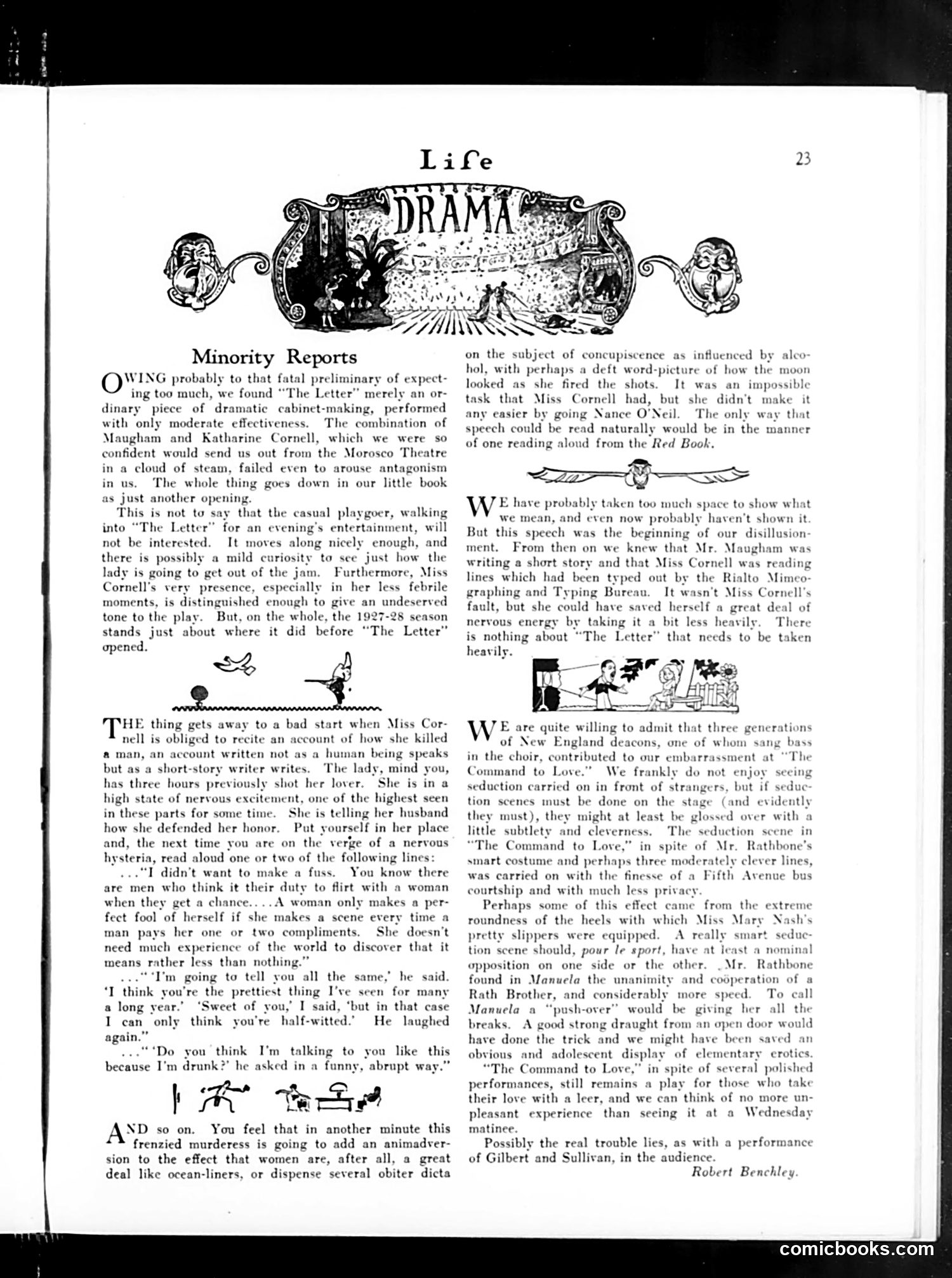
This page contains theatrical criticism of two Broadway plays: "The Letter" (starring Katharine Cornell, directed by Somerset Maugham) and "The Command to Love." **"The Letter" critique:** The reviewer faults Cornell's performance of a crucial monologue where her character explains killing her lover. The problem: she delivers literary, carefully-crafted dialogue as if reading from a magazine ("the Red Book"), rather than speaking naturally as a traumatized woman would. The quoted lines about making a fuss, compliments, and ocean-liners illustrate the reviewer's point—the dialogue feels artificially writerly rather than authentic human speech. **"The Command to Love" reference:** The critic admits personal prudishness (three generations of New England Puritan ancestors) affects his discomfort watching seduction scenes performed publicly. The overall tone is witty, self-aware theater criticism that values naturalistic performance over literary artifice.
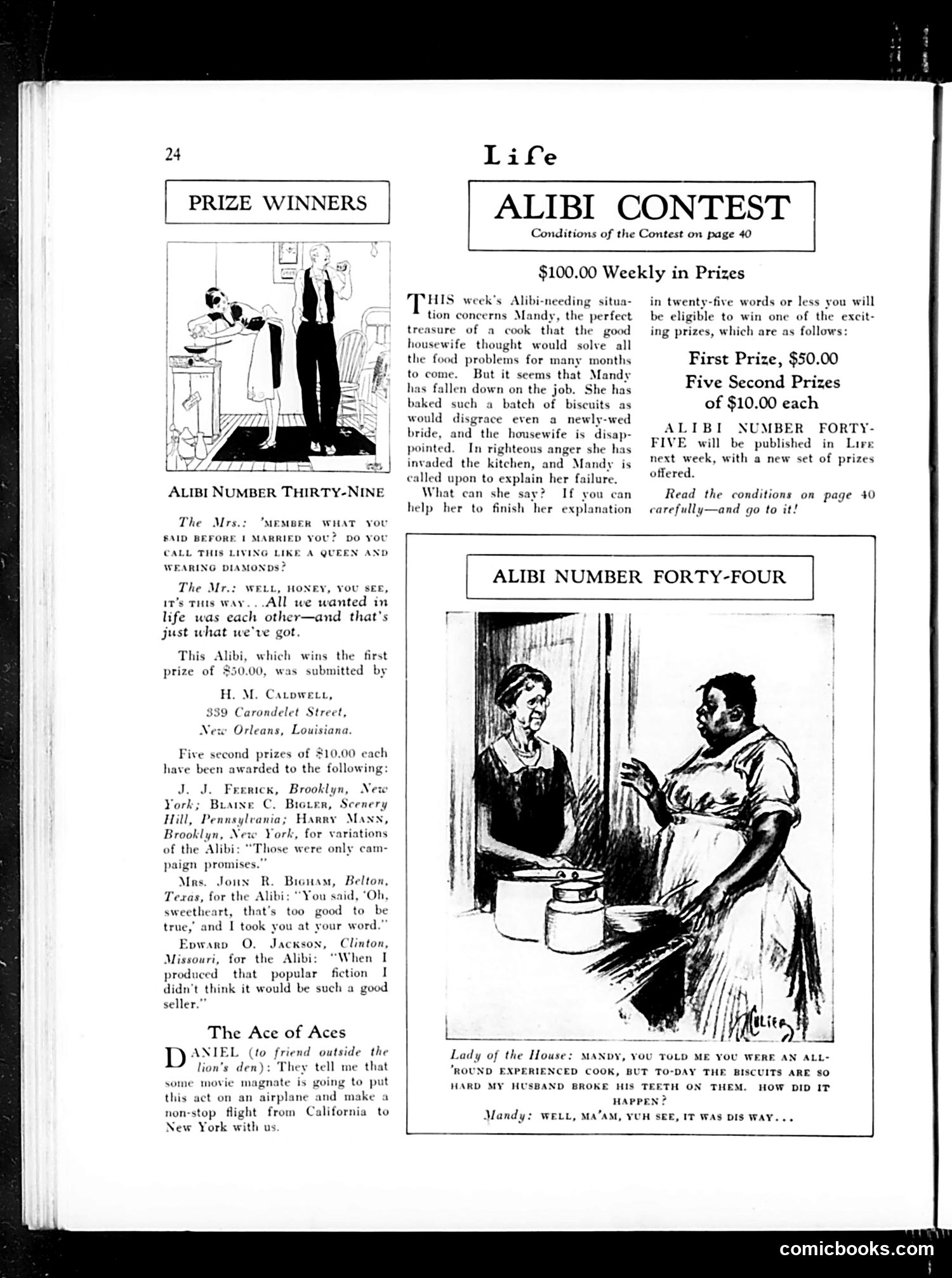
This page presents Life's humor contest where readers submit clever excuses ("alibis") for domestic failures. The winning entries mock married life and broken promises. **Alibi #39** (top): A husband excuses his failure to provide a luxurious life by claiming he and his wife only wanted each other—a romantic deflation of his earlier courtship promises. The joke satirizes how marriage transforms idealistic vows into modest reality. **Alibi #44** (bottom): A domestic servant named Mandy must explain why her biscuits are so hard the employer's husband broke his teeth. The cartoon depicts a common early-20th-century household scenario where servants bore blame for domestic mishaps. Both entries use humor to critique post-marriage disillusionment and the class dynamics of domestic service. The contest itself was interactive entertainment—readers submitted their own witty excuses for everyday failures, reflecting this era's fascination with clever wordplay and domestic comedy.
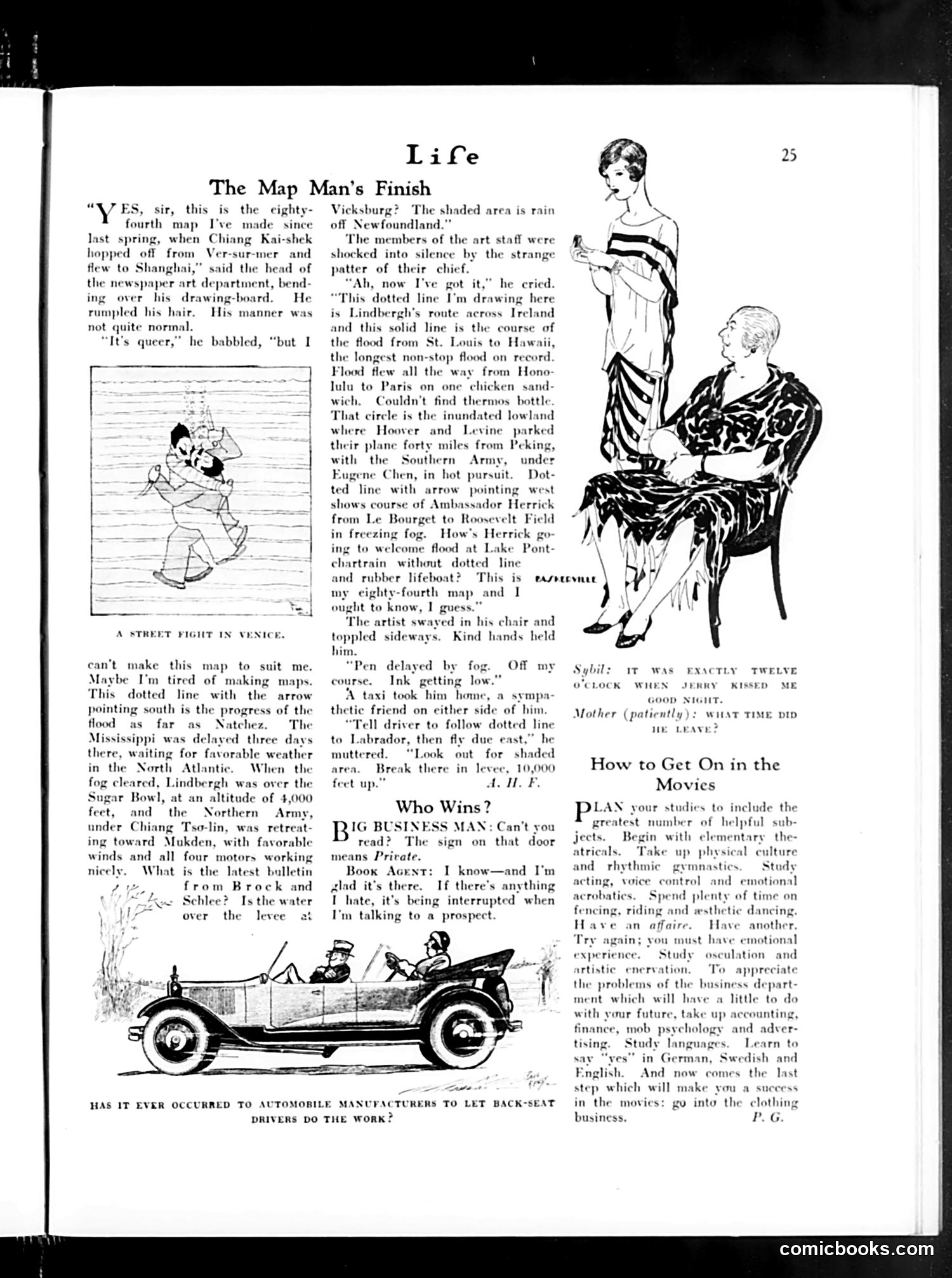
This page satirizes the overwhelming news coverage of the late 1920s. The cartoon shows a newspaper art department head suffering mental breakdown while trying to create maps that simultaneously track multiple major events: Charles Lindbergh's transatlantic flight, devastating Mississippi River floods, Chinese civil war movements (Chiang Kai-shek, Eugene Chen), and various diplomatic activities. The joke is that contemporary events are so numerous and geographically scattered that creating a single coherent map becomes impossible—he's ironically conflating unrelated events (the flood reaching Hawaii, planes parked near armies). By the cartoonist's count, he's made 84 maps in one spring. The satire mocks both the news cycle's relentless demand for fresh content and the public's consumption of sensationalized coverage, ultimately driving the mapmaker to complete exhaustion and delirium. It's commentary on modern information overload.
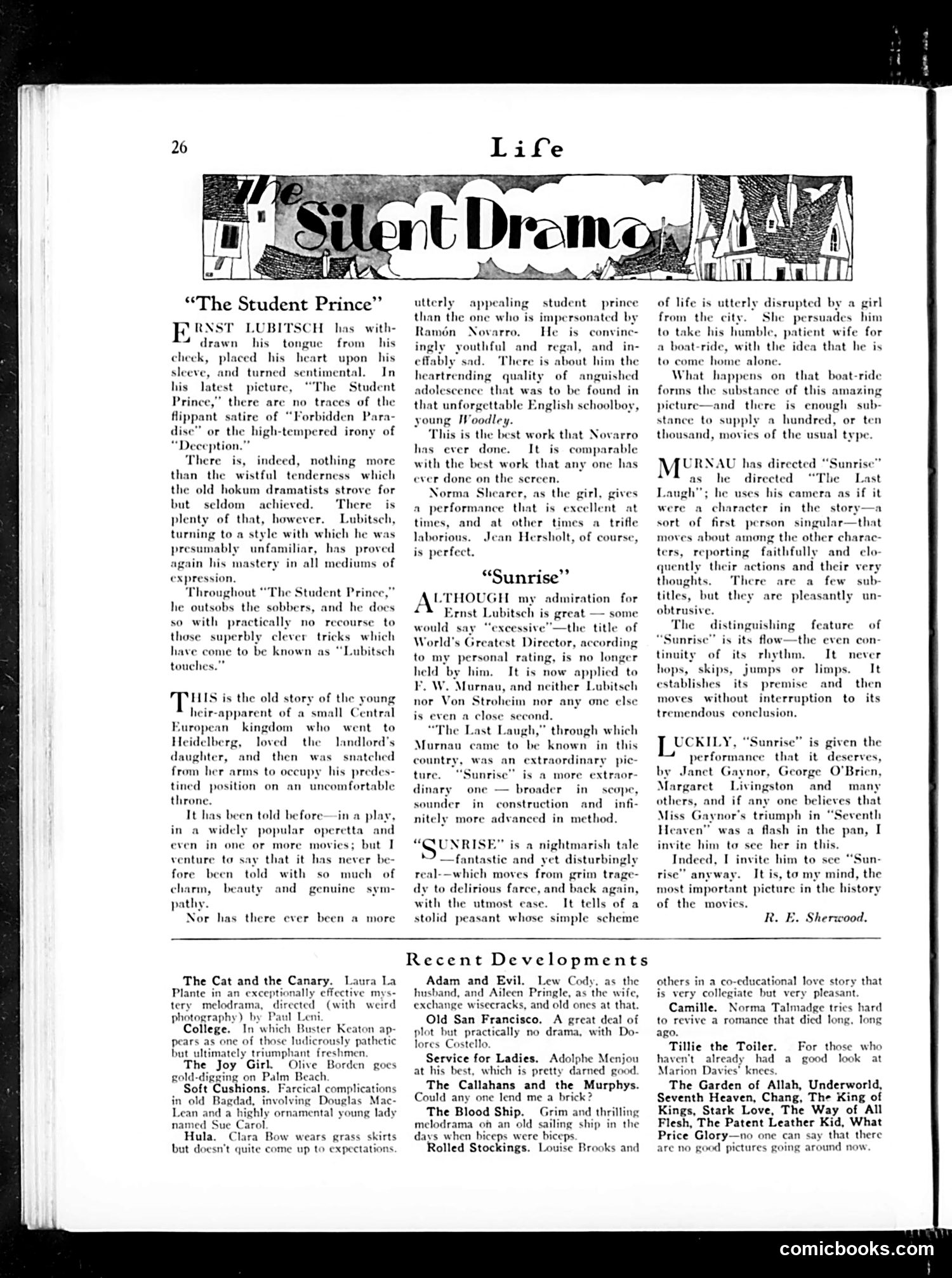
This page contains two film reviews without political satire—it's purely entertainment criticism from Life's arts section. **"The Student Prince"** review praises director Ernst Lubitsch's sentimental turn away from his typical satirical style. The film adapts a familiar European operetta plot about a young heir who falls in love at Heidelberg University. The critic highlights performances by Ramón Novarro (as the prince) and Norma Shearer, calling Novarro's work "the best work that any one has ever done on the screen." **"Sunrise"** review elevates director F.W. Murnau above Lubitsch, crediting him as the era's greatest director. The film tells of a peasant seduced by a city woman into abandoning his wife. The critic praises Murnau's innovative camera work and the film's rhythmic flow, calling it "extraordinary" in scope and construction. The page also lists recent film releases in a section titled "Recent Developments."
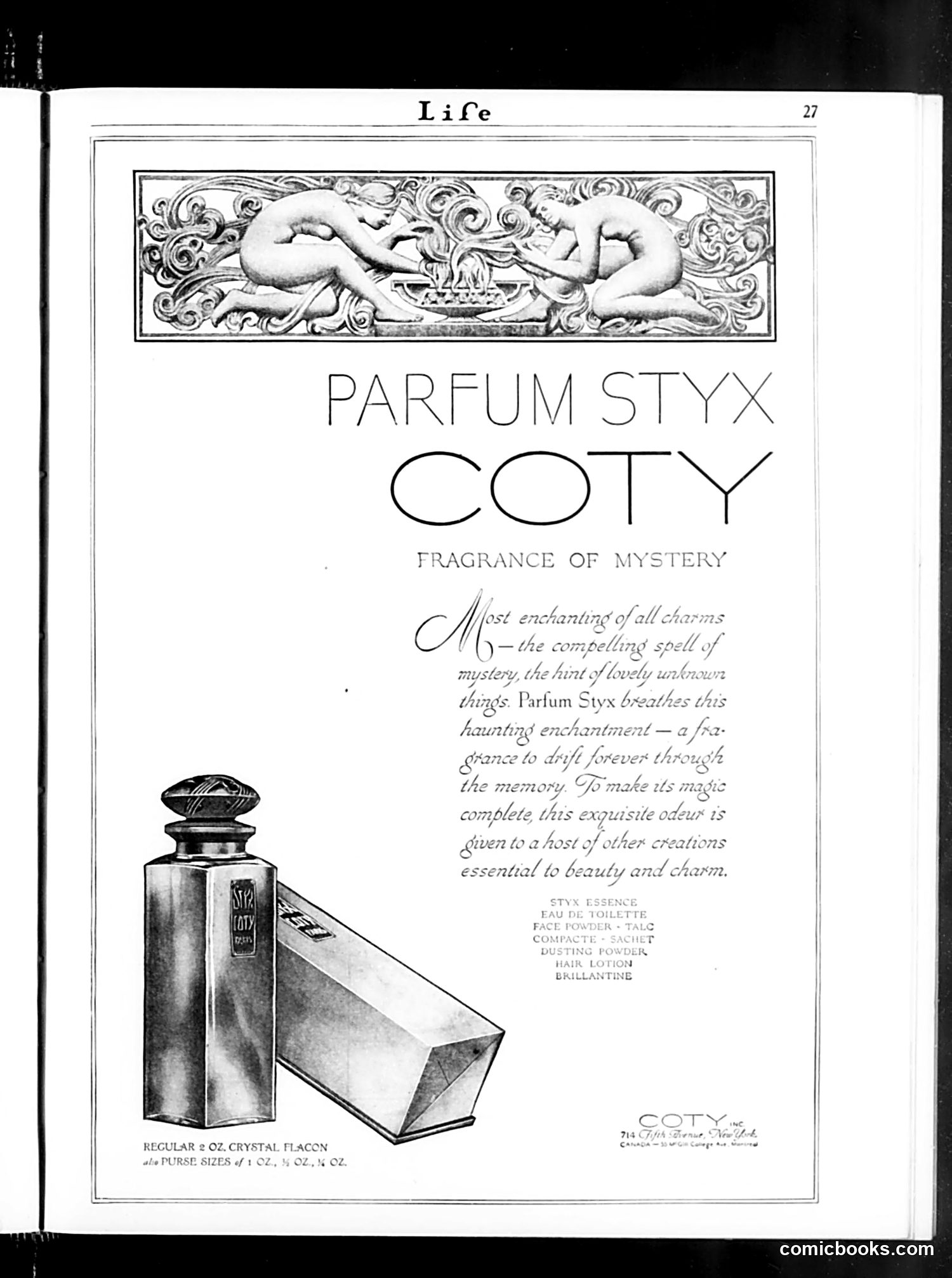
This page is primarily a **full-page advertisement**, not a cartoon or satire. It promotes "Parfum Styx Coty," a fragrance product from the Coty cosmetics company. The ad uses classical imagery—an ornamental header depicting cherubs or putti in baroque style—to evoke luxury and sophistication. The copy employs flowery, romantic language about "mystery," "enchantment," and "lovely unknown things" to market the perfume as an aspirational product. The product image shows a crystal flacon (decorative bottle) and packaging. The ad lists related Coty beauty products: essence, eau de toilette, face powder, talc, compacts, sachets, dusting powder, bath lotion, and brilliantine. This is typical early 20th-century luxury advertising aimed at middle and upper-class women, using classical allusions and mystique to justify premium pricing.
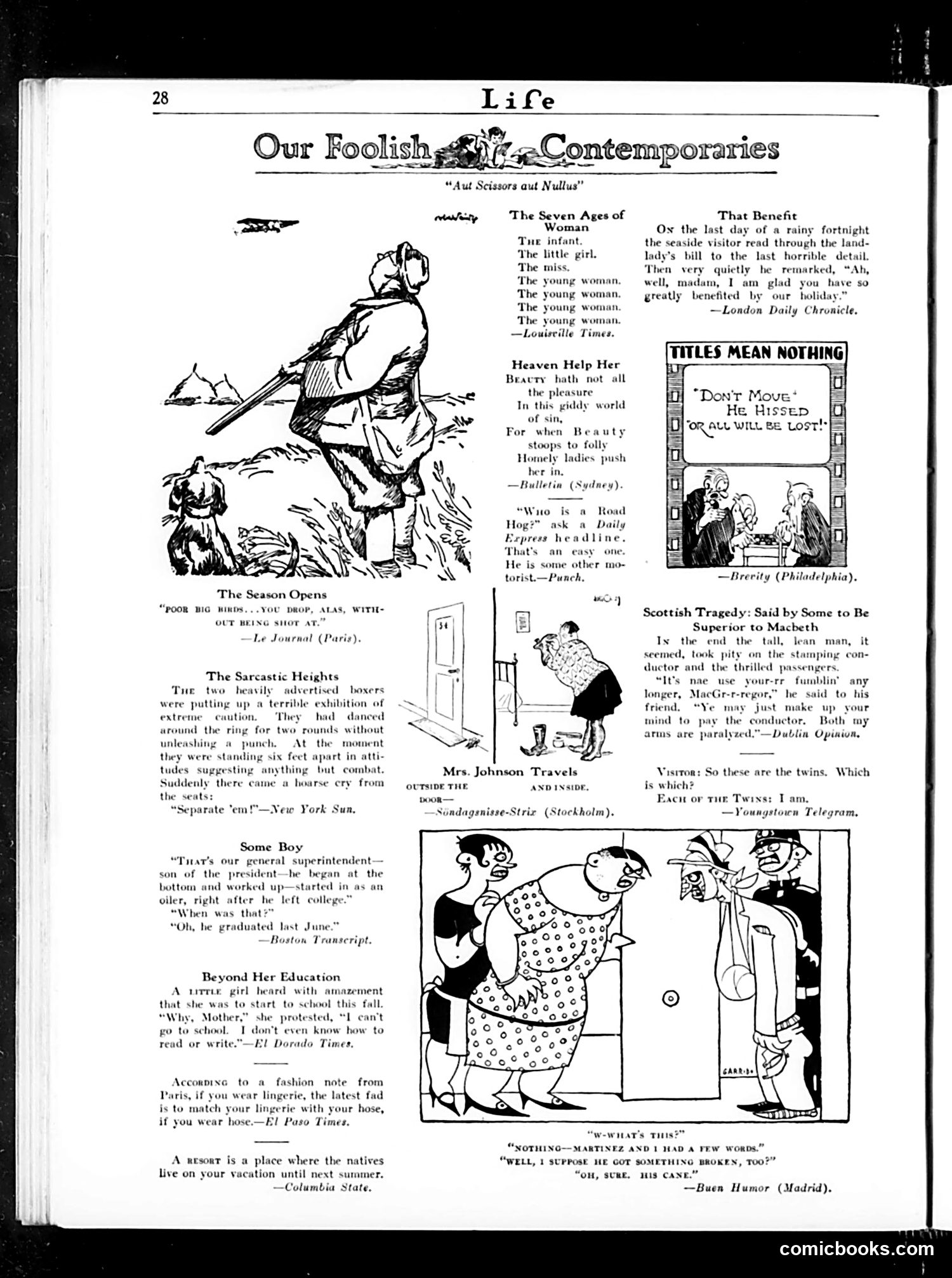
This page collects brief satirical quips and cartoons lampooning contemporary society (circa early 20th century). Key targets include: **Social absurdities:** Boxers so cautious they won't fight ("extreme caution"), a superintendent's son who "started as an oiler" right after college graduation, and a girl who can't read despite attending school—mocking pretension and incompetence. **Gender and fashion satire:** Women obsessing over matching lingerie to hosiery; beauty standards ("Homely ladies push her in" when beauty "stoops to folly"). **Travel and leisure:** A seaside hotel guest meticulously reviewing bills, a "resort" where natives exploit tourists' vacation spending. **International humor:** A Scottish man's stuttering accent preventing train payment (suggesting dialect comedy), and a marital spat with a cane injury ending in resignation—typical period slapstick. The cartoons use exaggeration and simple line drawings to mock consumer culture, class pretension, and gender stereotypes common to early 20th-century Life magazine humor.
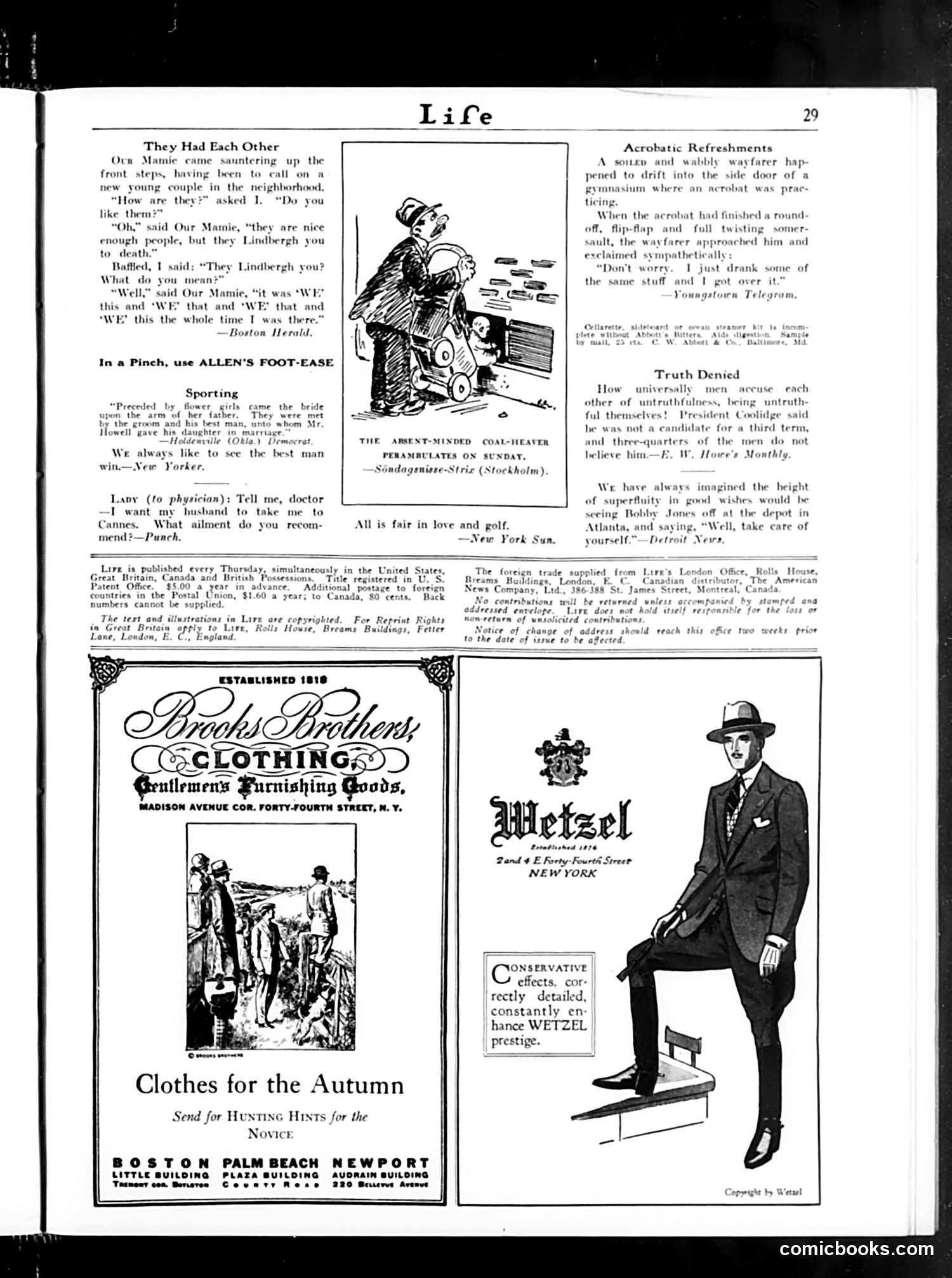
This page contains several brief satirical pieces typical of Life magazine's humor format: **"They Had Each Other"** mocks newlyweds who constantly use "we" instead of "I," suggesting their absorption in coupledom has erased individual identity. **"The Absent-Minded Coal-Heaver"** (Stockholm reference) is a wordless cartoon about a distracted laborer, likely poking fun at absent-mindedness as a universal human trait. **"Acrobatic Refreshments"** jokes about a drunk man mistaking an acrobat's flips for what alcohol does to him—comparing intoxication to physical contortion. **"Truth Denied"** references President Coolidge's denial of candidacy for a third term, sarcastically suggesting politicians deny things everyone disbelieves anyway. The page is primarily **advertising** (Brooks Brothers, Wetzel clothing), with humor fragments scattered between. These are light, domestic satires requiring no deep political knowledge—just observations about marriage, drunkenness, and political dishonesty.
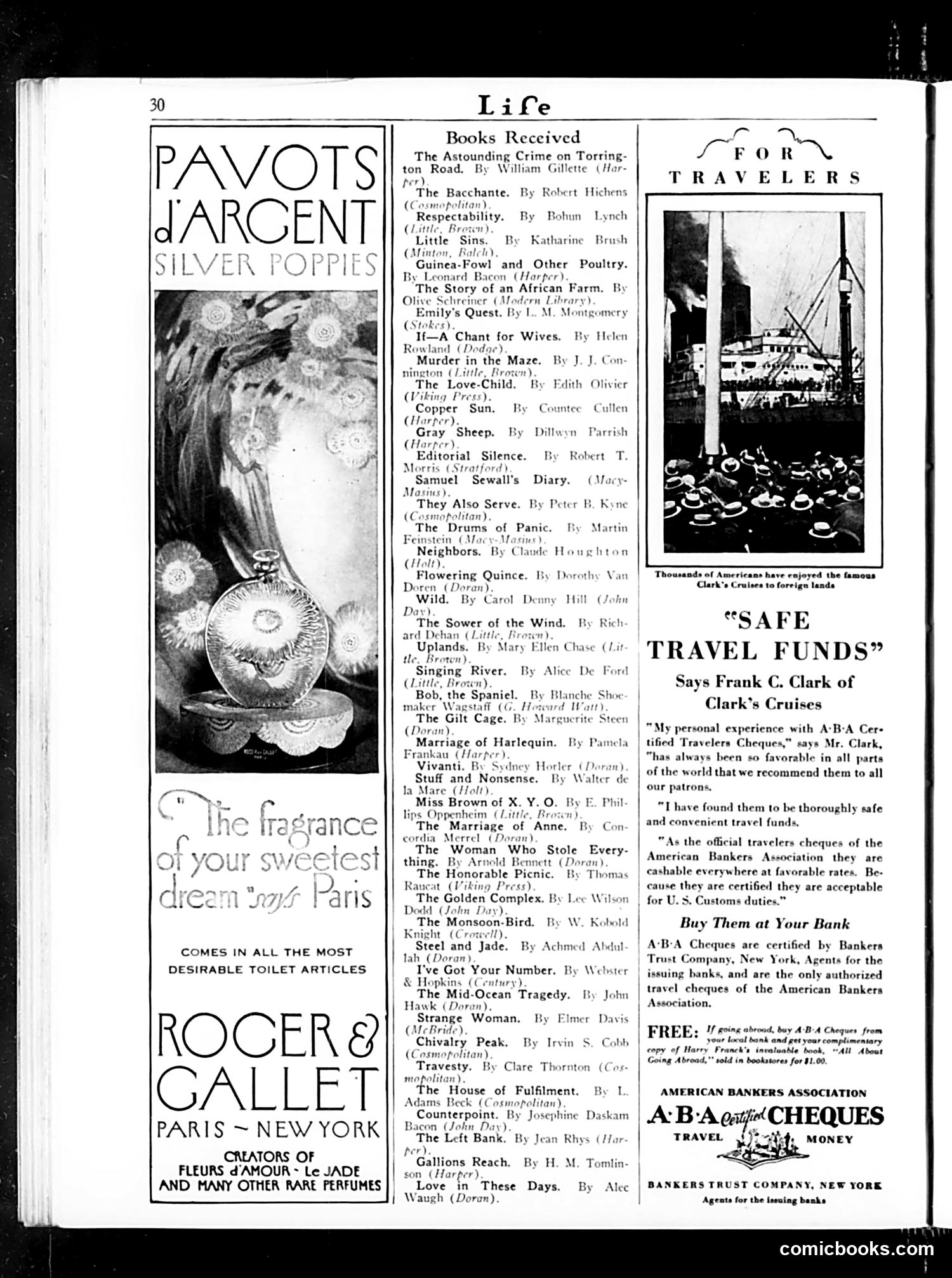
This page is primarily **commercial advertising and book listings** rather than political satire or comics. The left side features luxury perfume advertisements for **Pavots d'Argent** (Roger & Gallet, Paris-New York) and a fragrance ad emphasizing Parisian elegance—typical high-end consumer marketing from this era. The center contains an extensive **"Books Received"** listing of contemporary novels and literary works, showing Life's role as a cultural publication reviewing current publications. The right side advertises **Clark's Cruises travel services** and **A-B-A Certified Travelers Cheques** (American Bankers Association), featuring a photograph of a cruise ship and promoting safe, convenient travel funds for foreign destinations. No political cartoons or satirical commentary appears on this page. It represents Life magazine functioning as a lifestyle and consumer publication for affluent readers interested in luxury goods, literature, and travel.
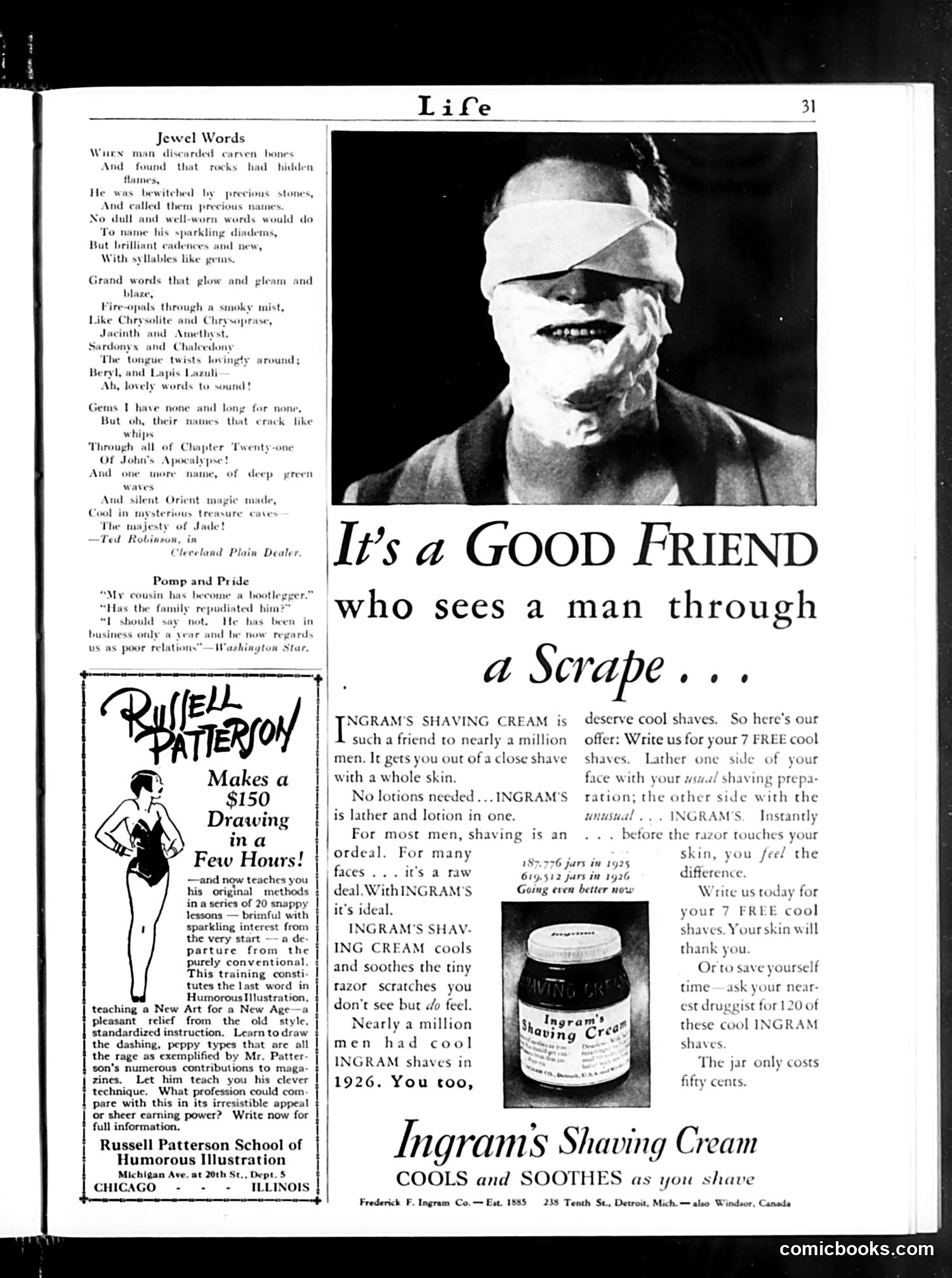
This page contains primarily **advertisements and light satirical content** rather than political commentary. The main elements are: 1. **"Jewel Words"** — A humorous poem (attributed to Ted Robinson) mocking overwrought, ornate vocabulary. It jokes that people discard plain words for fancy ones like "chrysolite" and "lapis lazuli" when simpler terms would do. The satire targets pretentious language use. 2. **Russell Patterson School advertisement** — Promotes a correspondence course in "humorous illustration," emphasizing modern, "peppy" drawing styles. Patterson was apparently a well-known magazine illustrator. 3. **Ingram's Shaving Cream advertisement** — The dominant ad features a blindfolded man and uses the slogan "It's a GOOD FRIEND who sees a man through a scrape." The ad emphasizes that the product soothes razor irritation and offers free samples. The blindfolded imagery is purely a visual pun on "scrape" — suggesting vulnerability while shaving — rather than any political reference. This is a straightforward commercial page with light humor.
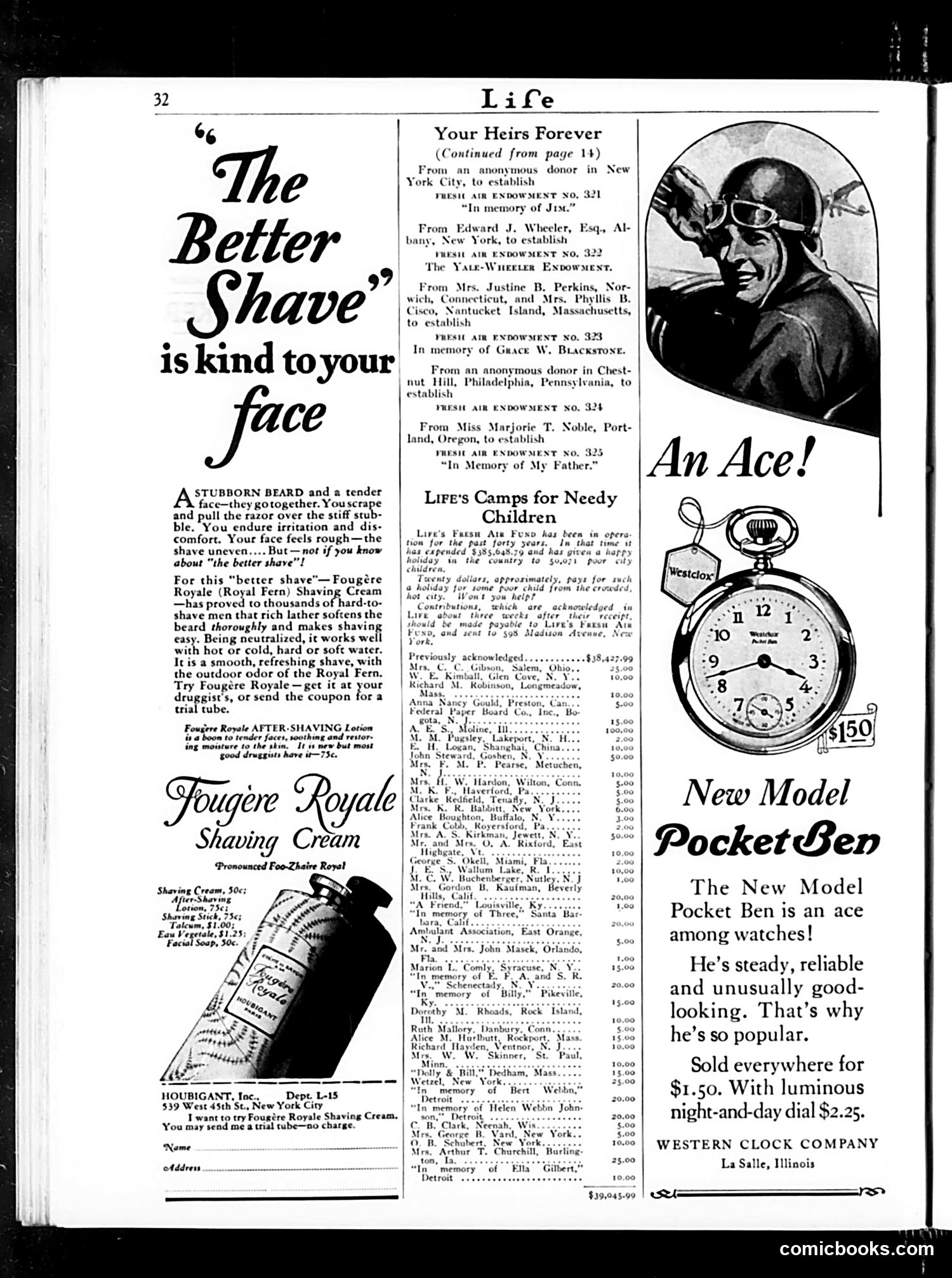
This page is primarily **advertising and fundraising content** from Life magazine, not political satire. **Left side:** A Fougère Royale shaving cream advertisement uses the common early-20th-century marketing approach of acknowledging a real problem (stubborn beards causing irritation) to sell a solution. The copy emphasizes comfort and smoothness—appeals designed for men who found shaving difficult. **Center:** A continuation of "Your Heirs Forever," listing donations to Life's Fresh Air Camp for Needy Children—a charitable endowment program. This reflects Progressive-era philanthropic concerns about poor urban children's health and welfare. **Right side:** An advertisement for the "Pocket Ben" pocket watch, priced at $1.50 (or $2.25 with a luminous dial), marketed as reliable and good-looking. The anthropomorphic "Ben" character calling himself "an ace" reflects period advertising's casual personification of products. The page reflects early-1900s consumer culture, charitable giving practices, and marketing strategies familiar to Life's middle and upper-class readership.
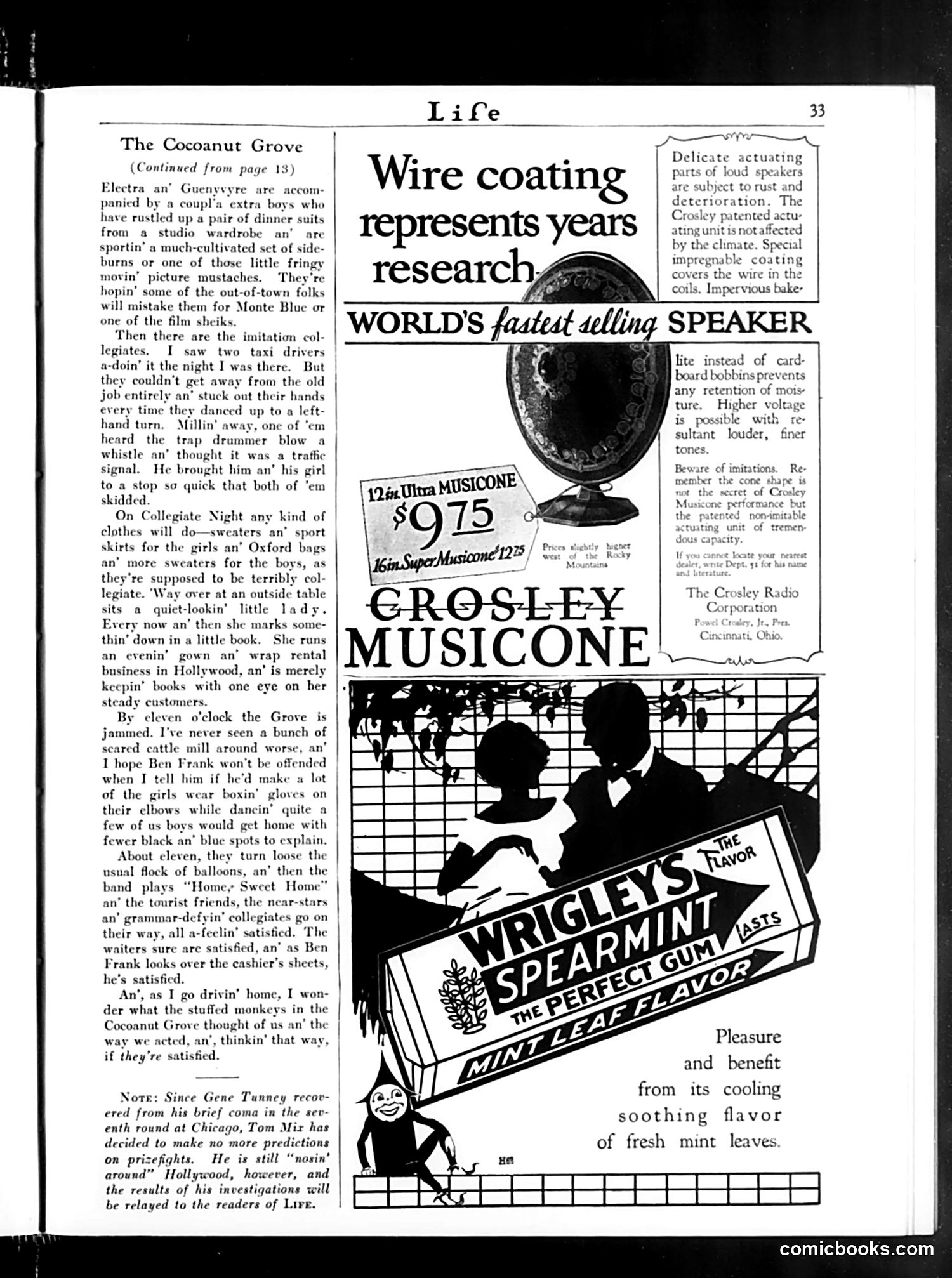
This page primarily contains **advertisements** rather than political cartoons. The main ads are: 1. **Crosley Musicone Speaker** ($9.75)—touting itself as the "world's fastest selling speaker," emphasizing its wire coating technology and superior sound quality. 2. **Wrigley's Spearmint Gum**—promoting the "perfect gum" with emphasis on its cooling, refreshing mint flavor. The left column contains a **satirical essay** titled "The Cocoanut Grove," describing the social scene at a popular nightclub. The author mocks various attendees: aspiring actors with fake sideburns, taxi drivers pretending to be collegians, and tourists. The humor derives from observational satire about people's pretensions and Hollywood's culture of artifice and social climbing during the Jazz Age. The note about Gene Tunney and Tom Mix suggests this is from the 1920s, when boxing and Western films dominated popular culture.
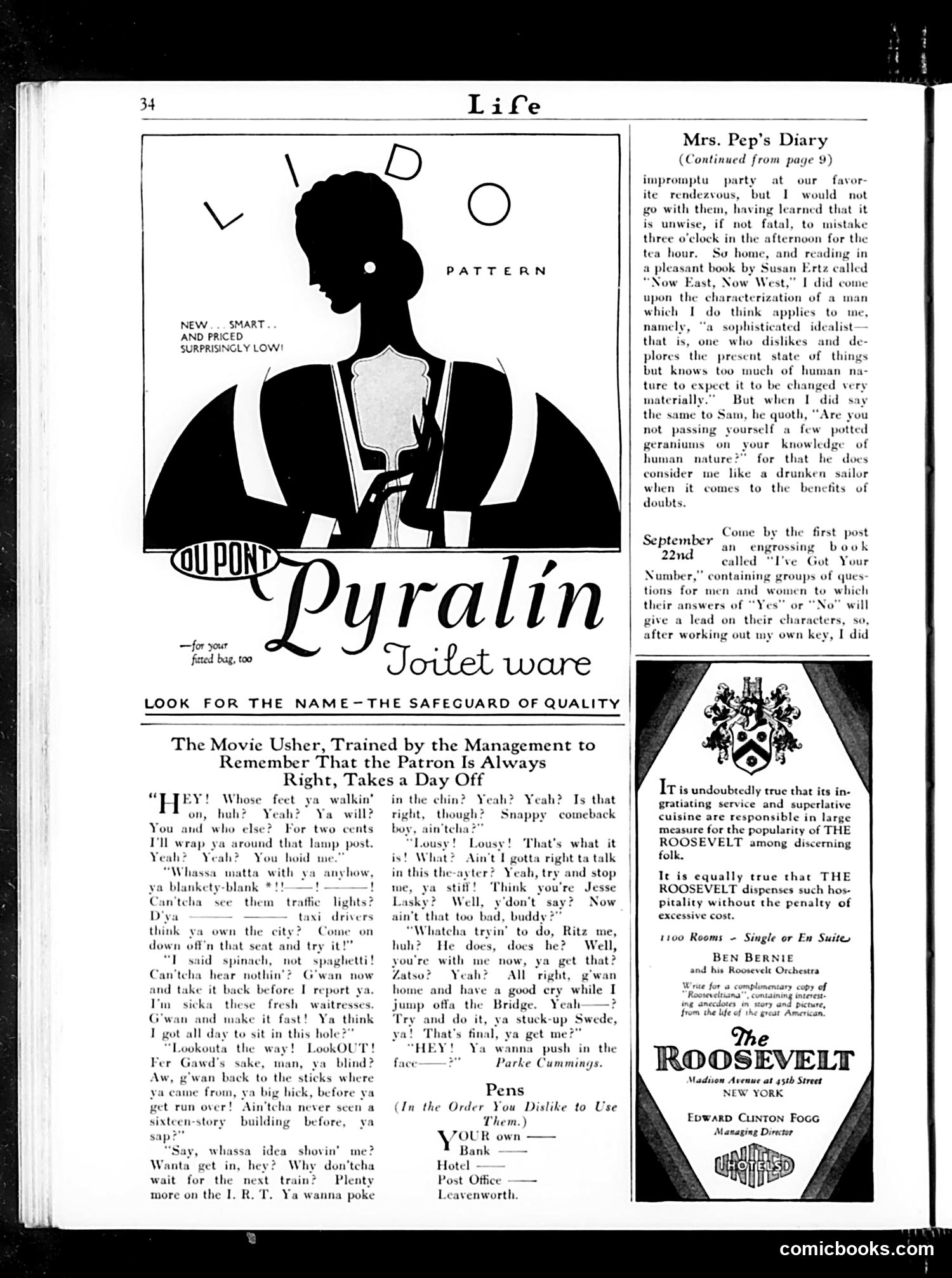
This page contains a DuPont Pyralin toilet ware advertisement and two satirical pieces typical of 1920s Life magazine humor. **The Main Cartoon** depicts a movie usher who, given a day off from his usual job of deferentially managing patrons, becomes a belligerent New York City street character—aggressively confronting pedestrians, taxi drivers, and fellow commuters with crude insults and threats. The satire mocks the performative politeness required in service jobs: the usher's "real" personality, once freed from workplace constraints, reveals itself as aggressive and hostile. This reflects 1920s class anxieties about urban workers and the artificial civility demanded by the emerging service economy. **"Pens You Dislike to Use"** is a humor list playing on pretentious or uncomfortable situations (your own bank, hotel, post office, Leavenworth—a federal penitentiary, the joke being imprisonment). The Roosevelt Hotel advertisement promotes its Manhattan location and service quality. The page primarily targets affluent urban readers with disposable income for both leisure and luxury accommodations.
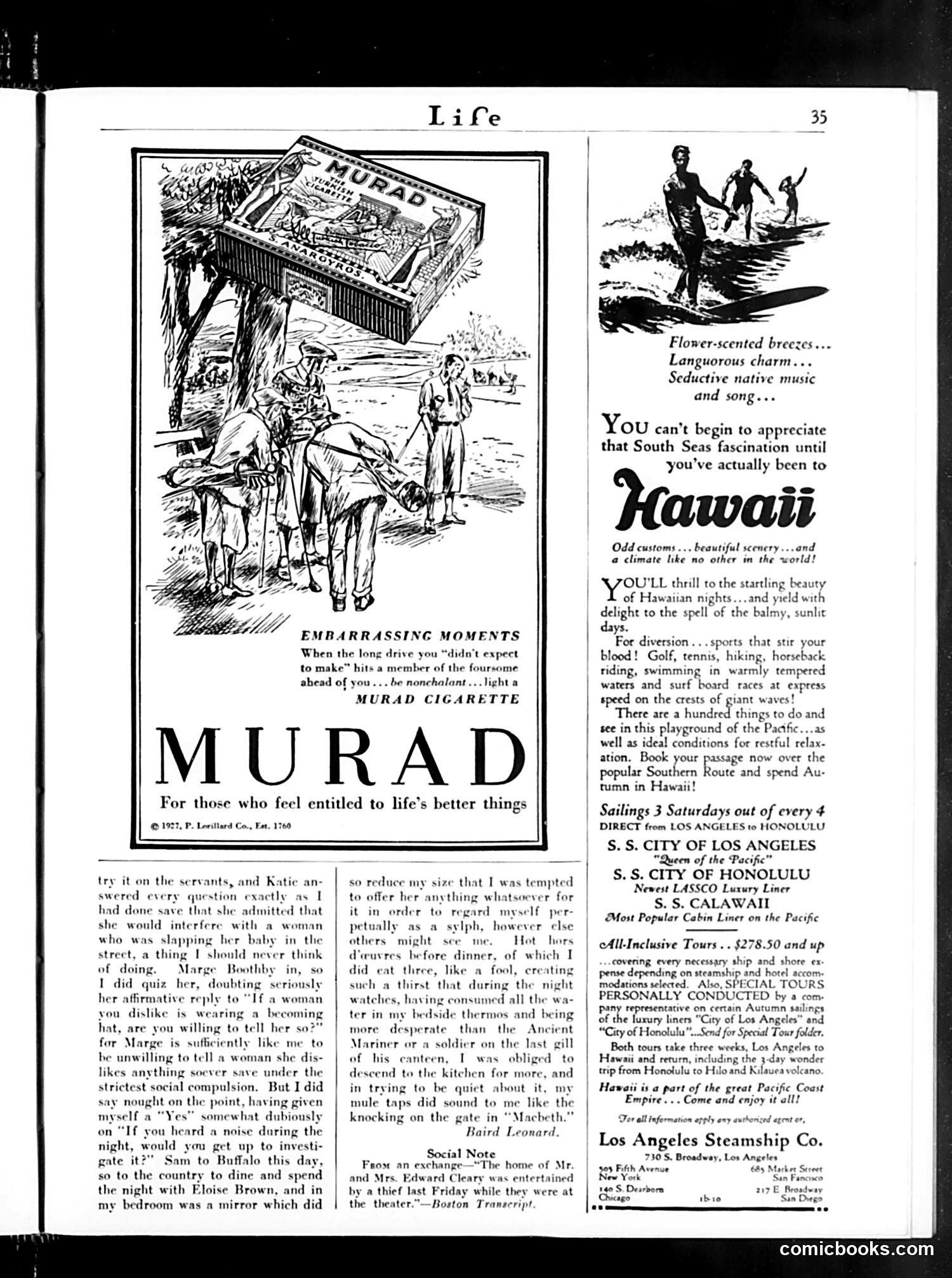
This page contains two distinct advertisements rather than political cartoons. **The Murad Cigarette Ad** (left) uses humor to sell cigarettes. The "Embarrassing Moments" caption depicts a golfer lighting a cigarette after hitting a ball into the group ahead—framed as a suave way to handle social awkwardness. The tagline "For those who feel entitled to life's better things" appeals to aspirational masculinity and sophistication. This reflects 1920s advertising that associated smoking with elegance and composure. **The Hawaii Tourism Ad** (right) promotes steamship travel to Hawaii, emphasizing exotic appeal: "flower-scented breezes," "seductive native music," and leisure activities. The language exoticizes Hawaiian culture while promoting Hawaii as a Pacific playground for affluent Americans. Both ads target wealthy, leisure-class readers. The satirical *Life* magazine's inclusion of such ads reveals period attitudes toward consumption, gender performance, and colonial leisure travel as markers of status.
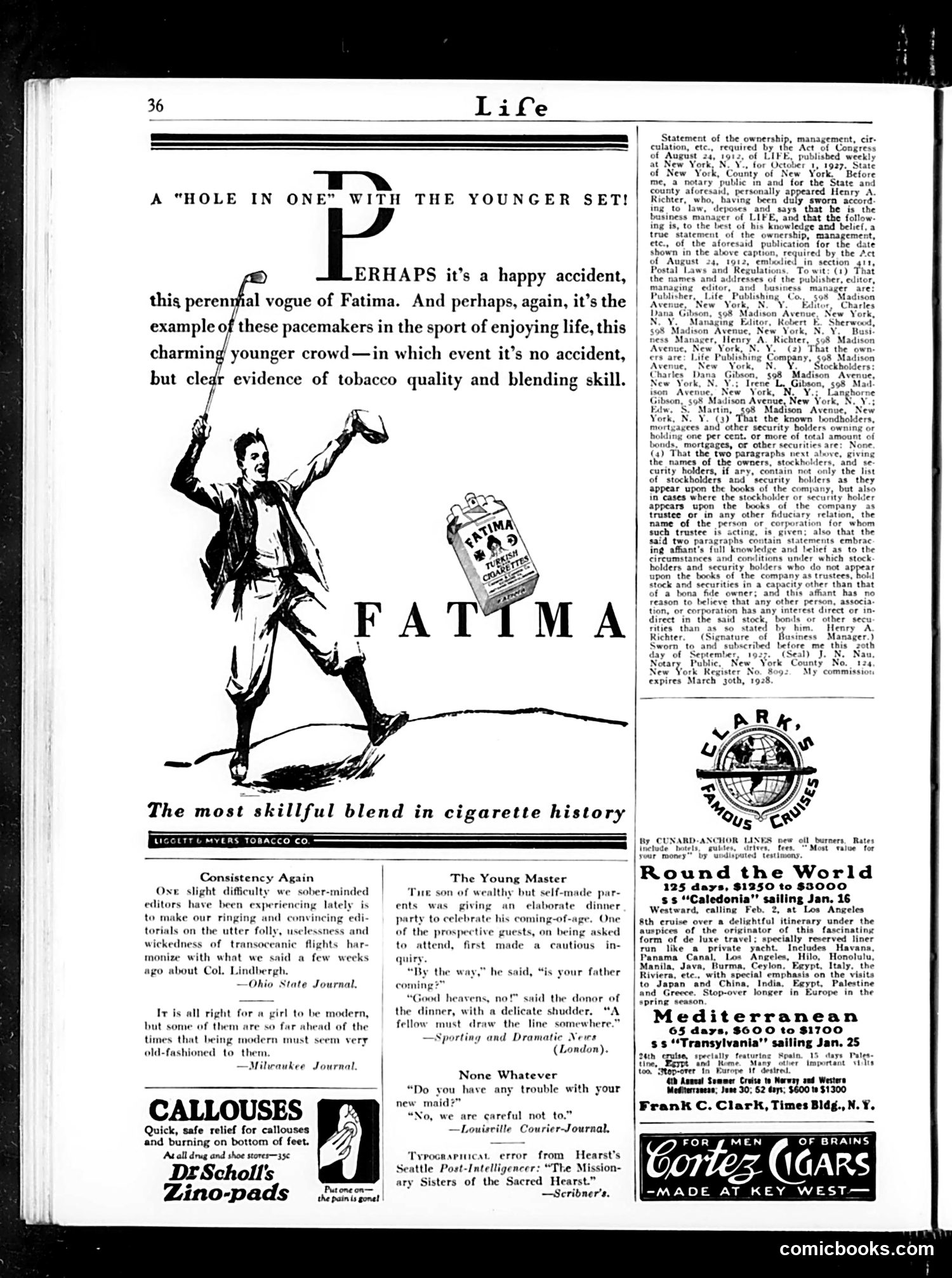
This page is primarily **advertising and legal content**, not political cartoons. The main feature is a Fatima cigarette advertisement depicting a joyful young man celebrating, with the tagline "The most skillful blend in cigarette history." The ad targets youth ("the younger set"), positioning cigarette smoking as sophisticated leisure and social success. The page includes several brief humorous editorial snippets typical of Life's format: - **"Consistency Again"** jokes about editors praising Col. Lindbergh while denouncing transatlantic flights - **"The Young Master"** mocks wealthy but crude self-made parents and their sons - **"None Whatever"** contains a mild domestic servant joke The rest consists of **Dr. Scholl's callous pad ads**, ship cruise advertisements, and required **magazine ownership statements** (legal filing mandated by Congress). The page reflects 1920s social attitudes: normalization of youth smoking, gentle class satire, and dated servant-related humor. No specific political figures are caricatured.
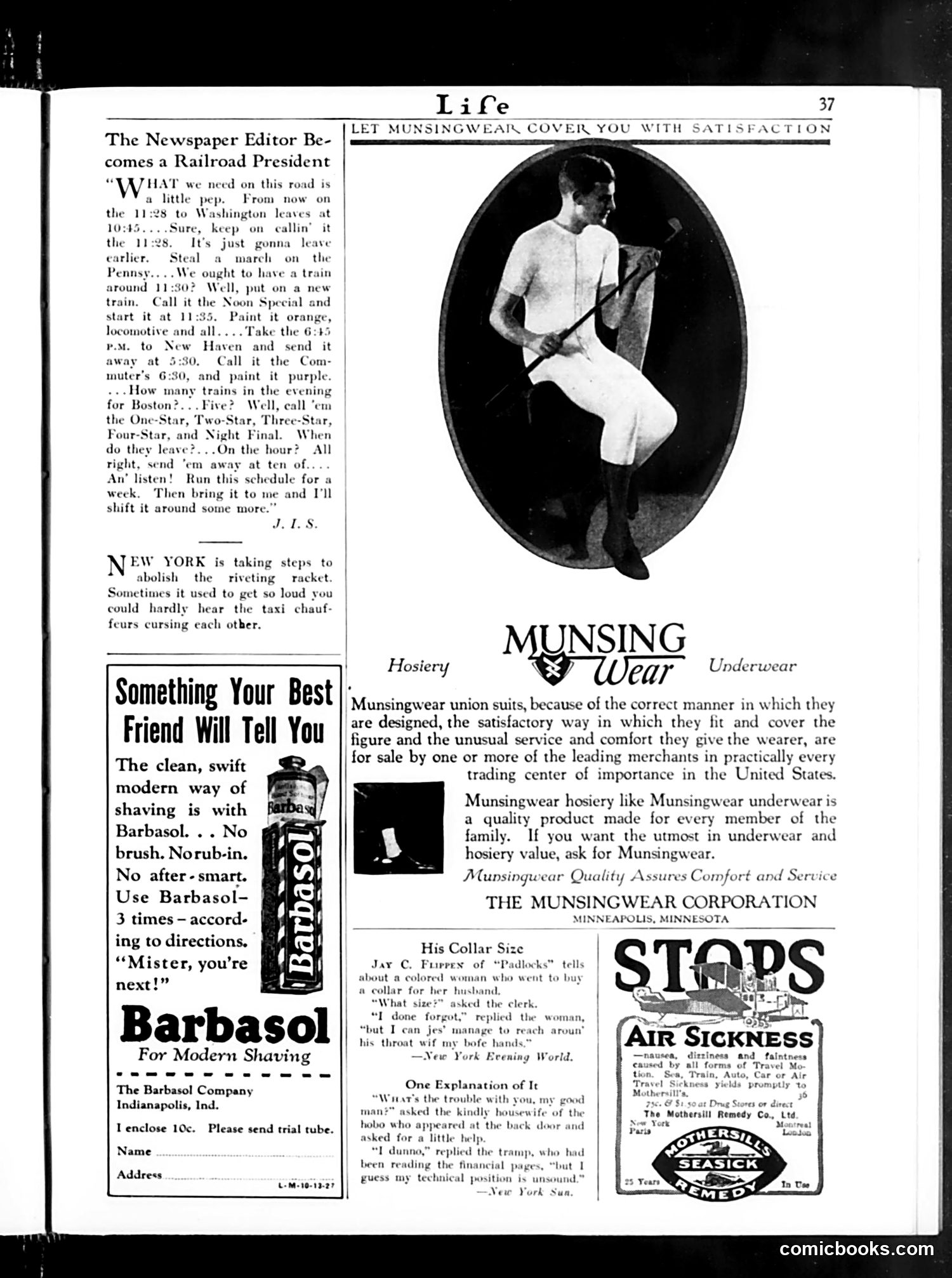
This page primarily contains **advertisements** with one brief satirical piece. **"The Newspaper Editor Becomes a Railroad President"** is a short joke mocking newspaper editors' tendency toward excessive tinkering and constant revision. The editor, hired to manage a railroad, applies journalistic habits to train schedules—constantly renaming trains (the "Noon Special" starting at 11:35), repainting them, and reorganizing departure times. The satire suggests editors compulsively "shift things around" without genuine improvement, prioritizing flashy cosmetic changes over substance. It's a workplace satire about management incompetence. The remaining content is commercial advertising: Barbasol shaving cream, Munsingwear underwear and hosiery, and Mothersill's seasickness remedy. Two brief humorous anecdotes about collar sizes and unemployment appear as filler text. The page reflects 1920s concerns about industrial efficiency and modernization, presented through period-appropriate advertising and light workplace humor.
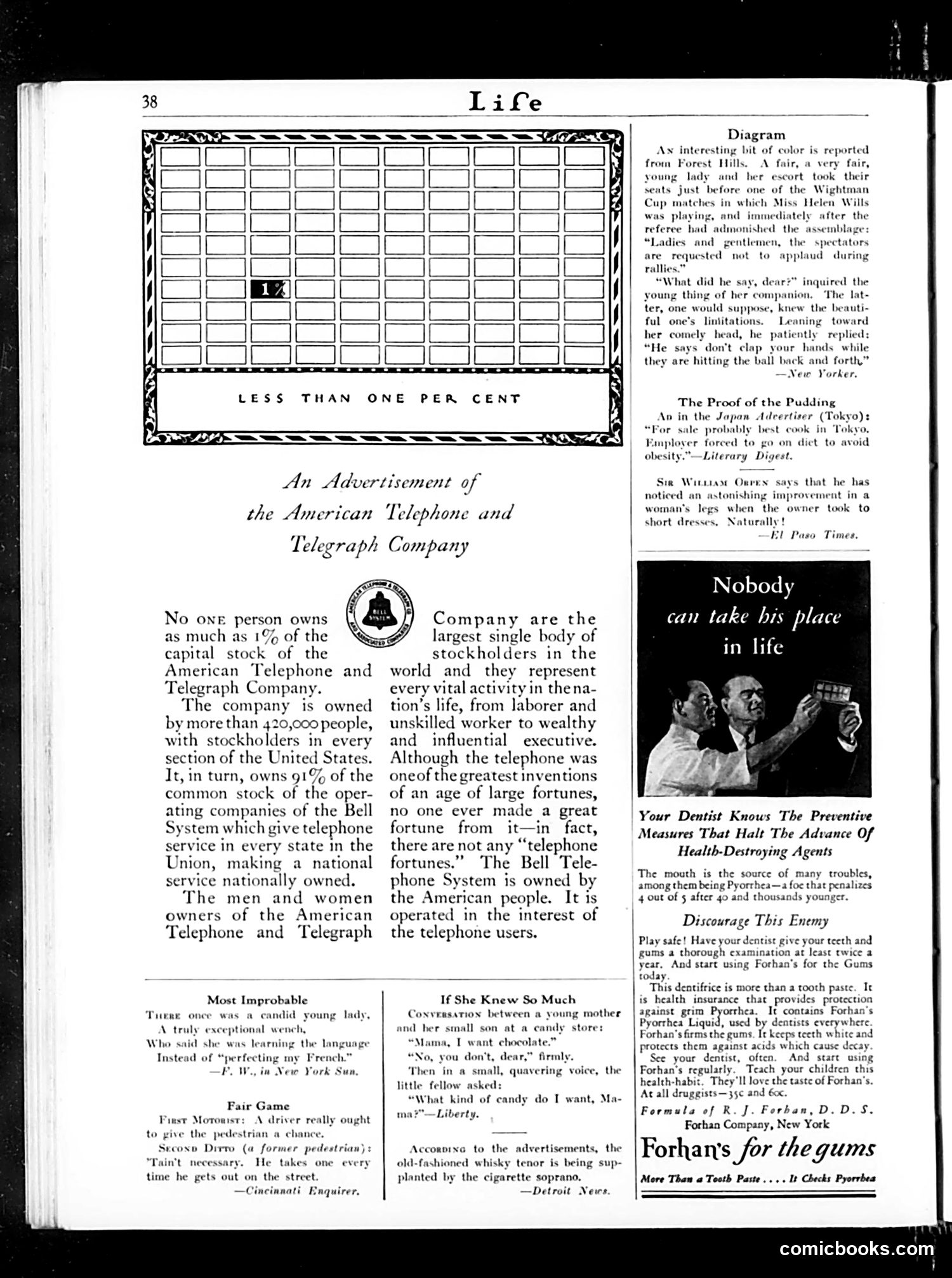
This page combines corporate PR with light satirical humor typical of 1920s Life magazine. **Main Advertisement**: AT&T promotes its dispersed ownership (no single person owns more than 1%) as evidence of democratic capitalism. The company claims 420,000 stockholders and argues the Bell System serves the public interest—subtle propaganda reassuring readers that this near-monopoly is actually "nationally owned." **Cartoons/Humor Items**: Brief satirical jokes mock: - A girl claiming to learn "the language" instead of French (likely referencing the pretense of self-improvement) - A motorist jokingly saying pedestrians need "one every time" they cross streets (dark humor about traffic danger) - A mother's child asking what candy *he* wants when told he can't have chocolate (absurdist humor) - Class commentary on women's fashion—legs improved when women wore shorter dresses **Also Advertised**: Forhan's toothpaste and a dental hygiene message about preventing pyorrhea (gum disease). The page exemplifies how Life mixed social satire, corporate messaging, and product advertising in early 20th-century American magazines.
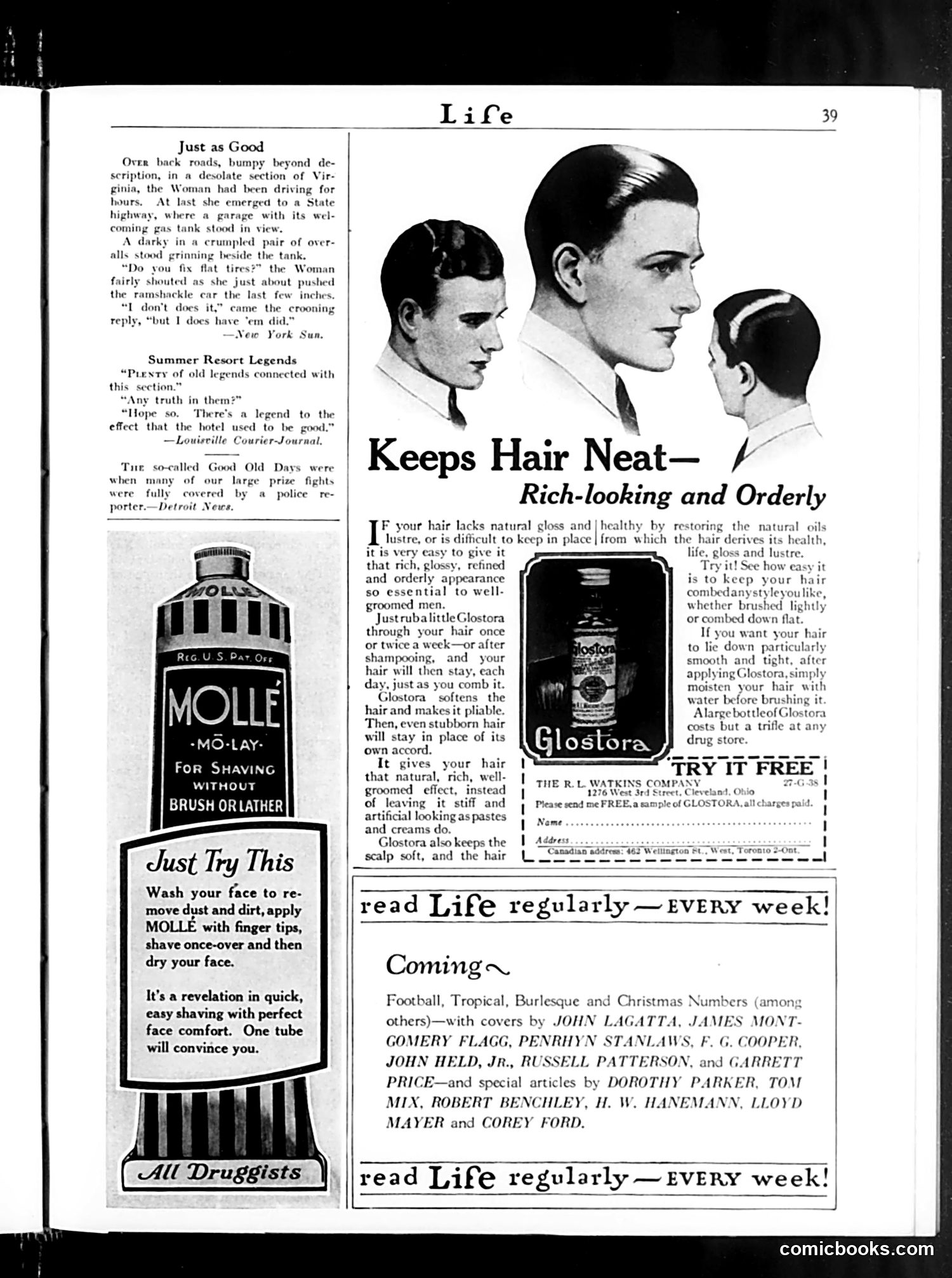
This page contains three separate humor pieces typical of Life's satirical format, plus advertisements. **"Just as Good"** mocks rural Southern mechanics. A woman asks a poorly-spoken Black mechanic if he can fix her car's flat tire. He replies he cannot fix flats but *does* have them—a play on dialect humor and the stereotype of incompetent service in rural areas. **"Summer Resort Legends"** satirizes false advertising and nostalgia. A guest asks if local legends about a hotel's former quality are true; the response jokes that the *only* legend is that the hotel "used to be good"—commentary on declining establishments trading on past reputation. **"Good Old Days"** briefly notes that prize fights were once covered by police reporters, implying modern boxing lacks such respectability—social commentary on entertainment's changing status. The remaining content comprises period advertisements for Mollé shaving cream and Glostora hair product, targeting male grooming standards of the era.
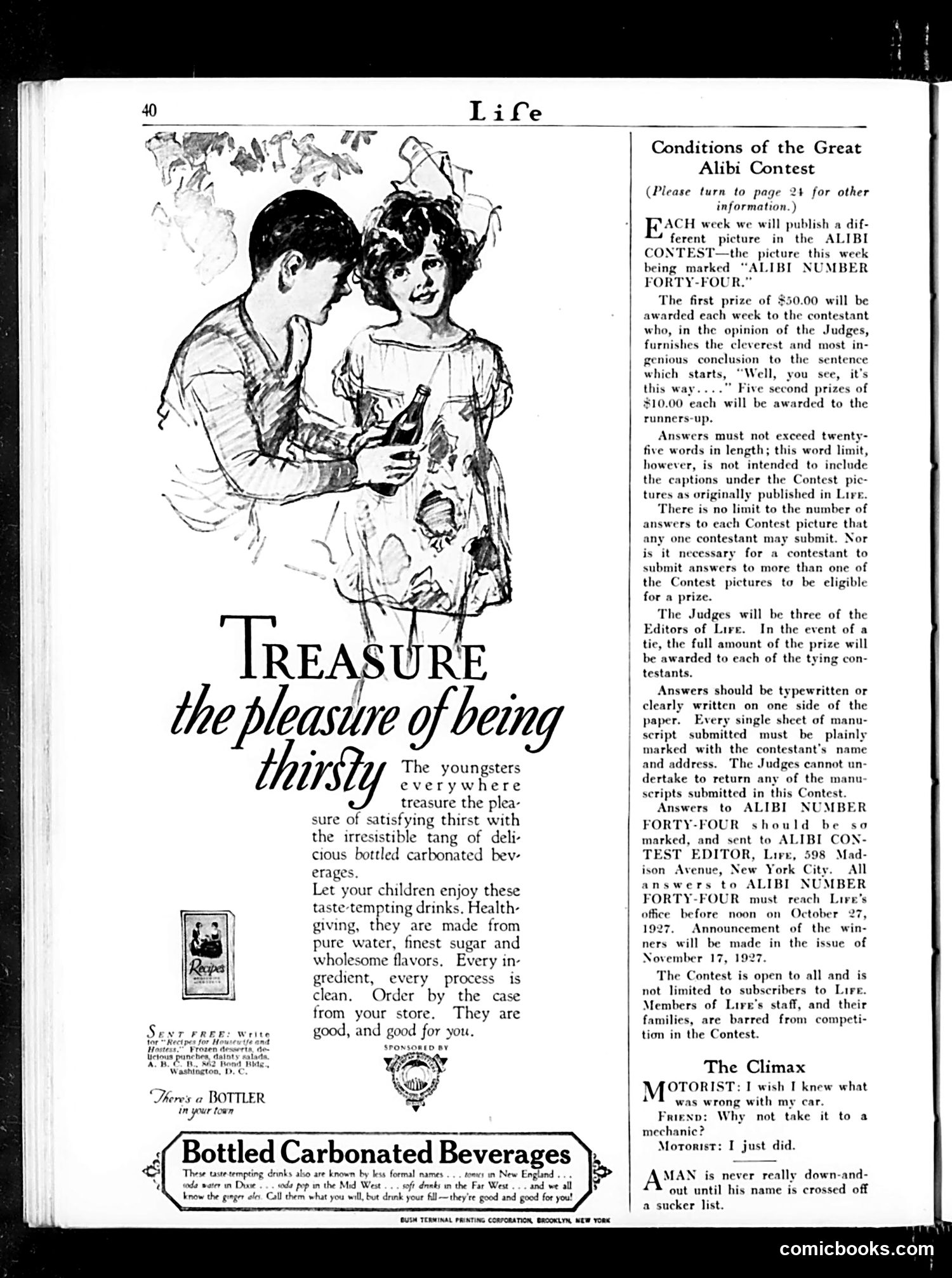
This page combines a beverage advertisement with two distinct features: **Main Advertisement**: A "Treasure" ad for bottled carbonated beverages, featuring an illustration of two children. The copy emphasizes these drinks as wholesome, health-giving refreshments made from "pure water, finest sugar and wholesome flavors"—typical marketing language for soft drinks of this era. **The Alibi Contest**: Life magazine's weekly contest where readers submit humorous explanations for captioned pictures, starting with "Well, you see, it's this way..." Winners received $50 (first prize) and $10 (runner-up prizes). This appears to be "Alibi Number Forty-Four," though the contest picture itself isn't clearly visible on this page. **Two Short Jokes**: - "The Climax" depicts a motorist frustrated with a mechanic's inability to diagnose car trouble - A final quip about a man whose name appears on a "sucker list" The page reflects 1920s popular entertainment and consumer advertising conventions.
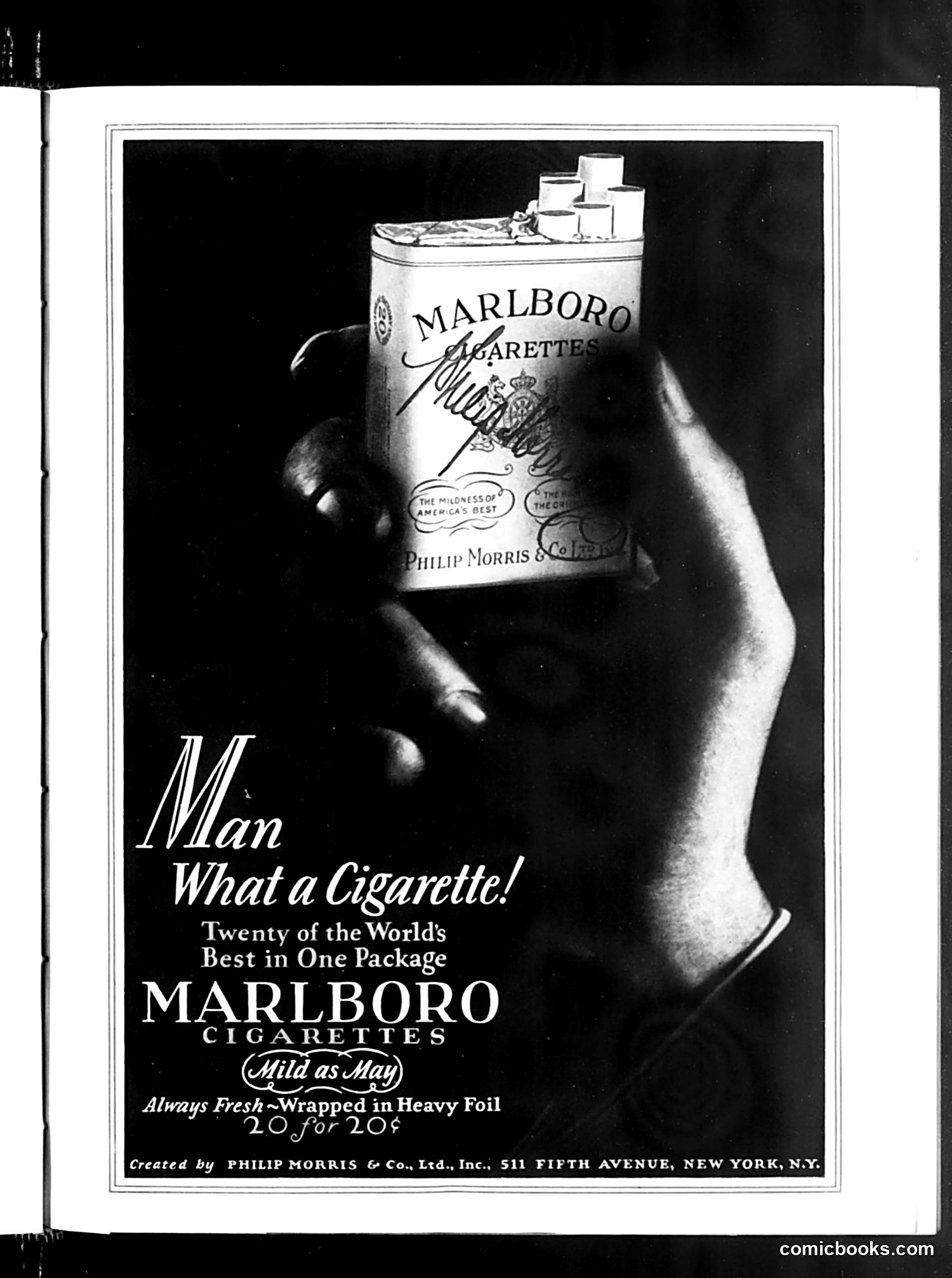
This is a cigarette advertisement, not political satire. It's a Marlboro ad from Philip Morris & Co., featuring a man's hands holding a cigarette package against a dark background. The ad emphasizes quality ("Twenty of the World's Best in One Package") and freshness ("Always Fresh~Wrapped in Heavy Foil"), pricing at 20 for 20 cents. The appeal is to masculine sophistication—note the elegant hand positioning and dramatic lighting typical of 1920s-30s luxury advertising. The tagline "Mild as May" and "Man What a Cigarette!" use casual, confident language to suggest social desirability. This represents pre-regulation tobacco marketing, when such ads appeared freely in mainstream publications without health warnings.
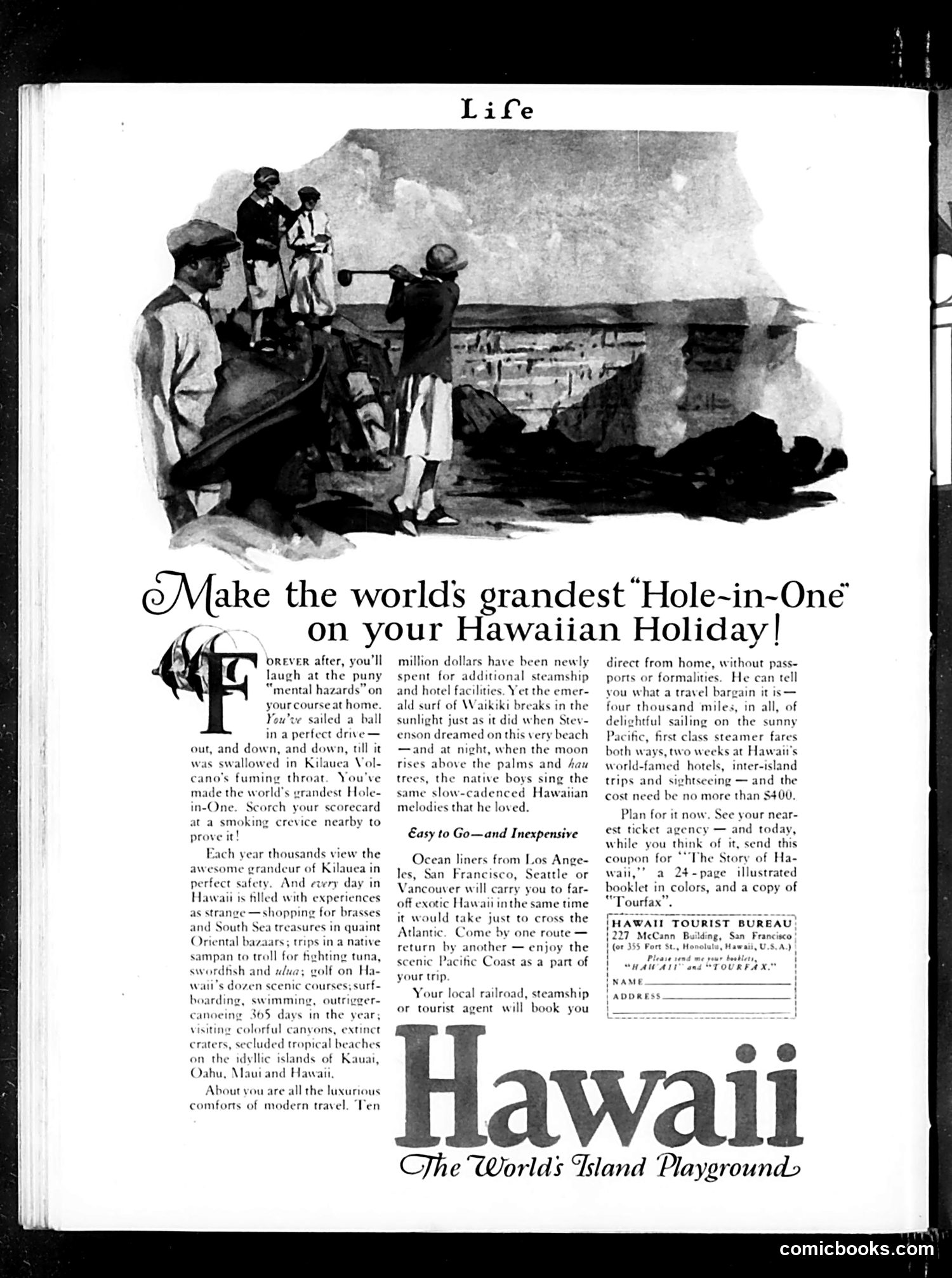
This is primarily a **travel advertisement** for Hawaii, not satire or political commentary. It promotes Hawaii as an exotic vacation destination to American readers. The illustration depicts tourists golfing at Kilauea volcano—the central conceit is a humorous exaggeration: a golfer's ball flies into the active volcano crater, creating "the world's grandest Hole-in-One." The joke plays on golf terminology for dark comedy effect. The ad emphasizes Hawaii's appeal: luxury steamship travel, modern hotel facilities, scenic activities (surfing, fishing, hiking), and affordability (around $400 for a two-week trip). It references Robert Louis Stevenson to add cultural prestige, and mentions "native boys" singing Hawaiian melodies, reflecting period attitudes toward indigenous culture as exotic entertainment. The text stresses accessibility and ease—no passports required, bookable through local agents—making the distant islands seem achievable for middle-class American travelers. This represents early 20th-century tourism promotion targeting leisure travelers with disposable income.