
Life, 1927-10-13 · page 25 of 44
Life — October 13, 1927 — page 25: what you’re looking at
What you’re looking at
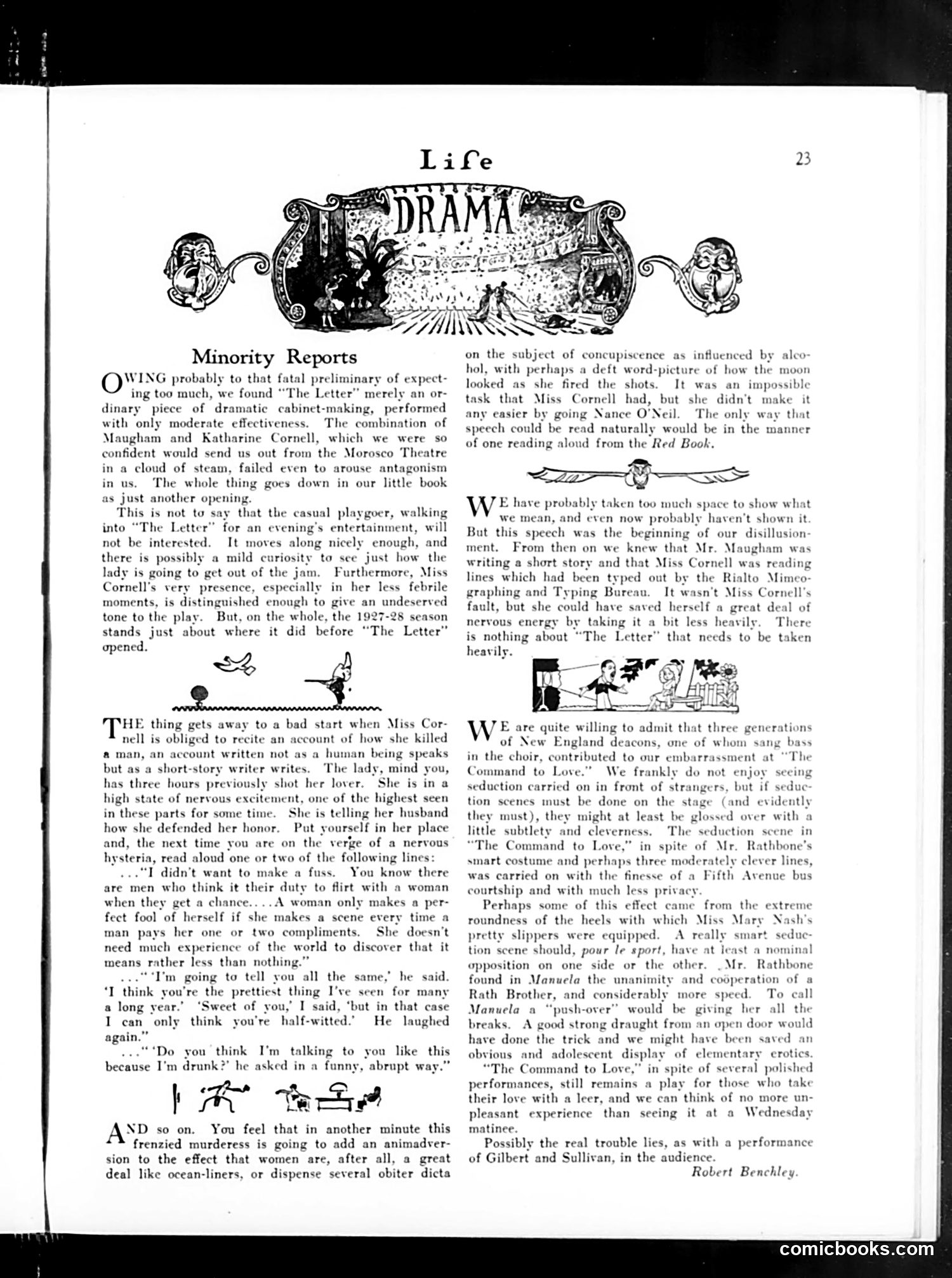
This page contains theatrical criticism of two Broadway plays: "The Letter" (starring Katharine Cornell, directed by Somerset Maugham) and "The Command to Love." **"The Letter" critique:** The reviewer faults Cornell's performance of a crucial monologue where her character explains killing her lover. The problem: she delivers literary, carefully-crafted dialogue as if reading from a magazine ("the Red Book"), rather than speaking naturally as a traumatized woman would. The quoted lines about making a fuss, compliments, and ocean-liners illustrate the reviewer's point—the dialogue feels artificially writerly rather than authentic human speech. **"The Command to Love" reference:** The critic admits personal prudishness (three generations of New England Puritan ancestors) affects his discomfort watching seduction scenes performed publicly. The overall tone is witty, self-aware theater criticism that values naturalistic performance over literary artifice.
📄 Transcribed text from this page (OCR, searchable)
Machine-transcribed from the original scan — historical spelling and the odd misread are preserved.
Minority Reports QW ING probably to that preliminary of expect- ing too much, we found “The Letter’ merely an or- dinary piece of dramatic cabinet-making, performed with only moderate effectiveness. The combination of Maugham and Katharine Cornell, which we were so confident would send us out from the Morosco Theatre in a cloud of steam, failed even to arouse antagonism in us. © whole thing goes down in our little book as just another opening. This is not to say that the casual playgoer, walking into “The Letter” for an evening's entertainment, will not be interested. It moves along nicely enough, and there is possibly a mild curiosity to see just how the lady is going to get out of the jam. Furthermore, Miss Cornell’s very presence, especially in her less febrile moments, is distinguished enough to give an undeserved tone to the play. But, on the whole, the 1927-28 season stands just about where it did before “The Letter” opened. = HE thing gets away to a bad start when Miss Cor- nell is obliged to recite an account of how she killed a man, an account written not as a human being speaks but as a short-story writer writes. The lady, mind you, has three hours previously shot her lover. She is in a high state of nervous excitement, one of the highest seen in these parts for some time. She is telling her husband how she defended her honor. Put yourself in her place and, the next time you are on the verge of a nervous hysteria, read aloud one or two of the following lines: wis didn’t want to make a fuss. You know there are men who think it their duty to flirt with a woman when they get a chance....A woman only makes a pe fect fool of herself if she makes a scene every time a man pays her one or two compliments. She doesn’t need much experience of the world to discover that it means rather less than nothing.” ... ‘I'm going to tell you all the e,’ he said ‘I think you're the prettiest thing I've seen for many a long year.’ ‘Sweet of you,’ I » ‘but in that case I can only think you're half-witted.’ He laughed ..."*Do you’ think I'm talking to you like this because I'm drunk?’ he asked in a funny, abrupt way.” | A eee ‘D so on. You feel that in another minute this frenzied murderess is going to add an animadver- sion to the effect that women are, after all, a great deal like ocean-liners, or dispense several obiter dicta on the subject of concupiscence as influenced by alco hol, with perhaps a deft word-picture of how the moon looked as she fired the shots. It was an impossible task that Miss Cornell had, but she didn't ake it any easier by going Nance O'Neil. The only way that speech could be read naturally would be in the manner of one reading aloud from the Red Book. W E have probably taken too much space to show wh we mean, and even now probably haven't shown it But this speech was the beginning of our disillusion ment. From then on we knew that Mr. Maugham was writing a short story and that Miss Cornell was reading lines which had been typed out by the Rialto Mimeo- graphing and Typing Bureau. It wasn't Miss Cornell's fault, but she could have saved herself a great deal of nervous energy by taking it a bit less heavily. There is nothing about “The Letter” that needs to be taken heavily. elec) W E are quite willing to admit that three generations of New England deacons, one whom sang bass in the choir, contributed to our embarrassment at “The Command to Love.” We frankly do not enjoy seeing seduction carried on in front of strangers, but if seduc tion scenes must be done on the st ind evidently they must), they might at least be d over with a le subtlety and cleverness. The seduction scene in he Command to Love,” in spite of Mr. Rathbone’s t costume and perhaps three moderately clever lines, yas carried on with the finesse of a Fifth Avenue bus courtship and with much less privacy Perhaps some of this effect came from the extreme roundness of the heels with which Miss Mary Nash's pretty slippers were equipped. A really smart seduc tion scene should, pour le sport, have at least a nominal opposition on one side or the other. .Mr. Rathbone found in Manuela the unanimity and codperation of a Rath Brother, and considerably more speed » call Manuela a “‘push-over” would be giving her all the breaks. A good strong draught from an open door would have done the trick and we might have been saved an obvious and adolescent display of elementary erotics “The Command to Love,” in spite of several polished performances, still remains a play for those who take their love with a leer, and we can think of no more un- pleasant experience than seeing it at a Wednesday matinee Possibly the real trouble lies, as with a performance of Gilbert and Sullivan, in the audience. Robert Benchley comicbooks.com