
Life, 1927-10-13 · page 20 of 44
Life — October 13, 1927 — page 20: what you’re looking at
What you’re looking at
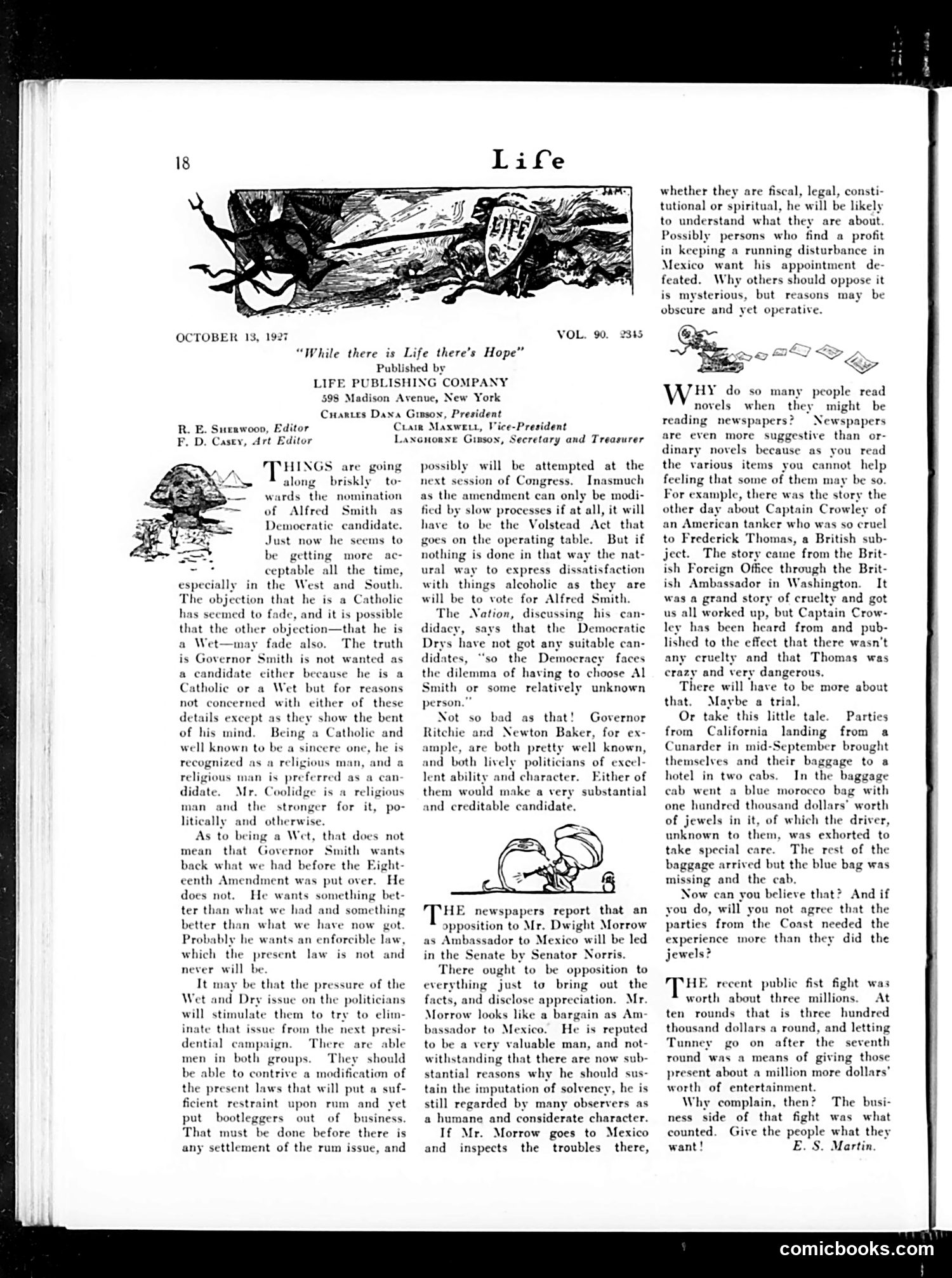
This page contains editorial commentary on 1927 American politics, primarily discussing Alfred Smith's emerging candidacy for the Democratic presidential nomination. **Main Topics:** 1. **Alfred Smith for President**: The editor argues Smith's Catholicism and "Wet" stance (opposing Prohibition) are becoming less objectionable. He suggests Smith wants enforceable alcohol regulation, not repeal of the Eighteenth Amendment. 2. **Prohibition Debate**: The piece advocates for modifying the Volstead Act to balance temperance with eliminating bootlegging—a pragmatic middle ground. 3. **Dwight Morrow as Ambassador to Mexico**: The editor supports Morrow's appointment, suggesting opposition may come from those profiting from Mexico's instability. The editorial tone is moderate and analytical rather than satirical. The small cartoons appear decorative rather than topical. This reflects Life's role as a serious (if witty) commentary magazine on contemporary politics, not primarily a humor publication by modern standards.
📄 Transcribed text from this page (OCR, searchable)
Machine-transcribed from the original scan — historical spelling and the odd misread are preserved.
OCTOBER 13, 1927 “While there is Life there’s Hope” Published by LIFE PUBLISHING COMPANY 598 Madison Avenue, New York Crartes Dana Ginson, President R. E. Surawoon, Editor F. D. Casey, drt Editor HINGS are going briskly to- wards the nomination of Alfred Smith as Democratic candidate. Just now he seems to be getting more ac- ceptable all the time, especially in the West and South. The objection that he is a Catholic has seemed to fade, and it is possible that the other objection—that he is a Wet—may fade also. The truth is Governor Smith is not wanted as a candidate either because he is a Catholic or a Wet but not concerned along for reasons with either of these details except as they show the bent of his mind. Being a Catholic and well known to be a sincere one, he is recognized as a religious man, and a religious man is preferred as a can didate. Mr. Coolidge is man and the stronger for it, litically and otherwise. As to being a Wet, that does not mean that Governor Smith wants back what we had before the Eight- eenth Amendment was put over. He does not. He wants something bet- ter than what we had and something better than what we have now got. Probably he wants an enforcible law, which the present law is not and never will be. It may be that the pressure of the Wet and Dry issue on the politicians will stimulate them to try to elim- inate that issue from the next presi- dential campaign. There are able men in both groups. They should be able to contrive a modification of the present laws that will put a suf- ficient restraint upon rum and yet put bootleggers out of business. That must be done before there is any settlement of the rum issue, and a reli Cuair Maxwett, Vice-President Laxonorxe Ginsox, Secretary and Treasurer possibly will be attempted at the next session of Congress. Inasmuch as the amendment can only be modi- fied by slow processes if at all, it will have to be the Volstead Act that goes on the operating table. But if nothing is done in that way the nat- ural way to express dissatisfaction with things alcoholic as they are will be to vote for Alfred Smith. The Nation, discussing his can- didacy, says that the Democratic Drys have not got any suitable can- didates, “‘so the Democracy faces the dilemma of having to choose Al Smith or some relatively unknown person.” Not so bad as that! Governor Ritchie and Newton Baker, for ex- ample, are both pretty well known, and both lively politicians of excel- lent ability and chara Either of them would make a very substantial and creditable candidate. HE newspapers report that an opposition to Mr. Dwight Morrow as Ambassador to Mexico will be led in the ate by Senator Norris. There ought to be opposition to everything just to bring out the facts, and disclose appreciation. Mr Morrow looks like a bargain as Am bassador to Mexico. He is reputed to be a very valuable man, and not- withstanding that there are now sub- stantial reasons why he should sus- tain the imputation of solvency, he is still regarded by many observers as a humane and considerate character. If Mr. Morrow goes to Mexico and inspects the troubles there, whether they are fiscal, legal, consti- tutional or spiritual, he will be likely to understand what they are about. Possibly persons who find a profit in keeping a running disturbance in Mexico want his appointment de- feated. Why others should oppose it is mysterious, but reasons may be obscure and yet operative. V HY do so many people read novels when they might be reading newspaper wspapers are even more suggestive than or- dinary novels because as you read the various items you cannot help feeling that some of them may be so. For example, there was the story the other day about Captain Crowley of an American tanker who was so cruel to Frederick Thomas, a British sub- ij The story came from the Brit- ish Foreign Office through the Brit- ish Ambassador in Washington. It was a grand story of cruelty and got us all worked up, but Captain Crow- rd from and pub- lished to the effect that there wasn't any cruelty and that Thomas was crazy and very dangerous. There will have to be more about that. Maybe a trial, Or take this little tale. Parties from California landing from a Cunarder in mid-September brought themselves and their baggage to a hotel in two cabs. In the baggage cab went a blue morocco bag with one hundred thousand dollars’ worth of jewels in it, of which the driver, unknown to them, was exhorted to take special care. The rest of the baggage arrived but the blue bag was missing and the cab. Now can you believe that? And if you do, will you not agree that the parties from the Coast needed the experience more than they did the jewels? THE recent public fist fight was worth about three millions. At ten rounds that is three hundred thousand dollars a round, and letting Tunney go on after the seventh round was a means of giving those present about a million more dollars’ worth of entertainment. Why complain, then? The busi- ness side of that fight was what counted. Give the people what they want! E. S. Martin. comicbooks.com