
Life, 1927-10-13 · page 28 of 44
Life — October 13, 1927 — page 28: what you’re looking at
What you’re looking at
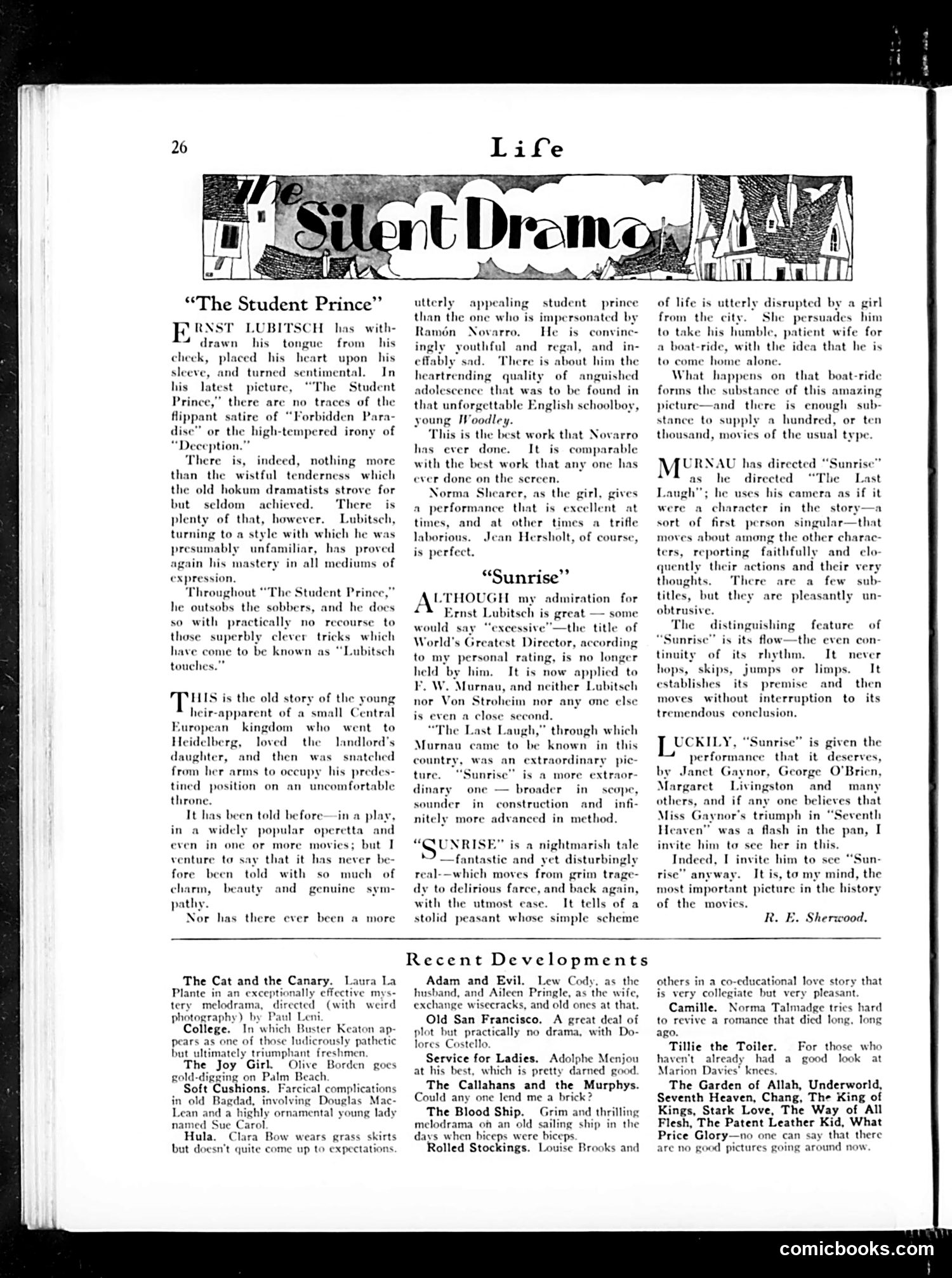
This page contains two film reviews without political satire—it's purely entertainment criticism from Life's arts section. **"The Student Prince"** review praises director Ernst Lubitsch's sentimental turn away from his typical satirical style. The film adapts a familiar European operetta plot about a young heir who falls in love at Heidelberg University. The critic highlights performances by Ramón Novarro (as the prince) and Norma Shearer, calling Novarro's work "the best work that any one has ever done on the screen." **"Sunrise"** review elevates director F.W. Murnau above Lubitsch, crediting him as the era's greatest director. The film tells of a peasant seduced by a city woman into abandoning his wife. The critic praises Murnau's innovative camera work and the film's rhythmic flow, calling it "extraordinary" in scope and construction. The page also lists recent film releases in a section titled "Recent Developments."
📄 Transcribed text from this page (OCR, searchable)
Machine-transcribed from the original scan — historical spelling and the odd misread are preserved.
“The Student Prince” GRNST LUBITSCH has. with- 4 drawn his tongue from his cheek, placed his heart upon his sleeve, and turned sentimental. In his latest picture, he Student Prince,” there are no traces of the flippant satire of “Forbidden Para- dise” or the high-tempered irony of “Deception.” There is, indeed, nothing more than the wistful tenderness which the old hokum dramatists strove for but seldom achieved. There is plenty of that, however. Lubitsch, turning to a style with which he was presumably unfamiliar, has proved sain his mastery in all mediums of pression. Throughout “The Student Prince,” he outsobs the sobbers, and he does so with practically no recourse to those superbly clever tricks which have come to be known as “Lubitsch touches.” HIS is the old story of the young heir-apparent of a small Central European kingdom who went to Heidelberg, loved the landlord's daughter, and then snatched from her arms to occupy his predes- tined position on an uncomfortable throne. It has been told before—in a play, in a widely popular operetta and even in one or more movies; but I venture ta say that it has never be- fore been told with so much of auty and genuine was sym- Nor has there ever been a more utterly appealing student than the one who is impersonated by Ramén Novarro. He is convine- ingly youthful and regal, and in- effably sad. There is about him the heartrending quality of anguished that was to be found in that unforgettable English schoolboy, young Woodley. This is the best work that Novarro has ever done. It is comparable with the best work that any one has ever done on the sereen. Norma Shearer, as the girl, gives a performance that is excellent: at and at other times a trifle Jean Hersholt, of course, prince adolescence times, laborious. is perfect. “Sunrise” LTHOUGH my admiration for Ernst Lubitsch is great would say “excessive”—the title of World's Greatest Director, according to my personal rating, is no longer held by him. It is now applied to PF. W. Murnau, and neither Lubitsch nor Von Stroh is even a close se 1 The Last Laugh,” through which Murnau came to be known in this country, was an extraordinary pic- ture. “Sunrise > extraor dinary one — broader in scope, construction and infi- ced in method. - some mm nor any one else is a mo sounder in nitely more advs and yet disturbingly es from grim trag dy to delirious farce, and back a with the utmost e It tells of a stolid peasant whose simple scheme of life is utterly disrupted by a girl from the city. She persuades him to take his humble, patient wife for with the idea that he is to come home alone. What happens on that boat-ride forms the substance of this amazing picture—and there is enough sub- stance to supply a hundred, or ten thousand, movies of the usual type. a boat-ride. N URNAU has directed “Sunrise” - directed “The Last Laugh”; he uses his camera as if it were a character in the story—a sort of first person. singular—that moves about among the other charac- ters, reporting faithfully and quently their actions and their very thoughts. There are a few sub- titles, but they are pleasantly un- obtrusive. The distinguishing feature of “Sunrise” is its flow—the even con- tinuity of its rhythm. It never hops, skips, jumps or limps. — It establishes its premise and_ then moves without interruption to its tremendous conclusion, UCKILY, “Sunrise” is given the performance that it deserves, by Janet ¢ orge O'Brien, Margaret Livingston and many others, and if any one believes that nor’s triumph in “Seventh was a flash in the pan, I invite him to see her in this. Indeed, I invite him to see ‘“Sun- rise” anyway. It is, to my mind, the most important picture in the history of the movies. Heaven R. E. Sherwood. The Cat and the Canary. Laura La Plante in an exceptionally effective mys- tery melodrama, directed (with weird photography) by Paul Leni College. In which Buster Keaton ap- pears as one of those ludicrously pathetic but ultimately triumphant freshmen The Joy Girl. Olive Borden gold-digging on Palm Beach. Soft Cushions, Farcical complications in old Bagdad, involving Douglas Mac- Lean and a highly ornamental young lady named Sue Care Hula. Clara Bow wears grass skirts but doesn’t quite come up to expectations. goes Recent Developments Adam and Evil. Lew Cody, as the husband, and Aileen Pringle, as the wife, exchange wisecracks, and old ones at t! Old San Francisco. A great deal of plot but practically no drama, with Do- lores Costello. Service for Ladies. Adolphe Menjou at his best, which is pretty darned good. The Callahans and the Murphys. Could any one lend me a brick? The Blood Ship. Grim and thrillir melodrama oh an old sailing ship in the days when biceps were biceps Rolled Stockings. Louise Brooks and others in a co-educational love story that is very collegiate but very pleasant. Camille. Norma Talmadge tries hard to revive a romance that died long, long ago. Tillie the Toiler. haven't already had Marion Davies’ knees. The Garden of Allah, Underworld, Seventh Heaven, Chang, The King of Kings, Stark Love, The Way of All Flesh, The Patent Leather Kid, What Price Glory. ome can say that there are no good pictures going around now For those who a good look at comicbooks.com i