
A complete issue · 46 pages · 1927
Life — June 2, 1927
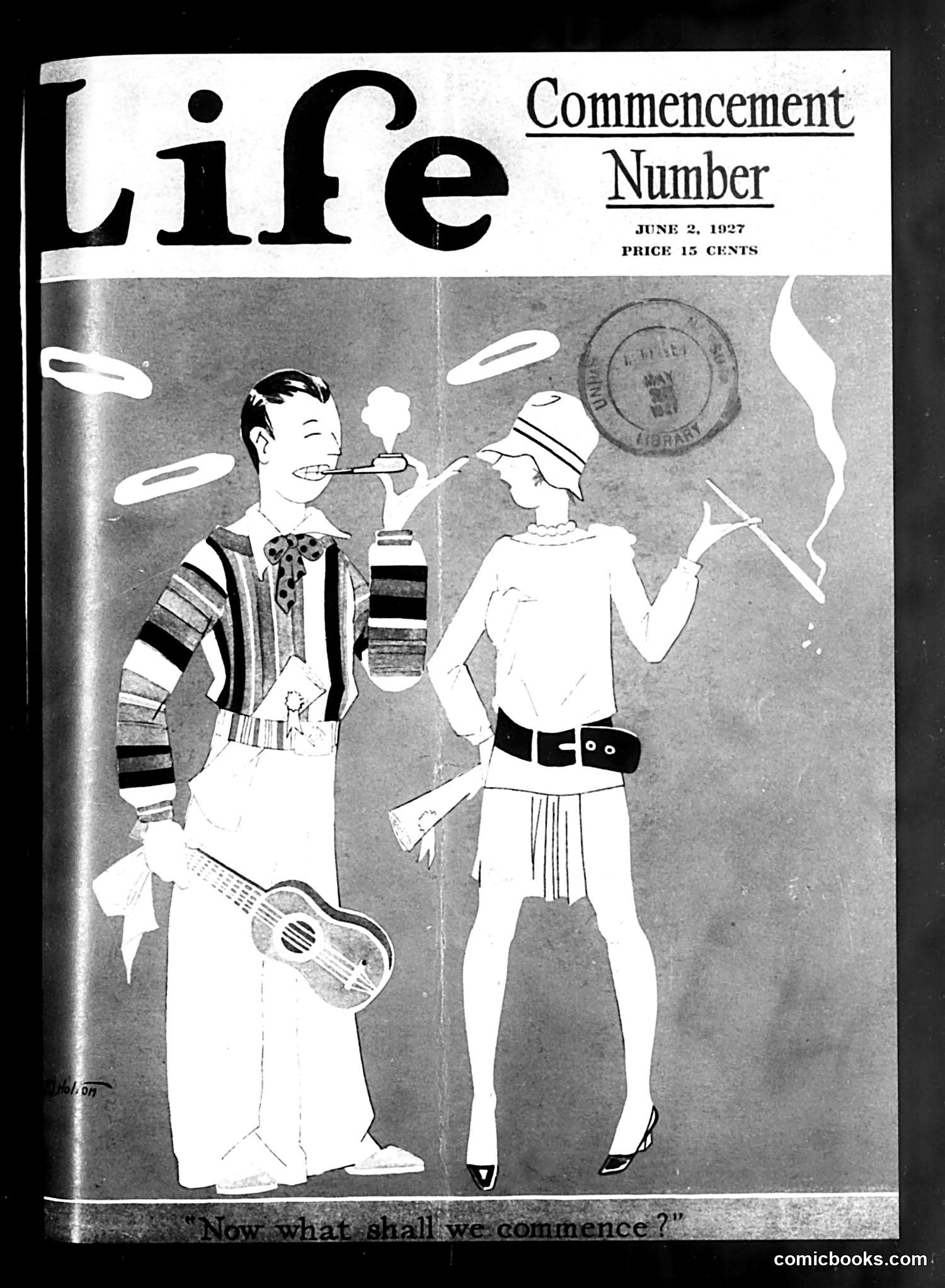
This is a satirical cover for Life's "Commencement Number" featuring two stylishly dressed young people in 1930s fashion. The figure on the left holds a guitar and wears a patterned jacket; the figure on the right wears a white outfit with a hat and holds a cigarette holder, striking a casual pose. The caption reads: "Now what shall we commence?" The satire targets recent college graduates facing an uncertain future during the Great Depression. Rather than pursuing traditional career paths, the illustration suggests young people were turning to entertainment, leisure, and frivolous pursuits. The "commencement" joke plays on the gap between graduation's supposed promise and the grim economic reality awaiting new graduates in 1937.
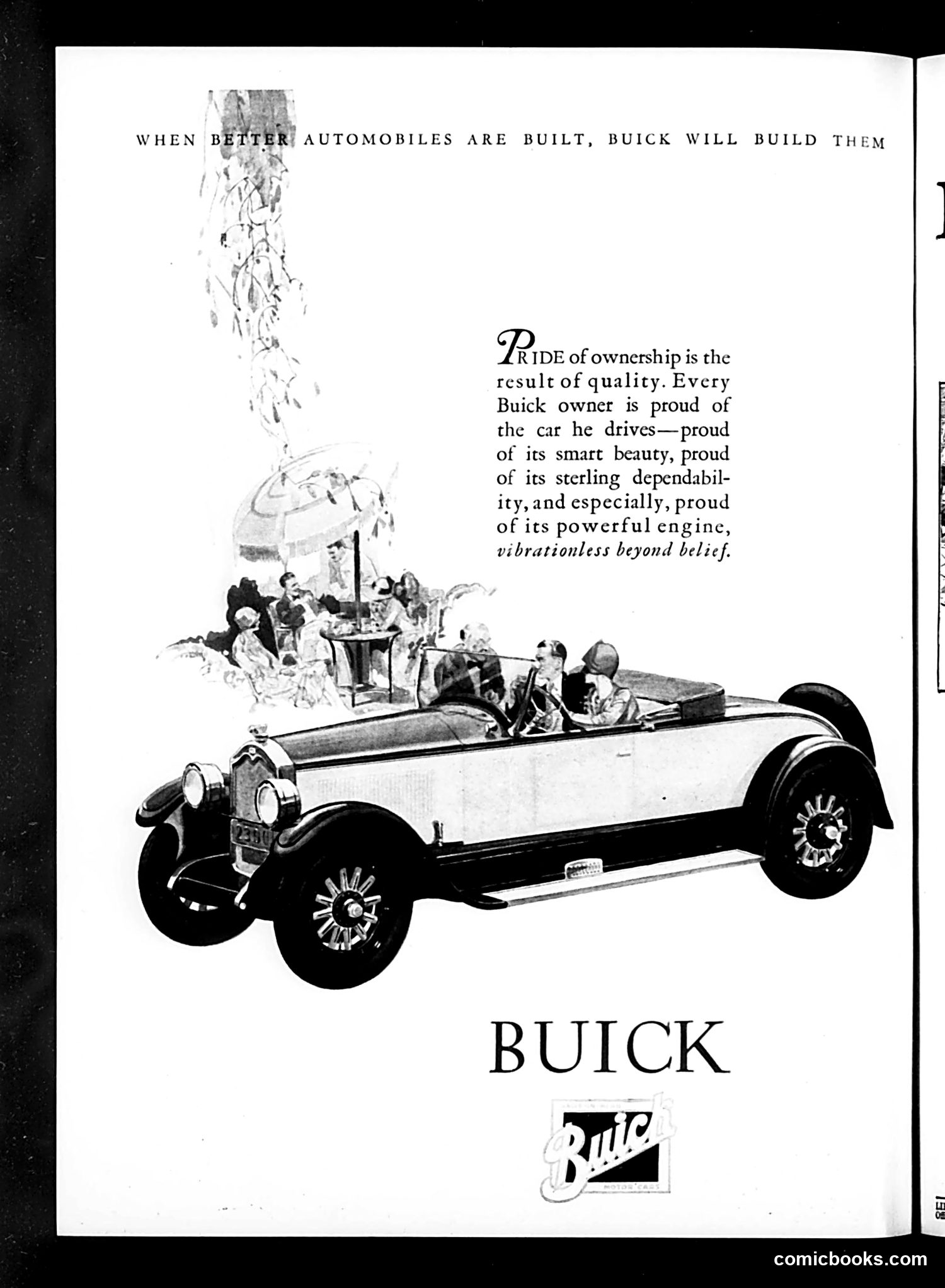
This is a **Buick automobile advertisement**, not political satire or a cartoon. The page features the famous Buick slogan "When Better Automobiles Are Built, Buick Will Build Them" at top, accompanied by an illustration of a 1920s-era open-air touring car filled with well-dressed passengers. The advertisement's text emphasizes owner pride in the vehicle's "smart beauty," "sterling dependability," and notably, its engine described as "vibrationless beyond belief"—a key selling point for automobiles of that era. The image shows passengers enjoying leisure travel, suggesting status and modern sophistication. There is no political message or satire present; this is straightforward commercial marketing typical of Life magazine's advertising content during the 1920s.
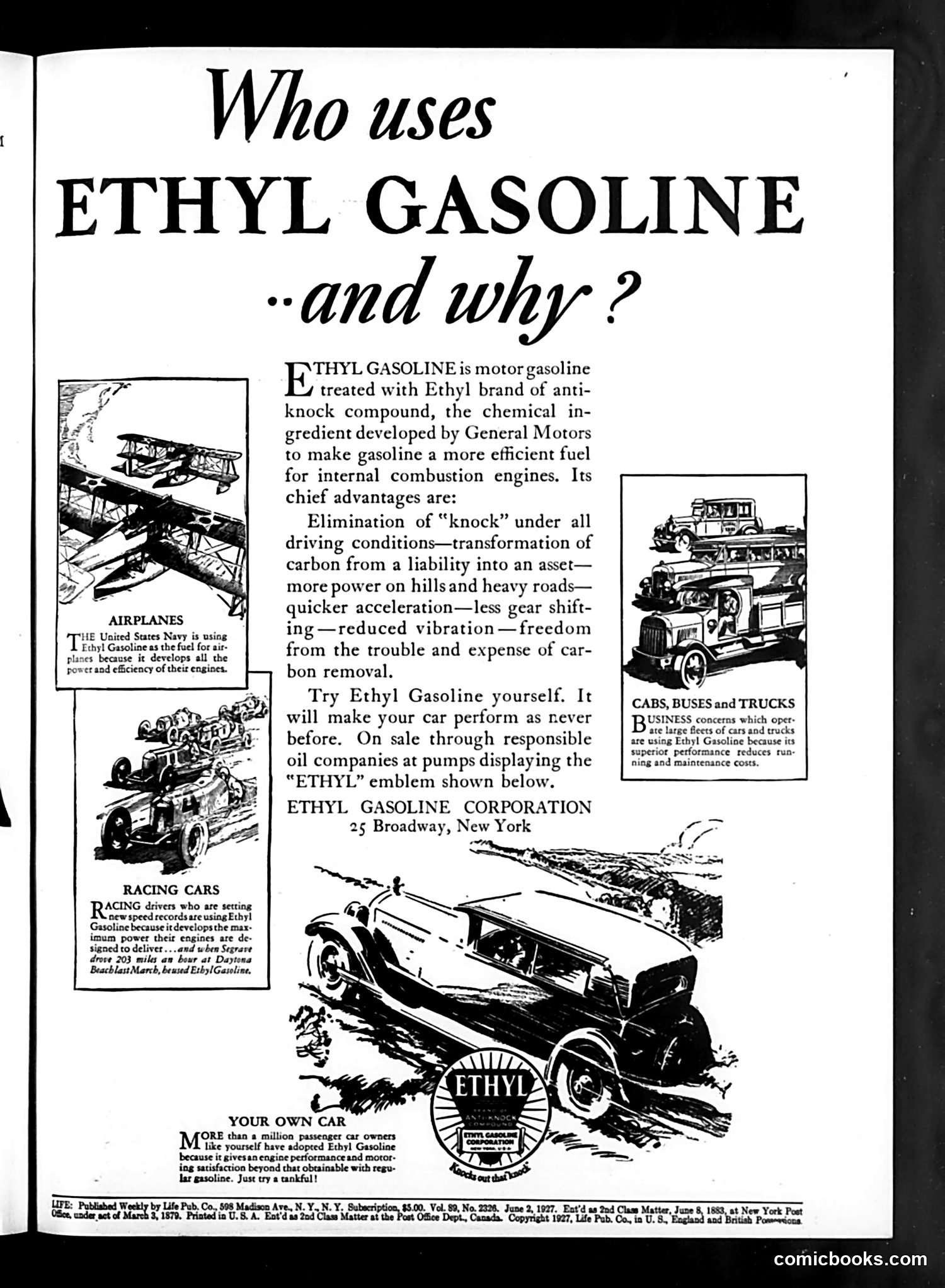
This is **not satire or political commentary** — it's a straightforward 1920s advertisement for Ethyl Gasoline, a motor fuel additive developed by General Motors. The page uses four illustrated sections showing different vehicle users: airplanes, racing cars, commercial trucks/buses, and passenger cars. Each testimonial claims Ethyl Gasoline improves performance by eliminating engine "knock" (pre-ignition), increasing power, and reducing maintenance costs. The Ethyl Corporation (25 Broadway, New York) positioned this as a premium fuel sold through participating oil companies. The messaging targets both professional operators and individual consumers by emphasizing efficiency gains and reliability. This represents early automotive marketing strategy, not editorial commentary.
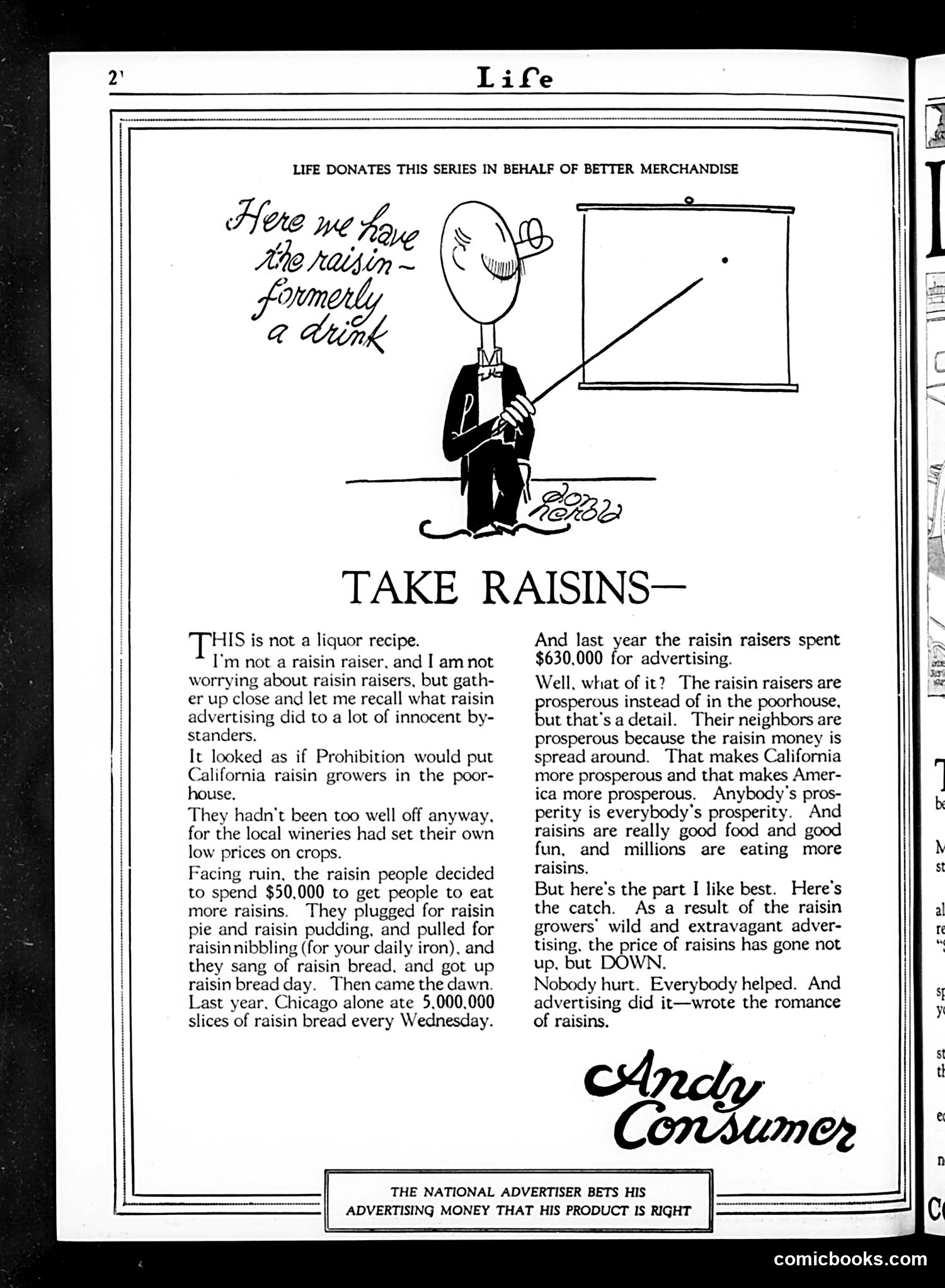
This is an advertisement for raisins disguised as social commentary. The cartoon shows a presenter pointing to a blank board, introducing the topic "Take Raisins." The text satirizes Prohibition-era marketing by California raisin growers. During Prohibition (when alcohol was banned), the raisin industry spent $50,000 advertising raisins as food, including promoting "raisin nibbling for your daily iron" and raisin bread consumption. The satire's point: the advertising campaign succeeded economically—raisin prices dropped despite massive promotion because supply exceeded demand. The author finds this amusing: the industry spent heavily to boost sales but inadvertently proved that aggressive advertising alone cannot overcome market fundamentals. Prosperity came to the region anyway, suggesting advertising's limited power. This is ultimately an advertisement betting "his product is right" through reasoned argument rather than hype.
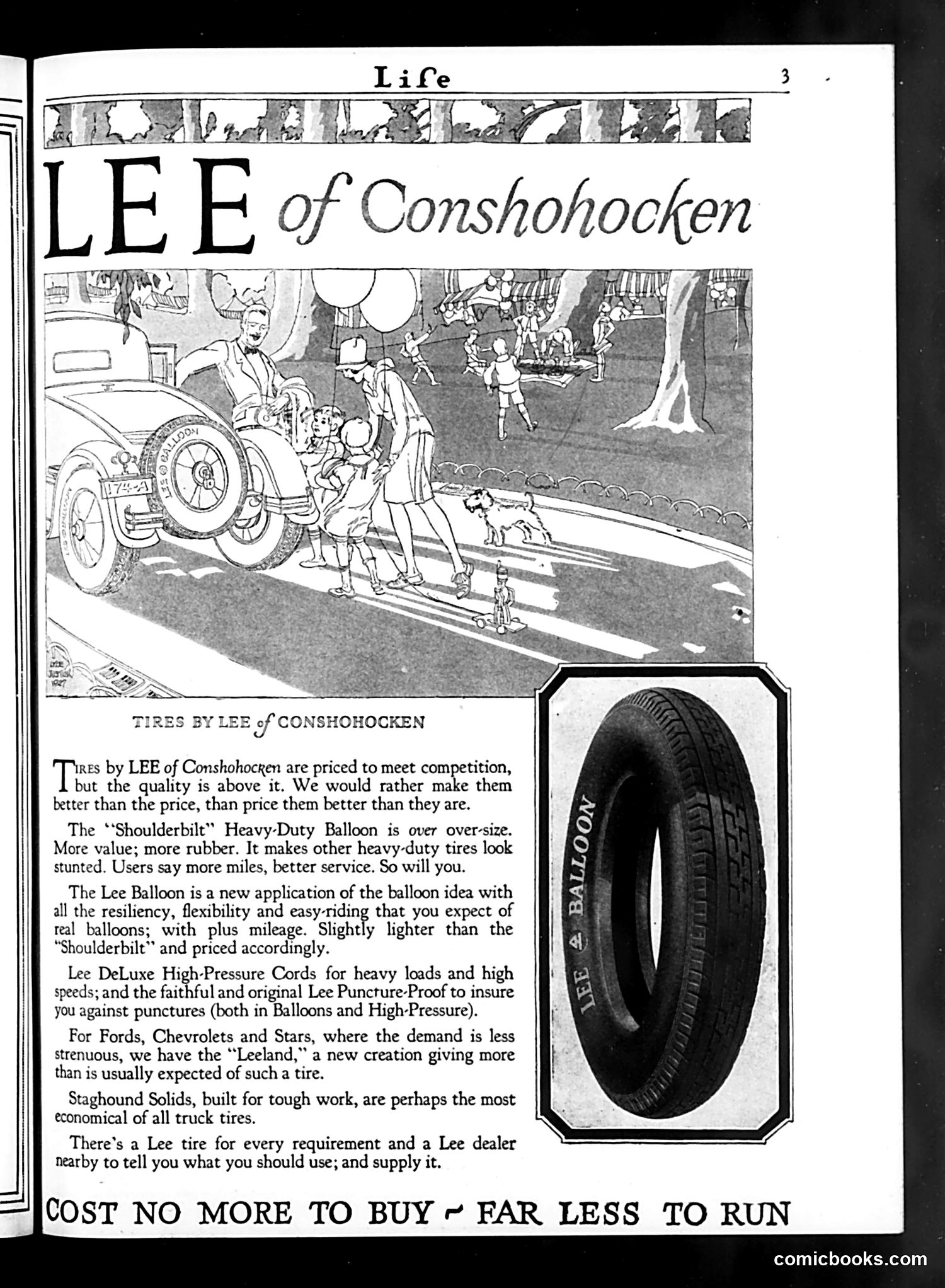
This page is primarily **advertising, not satire or political content**. It's a commercial advertisement for Lee tires, published in Life magazine. The illustration depicts a leisurely suburban scene—a well-dressed family with a car and children playing nearby—designed to associate Lee tires with comfortable, safe family life. The advertisement emphasizes practical selling points: durability ("over over-size"), value, and variety (different tire types for different vehicles: Fords, Chevrolets, Stars). The tagline "Cost No More to Buy – Far Less to Run" appeals to middle-class consumers concerned with both affordability and long-term economy. This represents early 20th-century automotive marketing targeting expanding car ownership among ordinary Americans.
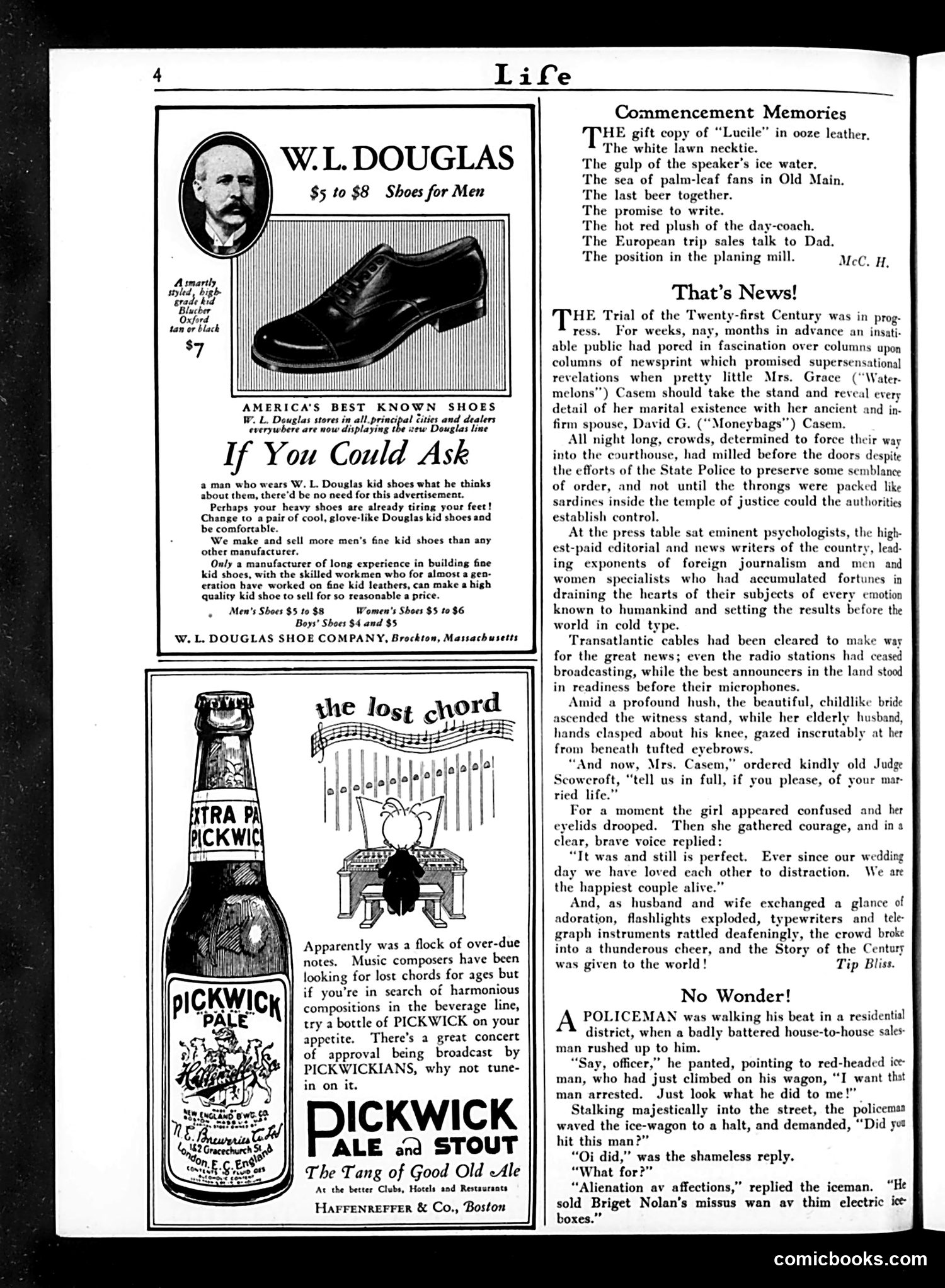
This page is primarily **advertising and light satirical content** rather than political commentary. The top advertisement features **W.L. Douglas shoes** ($5-$8), presenting the manufacturer as a man of experience and quality. The pitch emphasizes affordability without sacrificing craftsmanship. Below, a Pickwick Pale Ale advertisement includes "The Lost Chord" cartoon—a visual pun showing a figure at a piano with musical notes floating upward. The joke plays on the beer's appeal: apparently composers searching for harmonious compositions should try Pickwick Ale to inspire creativity. The tagline calls it "The Tang of Good Old Ale." The right column contains two brief humorous stories ("That's News!" and "No Wonder!") about everyday domestic and police matters, typical of Life's light satirical humor aimed at middle-class readers.
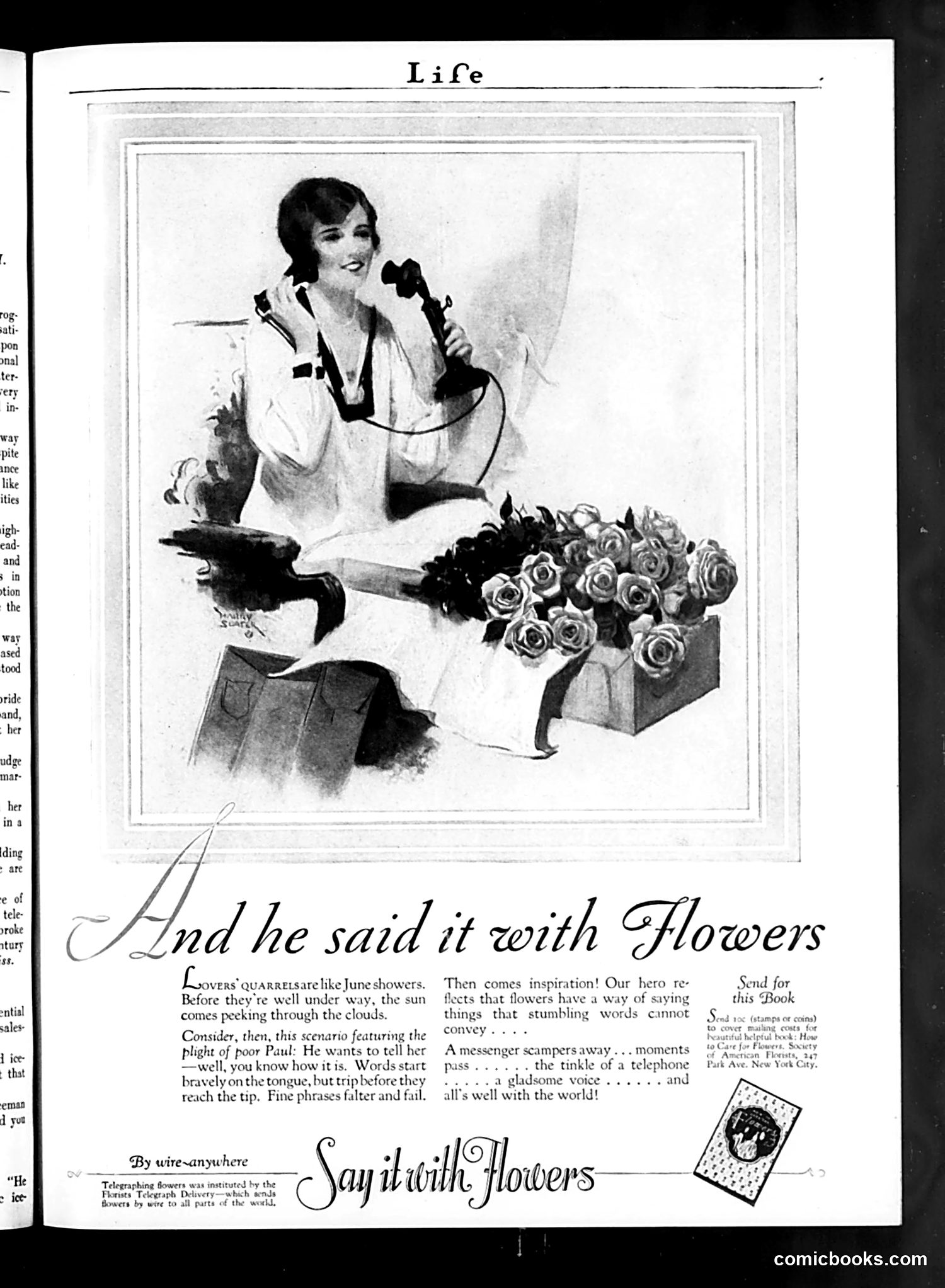
This is primarily **advertising content**, not political satire. The page features a romanticized illustration of a woman on a telephone, surrounded by roses, promoting "Saybrook Flowers" delivery service. The ad copy uses the sentimental framing "And he said it with flowers"—a common early 20th-century marketing phrase emphasizing flowers as a romantic gesture. The text describes flowers as superior to words for expressing emotion, positioning the florist service as enabling romance across distance via telephone ordering ("by wire-anywhere"). The small print indicates this is from the Florists' Telegraph Delivery service, which coordinated nationwide flower delivery. This represents early consumer advertising targeting affluent readers, blending romance, technology (telephones), and commercial convenience—typical of *Life* magazine's advertising strategies in this era.
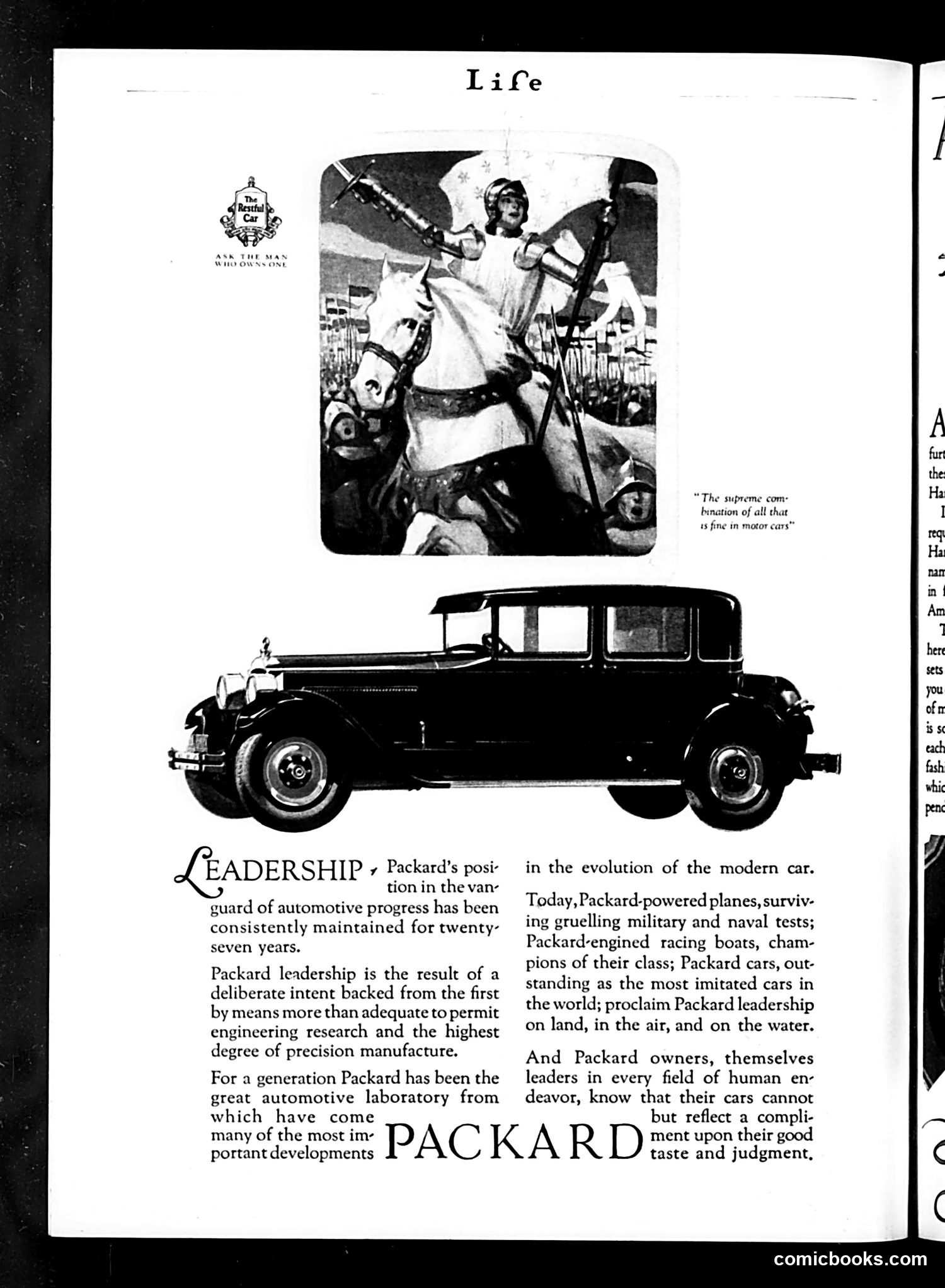
This page is primarily **Packard automobile advertising**, not satire or political commentary. The top image shows a medieval knight on horseback, wielding a sword and lance—a historical reference establishing Packard's "leadership" as longstanding and authoritative. Below is a 1920s-era Packard sedan. The text argues that Packard has maintained automotive market leadership for 27 years through deliberate engineering excellence and precision manufacturing. It claims Packard engines power successful racing vehicles, military planes, and boats, positioning the brand as a symbol of quality and good taste. The "leadership" metaphor compares Packard's market dominance to a knight's commanding position. The ad targets affluent buyers who equate car ownership with personal status and refined judgment—a common luxury marketing approach of the era.
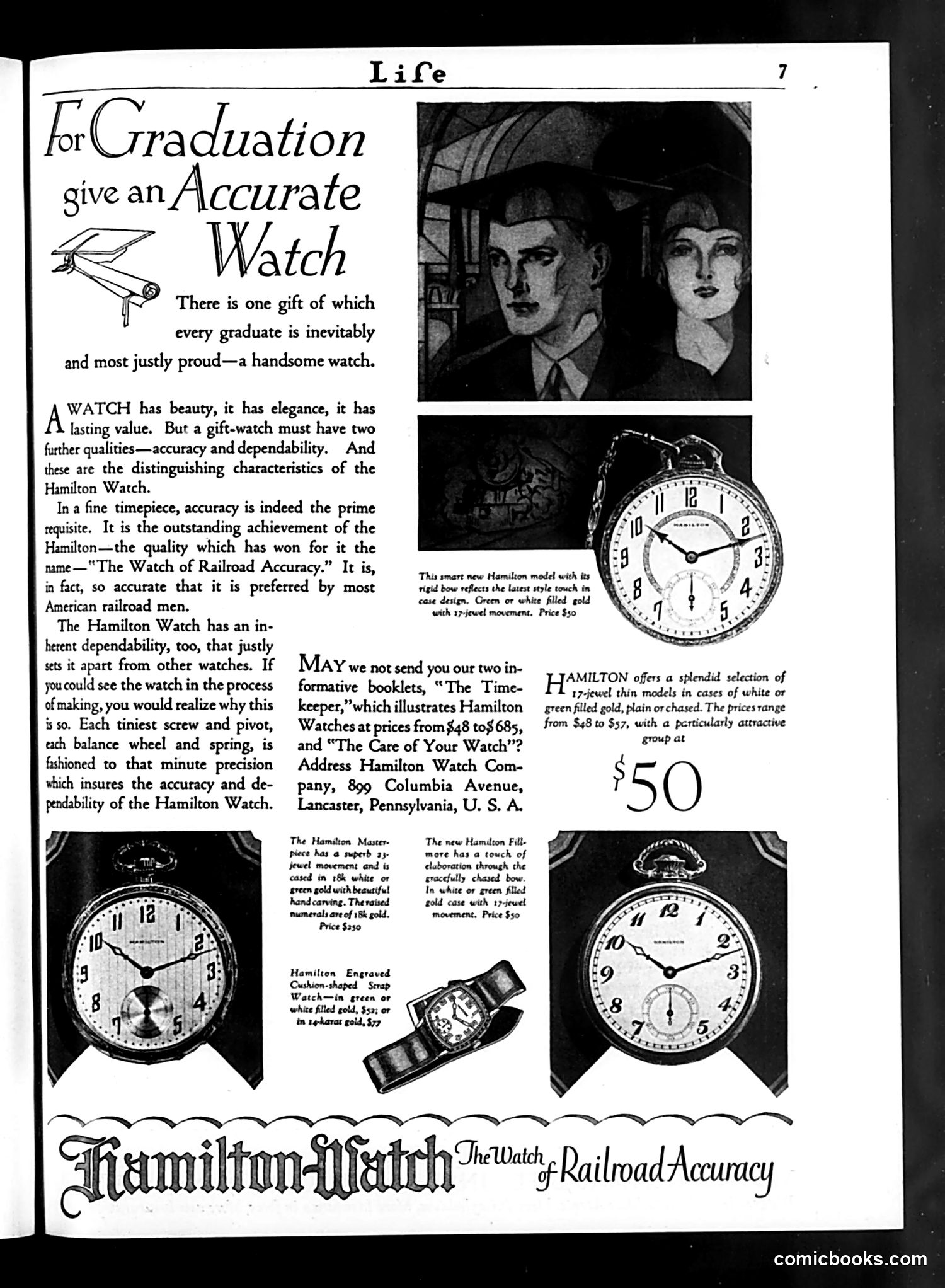
This page is primarily an advertisement for Hamilton Watches, not satirical content. The ad promotes watches as graduation gifts, emphasizing Hamilton's reputation for accuracy—specifically their "Railroad Accuracy" standard. The upper portion features a photograph of what appears to be a young man and woman, likely representing typical graduates or gift-givers of the era. Below are various Hamilton watch models with prices ranging from $48 to $75. The advertisement's appeal centers on precision and dependability as markers of quality suitable for marking life milestones. The "Railroad Accuracy" branding reflects early 20th-century American values associating mechanical precision with reliability and prestige. This is straightforward commercial messaging rather than satire or political commentary.
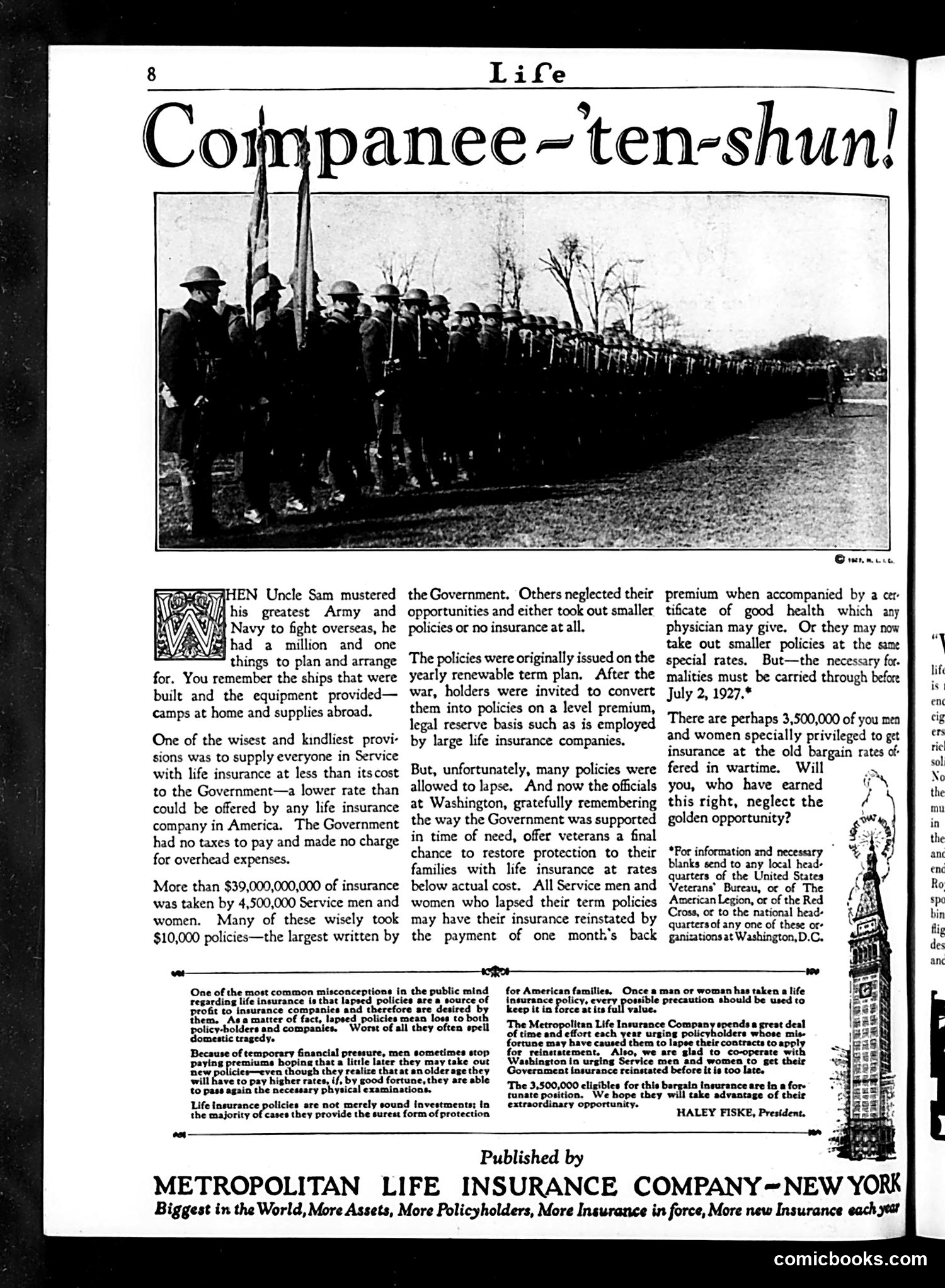
This is primarily a **Metropolitan Life Insurance Company advertisement**, not political satire. The image shows soldiers in military formation, likely from World War I era based on the uniforms and bare trees suggesting a military camp. The headline plays on "compensation"—the text discusses how Uncle Sam provided life insurance to servicemen during the war. The satire is subtle: the ad argues that many soldiers allowed their government-issued policies to lapse after the war, and now face exclusion from reinstatement. The piece appeals to veterans' patriotism and financial responsibility, suggesting they're missing a "golden opportunity" to restore coverage. It's essentially a recruitment pitch disguised as civic-minded advice, targeting the 3.5 million eligible service members.
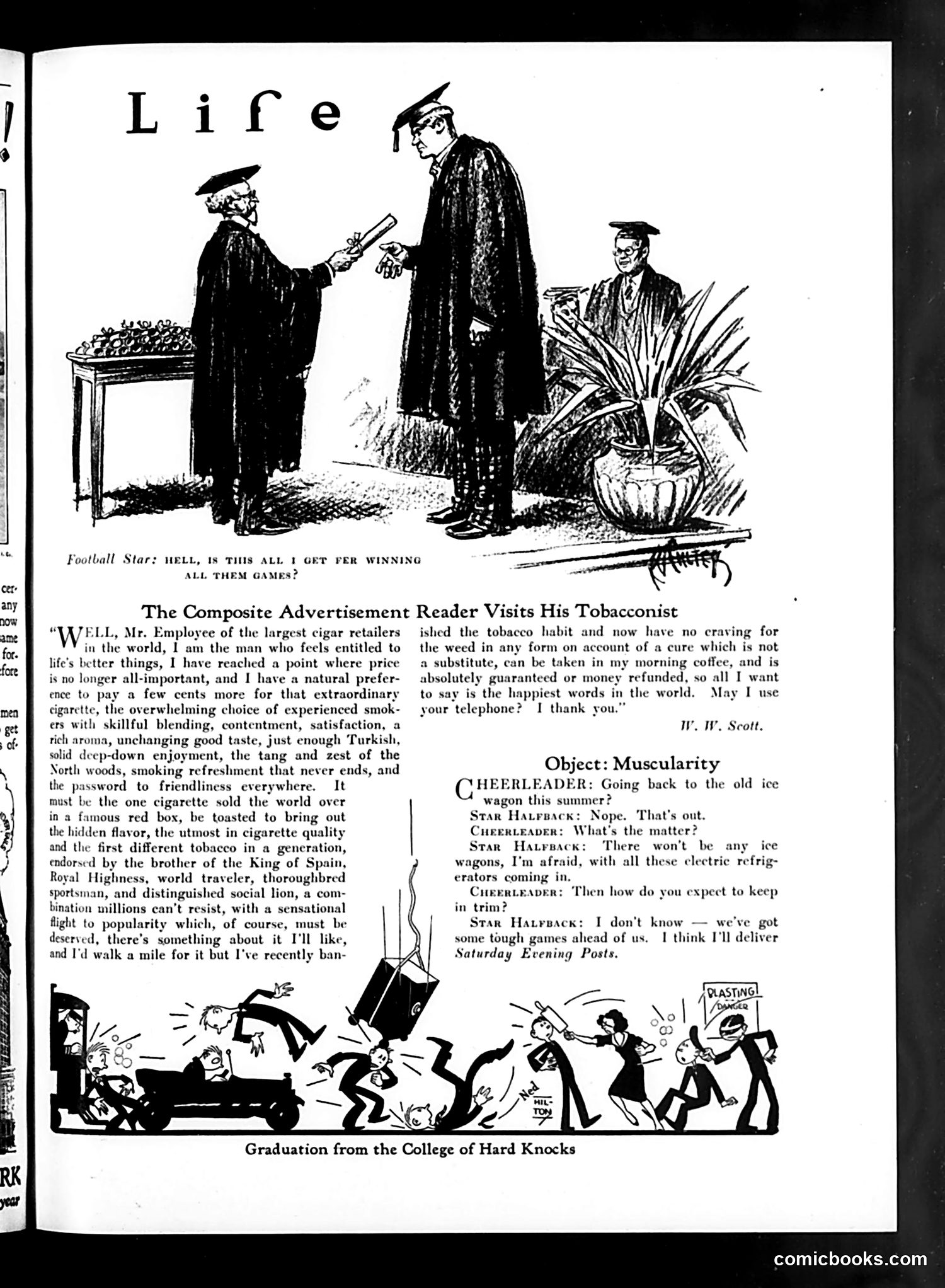
This page combines satire with advertising. The top cartoon mocks a football star's modest winnings—he receives only flowers and a potted plant after winning "all them games," satirizing how college athletes (despite their fame) received minimal material rewards. The main section is a **composite advertisement** for Turkish tobacco, written as if a cigar retailer is endorsing the product's superiority. It humorously positions the advertiser as an "employee" who feels entitled to speak frankly about quality. The bottom cartoon, "Graduation from the College of Hard Knocks," depicts chaotic slapstick violence—people being knocked around—as a visual pun on the phrase's meaning: life's tough lessons learned through hardship rather than formal education. The page reflects early 20th-century American humor styles mixing commentary on athletics, consumer goods, and working-class wisdom.
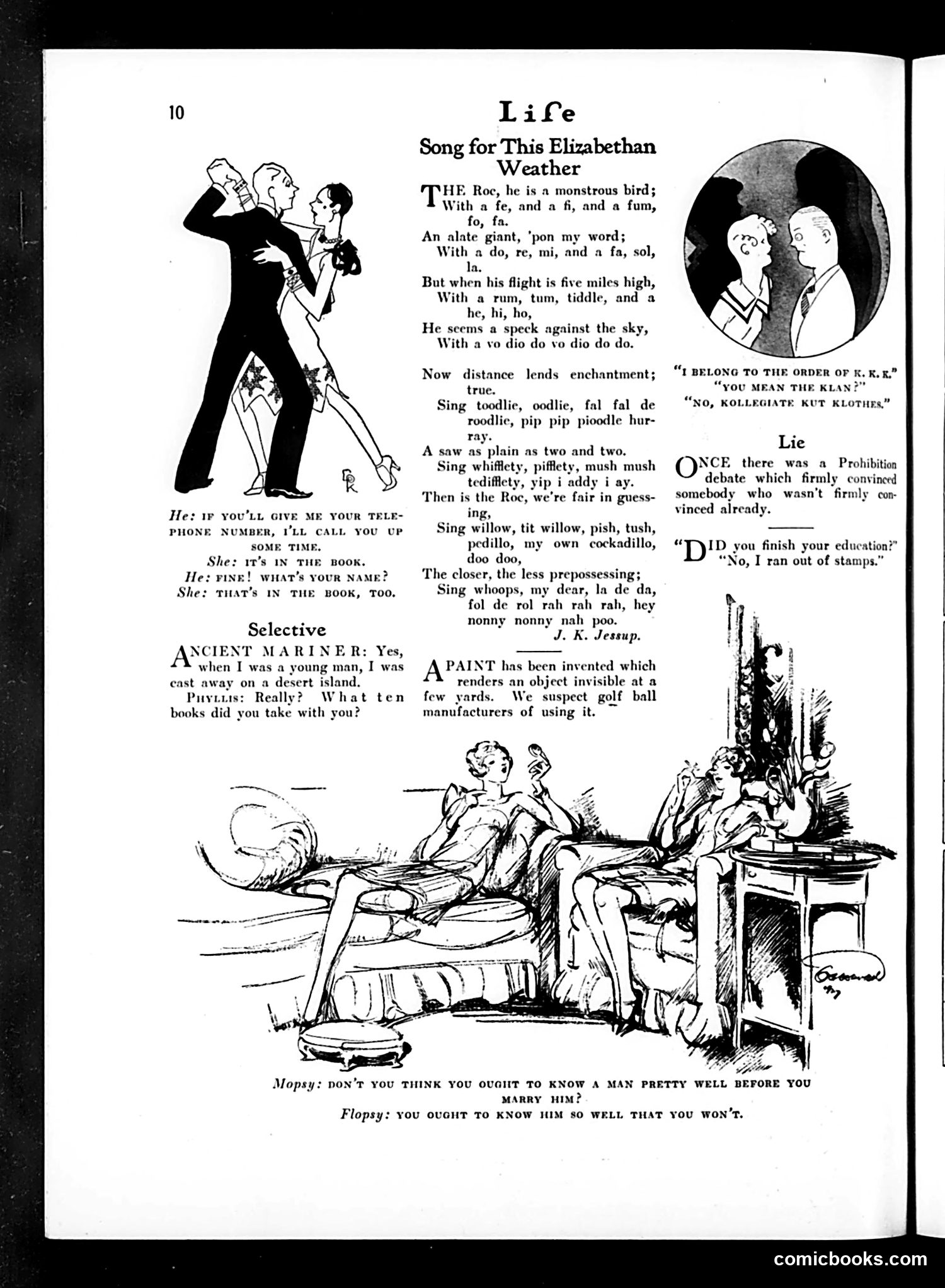
This page contains three distinct humor pieces: 1. **"Song for This Elizabethan Weather"** - A nonsense song mocking ornate musical composition styles, with elaborate syllabic sequences ("toodie, oodlie, fal fal de") rather than coherent lyrics. 2. **"Selective"** - A brief dialogue where an Ancient Mariner claims he took ten books to a desert island. The joke plays on the classic Coleridge poem reference, creating absurdist humor through unexpected answers. 3. **"Lie"** - A short piece about a Prohibition debate, using the educational excuse "I ran out of stamps" as an ironic non-sequitur. The large illustration shows women in a bedroom scene with dialogue below about marriage and knowing one's partner—typical early-20th-century domestic satire aimed at married couples or courtship customs. The overall tone is lighthearted wordplay and social commentary on contemporary manners.
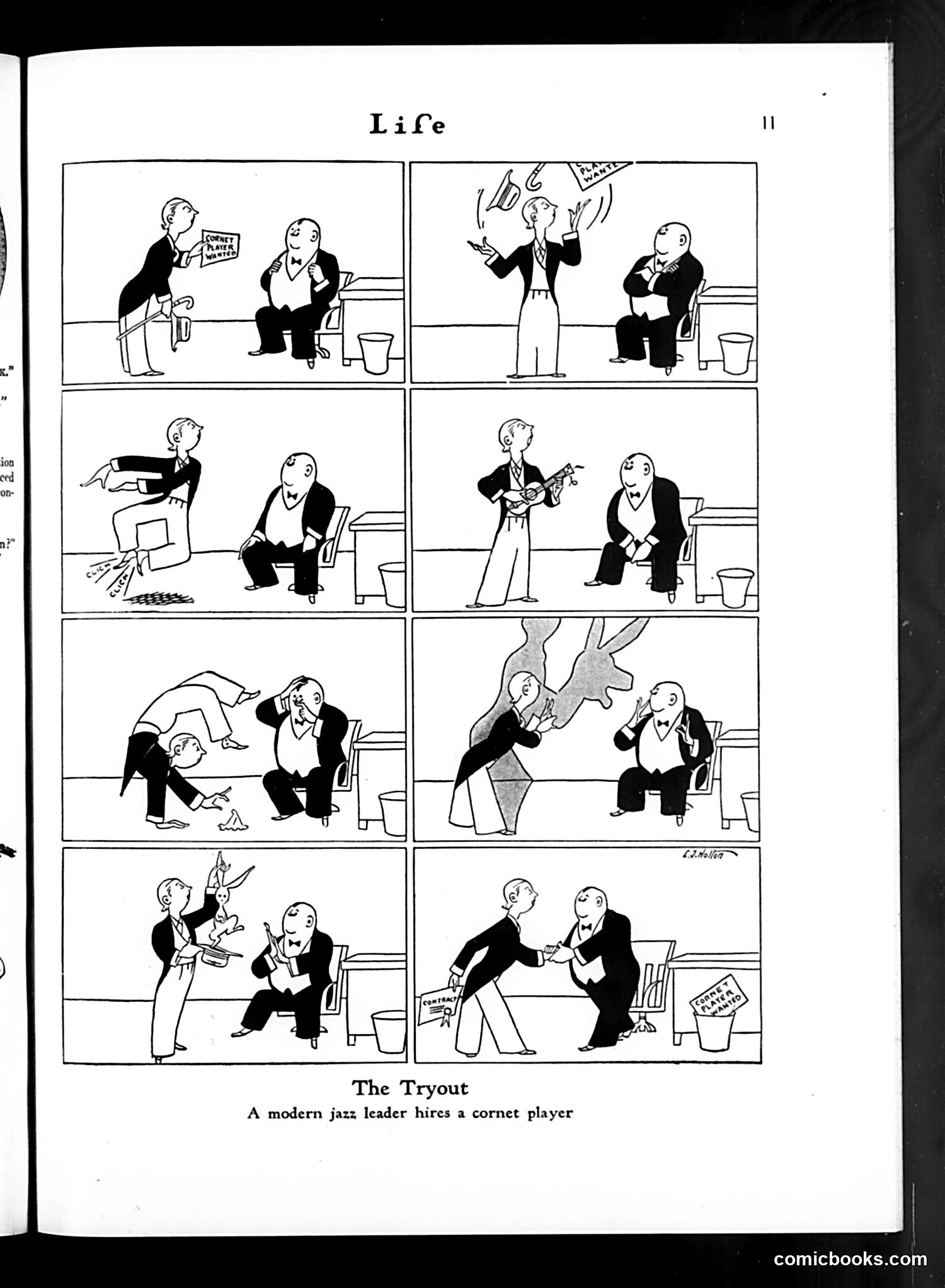
This eight-panel comic satirizes 1920s jazz culture. A well-dressed businessman (the jazz band leader) interviews a prospective cornet player. The sequence depicts an escalating audition: the candidate demonstrates increasingly wild, energetic playing—complete with exaggerated physical contortions and frantic gestures. Each panel amplifies the chaos and abandon associated with jazz performance. The satire mocks both jazz musicians' reputation for uninhibited, chaotic behavior and the contrast between the composed, buttoned-up businessman and the wild performer. The "modern jazz" label suggests contemporary jazz was viewed as novelty entertainment rather than serious music—a common attitude among older, more conservative audiences in the Jazz Age.
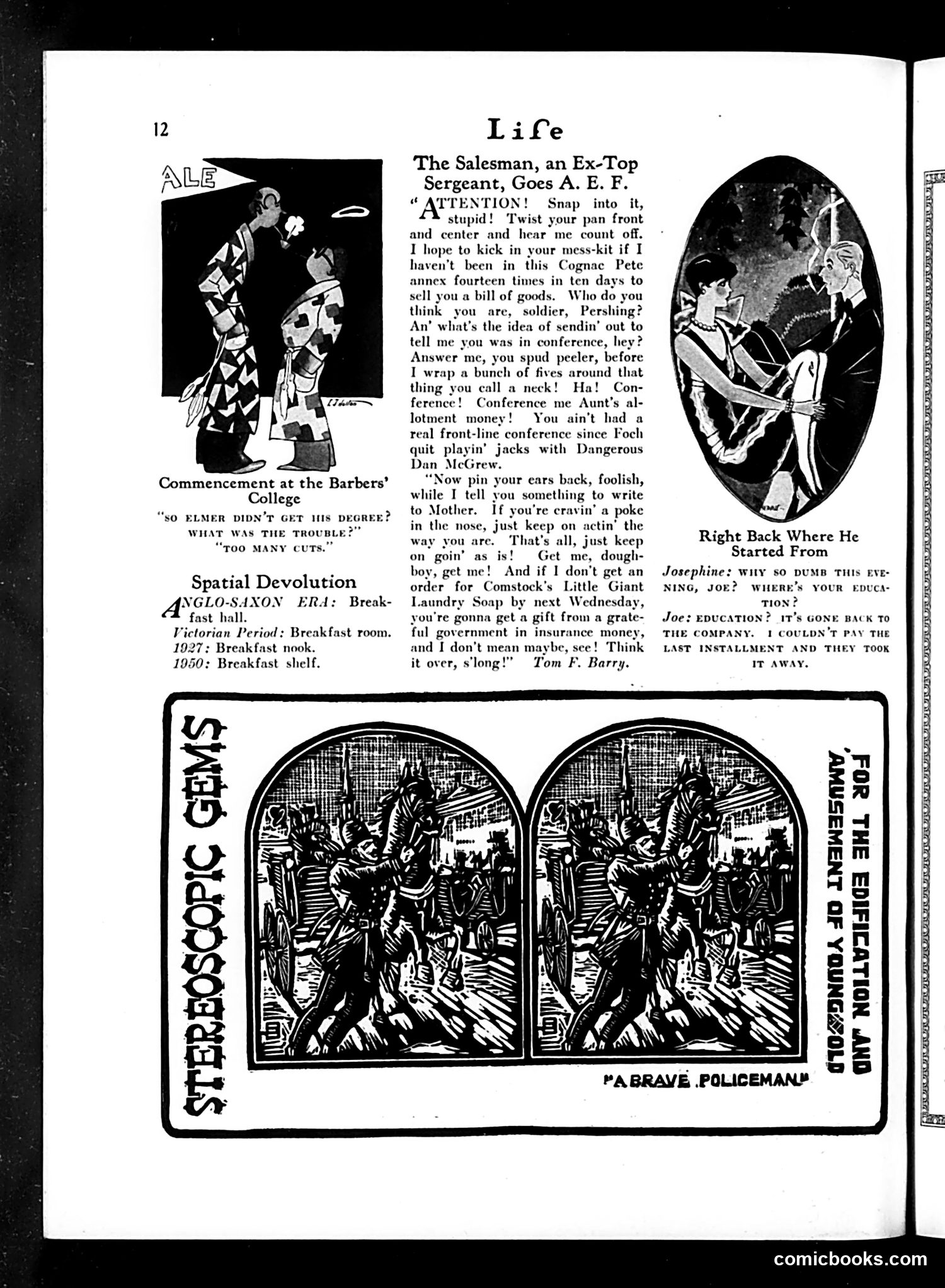
This page contains two main satirical pieces: **"The Salesman, an Ex-Top Sergeant Goes A.E.F."** depicts a loudmouthed ex-military sales pitch, likely mocking aggressive salesmen who leveraged WWI military service for credibility. The sergeant bombards a customer (labeled "Pershing") with pushy sales tactics while bragging about his war record and threatening consequences if orders aren't placed. **"Spatial Devolution" (Anglo-Saxon Era)** is a humorous etymology section showing how breakfast-related terms degraded over time from formal Victorian language to crude slang. The **Stereoscopic Gems** advertisement at bottom shows a stereoscope card of "A Brave Policeman"—promoting 3D viewing cards that were popular entertainment of that era. The overall page satirizes post-WWI American commercialism and linguistic decline.
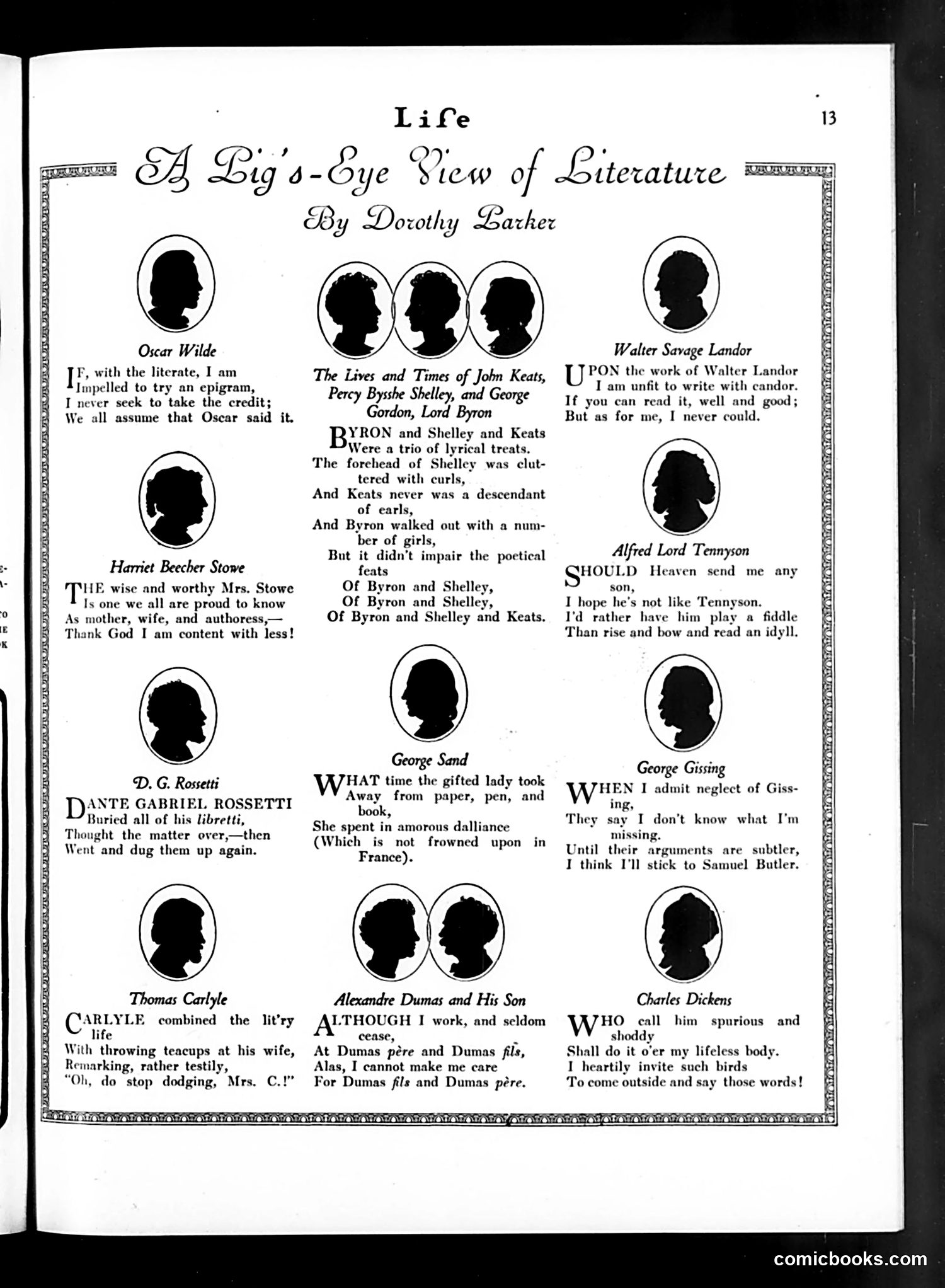
This satirical page presents silhouette portraits of famous literary figures with humorous commentary on their works and personalities. The cartoonist offers tongue-in-cheek critiques: Oscar Wilde receives credit for everyone's witticisms; Harriet Beecher Stowe is praised as a worthy mother figure; Byron, Shelley, and Keats are dismissed as self-absorbed poets; George Sand is mocked for her scandalous affairs and cross-dressing; Tennyson is criticized for being overly sentimental; and Charles Dickens is called "spurious and shoddy." The satire targets both the literary figures themselves and contemporary attitudes toward them—their reputations, moral character, and artistic merit. It's essentially literary gossip and critique dressed as irreverent commentary.
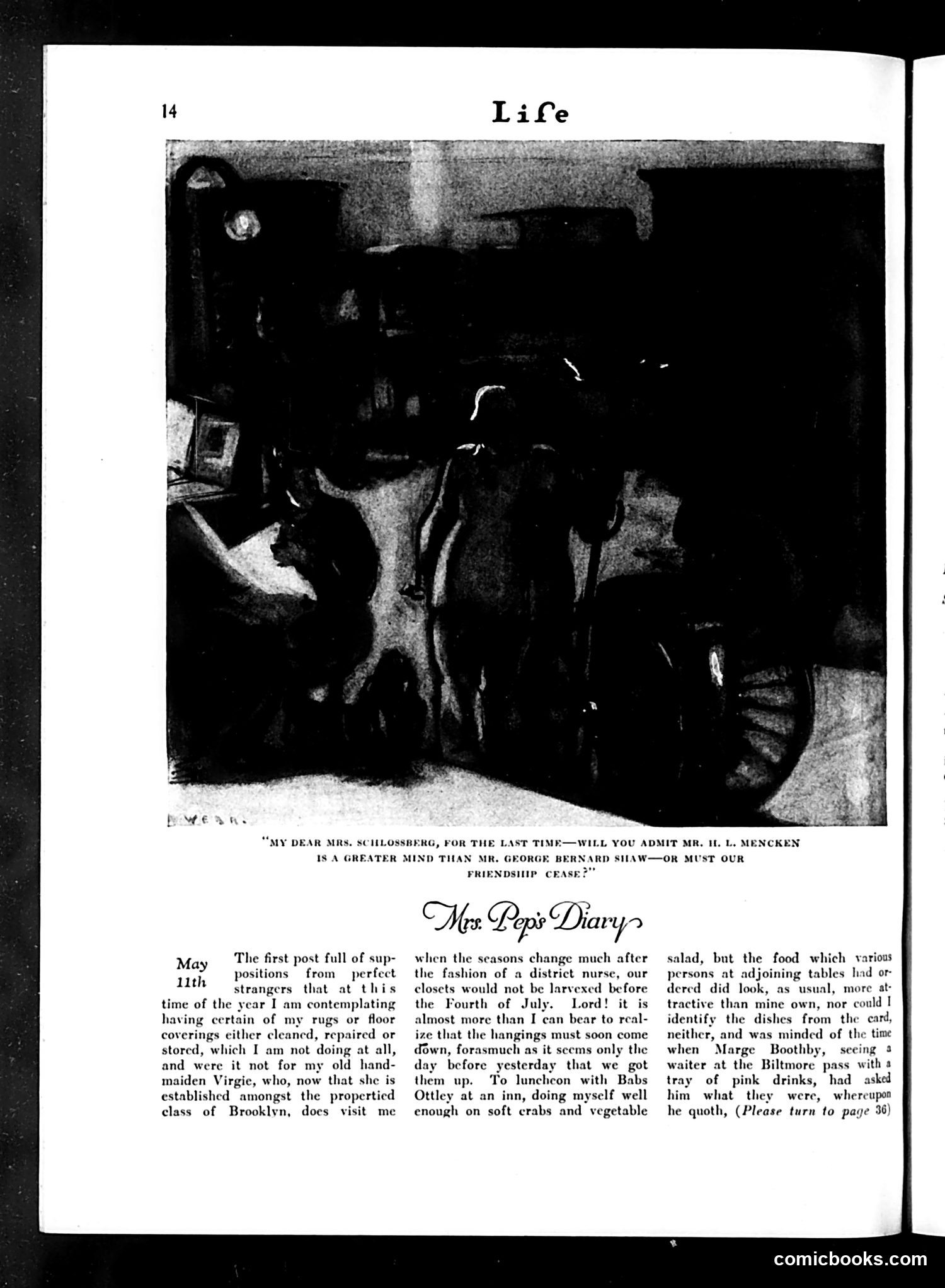
This page presents a serialized diary column rather than a political cartoon. The image shows what appears to be a domestic interior scene, though it's quite dark and difficult to parse clearly. The diary entry discusses household management—specifically concerns about rug cleaning and storage. The diarist mentions maintaining social standing in Brooklyn society and references lunch with "Babs Ottley at an inn." The caption quotes a conversation questioning whether "H. L. Mencken is a greater mind than Mr. George Bernard Shaw," suggesting this was satirizing educated middle-class social pretensions of the era. The humor likely targeted how such households discussed intellectual matters while preoccupied with domestic trivialities. Without additional context, the specific date and identities of referenced individuals remain unclear.
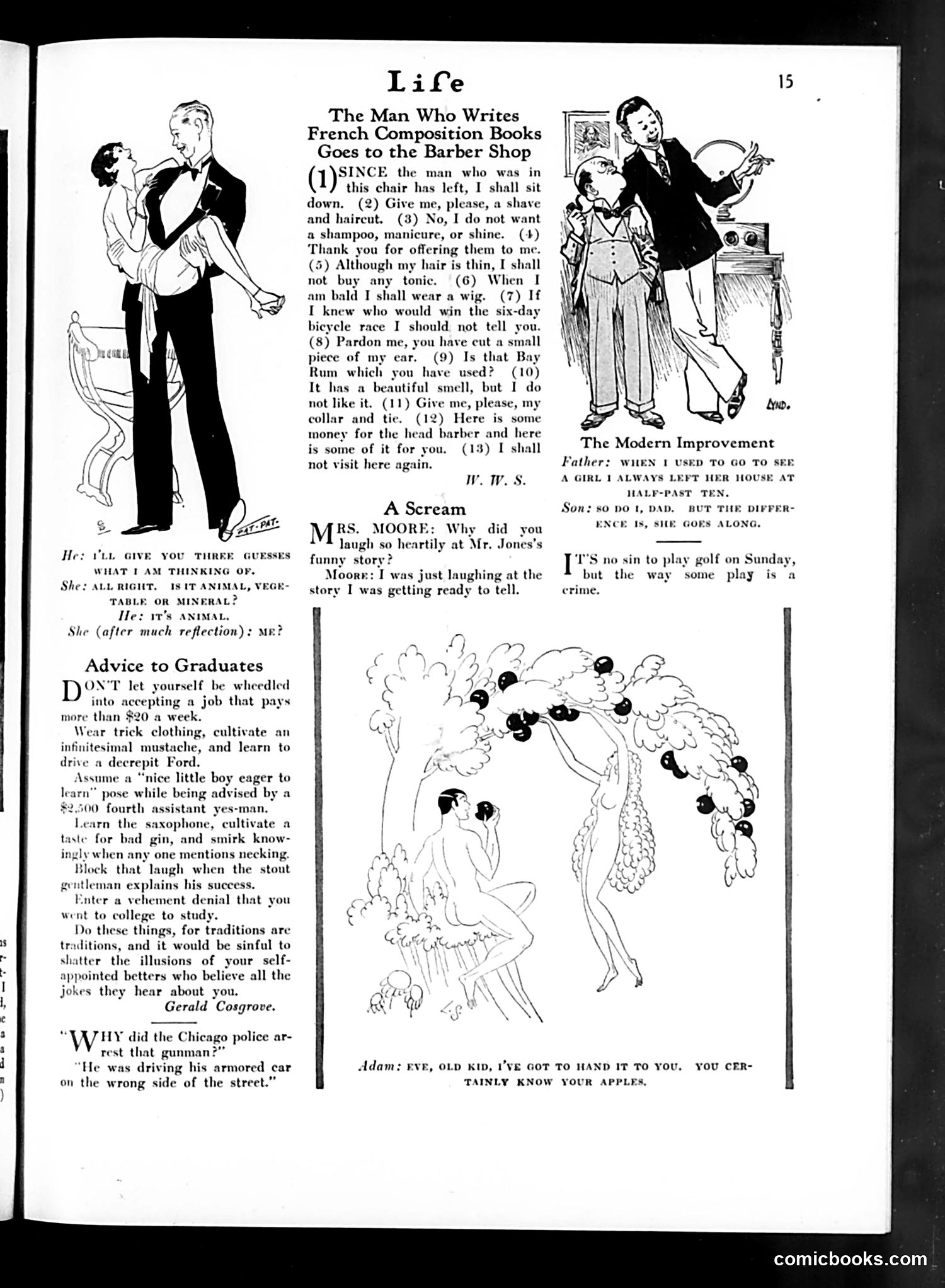
This page contains several satirical pieces typical of early 20th-century humor: **"The Man Who Writes French Composition Books Goes to the Barber Shop"** presents a pompous intellectual receiving a haircut while delivering absurdly formal statements (numbered 1-13). The satire mocks pretentious people who speak in overly elaborate, affected ways—likely targeting academics or intellectuals who use unnecessarily complex language in everyday situations. **"A Scream"** is a brief joke about Mrs. Moore laughing at Mr. Jones's story, with the punchline being the story itself was unremarkable. **"Advice to Graduates"** by Gerald Cosgrove satirizes cynical life advice for young people—suggesting they adopt fake personas, drink gin, and abandon idealism. It's a dark joke about corruption and compromise. The apple-tree cartoon illustrates a parent-child dialogue about apple ownership, appearing to comment on generational or property disputes.
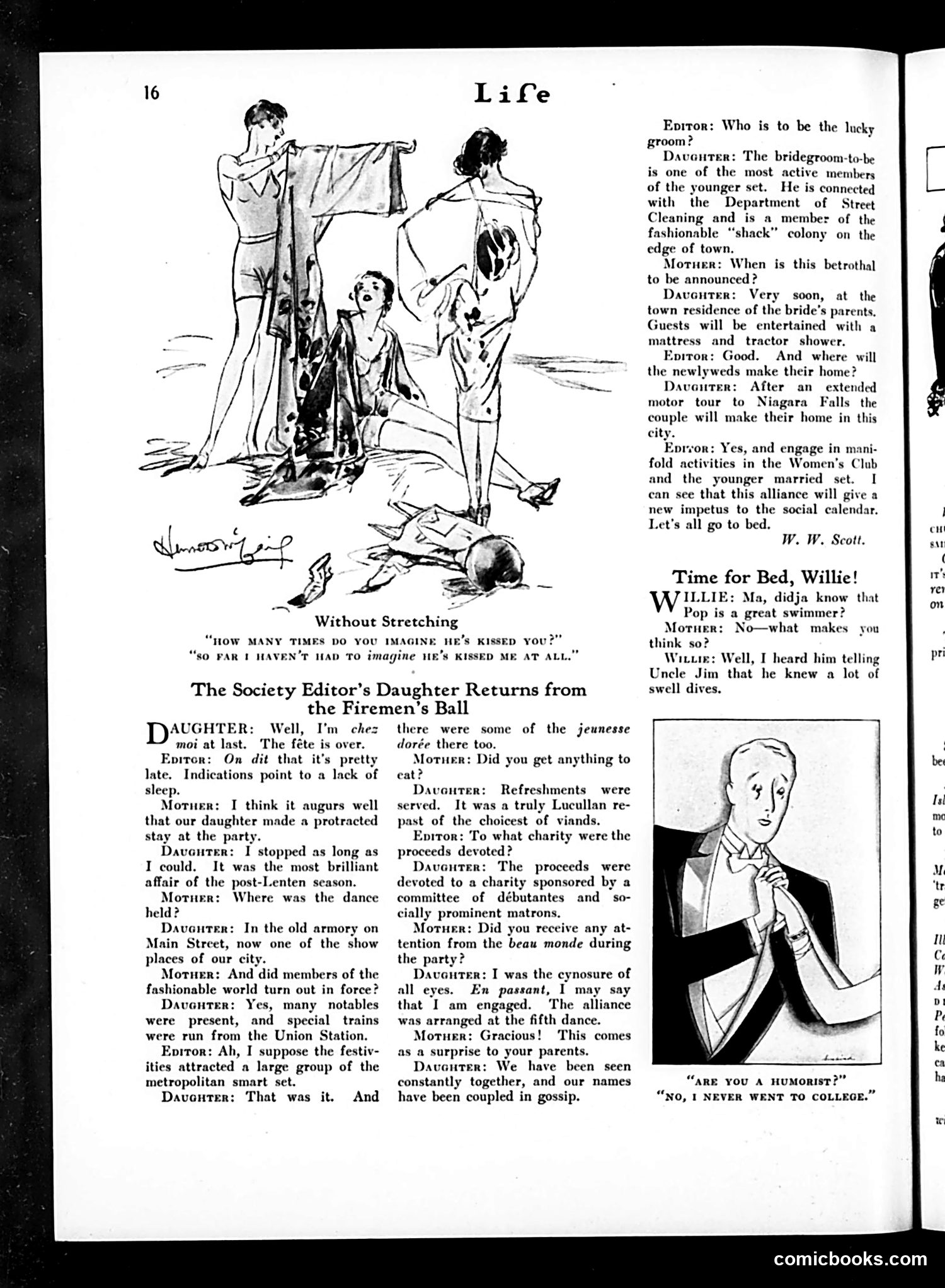
This page contains three humor pieces satirizing early 20th-century American social life: 1. **"Without Stretching"**: A cartoon mocking the physical demands of kissing, showing women's exaggerated contortions. 2. **"The Society Editor's Daughter Returns from the Firemen's Ball"**: A dialogue satirizing high-society pretension. The editor's daughter describes attending a charity ball, using French phrases ("jeunesse dorée," "en passant," "beau monde") to describe what was apparently a modest event. The humor targets upper-class affectation and the gap between genuine social status and performative sophistication. 3. **"Time for Bed, Willie!"**: A brief domestic humor piece about a child's fabricated swimming knowledge. The overall theme mocks social climbing and the pretentiousness of aspiring elites adopting superficial markers of high society.
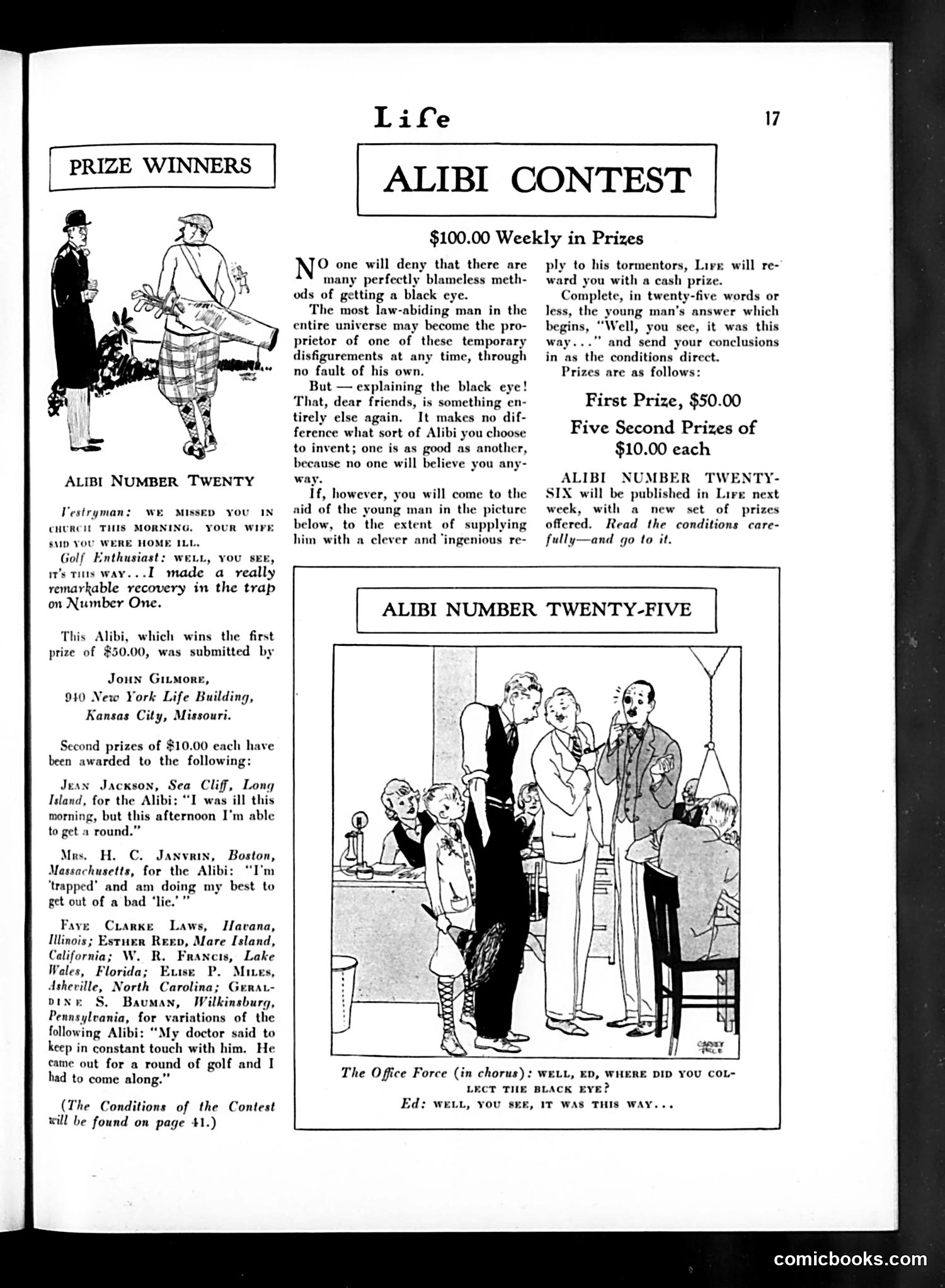
This page features Life's weekly "Alibi Contest," offering $100 in prizes for readers' creative excuses. The central cartoon (Alibi #25) depicts an office scene where a man with a black eye is questioned by coworkers about his injury. He claims innocence: "Well, you see, it was this way..." The satire mocks how people invent elaborate false explanations—"alibis"—to cover embarrassing situations. The cartoon plays on the universal experience of making unconvincing excuses. The contest invites readers to submit their own humorous alibis for everyday mishaps, with a first prize of $50 and five second prizes of $10 each. This reflects early 20th-century magazine culture of reader participation and humor.
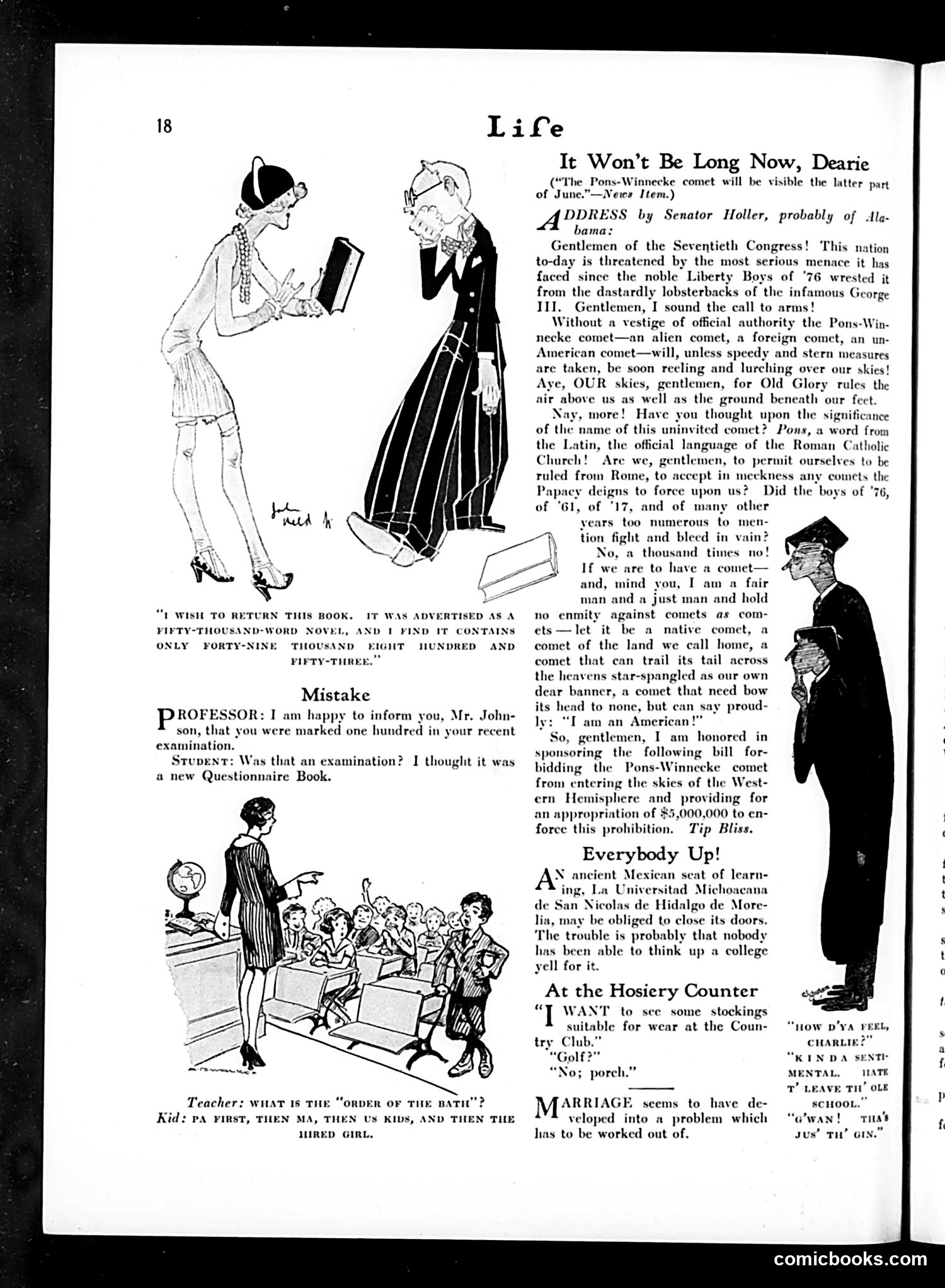
This page contains multiple satirical pieces typical of 1920s American humor: **"It Won't Be Long Now"** is the main political cartoon, mocking isolationist and xenophobic congressional rhetoric. Senator Holler delivers an absurdly overwrought speech treating the Pons-Winnecke comet as a foreign threat requiring military action and a $5 million appropriation. The satire targets jingoistic politicians who invoke Revolutionary War patriotism to oppose anything "foreign"—here, literally a celestial object. The Latin name becomes grounds for suspicion of Catholic/Roman influence, ridiculing nativist fears. The smaller jokes mock pedantry (a student misunderstanding an exam as a questionnaire), a child's literal interpretation of "order of the bath," and a customer confusing stockings with porches. The satire's point: American politicians inflate trivial foreign matters into existential threats using inflamed patriotic language, treating even nature as subject to national sovereignty.
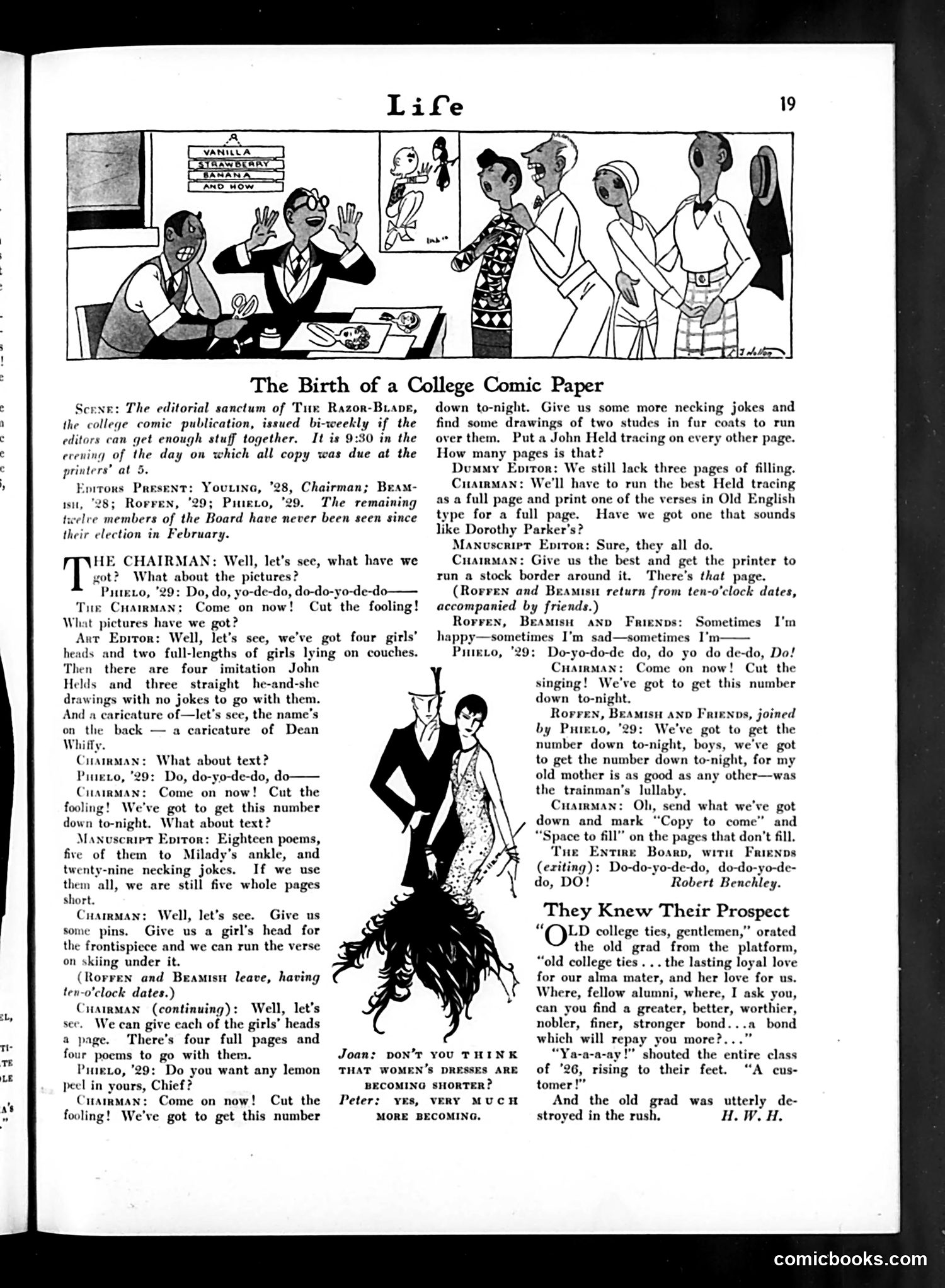
This satirical piece by Robert Benchley mocks the chaotic production of a college humor magazine (appearing to be based on *The Razor-Blade*, a real college publication). **The Setup:** The scene depicts editors frantically scrambling to fill pages hours before deadline, having collected minimal content—a few girl illustrations, poems about women's ankles, and "twenty-nine necking jokes." **The Satire:** The humor targets: - **College magazine mediocrity**: Recycled artwork (John Held cartoons—a popular contemporary cartoonist), filler, and padding with large typefaces to stretch thin content - **Editorial incompetence**: Editors leaving for dates mid-production; meaningless "do-do-do" ad-libs instead of actual work - **College life clichés**: Necking jokes, skiing verses, and romantic poetry as standard fare **Secondary joke**: The final vignette shows alumni sentimentally praising "college ties" while the '26 class shouts "A customer!"—suggesting the real bond isn't loyalty but commercial extraction from nostalgic graduates. The satire critiques both undergraduate frivolousness and the publishing shortcuts colleges tolerated.
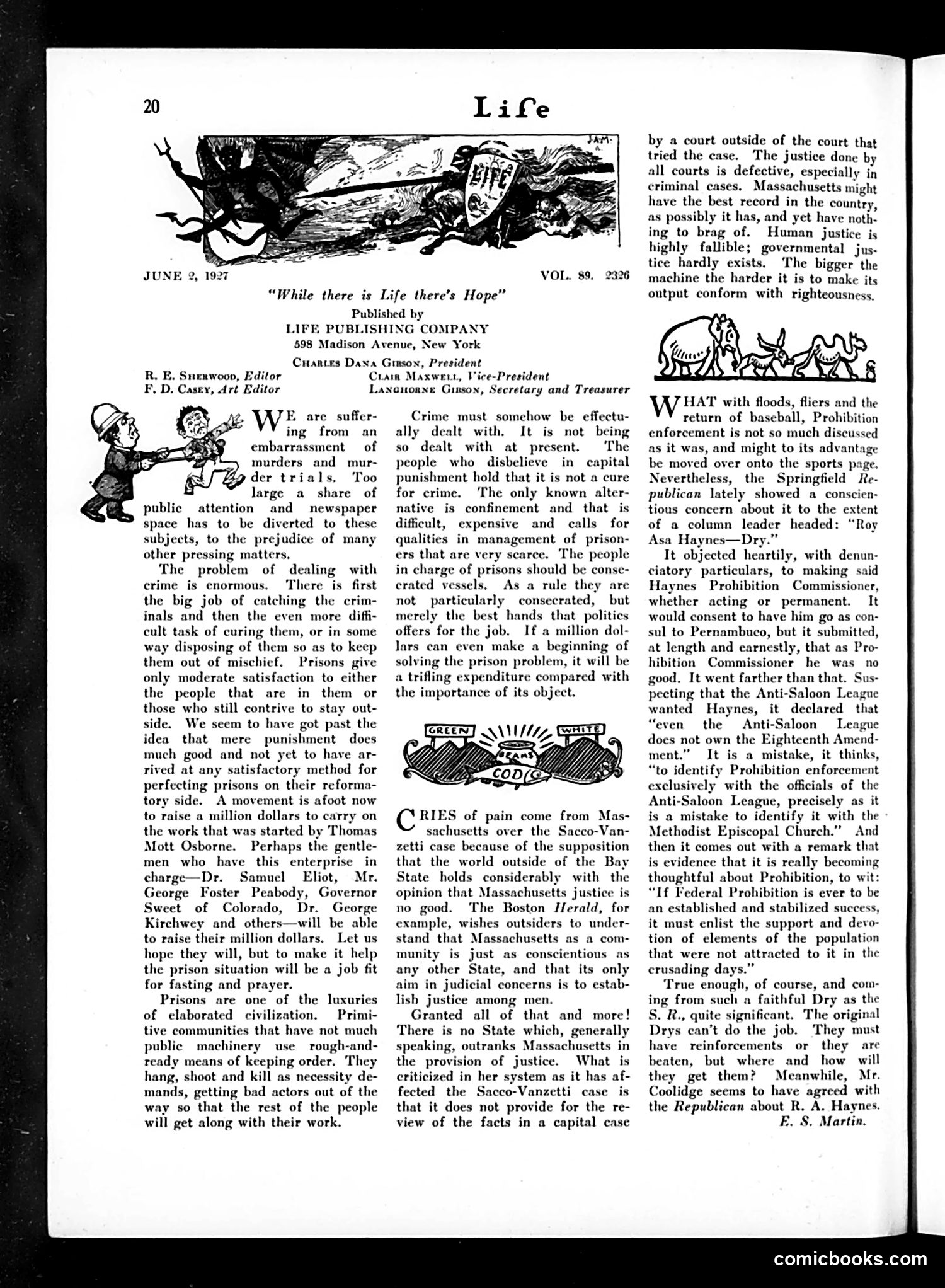
This editorial page addresses two major issues: prison reform and the controversial Sacco-Vanzetti case. The opening cartoon depicts two small figures (appearing to represent criminals or defendants) fleeing from a large, menacing figure labeled "JAIL"—satirizing public anxiety about crime and inadequate criminal justice. The main text criticizes America's overwhelmed criminal justice system, advocating for prison reform funding (mentioning Thomas Mott Osborne's initiative) over capital punishment, which the editors view as ineffective. The second section defends Massachusetts against criticism over the Sacco-Vanzetti case—the controversial trial of two Italian anarchists accused of murder. Life argues that while Massachusetts has a good judicial reputation, the case exposes a systemic flaw: capital cases lack independent appellate review of facts. The editors suggest that even well-intentioned legal systems can fail, critiquing the state's refusal to allow external court review of the trial's evidence.
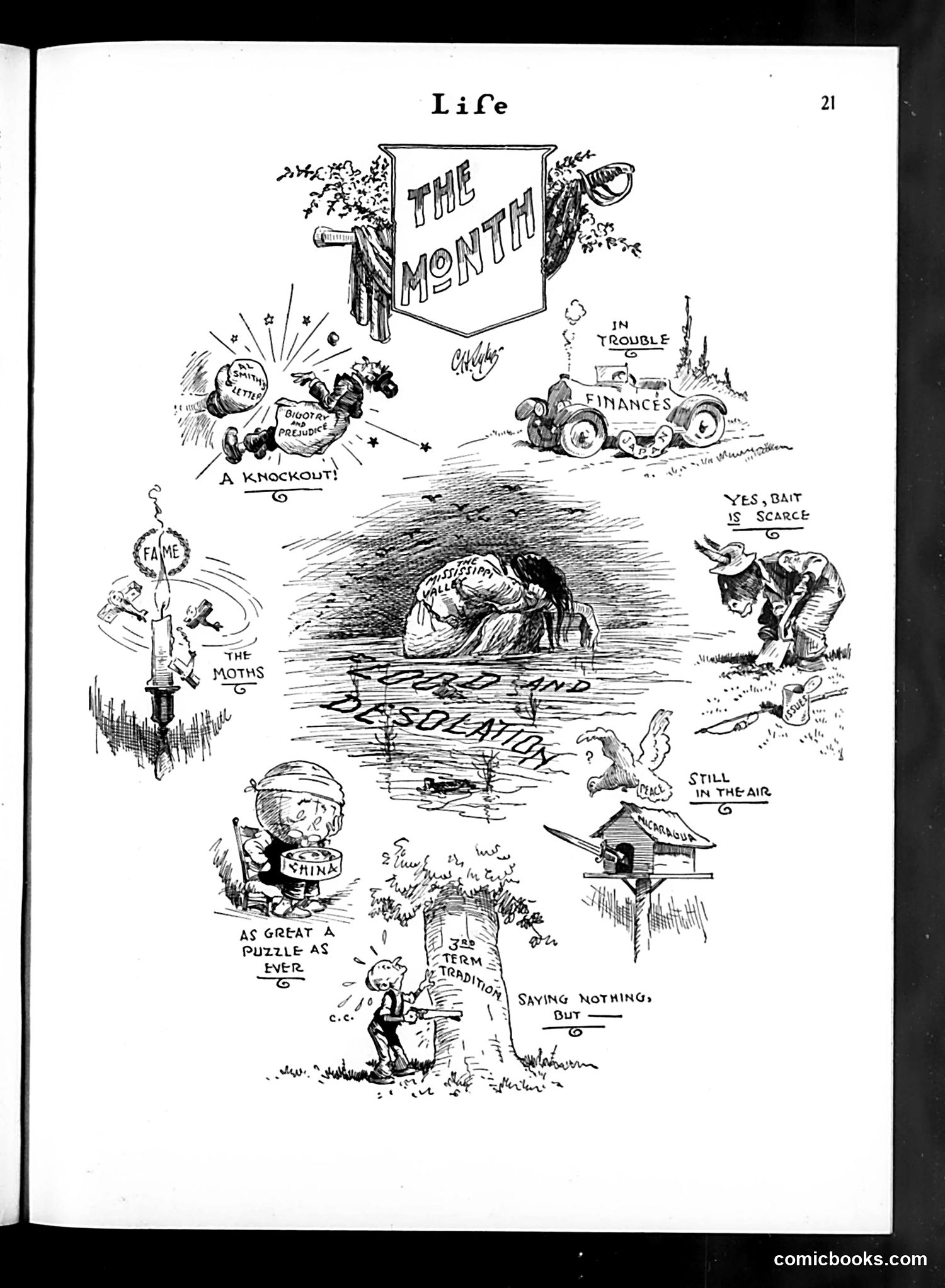
This page presents six separate political/social commentary sketches addressing current concerns of the publication's era: 1. **"A Knockout"** - depicts boxing-related scandal or controversy 2. **"In Trouble/Finances"** - shows a vehicle labeled "Finances" in distress, likely referencing economic hardship 3. **"The Moths"** - criticizes "Fame," suggesting it attracts destructive attention 4. **"Yes, Bait Is Scarce"** - commentary on scarcity, possibly wartime rationing 5. **"As Great a Puzzle as Ever"** - depicts "China" as an unsolvable problem 6. **"Still in the Air"** - shows uncertainty about an unresolved issue 7. **"Saying Nothing, But—"** - depicts someone (possibly a politician) making empty statements The sketches use anthropomorphic figures and symbolic imagery typical of early 20th-century American political cartooning. Without knowing the specific publication date, precise historical context remains unclear.
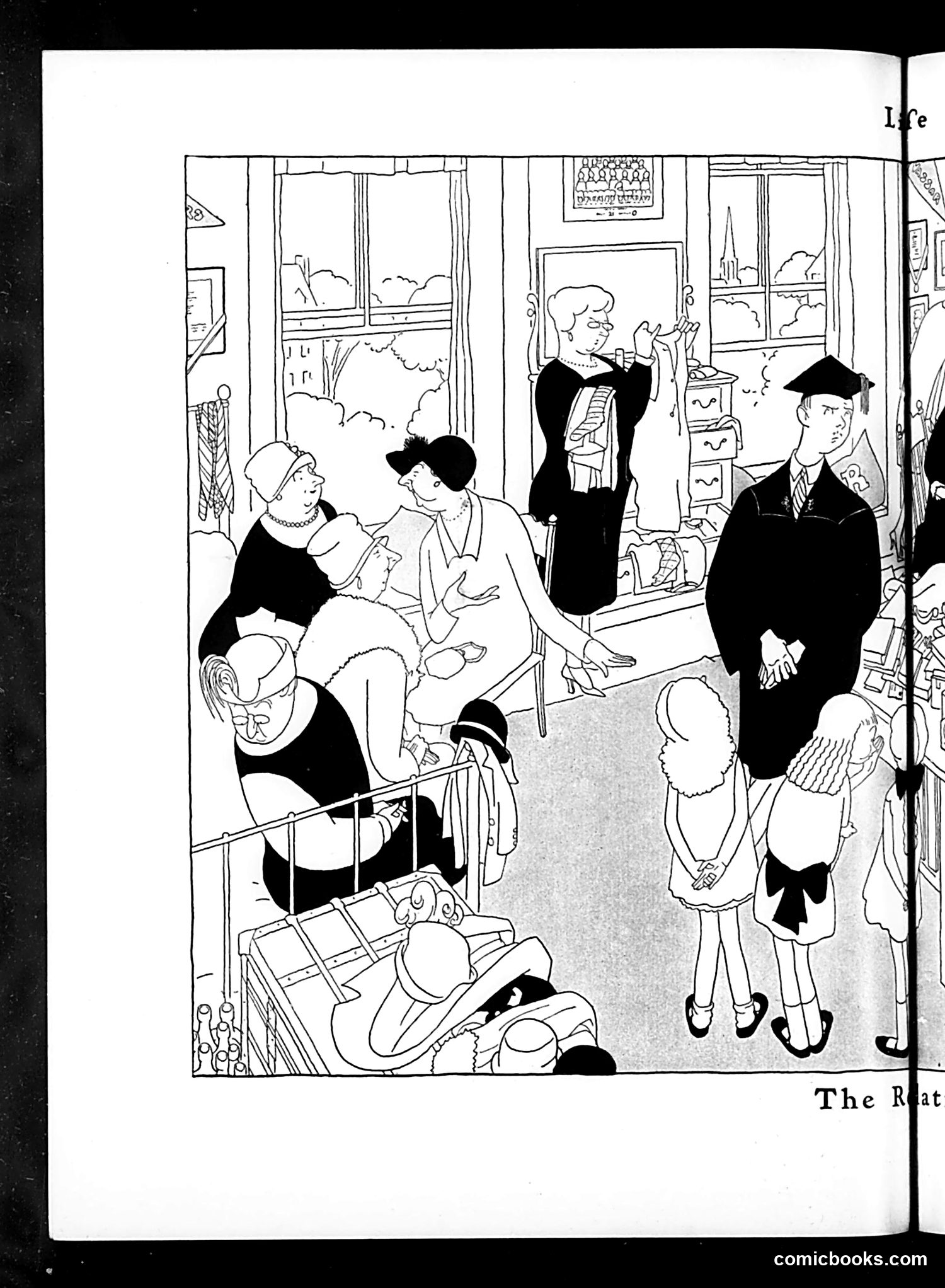
This appears to be a social satire cartoon from *Life* magazine showing an interior domestic scene. The title "The Rat" likely refers to a man (shown in military uniform on the right), suggesting satirical commentary on male infidelity or unreliability—"rat" being period slang for an unfaithful partner. The scene depicts a bedroom visit, with various well-dressed visitors observing what appears to be an intimate or compromising situation. The military uniform and the formal dress of other figures suggest this may comment on wartime social dynamics or the behavior of military personnel. Without additional context or visible publication date, the specific historical reference remains unclear, but the cartoon's humor depends on viewers recognizing the "rat" as a recognizable public figure or type worthy of ridicule.
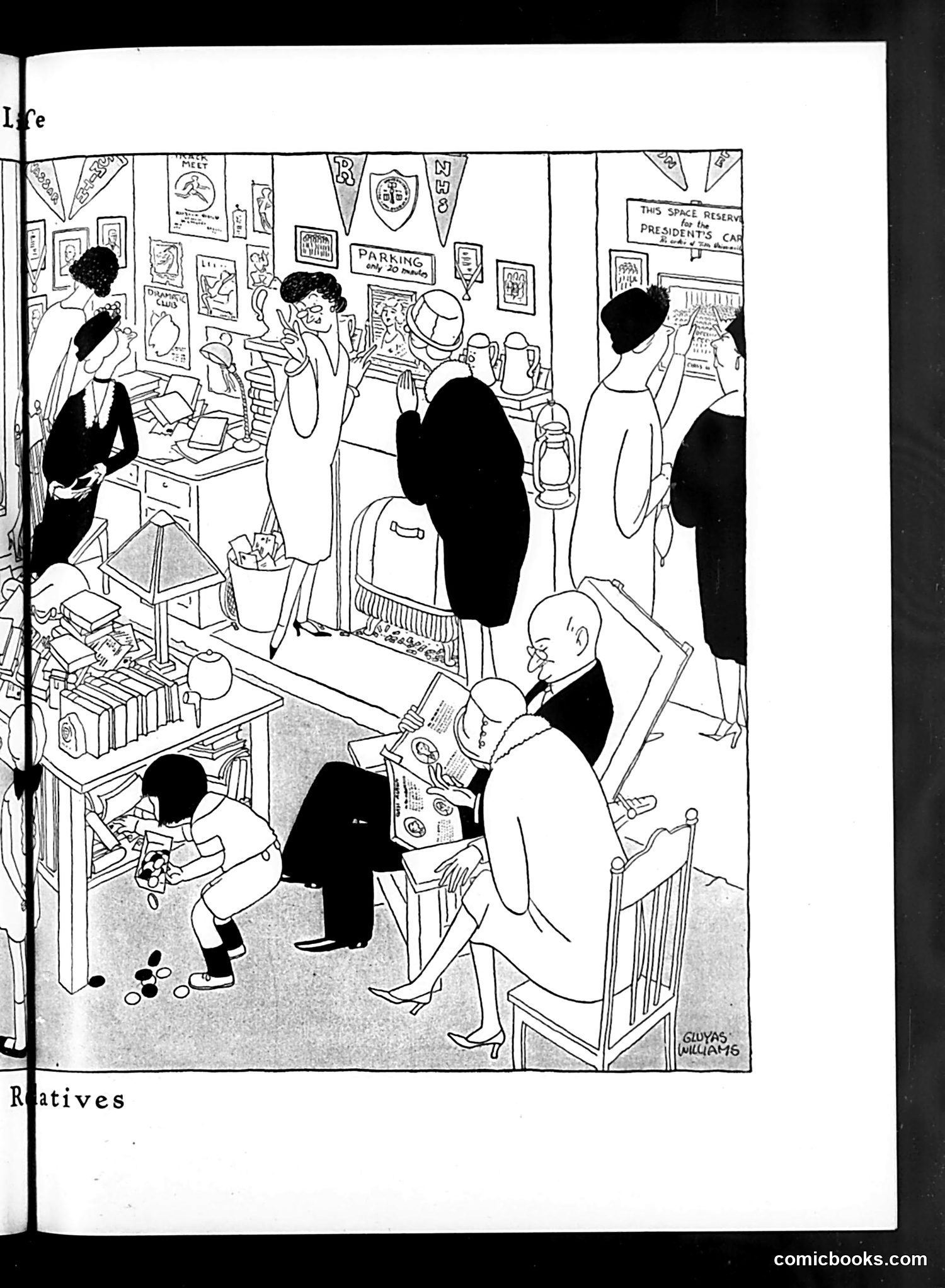
This cartoon depicts a chaotic domestic scene titled "Relatives," showing a crowded apartment with multiple figures engaged in various activities. The space is cluttered with artwork, decorations, and personal items covering the walls. A sign reads "THIS SPACE RESERVED FOR PRESIDENT'S CAR," suggesting satire about space constraints and perhaps housing shortages or urban overcrowding concerns of the era. The cartoon satirizes the challenges of managing multiple family members or guests in cramped living quarters—a relatable subject for post-war American readers. The humor derives from the visual chaos: children playing, adults socializing, and the general disorder of too many people occupying limited domestic space. This reflects broader mid-20th century social commentary about American housing and family dynamics. The artist signature reads "GLUYAS WILLIAMS."
This page reviews the recent theatrical season, expressing exasperation at the volume of mediocre new plays. The writer sarcastically notes that dramatic critics struggle to recall such a "mess of whitebait" (worthless plays) since April, questioning where all these scripts originate and who writes them. The review contrasts this chaos with the timeless, unchanging appeal of magician Thurston's show—his patter and illusions remain identical to those from decades past, yet audiences remain entertained. The writer notes Thurston modernly employs "plants" (audience members) as volunteer participants. The piece concludes by praising Paul Green's Pulitzer Prize-winning play "In Abraham's Bosom," commending its "honest strength" and the vivid performance by its Black cast member Frank Wilson, while acknowledging other season plays might have merited the award. The overall tone is one of theatrical fatigue mixed with genuine appreciation for quality work.
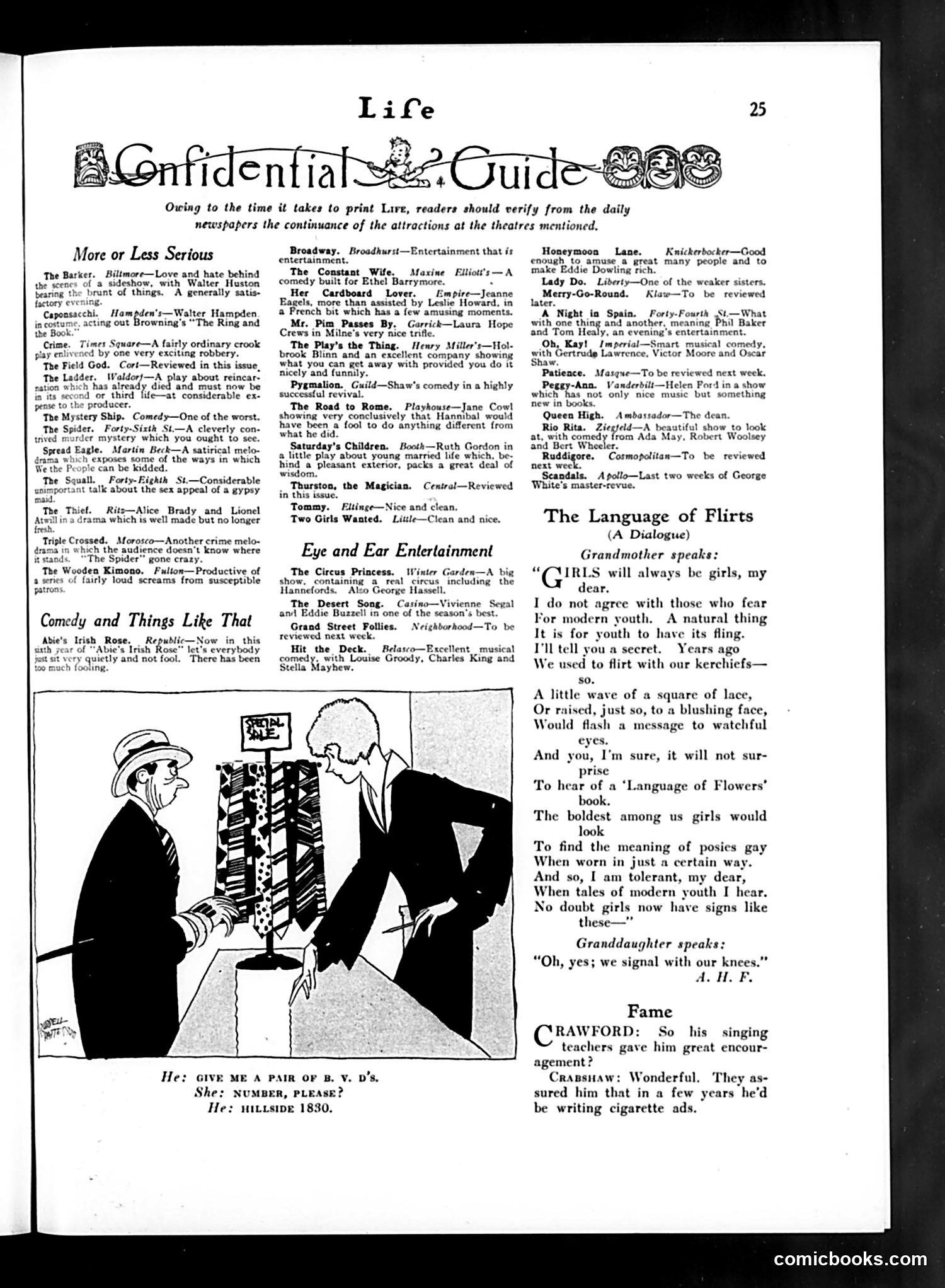
This page contains two main elements: a theatrical review section and a satirical dialogue piece titled "The Language of Flirts." ## The Cartoon The single cartoon depicts a flirtatious exchange at what appears to be a haberdashery or clothing shop. A man asks for "a pair of B.V.D.'s" (a brand of men's underwear), while the female shopkeeper responds "Number, please?" with a suggestive tone. The humor plays on double entendre—her innocent professional question ("What size?") is treated as if she's making a flirtatious comeback, implying coded romantic language or innuendo. ## "The Language of Flirts" Dialogue This mock-serious piece satirizes modern courtship rituals among young people. The grandmother warns that flirting has evolved from Victorian subtlety (the "language of flowers") to crude physical signals—specifically, the granddaughter's revelation that "we signal with our knees." The satire mocks both changing social mores and the gap between generations' understanding of romance and propriety. Both elements humorously capture 1920s anxieties about shifting courtship customs.
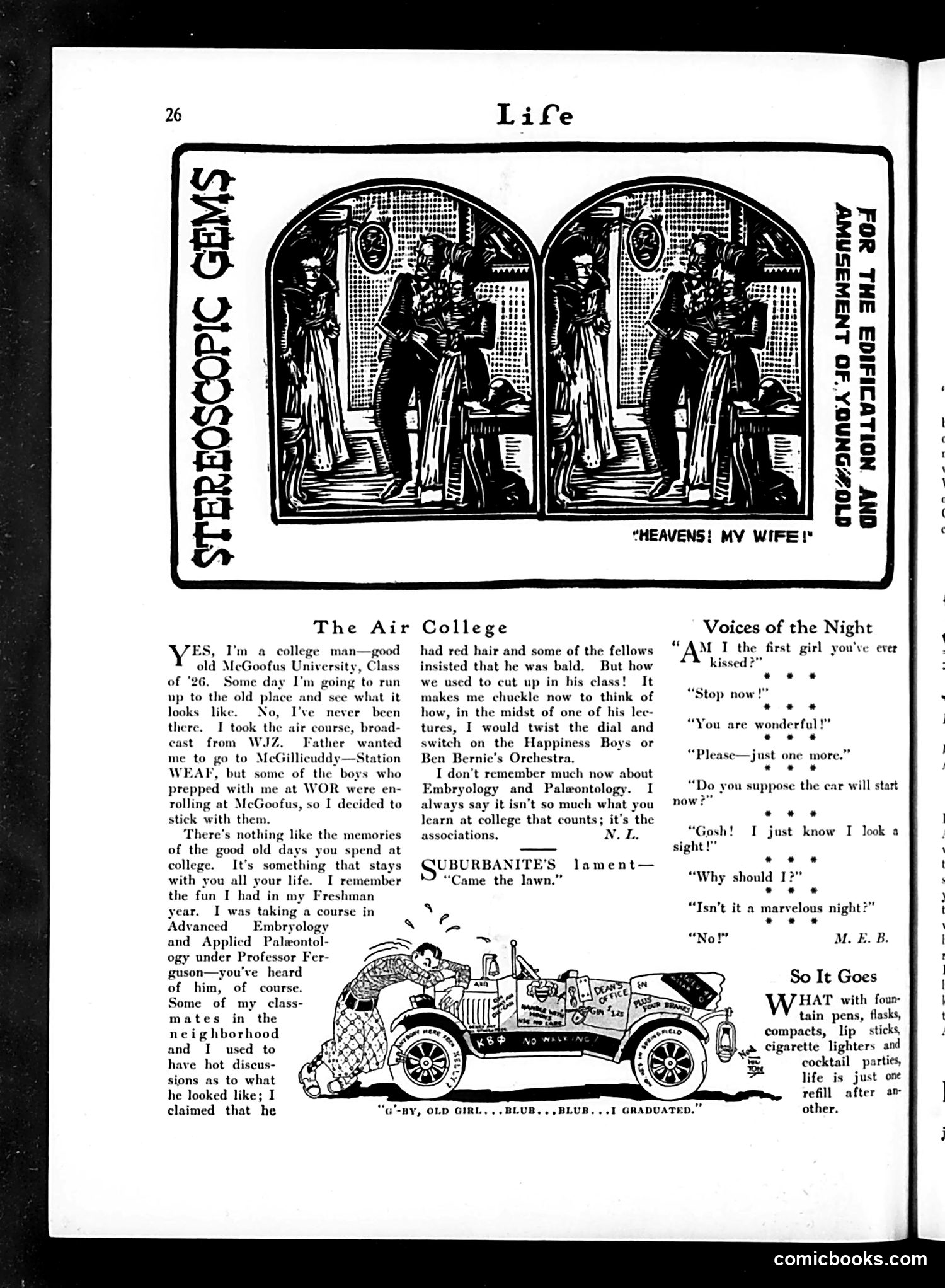
This page satirizes 1920s college culture and young adult life. **The main article** mocks a McGuffus University alumnus who brags about attending college but admits he never actually visited campus, took an "air course" via radio broadcast, and learned nothing meaningful—claiming college value lies only in "associations," not education. The humor targets the emptiness of collegiate pretension. **The stereoscopic cartoon** (top) shows a domestic scene captioned "Heavens! My wife!"—likely a visual gag implying either infidelity or marital shock, typical of period humor. **"Voices of the Night"** presents flirtatious dialogue between young couples, mocking their repetitive romantic clichés ("Am I the first girl you've ever kissed?" etc.). **"So It Goes"** satirizes affluent youth culture, reducing their possessions and social activities (fountain pens, flasks, compacts, cigarette lighters, cocktail parties) to meaningless consumption and constant replacement—a critique of materialistic excess during the prosperous 1920s.
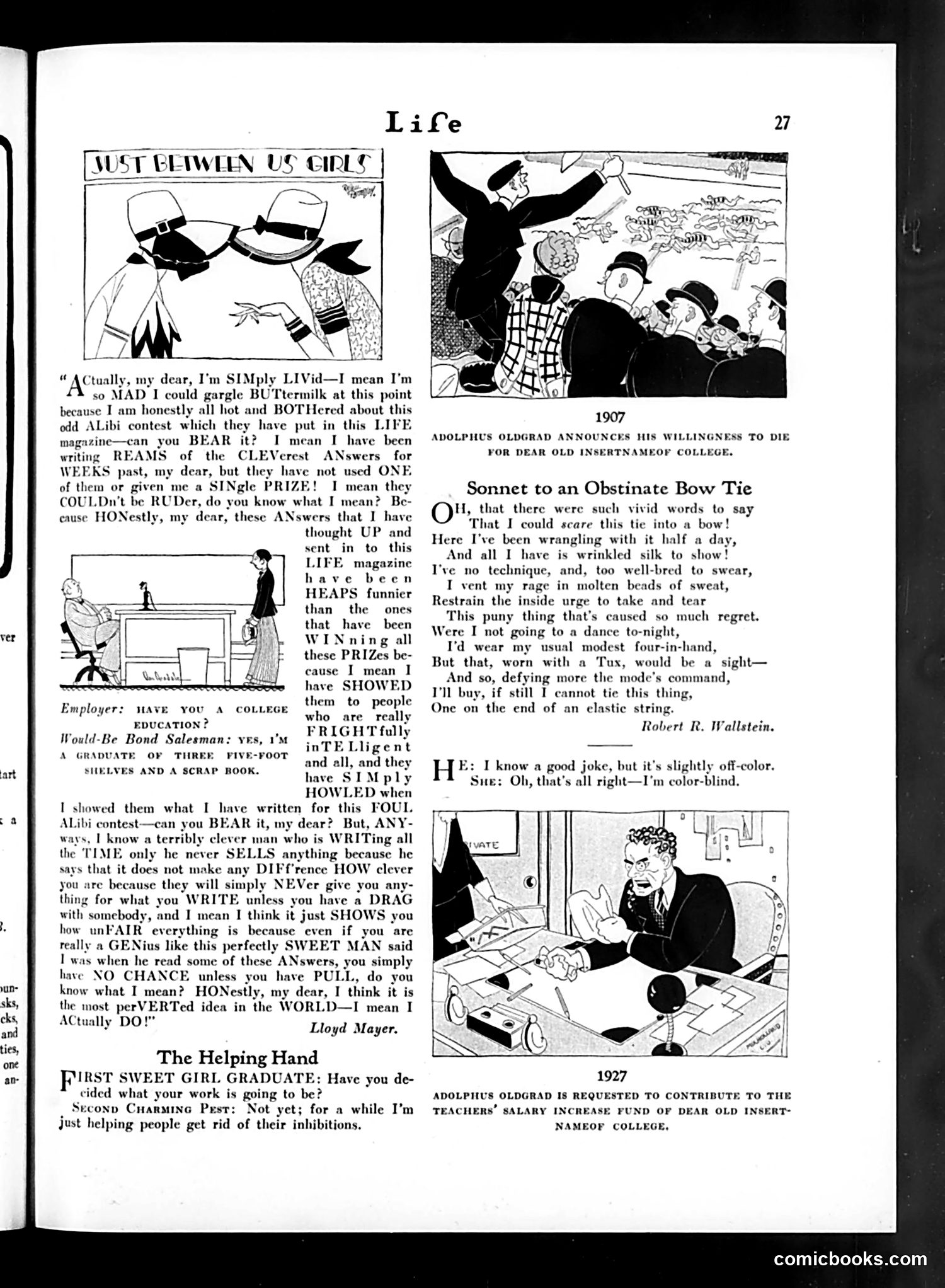
This 1920s humor page mocks several social pretensions of the era: **"Just Between Us Girls"** features a woman complaining that *Life* magazine's contest hasn't published her submitted answers, despite her believing them hilarious. The satire targets both her delusional self-assessment and the broader complaint that success in publishing requires "pull" (connections) rather than merit. Her affected speech patterns (capitalizing random words for emphasis) ridicule affected upper-class affectation. **"The Helping Hand"** offers quick one-liners mocking recent college graduates—one claims to help people "get rid of their inhibitions," satirizing pseudo-psychological fads of the period; another "bond salesman" admits his only credentials are three feet of shelves and a scrapbook, mocking credential inflation. **"Sonnet to an Obstinate Bow Tie"** humorously dramatizes the frustration of formal dress codes, particularly the bow tie's difficulty, suggesting buying one on an elastic string instead—poking fun at men's fashion constraints. The **Adolphus Oldgrad cartoons** appear to reference alumni fundraising appeals, a recurring satirical target.
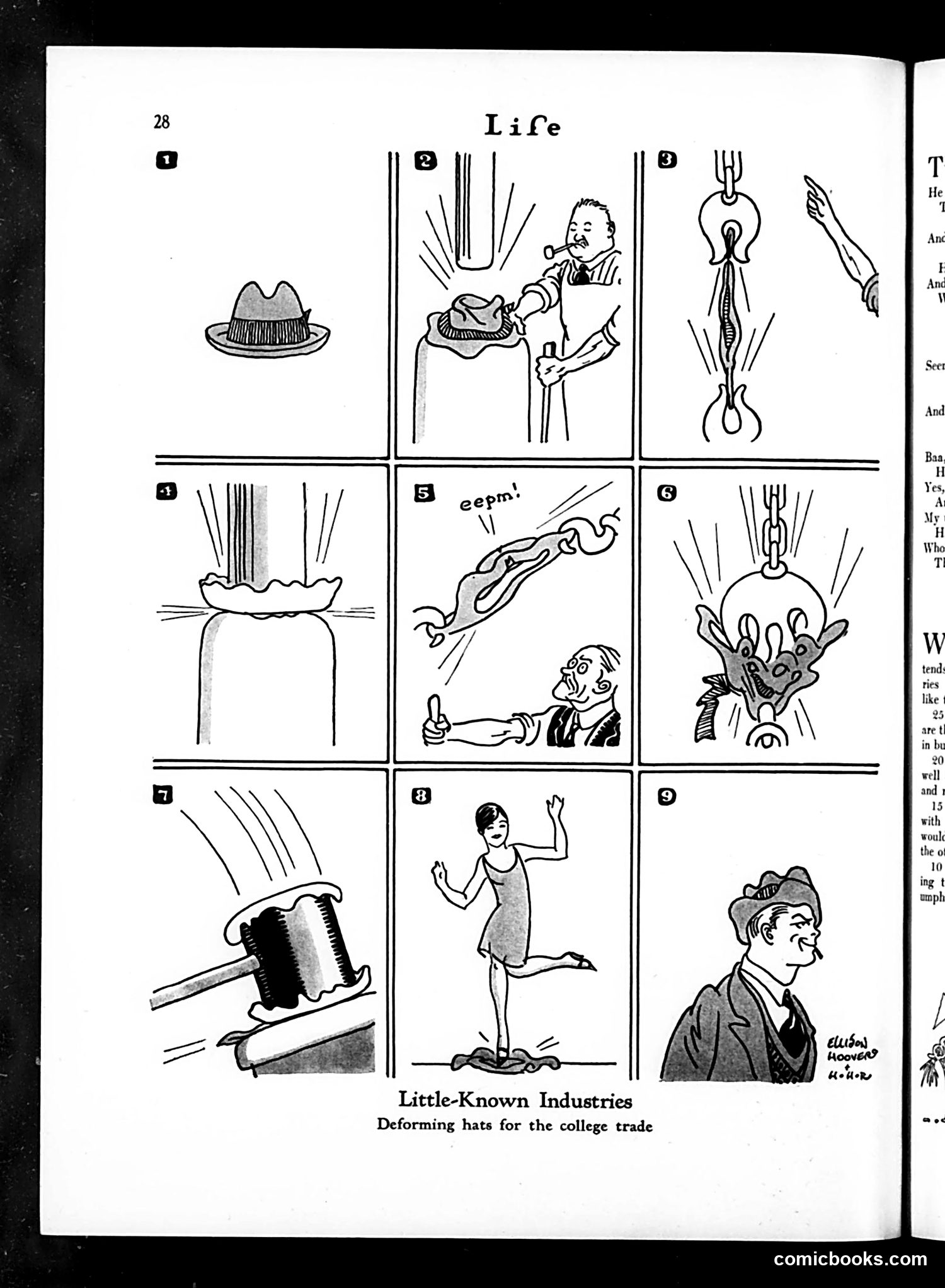
This is a humorous satirical strip about the manufacture of deliberately misshapen hats for college students. The nine panels show various violent and absurd processes—stretching, heating, striking with mallets, and electrical shocking—used to deform hats into fashionable college styles. The joke targets early 20th-century college fashion trends where students wore deliberately distorted hats as a status symbol or in-group marker. Life magazine ridicules this trend by presenting hat-deformation as an actual industrial process, complete with specialized workers and elaborate machinery. The satire mocks both the absurdity of fashion conventions and college student conformity to peer pressure—suggesting that looking distinctively "college" requires literal industrial damage to one's hat.
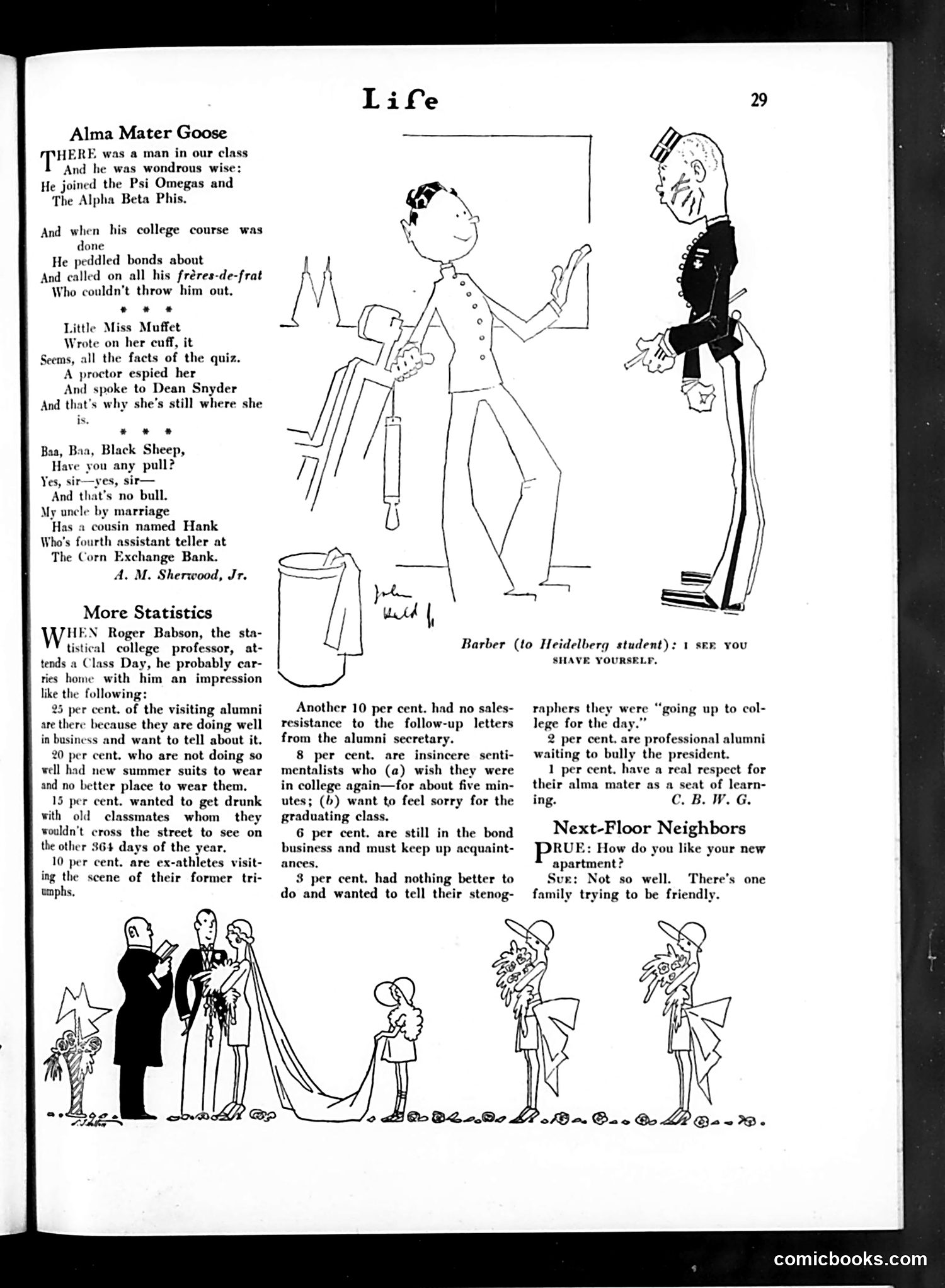
This page contains humorous verse and cartoons mocking college life and alumni culture. **"Alma Mater Goose"** satirizes fraternity members (Psi Omegas, Alpha Beta Phis) who become pretentious after graduation, "peddling bonds" and engaging in business fraud. **"More Statistics"** mocks a college professor (Roger Babson) presenting dubious alumni achievement statistics—showing 25% doing well in business while 15% want to get drunk and 10% are ex-athletes still reminiscing about college days. The satire targets both inflated institutional claims about graduate success and alumni nostalgia. The cartoon "**Barber (to Heidelberg student)**" jokes about German students' facial scars from dueling, instructing him to "shave yourself." **"Next-Floor Neighbors"** depicts a woman complaining about unfriendly new apartment neighbors, using visual gags of disheveled figures.
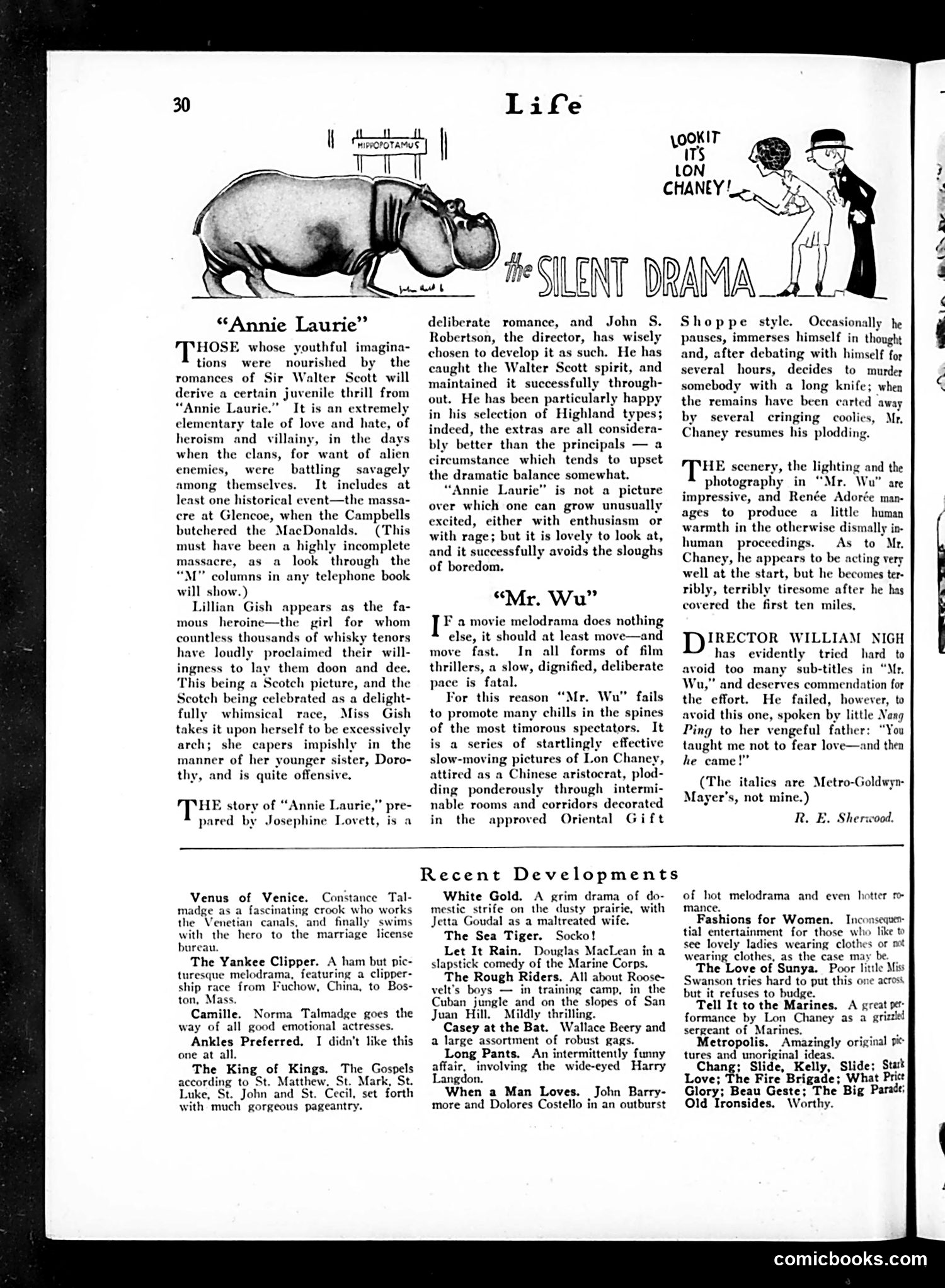
This page reviews three silent films. The cartoon at top depicts a hippopotamus labeled "PHOTOPLAYS" with two figures pointing, captioned "Look! It's Lon Chaney!" — a visual gag mocking actor Lon Chaney's prominent role in contemporary cinema. The reviews discuss *Annie Laurie* (starring Lillian Gish in a Scottish romance based on Walter Scott literature) and *Mr. Wu* (featuring Chaney as a Chinese aristocrat). The critic praises *Annie Laurie's* aesthetic appeal but finds it emotionally uninspiring, while savagely critiquing *Mr. Wu* for its glacial pacing and Chaney's "terribly, terribly tiresome" performance despite impressive cinematography. The satire targets silent-film conventions: overwrought acting styles, melodramatic plotting, and heavy reliance on visual spectacle over narrative momentum. The hippopotamus joke likely references how Chaney dominated contemporary film discourse—he was everywhere, much like the ungainly beast dominating the page.
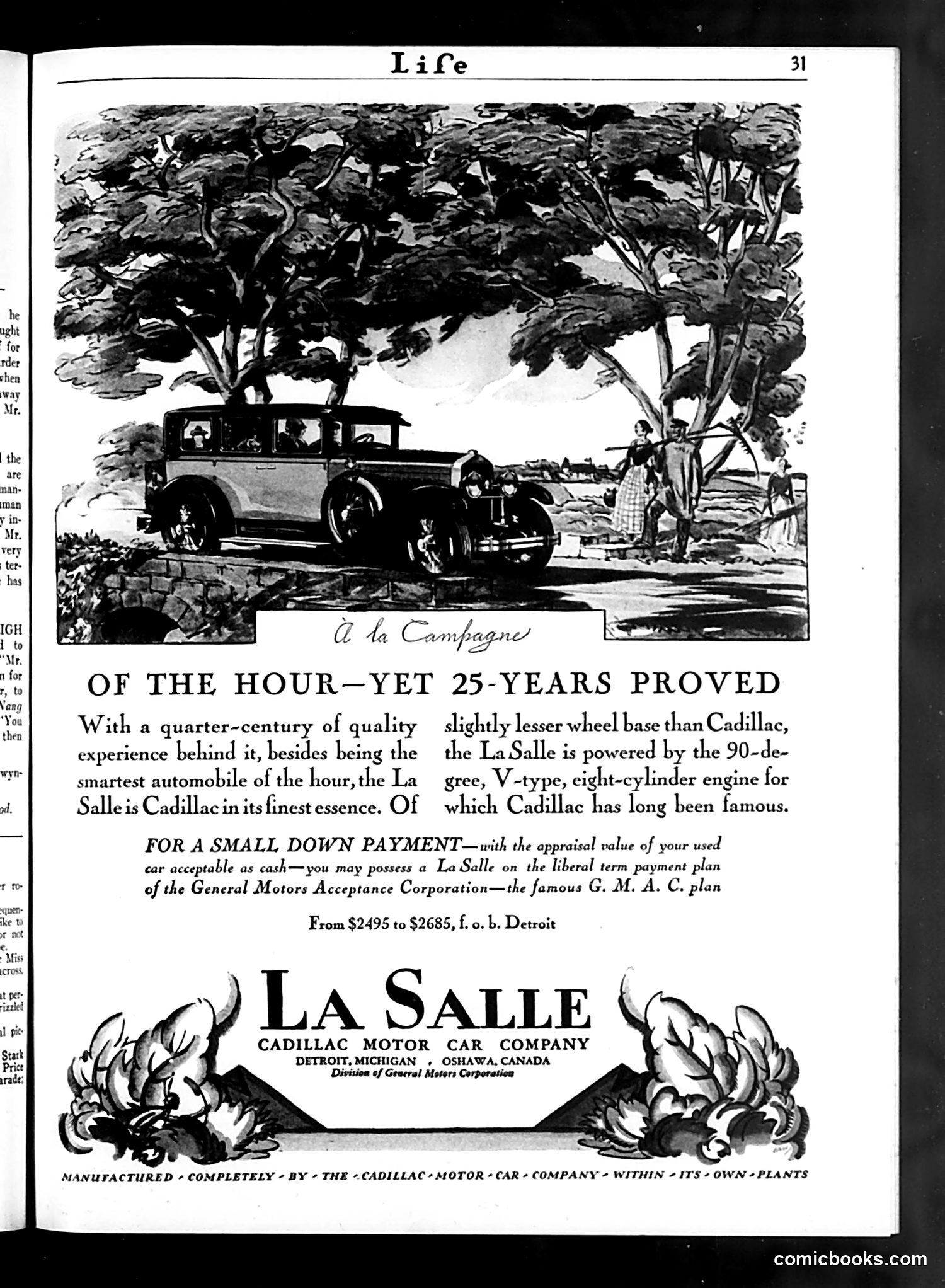
This page is **not a cartoon or satire**—it's a straightforward automobile advertisement. The illustration titled "à la Campagne" shows a La Salle luxury car parked beneath trees in a rural setting, depicting aspirational leisure. The ad promotes the La Salle as "Cadillac in its finest essence"—positioning it as an affordable entry to Cadillac's prestige. Key selling points include its 25-year track record, V-8 engine, and financing through General Motors Acceptance Corporation (G.M.A.C.), allowing buyers to trade in used cars as down payments. Priced $2,495–$2,685 (substantial for the era), the La Salle targeted middle-to-upper-class consumers seeking luxury without premium Cadillac pricing. The rural idyll imagery emphasizes freedom and elegance—common 1920s–30s automotive marketing appeals to emerging car culture and leisure mobility.
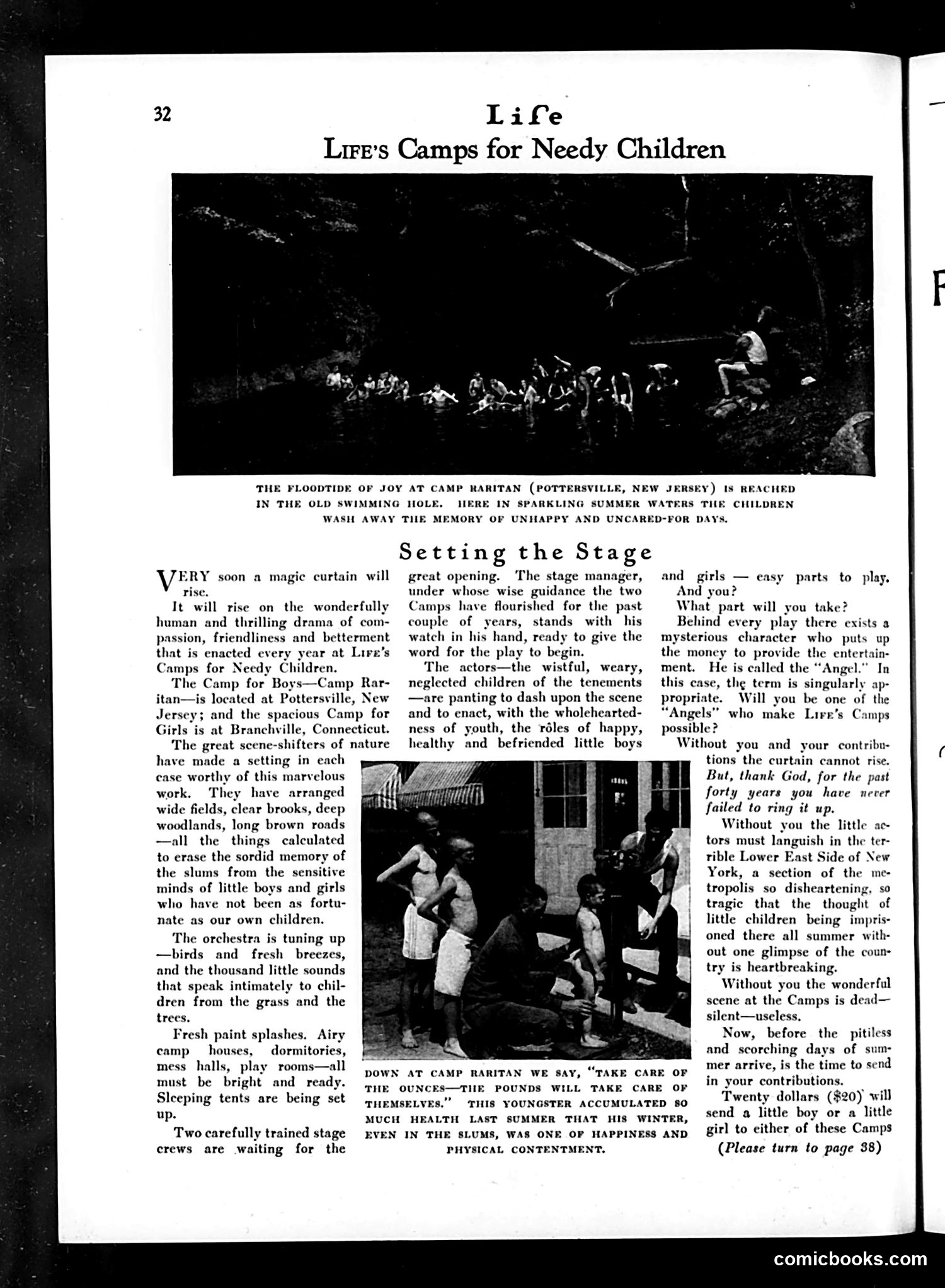
This page is not satire but rather a earnest charitable appeal. Life magazine is fundraising for its own philanthropic camps—Camp Raritan (boys, New Jersey) and Camp for Girls (Connecticut)—which provided summer respite for impoverished urban children, primarily from New York's Lower East Side tenements. The article uses theatrical metaphor ("Setting the Stage") to frame the camps as a redemptive drama. Children are cast as "actors" needing rescue from squalid slum conditions. The photographs show children swimming and playing—evidence of the camps' restorative work. The appeal is explicitly stated: Life seeks "Angels" (wealthy donors) to contribute $20 per child's summer placement. The rhetoric emphasizes moral obligation—without donors' support, disadvantaged children remain trapped in tragic urban poverty all summer. This reflects Progressive Era philanthropic messaging: charitable organizations positioned themselves as saviors providing nature, health, and happiness to the deserving poor.
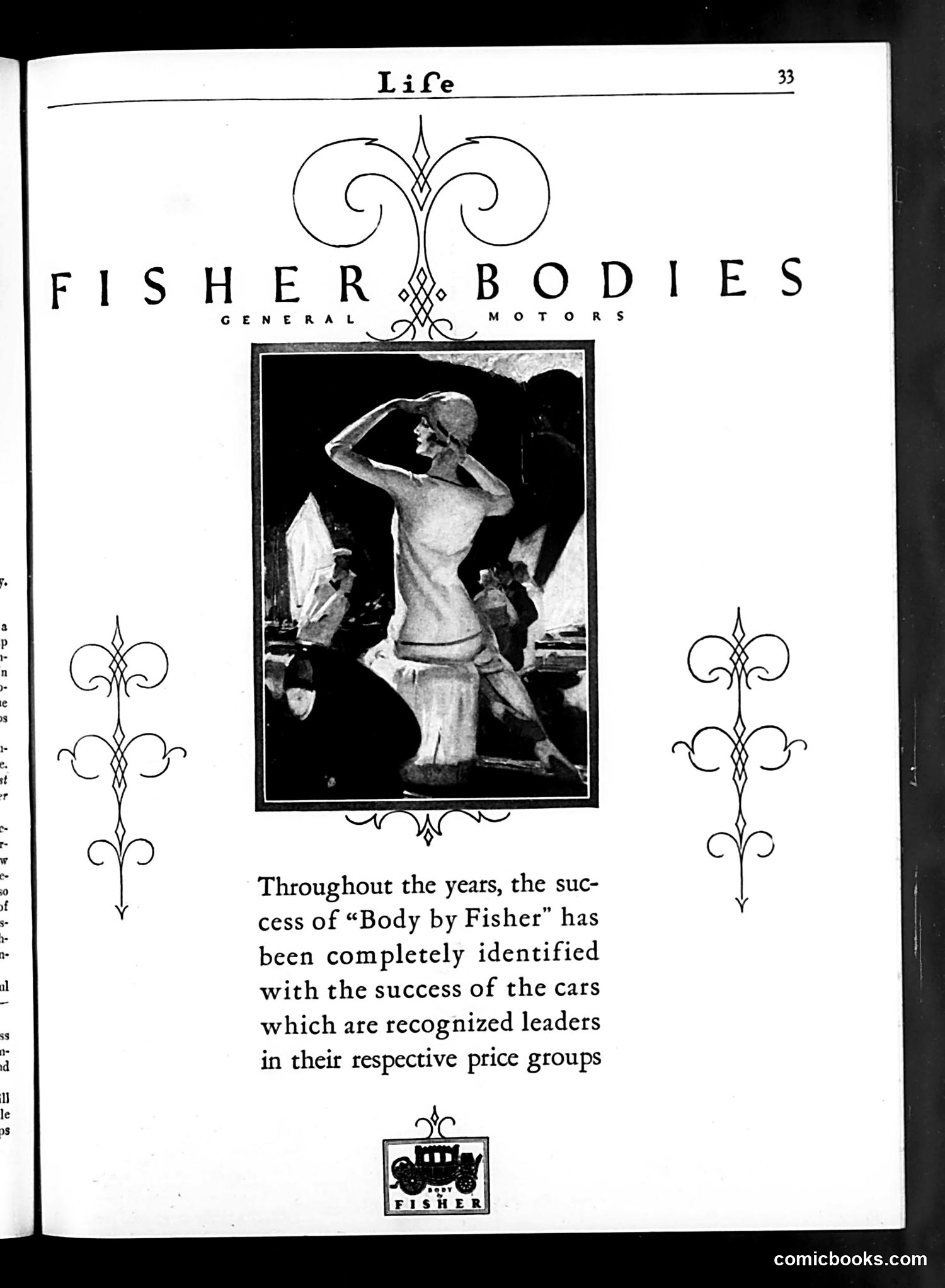
This is an advertisement for Fisher Body, a General Motors division that manufactured car bodies. Rather than satire, it's a branded marketing page designed to associate Fisher Body with luxury and success. The image shows a stylized woman in an Art Deco pose, consistent with 1920s-30s advertising aesthetics. The decorative fleur-de-lis motifs and ornate typography reinforce an upscale brand identity. The text claims Fisher Body's reputation for quality car construction parallels the success of General Motors vehicles across different price ranges. The advertisement uses aspirational imagery—the elegant female figure—to suggest that owning a Fisher Body car conveys sophistication and status, a common marketing strategy of the era. This is primarily commercial content rather than political commentary or satire.
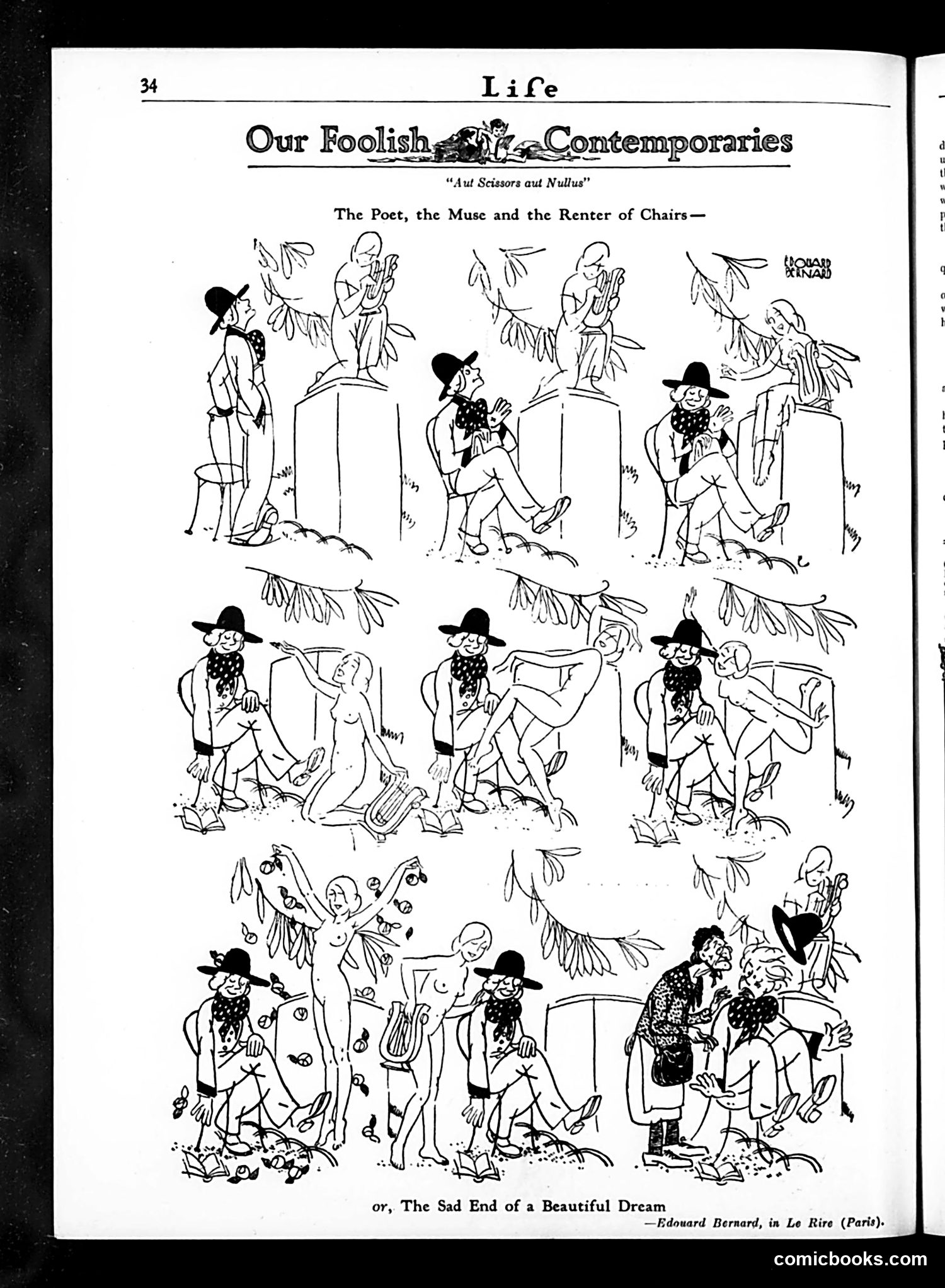
This is a satirical comic strip by French artist Edouard Bernard, republished in Life magazine. It depicts "The Poet, the Muse and the Renter of Chairs"—a narrative about romantic idealism meeting harsh reality. The sequence shows a poet courting a muse (nude female figure) in an idyllic garden setting beneath hanging foliage. A man in a hat (the chair renter) repeatedly interrupts their romantic moments, demanding payment. The strip progresses from the poet's initial courtship through increasingly awkward confrontations, culminating in the couple being chased away. The satire mocks both the poet's impractical romanticism and the crass materialism of commerce—the "renter of chairs" literally commodifying public space and interrupting artistic/amorous pursuits. The Latin subtitle "Aut Scissors aut Nullus" suggests art must cut away illusions or face oblivion. It's a bittersweet commentary on how practical financial demands destroy bohemian dreams.
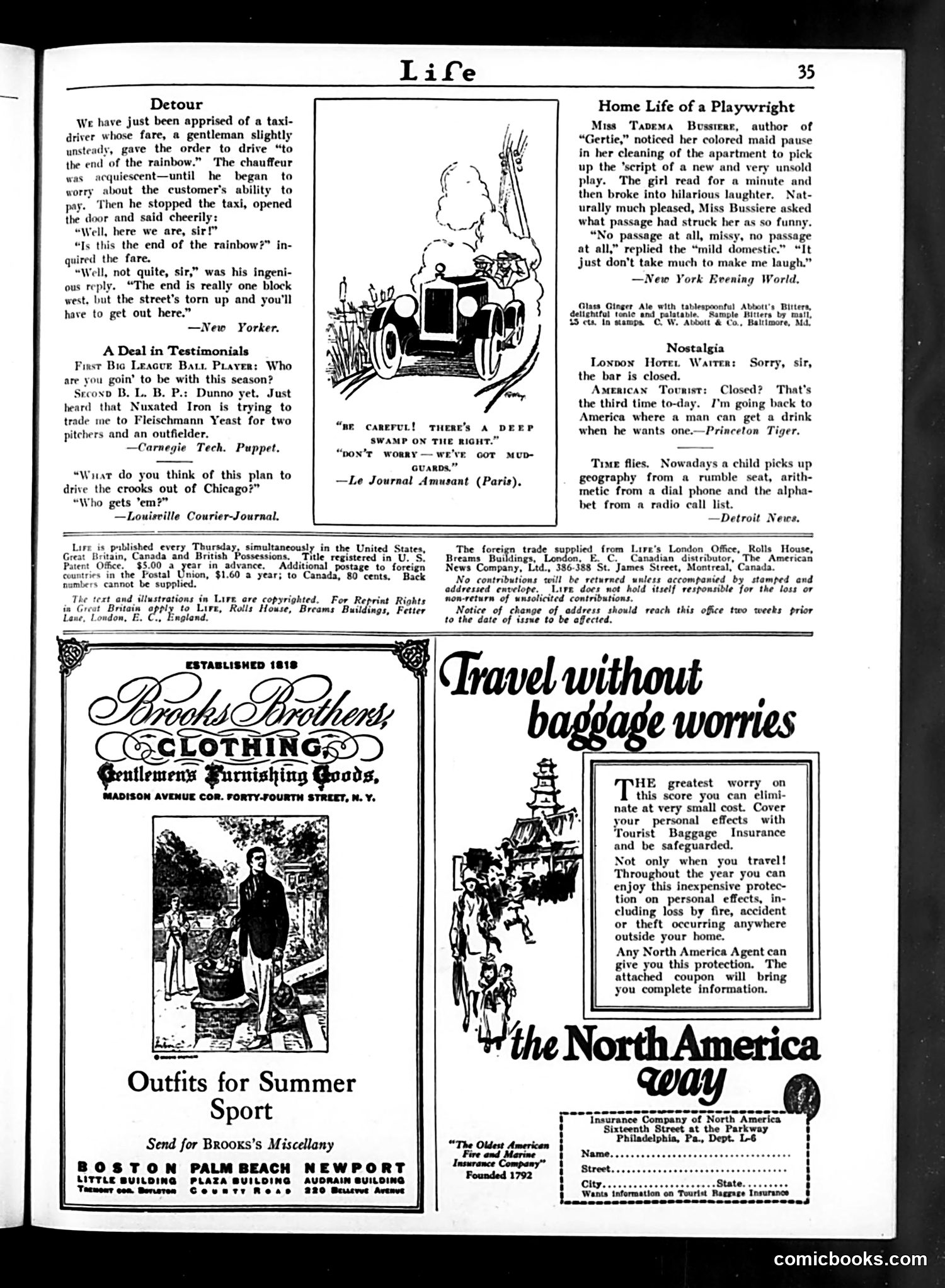
This page contains several short humorous anecdotes typical of Life's satirical format: **"Detour"** mocks a taxi driver's dishonesty—when a drunk passenger requests to be driven "to the end of the rainbow," the driver invents an excuse (street construction) to stop early and collect payment, exploiting the customer's impaired judgment. **"A Deal in Testimonials"** satirizes how commercial advertisements infiltrated even sports discussion—a baseball player discusses being "traded" between yeast and iron supplement brands, suggesting athletes' endorsements had become absurdly transactional. **"Home Life of a Playwright"** presents a joke about theatrical quality: a maid laughs at a playwright's unproduced script not because of any particular passage, but simply because "it don't take much to make me laugh"—implying the play itself is inherently laughable. The remaining brief jokes mock Prohibition-era bar closures and modern children learning skills from cars and radios rather than formal education. The page is primarily content-focused rather than advertising-heavy.
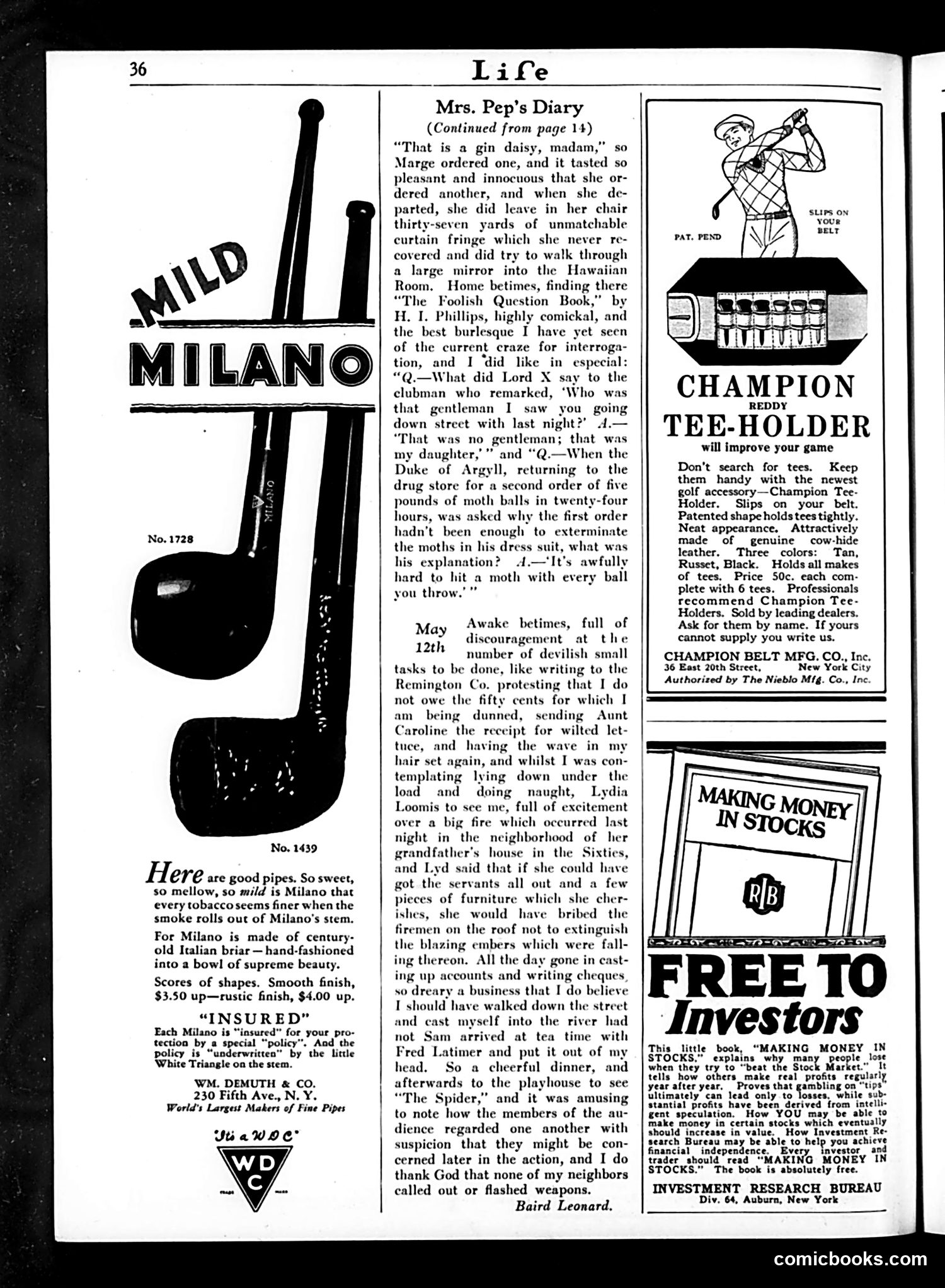
This is primarily a **magazine advertising page** from Life magazine, circa 1920s. The main content includes: **Milano Pipe Advertisement** (left): Promotes Italian briar smoking pipes, emphasizing their quality construction and "insured" guarantee marked by a white triangle symbol. **Mrs. Pep's Diary** (center): A serialized humorous diary column describing a society woman's mundane daily activities—dealing with cocktails, household tasks, and attending theater. The tone is satirical, mocking upper-class leisure and petty concerns. **Champion Tee-Holder Advertisement** (right): A golf accessory marketed as a belt attachment for holding golf tees. **Additional Advertisement** (bottom right): Promoting a stock investment book promising financial guidance. The page represents typical 1920s consumer culture and entertainment—mixing social satire with product advertisements targeting affluent readers. The diary's humor relies on exaggeration of trivial problems faced by wealthy women of the era.
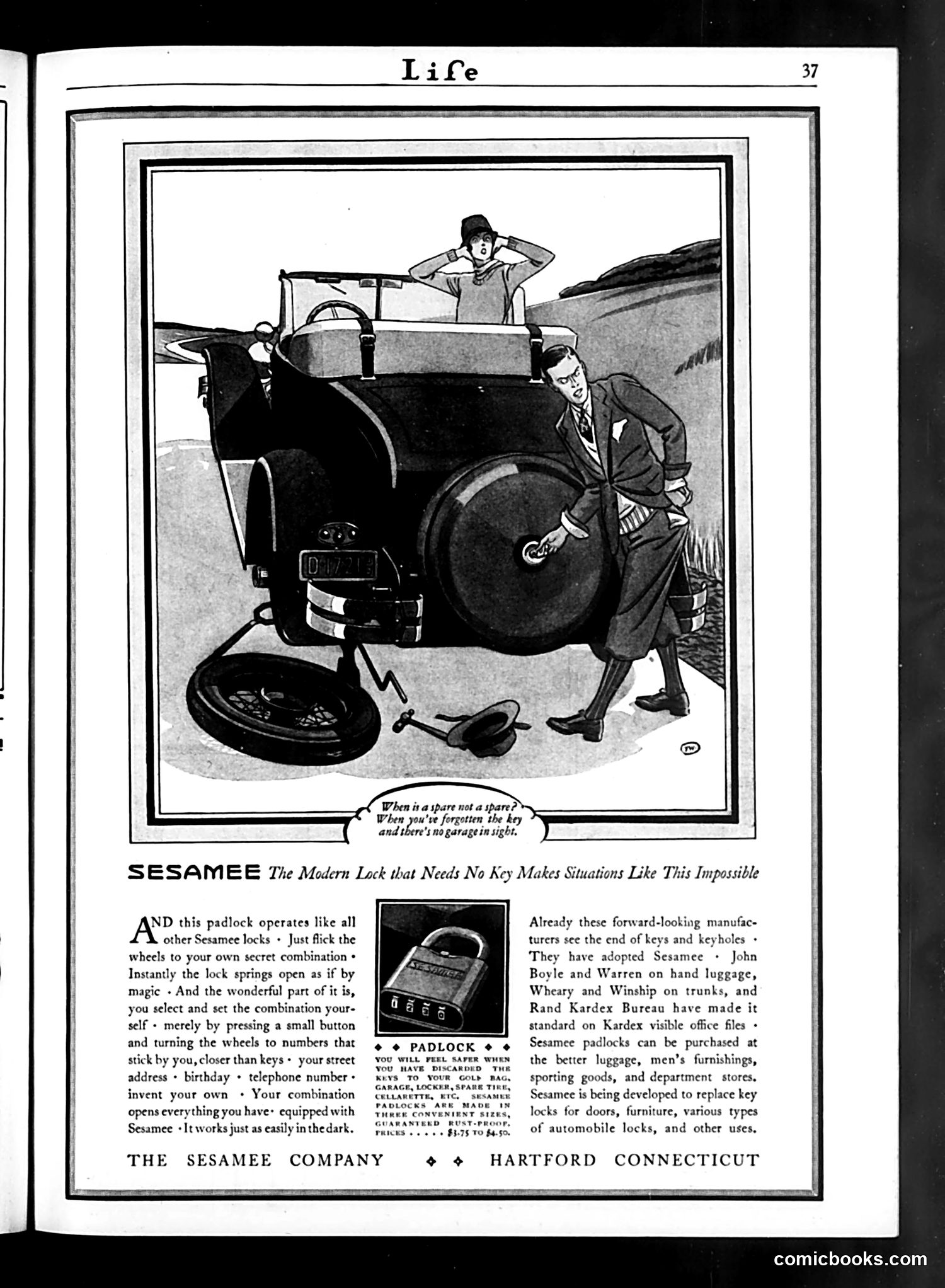
This is primarily an advertisement for the Sesamee brand combination padlock, not political satire. The cartoon illustrates the product's convenience by showing a humorous scenario: a motorist has forgotten his car keys and is stranded without a garage nearby—a common anxiety of the early automobile era. The joke's premise: "When is a spare not a spare? When you've forgotten the key and there's no garage in sight." The solution: use Sesamee's keyless combination lock instead, eliminating the problem of lost or forgotten keys. The ad emphasizes the lock's advantages—user-set combinations using memorable numbers (address, birthday, phone number)—and notes that major manufacturers were already adopting it for luggage, trunks, and office files. This represents early 20th-century marketing of a genuinely innovative security product to address a real consumer frustration.
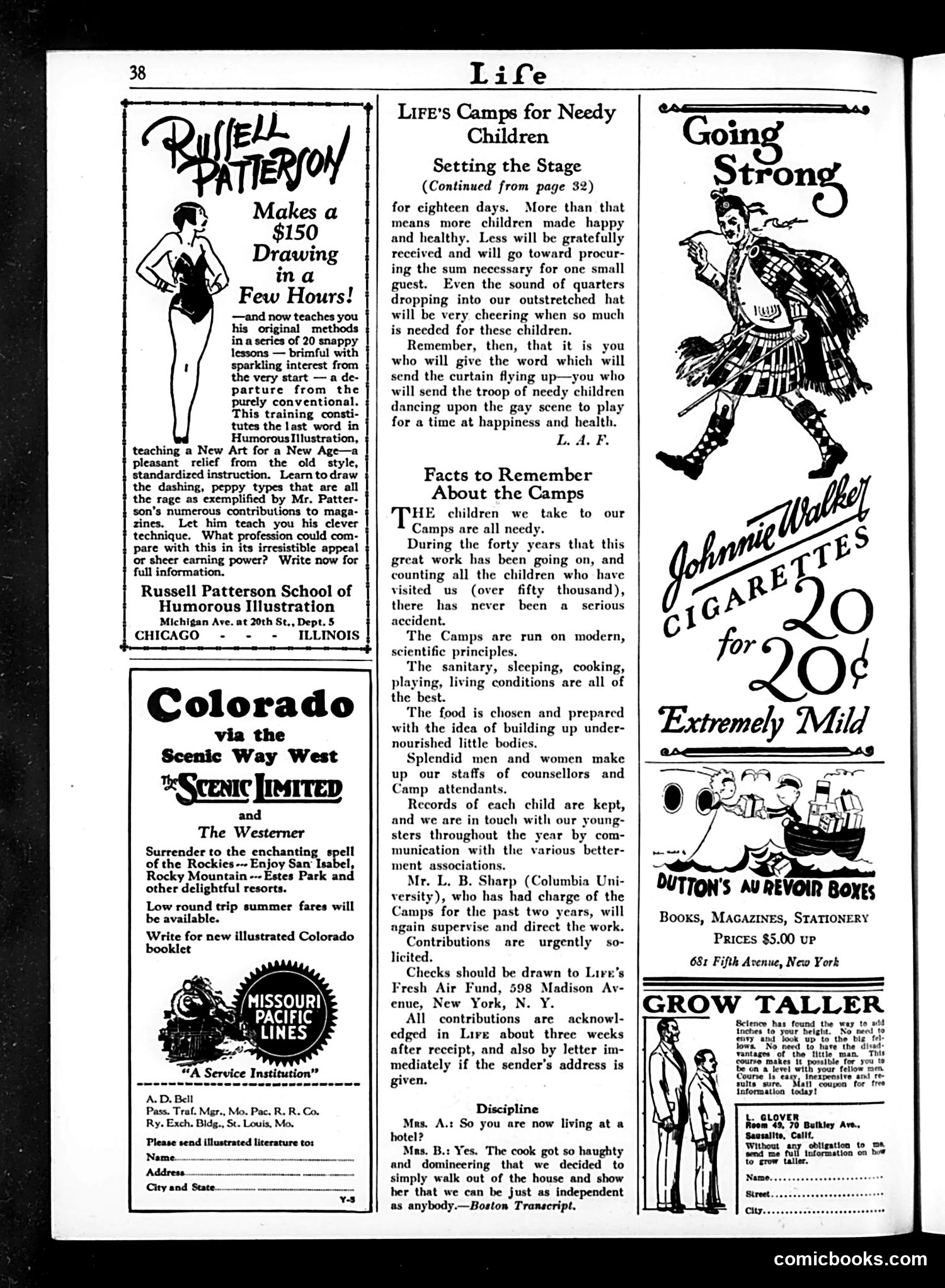
This page is primarily **advertising and public service content**, not political satire. The dominant sections are: 1. **Russell Patterson School advertisement**: An illustrator offers correspondence courses in "humorous illustration" promising $150 drawings after learning his methods—a typical early-20th-century art instruction scheme. 2. **Life's Camps for Needy Children**: A charitable campaign soliciting donations (including small contributions via an "outstretched hat") to send underprivileged children to camps for 18 days. The text emphasizes safety record and modern conditions. 3. **Supporting advertisements**: Colorado tourism, railroad service, and commercial products (cigarettes, books, height-increase courses). The small humor piece at bottom ("Discipline") offers a domestic joke about a maid asserting independence—typical of early Life magazine's lighter fare. No political cartoons or sophisticated satire appear on this page. It primarily reflects Depression-era or interwar concern for underfed urban children while showcasing commercial pitches characteristic of Life's business model.
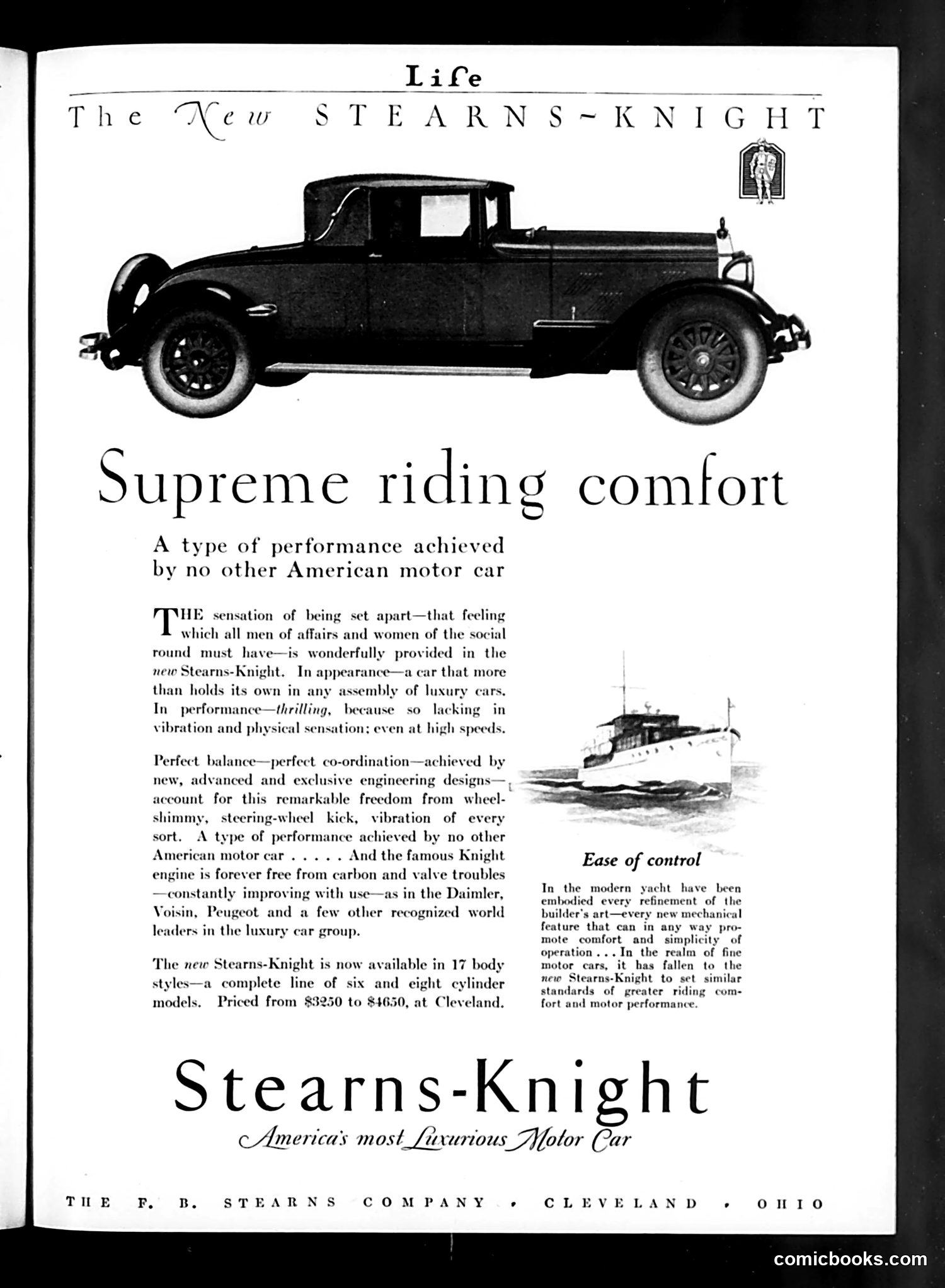
This is **not a political cartoon**—it's a luxury automobile advertisement for the Stearns-Knight motor car, published in *Life* magazine. The page promotes the 1920s Stearns-Knight as "America's most luxurious Motor Car," emphasizing its mechanical superiority: a smooth ride free from vibration, the reliability of its Knight engine, and engineering that prevents common problems like wheel-shimmy. The yacht illustration serves as a visual comparison—just as modern yachts represent refined engineering and comfort, so does the Stearns-Knight among automobiles. The ad's target audience is wealthy "men of affairs and women of the social round" seeking status and exclusivity. Priced from $3,250 to $4,650 (substantial sums in the 1920s), it competes with European luxury brands like Daimler and Peugeot. The satire *Life* might have offered about such conspicuous consumption isn't visible here—this appears to be a straightforward (if elegantly written) commercial advertisement in a magazine known for both humor and quality advertising.
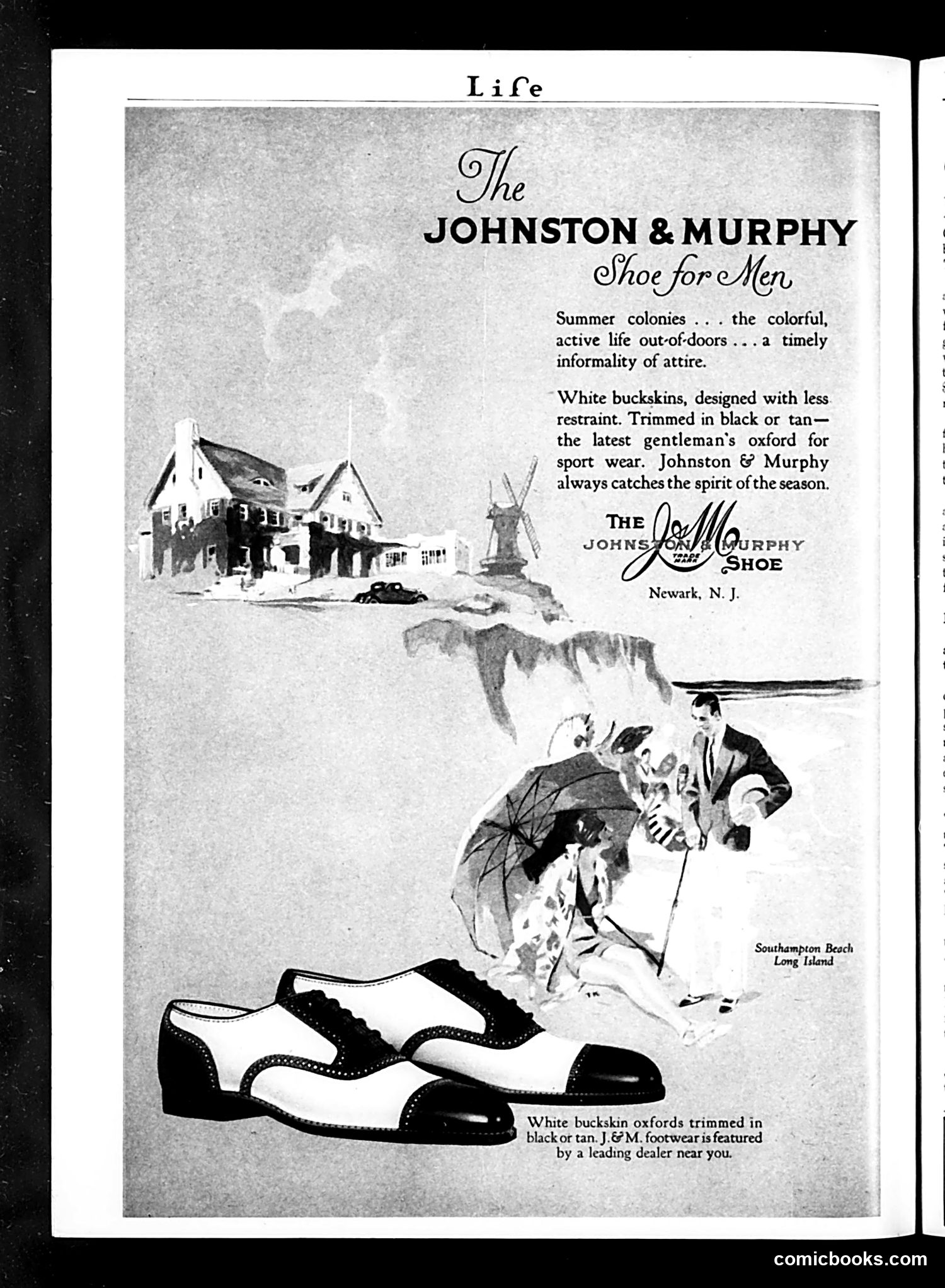
This is a **product advertisement**, not satire or political commentary. Johnston & Murphy, a Newark footwear company, promotes white buckskin oxfords as fashionable summer wear for affluent men. The ad targets wealthy leisure-class readers by depicting **Southampton Beach on Long Island**—an exclusive resort colony. The imagery shows well-dressed men and women at a beach cottage with a windmill, establishing aspirational vacation elegance. The shoes themselves are practical yet stylish: white canvas with black or tan leather trim, designed for "sport wear" and outdoor activity. The advertisement's appeal is purely social—associating the product with seasonal fashion, leisure culture, and genteel informality. There is no political message or satire here; it's straightforward vintage advertising using lifestyle imagery to sell shoes to upper-class consumers.
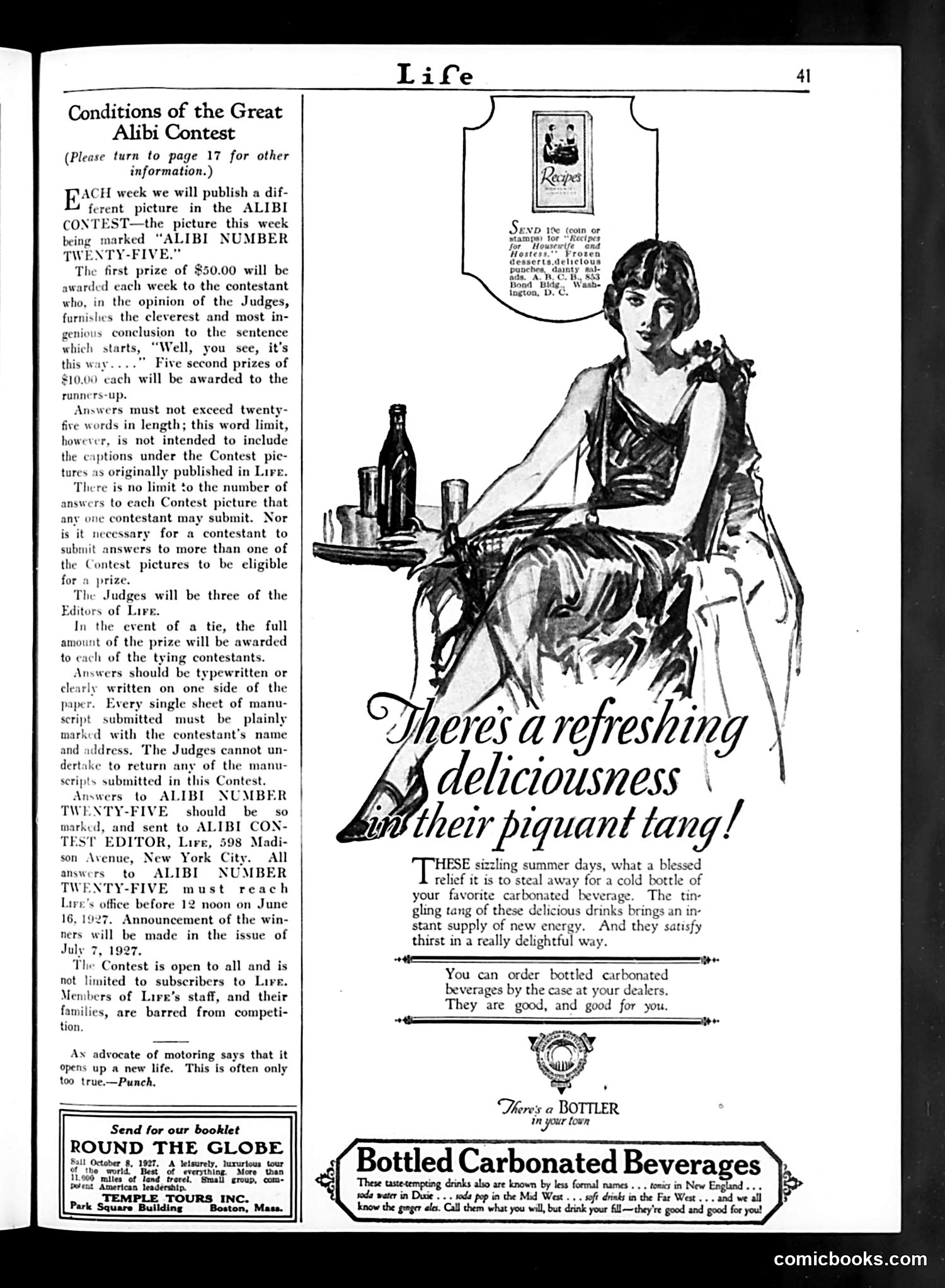
This page contains two elements: an "Alibi Contest" and a beverage advertisement. **The Contest:** Life magazine runs a weekly humor competition where readers complete captions for cartoons. The featured image shows a woman with drinks and bottles, captioned "There's a refreshing deliciousness in their piquant tang!" Contestants must finish the sentence "Well, you see, it's this way..." in 25 words or fewer. Winners receive $50 (first prize) or $10 (five runners-up). This was a common interactive feature in 1920s magazines, inviting reader participation and humor submissions. **The Advertisement:** The bottom half advertises "Bottled Carbonated Beverages"—generic sodas and soft drinks. The ad acknowledges regional naming variations (soda pop, soda water, ginger ale) while promoting bottled versions available by case. This reflects pre-Prohibition era beverage marketing, emphasizing mass-produced, commercially bottled drinks as modern conveniences.
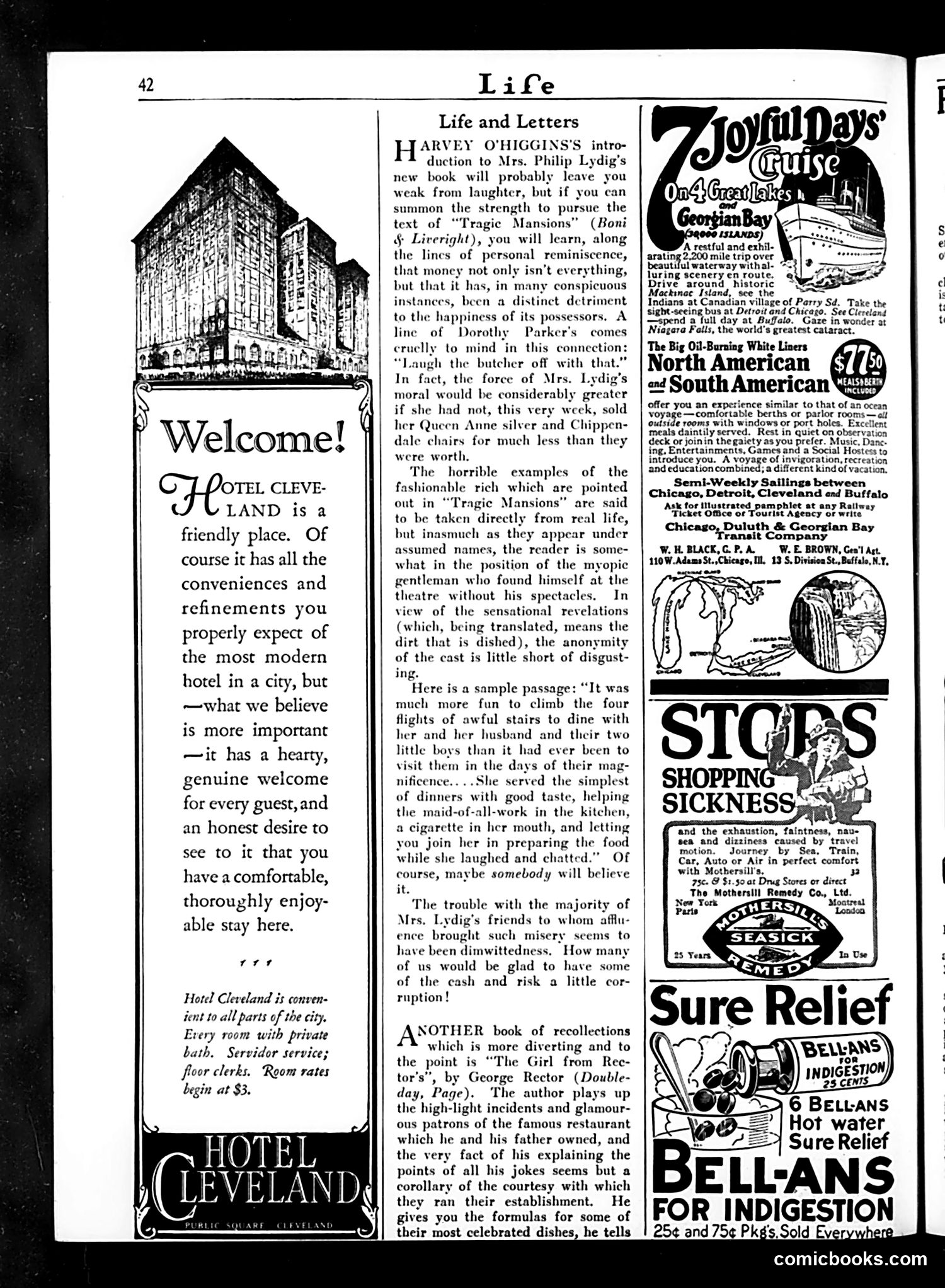
This page is primarily **advertising and book reviews**, not political satire. The left side features a hotel advertisement for Hotel Cleveland, emphasizing its modern conveniences and friendly service at $3/night rates. The center contains "Life and Letters," a book review section discussing Mrs. Philip Lydig's "Tragic Mansions"—a memoir about wealthy families whose money brought unhappiness. The reviewer is satirical about Lydig herself: she writes moralistically about the corrupting effects of wealth while simultaneously selling her own valuable antiques (Queen Anne silver, Chippendale chairs) at a loss. The critic also mocks the book's use of pseudonyms for real people, comparing readers to myopic theater-goers without spectacles. There's sardonic commentary that ordinary people would gladly risk "a little corruption" for such wealth. The right side shows various advertisements (cruise ships, shopping, indigestion remedies). The satire targets wealthy memoir-writers who critique wealth's moral dangers while profiting from their own possessions—a form of hypocrisy Life's readers would recognize.
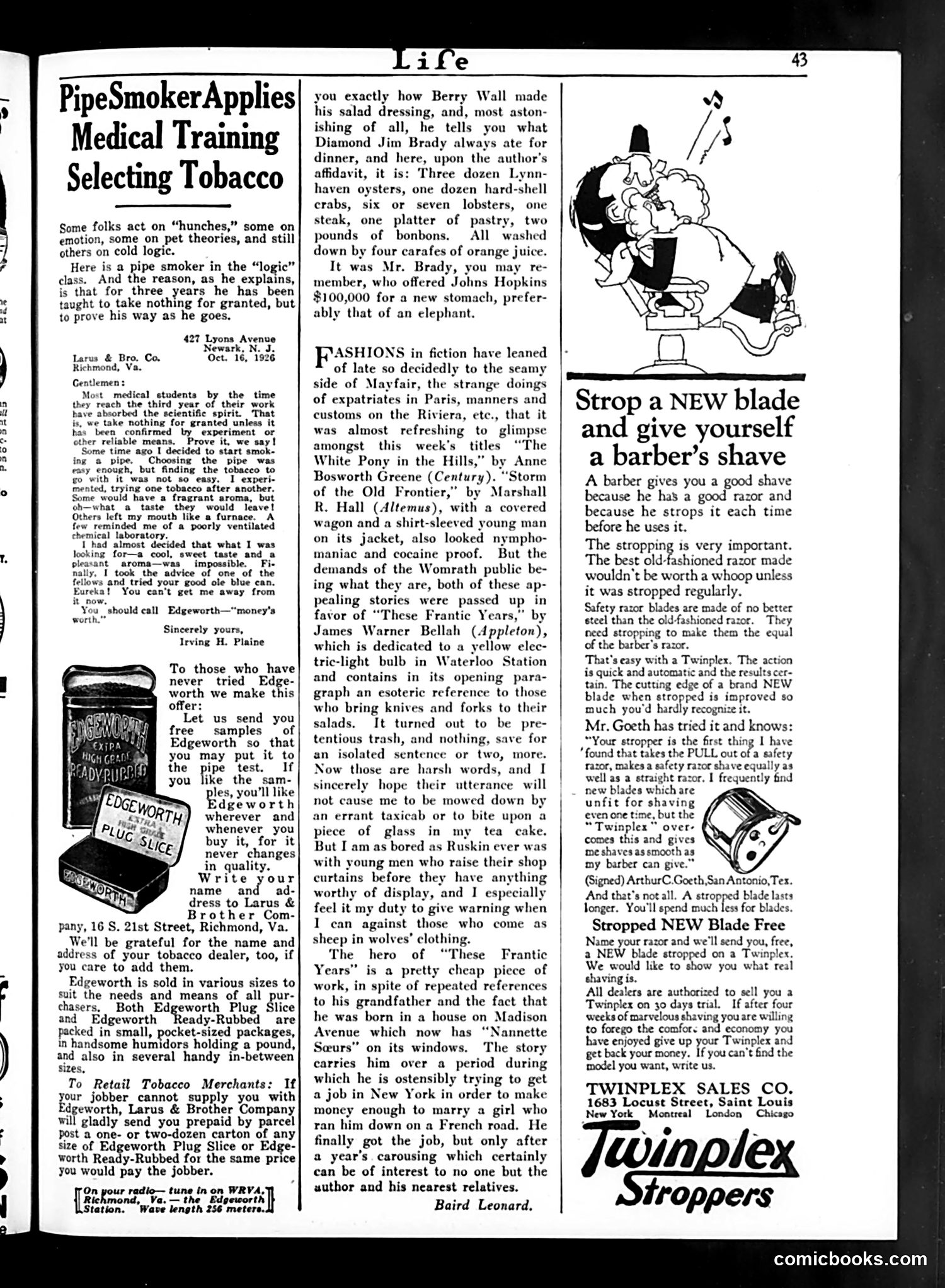
This page is primarily **advertising content** disguised as editorial material. The main feature is a testimonial letter from "Irving H. Plaine," a medical student praising Edgeworth pipe tobacco. The letter's structure mimics scientific reasoning—the student claims to have "experimentally" tested various tobaccos before finding Edgeworth superior. This is satirical: the "medical training" framing is tongue-in-cheek, treating tobacco selection with mock-scientific rigor to humorously legitimize a commercial product. The accompanying cartoon (top right) depicts a man smoking, reinforcing the product's appeal. The right column contains unrelated editorial content about fashions in fiction and references to figures like Diamond Jim Brady (a famous early-20th-century financier known for extravagant dining). The Twinplex Stropper advertisement below discusses razor blade maintenance, a contemporary consumer product. This entire page exemplifies **1920s advertising strategy**: merging entertainment, credibility claims, and product promotion within a magazine's editorial space.
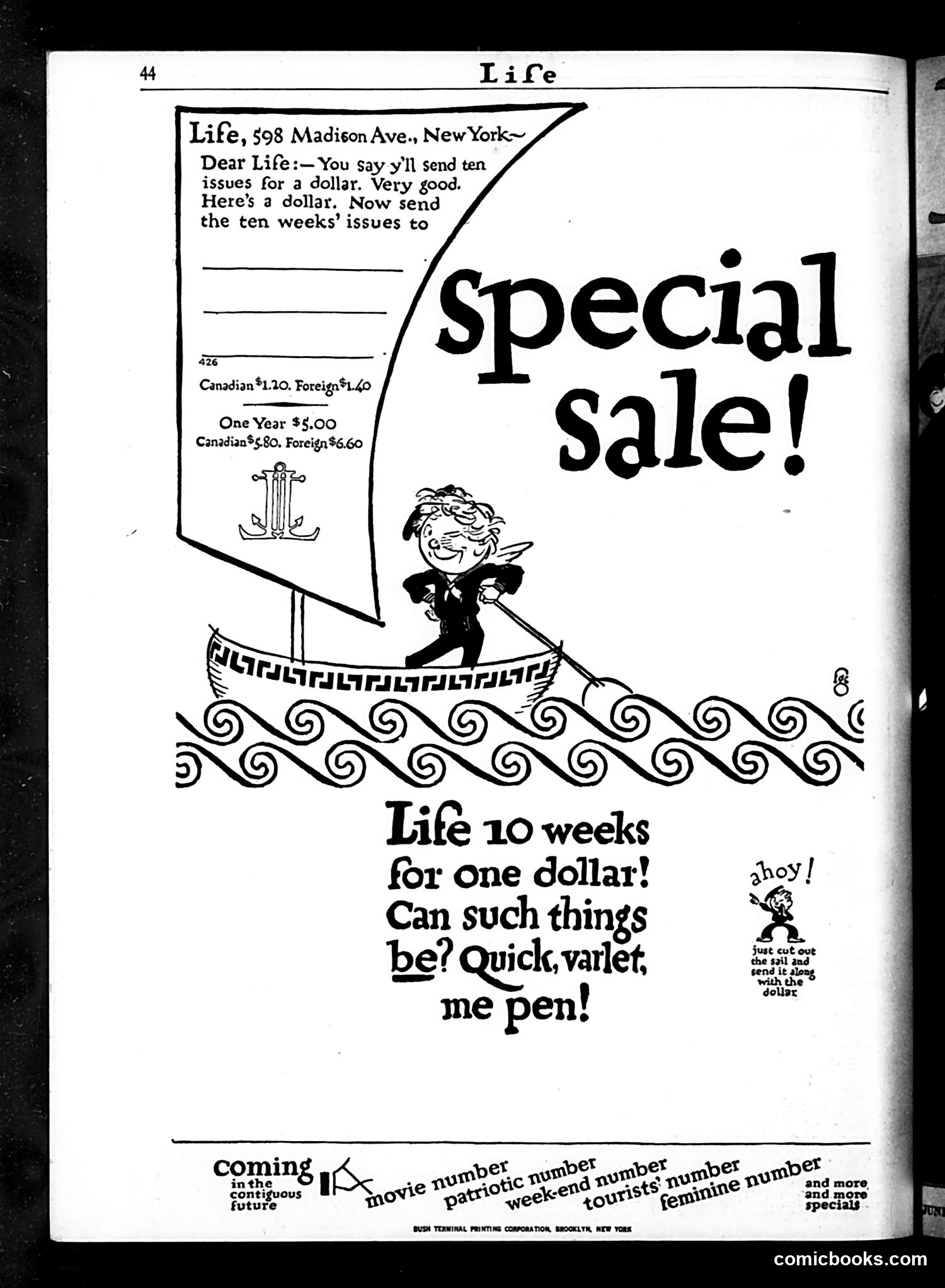
This is primarily a **subscription advertisement** for Life magazine, not political satire. The page promotes a special offer: ten weeks of Life for one dollar. The cartoon depicts a caricatured figure (appears to be a stock "eager customer" character, not a specific political figure) in a boat, enthusiastically responding to the magazine's bargain offer. The character exclaims "Quick, varlet, me pen!" — using mock-theatrical language to emphasize excitement about the deal. The satire is **self-directed**: Life is making fun of its own offer by presenting it as almost too good to be true ("Can such things be?"), using exaggerated language to highlight how unusually cheap the subscription is. The boat imagery and theatrical tone add whimsy rather than political commentary. The page includes pricing for Canadian and foreign subscriptions, and teases upcoming special issues (movie, patriotic, weekend, tourists', feminine numbers).