
Life, 1927-06-02 · page 26 of 46
Life — June 2, 1927 — page 26: what you’re looking at
What you’re looking at
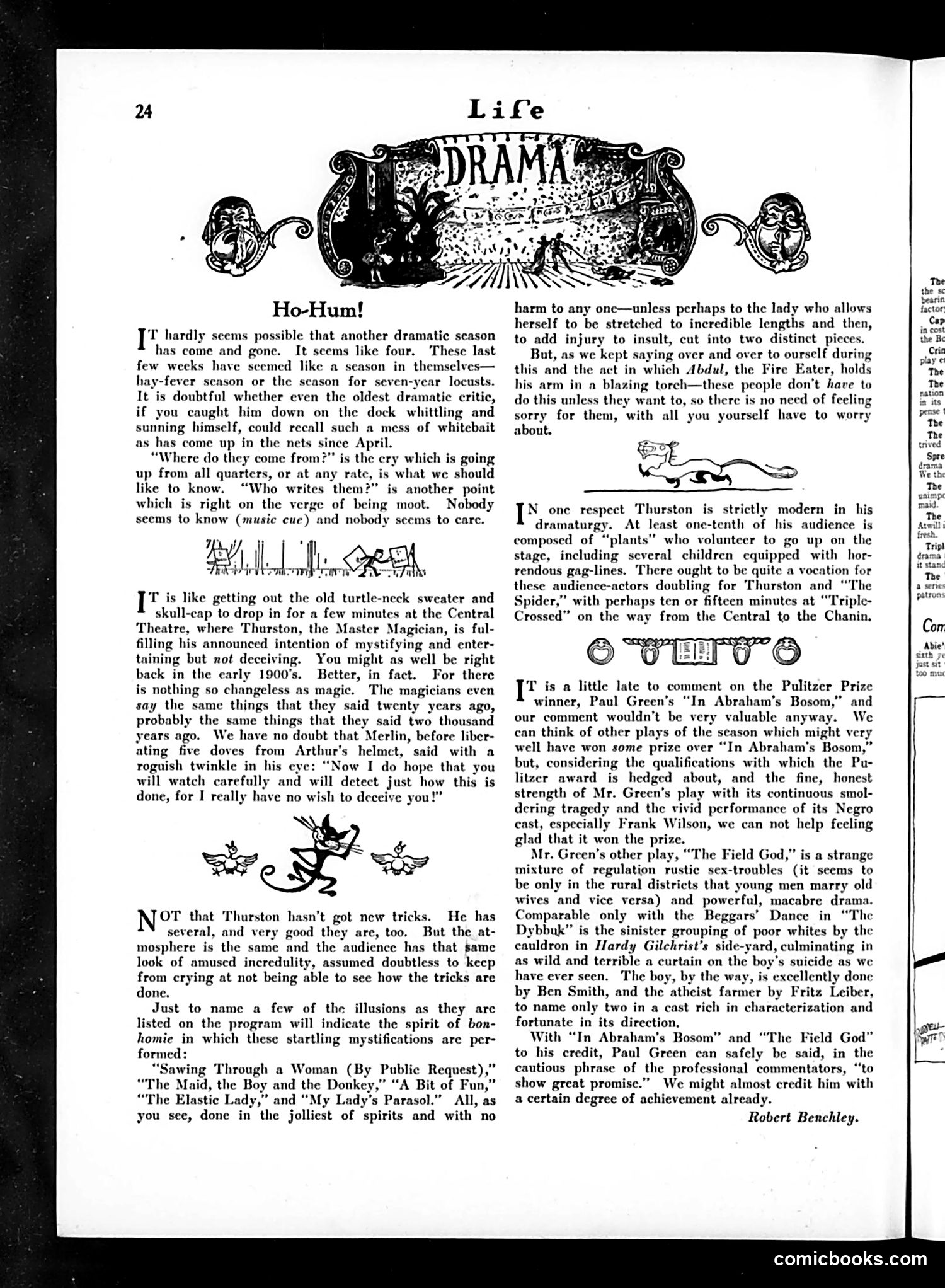
This page reviews the recent theatrical season, expressing exasperation at the volume of mediocre new plays. The writer sarcastically notes that dramatic critics struggle to recall such a "mess of whitebait" (worthless plays) since April, questioning where all these scripts originate and who writes them. The review contrasts this chaos with the timeless, unchanging appeal of magician Thurston's show—his patter and illusions remain identical to those from decades past, yet audiences remain entertained. The writer notes Thurston modernly employs "plants" (audience members) as volunteer participants. The piece concludes by praising Paul Green's Pulitzer Prize-winning play "In Abraham's Bosom," commending its "honest strength" and the vivid performance by its Black cast member Frank Wilson, while acknowledging other season plays might have merited the award. The overall tone is one of theatrical fatigue mixed with genuine appreciation for quality work.
📄 Transcribed text from this page (OCR, searchable)
Machine-transcribed from the original scan — historical spelling and the odd misread are preserved.
I" hardly seems possible that another dramatic season has come and gone. It scems like four. These last few weeks have scemed like a season in themselves hay-fever season or the scason for seven-year loc! It is doubtful whether even the oldest dramatic critic, if you caught him down on the dock whittling and sunning himself, could recall such a mess of whitebait as has come up in the nets since April. “Where do they come from?” is the ery which is going up from all quarters, or at any rate, is what we should like to know. “Who writes them?” is another point which is right on the verge of being moot. Nobody seems to know (music cue) and nobody seems to care. I‘ is like getting out the old turtle-neck sweater and skull-cap to drop in for a few minutes at the Central Theatre, where Thurston, the Master Magician, is ful- filling his announced intention of mystifying and enter- taining but not deceiving. You might as well be right back in the carly 1900's. Better, in fact. For there is nothing so changeless as magic. The magicians even say the same things that they said twenty years ago, probably the same things that they said two thousand years ago. We have no doubt that Merlin, before liber- ating five doves from Arthur's helmet, * said with a roguish twinkle in his eye: “Now I do hope that you will watch carefully and will detect just how this is done, for I really have no wish to deceive you!” re ee OT that Thurston hasn't got new tricks. He has several, and very good they are, too. But the at- mosphere is the same and the audience has that same look of amused incredulity, assumed doubtless to keep from crying at not being able to see how the tricks are done. Just to name a few of the illusions as they are listed on the program will indicate the spirit of bon- homie in which these startling mystifications are per- formed: “Sawing Through a Woman (By Public Request),” “The Maid, the Boy and the Donkey,” “A Bit of Fun,” “The Elastic Lady,” and “My Lady’s Parasol.” All, as you see, done in the jolliest of spirits and with no harm to any onc—unless perhaps to the lady who allows herself to be stretched to incredible lengths and then, to add injury to insult, cut into two distinct pieces. But, as we kept saying over and over to ourself during this and the act in which Abdul, the Fire Eater, holds his arm in a blazing torch—these people don’t have to do this unless they want to, so there is no need of feeling sorry for them, with all you yourself have to worry about. I’ one respect Thurston is strictly modern in his dramaturgy. At least one-tenth of his audience is composed of “plants” who volunteer to go up on the stage, including several children equipped with hor- rendous gag-lines. There ought to be quite a vocation for these audience-actors doubling for Thurston and “The ider,” with perhaps ten or fifteen minutes at ““Triple- Crossed” on the way from the Central to the Chanin, I" is a little late to comment on the Pulitzer Prize winner, Paul Green's “In Abraham's Bosom,” and our comment wouldn't be very valuable anyway. We can think of other plays of the season which might very well have won some prize over “In Abraham's Bosom,” but, considering the qualifications with which the Pu- litzer award is hedged about, and the fine, honest strength of Mr. Green’s play with its continuous smol- dering tragedy and the vivid performance of its Negro east, especially Frank Wilson, we can not help feeling glad that it won the prize. Mr. Green’s other play, “The Field God,” is a strange mixture of regulation rustic sex-troubles (it seems to be only in the rural districts that young men marry old wives and vice versa) and powerful, macabre drama. Comparable only with the Beggars’ Dance in “The Dybbuk” is the sinister grouping of poor whites by the cauldron in Hardy Gilchrist’s side-yard, culminating in as wild and terrible a curtain on the boy's suicide as we have ever seen. The boy, by the way, is excellently done by Ben Smith, and the atheist farmer by Fritz Leiber, to name only two in a cast rich in characterization and fortunate in its direction. With “In Abraham’s Bosom” and “The Field God” to his credit, Paul Green can safely be said, in the cautious phrase of the professional commentators, “to show great promise.” We might almost credit him with a certain degree of achievement already. Robert Benchley. comicbooks.com