
Life, 1927-06-02 · page 22 of 46
Life — June 2, 1927 — page 22: what you’re looking at
What you’re looking at
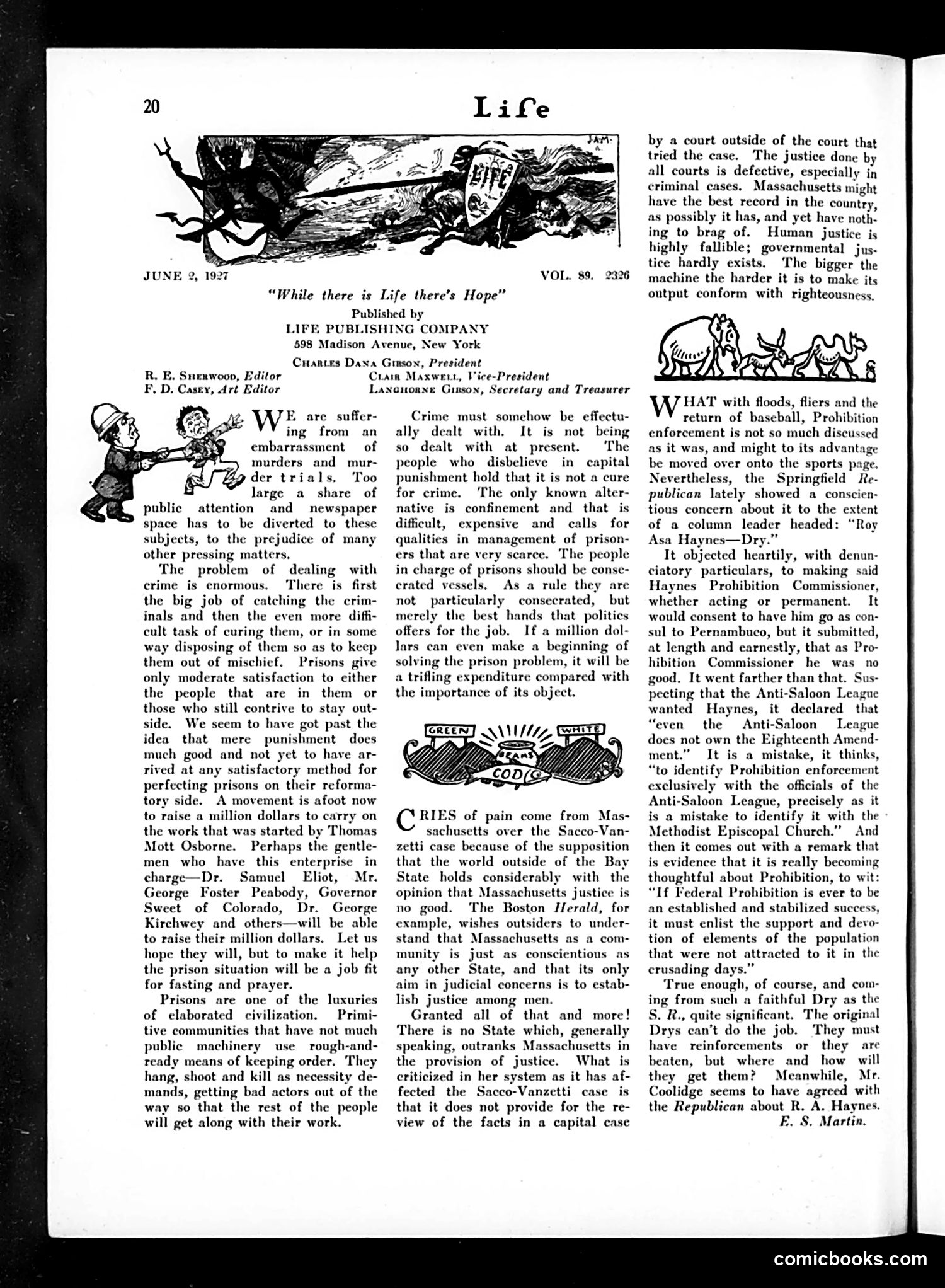
This editorial page addresses two major issues: prison reform and the controversial Sacco-Vanzetti case. The opening cartoon depicts two small figures (appearing to represent criminals or defendants) fleeing from a large, menacing figure labeled "JAIL"—satirizing public anxiety about crime and inadequate criminal justice. The main text criticizes America's overwhelmed criminal justice system, advocating for prison reform funding (mentioning Thomas Mott Osborne's initiative) over capital punishment, which the editors view as ineffective. The second section defends Massachusetts against criticism over the Sacco-Vanzetti case—the controversial trial of two Italian anarchists accused of murder. Life argues that while Massachusetts has a good judicial reputation, the case exposes a systemic flaw: capital cases lack independent appellate review of facts. The editors suggest that even well-intentioned legal systems can fail, critiquing the state's refusal to allow external court review of the trial's evidence.
📄 Transcribed text from this page (OCR, searchable)
Machine-transcribed from the original scan — historical spelling and the odd misread are preserved.
JUNE 2, 1927 VOL. 89. 2326 “While there is Life there’s Hope” Published by LIFE PUBLISHING COMPANY 898 Madison Avenue, New York Cuantes Dana Gmson, President Surwoon, Editor Casey, Art Editor 2, WE are suffer- ing from an embarrassment of murders and mur- der trials. Too large a share of public attention and newspaper space has to be diverted to these subjects, to the prejudice of many other pressing matters. The problem of dealing with crime is enormous. There is first the big job of catching the crim- inals and then the even more diffi- cult task of curing them, or in some way disposing of them so as to keep them out of mischief. Prisons give only moderate satisfaction to either the people that are in them or those who still contrive to stay out- side. We seem to have got past the idea that mere punishment does much good and not yet to have ar- rived at any satisfactory method for perfecting prisons on their reforma- tory side. A movement is afoot now to raise a million dollars to carry on the work that was started by Thomas Mott Osborne. Perhaps the gentle- men who have this enterprise in charge—Dr. Samuel Eliot, Mr. ‘orge Foster Peabody, Governor Sweet of Colorado, Dr. George Kirchwey and others—will be able to raise their million dollars. Let us hope they will, but to make it help the prison situation will be a job fit for fasting and prayer. Prisons are one of the luxuries of elaborated civilization. Primi- tive communities that have not much public machinery use rough-and- ready means of keeping order. They hang, shoot and kill as necessity de- mands, getting bad actors out of the way so that the rest of the people will get along with their work. Crain Maxweit, Vice-President Lanouorne Ginson, Secretary and Treasurer Crime must somehow be effectu- ally dealt with. It is not being so dealt with at present. The people who disbelieve in capital punishment hold that it is not a cure for crime. The only known alter- native is confinement and that is difficult, expensive and calls for qualities in management of prison- ers that are very scarce. The people in charge of prisons should be conse- crated vessels. As a rule they are not particularly consecrated, but merely the best hands that polities offers for the job. If a million dol- lars can even make a beginning of solving the prison problem, it will be a trifling expenditure compared with the importance of its object. CRIES of pain come from Mas- sachusetts over the Sacco-Van- zetti case because of the supposition that the world outside of the Bay State holds considerably with the opinion that Massachusetts justice is no good. The Boston Herald, for example, wishes outsiders to under- stand that Massachusetts as a com- munity is just as conscientious as any other State, and that its only aim in judicial concerns is to estab- lish justice among men. Granted all of that and more! There is no State which, generally speaking, outranks Massachusetts in the provision of justice. What is criticized in her system as it has af- fected the Sacco-Vanzetti case is that it does not provide for the re- view of the facts in a capital case by a court outside of the court that tried the case. The justice done by all courts is defective, especially in criminal cases. Massachusetts might have the best record in the country, as possibly it has, and yet have noth- ing to brag of. Human justice is highly fallible; governmental jus- tice hardly exists. The bigger the machine the harder it is to make its output conform with righteousness. HAT with floods, fliers and the return of baseball, Prohibition enforcement is not so much discussed as it was, and might to its advantage be moved over onto the sports page. Nevertheless, the Springfield Re- publican lately showed a conscien- tious concern about it to the extent of a column leader headed: “Roy Asa Haynes—Dry.” It objected heartily, with denun- ciatory particulars, to making said Haynes Prohibition Commissioner, whether acting or permanent. It would consent to have him go as con- sul to Pernambuco, but it submitted, at length and earnestly, that as Pro- hibition Commissioner he was no good, It went farther than that. Sus- pecting that the Anti-Saloon League wanted Haynes, it declared that “even the Anti-Saloon League does not own the Eighteenth Amend- ment.” It is a mistake, it thinks, “to identify Prohibition enforcement exclusively with the officials of the Anti-Saloon League, precisely as it is a mistake to identify it with the Methodist Episcopal Church.” And then it comes out with a remark that is evidence that it is really becoming thoughtful about Prohibition, to wit: “If Federal Prohibition is ever to be an established and stabilized success, it must enlist the support and devo- tion of elements of the population that were not attracted to it in the crusading days.” True enough, of course, and com- ing from such a faithful Dry as the S. R., quite significant. The original Drys can’t do the job. They must have reinforcements or they are beaten, but where and how will they get them? Meanwhile, Mr. Coolidge seems to have agreed with the Republican about R. A. Haynes. E. S. Martin, comicbooks.com