
Life, 1927-06-02 · page 32 of 46
Life — June 2, 1927 — page 32: what you’re looking at
What you’re looking at
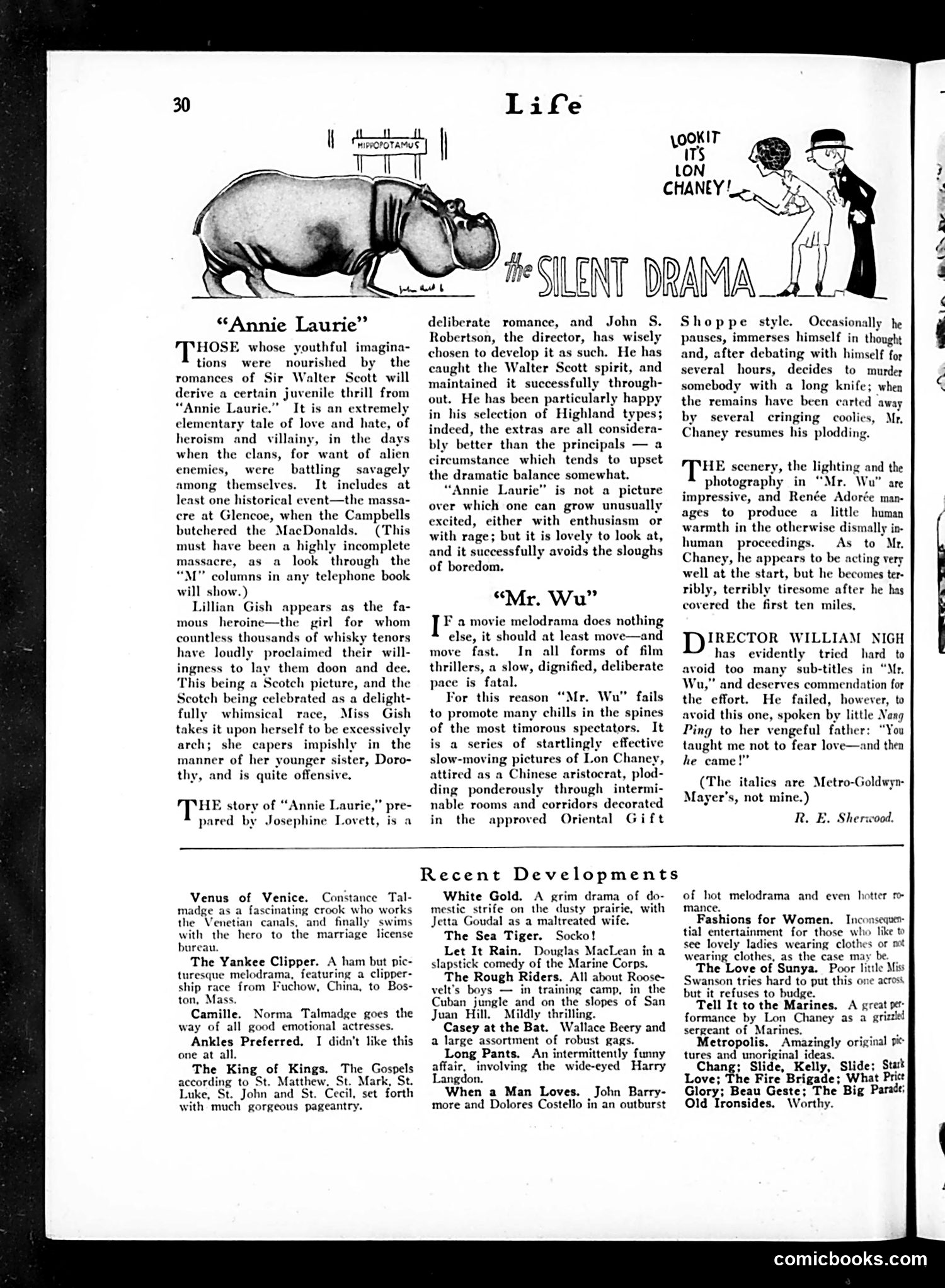
This page reviews three silent films. The cartoon at top depicts a hippopotamus labeled "PHOTOPLAYS" with two figures pointing, captioned "Look! It's Lon Chaney!" — a visual gag mocking actor Lon Chaney's prominent role in contemporary cinema. The reviews discuss *Annie Laurie* (starring Lillian Gish in a Scottish romance based on Walter Scott literature) and *Mr. Wu* (featuring Chaney as a Chinese aristocrat). The critic praises *Annie Laurie's* aesthetic appeal but finds it emotionally uninspiring, while savagely critiquing *Mr. Wu* for its glacial pacing and Chaney's "terribly, terribly tiresome" performance despite impressive cinematography. The satire targets silent-film conventions: overwrought acting styles, melodramatic plotting, and heavy reliance on visual spectacle over narrative momentum. The hippopotamus joke likely references how Chaney dominated contemporary film discourse—he was everywhere, much like the ungainly beast dominating the page.
📄 Transcribed text from this page (OCR, searchable)
Machine-transcribed from the original scan — historical spelling and the odd misread are preserved.
HOSE whose youthful imagina- tions were nourished by the romances of Sir Walter Scott will derive a certain juvenile thrill from “Annie Laurie.” It is an extremely elementary tale of love and hate, of heroism and villainy, in the days when the clans, for want of alien enemies, were battling savagely among themselves. It includes at least one historical event—the massa- cre at Glencoe, when the Campbells butchered the MacDonalds. (This must have been a highly incomplete as a look through the * columns in any telephone book will show. ) Lillian Gish appears as the fa- mous heroine—the girl for whom countless thousands of whisky tenors have loudly proclaimed their will- ingness to lay them doon and dee. This being a Scotch picture, and the Scotch being celebrated as a delight- fully whimsical race, M takes it upon herself to be excessively arch; she capers impishly in the manner of her younger sister, Doro- thy, and is quite offensive. HE story of “A pared by nie Laurie,” pre- Josephine Lovett, is a i SILENT DRAMA deliberate romance, and John S. Robertson, the director, has wisely chosen to develop it as such. He has caught the Walter Scott spirit, and maintained it successfully through- out. He has been particularly happy in his selection of Highland types; indeed, the extras are all considera- bly better than the principals — a circumstance which tends to upset the dramatic balance somewhat. “Annie Laurie” is not a picture over which one can grow unusually excited, either with enthusiasm or with rage; but it is lovely to look at, and it successfully avoids the sloughs of boredom. “Mr. Wu” F a movie melodrama does nothing else, it should at least move—and move fast. In all forms of film thrillers, a slow, dignified, deliberate pace is fatal. For this reason “Mr. Wu” fails to promote many chills in the spines of the most timorous spectators. It is a series of startlingly effective slow-moving pictures of Lon Chaney, attired as a Chinese aristocrat, plod- ding ponderously through intermi- nable rooms and corridors decorated in the approved Oriental Gift Shoppe style. Occasionally he pauses, immerses himself in thought and, after debating with himself for several hours, decides to murder somebody with a long knife; when the remains h: been carted away by several cringing coolies, Mr. Chaney resumes his plodding. HE scenery, the lighting and the photography in “Mr. Wu" are impressive, and Renée Adorée man- ages to produce a little human warmth in the otherwise dismally in- human proceedings. As to Mr, Chaney, he appears to be acting very well at the start, but he becomes ter- ribly, terribly tiresome after he has covered the first ten miles, IRECTOR WILLIAM NIGH has evidently tried hard to avoid too many sub-titles in “Mr, Wu,” and deserves commendation for the effort. He failed, however, to avoid this one, spoken by little Nang Ping to her vengeful father: “You taught me not to fear love—and then he came!” (The italics are Metro-Goldwyn- Mayer's, not mine.) R. E. She Venus of Venice. Constance Tal- madge as a fascinating crook who works the Venetian canals, and finally swims with the hero to the marriage license bureau. The Yankee Clipper. A ham but pic- turesque melodrama, featuring a clipper- ship race from Fuchow, China, to Bos- ton, Mass. Camille. Norma Talmadge goes the way of all good emotional actresses. Ankles Preferred, I didn’t like this one at all. The King of Kings. The Gospels according to St. Matthew, St. Mark, St. Luke, St. John and St. Cecil, set forth with much gorgeous pageantry. Recent Developments White Gold. A grim drama of do- mestic strife on the dusty prairie, with Jetta Goudal as a maltreated wife. The Sea Tiger. Socko! Let It Rain. Douglas MacLean ina slapstick comedy of the Marine Corps. The Rough Riders. All about Roose- velt’s boys — in training camp, in the Cuban jungle and on the slopes of San Juan Hill. Mildly thrilling. Casey at the Bat. Wallace Beery and a large assortment of robust gags. Long Pants. An intermittently funny affair, involving the wide-eyed Harry Langdon. When a Man Loves. John Barry- more and Dolores Costello in an outburst of hot melodrama and even hotter me mance. Fashions for Women. Inconsequen- tial entertainment for those who like to see lovely ladies wearing clothes or mt wearing clothes, as the case may be. ¢ Love of Sunya. Poor little Mis: Swanson tries hard to put this one across but it refuses to budge. Tell It to the Marines, A great per formance by Lon Chaney as a grizziel sergeant of Marines, Metropolis. Amazingly original pit tures and | unoriginal ideas. Chang; Slide, Kelly, Slide; Stat Love; he Fire Brigade; What Prict Glory; Beau Geste; The Big Parade; Old Ironsides. Worthy. comicbooks.com