
Life, 1927-06-02 · page 45 of 46
Life — June 2, 1927 — page 45: what you’re looking at
What you’re looking at
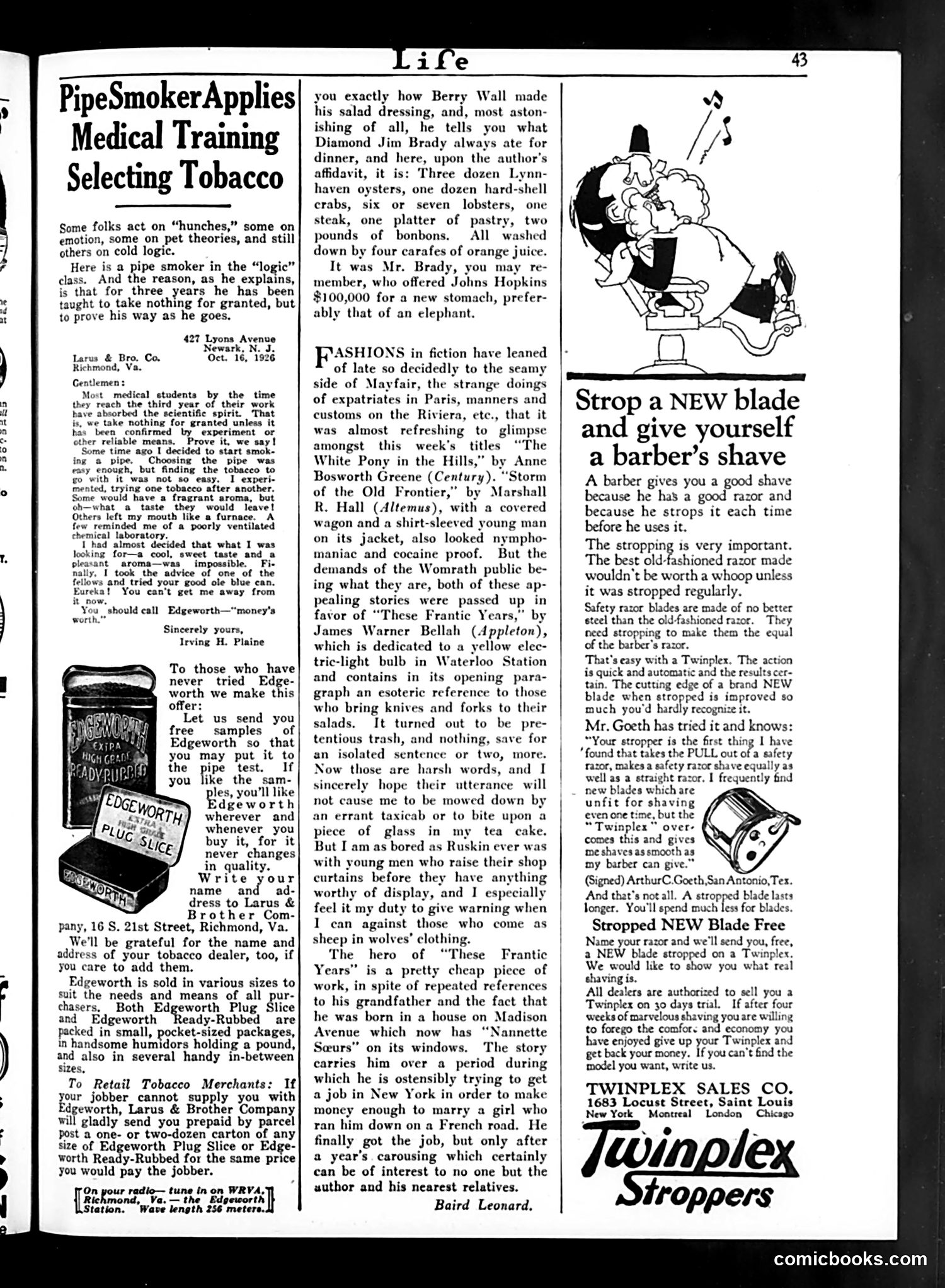
This page is primarily **advertising content** disguised as editorial material. The main feature is a testimonial letter from "Irving H. Plaine," a medical student praising Edgeworth pipe tobacco. The letter's structure mimics scientific reasoning—the student claims to have "experimentally" tested various tobaccos before finding Edgeworth superior. This is satirical: the "medical training" framing is tongue-in-cheek, treating tobacco selection with mock-scientific rigor to humorously legitimize a commercial product. The accompanying cartoon (top right) depicts a man smoking, reinforcing the product's appeal. The right column contains unrelated editorial content about fashions in fiction and references to figures like Diamond Jim Brady (a famous early-20th-century financier known for extravagant dining). The Twinplex Stropper advertisement below discusses razor blade maintenance, a contemporary consumer product. This entire page exemplifies **1920s advertising strategy**: merging entertainment, credibility claims, and product promotion within a magazine's editorial space.
📄 Transcribed text from this page (OCR, searchable)
Machine-transcribed from the original scan — historical spelling and the odd misread are preserved.
™€ Tr. sar enw Vv PipeSmokerApplies Medical Training Selecting Tobacco Some folks act on “hunches,” some on emotion, some on pet theories, and still others on cold logic. Here is a pipe smoker in the “logic” class. And the reason, as he explains, is that for three years he has been taught to take nothing for granted, but to prove his way as he goes, 427 Lyons Avenue Newark, N. J. Larus & Bro. Co, Oct. 16, 1926 Richmond, Va. Gentlemen: M medical students by the time they reach the third year of their work have absorbed the scientific spirit. That is, we take nothing for granted unless it has been confirmed by experiment or other reliable means. Prove it, we say! Some time ago I decided to start smok- ing a pipe. Choosing the pipe was easy enough, but finding the tobacco to go with it was not so easy. I experi- mented, trying one tobacco after another. Some would have a fragrant aroma, but oh—what a taste they would leave! Others left my mouth like a furnace. A few reminded me of a poorly ventilated chemical laboratory. I had almost decided that what I was looking for—a cool, sweet taste and a pleasant aroma—was impossible. Fi- nally, I took the advice of one of the fellows and tried your good ole blue can. Eureka! You can't get me away from it now. You should call Edgeworth—“money’s worth.” Sincerely yours, Irving H. Plaine To those who have never tried Edge- worth we make this offer: Let us send you free samples of Edgeworth so that you may put it to the pipe test. If you like the sam- ples, you'll like Edgeworth wherever and whenever you buy it, for it never changes in quality. Write your name and ad- dress to Larus & Brother Com- pany, 16 S. 21st Street, Richmond, Va. We'll be grateful for the name and address of your tobacco dealer, too, if you care to add them. Edgeworth is sold in various sizes to suit the needs and means of all pur- chasers, Both Edgeworth Plug Slice and Edgeworth eady-Rubbed are packed in small, pocket-sized packages, in handsome humidors holding a pound, and also in several handy in-between sizes, To Retail Tobacco Merchants: If your jobber cannot supply you with Edgeworth, Larus & Brother Company will gladly send you prepaid by parcel post a one- or two-dozen carton of any size of Edgeworth Plug Slice or Edge- worth Ready-Rubbed for the same price you would pay the jobber. ‘On tase radio— tune in on WRYA, [ze ynond, Wa.— the Elencorts | Station. Wave length 256 metere.. you exactly how Berry Wall made his salad dressing, and, most aston- ishing of all, he tells you what Diamond Jim Brady always ate for dinner, and here, upon the author's affidavit, it is: Three dozen Lynn- haven oysters, one dozen hard-shell crabs, six or seven lobsters, one steak, one platter of pastry, two pounds of bonbons. All washed down by four carafes of orange juice. It was Mr. Brady, you may re- member, who offered Johns Hopkins $100,000 for a new stomach, prefer- ably that of an elephant. FeAsHions in fiction have leaned of late so decidedly to the seamy side of Mayfair, the strange doings of expatriates in Paris, manners and customs on the Riviera, ete., that it was almost refreshing to glimpse amongst this week's titles “The White Pony in the Hills,” by Anne Bosworth Greene (Century). of the Old Frontier,” by Marshall R. Hall (Altemus), with a covered wagon and a shirt-sleeved young man on its jacket, also looked nympho- maniac and cocaine proof. But the demands of the Womrath public be- ing what they are, both of these ap- pealing stories were passed up in favor of “These Frantic Years,” by James Warner Bellah (Appleton), which is dedicated to a yellow elec- tric-light bulb in Waterloo Station and contains in its opening para- graph an esoteric reference to those who bring knives and forks to their salads. It turned out to be pre- tentious trash, and nothing, save for an isolated sentence or two, more. Now those are harsh words, and I sincerely hope their utterance will not cause me to be mowed down by an errant taxicab or to bite upon a piece of glass in my tea cake. But I am as bored as Ruskin ever was with young men who raise their shop curtains before they have anything worthy of display, and I especially feel it my duty to give warning when 1 can against those who come as sheep in wolves’ clothing. The hero of “These Frantic Years” is a pretty cheap piece of work, in spite of repeated references to his grandfather and the fact that he was born in a house on Madison Avenue which now has annette Seurs” on its windows. The story carries him over a period during which he is ostensibly trying to get a job in New York in order to make money enough to marry a girl who ran him down on a French road. He finally got the job, but only after a year’s carousing which certainly can be of interest to no one but the author and his nearest relatives. Baird Leonard, Strop a NEW blade and give yourself 9, a barber’s shave A barber gives you a good shave because he has a good razor and because he strops it each time before he uses it. The stropping is very important. The best old-fashioned razor made wouldn't be worth a whoop unless it was stropped regularly. Safety razor blades are made of no better steel than the old-fashioned razor. They need stropping to make them the equal of the barber's razor. That's easy with a Twinplex. The action is quick and automatic and the results cer- tain. The cutting edge of a brand NEW blade when stropped is improved so much you'd hardly recognize it. Mr. Goeth has tried it and knows: “Your stropper is the first thing I have ‘found that takes the PULL out of a safety razor, makes a safety razor shave equally as well as a straight razor. I frequently find new blades which are a unfit for shaving even one time, but the “Twinplex * over: comes this and gives me shaves as smooth as my barber can give.” & (Signed) ArthurC.Goeth,San Antonio,Tex. And that’s notall. A serooped blade lasts longer. You'll spend much less for blades. Stropped NEW Blade Free Name your razor and we'll send you, free, a NEW blade stropped on a Twinplex. We would like to show you what real shaving is. All dealers are authorized to sell you a Twinplex on 30 days trial. If after four weeks of marvelous shaving you are willing to forego the comfors and economy you have enjoyed give up your Twinplex and get back your money. If you can’t find the model you want, write us. TWINPLEX SALES CO. 1683 Locust Street, Saint Louis New York Montreal London Chicago Wwinple. comicbooks.com