
A complete issue · 43 pages · 1927
Life — May 12, 1927
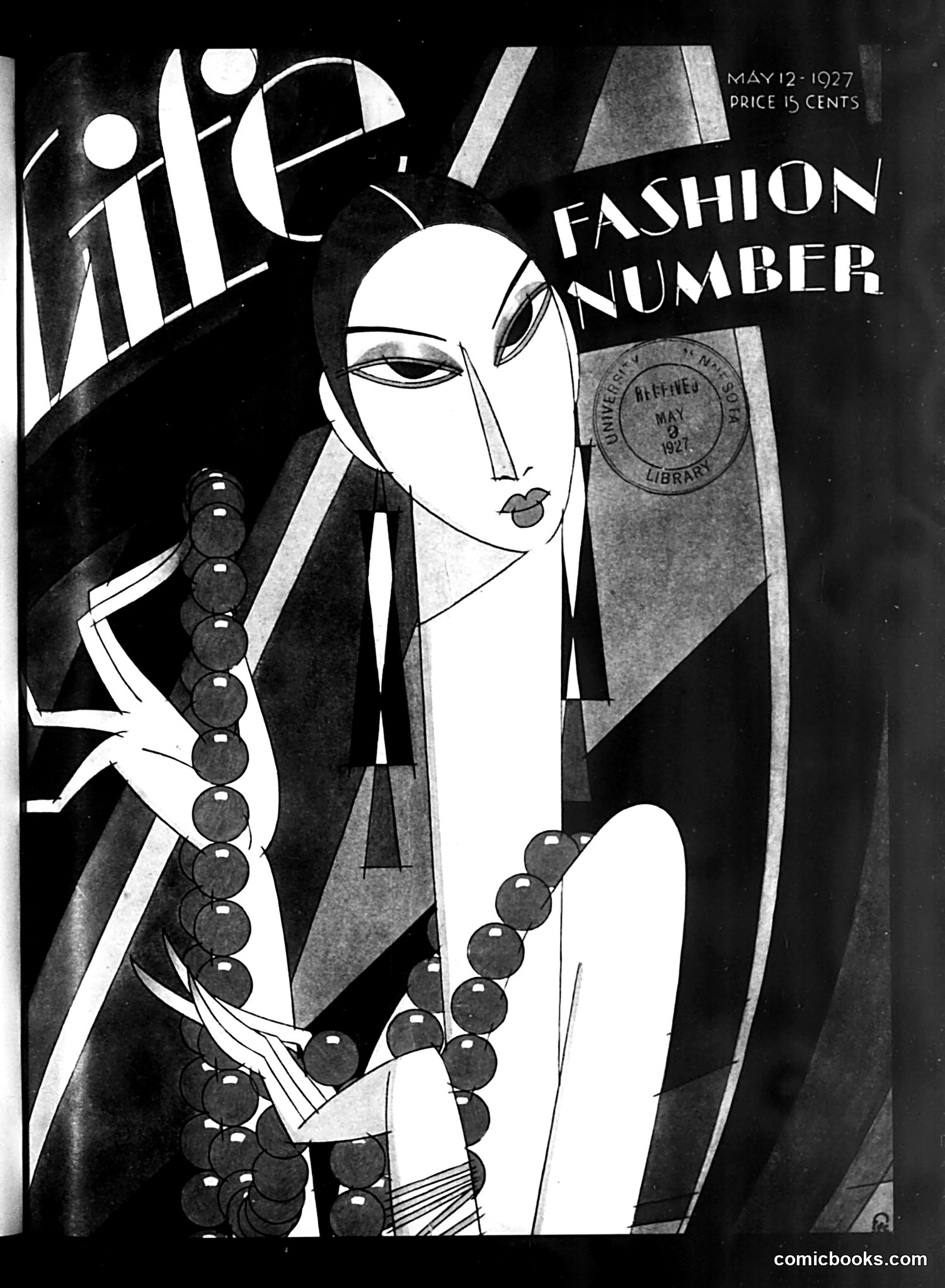
This is the May 12, 1927 cover of *Life* magazine's "Fashion Number." The illustration depicts a stylized 1920s woman embodying the era's modern aesthetic—the "flapper" ideal. Her elongated face, severe makeup with defined lips, and straight silhouette reflect Jazz Age fashion. The long strands of large beads she wears were quintessential 1920s accessories, often worn long and allowed to swing freely while dancing. The geometric, angular art style is characteristic of Art Deco design that dominated the period. The background's bold stripes and abstract shapes emphasize modernity and sophistication. For contemporary readers, this cover celebrated the liberation and fashion-forward spirit of 1920s women—a stark contrast to Victorian-era constraints. The "15 cents" price reflects Depression-era affordability, making high-fashion content accessible to middle-class audiences.
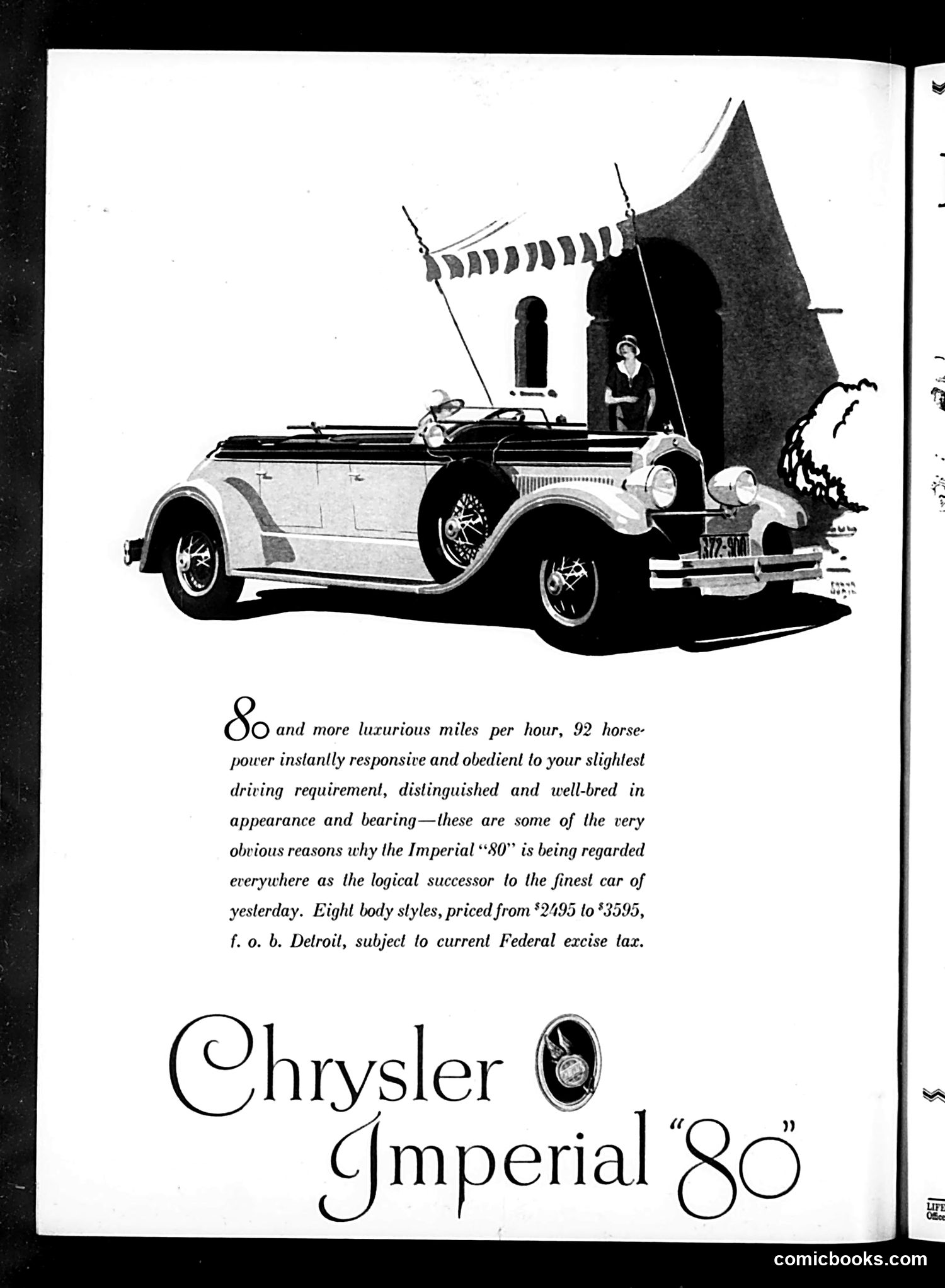
This page is primarily a **Chrysler advertisement**, not a political cartoon. It promotes the Imperial "80" automobile model with styling that evokes luxury and exotic travel. The advertisement uses an orientalist fantasy image: a convertible car parked before a large tent structure with Asian-inspired architecture, while a woman in period dress stands in the tent doorway. The styling suggests adventure in distant lands—a common advertising trope of the era. The text emphasizes the car's performance (92 horsepower, 80+ mph capability) and luxury positioning, listing eight body styles priced from $2,495 to $3,595. It's aimed at affluent buyers seeking prestige and speed. This reflects 1920s-30s consumer culture and how American luxury goods were marketed through aspirational imagery of travel and exoticism.
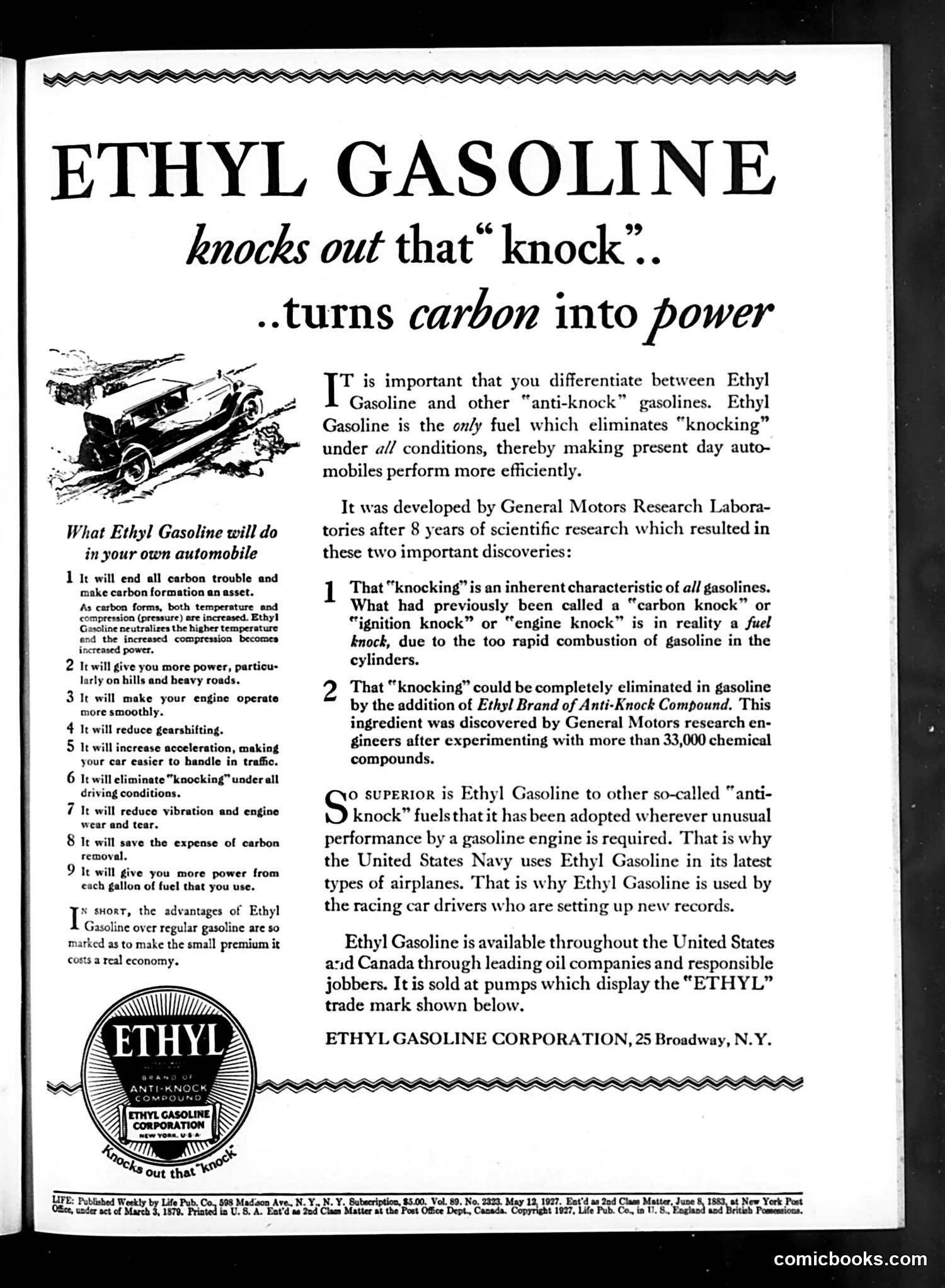
This is **advertising, not satire or political commentary**. It's a 1920s promotional page for Ethyl Gasoline, a fuel additive developed by General Motors Research Laboratories. The illustration (a crashed car) supports the product claim: Ethyl's anti-knock compound supposedly eliminates engine "knock"—the undesirable noise caused by premature fuel combustion. The ad argues this improves performance and efficiency. The marketing pitch emphasizes Ethyl's superiority over competitors and its adoption by the U.S. Navy, aircraft manufacturers, and racing drivers. The "trade mark" logo at bottom identifies authorized retailers. This represents early automotive-fuel branding and technical marketing from the era when leaded gasoline was being introduced (later proven harmful).
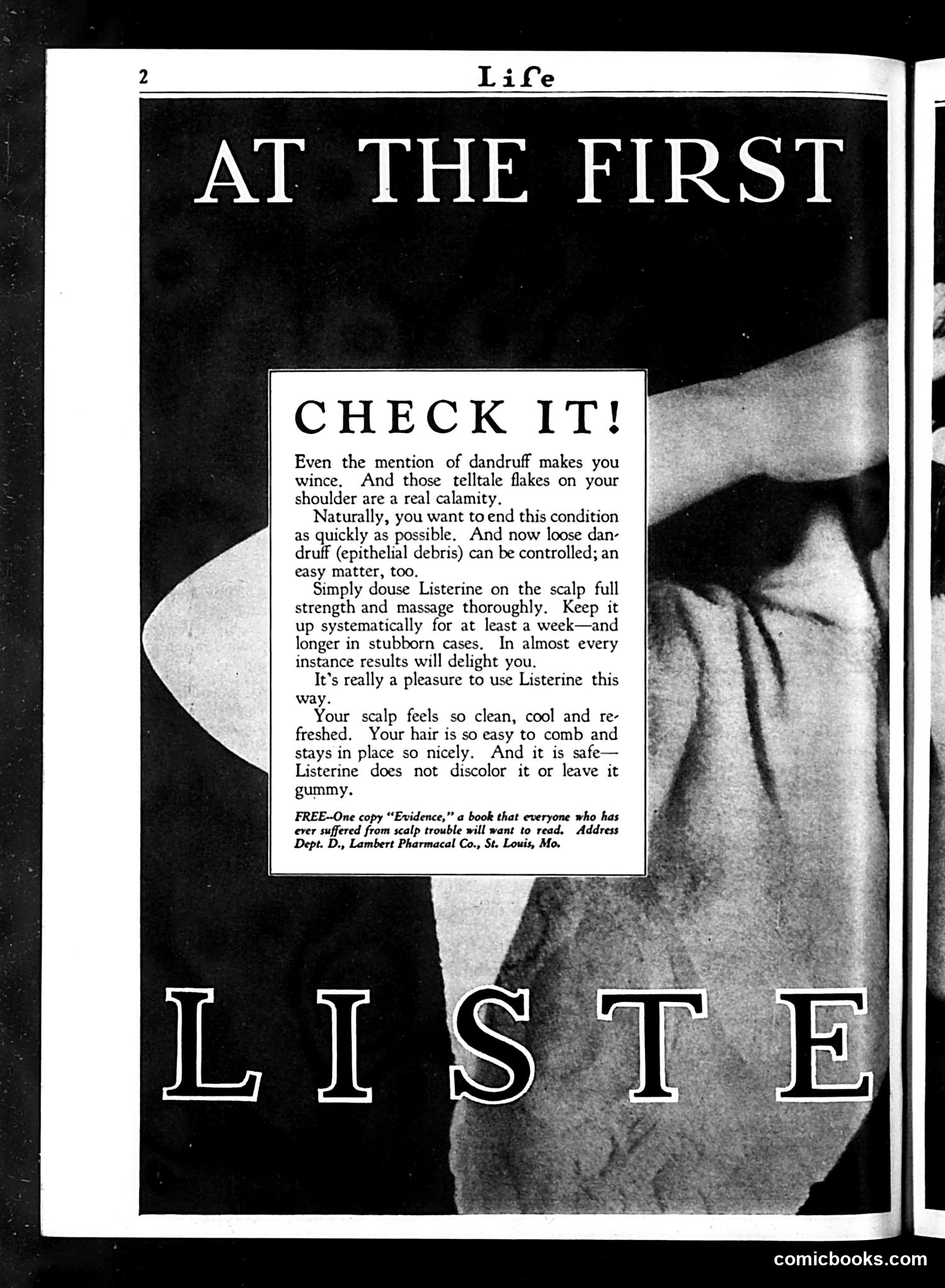
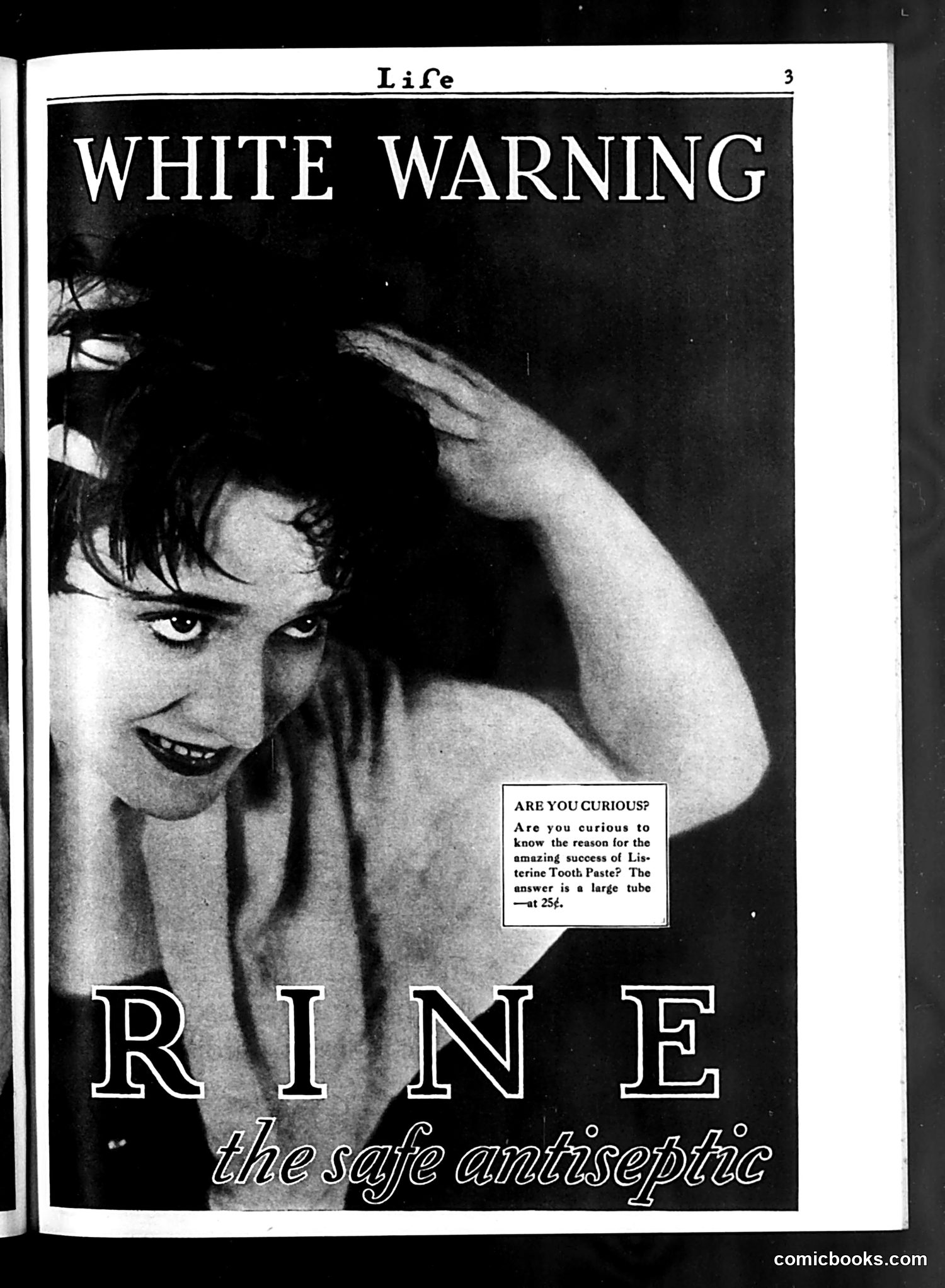
This is **not a political cartoon or satire**—it's a straightforward **advertisement for Listerine mouthwash**, disguised within a Life magazine page. The ad uses a "shock value" approach common to early-20th-century advertising, depicting dandruff as a social embarrassment ("Even the mention of dandruff makes you wince"). The grayscale photograph shows someone's shoulder with visible flakes. The advertisement recommends applying Listerine to the scalp as a dandruff treatment and promotes its benefits: cleanliness, easy combing, and safety. It offers a free booklet titled "Evidence" from Lambert Pharmacal Co. in St. Louis, Missouri. This represents the era when Listerine marketed itself as a cure-all product for various ailments beyond oral hygiene—a common but now-questionable practice in vintage advertising.
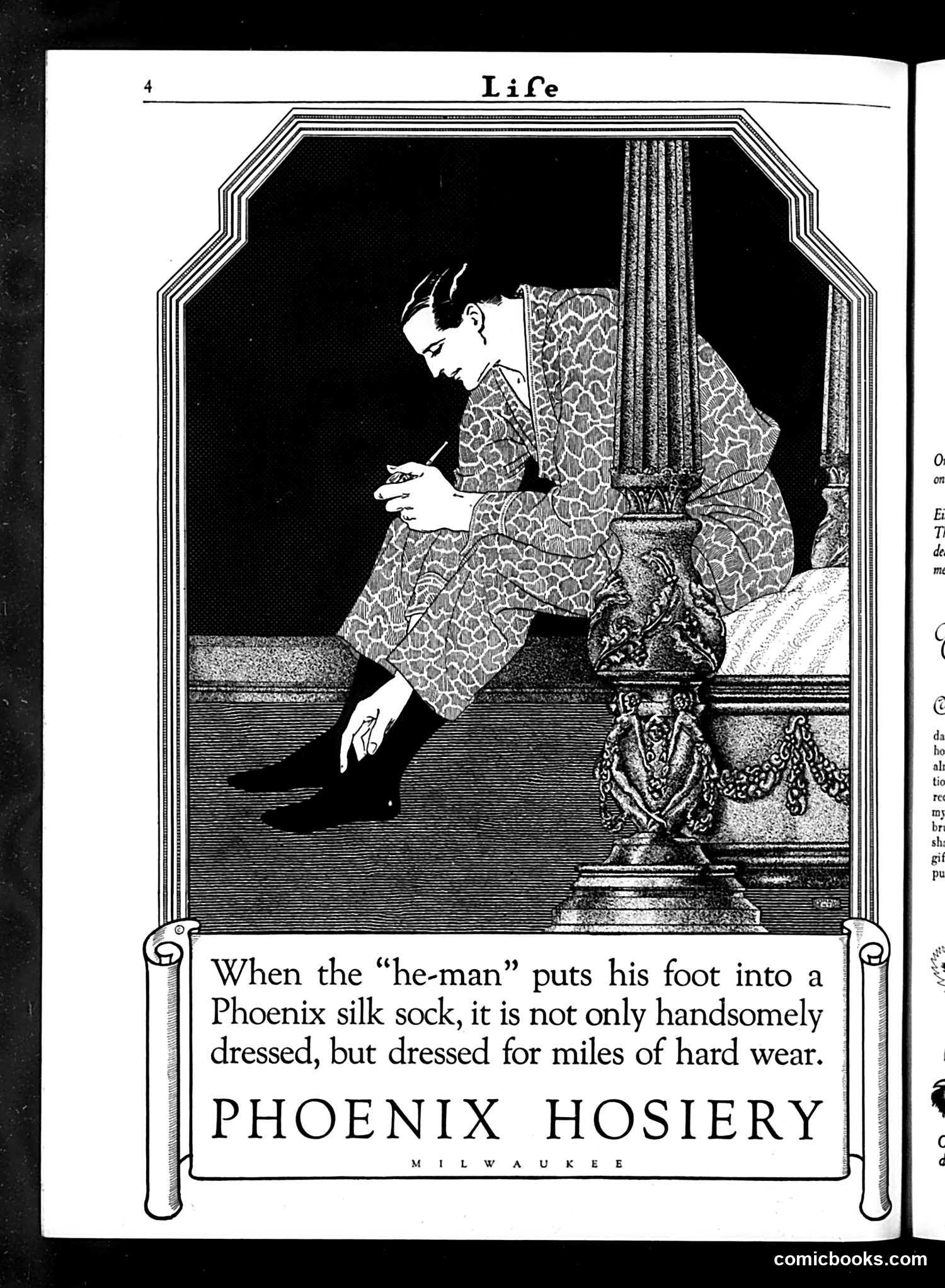
This page is primarily **advertising, not satire or political commentary**. It's a Phoenix Hosiery advertisement from Milwaukee featuring a stylized illustration of a well-dressed man putting on silk socks. The ad copy emphasizes that Phoenix silk socks are both fashionable ("handsomely dressed") and durable ("dressed for miles of hard wear"). The illustration's art deco style and refined aesthetic were typical of 1920s-30s advertising aimed at male consumers concerned with appearing sophisticated. There is no political cartoon or satirical content here—this is straightforward commercial promotion appearing in *Life* magazine's pages, likely among other advertisements and editorial content.
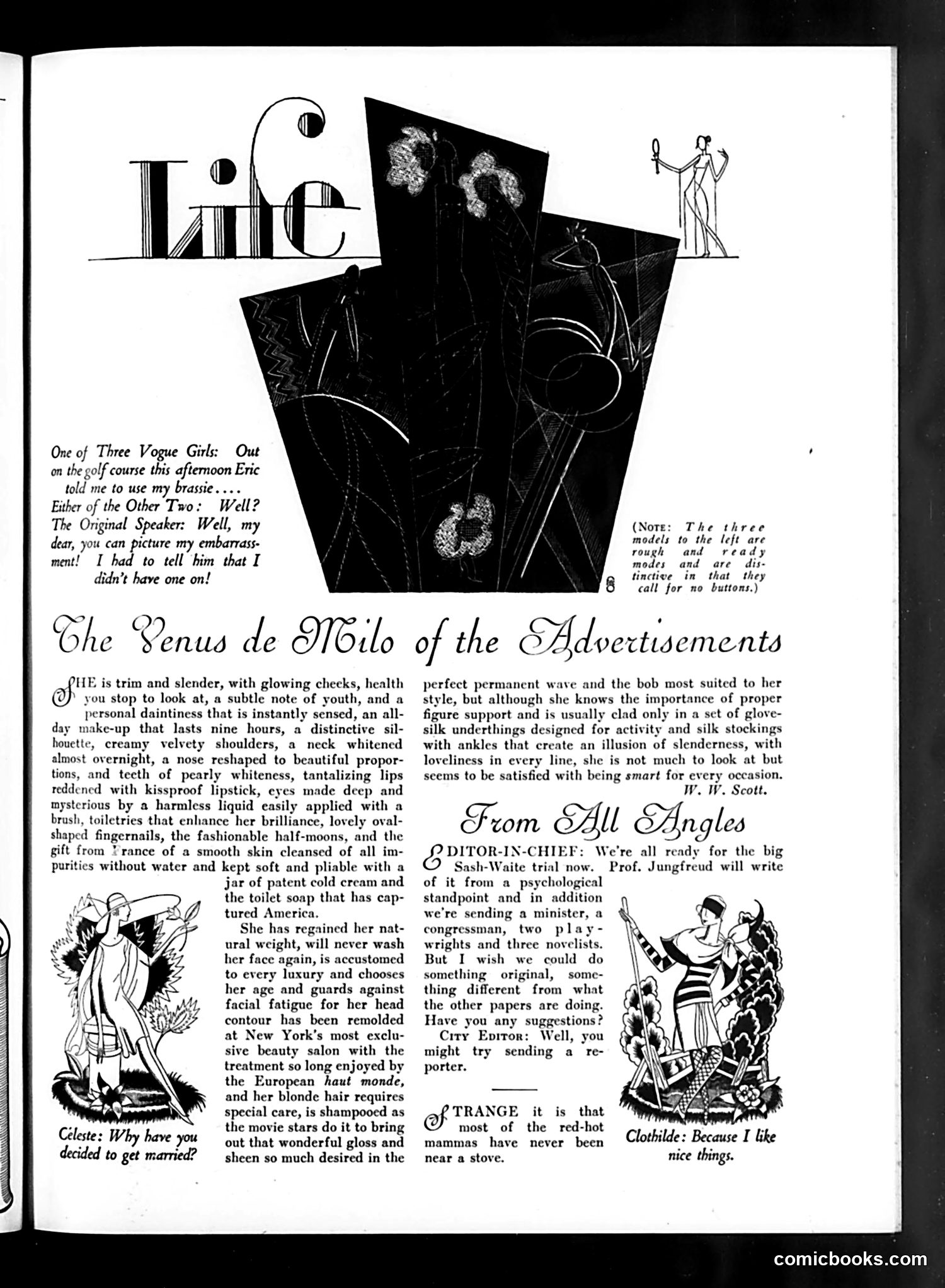
This page satirizes 1920s women's fashion and beauty culture. The top section features "The Venus de Milo of the Advertisements"—a mockery of how fashion advertisements present women as idealized objects. The text ironically catalogs the elaborate grooming regimen required: permanent waves, silk undergarments, makeup lasting "nine hours," special soaps, and hair treatments. The cartoons below mock contemporary social commentary. "From All Angles" presents editorial banter about a "Sash-Waite trial" (likely a reference to a contemporary scandal or court case, unclear from context) and satirizes different perspectives on modern topics. The overall thrust: Life ridicules how advertising creates impossible beauty standards while simultaneously mocking serious social debates, suggesting both are equally superficial preoccupations of the era.
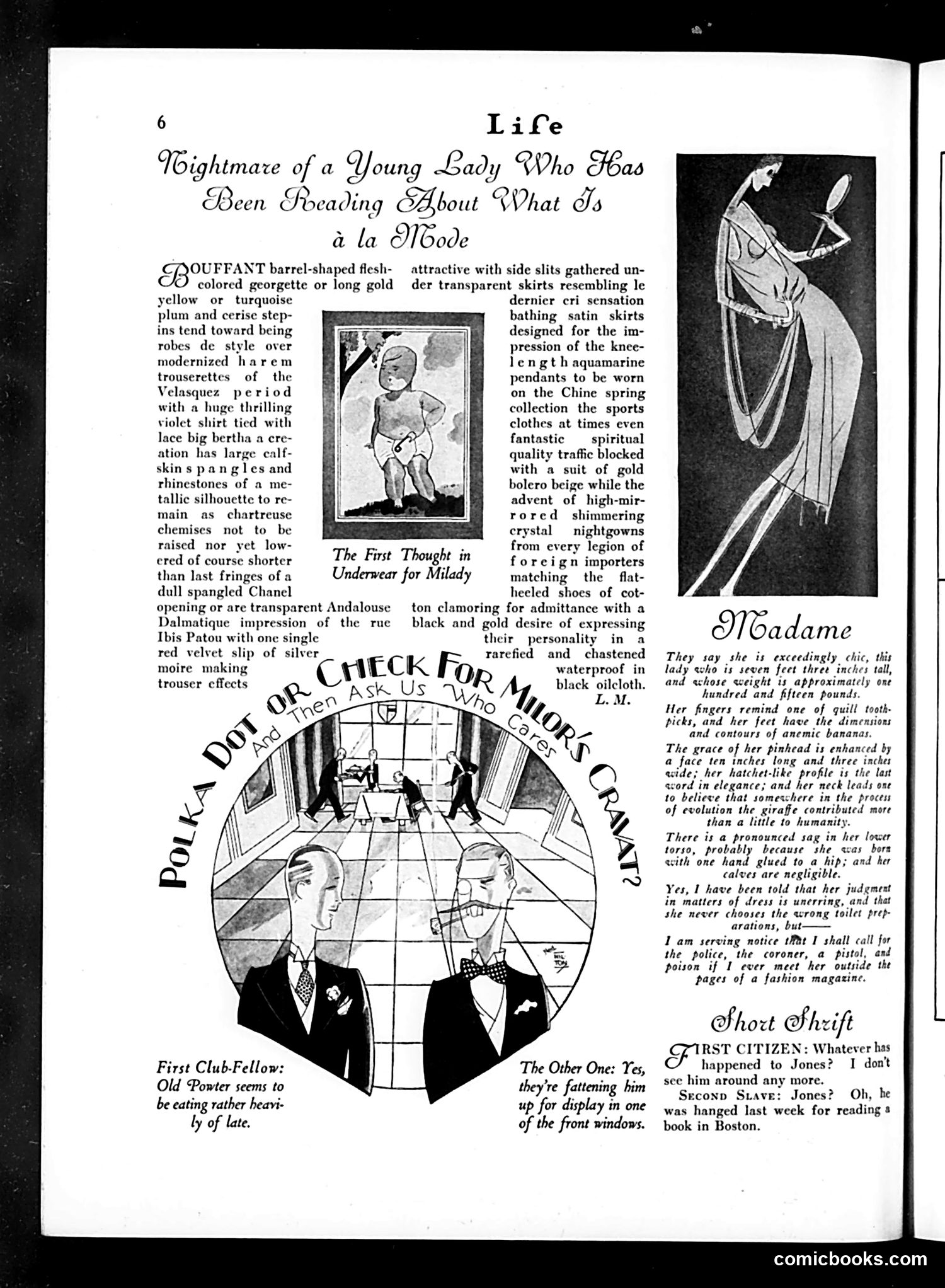
This page contains fashion satire and social commentary typical of Life magazine's style. **"Nightmare of a Young Lady Who Has Been Reading About What Is à la Mode"** mocks women's fashion aspirations by describing absurdly impractical haute couture elements—barrel-shaped skirts, excessive ornamentation, and ridiculous silhouettes—presented as current trends. **"A Polka Dot or Check for Those Who Works On[?]"** is a cartoon dialogue between two well-dressed men discussing a woman's appearance in a shop window, satirizing male obsession with fashionable female display and objectification. **"Short Shrift"** continues this theme with two men discussing a woman's dubious dress sense and an apparent scandal involving Boston. Overall, the page satirizes both women's pursuit of fashionable appearance and men's judgmental scrutiny of female fashion choices—common Life magazine social commentary of the era.
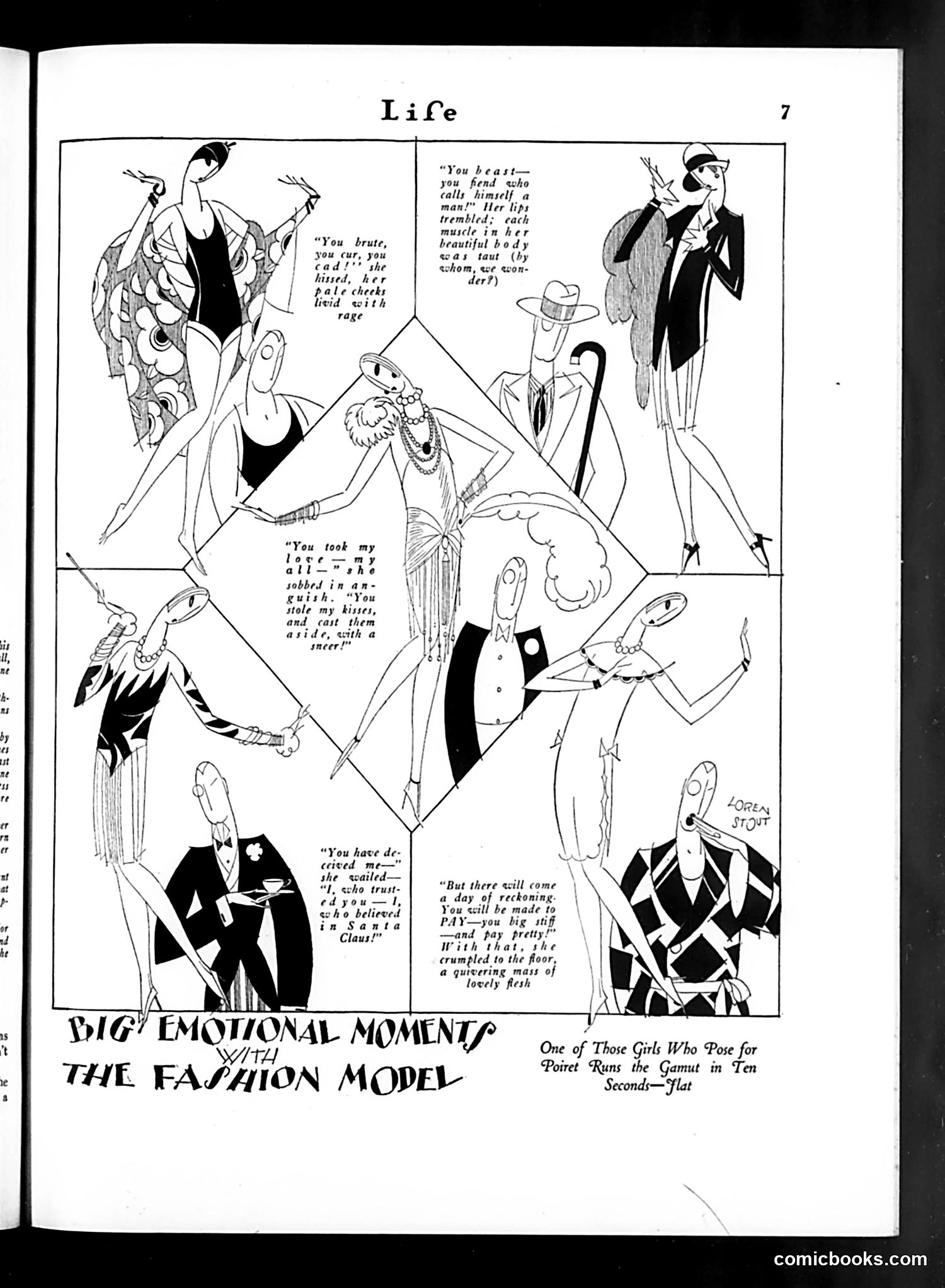
This satirical comic mocks the melodramatic posturing of 1920s fashion models. The page depicts various models in exaggerated emotional poses—claiming betrayal, theft, broken hearts—while striking theatrical stances in fashionable clothing. The satire targets both the models themselves (who apparently cultivated dramatic public personas) and the fashion industry's embrace of overwrought sentimentality. Each speech bubble contains absurdly grandiose accusations and emotional declarations meant to seem ridiculous when paired with the models' affected poses and glamorous outfits. The subtitle notes these are "girls who pose for Poiret runs" (a fashionable couture house), suggesting the fashion world encouraged this theatrical behavior. The joke is fundamentally about shallow pretense—models performing emotion as performatively as they perform fashion.
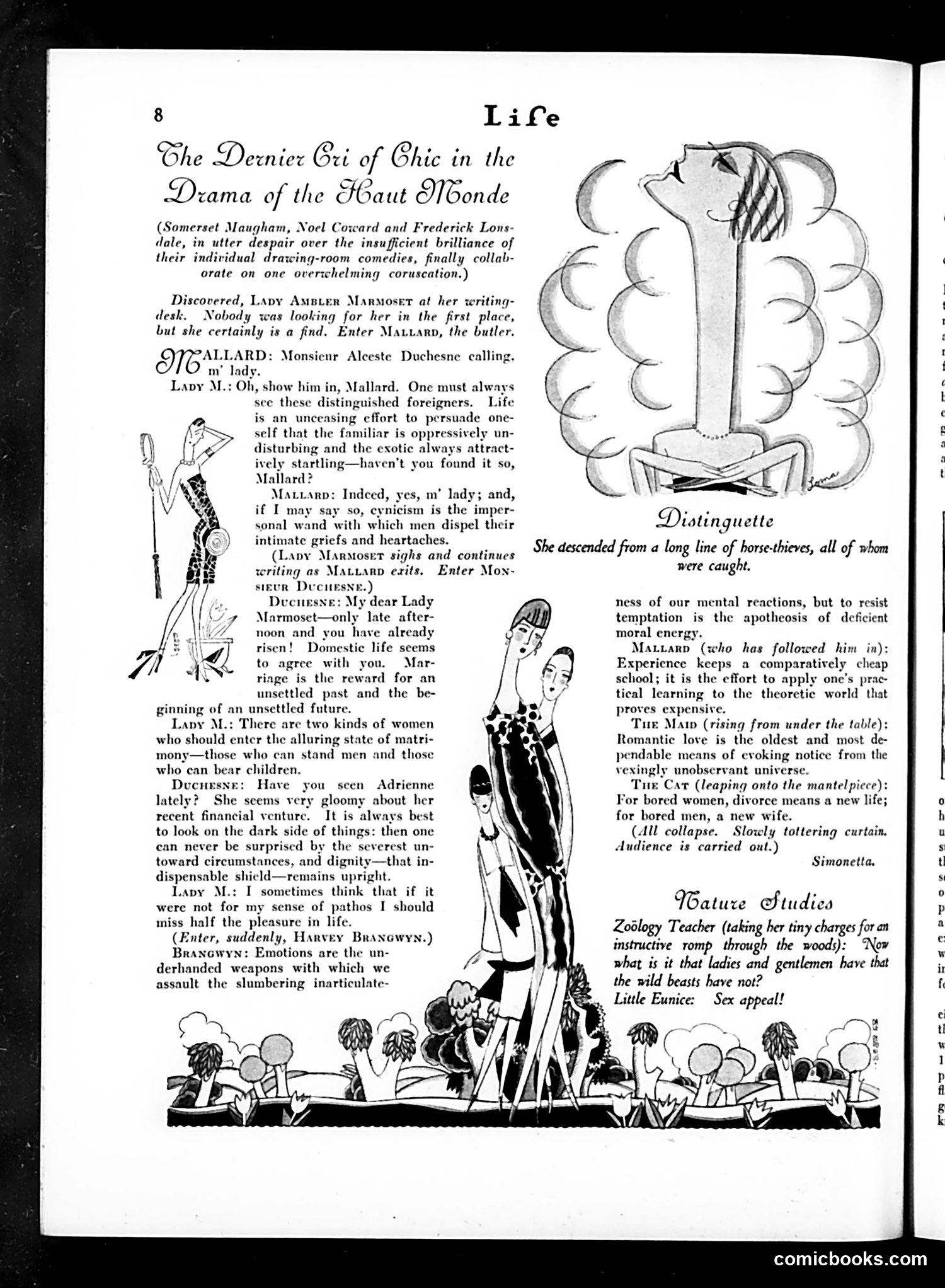
This page satirizes the social pretensions of wealthy aristocrats and their drawing-room comedies. The heading references Somerset Maugham, Noël Coward, and Frederick Lonsdale—three famous playwrights known for sophisticated comedies about the British upper class. The text mocks Lady Ambler Marmoset discovering a character named "Monsieur Alceste Duchesne" and the affected conversation that follows. The satire targets how the wealthy treat encounters with "distinguished foreigners" as status symbols, while engaging in tedious gossip about divorce, infidelity, and financial scandals presented as witty repartee. The accompanying illustration shows an elegantly dressed woman, emphasizing the visual mockery of high-society pretension. The cartoon critiques how this social class mistakes shallow worldliness for genuine sophistication and moral depth.
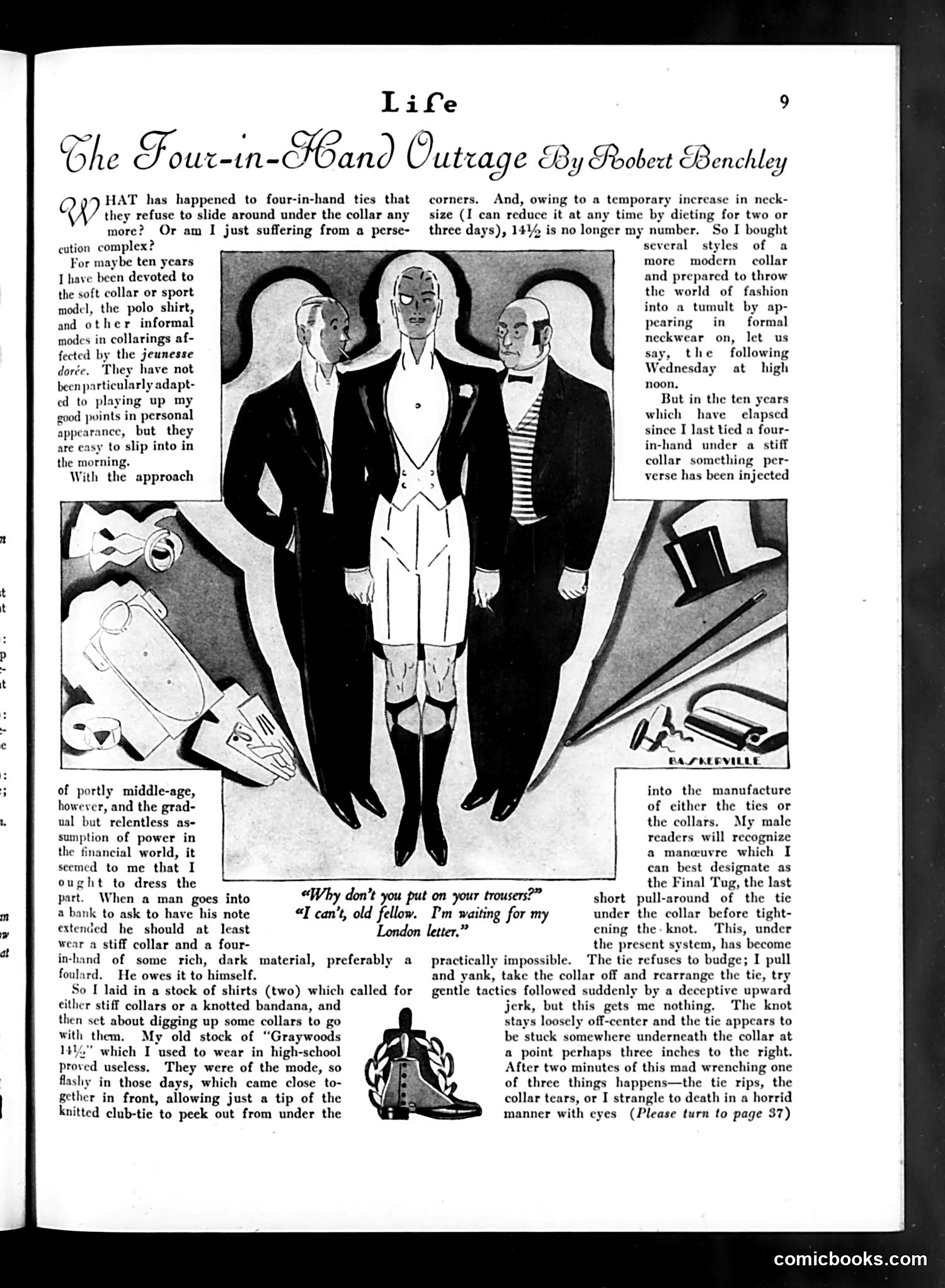
This satirical essay mocks the impracticality of four-in-hand neckties—a formal tie style popular in the era. Benchley humorously complains that the tie has become too tight around the collar, forcing him to diet to reduce his neck size rather than simply loosening the knot. The central illustration shows three men in formal wear demonstrating the tie's appeal, with a smaller sketch depicting a struggling man trying to manage it. The cartoon satirizes masculine vanity and the absurdity of fashion conventions that prioritize appearance over comfort—men would rather endure physical discomfort than admit their bodies don't conform to fashionable standards. The "London letter" caption references contemporary fashion-advice correspondence, poking fun at formal menswear rituals.
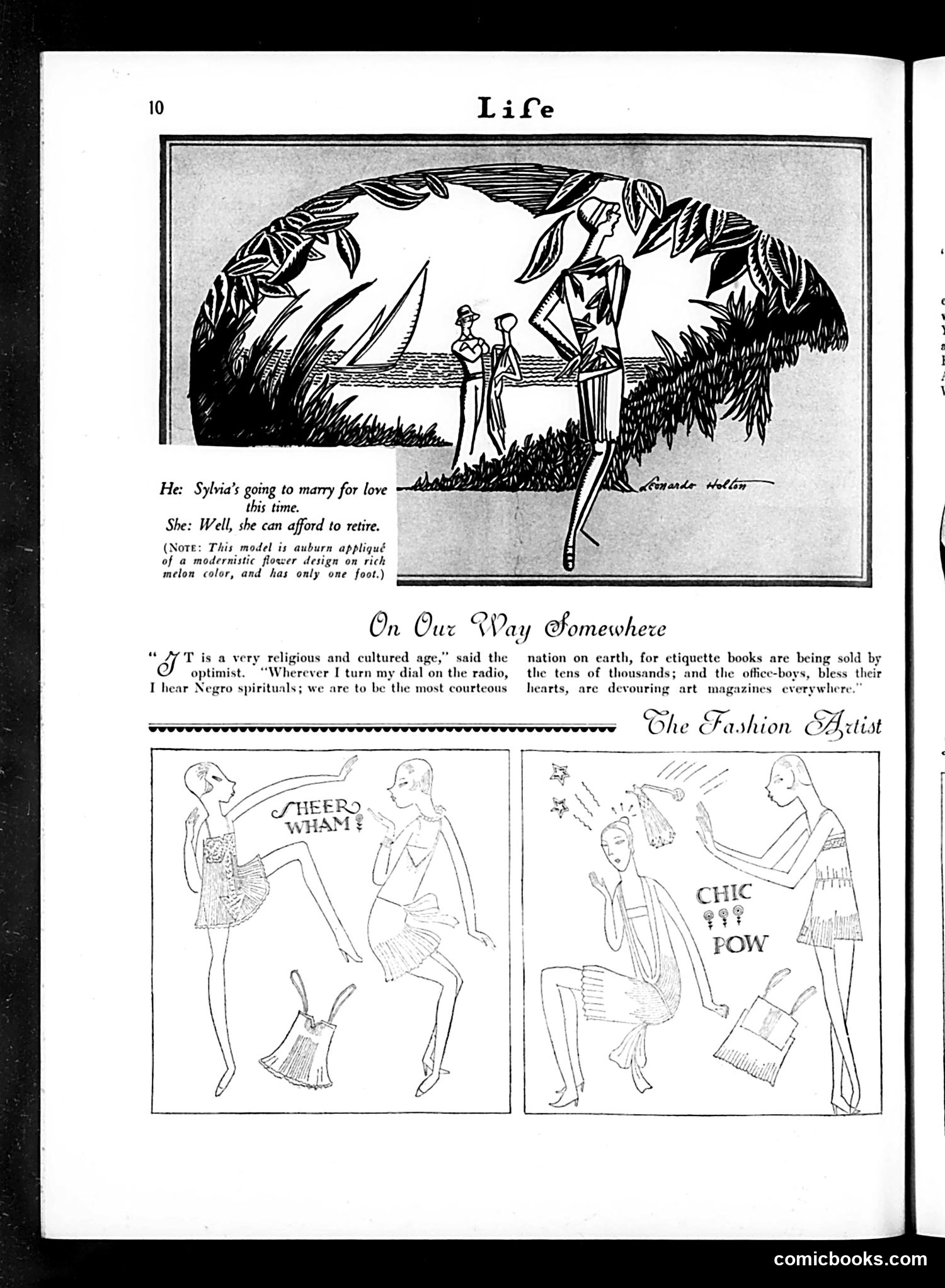
This page contains two distinct satirical pieces: **Top cartoon** ("On Our Way Somewhere"): A couple beneath an arbor discusses marriage. The man says Sylvia's marrying "for love this time," to which the woman replies she "can afford to retire." The satire targets wealthy women who marry repeatedly, suggesting marriage as a financial transaction rather than romantic commitment. **Bottom section** ("The Fashion Artist"): Two panels mock 1920s flapper fashion and behavior. Left panel shows women dancing with "SHEER WHAM," right panel depicts "CHIC" and "POW" poses. The satire ridicules the exaggerated, theatrical posturing of fashionable young women and the era's emphasis on bold, attention-seeking style over substance. Both reflect Jazz Age anxieties about changing gender roles and social values.
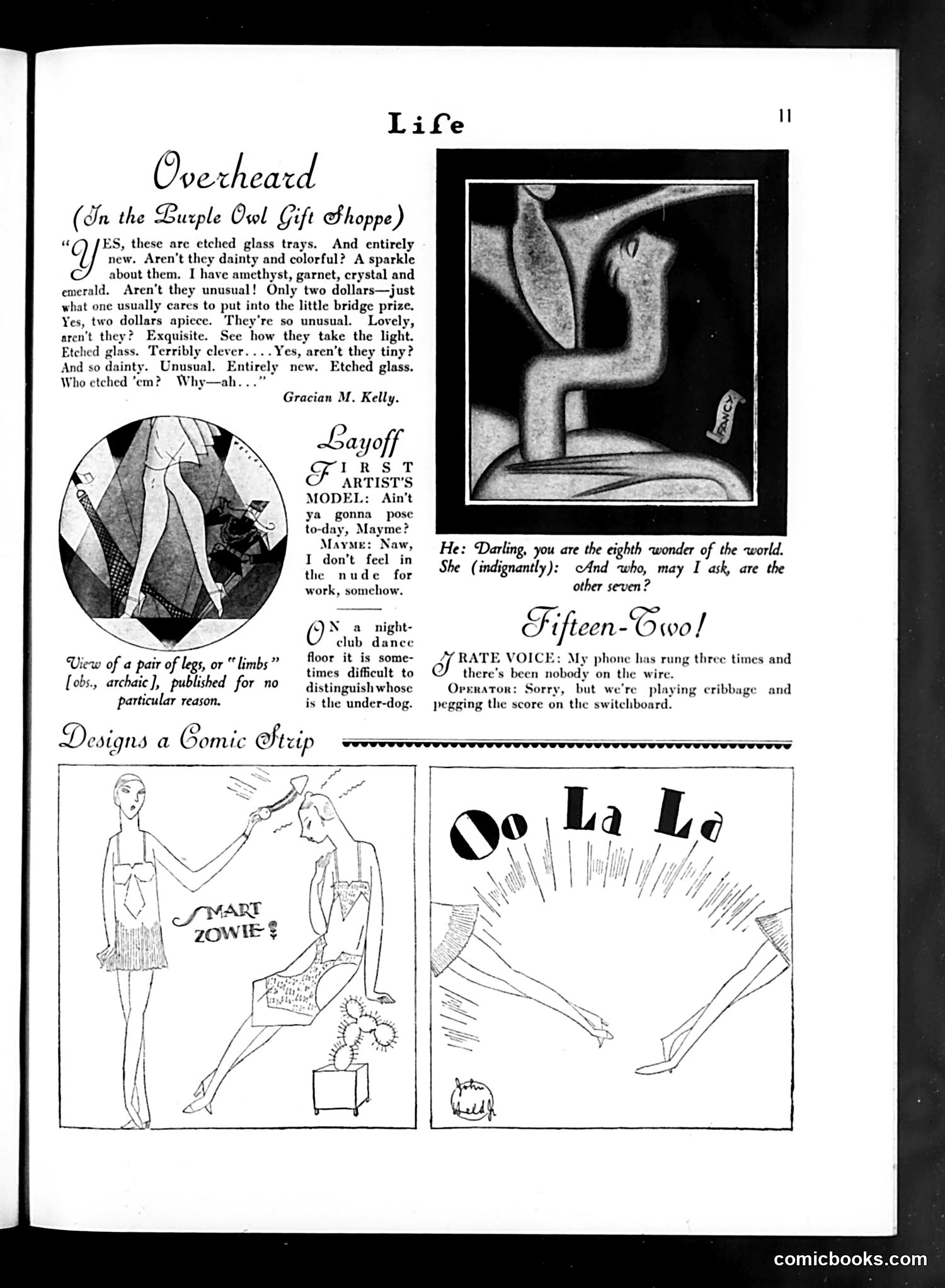
This page contains three distinct humor pieces: 1. **"Overheard (in the Purple Owl Gift Shoppe)"** - A monologue by Gracian M. Kelly satirizing department store clerks who oversell cheap merchandise using breathless enthusiasm and affected language ("Exquisite," "Terribly clever"). The etched glass trays at two dollars are presented as novelties despite being mass-produced trinkets. 2. **"Layoff First/Artist's Model"** - A brief joke about a model refusing to pose, claiming she doesn't "feel in the mood for work." 3. **"Designs a Comic Strip"** by Mart Zowie - Mockery of fashion illustration and comic strip conventions, showing stick-figure fashion poses with minimal artistic effort. 4. **"Fifteen-Swol"** - A telephone operator joke about switchboard confusion. The overall tone mocks American consumer culture, retail pretension, and low-effort commercial art.
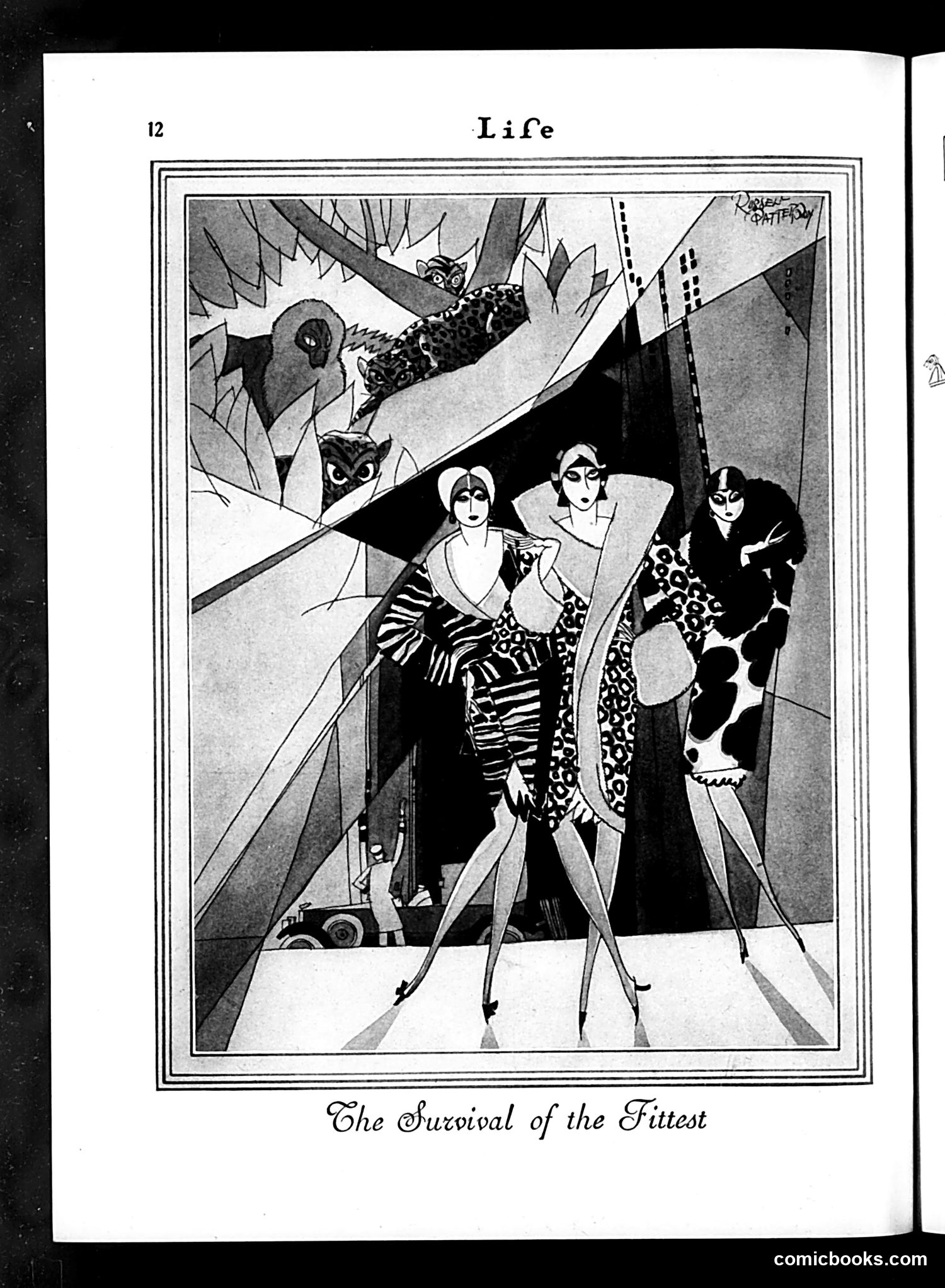
This satirical illustration depicts fashionable women in an exotic/jungle setting, with wild animals (leopards or similar predators) visible above them. The title "The Survival of the Fittest" references Darwin's evolutionary theory, but applies it to human fashion and social competition rather than biology. The cartoon likely satirizes: - **High fashion's fierce competitiveness** among wealthy women - **"Jungle" aesthetics in 1920s fashion** (animal prints, exotic styling visible in their clothing) - The irony that civilized society's most brutal competition occurs in fashion and appearance rather than actual survival The exaggerated, stylized figures and geometric Art Deco design are typical of Life magazine's sophisticated visual humor targeting upper-class fashion culture and the pretensions of high society.
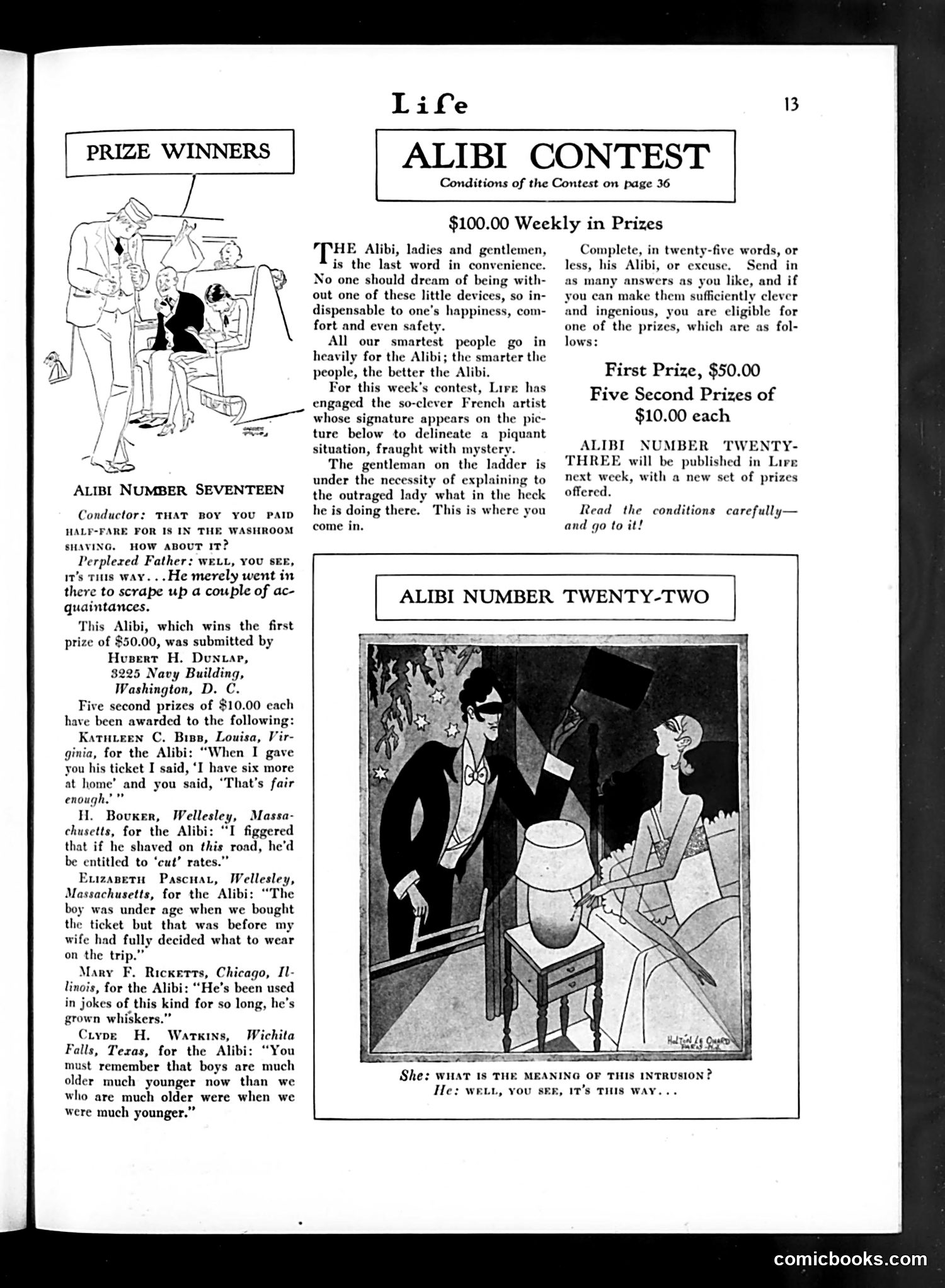
This is a **puzzle/contest page** rather than political satire. Life magazine's "Alibi Contest" invites readers to solve a visual mystery for cash prizes ($50 first prize, five $10 second prizes). **Alibi Number Twenty-Two** shows a cartoon illustration of a well-dressed man confronting a woman in what appears to be a bedroom or private space. The caption poses a riddle: "She: What is the meaning of this intrusion? He: Well, you see, it's this way..." Readers must complete his alibi—his explanation for being there—in 25 words or fewer. The humor relies on the suggestive, compromising scenario: the man needs a clever excuse for his presence in an intimate setting. This was a popular interactive entertainment format in early-20th-century magazines.
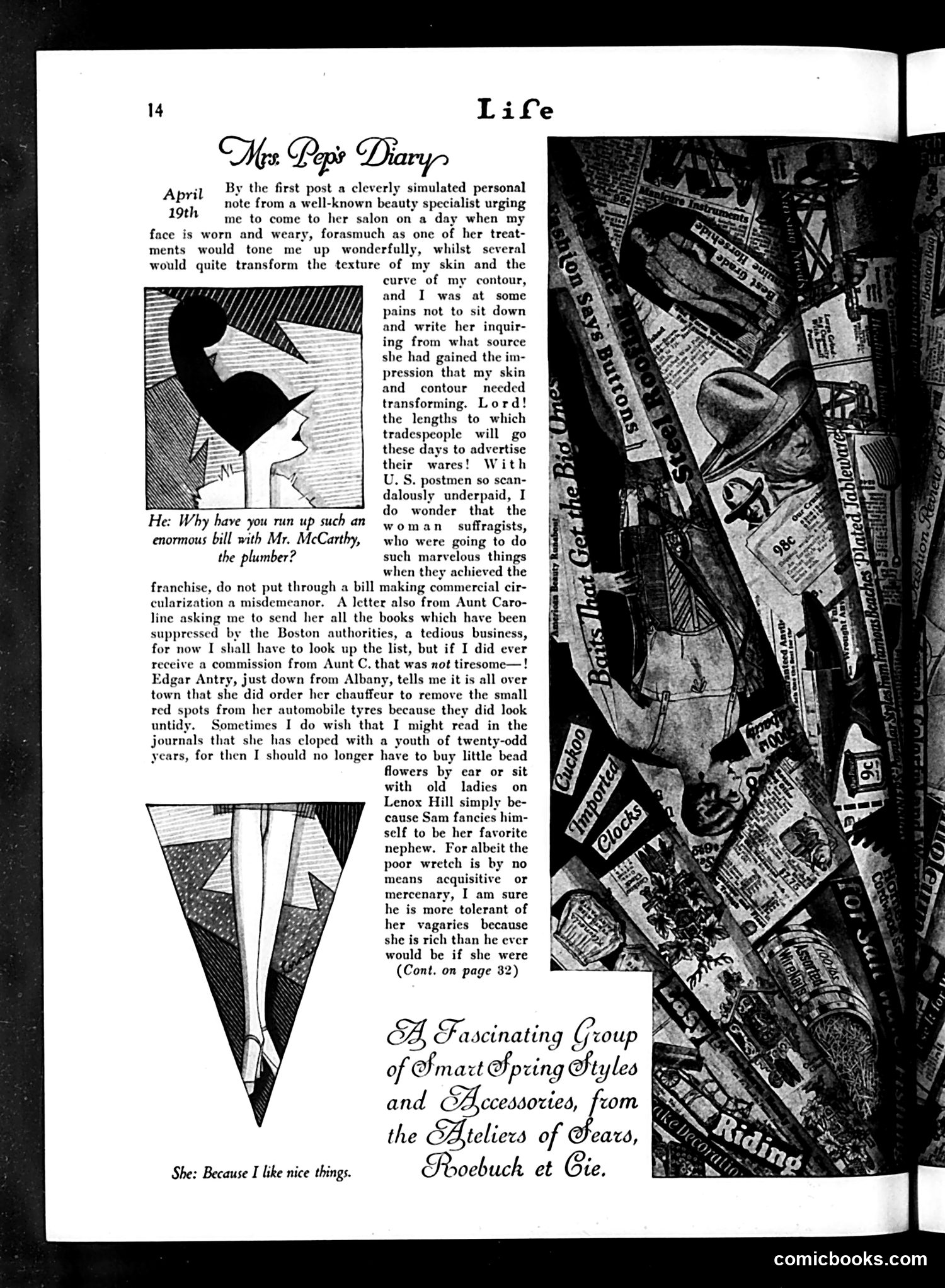
This page presents a humorous "diary" entry satirizing domestic life and consumer culture. The dated entry describes a woman receiving an unsolicited beauty treatment pitch and complaining about various domestic annoyances—a plumber's inflated bill, suppressed books from Boston authorities, and a relative's social climbing. The two accompanying illustrations show a woman's silhouette and her legs in fashionable shoes, visualizing the diary's concerns with appearance and materialism. The caption "She: Because I like nice things" suggests satirizing women's consumer desires. The lower section advertises spring fashions from Sears, using the diary's materialism as a natural segue to fashion marketing. This blends satirical social commentary with direct product promotion, typical of Life magazine's approach during this era.
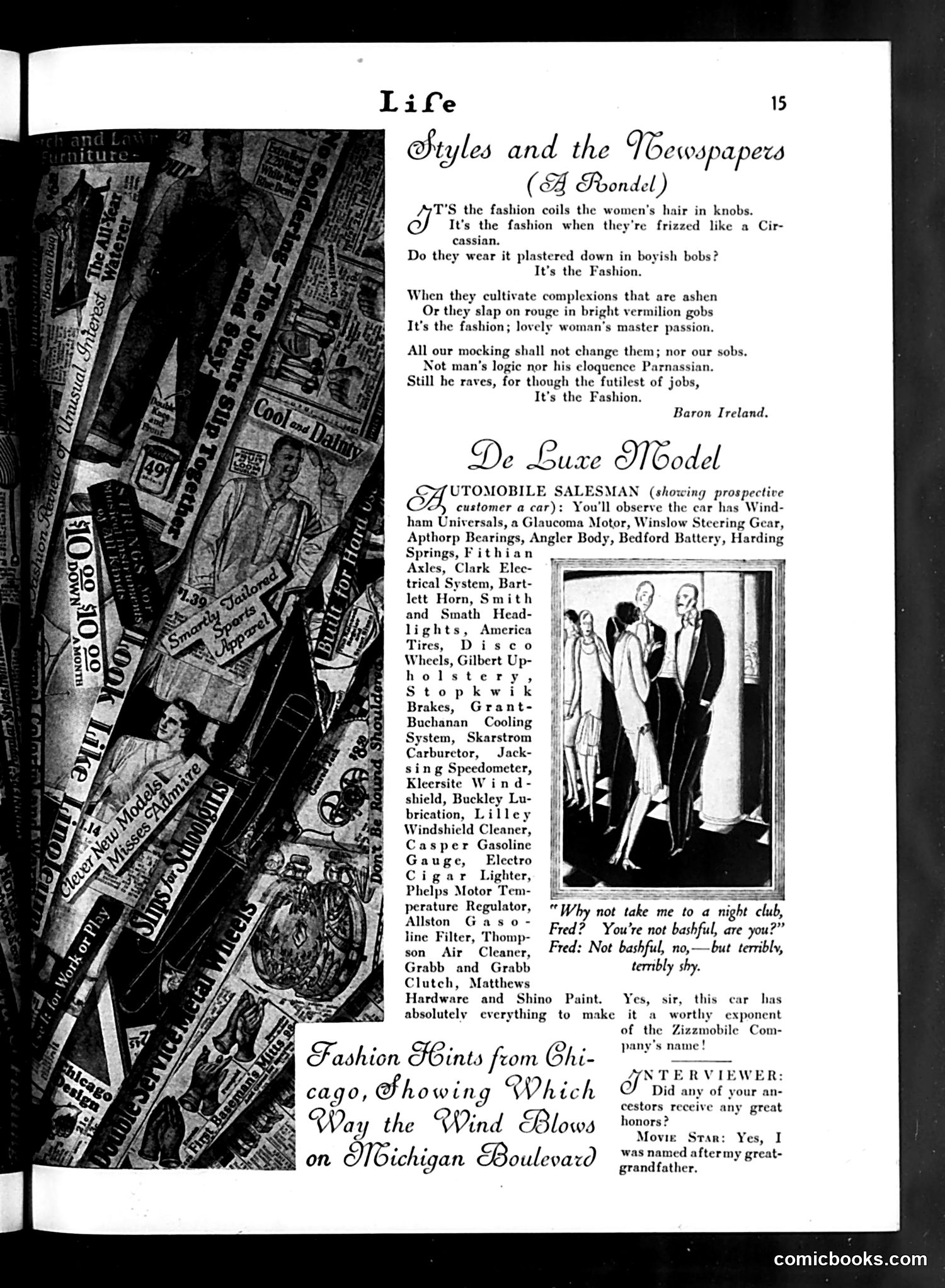
This page contains mixed content: a poem titled "Styles and the Newspapers" (attributed to Baron Ireland) satirizing women's fashion trends, and advertising content for a "De Luxe Model" automobile. The left side shows a **collage of newspaper mastheads and advertisements**, illustrating the poem's point that newspapers constantly promote and validate fashion trends—regardless of how absurd or unflattering they are to women. The poem mocks how fashion publications drive women's behavior ("It's the Fashion"), suggesting that media coverage alone legitimizes even ridiculous style choices like frizzed hair or heavy makeup. The right side advertises an automobile with extensive technical specifications, including a dialogue between a salesman and potential customer. The humor appears to emphasize the car's comprehensive features and complexity, contrasting presumably with the frivolity of fashion discussed opposite.
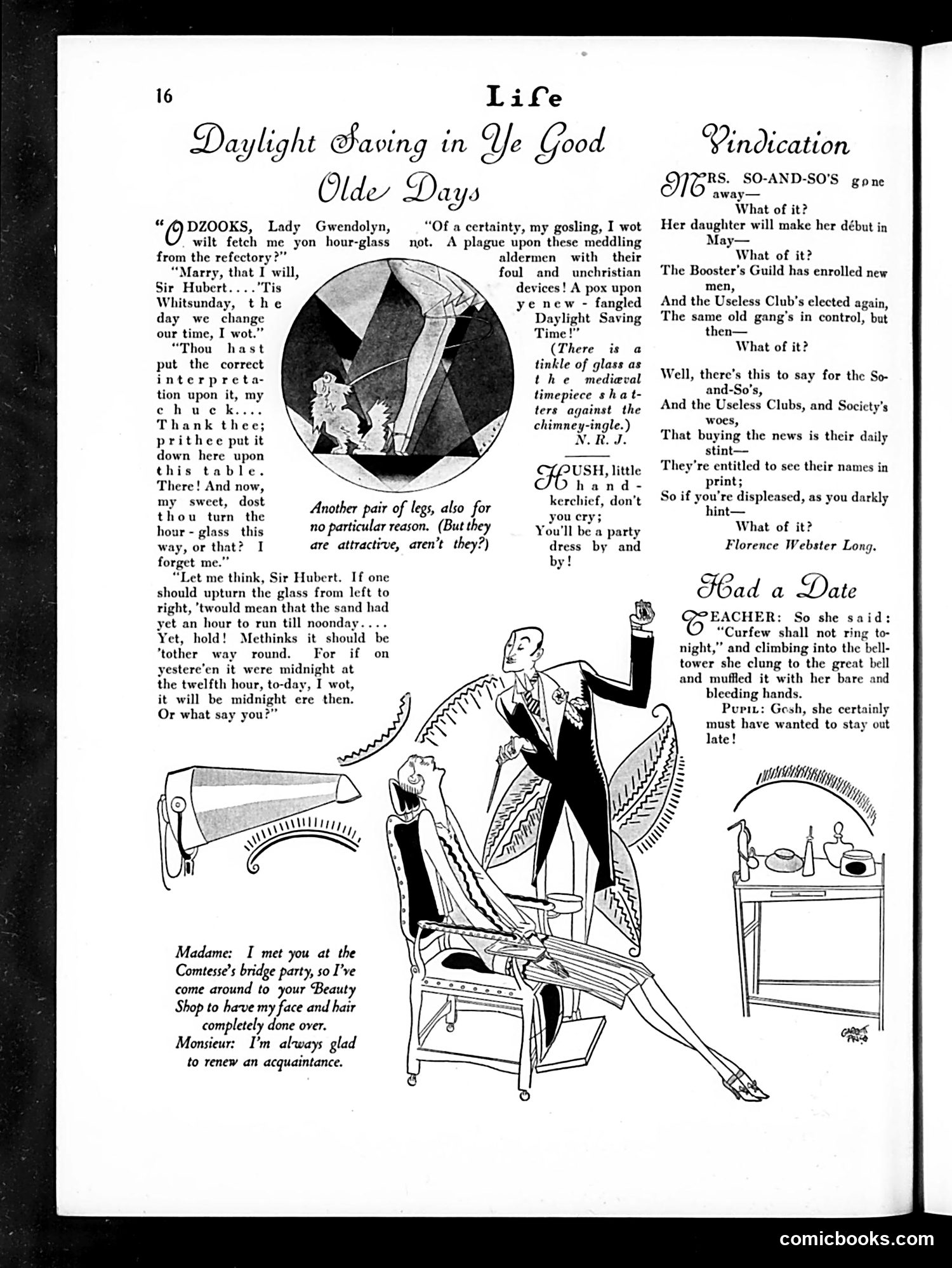
This page satirizes the adoption of Daylight Saving Time, a policy change that shifted clocks forward. The top section mocks confusion among the elderly about the time change—Sir Hubert complains the adjustment is disorienting, while Lady Gwendolyn questions whether upturn the glass hourly would work instead. The bottom cartoon, "Had a Date," shows a young couple's romantic evening ruined by the time change. The teacher character explains she told a student "curfew shall not ring to-night," but the bell-tower actually rang at the correct time, catching them out. The joke satirizes how the time shift created real social confusion and inconvenience, particularly for dating couples managing curfews.
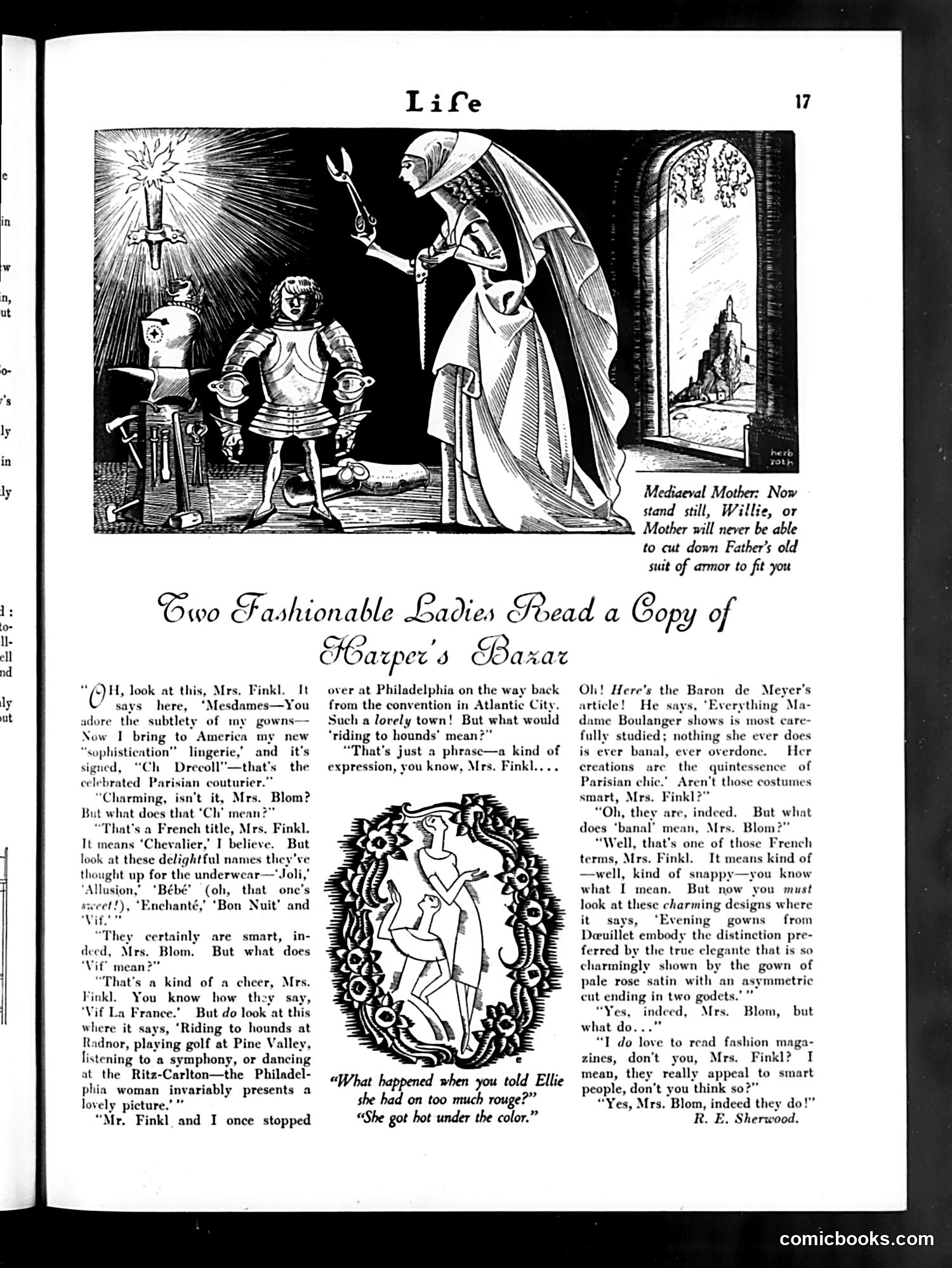
This page contains a satirical dialogue between two fashionable ladies discussing French fashion terminology and design trends. The conversation, titled "Two Fashionable Ladies Read a Copy of Harper's Bazar," mocks upper-class women's pretentious engagement with French fashion vocabulary. The women debate terms like "Chevalier" and "Vif La France," with one character (Mrs. Finkl) repeatedly misunderstanding or questioning French words' meanings. The satire targets both women's limited comprehension of fashion jargon and their social aspiration to appear knowledgeable about continental style. The accompanying illustration shows what appears to be a religious or allegorical scene (possibly a medieval mother figure with children and devil/demon imagery), likely commenting on the contrast between serious spiritual matters and women's frivolous fashion preoccupations—a common satirical theme of the era.
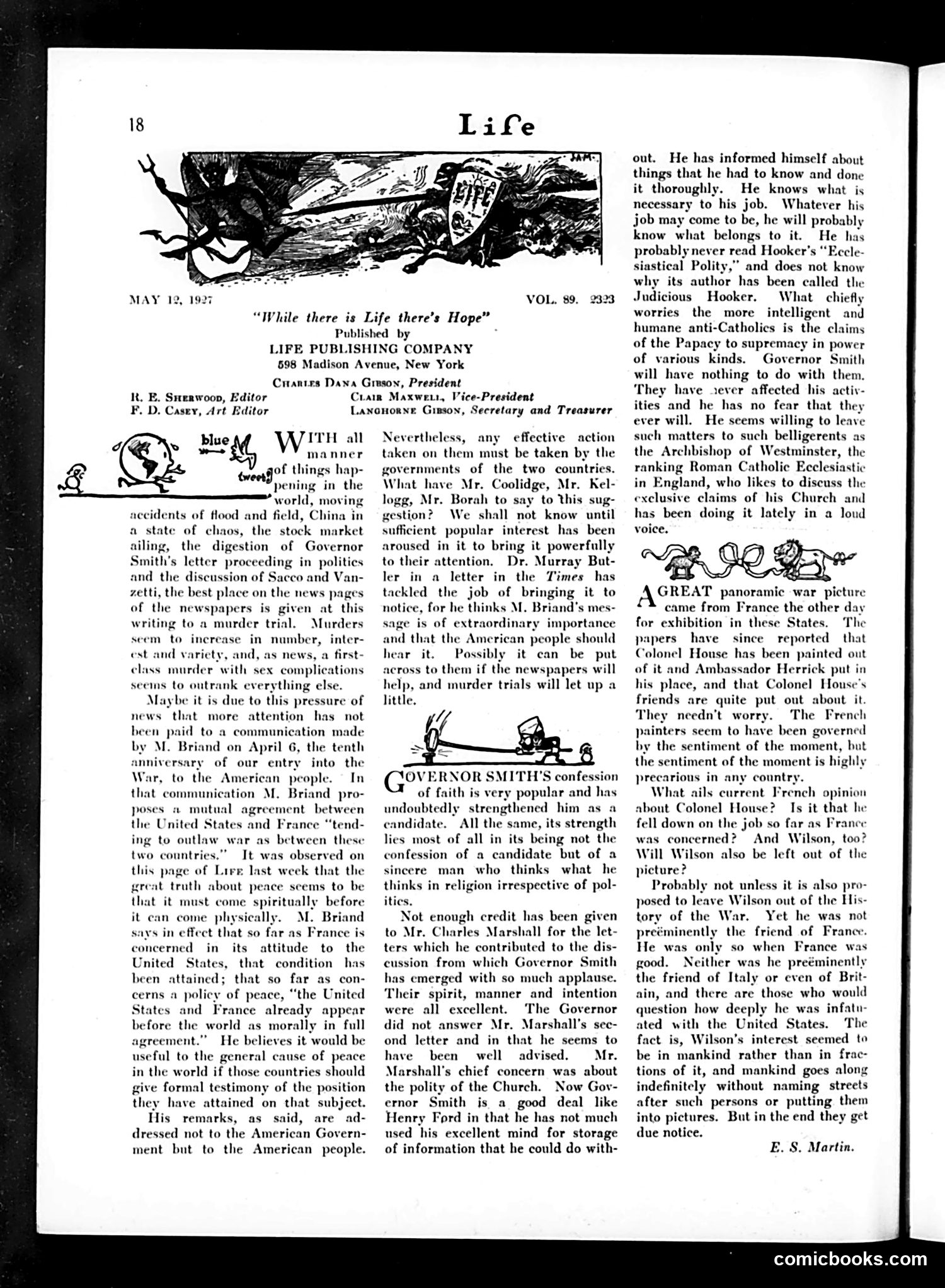
This editorial page discusses two major political topics of 1927: **1. Aristide Briand's Peace Proposal:** French Premier Briand proposed a mutual agreement between the U.S. and France to "outlaw war." The editorial criticizes American media for obsessing over murder trials rather than covering this significant diplomatic initiative. It appeals to readers to pressure President Coolidge, Secretary Kellogg, and Senator Borah to respond seriously to the proposal. **2. Governor Al Smith's Religious Confession:** The page praises Smith (likely the Democratic presidential candidate) for his candid statements about his Catholic faith, suggesting his strength lies in sincere conviction rather than political calculation. It credits Charles Marshall's published letters for prompting this important public discussion about religion and politics. The cartoons appear decorative rather than satirical—small illustrations of figures in various poses without obvious political commentary.
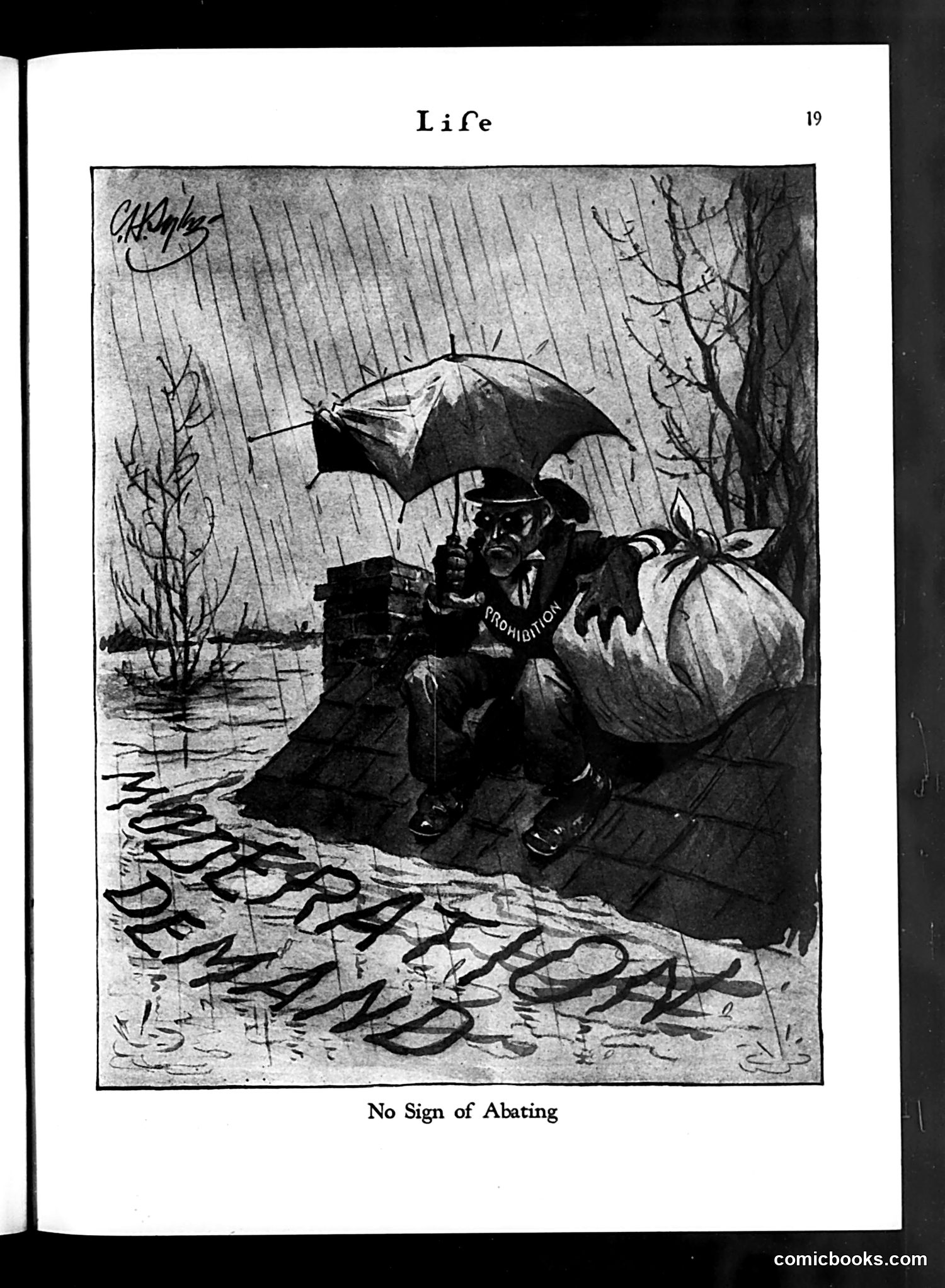
This political cartoon depicts a figure hunched under an umbrella during heavy rain, surrounded by what appears to be bodies of water rising. The title "No Sign of Abating" suggests the situation is worsening rather than improving. The cartoon likely comments on a contemporary crisis or disaster—possibly flooding, economic hardship, or a social problem—that persists despite hopes it would end. The figure's cramped, defensive posture conveys helplessness in the face of relentless circumstances. Without knowing the specific publication date, the exact historical event referenced remains unclear. However, the satire's point is clear: conditions initially expected to be temporary have become chronic, offering "no sign" of relief. The visual metaphor of rising water suggests an overwhelming, inescapable situation.
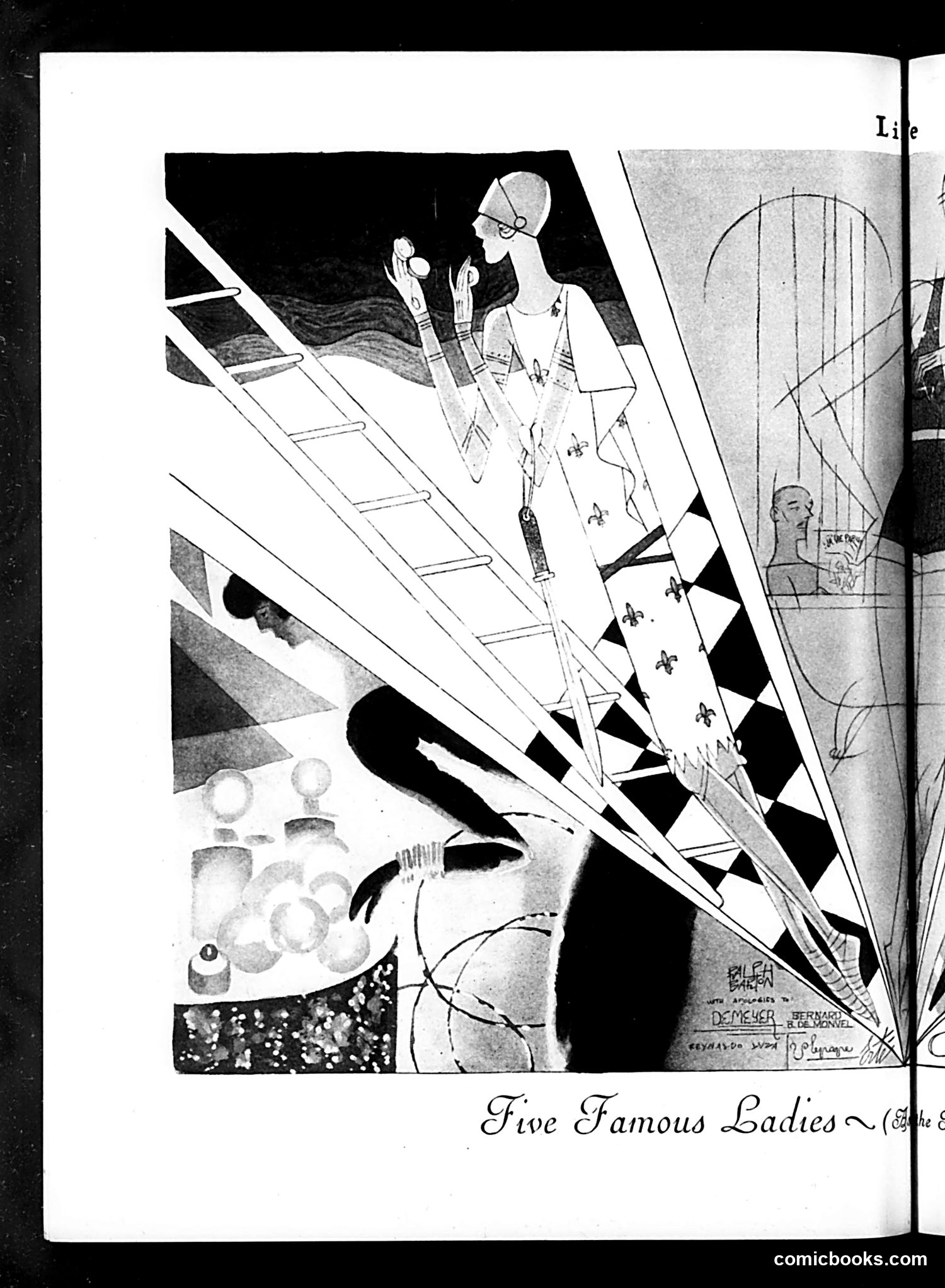
This page shows "Five Famous Ladies," an Art Deco-style illustration from *Life* magazine. The artwork depicts an elegant woman in 1920s fashion descending a geometric staircase, wearing a patterned dress and cloche hat. She holds what appear to be cosmetics or beauty products. The lower left shows various beauty supplies and accessories—bottles, pearls, and decorative items. The satire likely mocks the era's obsession with beauty consumption and the cosmetics industry's marketing to women. The "famous ladies" reference is unclear without seeing the complete feature, but the emphasis on products and glamorous presentation suggests commentary on how women were defined by appearance and purchasing power during the Jazz Age.
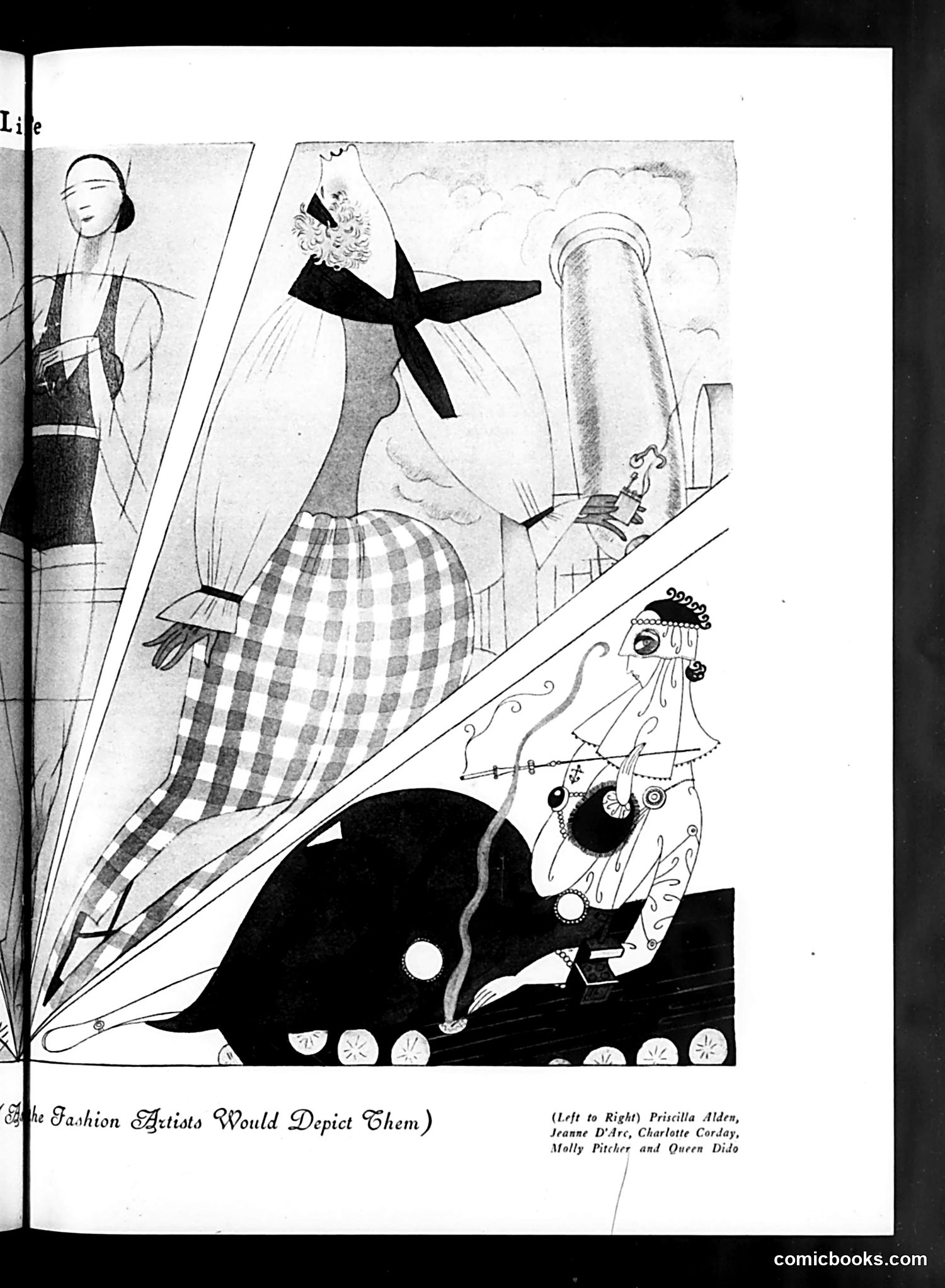
This satirical cartoon depicts five famous historical and legendary women as they might appear in 1920s fashion illustrations. The caption identifies them as (left to right): Priscilla Alden, Jeanne d'Arc, Charlotte Corday, Molly Pitcher, and Queen Dido. The satire mocks how fashion artists of the era would stylize these serious historical figures—warriors, revolutionaries, and patriots—by rendering them as glamorous, decorative fashion plates with exaggerated features, elaborate clothing, and theatrical poses. The juxtaposition of grave historical significance with frivolous 1920s aesthetic sensibility creates the humor: women known for military service or political importance are reduced to fashionable silhouettes, stripping them of their actual accomplishments and agency. It's a commentary on how commercial fashion art trivializes historical women's legacies.
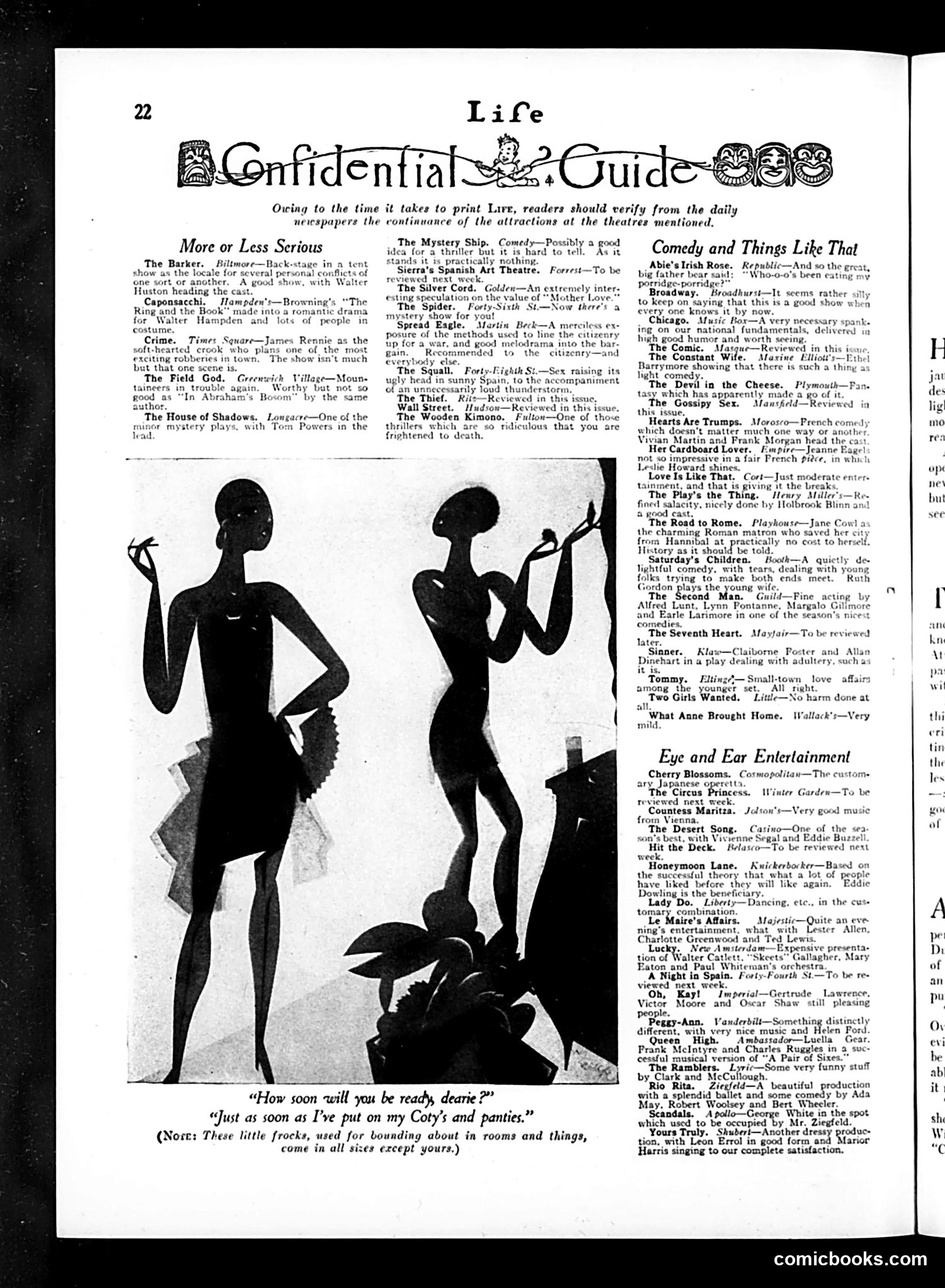
This is a **theater review page** from Life magazine, not primarily a political cartoon. The central image shows silhouetted figures in what appears to be a comedic or theatrical pose, with a caption about getting dressed ("How soon will you be ready, dearie?"). The page's main content is theatrical reviews of Broadway shows and entertainment venues. The satire here is **gentle social commentary** embedded in brief reviews—mocking pretentious theater, sentimental plots, and formulaic entertainment rather than political figures. References include Broadway theaters (Belasco, Fulton, etc.), performers (Holbrook Blinn, Jane Cowl), and shows with period titles like "The Road to Rome" and "Saturday's Children." The humor derives from **Life's sardonic dismissals of mediocre productions**—calling them "ridiculously" thrilling or noting when plots are recycled because audiences "will like again" what they've seen before. This represents early 20th-century middlebrow cultural criticism packaged as entertainment journalism.
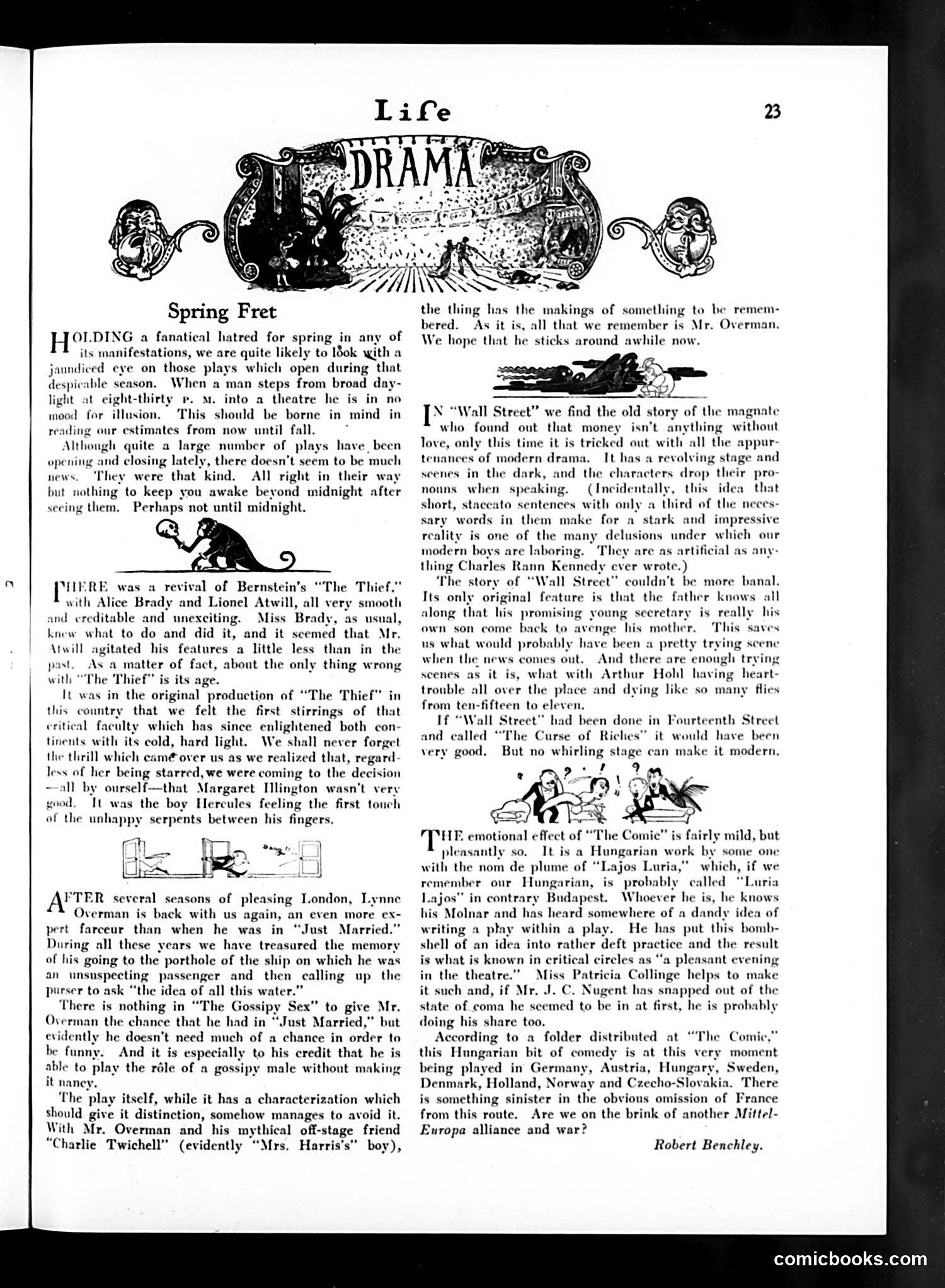
This drama review page critiques spring theatrical productions. The author expresses disdain for plays opening during spring, when audiences prefer outdoor activities to theater. **Key Reviews:** - **"The Thief"**: A revival featuring Alice Brady and Lionel Atwill. The critic credits this production with awakening their critical judgment, noting Margaret Illington's performance helped them recognize she wasn't truly excellent—comparing the realization to Hercules first feeling serpents. - **"The Gossipy Sex"**: Showcasing farceur Lynne Overman, who excels despite the play's weak material. The critic praises Overman's comedic talent while criticizing the play itself. - **"Wall Street"**: Dismissed as banal melodrama with artificial modernist techniques (staccato dialogue, dark staging). The plot—a father unknowingly employing his secret illegitimate son—is predictable, and Arthur Hohl's excessive emotional scenes are mocked. The overall tone is witty and dismissive of spring theater's generally poor quality.
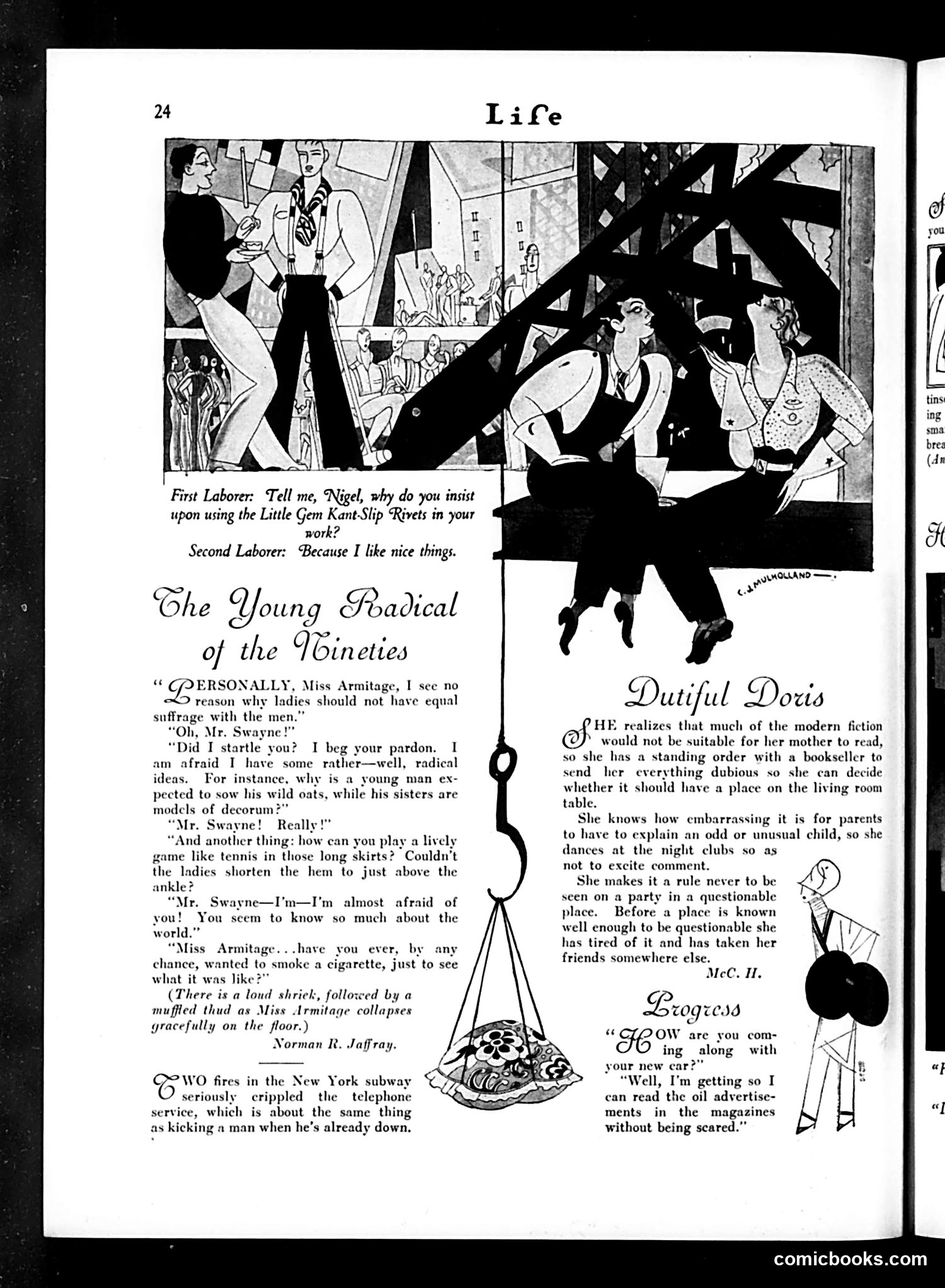
This page contains satirical commentary on 1920s social attitudes. **"The Young Radical of the Nineties"** mocks a man (Mr. Swayne) expressing progressive ideas—women's suffrage, shorter skirts for athletic activity, women smoking cigarettes—that shock his female companion (Miss Armitage) into fainting. The joke ridicules both the radical's earnest advocacy and the woman's exaggerated prudishness, suggesting these "modern" ideas still scandalize society. **"Dutiful Doris"** satirizes a young woman who performs respectability by pre-screening her mother's reading materials and carefully timing her visits to nightclubs—waiting until venues become questionable before avoiding them. The humor targets performative propriety: she's morally complicit in modern behavior while maintaining plausible deniability. The **product advertisement** (rivet rivets) uses working-class dialogue as humor, suggesting trivial consumer preference over practical necessity. Together, these pieces mock 1920s anxieties about changing social norms, particularly regarding women's liberation, generational conflict, and the tension between modern behavior and traditional respectability.
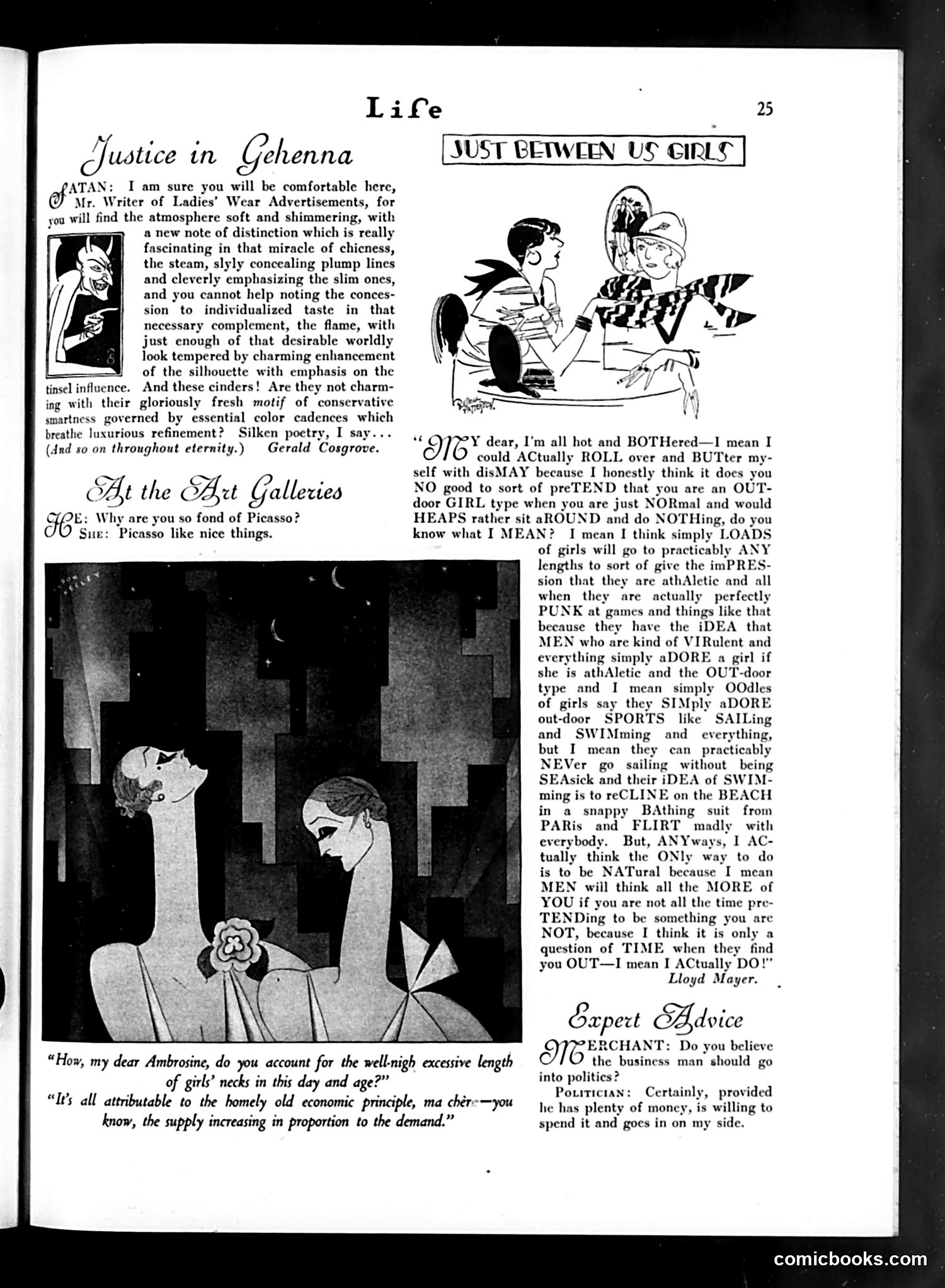
This page contains three satirical pieces mocking early 20th-century society: **"Justice in Gehenna"** (top left): Satan welcomes a "Writer of Ladies' Wear Advertisements" to Hell, sarcastically praising the absurd flowery language used in fashion advertising—mocking how copywriters use elaborate euphemisms ("steam," "tinsel influence," "silken poetry") to hide unflattering truths about clothing. **"At the Art Galleries"** (lower left): A brief joke about Picasso's popularity, suggesting people admire modern art without understanding it. **"Just Between Us Girls"** (right): A monologue by a young woman (Lloyd Mayer) satirizing how girls pretend to be athletic and outdoorsy to impress men, when they actually prefer sitting around. She highlights the performative nature of femininity—girls adopt false personas based on what they think men desire, rather than being authentic. The page collectively ridicules advertising fakery, pretentious art appreciation, and performative gender roles.
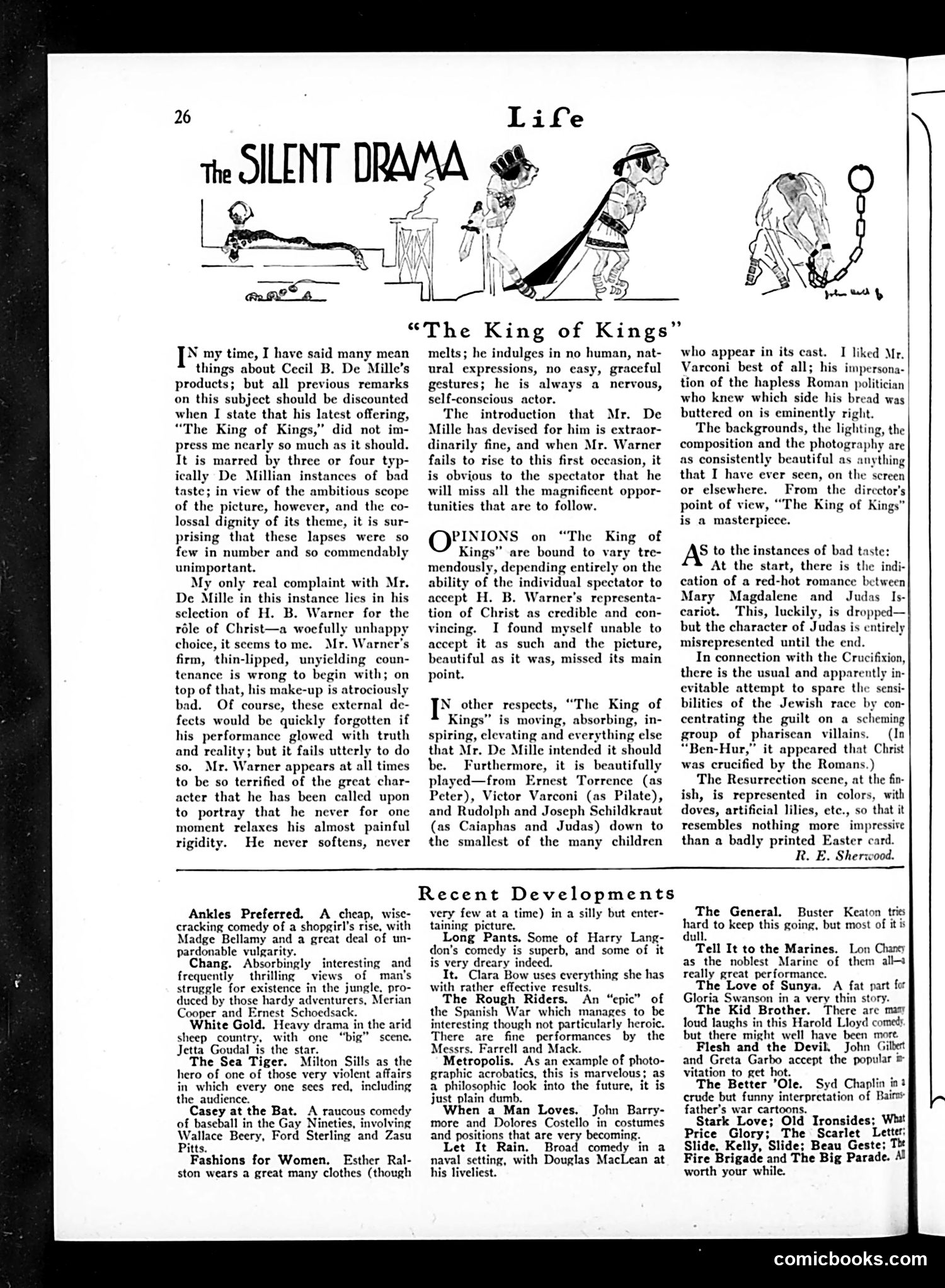
This page reviews Cecil B. DeMille's 1927 film *The King of Kings*, a major religious epic about Christ's life. The reviewer praises the film's ambition and production values but criticizes H.B. Warner's casting as Jesus, describing his performance as rigid, terrified, and lacking natural human expression. Warner's thin-lipped, unyielding appearance and poor makeup undermine the character's credibility, the critic argues. The reviewer acknowledges that audience reactions will depend on their willingness to accept Warner's portrayal. Despite this central flaw, the film is praised as "moving, absorbing, inspiring" with strong supporting performances from Ernest Torrence, Victor Varconi, and others. The page also briefly reviews other current films including *Ankles Preferred*, *Chang*, and *Metropolis*, typical of Life's regular cinema criticism section.
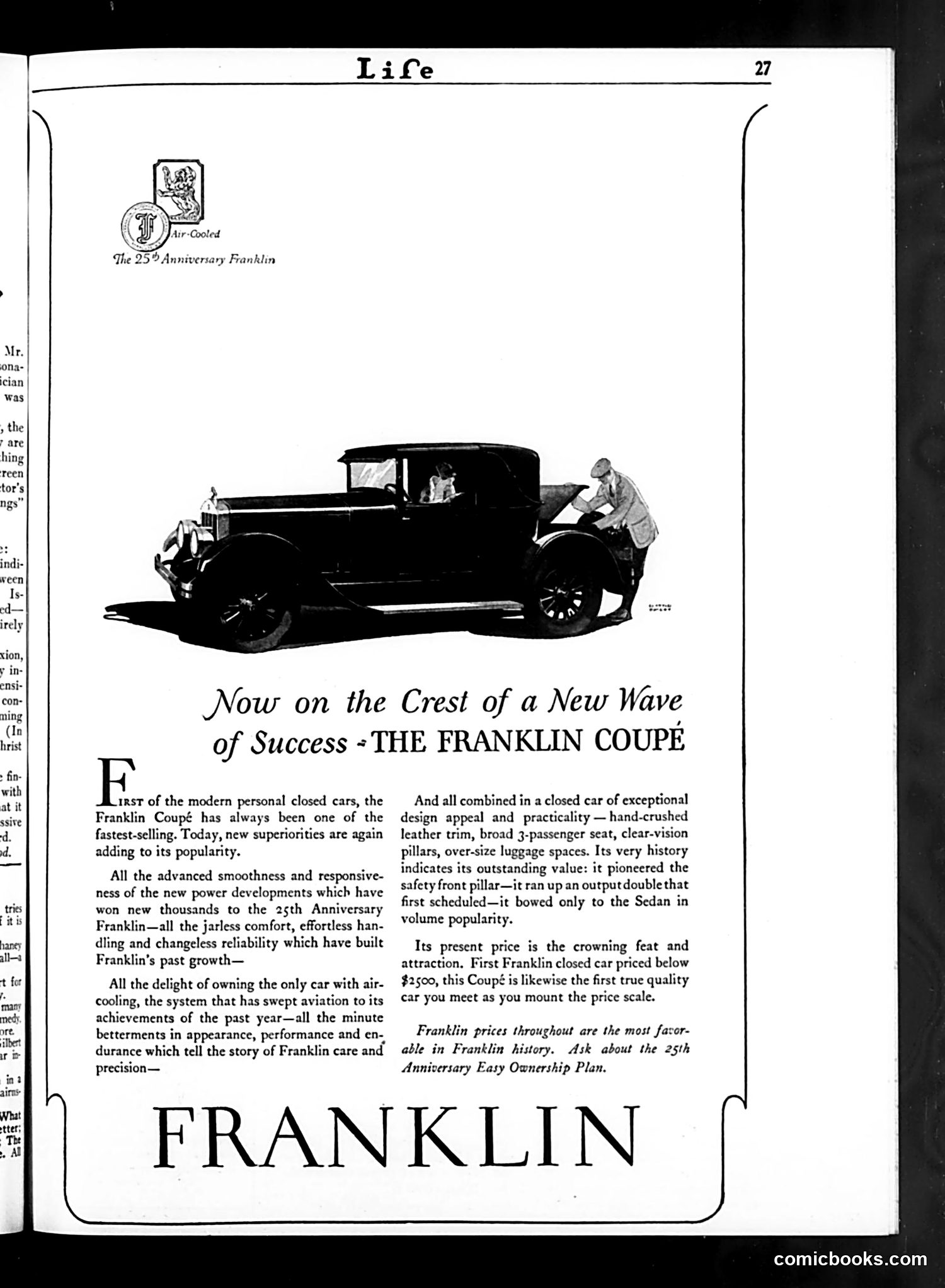
This is **not a cartoon or satire**—it's a straightforward automobile advertisement from Life magazine's 25th anniversary issue, celebrating the Franklin Coupe. The ad emphasizes the Franklin's market position: it's a closed (fully enclosed) car with air-cooling technology—then a novel feature borrowed from aviation. The text highlights competitive advantages: safety innovations (pioneering the safety front pillar), reliability, and crucially, **affordability under $2,500**, positioning it as "the first true quality car" at an accessible price point. The illustration shows the car in profile with a man examining or gesturing toward it, a common advertising trope suggesting quality and appeal. The "25th Anniversary Easy Ownership Plan" references financing options meant to further democratize car ownership. This reflects the 1920s automotive market's expansion beyond luxury goods toward mass consumer accessibility.
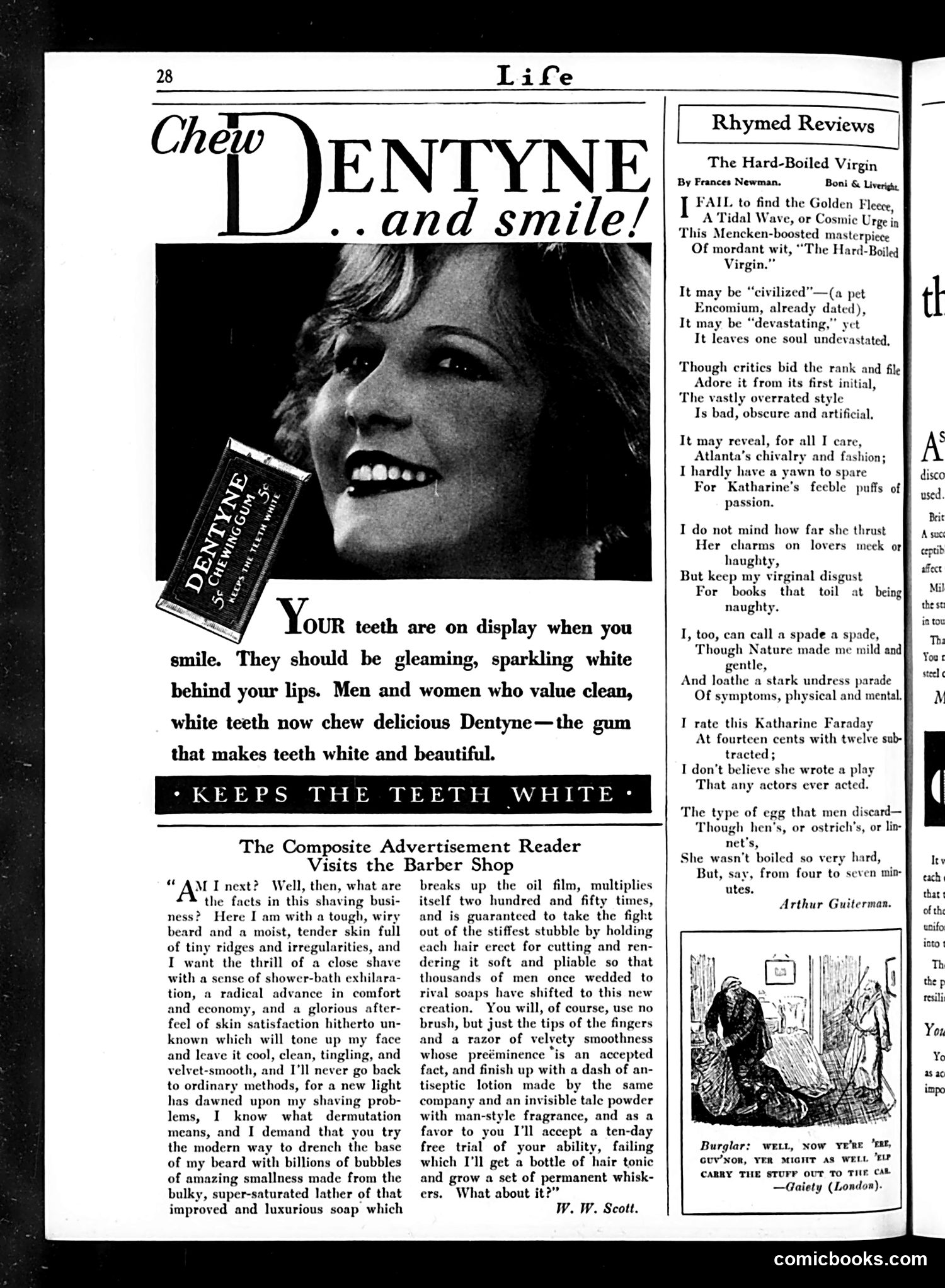
This page mixes **advertising with literary satire** typical of *Life* magazine's format. The **Dentyne gum advertisement** uses a smiling woman's photograph to promote teeth-whitening—straightforward early 20th-century marketing appealing to vanity and social acceptance. The **barber-shop satire** by W.W. Scott mocks **advertising hyperbole itself**. A customer recites absurdly inflated claims about shaving products—"billions of bubbles," "velvety smoothness," "guaranteed" results—satirizing how advertisements pile on pseudo-scientific jargon and exaggerated promises to sell mundane products. The joke is that real people absorbed this language and now parrot it back. The **"Hard-Boiled Virgin" review** by Arthur Guiterman dismisses Frances Newman's Mencken-praised novel as affected, pretentious, and sexually provocative without substance. "Hard-boiled" refers to the book's tough, cynical tone; Guiterman sarcastically defends his own "virginal disgust" at such naughty literature. The **cartoon** (bottom right) shows a burglar caught mid-robbery, casually asking permission to steal—British humor about working-class criminality.
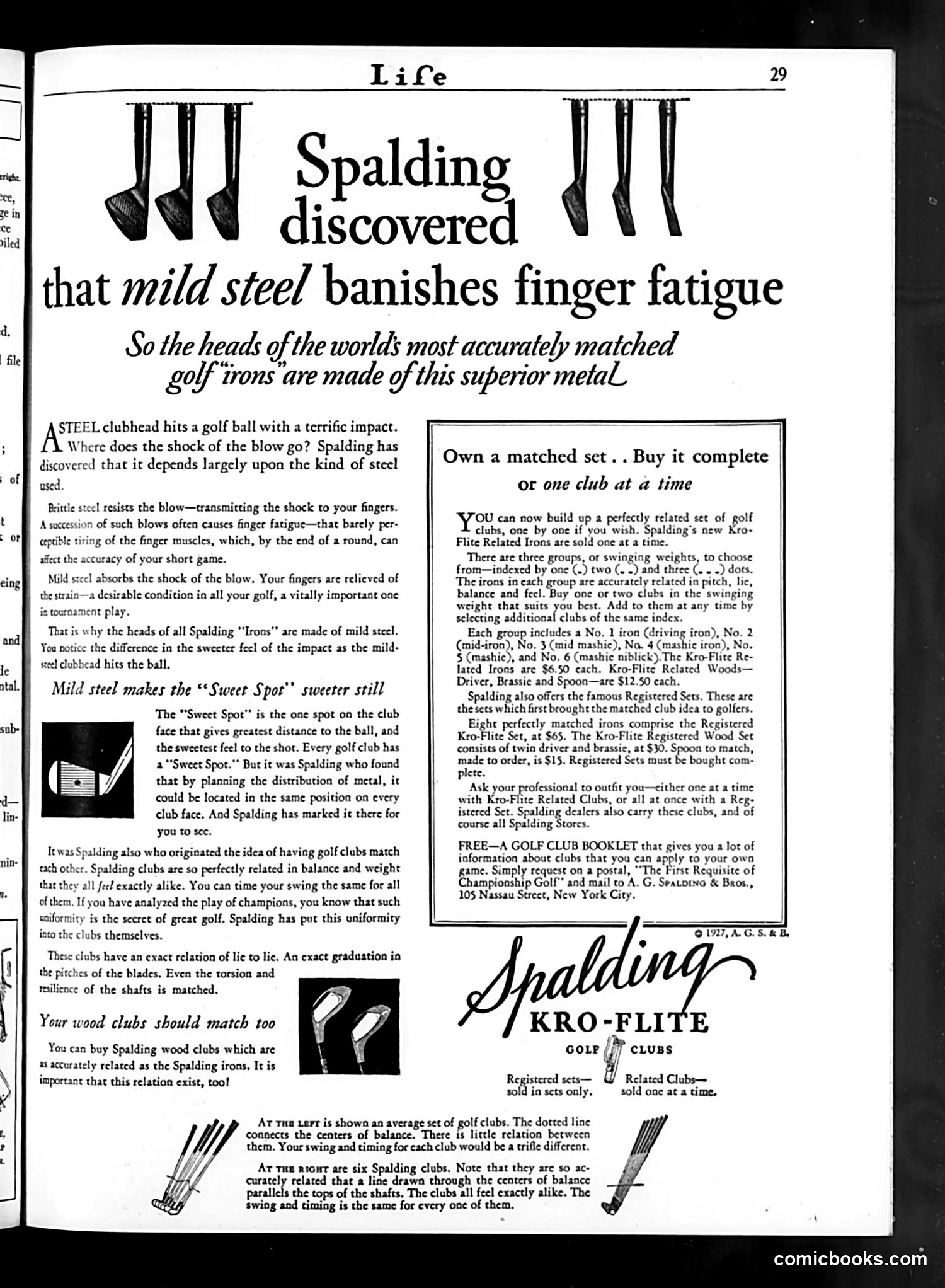
This is **not a cartoon or satire** — it's a straightforward **product advertisement** for Spalding golf clubs, appearing in Life magazine's pages. The page promotes Spalding's discovery that mild steel absorbs impact shock better than brittle steel, reducing "finger fatigue" during golf. The advertisement emphasizes two key innovations: the "Sweet Spot" (a marked optimal striking point on each club face, positioned consistently across all clubs) and matched club sets where all irons are precisely calibrated in weight, balance, and pitch so golfers can use identical swing timing. The ad appeals to both casual golfers and competitive players, offering either complete matched sets ($65) or individual clubs purchased gradually. Small illustrations show proper club alignment. This represents early-20th-century golf equipment marketing emphasizing technical precision and engineering superiority — positioning Spalding as the innovator in club design.
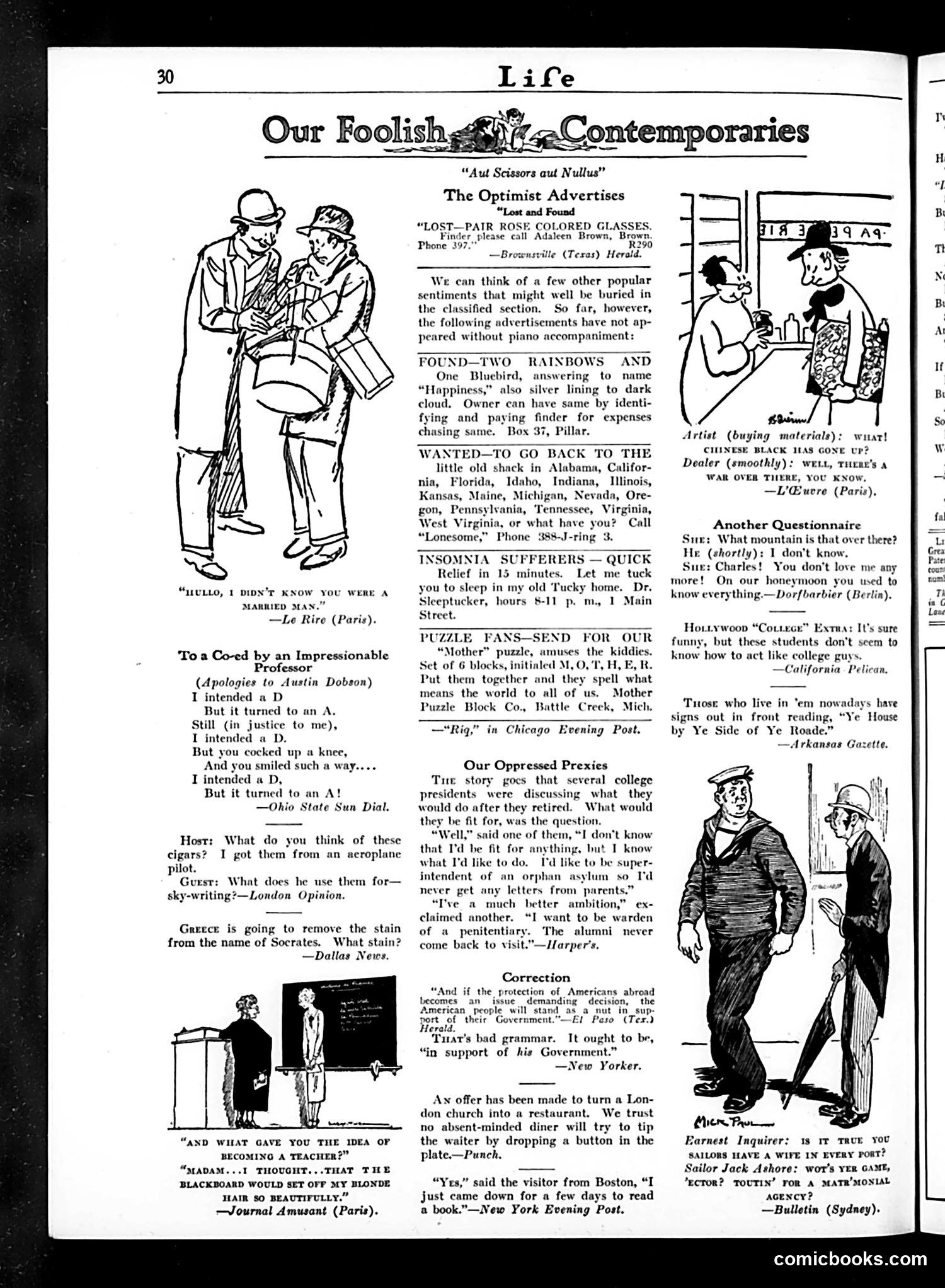
This page from *Life* magazine presents satirical humor through short jokes and cartoons mocking contemporary follies. **Main themes:** 1. **Academic impropriety**: A professor grades a female student higher (A instead of D) because she's attractive, satirizing professorial weakness and conflicts of interest. 2. **Optimistic classified ads**: The magazine parodies overly sentimental newspaper advertisements by inventing absurd "lost and found" notices (rainbows, bluebirds, happiness)—mocking nostalgia and wishful thinking. 3. **College presidents' complaints**: College administrators joke they'd prefer running orphanages or prisons to avoid pestering alumni and parents—satirizing the burdensome aspects of university administration. 4. **Marital discord**: A honeymoon couple joke about the husband's declining attentiveness, suggesting husbands lose interest after marriage. 5. **International references**: Several jokes cite European publications (*Le Rire*, *Punch*), suggesting *Life*'s cosmopolitan audience. The humor targets predictable human weaknesses: romantic susceptibility, nostalgia, institutional fatigue, and marriage deterioration.
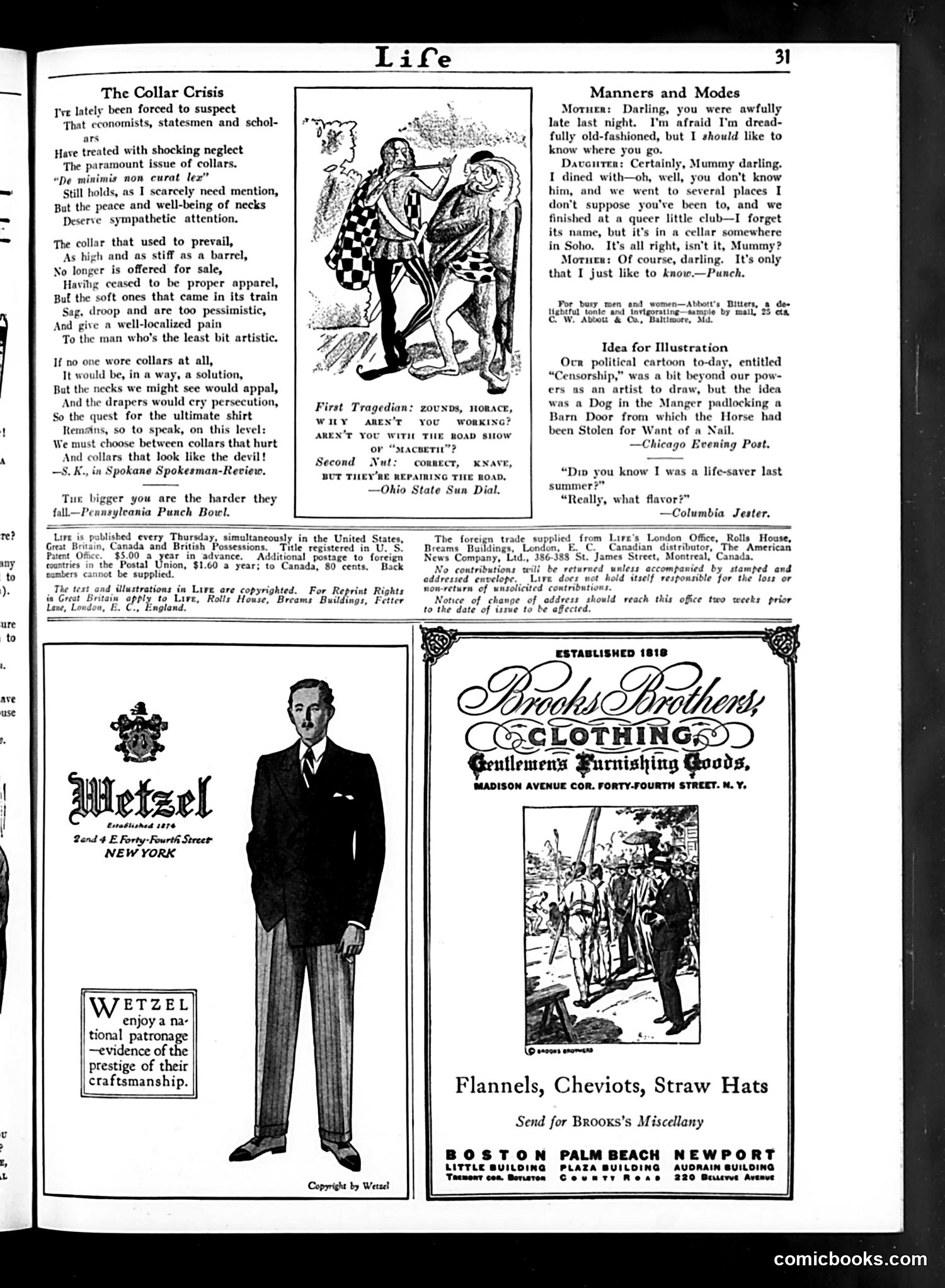
This page contains three humorous pieces from *Life* magazine: **"The Collar Crisis"** is a satirical poem mocking economists and politicians who ignore trivial issues. It jokes about the practical problem of men's collars—the old stiff barrel collars are no longer sold, but their soft replacements sag uncomfortably. The satire suggests that even minor domestic annoyances deserve serious attention. **"Manners and Modes"** is a brief comedic dialogue where a concerned mother asks her daughter where she went out late. The daughter admits to dining at mysterious places and an underground Soho club, yet the mother approves—satirizing either parental permissiveness or generational shifts in social expectations. The remaining items are short jokes from other publications and advertisements for men's clothing (Wetzel, Brooks Brothers). The "Idea for Illustration" references censorship through the proverb "the Horse had been Stolen for Want of a Nail"—suggesting problems ignored become disasters.
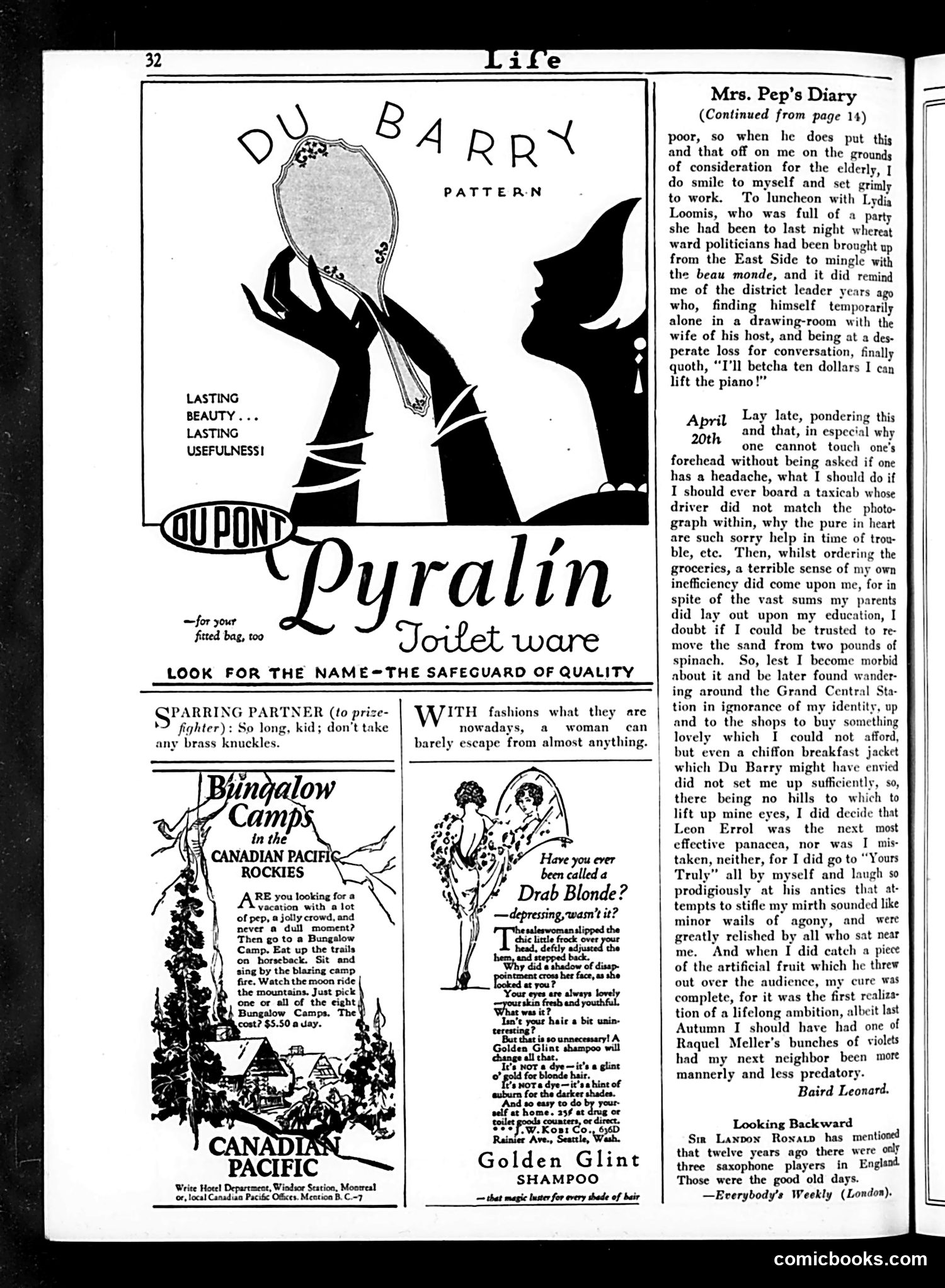
This page is primarily **advertising**, featuring beauty and travel products typical of 1920s consumer culture. Key elements: **Advertisements:** - Du Barry Pyralin toiletries (handbag pattern) - Canadian Pacific Bungalow Camps - Golden Glint Shampoo (addressing women's hair color concerns) **Cartoon/Joke:** A small panel shows a boxer's sparring partner saying "So long, kid; don't take any brass knuckles"—a mild, dated boxing joke playing on the phrase's double meaning. **Editorial Content:** "Mrs. Pep's Diary" is a humorous column describing mundane domestic life—anxiety about household tasks, theater-going, shopping impulses. It reflects 1920s upper-middle-class women's concerns and leisure activities. **"Looking Backward":** A brief nostalgia piece lamenting that England had only three saxophone players twelve years prior, suggesting the instrument's (then-modern) popularity has since exploded. The page captures period consumer aspirations and social attitudes rather than political satire—it's a snapshot of 1920s advertising and lifestyle humor aimed at affluent readers.
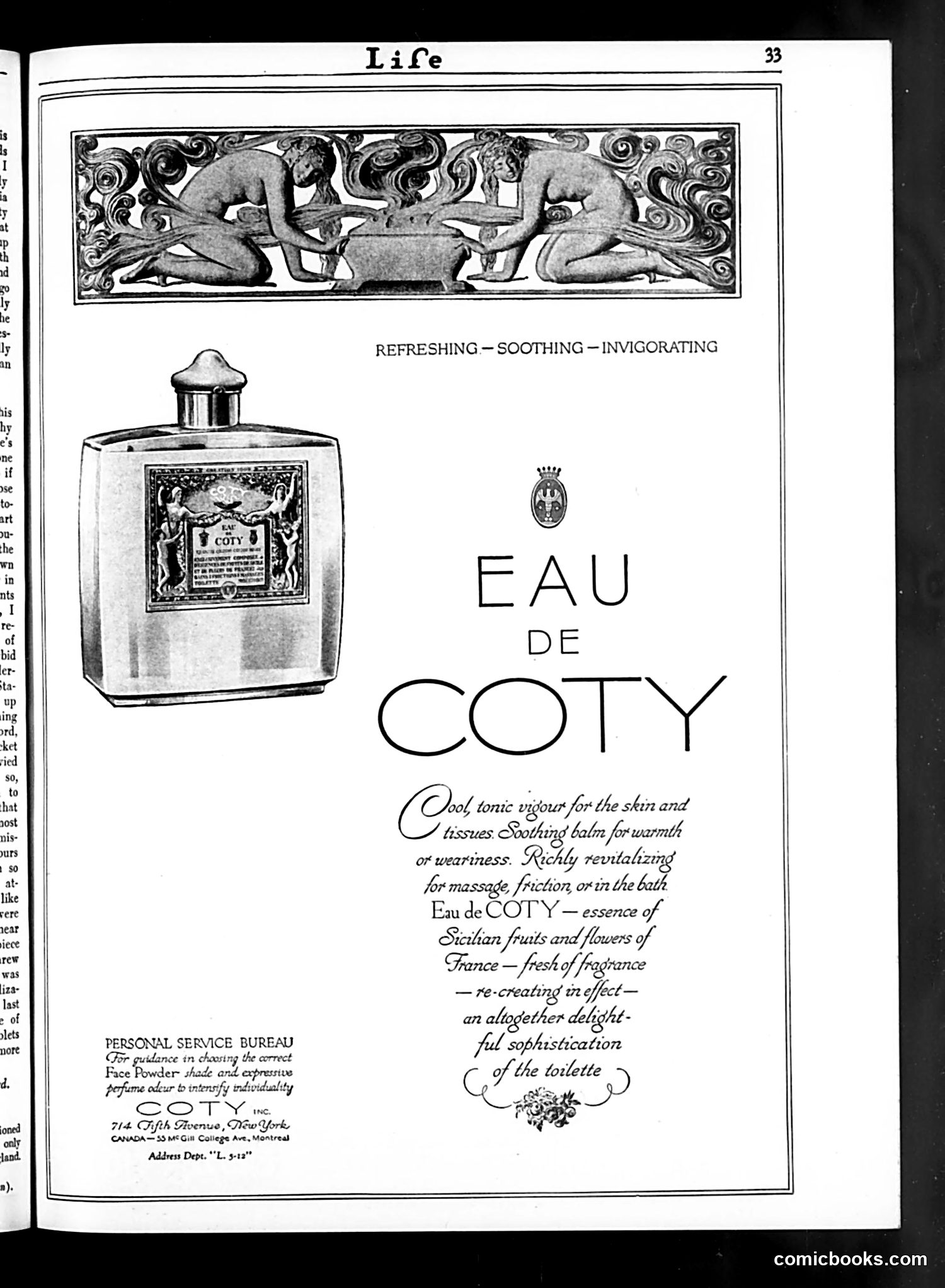
This is a **full-page advertisement**, not a cartoon or satirical piece. It promotes "Eau de Coty," a French perfume and cosmetics brand popular in the early 20th century. The decorative header features classical nude figures in an ornamental style typical of luxury product advertising from this era. The ad emphasizes the product's sophistication by referencing "Sicilian fruits and flowers of France" and its multiple uses—as a skin tonic, massage oil, and bath ingredient. The "Personal Service Bureau" section at bottom indicates Coty offered guidance on selecting face powder shades and perfumes, suggesting personalized beauty consultation was a novel marketing approach. The company had offices in New York and Montreal. This represents how *Life* magazine—primarily satirical—also carried upscale advertisements targeting affluent readers. The elaborate, pseudo-literary copy and classical imagery reflect marketing strategies emphasizing European elegance and cosmopolitan refinement to appeal to American consumers seeking status through beauty products.
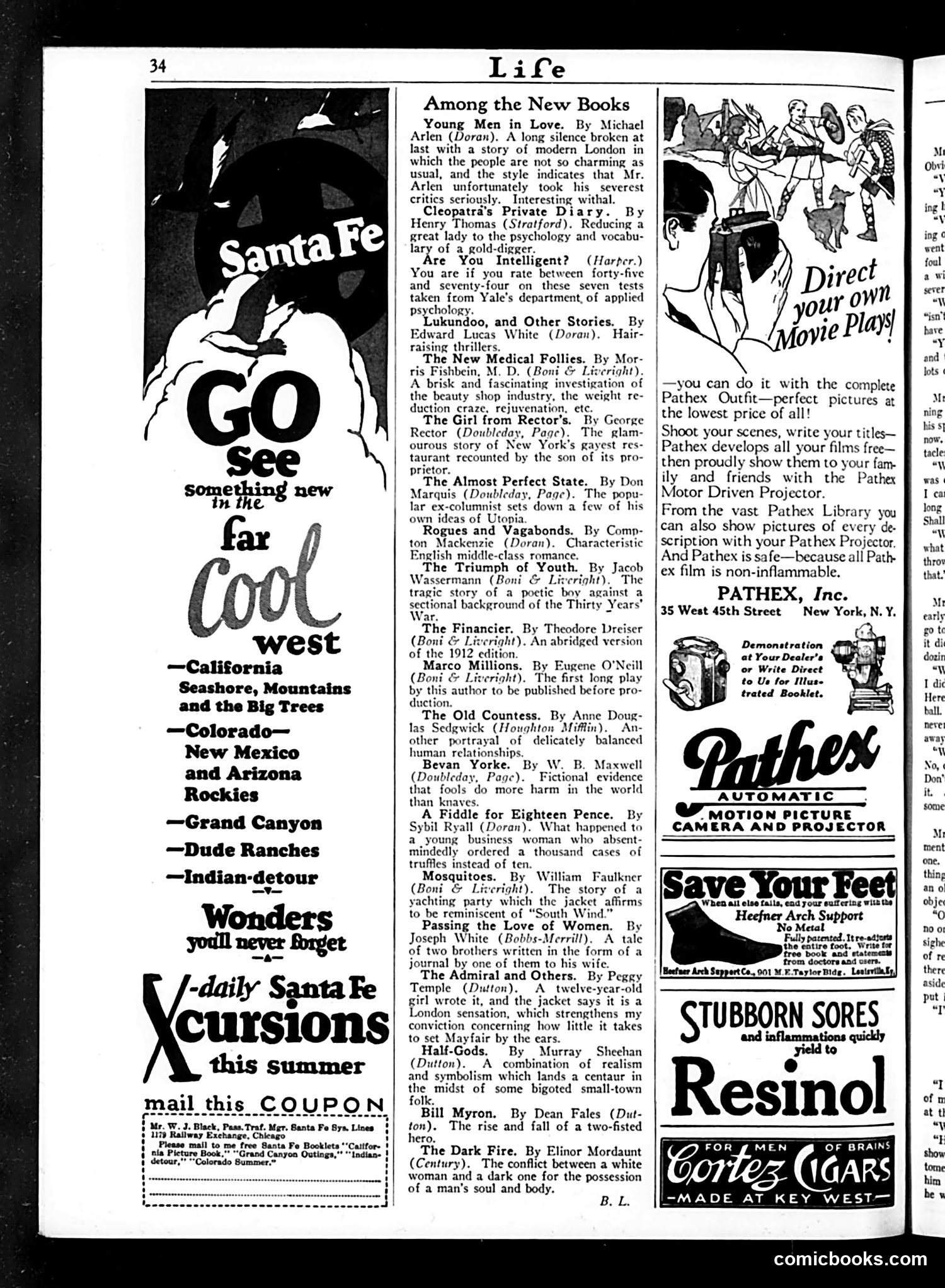
This page is primarily **advertising and book reviews**, not political satire. The dominant left-side advertisement promotes **Santa Fe Railway excursions** to western American destinations (California, Colorado, Arizona, Grand Canyon, dude ranches). The stylized illustration of a silhouetted figure suggests adventure and tourism. The center column reviews contemporary books from the 1920s, including works by Michael Arlen, Eugene O'Neill, and William Faulkner—typical literary fare of the era. The right side advertises **Pathex**, an early amateur motion-picture camera and projector system, encouraging readers to "direct your own movie plays"—reflecting 1920s enthusiasm for emerging home-film technology. Below is an advertisement for **Resinol**, a medical/pharmaceutical product for treating sores and inflammations, and **Cortez Cigars** ("made at Key West"). The page reflects commercial Life magazine content: travel promotion, book criticism, and consumer products targeting middle-class readers interested in leisure, culture, and modern conveniences.
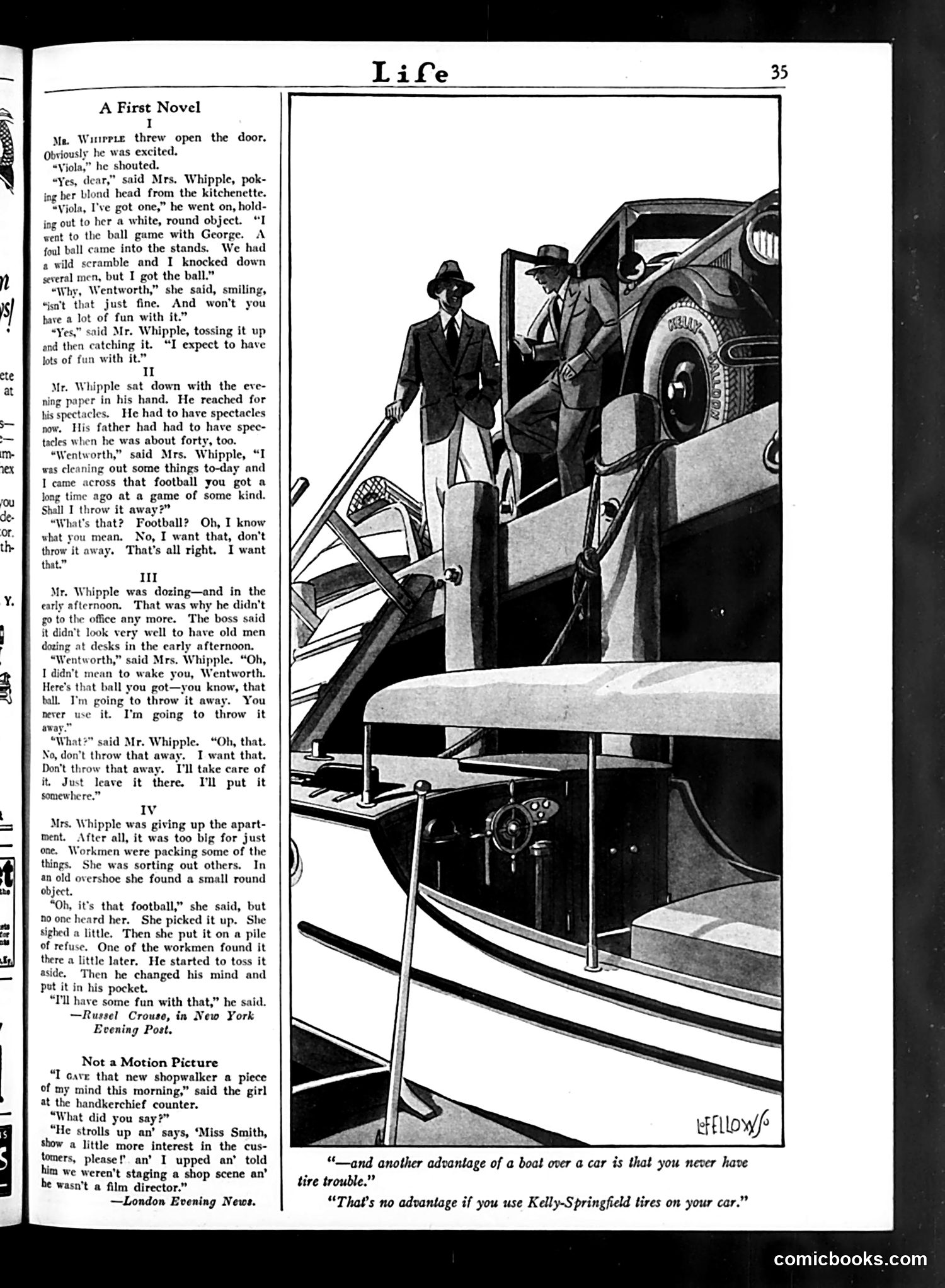
This satirical short story traces the life cycle of middle-class aspiration and decline through a single object: a foul ball Mr. Whipple catches at a baseball game. The humor lies in the **poignant contrast between youthful excitement and aging irrelevance**. Whipple treasures this trophy of a thrilling moment, but the narrative progressively reveals his diminishment: he stops going to the office, dozes in afternoons, loses his apartment. Mrs. Whipple repeatedly tries to discard the ball—it becomes literally garbage. The final twist—a workman salvages it from refuse, pocketing it with genuine enthusiasm—underscores the satire: **the ball's value wasn't in the object itself but in Whipple's ability to enjoy it**. Once he lost his vigor and purpose, even his prized possession became meaningless refuse. The accompanying advertisement joke (bottom) employs a similar structure: undercutting the opening claim about tire reliability with a plug for Kelly-Springfield tires. This reflects 1920s anxieties about obsolescence and aging in modern, industrial society.
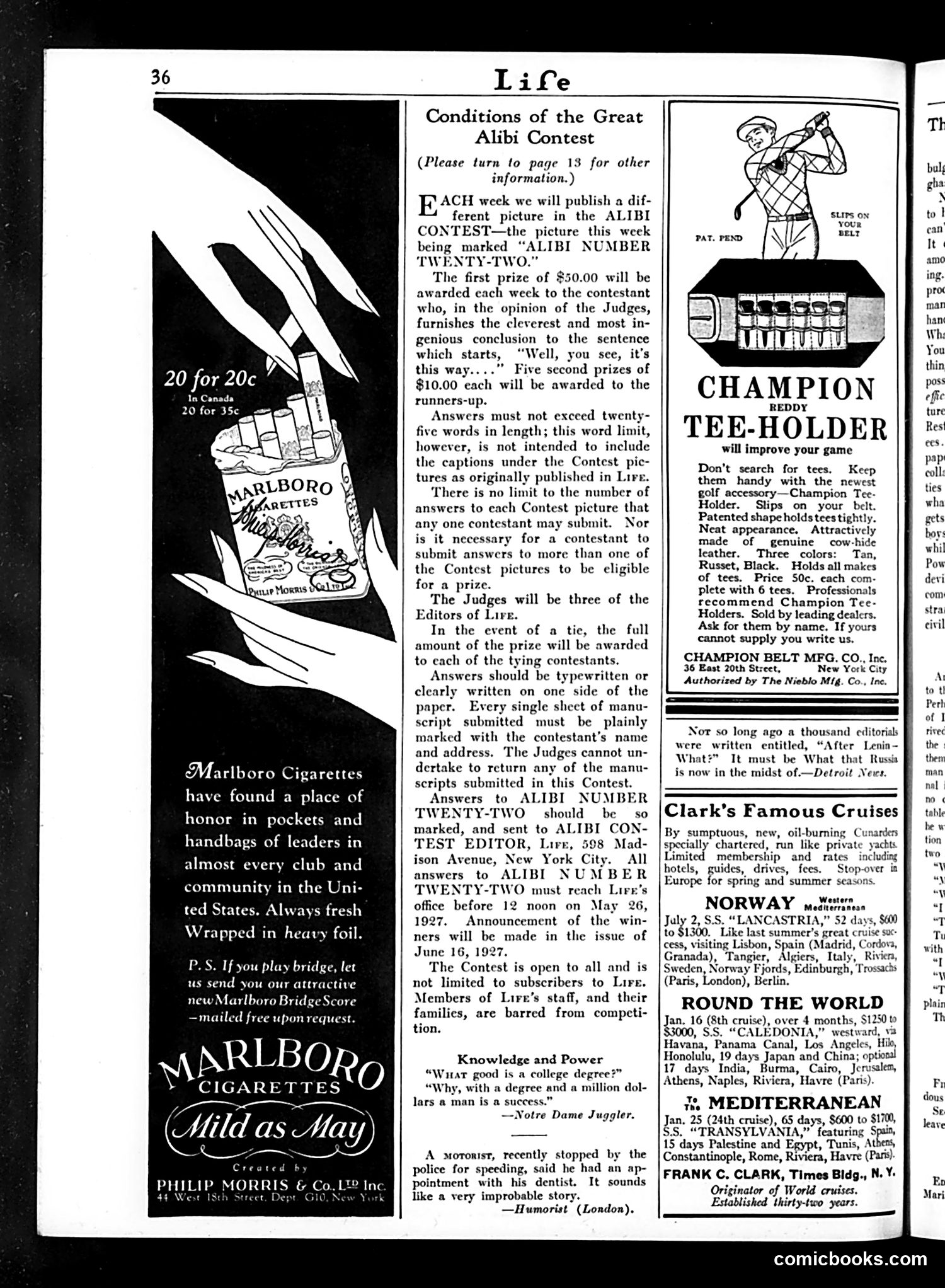
This page is primarily **advertising and contest information**, not political satire. The dominant content includes: **The Alibi Contest**: Life magazine runs a weekly creative-writing competition where readers submit humorous conclusions to image captions ("Well, you see, it's this way..."). First prize is $50; entries limited to 25 words. Winners announced in future issues. **Advertisements**: - **Marlboro Cigarettes** (left): Marketed as affordable (20¢) and prestigious—found in "pockets and handbags of leaders in almost every club." - **Champion Tee-Holder** (center): A belt accessory for golfers to hold tees. - **Clark's Famous Cruises** (bottom right): Luxury cruise packages to Norway and the Mediterranean. There are also brief humorous quotes about college degrees and a motorist's implausible speeding excuse—typical filler humor for the era. The page reflects 1920s consumer culture and leisure activities rather than political commentary.
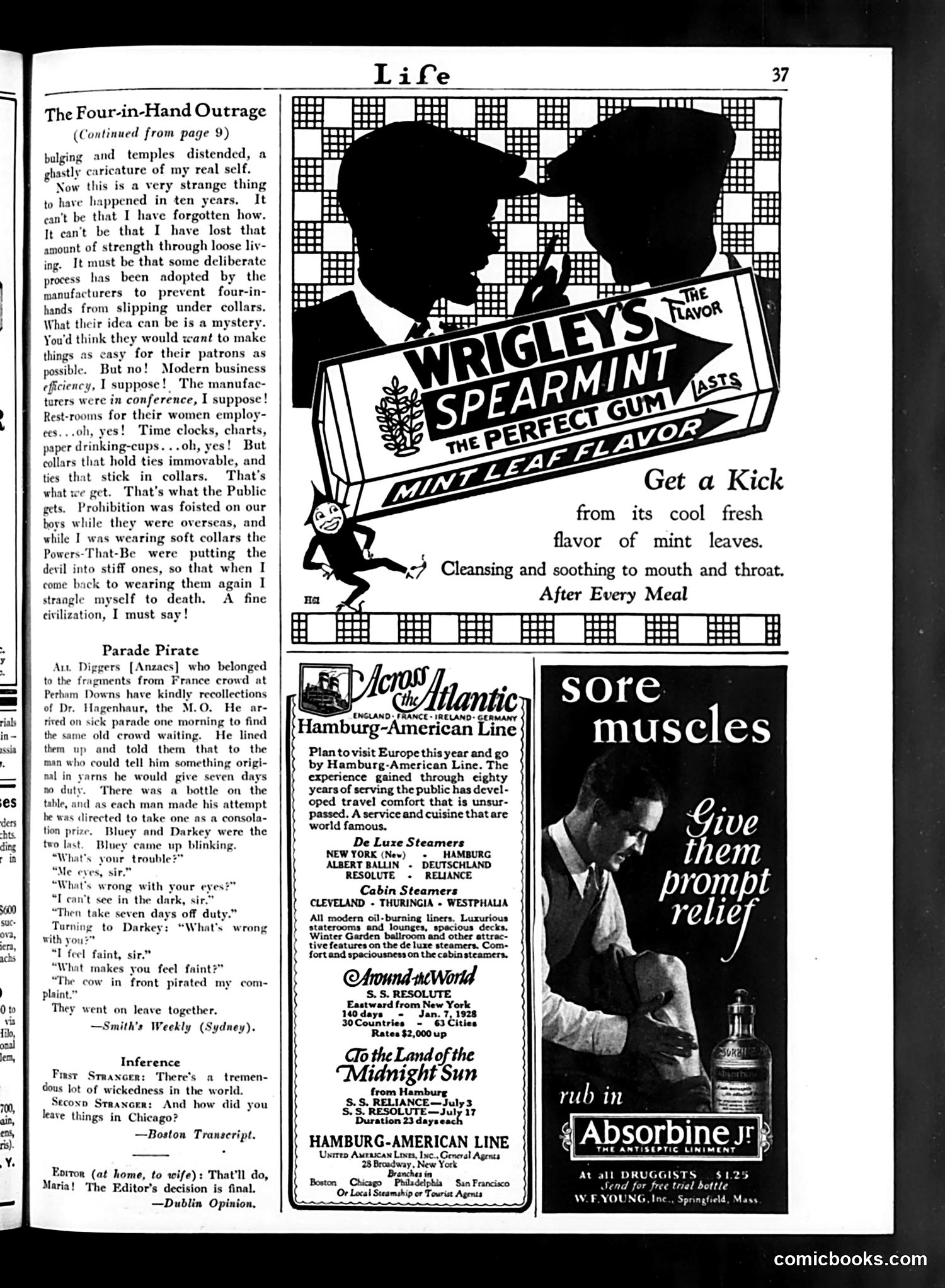
**"The Four-in-Hand Outrage"** is a humorous complaint about modern manufacturing. The author grumbles that four-in-hand neckties now stick stubbornly in shirt collars—a problem he blames on deliberate design by manufacturers pursuing "efficiency." He sarcastically contrasts this with corporate perks like rest-rooms and time clocks for employees, while workers suffer. The piece also vents about Prohibition being "foisted" on soldiers overseas, connecting necktie frustration to broader post-WWI social grievances. **"Parade Pirate"** is an Australian military anecdote (from *Smith's Weekly*) about a doctor rewarding soldiers who tell original jokes during sick parade with bottles of liquor. When the last soldier claims he "can't see in the dark," he gets seven days off—but the final soldier admits he simply copied the complaint, pirating the joke. Both pieces reflect 1920s anxieties: consumer frustration with mass production and nostalgia for simpler times, alongside post-war soldier culture. The page is otherwise advertisements for shipping lines, Wrigley's gum, and Absorbine liniment.
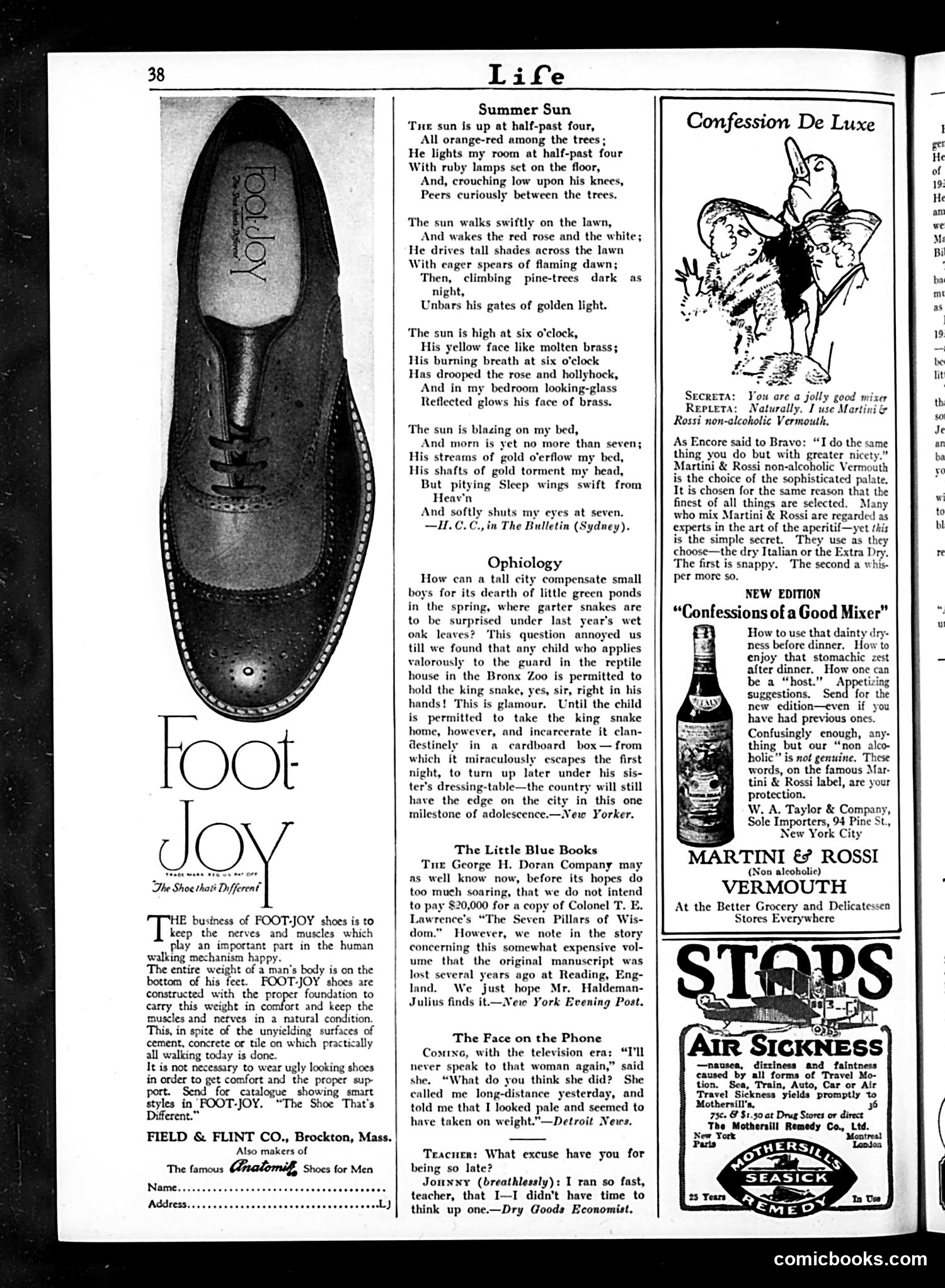
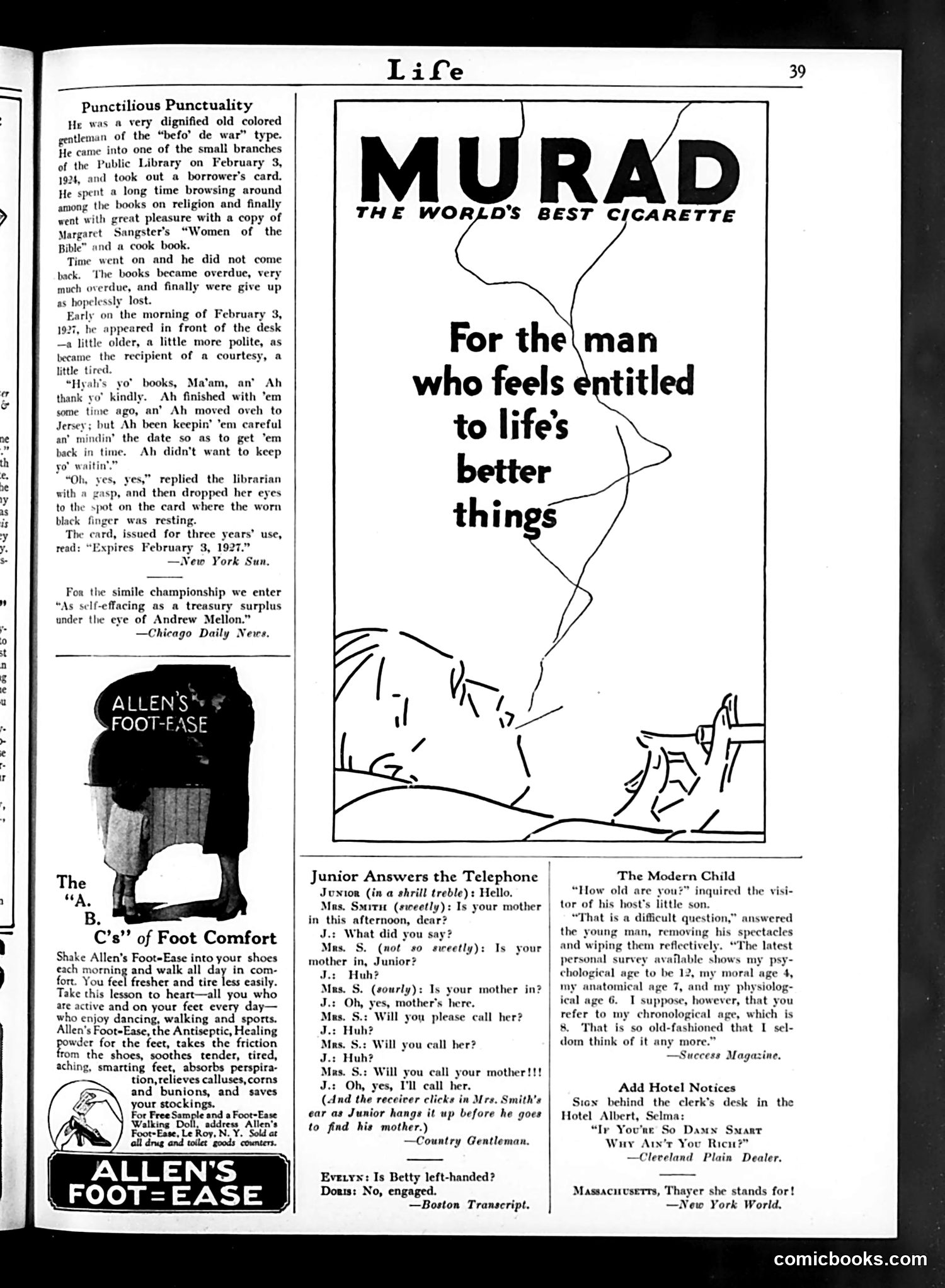
This anecdote satirizes bureaucratic rigidity. An elderly Black man borrows two library books in 1924 on a three-year card. He moves to New Jersey but carefully keeps the books, returning them exactly on February 3, 1927—the expiration date. The librarian is shocked to discover he's returned them precisely on time after three years, having scrupulously honored the deadline despite the books being technically overdue for years. The satire targets inflexible institutional rules: the man's dignity and conscientiousness are rendered comical by his desperate adherence to a technicality. The story, credited to the *New York Sun*, uses dialect and the formal politeness of an older gentleman to emphasize the absurdity of prioritizing deadline compliance over practical reality. It reflects 1920s anxieties about how modern bureaucracy could trap people in meaningless formality.
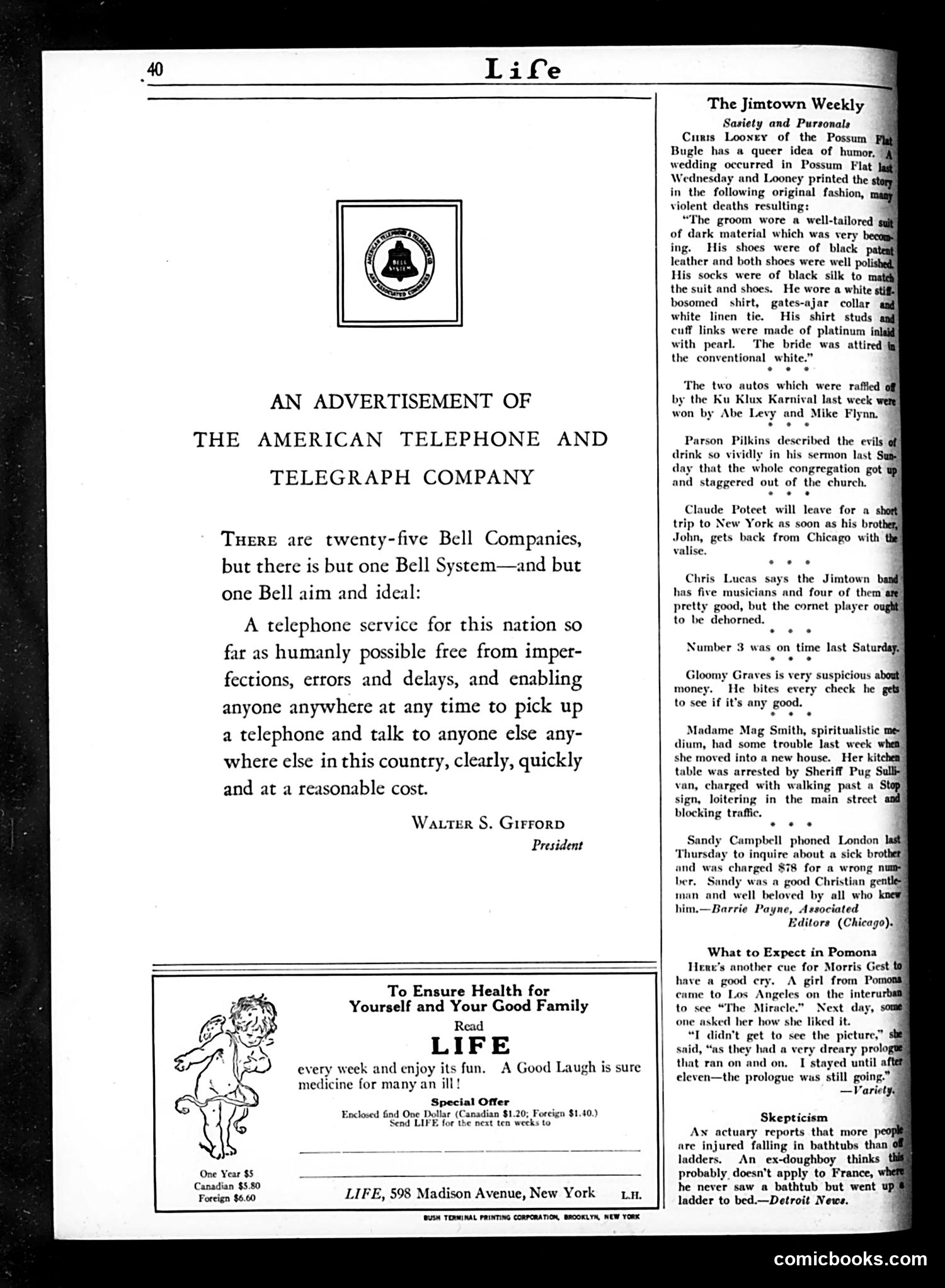
This page combines an AT&T corporate advertisement with satirical small-town gossip under the heading "The Jimtown Weekly." **The Advertisement:** AT&T President Walter S. Gifford promotes the unified "Bell System," emphasizing reliable nationwide telephone service free from errors and delays—a standard corporate pitch positioned as serving the nation's interests. **The Satire:** The facing column mocks small-town life through fictional gossip items. Key jokes include: - A wedding announcement absurdly describing the groom's clothing in violent language ("violent deaths resulting") - References to the Ku Klux Klan's "Karnival" as casual local entertainment - A preacher whose sermon about drinking's evils causes the congregation to appear drunk - Surreal items (a kitchen table arrested by sheriff, spiritualist medium's troubles) - A final item about Sandy Campbell being charged $78 for a wrong-number call to London—ironically placed opposite AT&T's promise of affordable, reliable service **The Point:** The juxtaposition satirizes the disconnect between corporate promises of modern efficiency and the chaotic reality of American small-town life, where even basic services like long-distance calls remain expensive and error-prone.

I can see this is a page from Life magazine, but the image quality is too poor for me to reliably read the text or identify specific cartoon content, figures, or caricatures with confidence. The page appears to contain text on the left margin and what may be illustrated content in the center, but the contrast and resolution make it impossible to discern details accurately. To provide the historically accurate analysis you've requested—identifying specific figures, political references, and satirical intent—I would need a clearer image. I cannot responsibly guess at identities or meanings without being able to see them clearly, as this could lead to historical inaccuracy. If you have a higher-resolution version of this page, I'd be happy to analyze it properly.