
Life, 1927-05-12 · page 37 of 43
Life — May 12, 1927 — page 37: what you’re looking at
What you’re looking at
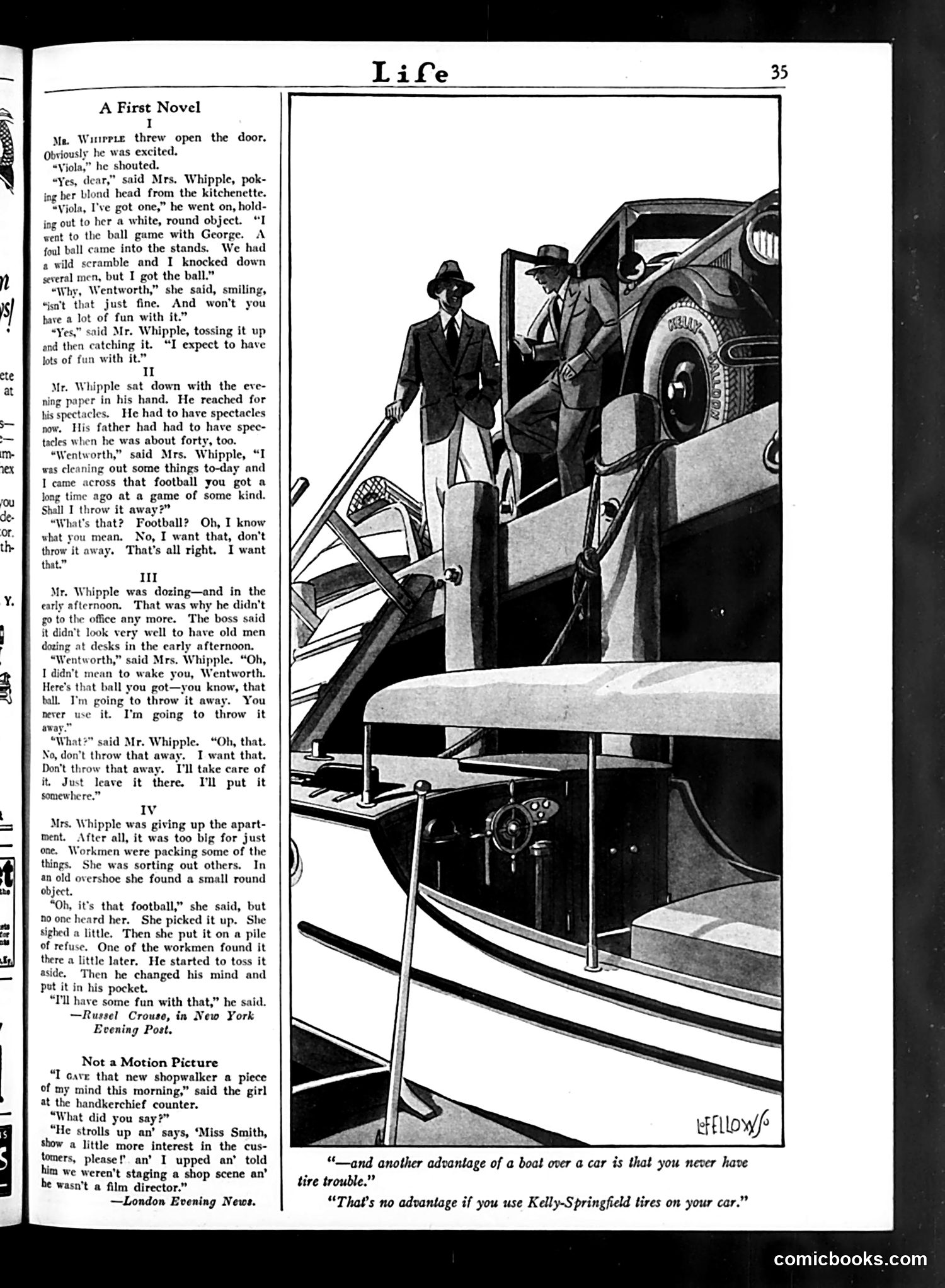
This satirical short story traces the life cycle of middle-class aspiration and decline through a single object: a foul ball Mr. Whipple catches at a baseball game. The humor lies in the **poignant contrast between youthful excitement and aging irrelevance**. Whipple treasures this trophy of a thrilling moment, but the narrative progressively reveals his diminishment: he stops going to the office, dozes in afternoons, loses his apartment. Mrs. Whipple repeatedly tries to discard the ball—it becomes literally garbage. The final twist—a workman salvages it from refuse, pocketing it with genuine enthusiasm—underscores the satire: **the ball's value wasn't in the object itself but in Whipple's ability to enjoy it**. Once he lost his vigor and purpose, even his prized possession became meaningless refuse. The accompanying advertisement joke (bottom) employs a similar structure: undercutting the opening claim about tire reliability with a plug for Kelly-Springfield tires. This reflects 1920s anxieties about obsolescence and aging in modern, industrial society.
📄 Transcribed text from this page (OCR, searchable)
Machine-transcribed from the original scan — historical spelling and the odd misread are preserved.
A First Novel I Me. Winrrte threw open the door, Obviously he was excited, “Viola,” he shouted. “Yes, dear,” said Mrs. Whipple, pok- ing ber blond head from the kitchenette. “Viola, I've got one,” he went on, hold- ing out to her a white, round object. “I went to the ball game with George. A foul ball came into the stands. We had a wild scramble and I knocked down several men, but I got the ball.” “Why, Wentworth,” she said, smiling, “isn't that just fine. nd won't you have a lot of fun with it.” “Yes,” said Mr. Whipple, tossing it up and then catching it. “I expect to have ots of fun with it.” bet Mr. Whipple sat down with the eve- ning paper in his hand. He reached for his spectacles. He had to have spectacles now, Hlis father had had to have spec- tacles when he was about forty, too. “Wentworth,” said Mrs. Whipple, “I was cleaning out some things to-day and I came across that football you got a long time ago at a game of some kind. Shall I throw it away?” “What's that? Football? Oh, I know what you mean. No, I want that, don’t throw it away. That's all right. I want that.” ul Mr. Whipple was dozing—and in the early afternoon. That was why he didn’t g0 to the office any more. The boss said it didn’t look very well to have old men dozing at desks ii arly “Wentworth,” s I didn’t mean to wake you, Wentworth. Here’s that ball you got—you know, that tall. I'm going to throw it away. You never use it. I'm going to throw it away. hat?” said Mr. Whipple. “Oh, that. No, don’t throw that away. I want that. Don’t throw that away, I'll take care of it, Just leave it there. I'll put it somewhere.” IV Mrs. Whipple was giving up the apart- ment. After all, it was too big for just one. Workmen were packing some of the things. She was sorting out others. In an old overshoe she found a small round object. “Oh, it's that football,” she said, but noone heard her. She picked it up. She sighed a little. Then she put it on a pile of refuse. One of the workmen found it there a little later. He started to toss it aside, Then he changed his mind and put it in his pocket. “Tl have some fun with that,” he said. —Russel Crouse, in New York Evening Post. Not a Motion Picture “I cave that new shopwalker a piece of my mind this morning,” said the girl at the handkerchief counter. “What did you say?” “He strolls up an’ says, ‘Miss Smith, show a little more interest in the cus- tomers, please!’ an’ I upped an’ told him we weren't staging a shop scene an’ wasn't a film director.” —London Evening News. “—and another advantage of a boat over a car is that you never have tire trouble.” “That's no advantage if you use Kelly-Springfield tires on your car.” comicbooks.com