
Life, 1927-05-12 · page 20 of 43
Life — May 12, 1927 — page 20: what you’re looking at
What you’re looking at
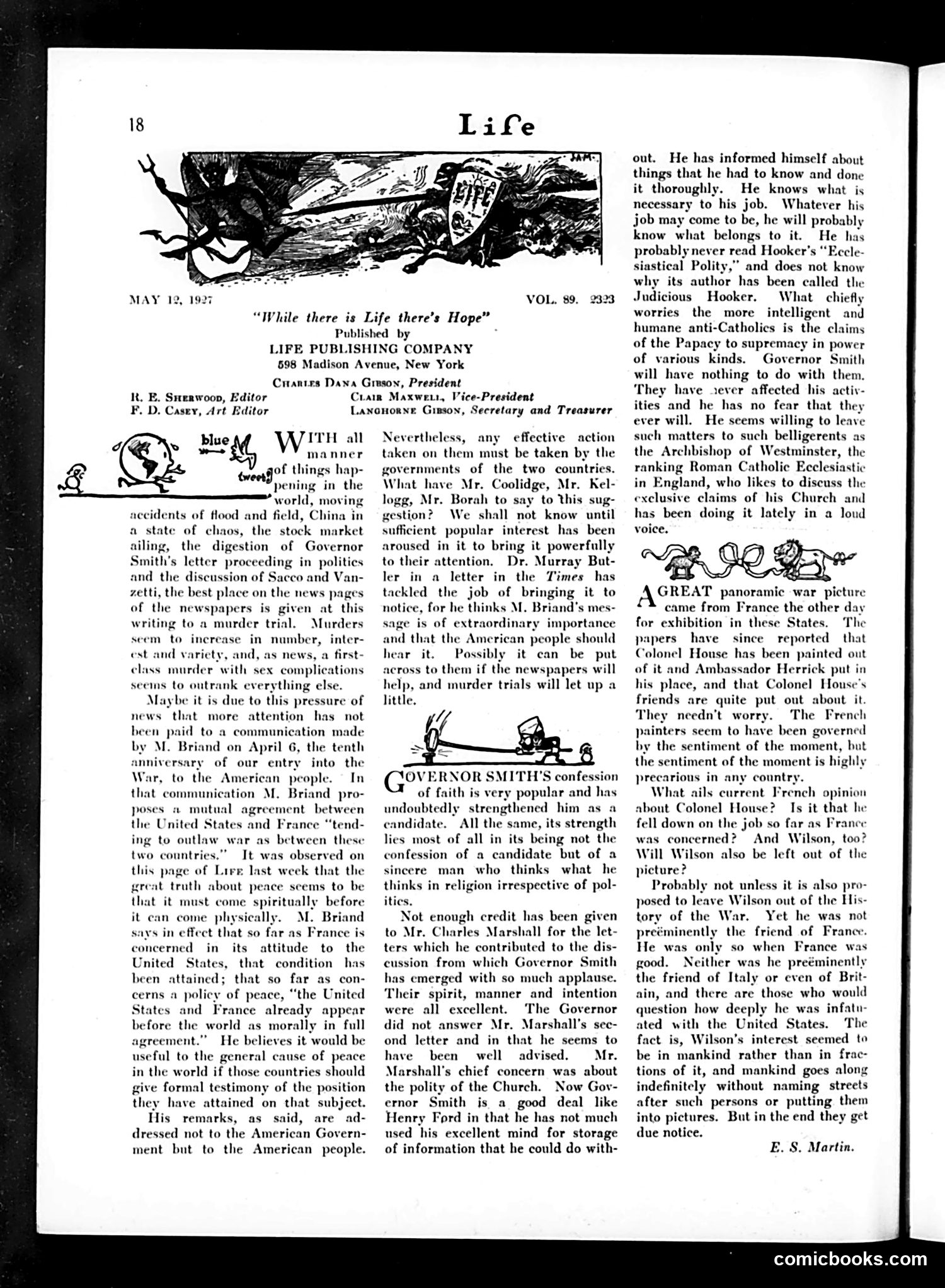
This editorial page discusses two major political topics of 1927: **1. Aristide Briand's Peace Proposal:** French Premier Briand proposed a mutual agreement between the U.S. and France to "outlaw war." The editorial criticizes American media for obsessing over murder trials rather than covering this significant diplomatic initiative. It appeals to readers to pressure President Coolidge, Secretary Kellogg, and Senator Borah to respond seriously to the proposal. **2. Governor Al Smith's Religious Confession:** The page praises Smith (likely the Democratic presidential candidate) for his candid statements about his Catholic faith, suggesting his strength lies in sincere conviction rather than political calculation. It credits Charles Marshall's published letters for prompting this important public discussion about religion and politics. The cartoons appear decorative rather than satirical—small illustrations of figures in various poses without obvious political commentary.
📄 Transcribed text from this page (OCR, searchable)
Machine-transcribed from the original scan — historical spelling and the odd misread are preserved.
VOL, 89. 2323 “While there is Life there’s Hope” Published by LIFE PUBLISHING COMPANY 598 Madison Avenue, New York Crrantrs Dawa Gruson, President R. E. Sreawoop, Editor Cu F. D. Casey, Art Editor blue MG — we all nner 4 of ilitags hap- & tweed ening in the world, moving accidents of flood and field, China in a state of chaos, the stock market ailing, the digestion of Governor Smith's letter proceeding in politics and the discussion of Sacco and Van- zetti, the best place on the news pages of the newspapers is en at this writing to a murder trial. Murders seem to increase in number, inter- est and variety, and, as news, a first- class murder with sex complications seems to outrank everything else. Maybe it is due to this pressure of news that more attention has not been paid to a communication made by M. Briand on April 6, the tenth anniversary of our entry into the War, to the American people. — In that communication M. Briand pro- poses a mutual agreement between the United States and France “tend- ing to outlaw war as between these two countries.” It was observed on this page of Lire last week that the great truth about peace scems to be that it must come spiritually before it can come physically. M. Briand effect that so far as France is concerned in its attitude to the United that condition has been attained; that so far as con- cerns a policy of peace, “the United States and France already appear before the world as morally in full agreement.” He believes it would be useful to the general cause of peace in the world if those countries should formal testimony of the position have attained on that subject. His remarks, as said, are ad- dressed not to the American Govern- ment but to the American people. ates, Maxwent, Vice-President Lananorne Gipson, Secretary and Treasurer Nevertheless, any effective action taken on them must be taken by the governments of the two countries. What have Mr. Coolidge, Mr. Kel- logg, Mr. Borah to say to this sug- gestion? We shall not know until sufficient popular interest has been aroused in it to bring it powerfully to their attention. Dr. Murray But- ler in a letter in the Times has tackled the job of bringing it to notice, for he thinks M. Briand’s mes- sage is of extraordinary importance and that the American people should hear it. Possibly it can be put across to them if the newspapers will help, and murder trials will let up a little. OVERNOR SMITHS confession of faith is very popular and has undoubtedly strengthened him as a candidate. All the same, its strength lies most of all in its being not the confession of a candidate but of a sincere man who thinks what he thinks in religion irrespective of pol- ities. Not enough credit has been given to Mr. Charles Marshall for the let- ters which he contributed to the dis- cussion from which Governor Smith has emerged with so much applause. Their spirit, manner and intention were all excellent. The Governor did not answer Mr. Marshall's sec- ond letter and in that he seems to have been well advised. = Mr. Marshall's chief concern was about the polity of the Church. Now Gov- ernor Smith isa good deal like Henry Ford in that he has not much used his excellent mind for storage of information that he could do with- out. He has informed himself about things that he had to know and done it thoroughly. He knows what is necessary to his job. Whatever his job may come to be, he will probably know what belongs to it. He has probably never read Hooker's “Eccle- siastical Polity,” and does not know why its author has been called the Judicious Hooker. What chiefly worries the more intelligent and humane anti-Catholics is the claims of the Papacy to supremacy in power of various kinds. Governor Smith will have nothing to do with them. They have rever affected his activ- ities and he has no fear that they ever will. He seems willing to leave such matters to such belligerents as the Archbishop of Westminster, the ranking Roman Catholic Ecclesiastic in England, who likes to discuss the exclusive claims of his Church and been doing it lately in a loud GREAT panoramic war picture came from France the other day for exhibition in these States. The papers have since reported that Colonel House has been painted out of it and Ambassador Herrick put in his place, and that Colonel House's friends are quite put out about it. They needn't worry. The French painters seem to have been governed by the sentiment of the moment, but the sentiment of the moment is highly prees ‘arious in any country. at ails current French opinion about Colonel House? Is it that he fell down on the job so far as France was concerned? And Wilson, too? Will Wilson also be left out of the picture? Probably not unless it is also pro- posed to leave Wilson out of the His- tory of the War. Yet he was not preéminently the friend of France. He was only so when France ; good. Neither was he pr the friend of Italy or even of Brit- ain, and there are those who would question how deeply he was infatu- ated with the United States. The fact is, Wilson’s interest seemed to be in mankind rather than in frac- tions of it, and mankind goes along indefinitely without naming streets after such persons or putting them into pictures. But in the end they get due notice. E. S. Martin. comicbooks.com