
Life, 1927-05-12 · page 25 of 43
Life — May 12, 1927 — page 25: what you’re looking at
What you’re looking at
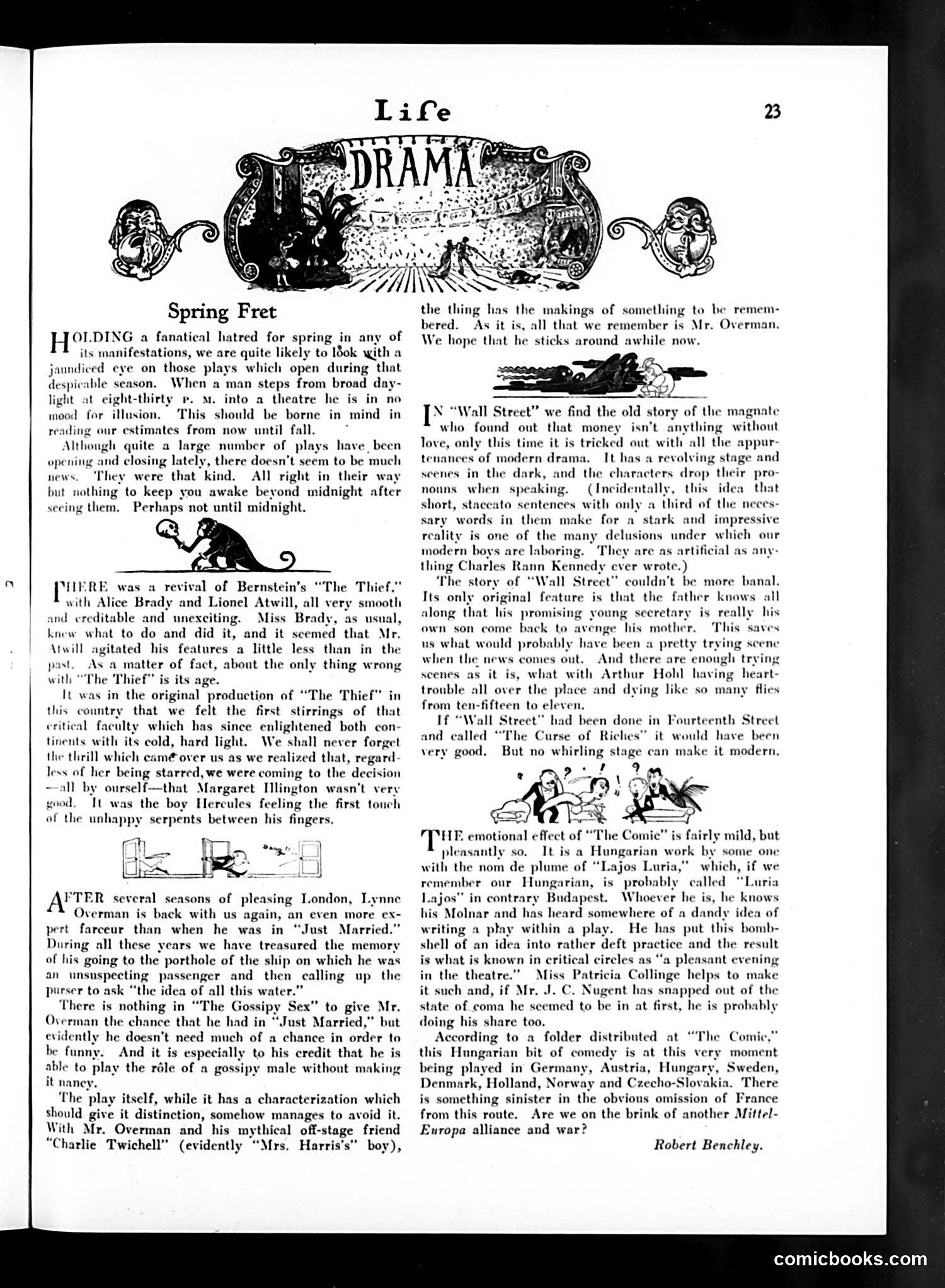
This drama review page critiques spring theatrical productions. The author expresses disdain for plays opening during spring, when audiences prefer outdoor activities to theater. **Key Reviews:** - **"The Thief"**: A revival featuring Alice Brady and Lionel Atwill. The critic credits this production with awakening their critical judgment, noting Margaret Illington's performance helped them recognize she wasn't truly excellent—comparing the realization to Hercules first feeling serpents. - **"The Gossipy Sex"**: Showcasing farceur Lynne Overman, who excels despite the play's weak material. The critic praises Overman's comedic talent while criticizing the play itself. - **"Wall Street"**: Dismissed as banal melodrama with artificial modernist techniques (staccato dialogue, dark staging). The plot—a father unknowingly employing his secret illegitimate son—is predictable, and Arthur Hohl's excessive emotional scenes are mocked. The overall tone is witty and dismissive of spring theater's generally poor quality.
📄 Transcribed text from this page (OCR, searchable)
Machine-transcribed from the original scan — historical spelling and the odd misread are preserved.
Spring Fret I OLDING a fanatical hatred for spring in any of its manifestations, we are quite likely to Bok wi jaundiced eye on those plays which open during that despicable season, When a man steps from broad day- light at eight-thirty M. into a theatre he is in no mood for illusion, This should be borne in mind in reading our estimates from now until fall. Although quite a large number of plays have been opening and closing lately, there doesn’t seem to be much news. ‘They were that kind. All right in their way but nothing to keep you awake beyond midnight after seeing them, Perhaps not until midnight. PUlERE was a revival of Bernstein's “The Thief.” with Alice Brady and Lionel Atwill, all very smooth and creditable and unexciting. Miss Brady, as usual, knew what to do and did it, and it seemed that Mr. \twill agitated his features a little less than in’ the past matter of fact, about the only thing wrong with “The Thief” is its age. It was in the original production of “The Thief” in this country that we felt the first stirrings of that cal faculty which has since enlightened both con- tinents with its cold, hard light. We shall never forget the thrill which camé@ over us as we realized that, regard less of her being starred, we were coming to the decision ~all by ourself—that Margaret Illington wasn’t very It was the boy Hercules feeling the first touch of the unhappy serpents between his fingers. good, FTER several seasons of pleasing London, Lynne Overman is back with us again, an even more ex- pert farceur than when he was in “Just Married.” During all these years we have treasured the memory of his going to the porthole of the ship on which he was an unsuspecting passenger and then calling up the purser to ask “the idea of all this water.” There is nothing in “The Gossipy Sex” to give Mr. Overman the chance that he had in “Just Married,” but evidently he doesn’t need much of a chance in order to be funny. And it is especially to his credit that he is able to play the réle of a gossipy male without making it naney, The play itself, while it has a characterization which should give it distinction, somehow manages to avoid it. With Mr. Overman and his mythical off-stage friend “Charlie Twichell” (evidently “Mrs, Harris's” boy), the thing has the makings of something to be remem- bered. As it is, all that we remember is Mr. Overman. We hope that he sticks around awhile now. = sy) N “Wall Street” we find the old story of the magnate who found out that money isn’t anything without , only this time it is tricked out with all the tenances of modern drama. It has a revolving st seenes in the dark, and the characters drop their pro- nouns when speaking. (Incidentally, this idea that short, staccato sentences with only a third of the n sary words in them make for a stark and impressive reality is one of the many delusions under which our modern boys are laboring. They are as artificial as any- thing Charles Rann Kennedy ever wrote.) The story of “Wall Street” couldn’t be more banal. Its only original feature is that the father knows all along that his promising young secretary is really his own son come back to avenge his mother. This saves us what would probably have been a pretty trying scene when the news comes out. And there are enough trying scenes as it is, what with Arthur Hohl having heart- trouble all over the place and dying like so many flies from ten-fifteen to eleven, If “Wall Street” had been done in Fourteenth Street and called “The Curse of Riches” it would have been very good, But no whirling stage can make it modern, @ a! 1 ott HE. emotional effect of “The Comic” is fairly mild, but It is a Hungarian work by some one f we Luria pest. Whoever he is, he knows his Molnar and has heard somewhere of a dandy idea of ting a ptay within a play. He has put this bomb- shell of an idea into rather deft practice and the result is what is known in critical circles as “a pleasant evening in the theatre.” Miss Patricia Collinge helps to make it such and, if Mr. J. C. Nugent has snapped out of the state of coma he seemed to be in at first, he is probably doing his share too. According to a folder distributed at “The Comic,” this Hungarian bit of comedy is at this very moment being played in Germany, Austria, Hun; Sweden, Denmark, Holland, Norway and Czecho-Slovakia. There is something sinister in the obvious omission of France from this route. Are we on the brink of another Mittel- Europa alliance and war? pleasantly so. Lajos” in contrary Buc Robert Benchley. comicbooks.com